Works › The Mariale: Questions on “Missus est”
Volume 37 · pp. 83–84
Solution to the aforesaid, § II, opening
A marker with ≈ is an approximate page boundary, placed by measure of the text; the page photographs remain the authority. In the paired views, clicking a page marker brings that page into view.
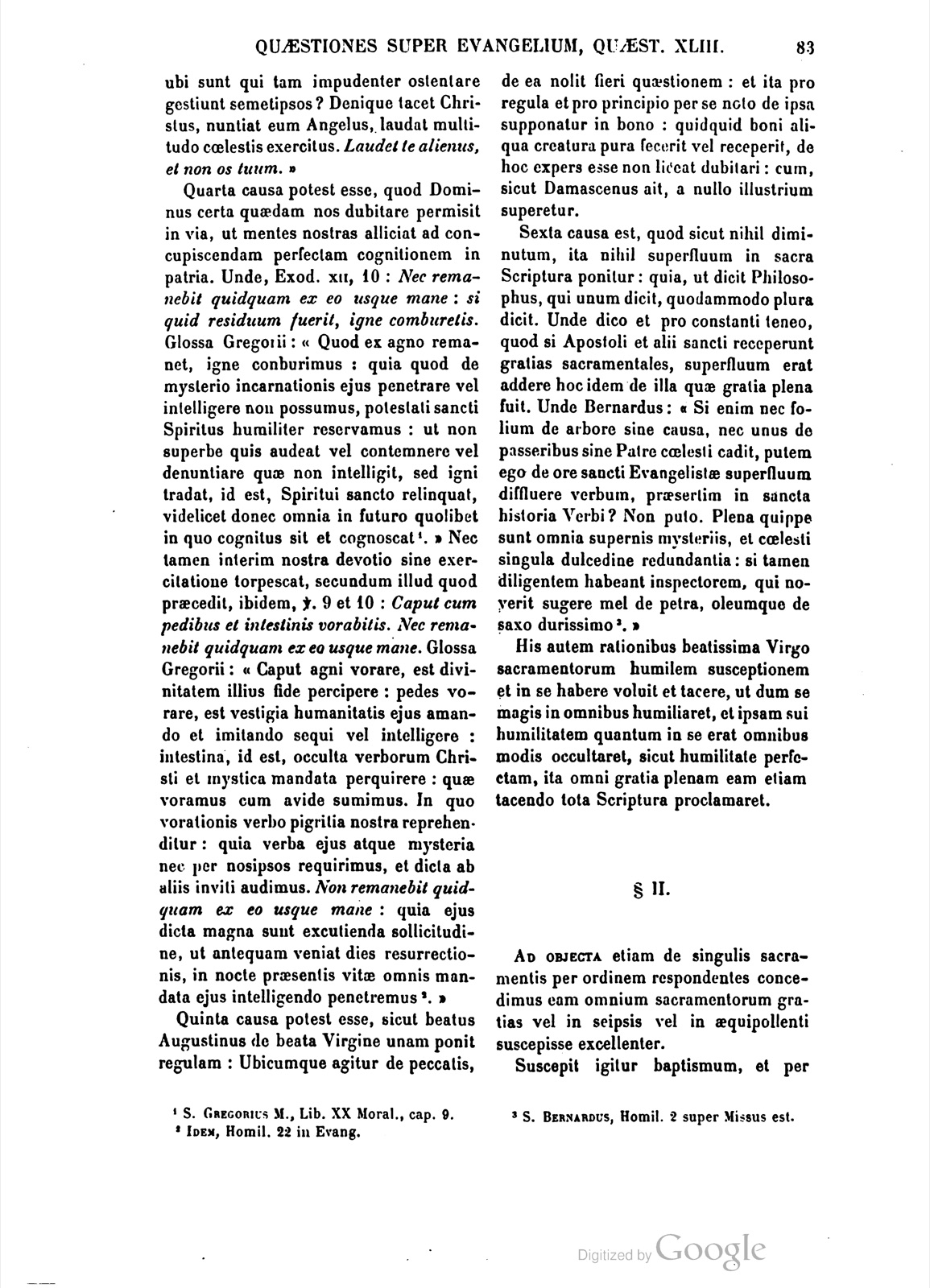
§ II. Ad objecta etiam de singulis sacramentis per ordinem respondentes concedimus eam omnium sacramentorum gratias vel in seipsis vel in aequipollenti suscepisse excellenter.
Suscepit igitur baptismum, et per baptismum characteris impressionem, virtutum exercitationem, meritorum augmentationem. Quare autem non agatur festum ejus baptismi, sicut purificationis, una ratio esse potest: quia baptismus ejus celebratus fuit in secreto, oblatio autem post purificationem in manifesto. Alia est ratio quare baptismi festum non celebratur: quia baptismus per se et principaliter datus est in medicinam peccatorum. Nec obstat, quod Ecclesia baptismum Domini solemnizet: quia sua baptizatio nostri baptismi fuit consecratio, nostra autem ad gratiam et gloriam regeneratio: beatissima autem Virgo ad baptismum accedens ficta non fuit: quia eo quod habere debuit, non caruit, sed abundavit peccati detestatione et fidei perfectione, quae requiruntur in accedente. Alia de baptismo objecta, soluta sunt per praedicta.
Similiter eodem modo dicendum est de sacramento confirmationis, in quo recepit alterius characteris impressionem, ampliorem meritorum augmentationem, perfectiorem virtutum exercitationem et declarationem.
De sacramento altaris recepit Dominicae passionis rememorationem, devotionis actualis exercitationem, contra corporalem Filii absentiam consolationem.
De sacramento vero poenitentiae recepit gratiam in excellentia aequipollenti. Pro contritione innocentiae conversationem, pro confessione gratiarum actionem, pro satisfactione supererogationem.
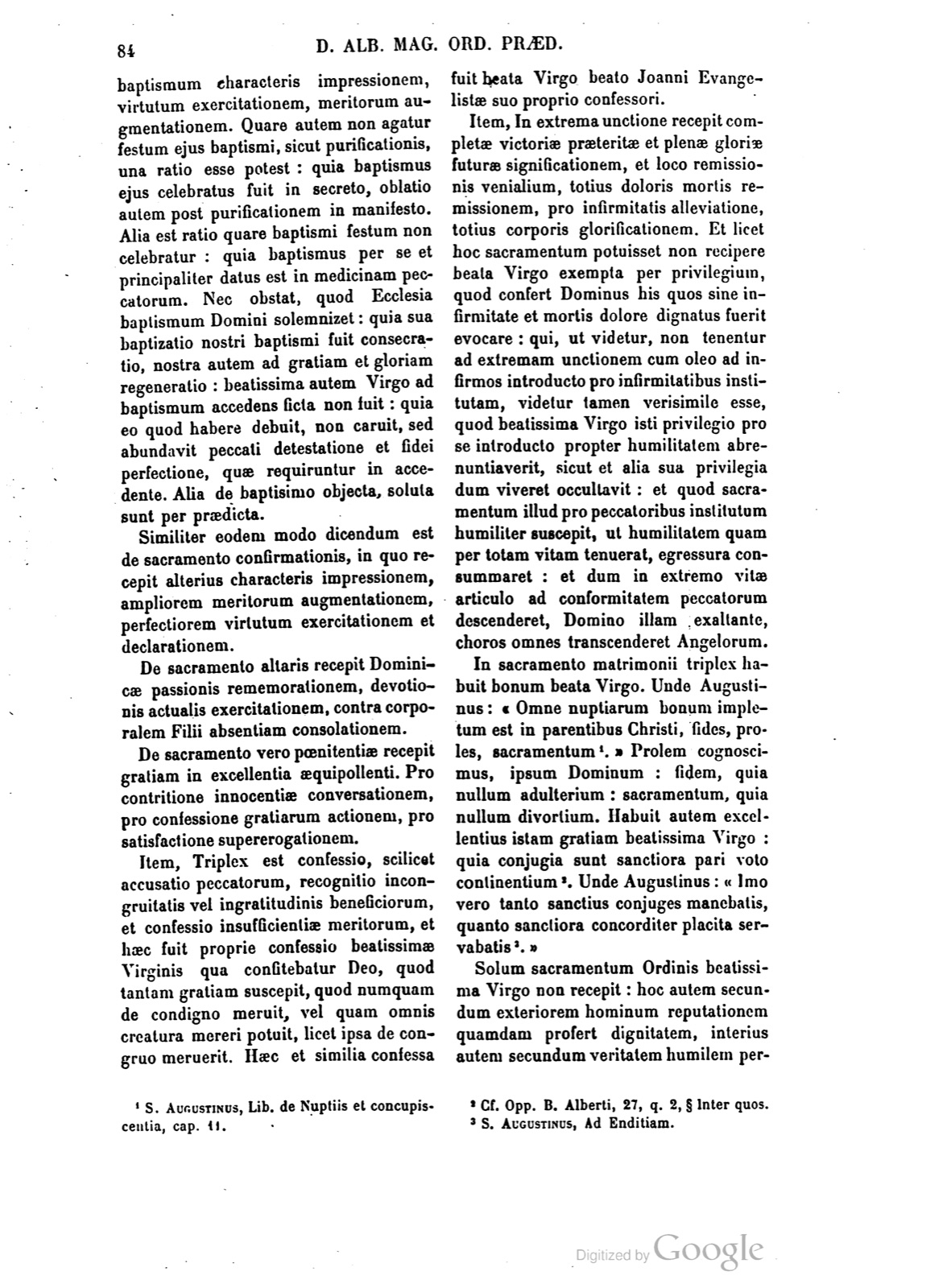
Item, Triplex est confessio, scilicet accusatio peccatorum, recognitio incongruitatis vel ingratitudinis beneficiorum, et confessio insufficientiae meritorum, et haec fuit proprie confessio beatissimae Virginis qua confitebatur Deo, quod tantam gratiam suscepit, quod numquam de condigno meruit, vel quam omnis creatura mereri potuit, licet ipsa de congruo meruerit. Haec et similia confessa fuit beata Virgo beato Joanni Evangelistae suo proprio confessori.
§ II. Also, responding in order to the objections concerning the individual sacraments, we concede that she excellently received the graces of all the sacraments either in themselves or in an equivalent.
Therefore she received baptism, and through baptism the impression of character, the exercise of virtues, and the augmentation of merits. But why the feast of her baptism is not kept, as that of her purification is kept, one reason can be this: because her baptism was celebrated in secret, but the oblation after purification was in public. Another reason why the feast of her baptism is not celebrated is that baptism through itself and principally was given as a medicine for sins. Nor is it an objection that the Church solemnizes the Lord's baptism, because his baptism was the consecration of our baptism, but ours is regeneration unto grace and glory. But the most blessed Virgin, approaching baptism, was not false, because she was not lacking in that which she ought to have, but abounded in detestation of sin and in perfection of faith, which are required in the one approaching. The other things objected about baptism are solved through the aforesaid.
Similarly, in the same way one must speak about the sacrament of confirmation, in which she received the impression of another character, a fuller augmentation of merits, and a more perfect exercise and declaration of virtues.
From the sacrament of the altar she received the remembrance of the Lord's passion, the exercise of actual devotion, and consolation against the bodily absence of the Son.
But from the sacrament of penance she received grace in equivalent excellence: in place of contrition, the manner of life of innocence; in place of confession, thanksgiving; in place of satisfaction, supererogation.
Likewise, confession is threefold, namely accusation of sins, recognition of the incongruity or ingratitude of benefits, and confession of the insufficiency of merits. And this last was properly the confession of the most blessed Virgin, by which she confessed to God that she had received so great a grace that she never merited it by condignity, or that any creature could merit it, although she herself merited it by congruity. These and similar things the blessed Virgin confessed to blessed John the Evangelist, her own proper confessor.
Item, In extrema unctione recepit completae victoriae praeteritae et plenae gloriae futurae significationem, et loco remissionis venialium, totius doloris mortis remissionem, pro infirmitatis alleviatione, totius corporis glorificationem. Et licet hoc sacramentum potuisset non recipere beata Virgo exempta per privilegium, quod confert Dominus his quos sine infirmitate et mortis dolore dignatus fuerit evocare: qui, ut videtur, non tenentur ad extremam unctionem cum oleo ad infirmos introducto pro infirmitatibus institutam, videtur tamen verisimile esse, quod beatissima Virgo isti privilegio pro se introducto propter humilitatem abrenuntiaverit, sicut et alia sua privilegia dum viveret occultavit: et quod sacramentum illud pro peccatoribus institutum humiliter suscepit, ut humilitatem quam per totam vitam tenuerat, egressura consummaret: et dum in extremo vitae articulo ad conformitatem peccatorum descenderet, Domino illam exaltante, choros omnes transcenderet Angelorum.
In sacramento matrimonii triplex habuit bonum beata Virgo. Unde Augustinus: « Omne nuptiarum bonum impletum est in parentibus Christi, fides, proles, sacramentum 1. » Prolem cognoscimus, ipsum Dominum: fidem, quia nullum adulterium: sacramentum, quia nullum divortium. Habuit autem excellentius istam gratiam beatissima Virgo: quia conjugia sunt sanctiora pari voto continentium 2. Unde Augustinus: « Imo vero tanto sanctius conjuges manebatis, quanto sanctiora concorditer placita servabatis 3. »
Solum sacramentum Ordinis beatissima Virgo non recepit: hoc autem secundum exteriorem hominum reputationem quamdam profert dignitatem, interius autem secundum veritatem humilem pertinet ad servitutem.
Likewise, in extreme unction she received the signification of completed past victory and of full future glory, and, in place of remission of venial sins, the remission of every pain of death, and, in place of the alleviation of infirmity, the glorification of the whole body. And although the blessed Virgin, exempted by privilege, could have not received this sacrament, which privilege the Lord confers on those whom without infirmity and the pain of death he has deigned to summon, who, as it seems, are not bound to extreme unction with oil introduced for the sick and instituted for infirmities, nevertheless it seems likely that the most blessed Virgin, because of humility, renounced that privilege introduced on her behalf, just as she also concealed her other privileges while she lived; and that she humbly received that sacrament instituted for sinners, so that, as she was about to depart, she might consummate the humility that she had held through her whole life; and while at the final moment of life she descended to conformity with sinners, with the Lord exalting her, she would transcend all choirs of Angels.
In the sacrament of marriage the blessed Virgin had a threefold good. Hence Augustine says: "Every good of marriages was fulfilled in the parents of Christ: faith, offspring, sacrament 1." We recognize the offspring, the Lord himself; faith, because there was no adultery; sacrament, because there was no divorce. But the most blessed Virgin had this grace more excellently, because marriages of those continent by an equal vow are holier 2. Hence Augustine says: "Indeed, you remained spouses so much the more holily, as you preserved harmoniously the holier things that pleased you 3."
The most blessed Virgin did not receive only the sacrament of Order. But this, according to the exterior reputation of men, sets forth a certain dignity; inwardly, however, according to the truth, it pertains to humble service.
Notes
If a page does not appear, its photograph has not been uploaded yet.