Works › The Mariale: Questions on “Missus est”
Volume 37 · p. 77
Question XXXVIII. Whether the blessed Virgin received the Lord's body under the sacrament of the altar?
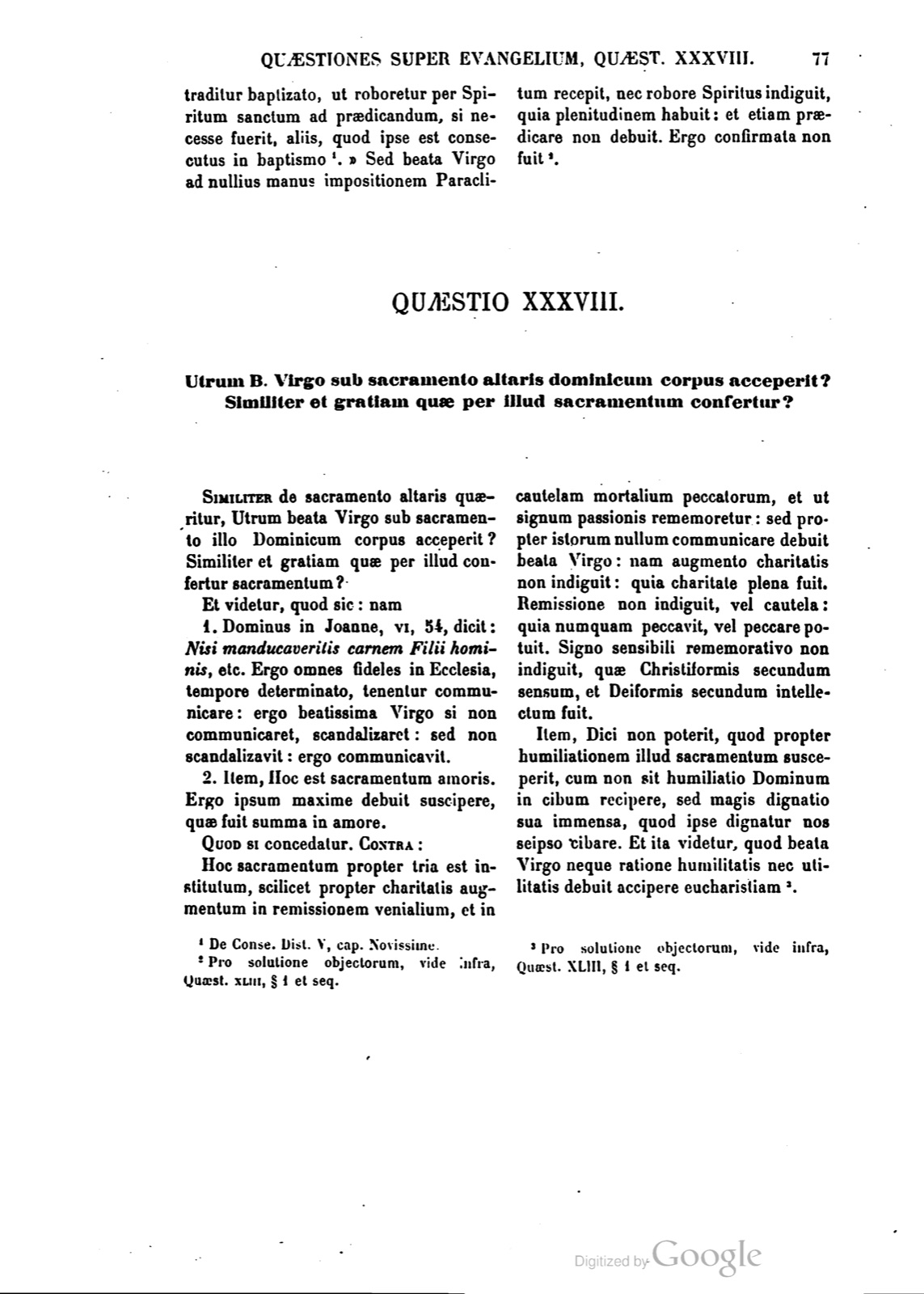
QUAESTIO XXXVIII. Utrum B. Virgo sub sacramento altaris dominicum corpus acceperit? Similiter et gratiam quae per illud sacramentum confertur?
Similiter de sacramento altaris quaeritur, Utrum beata Virgo sub sacramento illo Dominicum corpus acceperit? Similiter et gratiam quae per illud confertur sacramentum?
Et videtur, quod sic: nam
1. Dominus in Joanne, VI, 54, dicit: Nisi manducaveritis carnem Filii hominis, etc. Ergo omnes fideles in Ecclesia, tempore determinato, tenentur communicare: ergo beatissima Virgo si non communicaret, scandalizaret: sed non scandalizavit: ergo communicavit.
2. Item, Hoc est sacramentum amoris. Ergo ipsum maxime debuit suscipere, quae fuit summa in amore.
Quod si concedatur. Contra:
Hoc sacramentum propter tria est institutum, scilicet propter charitatis augmentum in remissionem venialium, et in cautelam mortalium peccatorum, et ut signum passionis rememoretur: sed propter istorum nullum communicare debuit beata Virgo: nam augmento charitatis non indiguit: quia charitate plena fuit. Remissione non indiguit, vel cautela: quia numquam peccavit, vel peccare potuit. Signo sensibili rememorativo non indiguit, quae Christiformis secundum sensum, et Deiformis secundum intellectum fuit.
Item, Dici non poterit, quod propter humiliationem illud sacramentum susceperit, cum non sit humiliatio Dominum in cibum recipere, sed magis dignatio sua immensa, quod ipse dignatur nos seipso cibare. Et ita videtur, quod beata Virgo neque ratione humilitatis nec utilitatis debuit accipere eucharistiam 1.
QUESTION XXXVIII. Whether the blessed Virgin received the Lord's body under the sacrament of the altar? Likewise, whether she received the grace that is conferred through that sacrament?
Similarly, concerning the sacrament of the altar it is asked whether the blessed Virgin received the Lord's body under that sacrament, and likewise the grace that is conferred through that sacrament.
And it seems that she did, for:
1. The Lord in John 6:54 says: Unless you shall have eaten the flesh of the Son of Man, and so forth. Therefore all the faithful in the Church, at the determined time, are bound to communicate. Therefore, if the most blessed Virgin did not communicate, she would scandalize. But she did not scandalize. Therefore she communicated.
2. Likewise, this is the sacrament of love. Therefore she who was highest in love ought especially to have received it.
But if this is granted, to the contrary:
This sacrament was instituted for three things, namely for the increase of charity unto the remission of venial sins, and for a safeguard against mortal sins, and so that the sign of the passion might be remembered. But the blessed Virgin ought not to have communicated for any of these things. For she did not need an increase of charity, because she was full of charity. She did not need remission, or safeguard, because she never sinned, nor could sin. She did not need a sensible commemorative sign, since she was Christ-formed according to sense, and God-formed according to intellect.
Likewise, it will not be possible to say that she received that sacrament because of humiliation, since it is not humiliation to receive the Lord as food, but rather his own immense condescension, because he deigns to feed us with himself. And thus it seems that the blessed Virgin ought to have received the eucharist neither by reason of humility nor by reason of utility 1.
Notes
- For the solution of the objections, see below, Question XLIII, § 1 and following. (Pro solutione objectorum, vide infra, Quaest. XLIII, § 1 et seq.) ↩
If a page does not appear, its photograph has not been uploaded yet.