Works › The Mariale: Questions on “Missus est”
Volume 37 · p. 78
Question XXXIX. Whether the blessed Virgin received any grace through the sacrament of Penance?
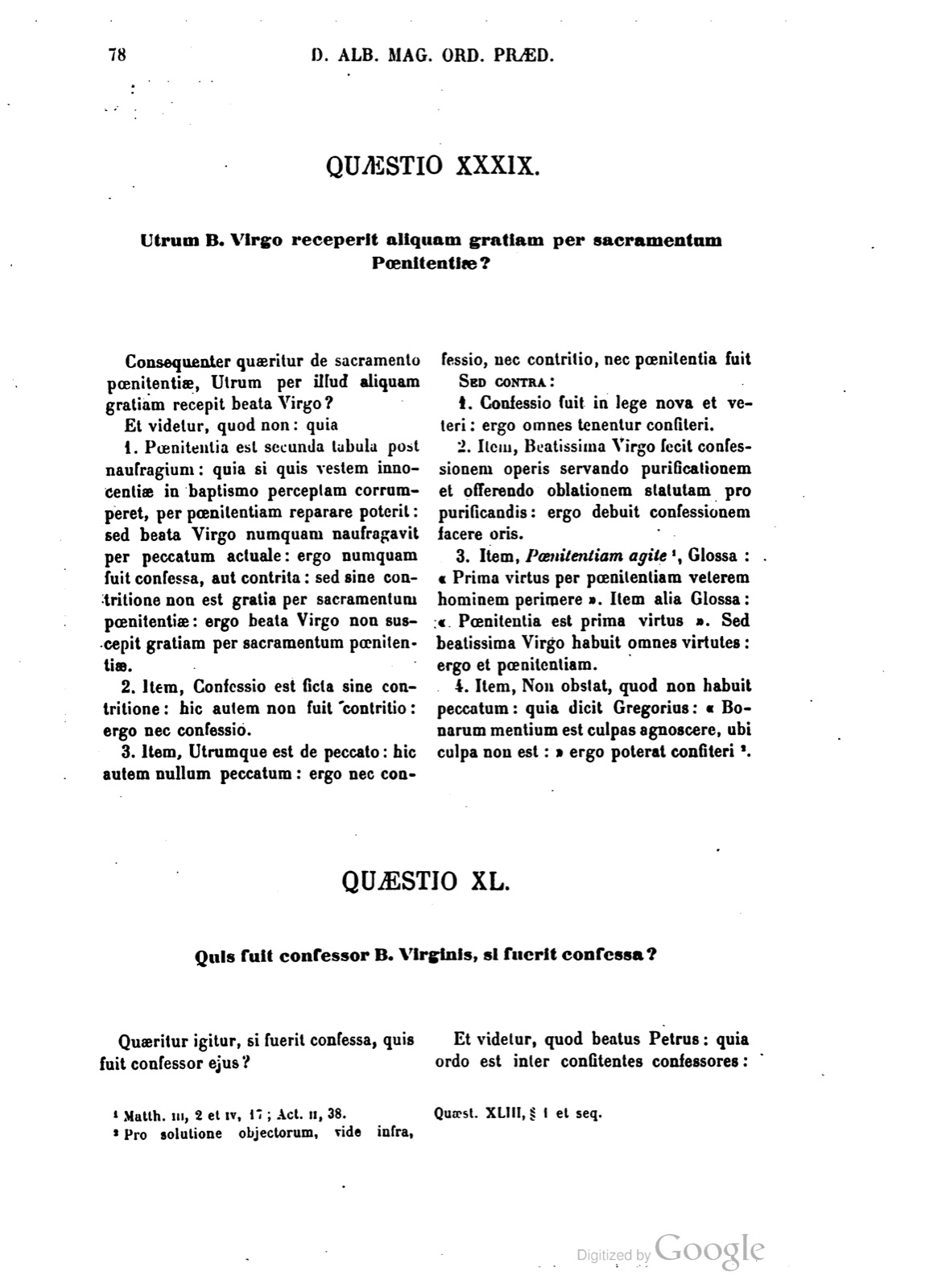
QUAESTIO XXXIX. Utrum B. Virgo receperit aliquam gratiam per sacramentum Poenitentiae?
Consequenter quaeritur de sacramento poenitentiae, Utrum per illud aliquam gratiam recepit beata Virgo?
Et videtur, quod non: quia
1. Poenitentia est secunda tabula post naufragium: quia si quis vestem innocentiae in baptismo perceptam corrumperet, per poenitentiam reparare poterit: sed beata Virgo numquam naufragavit per peccatum actuale: ergo numquam fuit confessa, aut contrita: sed sine contritione non est gratia per sacramentum poenitentiae: ergo beata Virgo non suscepit gratiam per sacramentum poenitentiae.
2. Item, Confessio est ficta sine contritione: hic autem non fuit contritio: ergo nec confessio.
3. Item, Utrumque est de peccato: hic autem nullum peccatum: ergo nec confessio, nec contritio, nec poenitentia fuit.
Sed contra:
1. Confessio fuit in lege nova et veteri: ergo omnes tenentur confiteri.
2. Item, Beatissima Virgo fecit confessionem operis servando purificationem et offerendo oblationem statutam pro purificandis: ergo debuit confessionem facere oris.
3. Item, Poenitentiam agite 1, Glossa: « Prima virtus per poenitentiam veterem hominem perimere. » Item alia Glossa: « Poenitentia est prima virtus. » Sed beatissima Virgo habuit omnes virtutes: ergo et poenitentiam.
4. Item, Non obstat, quod non habuit peccatum: quia dicit Gregorius: « Bonarum mentium est culpas agnoscere, ubi culpa non est: » ergo poterat confiteri 2.
QUESTION XXXIX. Whether the blessed Virgin received any grace through the sacrament of Penance?
Consequently it is asked concerning the sacrament of penance, whether through it the blessed Virgin received any grace.
And it seems that she did not, because:
1. Penance is the second plank after shipwreck, because if someone corrupts the garment of innocence received in baptism, he will be able to repair it through penance. But the blessed Virgin was never shipwrecked through actual sin. Therefore she was never confessed, or contrite. But without contrition there is no grace through the sacrament of penance. Therefore the blessed Virgin did not receive grace through the sacrament of penance.
2. Likewise, confession is false without contrition. But here there was no contrition. Therefore neither was there confession.
3. Likewise, each is about sin. But here there was no sin. Therefore there was neither confession, nor contrition, nor penance.
But to the contrary:
1. Confession existed in the new law and the old. Therefore all are bound to confess.
2. Likewise, the most blessed Virgin made a confession of deed by observing purification and by offering the oblation appointed for those being purified. Therefore she ought to have made confession of mouth.
3. Likewise, Do penance 1. The Gloss says: "The first virtue is to destroy the old man through penance." Likewise another Gloss says: "Penance is the first virtue." But the most blessed Virgin had all virtues. Therefore she also had penance.
4. Likewise, it is no obstacle that she did not have sin, because Gregory says: "It belongs to good minds to acknowledge faults where there is no fault." Therefore she was able to confess 2.
Notes
- Matthew 3:2 and 4:17; Acts 2:38. (Matth. III, 2 et IV, 17; Act. II, 38.) ↩
- For the solution of the objections, see below, Question XLIII, § 1 and following. (Pro solutione objectorum, vide infra, Quaest. XLIII, § 1 et seq.) ↩
If a page does not appear, its photograph has not been uploaded yet.