Works › The Mariale: Questions on “Missus est”
Volume 37 · p. 74
Question XXXV. What is understood by the fullness of grace in Mary?
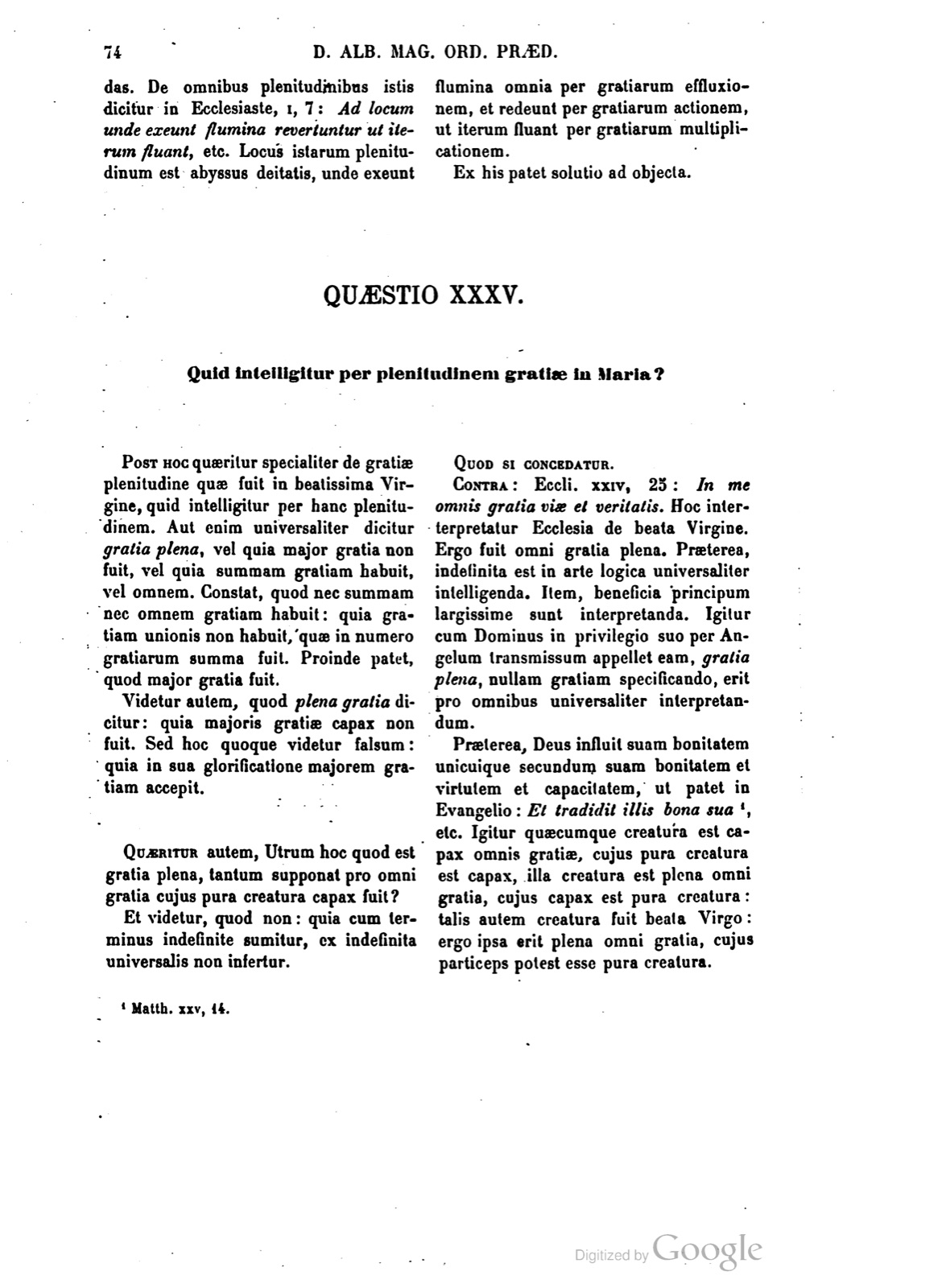
QUAESTIO XXXV. Quid intelligitur per plenitudinem gratiae in Maria?
Post hoc quaeritur specialiter de gratiae plenitudine quae fuit in beatissima Virgine, quid intelligitur per hanc plenitudinem. Aut enim universaliter dicitur gratia plena, vel quia major gratia non fuit, vel quia summam gratiam habuit, vel omnem. Constat, quod nec summam nec omnem gratiam habuit: quia gratiam unionis non habuit, quae in numero gratiarum summa fuit. Proinde patet, quod major gratia fuit.
Videtur autem, quod plena gratia dicitur: quia majoris gratiae capax non fuit. Sed hoc quoque videtur falsum: quia in sua glorificatione majorem gratiam accepit.
Quaeritur autem, Utrum hoc quod est gratia plena, tantum supponat pro omni gratia cujus pura creatura capax fuit?
Et videtur, quod non: quia cum terminus indefinite sumitur, ex indefinita universalis non infertur.
Quod si concedatur. Contra: Eccli. XXIV, 25: In me omnis gratia viae et veritatis. Hoc interpretatur Ecclesia de beata Virgine. Ergo fuit omni gratia plena. Praeterea, indefinita est in arte logica universaliter intelligenda. Item, beneficia principum largissime sunt interpretanda. Igitur cum Dominus in privilegio suo per Angelum transmissum appellet eam, gratia plena, nullam gratiam specificando, erit pro omnibus universaliter interpretandum.
Praeterea, Deus influit suam bonitatem unicuique secundum suam bonitatem et virtutem et capacitatem, ut patet in Evangelio: Et tradidit illis bona sua 1, etc. Igitur quaecumque creatura est capax omnis gratiae, cujus pura creatura est capax, illa creatura est plena omni gratia, cujus capax est pura creatura: talis autem creatura fuit beata Virgo: ergo ipsa erit plena omni gratia, cujus particeps potest esse pura creatura.
QUESTION XXXV. What is understood by the fullness of grace in Mary?
After this it is asked specially concerning the fullness of grace that was in the most blessed Virgin, what is understood by this fullness. For either she is universally called full of grace because there was no greater grace, or because she had the highest grace, or because she had every grace. It is evident that she had neither the highest grace nor every grace, because she did not have the grace of union, which was highest in the number of graces. Therefore it is clear that there was a greater grace.
But it seems that she is called full of grace because she was not capable of greater grace. Yet this also seems false, because in her glorification she received a greater grace.
But it is asked whether this expression, full of grace, stands only for every grace of which a pure creature was capable.
And it seems that it does not, because when a term is taken indefinitely, a universal is not inferred from an indefinite.
But if this is granted, to the contrary: Ecclesiasticus 24:25 says: In me is every grace of the way and of truth. The Church interprets this concerning the blessed Virgin. Therefore she was full of every grace. Besides, an indefinite is to be understood universally in the art of logic. Likewise, the benefits of princes are to be interpreted most broadly. Therefore, since the Lord in his privilege transmitted through the Angel calls her full of grace, specifying no grace, it will have to be interpreted universally for all graces.
Besides, God pours his goodness into each thing according to its goodness and power and capacity, as is clear in the Gospel: And he delivered to them his goods 1, and so forth. Therefore whatever creature is capable of every grace of which a pure creature is capable, that creature is full of every grace of which a pure creature is capable. But the blessed Virgin was such a creature. Therefore she will be full of every grace of which a pure creature can be a participant.
Notes
- Matthew 25:14. (Matth. XXV, 14.) ↩
If a page does not appear, its photograph has not been uploaded yet.