Works › Posterior Analytics, Books I–II
Volume 2 · pp. 113–117
Treatise IV, Chapter XI. On The Solution Of The First And Second Questions, Namely That The Extremes Stand Finite, Etc.
A marker with ≈ is an approximate page boundary, placed by measure of the text; the page photographs remain the authority. In the paired views, clicking a page marker brings that page into view.
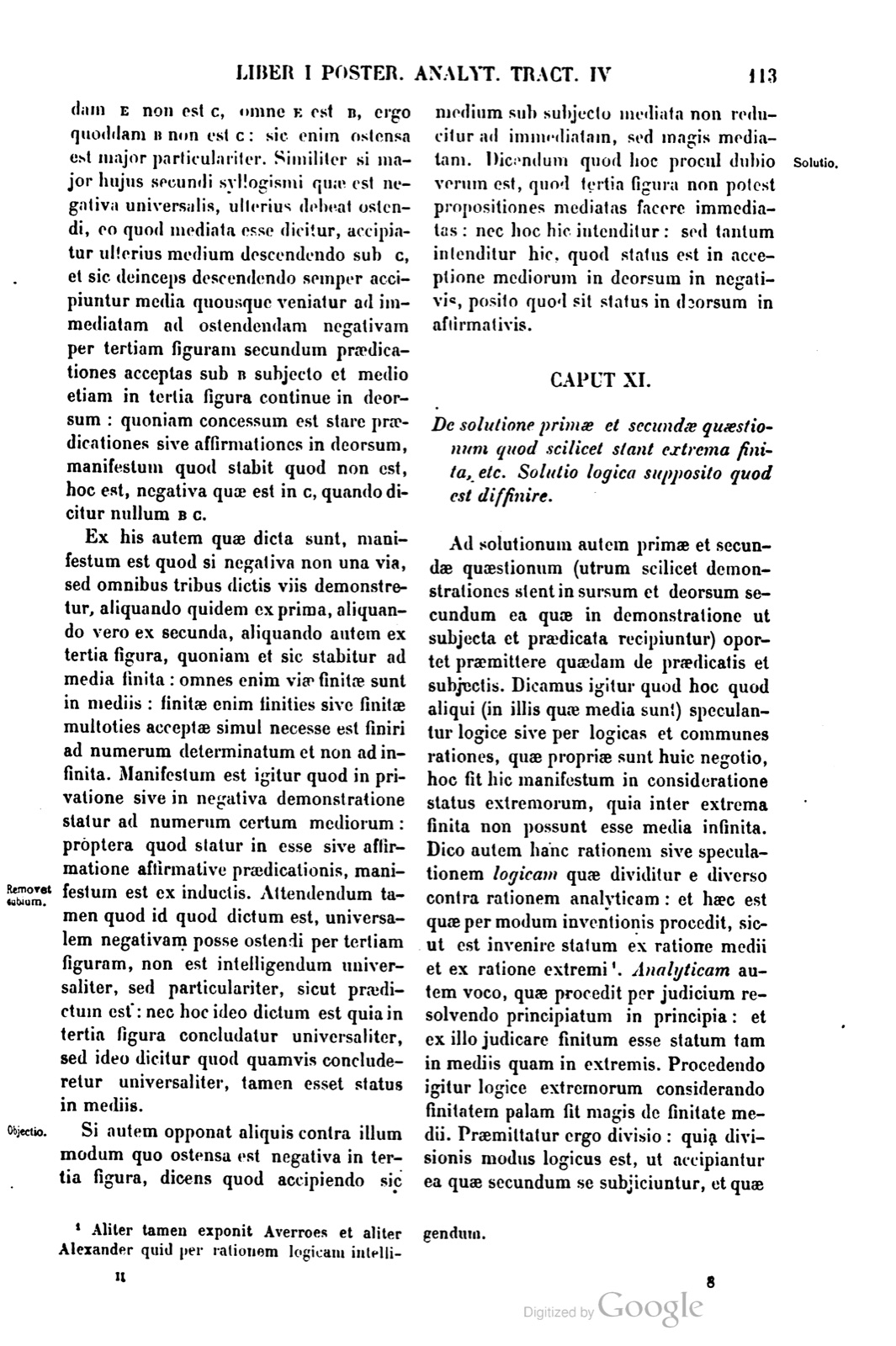
De solutione primae et secundae quaestionum quod scilicet stant extrema finita, etc. Solutio logica supposito quod est diffinire.
Ad solutionem autem primae et secundae quaestionum (utrum scilicet demonstrationes stent in sursum et deorsum secundum ea quae in demonstratione ut subjecta et praedicata recipiuntur) oportet praemittere quaedam de praedicatis et subjectis. Dicamus igitur quod hoc quod aliqui (in illis quae media sunt) speculantur logice sive per logicas et communes rationes, quae propriae sunt huic negotio, hoc fit hic manifestum in consideratione status extremorum, quia inter extrema finita non possunt esse media infinita. Dico autem hanc rationem sive speculationem logicam quae dividitur e diverso contra rationem analyticam: et haec est quae per modum inventionis procedit, sicut est invenire statum ex ratione medii et ex ratione extremi 1. Analyticam autem voco, quae procedit per judicium resolvendo principiatum in principia: et ex illo judicare finitum esse statum tam in mediis quam in extremis. Procedendo igitur logice extremorum considerando finitatem palam fit magis de finitate medii. Praemittatur ergo divisio: quia divisionis modus logicus est, ut accipiantur ea quae secundum se subjiciuntur, et quae secundum se praedicantur, ab his quae subjiciuntur et praedicantur secundum accidens, quia illa quae secundum se subjiciuntur et praedicantur secundum se, finita sunt: quae autem secundum accidens subjiciuntur et praedicantur, ad finitatem certam per artem redigi non possunt.
Dicamus ergo quod in his quae in quid est simpliciter et secundum esse praedicantur (sicut in coordinatione praedicabilium substantiae) patens est, quod stant extrema et in summo et in infimo: si enim est vel contingit diffinire in substantia in qua est diffinitio simpliciter, aut si notum quod aliquod erit esse sive quidditas quae est diffinitio: tunc hoc supposito erit status in extremis. Quia id quod est in infimis stans, hoc diffinitur tantum: et id quod est in summo, est diffiniens tantum: et media in linea recta et laterali sunt secundum aliquid diffinientia, et secundum aliquid diffinita. Oportet ergo quod sint finita et stantia superius et inferius: quia diffinientem non contingit transire infinita. Diffinitio autem ab infimo recurrit usque in summum: cujus ratio est, quia quod in se non est finitum, non diffinit: medium nisi reducatur in terminum, de se non est finitum, et ideo medium non diffinit nisi sit reductum in primum, quod est finis.
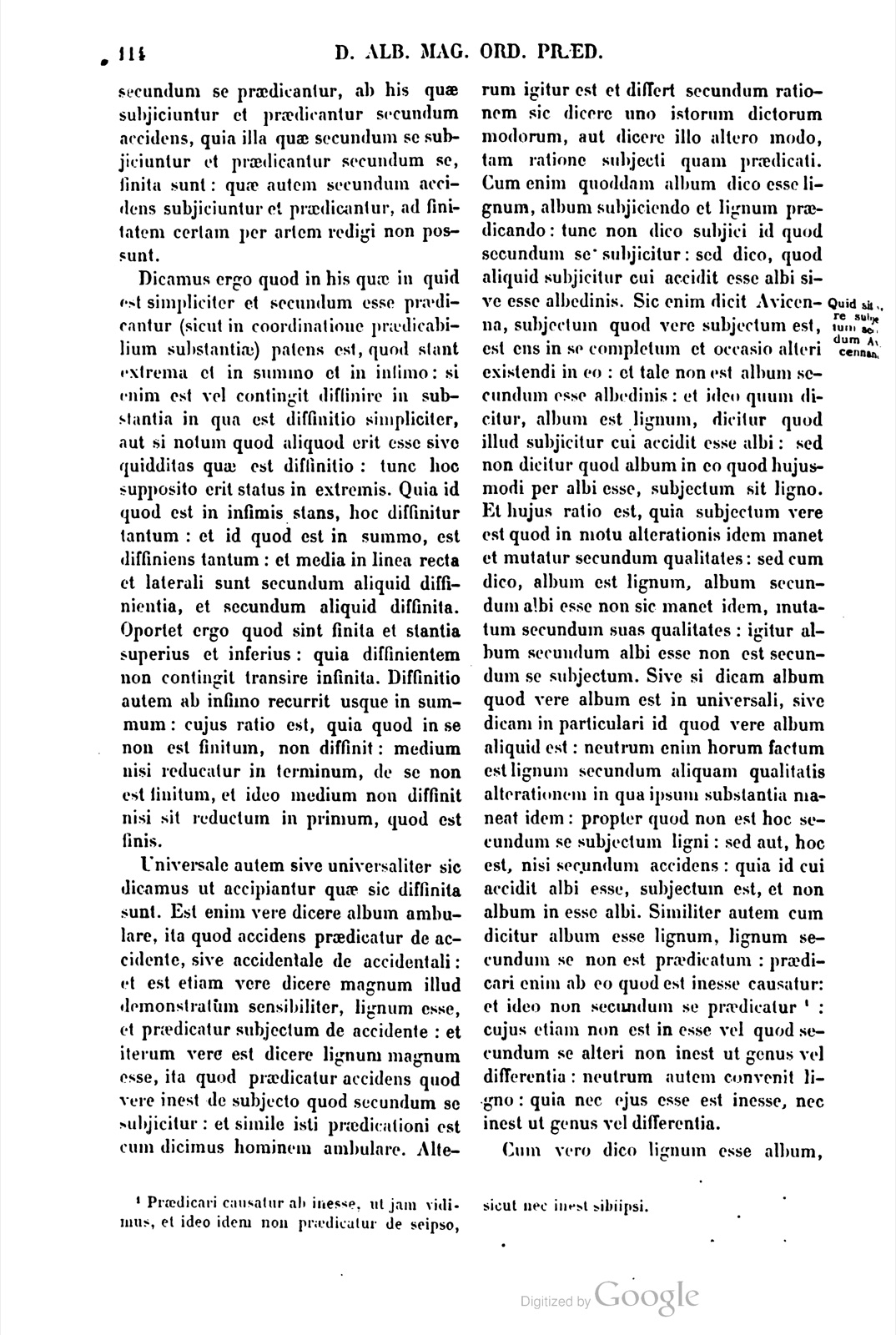
Universale autem sive universaliter sic dicamus ut accipiantur quae sic diffinita sunt. Est enim vere dicere album ambulare, ita quod accidens praedicatur de accidente, sive accidentale de accidentali: et est etiam vere dicere magnum illud demonstratum sensibiliter, lignum esse, et praedicatur subjectum de accidente: et iterum vere est dicere lignum magnum esse, ita quod praedicatur accidens quod vere inest de subjecto quod secundum se subjicitur: et simile isti praedicationi est cum dicimus hominem ambulare. Alterum igitur est et differt secundum rationem sic dicere uno istorum dictorum modorum, aut dicere illo altero modo, tam ratione subjecti quam praedicati. Cum enim quoddam album dico esse lignum, album subjiciendo et lignum praedicando: tunc non dico subjici id quod secundum se subjicitur: sed dico, quod aliquid subjicitur cui accidit esse albi sive esse albedinis. Sic enim dicit Avicenna, subjectum quod vere subjectum est, est ens in se completum et occasio alteri existendi in eo: et tale non est album secundum esse albedinis: et ideo quum dicitur, album est lignum, dicitur quod illud subjicitur cui accidit esse albi: sed non dicitur quod album in eo quod hujusmodi per albi esse, subjectum sit ligno. Et hujus ratio est, quia subjectum vere est quod in motu alterationis idem manet et mutatur secundum qualitates: sed cum dico, album est lignum, album secundum albi esse non sic manet idem, mutatum secundum suas qualitates: igitur album secundum albi esse non est secundum se subjectum. Sive si dicam album quod vere album est in universali, sive dicam in particulari id quod vere album aliquid est: neutrum enim horum factum est lignum secundum aliquam qualitatis alterationem in qua ipsum substantia maneat idem: propter quod non est hoc secundum se subjectum ligni: sed aut, hoc est, nisi secundum accidens: quia id cui accidit albi esse, subjectum est, et non album in esse albi. Similiter autem cum dicitur album esse lignum, lignum secundum se non est praedicatum: praedicari enim ab eo quod est inesse causatur: et ideo non secundum se praedicatur 2: cujus etiam non est in esse vel quod secundum se alteri non inest ut genus vel differentia: neutrum autem convenit ligno: quia nec ejus esse est inesse, nec inest ut genus vel differentia.
On the solution of the first and second questions, namely that the extremes stand finite, etc. A logical solution, with the fact that defining exists being supposed.
But for the solution of the first and second questions, namely whether demonstrations stand upward and downward according to those things which are received in demonstration as subjects and predicates, it is necessary to premise certain things about predicates and subjects. Therefore let us say that what some people consider logically in those things which are middles, or through logical and common arguments which are proper to this business, this is made manifest here in the consideration of the standing of the extremes, because infinite middles cannot exist between finite extremes. But I call this argument or speculation logical, which is divided on the other side against the analytical argument; and this is the argument which proceeds by the mode of discovery, as it is to discover a stand from the account of the middle and from the account of the extreme 1. But I call that analytical which proceeds by judgment, by resolving the thing principled into principles, and from that judging that the stand is finite both in middles and in extremes. Therefore, proceeding logically by considering the finitude of the extremes, it becomes more evident about the finitude of the middle. Therefore let a division be premised, because the logical mode of division is that those things which are subjected according to themselves and those which are predicated according to themselves be distinguished from those which are subjected and predicated according to accident, because those which are subjected according to themselves and predicated according to themselves are finite; but those which are subjected and predicated according to accident cannot be reduced by art to a certain finitude.
Therefore let us say that in those things which are predicated in what-it-is simply and according to being, as in the coordination of the predicables of substance, it is evident that the extremes stand both in the highest and in the lowest. For if there is, or if it happens, to define in substance, in which there is definition simply, or if it is known that there will be some being or quiddity which is definition, then, with this supposed, there will be a stand in the extremes. For that which is standing among the lowest things, this is only defined; and that which is in the highest is only defining; and the middles in the straight and lateral line are in one respect defining and in another respect defined. Therefore they must be finite and standing higher and lower, because it does not happen that one defining passes through infinite things. But definition runs back from the lowest up to the highest; the reason for this is that what is not finite in itself does not define. A middle, unless it is reduced to a term, is not finite of itself, and therefore a middle does not define unless it has been reduced to the first thing, which is the end.
But let us speak of the universal or universally in this way, so that those things which are thus defined are accepted. For it is true to say that a white thing walks, so that an accident is predicated of an accident, or an accidental of an accidental; and it is also true to say that that great thing, sensibly demonstrated, is wood, and the subject is predicated of the accident. And again it is true to say that wood is great, so that an accident which is truly present is predicated of a subject which is subjected according to itself; and similar to this predication is when we say that man walks. Therefore it is a different thing, and differs according to reason, to speak thus in one of those stated modes or to speak in that other mode, both by reason of subject and by reason of predicate. For when I say that some white thing is wood, by subjecting white and predicating wood, then I do not say that what is subjected according to itself is subjected; but I say that something is subjected to which it happens to be white or to have the being of whiteness. For thus Avicenna says that the subject which is truly a subject is a being complete in itself and the occasion for another to exist in it; and such a thing is not white according to the being of whiteness. And therefore when it is said, a white thing is wood, it is said that that is subjected to which it happens to be white; but it is not said that white, insofar as it is of this sort through the being of white, is subject to wood. And the reason for this is that the subject truly is what remains the same in the motion of alteration and is changed according to qualities. But when I say, a white thing is wood, white according to the being of white does not remain the same in that way, changed according to its qualities. Therefore white according to the being of white is not a subject according to itself. Or if I speak of white which is truly white in the universal, or if I speak in the particular of that which is truly something white, neither of these has been made wood according to some alteration of quality in which the substance itself remains the same. On account of this it is not this, according to itself, which is the subject of wood, except according to accident, because that to which it happens to be white is the subject, and not white in the being of white. Similarly, however, when white is said to be wood, wood is not the predicate according to itself; for being predicated is caused by being-in, and therefore it is not predicated according to itself 2, to which also there does not belong being-in, or which is not present according to itself in another as genus or difference. But neither belongs to wood, because neither is its being to be in, nor is it present as genus or difference.
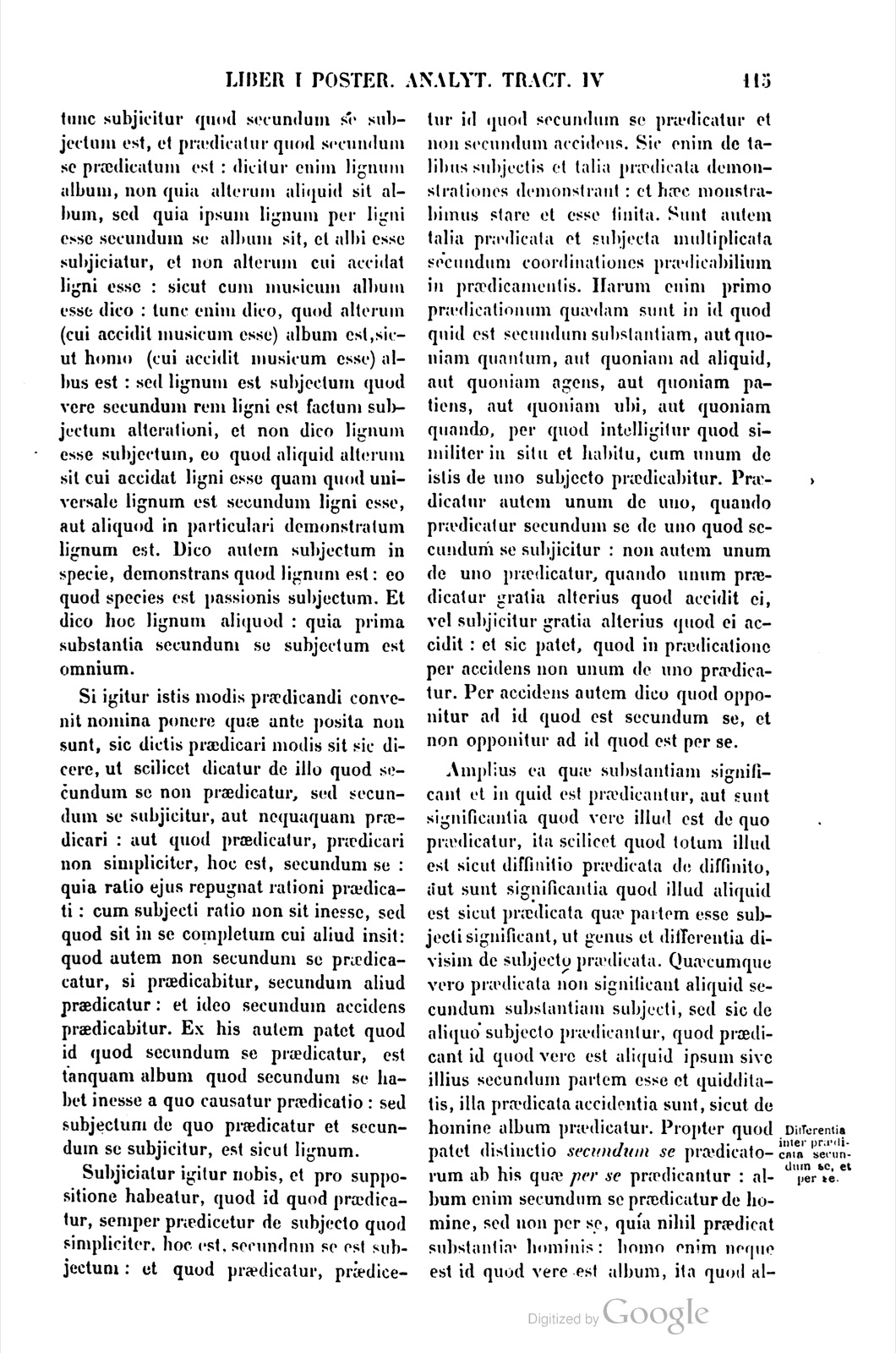
Cum vero dico lignum esse album, tunc subjicitur quod secundum se subjectum est, et praedicatur quod secundum se praedicatum est: dicitur enim lignum album, non quia alterum aliquid sit album, sed quia ipsum lignum per ligni esse secundum se album sit, et albi esse subjiciatur, et non alterum cui accidat ligni esse: sicut cum musicum album esse dico: tunc enim dico, quod alterum (cui accidit musicum esse) album est, sicut homo (cui accidit musicum esse) albus est: sed lignum est subjectum quod vere secundum rem ligni est factum subjectum alterationi, et non dico lignum esse subjectum, eo quod aliquid alterum sit cui accidat ligni esse quam quod universale lignum est secundum ligni esse, aut aliquod in particulari demonstratum lignum est. Dico autem subjectum in specie, demonstrans quod lignum est: eo quod species est passionis subjectum. Et dico hoc lignum aliquod: quia prima substantia secundum se subjectum est omnium.
Si igitur istis modis praedicandi convenit nomina ponere quae ante posita non sunt, sic dictis praedicari modis sit sic dicere, ut scilicet dicatur de illo quod secundum se non praedicatur, sed secundum se subjicitur, aut nequaquam praedicari: aut quod praedicatur, praedicari non simpliciter, hoc est, secundum se: quia ratio ejus repugnat rationi praedicati: cum subjecti ratio non sit inesse, sed quod sit in se completum cui aliud insit: quod autem non secundum se praedicatur, si praedicabitur, secundum aliud praedicatur: et ideo secundum accidens praedicabitur. Ex his autem patet quod id quod secundum se praedicatur, est tanquam album quod secundum se habet inesse a quo causatur praedicatio: sed subjectum de quo praedicatur et secundum se subjicitur, est sicut lignum.
But when I say that wood is white, then what is a subject according to itself is subjected, and what is a predicate according to itself is predicated. For wood is said to be white, not because some other thing is white, but because the wood itself through the being of wood is white according to itself and is subjected to the being of white, and not some other thing to which it happens to be wood. This is like when I say that the musical thing is white; for then I say that another thing, to which it happens to be musical, is white, just as man, to whom it happens to be musical, is white. But wood is a subject which truly according to the reality of wood has been made subject to alteration; and I do not say that wood is a subject because there is something else to which it happens to be wood, other than the fact that universal wood is according to the being of wood, or that some wood demonstrated in particular is. But I call the subject in species, demonstrating that it is wood, because species is the subject of a property. And I say this some wood, because first substance is the subject according to itself of all things.
Therefore, if it is fitting to put names for these modes of predicating, which were not put before, let speaking thus according to the modes of predicating that have been stated be such that, namely, it is said of that which is not predicated according to itself but is subjected according to itself, that it is not predicated at all; or that what is predicated is not predicated simply, that is, according to itself, because its account is opposed to the account of a predicate, since the account of a subject is not to be in, but to be complete in itself, to which another is present. But what is not predicated according to itself, if it is predicated, is predicated according to another, and therefore it will be predicated according to accident. But from these things it is clear that what is predicated according to itself is like white, which according to itself has being-in, from which predication is caused; but the subject of which it is predicated and which is subjected according to itself is like wood.
Subjiciatur igitur nobis, et pro suppositione habeatur, quod id quod praedicatur, semper praedicetur de subjecto quod simpliciter, hoc est, secundum se est subjectum: et quod praedicatur, praedicetur id quod secundum se praedicatur et non secundum accidens. Sic enim de talibus subjectis et talia praedicata demonstrationes demonstrant: et haec monstrabimus stare et esse finita. Sunt autem talia praedicata et subjecta multiplicata secundum coordinationes praedicabilium in praedicamentis. Harum enim primo praedicationum quaedam sunt in id quod quid est secundum substantiam, aut quoniam quantum, aut quoniam ad aliquid, aut quoniam agens, aut quoniam patiens, aut quoniam ubi, aut quoniam quando, per quod intelligitur quod similiter in situ et habitu, cum unum de istis de uno subjecto praedicabitur. Praedicatur autem unum de uno, quando praedicatur secundum se de uno quod secundum se subjicitur: non autem unum de uno praedicatur, quando unum praedicatur gratia alterius quod accidit ei, vel subjicitur gratia alterius quod ei accidit: et sic patet, quod in praedicatione per accidens non unum de uno praedicatur. Per accidens autem dico quod opponitur ad id quod est secundum se, et non opponitur ad id quod est per se.
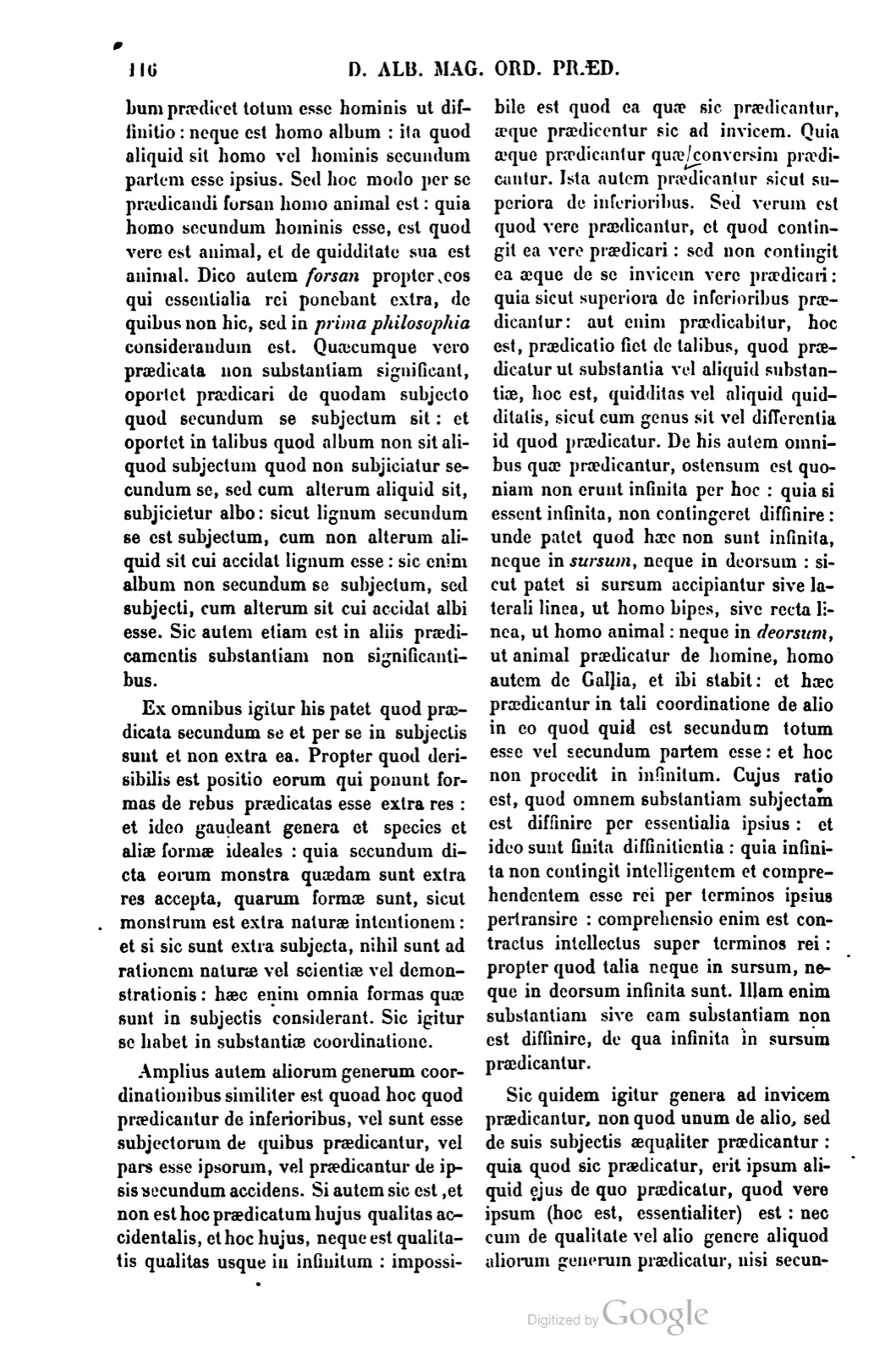
Amplius ea quae substantiam significant et in quid est praedicantur, aut sunt significantia quod vere illud est de quo praedicatur, ita scilicet quod totum illud est sicut diffinitio praedicata de diffinito, aut sunt significantia quod illud aliquid est sicut praedicata quae partem esse subjecti significant, ut genus et differentia divisim de subjecto praedicata. Quaecumque vero praedicata non significant aliquid secundum substantiam subjecti, sed sic de aliquo subjecto praedicantur, quod praedicant id quod vere est aliquid ipsum sive illius secundum partem esse et quidditatis, illa praedicata accidentia sunt, sicut de homine album praedicatur. Propter quod patet distinctio secundum se praedicatorum ab his quae per se praedicantur: album enim secundum se praedicatur de homine, sed non per se, quia nihil praedicat substantiae hominis: homo enim neque est id quod vere est album, ita quod album praedicet totum esse hominis ut diffinitio: neque est homo album: ita quod aliquid sit homo vel hominis secundum partem esse ipsius. Sed hoc modo per se praedicandi forsan homo animal est: quia homo secundum hominis esse, est quod vere est animal, et de quidditate sua est animal. Dico autem forsan propter eos qui essentialia rei ponebant extra, de quibus non hic, sed in prima philosophia considerandum est. Quaecumque vero praedicata non substantiam significant, oportet praedicari de quodam subjecto quod secundum se subjectum sit: et oportet in talibus quod album non sit aliquod subjectum quod non subjiciatur secundum se, sed cum alterum aliquid sit, subjicietur albo: sicut lignum secundum se est subjectum, cum non alterum aliquid sit cui accidat lignum esse: sic enim album non secundum se subjectum, sed subjecti, cum alterum sit cui accidat albi esse. Sic autem etiam est in aliis praedicamentis substantiam non significantibus.
Ex omnibus igitur his patet quod praedicata secundum se et per se in subjectis sunt et non extra ea. Propter quod derisibilis est positio eorum qui ponunt formas de rebus praedicatas esse extra res: et ideo gaudeant genera et species et aliae formae ideales: quia secundum dicta eorum monstra quaedam sunt extra res accepta, quarum formae sunt, sicut monstrum est extra naturae intentionem: et si sic sunt extra subjecta, nihil sunt ad rationem naturae vel scientiae vel demonstrationis: haec enim omnia formas quae sunt in subjectis considerant. Sic igitur se habet in substantiae coordinatione.
Therefore let it be subjected by us, and let it be held as a supposition, that what is predicated is always predicated of a subject which simply, that is, according to itself, is subject; and that what is predicated is predicated as that which is predicated according to itself and not according to accident. For demonstrations demonstrate concerning such subjects and such predicates, and we shall show that these stand and are finite. But such predicates and subjects are multiplied according to the coordinations of predicables in the predicaments. For among these first predications, certain ones are in what-it-is according to substance, or because it is quantity, or because it is relation, or because it is acting, or because it is undergoing, or because it is where, or because it is when; by this it is understood that it is similar in position and habit, when one of these is predicated of one subject. But one thing is predicated of one thing when it is predicated according to itself of one thing which is subjected according to itself. But one is not predicated of one when one is predicated for the sake of another thing which happens to it, or is subjected for the sake of another thing which happens to it; and thus it is clear that in predication according to accident, one is not predicated of one. But by according to accident I mean what is opposed to that which is according to itself, and is not opposed to that which is per se.
Furthermore, those things which signify substance and are predicated in what-it-is either are signifying what that truly is of which it is predicated, namely so that that whole is as a definition predicated of the thing defined, or they are signifying that it is something of that, as predicates which signify part of the being of the subject, as genus and difference predicated separately of the subject. But whatever predicates do not signify something according to the substance of the subject, but are predicated of some subject in such a way that they predicate that which truly is the thing itself, or that which belongs to it according to part of being and of quiddity, those predicates are accidents, as white is predicated of man. On account of this the distinction of things predicated according to themselves from those which are predicated per se is clear. For white is predicated of man according to itself, but not per se, because it predicates nothing of the substance of man; for man is neither what is truly white, so that white predicates the whole being of man as a definition, nor is man white in such a way that something is man or belongs to man according to part of his being. But perhaps man is animal according to this mode of predicating per se, because man, according to the being of man, is what is truly animal, and animal is of his quiddity. But I say perhaps on account of those who posited the essential things of a thing outside, concerning whom one must consider not here, but in first philosophy. But whatever predicates do not signify substance must be predicated of some subject which is subject according to itself; and in such things it is necessary that white is not some subject which is not subjected according to itself, but when it is some other thing, it will be subjected to white, just as wood is a subject according to itself, since there is no other thing to which it happens to be wood. For thus white is not a subject according to itself but belongs to a subject, since there is another thing to which it happens to be white. And thus it is also in the other predicaments that do not signify substance.
Therefore from all these things it is clear that predicates according to themselves and per se are in subjects and not outside them. On account of this the position of those who posit forms predicated of things to be outside things is laughable; and therefore let genera and species and other ideal forms rejoice, because according to their sayings certain monstrosities are accepted outside the things whose forms they are, just as a monstrosity is outside the intention of nature. And if in this way they are outside subjects, they are nothing for the account of nature or science or demonstration, for all these consider forms which are in subjects. Thus, therefore, it stands in the coordination of substance.
Amplius autem aliorum generum coordinationibus similiter est quoad hoc quod praedicantur de inferioribus, vel sunt esse subjectorum de quibus praedicantur, vel pars esse ipsorum, vel praedicantur de ipsis secundum accidens. Si autem sic est, et non est hoc praedicatum hujus qualitas accidentalis, et hoc hujus, neque est qualitatis qualitas usque in infinitum: impossibile est quod ea quae sic praedicantur, aeque praedicentur sic ad invicem. Quia aeque praedicantur quae conversim praedicantur. Ista autem praedicantur sicut superiora de inferioribus. Sed verum est quod vere praedicantur, et quod contingit ea vere praedicari: sed non contingit ea aeque de se invicem vere praedicari: quia sicut superiora de inferioribus praedicantur: aut enim praedicabitur, hoc est, praedicatio fiet de talibus, quod praedicatur ut substantia vel aliquid substantiae, hoc est, quidditas vel aliquid quidditatis, sicut cum genus sit vel differentia id quod praedicatur. De his autem omnibus quae praedicantur, ostensum est quoniam non erunt infinita per hoc: quia si essent infinita, non contingeret diffinire: unde patet quod haec non sunt infinita, neque in sursum, neque in deorsum: sicut patet si sursum accipiantur sive laterali linea, ut homo bipes, sive recta linea, ut homo animal: neque in deorsum, ut animal praedicatur de homine, homo autem de Gallia, et ibi stabit: et haec praedicantur in tali coordinatione de alio in eo quod quid est secundum totum esse vel secundum partem esse: et hoc non procedit in infinitum. Cujus ratio est, quod omnem substantiam subjectam est diffinire per essentialia ipsius: et ideo sunt finita diffinitientia: quia infinita non contingit intelligentem et comprehendentem esse rei per terminos ipsius pertransire: comprehensio enim est contractus intellectus super terminos rei: propter quod talia neque in sursum, neque in deorsum infinita sunt. Illam enim substantiam sive eam substantiam non est diffinire, de qua infinita in sursum praedicantur.
Sic quidem igitur genera ad invicem praedicantur, non quod unum de alio, sed de suis subjectis aequaliter praedicantur: quia quod sic praedicatur, erit ipsum aliquid ejus de quo praedicatur, quod vere ipsum, hoc est, essentialiter, est: nec cum de qualitate vel alio genere aliquod aliorum generum praedicatur, nisi secundum accidens, ut dictum est: omnia enim haec genera accidentium accidit, non tantum de suis inferioribus, sed etiam de subjectis in quibus et a quibus esse habent, praedicari. Sed quoniam, sicut dictum est, in sursum non erunt infinita: unumquodque enim quod sic de suo inferiori praedicatur, aut significat quid, aut quale, et in illo stat in summo: aut quantum, et hoc stat in quanto in summo: aut hujusmodi aliquod generalissimum, in quo stat sicut in summo: aut secundum accidentalem praedicationem significat genera accidentium, quae sunt in substantia sicut in subjecto. Haec autem omnia finita sunt: et ideo status est in ipsis. Similiter autem et genera ipsa praedicamentorum omnia simul accepta sunt finita: aut enim significant quale, aut quantum, aut ad aliquid, aut faciens, aut patiens, aut ubi, aut quando, et stant in numero finito.
Furthermore, in the coordinations of the other genera it is similar with respect to the fact that they are predicated of inferiors: either they are the being of the subjects of which they are predicated, or part of their being, or they are predicated of them according to accident. But if it is thus, and this predicate is not an accidental quality of this, and this of this, nor is there a quality of a quality up to infinity, then it is impossible that those things which are predicated thus are equally predicated in this way of one another. For those are predicated equally which are predicated conversely. But these are predicated as superiors of inferiors. Yet it is true that they are truly predicated and that it happens that they are truly predicated; but it does not happen that they are truly predicated equally of one another, because they are predicated as superiors of inferiors. For either it will be predicated, that is, predication will be made of such things, because it is predicated as substance or something of substance, that is, quiddity or something of quiddity, as when genus or difference is what is predicated. But about all these things which are predicated, it has been shown that they will not be infinite through this: because if they were infinite, it would not happen to define. Hence it is clear that these are not infinite, neither upward nor downward, as is clear if they are accepted upward either in the lateral line, as man, biped, or in the straight line, as man, animal; nor downward, as animal is predicated of man, but man of Gallia, and there it will stand. And these are predicated in such a coordination of another in what-it-is, according to the whole being or according to part of being; and this does not proceed into infinity. The reason for this is that every subject substance can be defined through its essentials, and therefore the things defining are finite, because it does not happen that one understanding and comprehending the being of a thing passes through infinite things through the terms of that thing. For comprehension is the drawing together of the intellect upon the terms of the thing; on account of this such things are infinite neither upward nor downward. For that substance, or that substance itself, of which infinite things are predicated upward, cannot be defined.
Thus, therefore, genera are predicated in relation to one another, not because one is predicated of another, but because they are predicated equally of their subjects, since what is predicated in this way will be something itself of that of which it is predicated, which it truly, that is, essentially, is. Nor, when some one of the other genera is predicated of quality or of another genus, is this done except according to accident, as has been said; for it happens that all these genera of accidents are predicated not only of their inferiors, but also of the subjects in which and from which they have being. But because, as has been said, they will not be infinite upward, for each thing which is thus predicated of its inferior either signifies what, or what sort, and in that there is a stand in the highest; or it signifies how much, and this stands in quantity as in the highest; or it signifies some most general thing of this sort, in which it stands as in the highest; or according to accidental predication it signifies the genera of accidents, which are in substance as in a subject. But all these are finite, and therefore there is a stand in them. Similarly also all the genera themselves of the predicaments taken together are finite, for they signify either what sort, or how much, or relation, or acting, or undergoing, or where, or when; and they stand in a finite number.
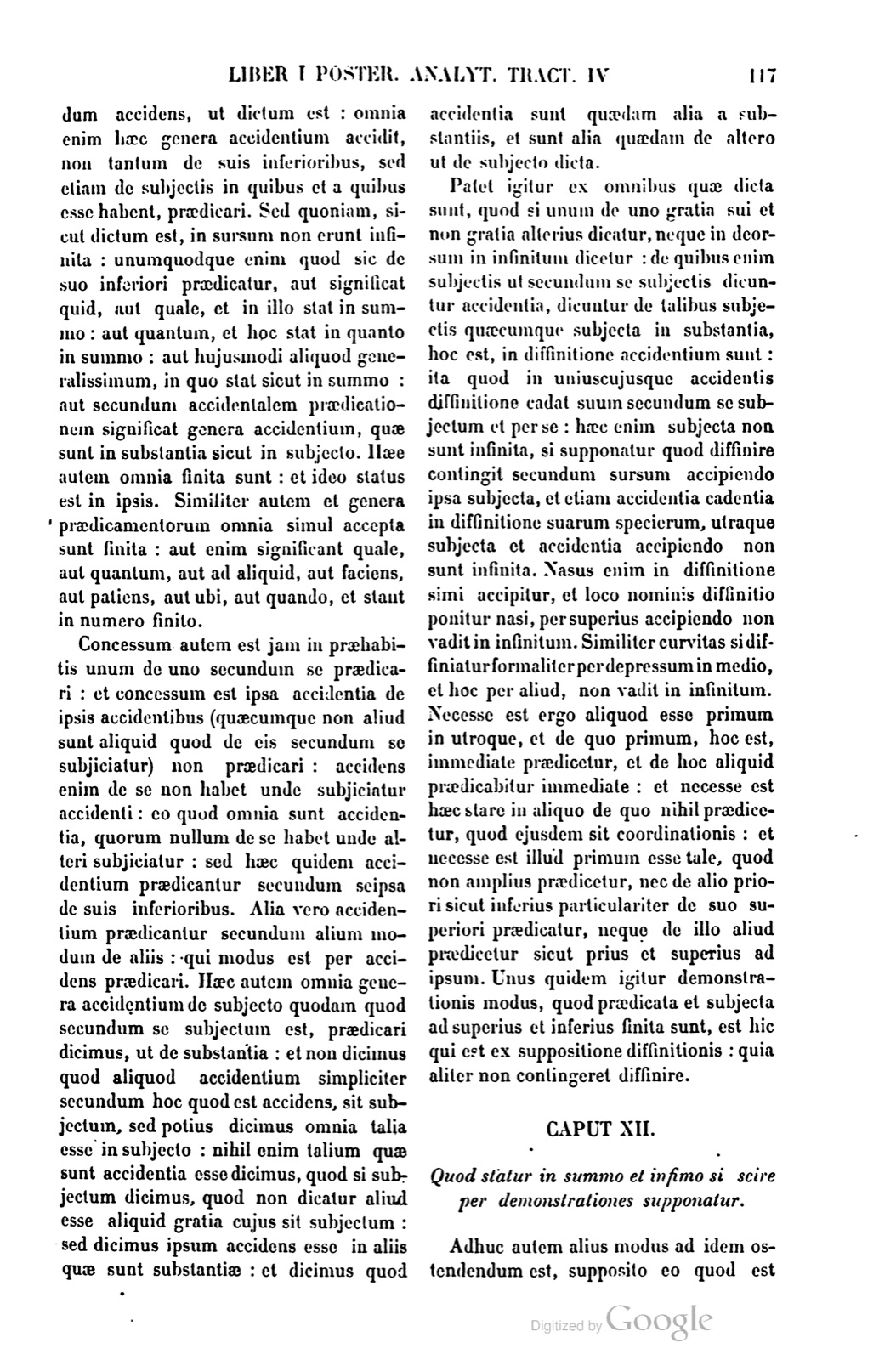
Concessum autem est jam in praehabitis unum de uno secundum se praedicari: et concessum est ipsa accidentia de ipsis accidentibus (quaecumque non aliud sunt aliquid quod de eis secundum se subjiciatur) non praedicari: accidens enim de se non habet unde subjiciatur accidenti: eo quod omnia sunt accidentia, quorum nullum de se habet unde alteri subjiciatur: sed haec quidem accidentium praedicantur secundum seipsa de suis inferioribus. Alia vero accidentium praedicantur secundum alium modum de aliis: qui modus est per accidens praedicari. Haec autem omnia genera accidentium de subjecto quodam quod secundum se subjectum est, praedicari dicimus, ut de substantia: et non dicimus quod aliquod accidentium simpliciter secundum hoc quod est accidens, sit subjectum, sed potius dicimus omnia talia esse in subjecto: nihil enim talium quae sunt accidentia esse dicimus, quod si subjectum dicimus, quod non dicatur aliud esse aliquid gratia cujus sit subjectum: sed dicimus ipsum accidens esse in aliis quae sunt substantiae: et dicimus quod accidentia sunt quaedam alia a substantiis, et sunt alia quaedam de altero ut de subjecto dicta.
Patet igitur ex omnibus quae dicta sunt, quod si unum de uno gratia sui et non gratia alterius dicatur, neque in deorsum in infinitum dicetur: de quibus enim subjectis ut secundum se subjectis dicuntur accidentia, dicuntur de talibus subjectis quaecumque subjecta in substantia, hoc est, in diffinitione accidentium sunt: ita quod in uniuscujusque accidentis diffinitione cadat suum secundum se subjectum et per se: haec enim subjecta non sunt infinita, si supponatur quod diffinire contingit secundum sursum accipiendo ipsa subjecta, et etiam accidentia cadentia in diffinitione suarum specierum, utraque subjecta et accidentia accipiendo non sunt infinita. Nasus enim in diffinitione simi accipitur, et loco nominis diffinitio ponitur nasi, per superius accipiendo non vadit in infinitum. Similiter curvitas si diffiniatur formaliter per depressum in medio, et hoc per aliud, non vadit in infinitum. Necesse est ergo aliquod esse primum in utroque, et de quo primum, hoc est, immediate praedicetur, et de hoc aliquid praedicabitur immediate: et necesse est haec stare in aliquo de quo nihil praedicetur, quod ejusdem sit coordinationis: et necesse est illud primum esse tale, quod non amplius praedicetur, nec de alio priori sicut inferius particulariter de suo superiori praedicatur, neque de illo aliud praedicetur sicut prius et superius ad ipsum. Unus quidem igitur demonstrationis modus, quod praedicata et subjecta ad superius et inferius finita sunt, est hic qui est ex suppositione diffinitionis: quia aliter non contingeret diffinire.
But it has already been conceded in the preceding things that one thing is predicated of one thing according to itself, and it has been conceded that the accidents themselves are not predicated of the accidents themselves, namely whatever are not some other thing which is subjected to them according to itself. For an accident does not have of itself whence it may be subjected to an accident, by the fact that all are accidents, of which none has of itself whence it may be subjected to another. But these accidents indeed are predicated according to themselves of their inferiors. Other accidents, however, are predicated of others according to another mode, and that mode is to be predicated according to accident. But all these genera of accidents we say are predicated of some subject which is subject according to itself, as of substance; and we do not say that any of the accidents, simply according to the fact that it is an accident, is a subject, but rather we say that all such things are in a subject. For we say that none of such things which are accidents exists such that, if we call it a subject, it is not said to be something other for the sake of which it is subject; but we say that the accident itself is in other things which are substances; and we say that accidents are certain things other than substances, and are certain other things said of another as of a subject.
Therefore it is clear from all the things that have been said that, if one thing is said of one thing for its own sake and not for the sake of another, neither will it be said downward into infinity. For concerning the subjects of which accidents are said as of subjects according to themselves, whatever subjects are in the substance, that is, in the definition of the accidents, are said of such subjects, so that in the definition of each accident its subject according to itself and per se falls. For these subjects are not infinite, if it is supposed that defining happens by accepting the subjects themselves upward; and also the accidents falling in the definition of their species, when both subjects and accidents are accepted, are not infinite. For nose is accepted in the definition of snub, and in place of the name the definition of nose is posited; by accepting higher, it does not go into infinity. Similarly, if curvature is defined formally through depressed in the middle, and this through another, it does not go into infinity. Therefore there must be something first in each direction, and something of which it is first, that is, immediately predicated, and something will be predicated immediately of this. And these must stand in something of which nothing is predicated which is of the same coordination; and that first thing must be such that it is not predicated further, neither of another prior thing as an inferior is particularly predicated of its superior, nor is something else predicated of it as prior and superior to it. Therefore one mode of demonstration, that predicates and subjects are finite toward the higher and toward the lower, is this one, which is from the supposition of definition, because otherwise it would not happen to define.
Notes
- Nevertheless Averroes explains in one way and Alexander in another what must be understood by a logical argument. (Aliter tamen exponit Averroes et aliter Alexander quid per rationem logicam intelligendum.) ↩
- Being predicated is caused by being present, as we have already seen, and therefore the same thing is not predicated of itself, just as neither is it present to itself. (Praedicari causatur ab inesse, ut jam vidimus, et ideo idem non praedicatur de seipso, sicut nec inest sibiipsi.) ↩
If a page does not appear, its photograph has not been uploaded yet.