Works › Posterior Analytics, Books I–II
Volume 2 · pp. 190–193
Chapter XI. Of what sort the definition ought to be as a middle in the demonstration of a passion.
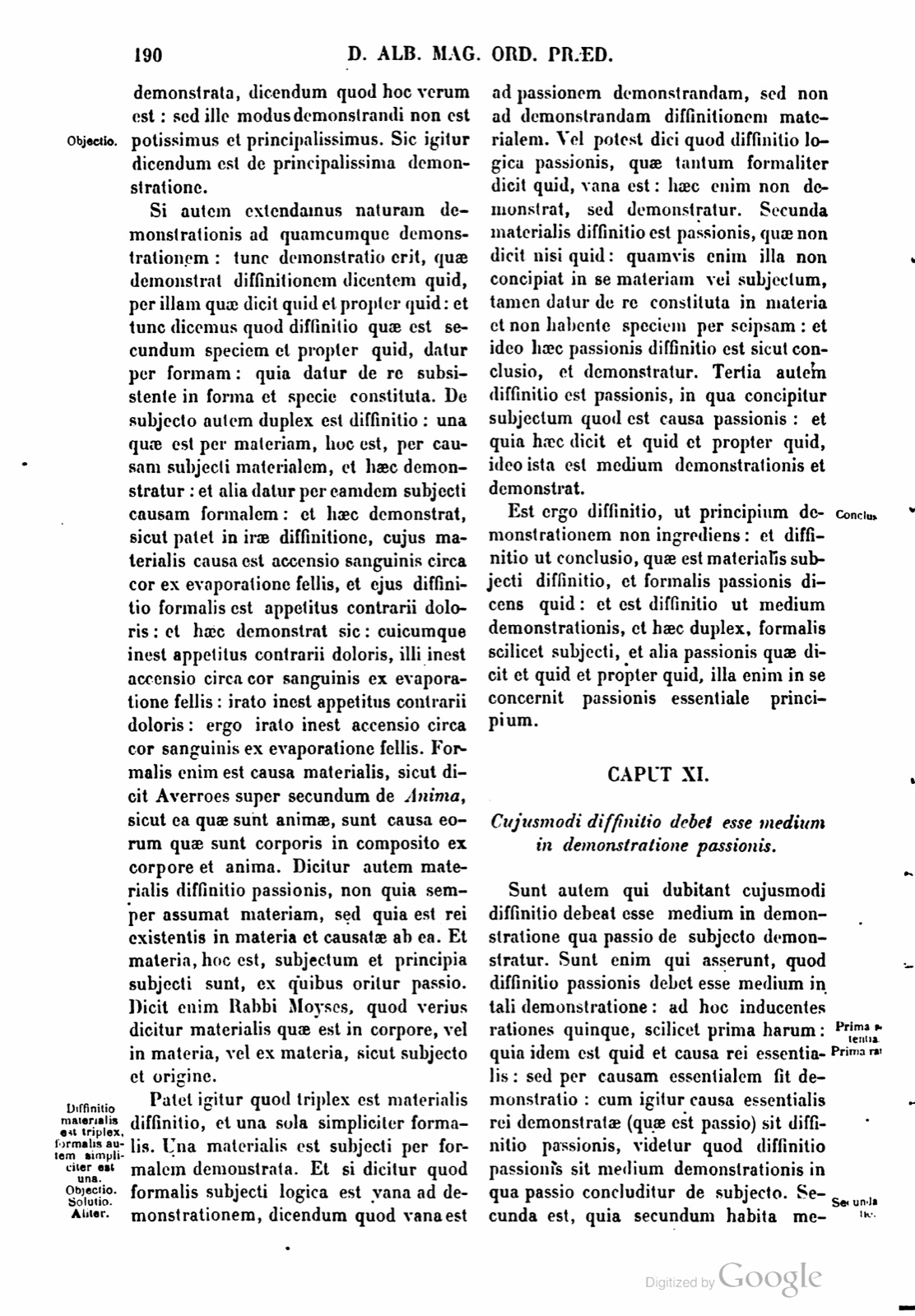
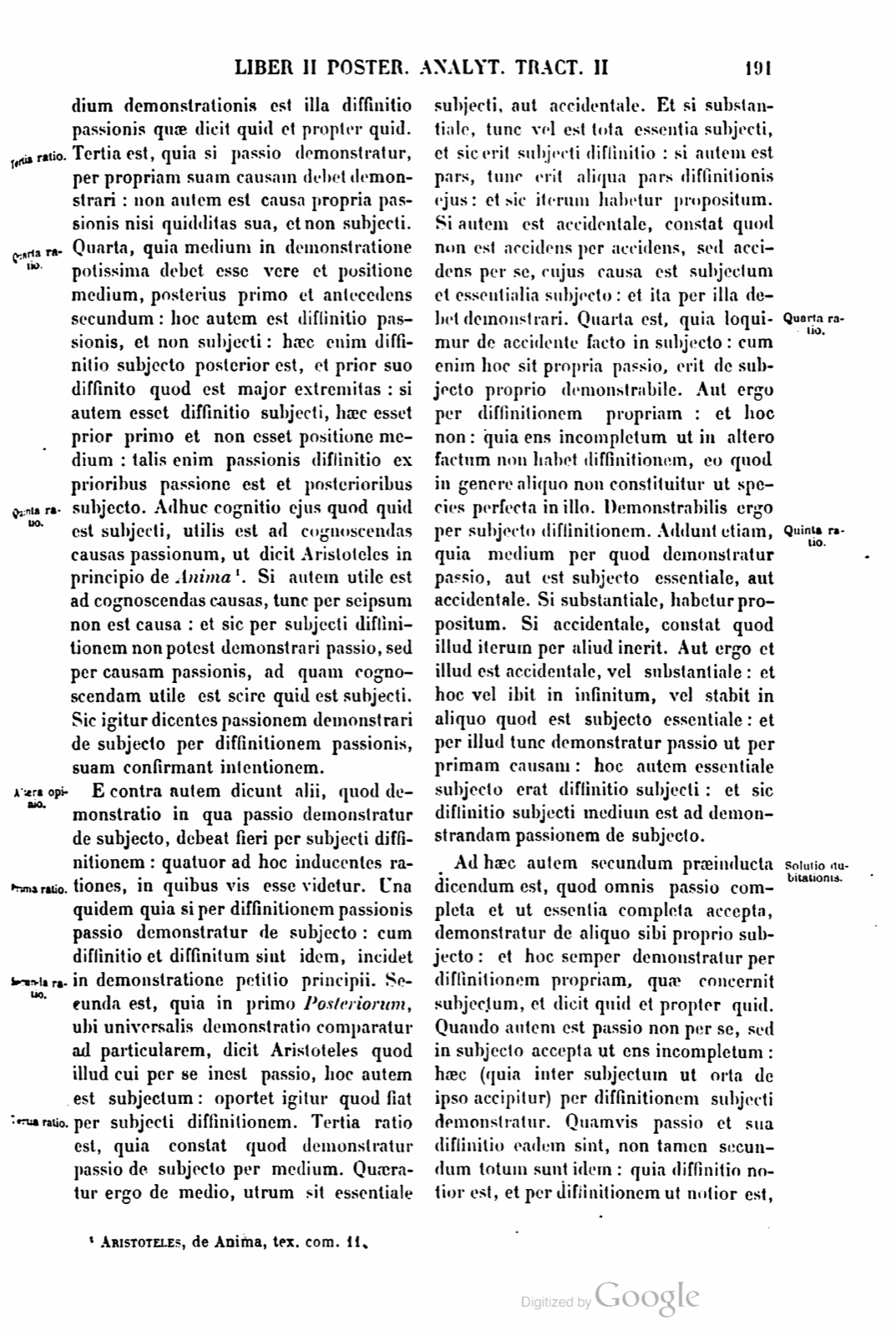
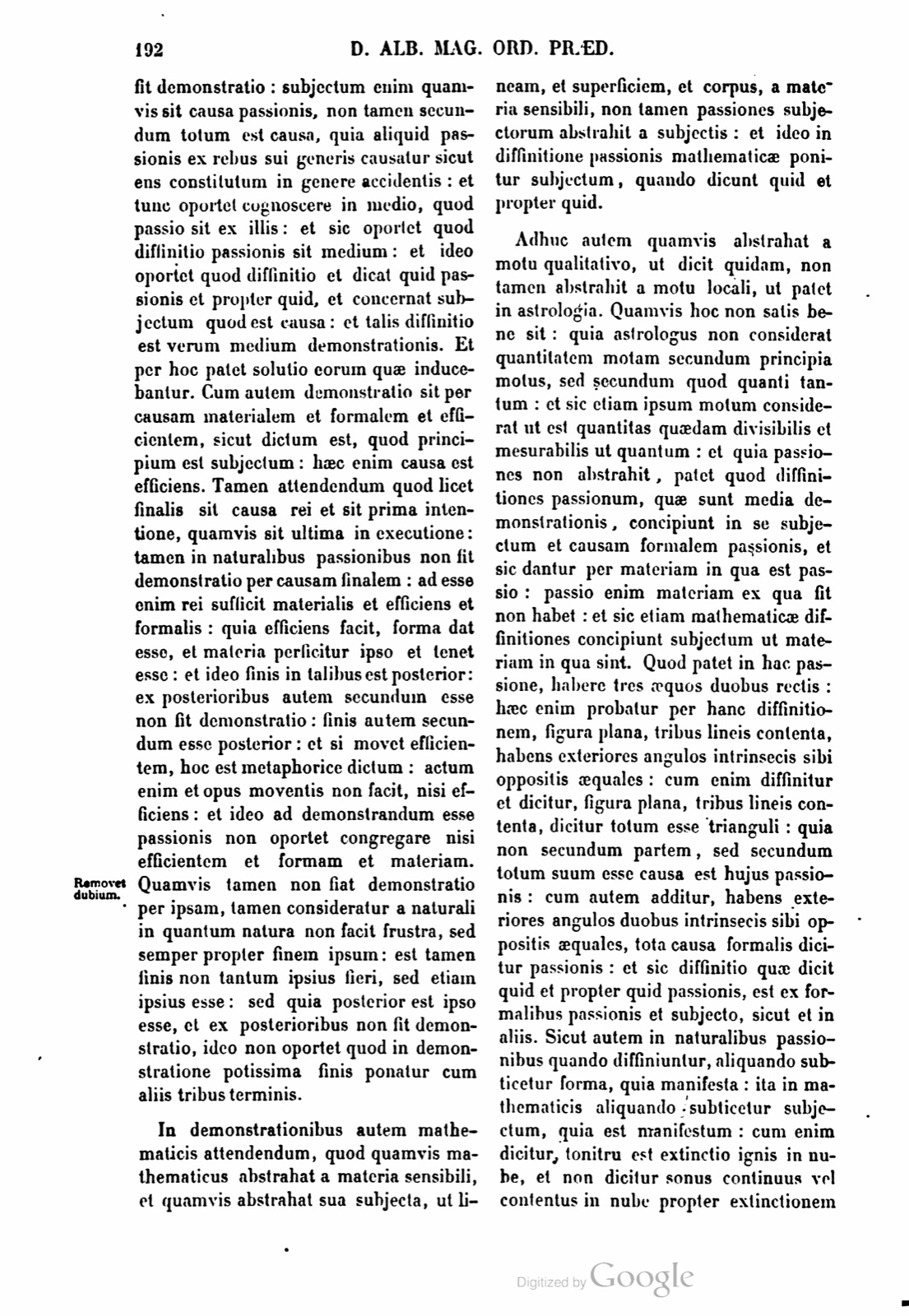
CAPUT XI. Cujusmodi diffinitio debet esse medium in demonstratione passionis. Sunt autem qui dubitant cujusmodi diffinitio debeat esse medium in demonstratione qua passio de subjecto demonstratur. Sunt enim qui asserunt, quod diffinitio passionis debet esse medium in tali demonstratione: ad hoc inducentes rationes quinque, scilicet prima harum: <marginal-label>Prima sententia.</marginal-label> <marginal-label>Prima ratio.</marginal-label> quia idem est quid et causa rei essentialis: sed per causam essentialem fit demonstratio: cum igitur causa essentialis rei demonstratae (quae est passio) sit diffinitio passionis, videtur quod diffinitio passionis sit medium demonstrationis in qua passio concluditur de subjecto. <marginal-label>Secunda ratio.</marginal-label> Secunda est, quia secundum habita medium demonstrationis est illa diffinitio passionis quae dicit quid et propter quid. <marginal-label>Tertia ratio.</marginal-label> Tertia est, quia si passio demonstratur, per propriam suam causam debet demonstrari: non autem est causa propria passionis nisi quidditas sua, et non subjecti. <marginal-label>Quarta ratio.</marginal-label> Quarta, quia medium in demonstratione potissima debet esse vere et positione medium, posterius primo et antecedens secundum: hoc autem est diffinitio passionis, et non subjecti: haec enim diffinitio subjecto posterior est, et prior suo diffinito quod est major extremitas: si autem esset diffinitio subjecti, haec esset prior primo et non esset positione medium: talis enim passionis diffinitio ex prioribus passione est et posterioribus subjecto. <marginal-label>Quinta ratio.</marginal-label> Adhuc cognitio ejus quod quid est subjecti, utilis est ad cognoscendas causas passionum, ut dicit Aristoteles in principio de Anima 1. Si autem utile est ad cognoscendas causas, tunc per seipsum non est causa: et sic per subjecti diffinitionem non potest demonstrari passio, sed per causam passionis, ad quam cognoscendam utile est scire quid est subjecti. Sic igitur dicentes passionem demonstrari de subjecto per diffinitionem passionis, suam confirmant intentionem. <marginal-label>Altera opinio.</marginal-label> Econtra autem dicunt alii, quod demonstratio in qua passio demonstratur de subjecto, debeat fieri per subjecti diffinitionem: quatuor ad hoc inducentes rationes, in quibus vis esse videtur. <marginal-label>Prima ratio.</marginal-label> Una quidem quia si per diffinitionem passionis passio demonstratur de subjecto: cum diffinitio et diffinitum sint idem, incidet in demonstratione petitio principii. <marginal-label>Secunda ratio.</marginal-label> Secunda est, quia in primo Posteriorum, ubi universalis demonstratio comparatur ad particularem, dicit Aristoteles quod illud cui per se inest passio, hoc autem est subjectum: oportet igitur quod fiat per subjecti diffinitionem. <marginal-label>Tertia ratio.</marginal-label> Tertia ratio est, quia constat quod demonstratur passio de subjecto per medium. Quaeratur ergo de medio, utrum sit essentiale subjecti, aut accidentale. Et si substantiale, tunc vel est tota essentia subjecti, et sic erit subjecti diffinitio: si autem est pars, tunc erit aliqua pars diffinitionis ejus: et sic iterum habetur propositum. Si autem est accidentale, constat quod non est accidens per accidens, sed accidens per se, cujus causa est subjectum et essentialia subjecto: et ita per illa debet demonstrari. <marginal-label>Quarta ratio.</marginal-label> Quarta est, quia loquimur de accidente facto in subjecto: cum enim hoc sit propria passio, erit de subjecto proprio demonstrabile. Aut ergo per diffinitionem propriam: et hoc non: quia ens incompletum ut in altero factum non habet diffinitionem, eo quod in genere aliquo non constituitur ut species perfecta in illo. Demonstrabilis ergo per subjecti diffinitionem. <marginal-label>Quinta ratio.</marginal-label> Addunt etiam, quia medium per quod demonstratur passio, aut est subjecto essentiale, aut accidentale. Si substantiale, habetur propositum. Si accidentale, constat quod illud iterum per aliud inerit. Aut ergo et illud est accidentale, vel substantiale: et hoc vel ibit in infinitum, vel stabit in aliquo quod est subjecto essentiale: et per illud tunc demonstratur passio ut per primam causam: hoc autem essentiale subjecto erat diffinitio subjecti: et sic diffinitio subjecti medium est ad demonstrandam passionem de subjecto. <marginal-label>Solutio dubitationis.</marginal-label> Ad haec autem secundum praeinducta dicendum est, quod omnis passio completa et ut essentia completa accepta, demonstratur de aliquo sibi proprio subjecto: et hoc semper demonstratur per diffinitionem propriam, quae concernit subjectum, et dicit quid et propter quid. Quando autem est passio non per se, sed in subjecto accepta ut ens incompletum: haec (quia inter subjectum ut orta de ipso accipitur) per diffinitionem subjecti demonstratur. Quamvis passio et sua diffinitio eadem sint, non tamen secundum totum sunt idem: quia diffinitio notior est, et per diffinitionem ut notior est, fit demonstratio: subjectum enim quamvis sit causa passionis, non tamen secundum totum est causa, quia aliquid passionis ex rebus sui generis causatur sicut ens constitutum in genere accidentis: et tunc oportet cognoscere in medio, quod passio sit ex illis: et sic oportet quod diffinitio passionis sit medium: et ideo oportet quod diffinitio et dicat quid passionis et propter quid, et concernat subjectum quod est causa: et talis diffinitio est verum medium demonstrationis. Et per hoc patet solutio eorum quae inducebantur. Cum autem demonstratio sit per causam materialem et formalem et efficientem, sicut dictum est, quod principium est subjectum: haec enim causa est efficiens. Tamen attendendum quod licet finalis sit causa rei et sit prima intentione, quamvis sit ultima in executione: tamen in naturalibus passionibus non fit demonstratio per causam finalem: ad esse enim rei sufficit materialis et efficiens et formalis: quia efficiens facit, forma dat esse, et materia perficitur ipso et tenet esse: et ideo finis in talibus est posterior: ex posterioribus autem secundum esse non fit demonstratio: finis autem secundum esse posterior: et si movet efficientem, hoc est metaphorice dictum: actum enim et opus moventis non facit, nisi efficiens: et ideo ad demonstrandum esse passionis non oportet congregare nisi efficientem et formam et materiam. <marginal-label>Removet dubium.</marginal-label> Quamvis tamen non fiat demonstratio per ipsam, tamen consideratur a naturali in quantum natura non facit frustra, sed semper propter finem ipsum: est tamen finis non tantum ipsius fieri, sed etiam ipsius esse: sed quia posterior est ipso esse, et ex posterioribus non fit demonstratio, ideo non oportet quod in demonstratione potissima finis ponatur cum aliis tribus terminis. In demonstrationibus autem mathematicis attendendum, quod quamvis mathematicus abstrahat a materia sensibili, et quamvis abstrahat sua subjecta, ut lineam, et superficiem, et corpus, a materia sensibili, non tamen passiones subjectorum abstrahit a subjectis: et ideo in diffinitione passionis mathematicae ponitur subjectum, quando dicunt quid et propter quid. Adhuc autem quamvis abstrahat a motu qualitativo, ut dicit quidam, non tamen abstrahit a motu locali, ut patet in astrologia. Quamvis hoc non satis bene sit: quia astrologus non considerat quantitatem motam secundum principia motus, sed secundum quod quanti tantum: et sic etiam ipsum motum considerat ut est quantitas quaedam divisibilis et mensurabilis ut quantum: et quia passiones non abstrahit, patet quod diffinitiones passionum, quae sunt media demonstrationis, concipiunt in se subjectum et causam formalem passionis, et sic dantur per materiam in qua est passio: passio enim materiam ex qua fit non habet: et sic etiam mathematicae diffinitiones concipiunt subjectum ut materiam in qua sint. Quod patet in hac passione, habere tres aequos duobus rectis: haec enim probatur per hanc diffinitionem, figura plana, tribus lineis contenta, habens exteriores angulos intrinsecis sibi oppositis aequales: cum enim diffinitur et dicitur, figura plana, tribus lineis contenta, dicitur totum esse trianguli: quia non secundum partem, sed secundum totum suum esse causa est hujus passionis: cum autem additur, habens exteriores angulos duobus intrinsecis sibi oppositis aequales, tota causa formalis dicitur passionis: et sic diffinitio quae dicit quid et propter quid passionis, est ex formalibus passionis et subjecto, sicut et in aliis. Sicut autem in naturalibus passionibus quando diffiniuntur, aliquando subticetur forma, quia manifesta: ita in mathematicis aliquando subticetur subjectum, quia est manifestum: cum enim dicitur, tonitru est extinctio ignis in nube, et non dicitur sonus continuus vel contentus in nube propter extinctionem.
CHAPTER XI. Of what sort the definition ought to be as a middle in the demonstration of a passion. But there are those who doubt what sort of definition ought to be the middle in the demonstration by which a passion is demonstrated of a subject. For there are those who assert that the definition of the passion ought to be the middle in such a demonstration, bringing forward five arguments for this, namely the first of these: <marginal-label>First opinion.</marginal-label> <marginal-label>First argument.</marginal-label> because what and the cause of the essential thing are the same; but demonstration is made through an essential cause; therefore, since the essential cause of the demonstrated thing, which is the passion, is the definition of the passion, it seems that the definition of the passion is the middle of the demonstration in which the passion is concluded of the subject. <marginal-label>Second argument.</marginal-label> The second is because, according to things already had, the middle of demonstration is that definition of the passion which says what and on account of what. <marginal-label>Third argument.</marginal-label> The third is because, if the passion is demonstrated, it ought to be demonstrated through its proper cause; but there is no proper cause of the passion except its quidditas, and not that of the subject. <marginal-label>Fourth argument.</marginal-label> The fourth: because the middle in the most powerful demonstration ought to be truly and in position a middle, posterior to the first and preceding the second. But this is the definition of the passion, and not of the subject; for this definition is posterior to the subject and prior to its defined thing, which is the greater extremity. But if it were the definition of the subject, this would be prior to the first and would not be a middle in position; for such a definition of the passion is from things prior to the passion and posterior to the subject. <marginal-label>Fifth argument.</marginal-label> Moreover, cognition of what the subject is is useful for knowing the causes of the passions, as Aristotle says at the beginning of On the Soul 1. But if it is useful for knowing the causes, then through itself it is not a cause; and thus the passion cannot be demonstrated through the definition of the subject, but through the cause of the passion, for knowing which it is useful to know what the subject is. Thus therefore, in saying that the passion is demonstrated of the subject through the definition of the passion, they confirm their intention. <marginal-label>The other opinion.</marginal-label> But on the contrary others say that the demonstration in which the passion is demonstrated of the subject ought to be made through the definition of the subject, bringing forward four arguments for this, in which there seems to be force. <marginal-label>First argument.</marginal-label> One indeed is because, if the passion is demonstrated of the subject through the definition of the passion, since definition and defined are the same, a begging of the principle will occur in the demonstration. <marginal-label>Second argument.</marginal-label> The second is because in the first book of the Posterior Analytics, where universal demonstration is compared to particular demonstration, Aristotle says that that to which a passion belongs per se is this, namely the subject. Therefore it must be done through the definition of the subject. <marginal-label>Third argument.</marginal-label> The third argument is because it is agreed that a passion is demonstrated of a subject through a middle. Therefore let it be asked concerning the middle whether it is essential to the subject or accidental. And if substantial, then either it is the whole essence of the subject, and thus it will be the definition of the subject; but if it is a part, then it will be some part of its definition, and thus again the proposed point is had. But if it is accidental, it is agreed that it is not an accident by accident, but an accident per se, whose cause is the subject and the things essential to the subject; and so it ought to be demonstrated through those things. <marginal-label>Fourth argument.</marginal-label> The fourth is because we are speaking of an accident made in a subject; for since this is a proper passion, it will be demonstrable of its proper subject. Therefore either through its proper definition, and not this, because an incomplete being, as made in another, does not have a definition, because it is not constituted in some genus as a perfect species in that genus. Therefore it is demonstrable through the definition of the subject. <marginal-label>Fifth argument.</marginal-label> They add also that the middle through which a passion is demonstrated is either essential to the subject or accidental. If substantial, the proposed point is had. If accidental, it is agreed that that will again belong through something else. Therefore either that too is accidental or substantial; and this either will go to infinity or will stand in something that is essential to the subject; and through that the passion is then demonstrated as through the first cause. But this essential thing belonging to the subject was the definition of the subject; and thus the definition of the subject is the middle for demonstrating the passion of the subject. <marginal-label>Solution of the doubt.</marginal-label> But to these things one must say according to what has been brought in before that every complete passion, and one taken as a complete essence, is demonstrated of some subject proper to itself; and this is always demonstrated through the proper definition, which concerns the subject and says what and on account of what. But when there is a passion not per se, but accepted in a subject as an incomplete being, this, because it is accepted among the subject as arising from it, is demonstrated through the definition of the subject. Although the passion and its definition are the same, nevertheless they are not the same according to the whole, because the definition is better known, and through the definition as better known the demonstration is made. For although the subject is the cause of the passion, nevertheless it is not the cause according to the whole, because something of the passion is caused from things of its own genus as a being constituted in the genus of accident; and then one must know in the middle that the passion is from those things; and thus the definition of the passion must be the middle. And therefore the definition must both say what the passion is and on account of what, and concern the subject which is the cause; and such a definition is the true middle of demonstration. And through this the solution of those things which were brought forward is clear. But since demonstration is through the material and formal and efficient cause, as has been said, that the principle is the subject; for this cause is efficient. Nevertheless one must attend that, although the final cause is a cause of the thing and is first in intention, although it is last in execution, nevertheless in natural passions demonstration is not made through the final cause. For the material, efficient, and formal causes suffice for the being of a thing, because the efficient cause makes, the form gives being, and the matter is perfected by that very thing and holds being; and therefore the end in such things is posterior. But from things posterior according to being demonstration is not made. Moreover the end is posterior according to being; and if it moves the efficient cause, this is said metaphorically, for it does not make the act and work of the mover unless it is the efficient cause; and therefore for demonstrating the being of a passion one must gather only the efficient, the form, and the matter. <marginal-label>He removes a doubt.</marginal-label> Although nevertheless demonstration is not made through it, nevertheless it is considered by the natural philosopher insofar as nature does not act in vain, but always on account of the end itself; nevertheless the end is not only of the very coming-to-be, but also of the very being. But because it is posterior to the being itself, and demonstration is not made from posterior things, therefore in the most powerful demonstration it is not necessary that the end be posited with the other three terms. But in mathematical demonstrations one must attend that, although the mathematician abstracts from sensible matter, and although he abstracts his subjects, such as line and surface and body, from sensible matter, nevertheless he does not abstract the passions of the subjects from the subjects; and therefore in the definition of a mathematical passion the subject is posited, when they say what and on account of what. Moreover, although he abstracts from qualitative motion, as someone says, nevertheless he does not abstract from local motion, as is clear in astrology. Although this is not quite well said, because the astrologer does not consider moved quantity according to the principles of motion, but only according as it belongs to quantity; and thus he also considers motion itself as it is a certain divisible and measurable quantity as quantity. And because he does not abstract passions, it is clear that the definitions of passions which are middles of demonstration conceive in themselves the subject and the formal cause of the passion, and thus are given through the matter in which the passion is. For a passion does not have matter from which it comes to be; and thus also mathematical definitions conceive the subject as matter in which they are. This is clear in this passion, having three angles equal to two right angles; for this is proved through this definition: a plane figure contained by three lines, having exterior angles equal to the intrinsic angles opposite to them. For when it is defined and said, a plane figure contained by three lines, the whole being of the triangle is stated, because it is the cause of this passion not according to a part but according to its whole being. But when there is added, having exterior angles equal to two intrinsic angles opposite to them, the whole formal cause of the passion is stated; and thus the definition which says what and on account of what of the passion is from the formal things of the passion and from the subject, as also in other things. But just as in natural passions when they are defined, sometimes the form is left unspoken because it is manifest, so too in mathematics sometimes the subject is left unspoken because it is manifest; for when it is said, thunder is extinction of fire in a cloud, and there is not said continuous sound or sound contained in a cloud on account of the extinction.
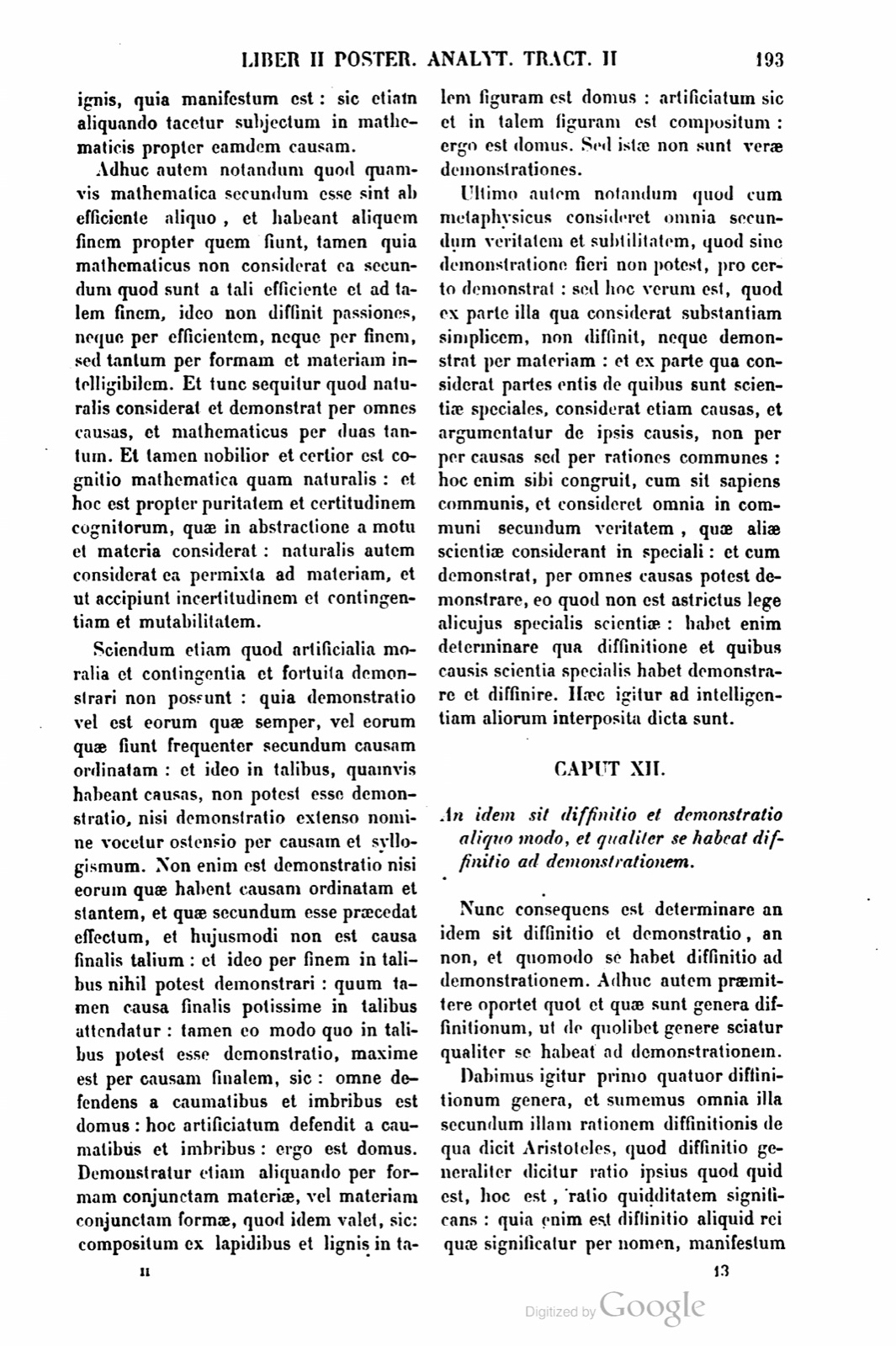
ignis, quia manifestum est: sic etiam aliquando tacetur subjectum in mathematicis propter eamdem causam. Adhuc autem notandum quod quamvis mathematica secundum esse sint ab efficiente aliquo, et habeant aliquem finem propter quem fiunt, tamen quia mathematicus non considerat ea secundum quod sunt a tali efficiente et ad talem finem, ideo non diffinit passiones, neque per efficientem, neque per finem, sed tantum per formam et materiam intelligibilem. Et tunc sequitur quod naturalis considerat et demonstrat per omnes causas, et mathematicus per duas tantum. Et tamen nobilior et certior est cognitio mathematica quam naturalis: et hoc est propter puritatem et certitudinem cognitorum, quae in abstractione a motu et materia considerat: naturalis autem considerat ea permixta ad materiam, et ut accipiunt incertitudinem et contingentiam et mutabilitatem. Sciendum etiam quod artificialia moralia et contingentia et fortuita demonstrari non possunt: quia demonstratio vel est eorum quae semper, vel eorum quae fiunt frequenter secundum causam ordinatam: et ideo in talibus, quamvis habeant causas, non potest esse demonstratio, nisi demonstratio extenso nomine vocetur ostensio per causam et syllogismum. Non enim est demonstratio nisi eorum quae habent causam ordinatam et stantem, et quae secundum esse praecedat effectum, et hujusmodi non est causa finalis talium: et ideo per finem in talibus nihil potest demonstrari: quum tamen causa finalis potissime in talibus attendatur: tamen eo modo quo in talibus potest esse demonstratio, maxime est per causam finalem, sic: omne defendens a caumatibus et imbribus est domus: hoc artificiatum defendit a caumatibus et imbribus: ergo est domus. Demonstratur etiam aliquando per formam conjunctam materiae, vel materiam conjunctam formae, quod idem valet, sic: compositum ex lapidibus et lignis in talem figuram est domus: artificiatum sic et in talem figuram est compositum: ergo est domus. Sed istae non sunt verae demonstrationes. Ultimo autem notandum quod cum metaphysicus consideret omnia secundum veritatem et subtilitatem, quod sine demonstratione fieri non potest, pro certo demonstrat: sed hoc verum est, quod ex parte illa qua considerat substantiam simplicem, non diffinit, neque demonstrat per materiam: et ex parte qua considerat partes entis de quibus sunt scientiae speciales, considerat etiam causas, et argumentatur de ipsis causis, non per causas sed per rationes communes: hoc enim sibi congruit, cum sit sapiens communis, et consideret omnia in communi secundum veritatem, quae aliae scientiae considerant in speciali: et cum demonstrat, per omnes causas potest demonstrare, eo quod non est astrictus lege alicujus specialis scientiae: habet enim determinare qua diffinitione et quibus causis scientia specialis habet demonstrare et diffinire. Haec igitur ad intelligentiam aliorum interposita dicta sunt.
of fire, because it is manifest; thus also sometimes the subject is left unspoken in mathematics for the same cause. Moreover it must be noted that, although mathematical things according to being are from some efficient cause and have some end on account of which they come to be, nevertheless because the mathematician does not consider them according as they are from such an efficient cause and toward such an end, therefore he does not define the passions either through the efficient cause or through the end, but only through form and intelligible matter. And then it follows that the natural philosopher considers and demonstrates through all the causes, and the mathematician through two only. And nevertheless mathematical cognition is nobler and more certain than natural cognition; and this is because of the purity and certainty of the things known, which he considers in abstraction from motion and matter. But the natural philosopher considers them mixed with matter and as they receive uncertainty and contingency and mutability. One must also know that artificial, moral, contingent, and chance things cannot be demonstrated, because demonstration is either of those things which are always or of those things which come to be frequently according to an ordered cause. And therefore in such things, although they have causes, there cannot be demonstration, unless demonstration, by an extended name, is called a showing through cause and syllogism. For there is demonstration only of those things which have an ordered and standing cause, and one which according to being precedes the effect; and a final cause of such things is not of this sort. And therefore through the end nothing can be demonstrated in such things, although nevertheless the final cause is attended to most powerfully in such things. Yet in the mode in which there can be demonstration in such things, it is especially through the final cause, thus: everything defending from heats and rains is a house; this artifact defends from heats and rains; therefore it is a house. It is also sometimes demonstrated through form joined to matter, or matter joined to form, which has the same force, thus: what is composed from stones and wood in such a figure is a house; what has been made by art in this way and in such a figure is a composite; therefore it is a house. But these are not true demonstrations. Lastly it must be noted that, since the metaphysician considers all things according to truth and subtlety, he certainly demonstrates what cannot be done without demonstration. But this is true, that on that side on which he considers simple substance, he neither defines nor demonstrates through matter; and on the side on which he considers the parts of being concerning which there are special sciences, he also considers causes and argues concerning the causes themselves, not through causes but through common accounts. For this befits him, since he is the common wise man and considers in common according to truth all things which the other sciences consider in special. And when he demonstrates, he can demonstrate through all causes, because he is not bound by the law of some special science; for he has to determine by what definition and by which causes a special science has to demonstrate and define. Therefore these things have been said parenthetically for the understanding of other matters.
Notes
- Aristotle, On the Soul, commentary text 11. (Aristoteles, de Anima, tex. com. 11.) ↩
If a page does not appear, its photograph has not been uploaded yet.