Works › Posterior Analytics, Books I–II
Volume 2 · pp. 109–113
Treatise IV, Chapter X. On The Solution Of The Third Question, Whether The Middles Are Infinite Both In Affirmatives And In Negatives
A marker with ≈ is an approximate page boundary, placed by measure of the text; the page photographs remain the authority. In the paired views, clicking a page marker brings that page into view.
Caput X.
De solutione tertiae quaestionis, an media sint infinita tam in affirmativis quam in negativis.
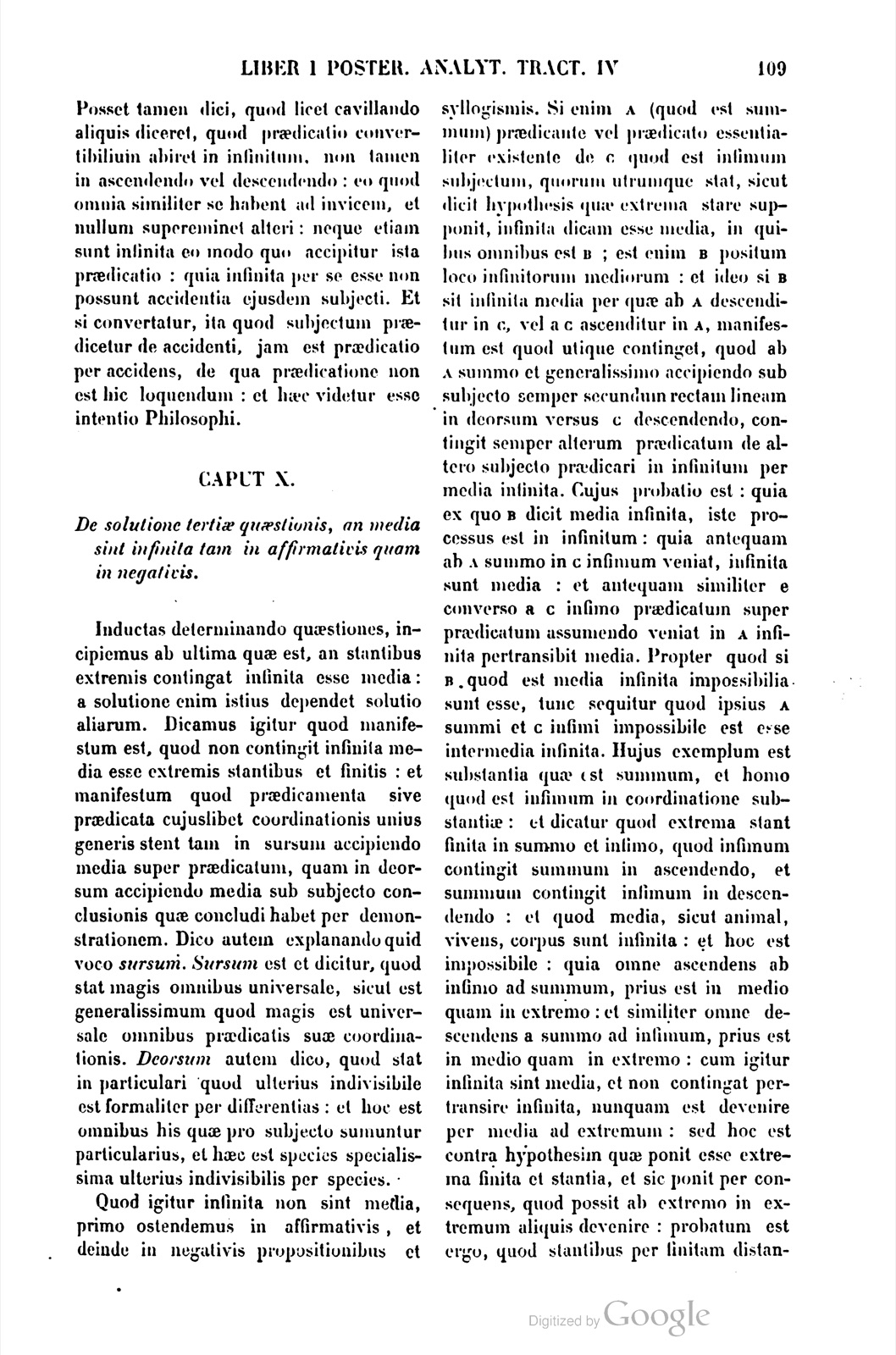
Inductas determinando quaestiones, incipiemus ab ultima quae est, an stantibus extremis contingat infinita esse media: a solutione enim istius dependet solutio aliarum. Dicamus igitur quod manifestum est, quod non contingit infinita media esse extremis stantibus et finitis: et manifestum quod praedicamenta sive praedicata cujuslibet coordinationis unius generis stent tam in sursum accipiendo media super praedicatum, quam in deorsum accipiendo media sub subjecto conclusionis quae concludi habet per demonstrationem. Dico autem explanando quid voco sursum. Sursum est et dicitur, quod stat magis omnibus universale, sicut est generalissimum quod magis est universale omnibus praedicatis suae coordinationis. Deorsum autem dico, quod stat in particulari quod ulterius indivisibile est formaliter per differentias: et hoc est omnibus his quae pro subjecto sumuntur particularius, et haec est species specialissima ulterius indivisibilis per species.
Quod igitur infinita non sint media, primo ostendemus in affirmativis, et deinde in negativis propositionibus et syllogismis. Si enim A (quod est summum) praedicante vel praedicato essentialiter existente de C quod est infimum subjectum, quorum utrumque stat, sicut dicit hypothesis quae extrema stare supponit, infinita dicam esse media, in quibus omnibus est; est enim B positum loco infinitorum mediorum: et ideo si B sit infinita media per quae ab A descenditur in C, vel a C ascenditur in A, manifestum est quod utique continget, quod ab A summo et generalissimo accipiendo sub subjecto semper secundum rectam lineam in deorsum versus C descendendo, contingit semper alterum praedicatum de altero subjecto praedicari in infinitum per media infinita. Cujus probatio est: quia ex quo B dicit media infinita, iste processus est in infinitum: quia antequam ab A summo in C infimum veniat, infinita sunt media: et antequam similiter e converso a C infimo praedicatum super praedicatum assumendo veniat in A infinita pertransibit media. Propter quod si B quod est media infinita impossibilia sunt esse, tunc sequitur quod ipsius A summi et C infimi impossibile est esse intermedia infinita. Hujus exemplum est substantia quae est summum, et homo quod est infimum in coordinatione substantiae: et dicatur quod extrema stant finita in summo et infimo, quod infimum contingit summum in ascendendo, et summum contingit infimum in descendendo: et quod media, sicut animal, vivens, corpus sunt infinita: et hoc est impossibile: quia omne ascendens ab infimo ad summum, prius est in medio quam in extremo: et similiter omne descendens a summo ad infimum, prius est in medio quam in extremo: cum igitur infinita sint media, et non contingat pertransire infinita, nunquam est devenire per media ad extremum: sed hoc est contra hypothesim quae ponit esse extrema finita et stantia, et sic ponit per consequens, quod possit ab extremo in extremum aliquis devenire: probatum est ergo, quod stantibus per finitam distantiam extremis, impossibile est media esse infinita.
Neque huic rationi obstat, quod si aliquis cavillator dicat, quod haec quidem proxima summo quae sunt A B C sint contingentia, hoc est, consequentia ad invicem: propter quod necesse sit illa vera esse media et finita. Illa vero quae a summo distant, et sunt juxta infimum, non accipere pro mediis contingentibus se ab A, et dicere quod illa sint infinita: ita tamen quod sint ejusdem coordinationis, sed quia infinita sint juxta summum. Sic enim dicere nihil differt ab hoc quin semper sint media infinita: sive enim continuo processu sint infinita, sive superiora quaedam sint finita et inferiora in eadem linea sint infinita, nullam habet differentiam: ex utroque enim sequitur quod media sunt infinita, et quod procedentem a superiori ad inferius, vel e converso ab inferiori ad superius, oporteret transire media infinita. In omni enim processu, sicut dicit Zeno, procedens prius est in medio quam in extremo: et prius est in medio sibi immediato quam in medio mediato: et prius in proximo quam in distante ab ipso. Quodcumque enim utique accipio eorum infinitorum quae sunt B (quod signat media infinita) hoc erat medium se continens ad A summum, aut ad C infimum: aut ergo haec erunt infinita media, aut non erunt infinita. Et nihil differt a proposito a quo terminorum accepta fuerint in summo sive in infimo primum sicut infinita: et sive statim continue sint, sive non statim, ut dicatur quod continentia ad unum terminum sint finita, et distantia ab illis versus alium terminum sint infinita: in omnibus enim his nulla differentia est: quia si dicatur quod continentia ad unum extremum finita sunt, tunc adhuc quae sunt post hoc versus aliud extremum sunt infinita: et semper sequitur quod media sunt infinita, et quod infinita non contingit pertransire: et sic non contingit ab extremo in extremum devenire, quod est inconveniens si stant extrema ut positum est.
Chapter X.
On the solution of the third question, whether the middles are infinite both in affirmatives and in negatives.
In determining the questions that have been introduced, we shall begin from the last one, which is whether, with the extremes standing, it happens that the middles are infinite; for the solution of the others depends on the solution of this one. Therefore let us say that it is manifest that it does not happen that there are infinite middles when the extremes stand and are finite. And it is manifest that the predicaments or predicates of each coordination of one genus stand both in taking middles upward above the predicate and in taking middles downward beneath the subject of the conclusion which has to be concluded through demonstration. But I say this by explaining what I call upward. Upward is, and is called, that which stands as more universal than all, as is the most general thing, which is more universal than all the predicates of its coordination. But I call downward that which stands in the particular which is further indivisible formally through differences; and this is more particular than all those things which are taken as subject, and this is the most special species, further indivisible through species.
Therefore, that the middles are not infinite, we shall show first in affirmatives and then in negative propositions and syllogisms. For if, when A, which is the highest, is predicating or is a predicate existing essentially of C, which is the lowest subject, each of which stands, as the hypothesis says, which supposes that the extremes stand, I should say that there are infinite middles, in all of which A is; for B is posited in the place of infinite middles. And therefore if B is infinite middles through which one descends from A into C, or ascends from C into A, it is manifest that it will indeed happen that, in taking under the subject from A the highest and most general, always according to a straight line by descending downward toward C, it always happens that one predicate is predicated of another subject into infinity through infinite middles. The proof of this is that, from the fact that B signifies infinite middles, that process is into infinity, because before it comes from A the highest into C the lowest, there are infinite middles; and before, similarly conversely, by taking predicate above predicate from C the lowest, it comes into A, it will pass through infinite middles. On account of this, if B, which is infinite middles, is impossible to be, then it follows that it is impossible that there are infinite intermediates between A the highest and C the lowest. An example of this is substance, which is the highest, and man, which is the lowest in the coordination of substance; and let it be said that the extremes stand finite in the highest and the lowest, that the lowest reaches the highest in ascending and the highest reaches the lowest in descending, and that the middles, such as animal, living thing, and body, are infinite. And this is impossible, because every thing ascending from the lowest to the highest is in the middle before it is in the extreme; and similarly every thing descending from the highest to the lowest is in the middle before it is in the extreme. Therefore, since the middles are infinite and it does not happen that infinite things are passed through, there is never an arriving through middles at the extreme. But this is contrary to the hypothesis which posits that the extremes are finite and standing, and so consequently posits that someone can arrive from extreme to extreme. Therefore it has been proved that, when the extremes stand by a finite distance, it is impossible that the middles be infinite.
Nor does it stand against this argument if some caviller says that these things indeed, which are nearest to the highest, namely A B C, are contingent, that is, consequent upon one another, on account of which it is necessary that those are true, middle, and finite; but that those things which are distant from the highest and are next to the lowest are not to be accepted as middles contingent upon themselves from A, and that one should say that those are infinite, yet in such a way that they are of the same coordination, but because infinite things are next to the highest. For to speak in this way differs in nothing from this, that there are always infinite middles. For whether they are infinite by a continuous process, or certain superior things are finite and inferior things in the same line are infinite, it has no difference; for from either one it follows that the middles are infinite, and that one proceeding from the superior to the inferior, or conversely from the inferior to the superior, would have to cross infinite middles. For in every process, as Zeno says, the one proceeding is in the middle before he is in the extreme, and he is first in the middle immediate to himself before he is in the mediate middle, and first in what is near before he is in what is distant from him. For whatever I indeed accept of those infinite things which are B, which signifies infinite middles, this was a middle containing itself toward A the highest or toward C the lowest. Therefore either these will be infinite middles, or they will not be infinite. And it makes no difference to the proposed matter from which of the terms the things were first accepted as infinite, whether in the highest or in the lowest, and whether they are immediately continuous or not immediately, so that it is said that the things containing themselves toward one term are finite, and the things distant from them toward the other term are infinite. For in all these there is no difference, because if it is said that the things containing themselves toward one extreme are finite, then still the things after this toward the other extreme are infinite. And it always follows that the middles are infinite, and that it does not happen that infinite things are passed through; and thus it does not happen that one arrives from extreme to extreme, which is unsuitable if the extremes stand as has been posited.
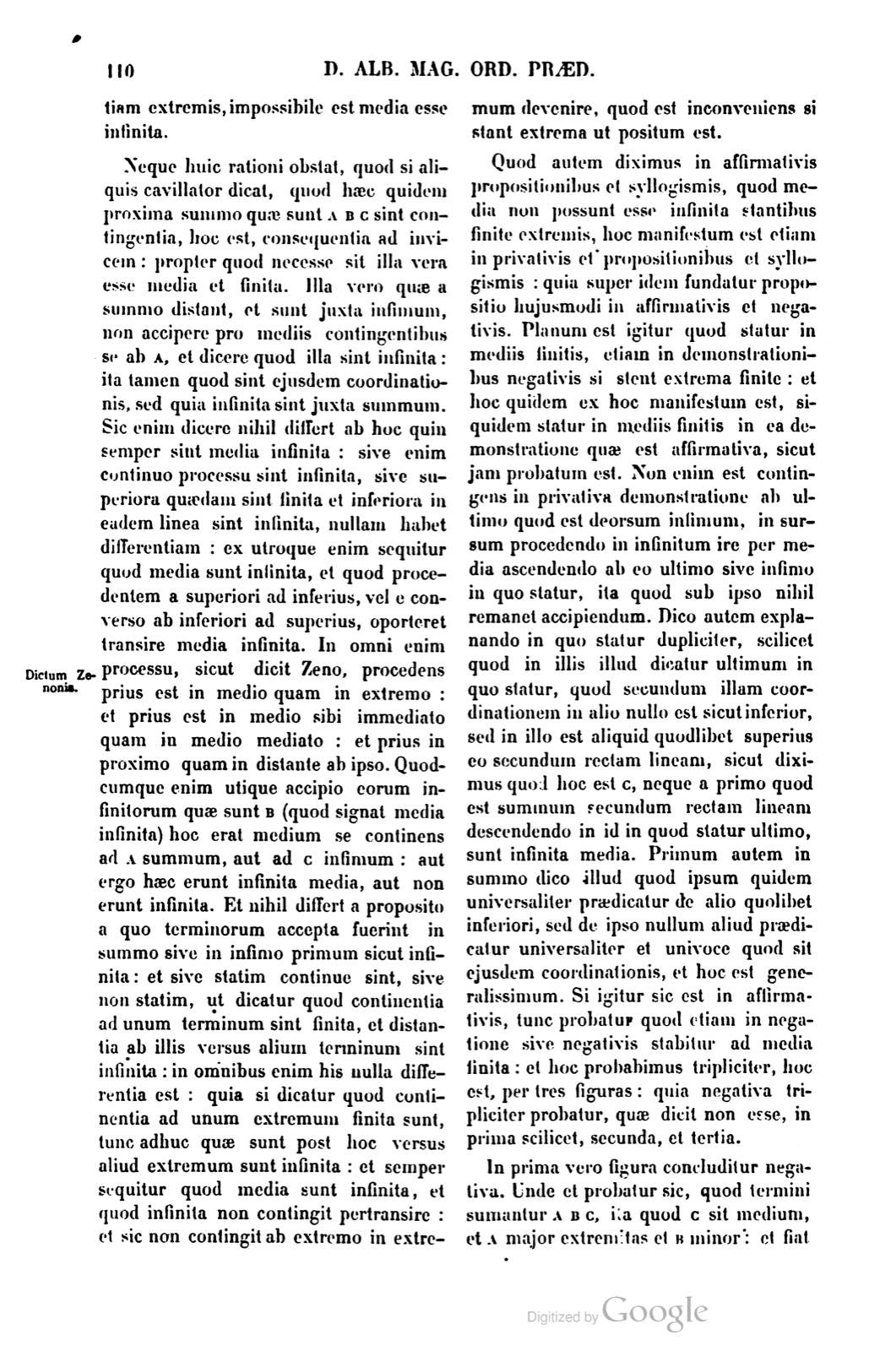
Quod autem diximus in affirmativis propositionibus et syllogismis, quod media non possunt esse infinita stantibus finite extremis, hoc manifestum est etiam in privativis et propositionibus et syllogismis: quia super idem fundatur propositio hujusmodi in affirmativis et negativis. Planum est igitur quod statur in mediis finitis, etiam in demonstrationibus negativis si stent extrema finite: et hoc quidem ex hoc manifestum est, siquidem statur in mediis finitis in ea demonstratione quae est affirmativa, sicut jam probatum est. Non enim est contingens in privativa demonstratione ab ultimo quod est deorsum infimum, in sursum procedendo in infinitum ire per media ascendendo ab eo ultimo sive infimo in quo statur, ita quod sub ipso nihil remanet accipiendum. Dico autem explanando in quo statur dupliciter, scilicet quod in illis illud dicatur ultimum in quo statur, quod secundum illam coordinationem in alio nullo est sicut inferior, sed in illo est aliquid quodlibet superius eo secundum rectam lineam, sicut diximus quod hoc est C, neque a primo quod est summum secundum rectam lineam descendendo in id in quod statur ultimo, sunt infinita media. Primum autem in summo dico illud quod ipsum quidem universaliter praedicatur de alio quolibet inferiori, sed de ipso nullum aliud praedicatur universaliter et univoce quod sit ejusdem coordinationis, et hoc est generalissimum. Si igitur sic est in affirmativis, tunc probatur quod etiam in negatione sive negativis stabitur ad media finita: et hoc probabimus tripliciter, hoc est, per tres figuras: quia negativa tripliciter probatur, quae dicit non esse, in prima scilicet, secunda, et tertia.
In prima vero figura concluditur negativa. Unde et probatur sic, quod termini sumantur A B C, ita quod C sit medium, et A major extremitas et B minor: et fiat syllogismus in secundo primae sic: nullum C A, omne B C, ergo nullum B A: tunc enim tali modo probatur non esse sive negativa, quod in omni in quo est C est B, et in minori propositione, sed in quo est B nulli inest A in conclusione. Tunc enim tali syllogismo facto propositionis minoris affirmativae quae est B C, necesse est ire probationem si mediata sit et probari hanc: et sic necesse est devenire in stantem finem, sicut jam probatum est quod in affirmativis statur in mediis: et quia in omni syllogismo altera propositio est affirmativa, necesse est in omni syllogismo in affirmativa stare ad media finita: B C enim propositio minor semper in prima figura praedicativa est.
But what we have said in affirmative propositions and syllogisms, that the middles cannot be infinite when the extremes stand finitely, is also manifest in privative propositions and syllogisms, because a proposition of this sort is founded on the same thing in affirmatives and negatives. Therefore it is plain that one stands in finite middles, also in negative demonstrations, if the extremes stand finitely. And this indeed is manifest from this, namely because one stands in finite middles in that demonstration which is affirmative, as has already been proved. For in privative demonstration it is not contingent, from the ultimate which is downward, the lowest, by proceeding upward, to go into infinity through middles, by ascending from that ultimate or lowest in which one stands, so that beneath it nothing remains to be accepted. But I say this by explaining that in which one stands in two ways, namely that in those things that is called the ultimate in which one stands which, according to that coordination, is in no other as inferior, but in which there is any thing superior to it according to a straight line, just as we said that this is C; nor, by descending from the first, which is the highest according to a straight line, into that in which one stands as ultimate, are there infinite middles. But by the first in the highest I mean that which itself indeed is predicated universally of any other inferior, but of which no other thing is predicated universally and univocally which is of the same coordination; and this is the most general thing. Therefore if it is thus in affirmatives, then it is proved that also in negation or in negatives there will be a stand at finite middles. And we shall prove this in three ways, that is, through the three figures, because the negative which says not-being is proved in three ways, namely in the first, second, and third.
But in the first figure a negative is concluded. Whence it is also proved thus: let the terms A B C be taken, so that C is the middle, A the major extreme, and B the minor; and let a syllogism be made in the second mode of the first figure thus: no C is A; every B is C; therefore no B is A. For then not-being or the negative is proved in such a mode, because in every thing in which C is, B is, and this is in the minor proposition, but in that in which B is, A is present to none in the conclusion. Therefore, when such a syllogism has been made, concerning the affirmative minor proposition which is B C, it is necessary to go to a proof if it is mediate, and this must be proved; and thus it is necessary to come to a standing end, as it has already been proved that in affirmatives one stands in the middles. And because in every syllogism one proposition is affirmative, it is necessary in every syllogism to stand at finite middles in the affirmative; for B C, the minor proposition, is always predicative in the first figure.
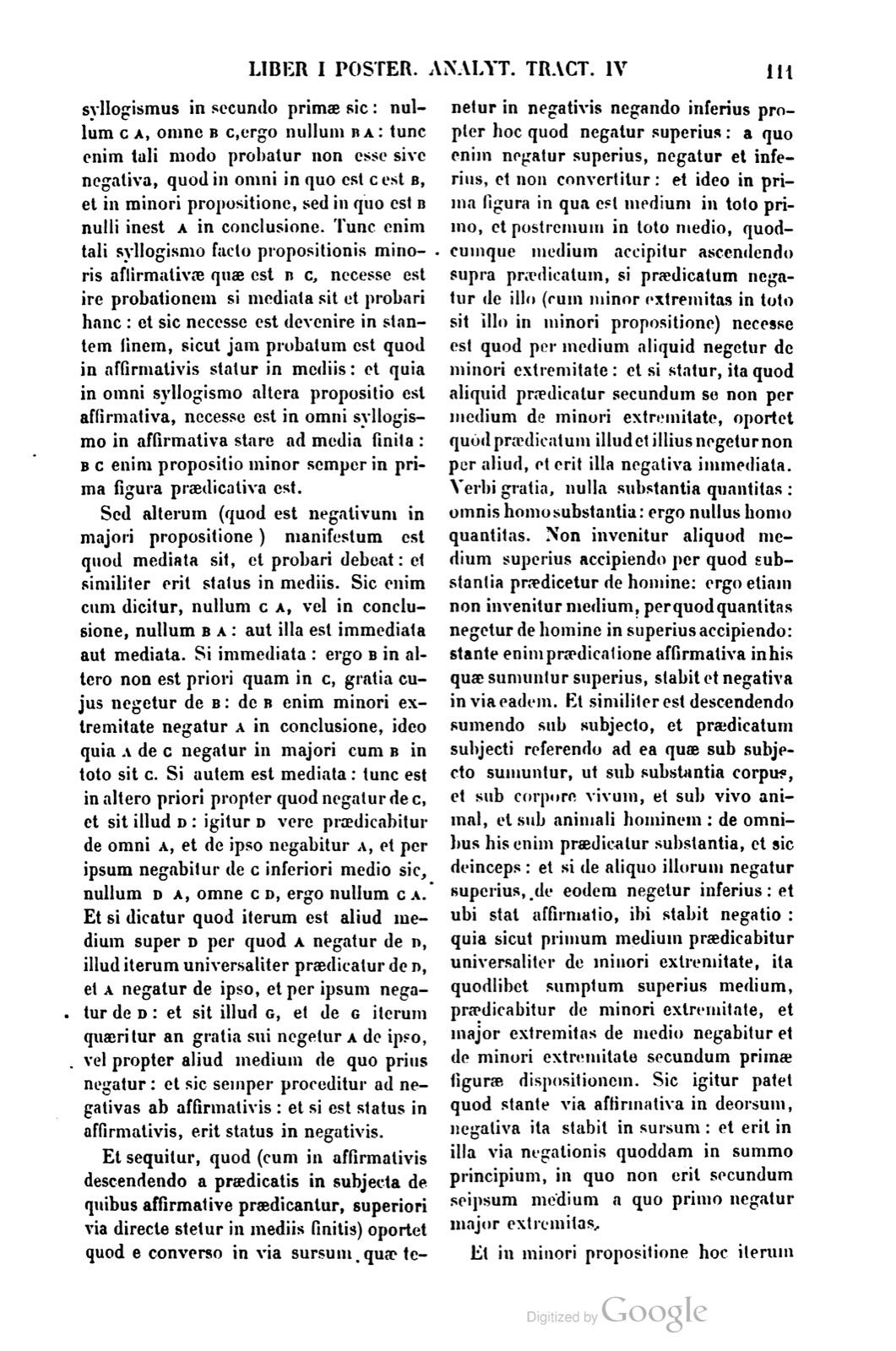
Sed alterum (quod est negativum in majori propositione) manifestum est quod mediata sit, et probari debeat: et similiter erit status in mediis. Sic enim cum dicitur, nullum C A, vel in conclusione, nullum B A: aut illa est immediata aut mediata. Si immediata: ergo B in altero non est priori quam in C, gratia cujus negetur de B: de B enim minori extremitate negatur A in conclusione, ideo quia A de C negatur in majori cum B in toto sit C. Si autem est mediata: tunc est in altero priori propter quod negatur de C, et sit illud D: igitur D vere praedicabitur de omni C, et de ipso negabitur A, et per ipsum negabitur de C inferiori medio sic, nullum D A, omne C D, ergo nullum C A. Et si dicatur quod iterum est aliud medium super D per quod A negatur de D, illud iterum universaliter praedicatur de D, et A negatur de ipso, et per ipsum negatur de D: et sit illud G, et de G iterum quaeritur an gratia sui negetur A de ipso, vel propter aliud medium de quo prius negatur: et sic semper proceditur ad negativas ab affirmativis: et si est status in affirmativis, erit status in negativis.
Et sequitur, quod (cum in affirmativis descendendo a praedicatis in subjecta de quibus affirmative praedicantur, superiori via directe stetur in mediis finitis) oportet quod e converso in via sursum quae tenetur in negativis negando inferius propter hoc quod negatur superius: a quo enim negatur superius, negatur et inferius, et non convertitur: et ideo in prima figura in qua est medium in toto primo, et postremum in toto medio, quodcumque medium accipitur ascendendo supra praedicatum, si praedicatum negatur de illo (cum minor extremitas in toto sit illo in minori propositione) necesse est quod per medium aliquid negetur de minori extremitate: et si statur, ita quod aliquid praedicatur secundum se non per medium de minori extremitate, oportet quod praedicatum illud et illius negetur non per aliud, et erit illa negativa immediata. Verbi gratia, nulla substantia quantitas: omnis homo substantia: ergo nullus homo quantitas. Non invenitur aliquod medium superius accipiendo per quod substantia praedicetur de homine: ergo etiam non invenitur medium, per quod quantitas negetur de homine in superius accipiendo: stante enim praedicatione affirmativa in his quae sumuntur superius, stabit et negativa in via eadem. Et similiter est descendendo sumendo sub subjecto, et praedicatum subjecti referendo ad ea quae sub subjecto sumuntur, ut sub substantia corpus, et sub corpore vivum, et sub vivo animal, et sub animali hominem: de omnibus his enim praedicatur substantia, et sic deinceps: et si de aliquo illorum negatur superius, de eodem negetur inferius: et ubi stat affirmatio, ibi stabit negatio: quia sicut primum medium praedicabitur universaliter de minori extremitate, ita quodlibet sumptum superius medium, praedicabitur de minori extremitate, et major extremitas de medio negabitur et de minori extremitate secundum primae figurae dispositionem. Sic igitur patet quod stante via affirmativa in deorsum, negativa ita stabit in sursum: et erit in illa via negationis quoddam in summo principium, in quo non erit secundum seipsum medium a quo primo negatur major extremitas.
But the other, which is the negative in the major proposition, is manifestly mediate and ought to be proved; and similarly there will be a stand in the middles. For when it is said, no C is A, or in the conclusion, no B is A, either that proposition is immediate or mediate. If it is immediate, therefore B is not in another prior thing than in C, for the sake of which it is denied of B; for A is denied of B, the minor extreme, in the conclusion, because A is denied of C in the major while B is in the whole of C. But if it is mediate, then it is in another prior thing on account of which it is denied of C, and let that be D. Therefore D will truly be predicated of every C, and A will be denied of it, and through it A will be denied of C the inferior middle thus: no D is A; every C is D; therefore no C is A. And if it is said that again there is another middle above D through which A is denied of D, that in turn is predicated universally of D, and A is denied of it, and through it A is denied of D; and let that be G, and concerning G again it is asked whether A is denied of it for its own sake, or on account of another middle of which it is denied before. And in this way one always proceeds to negatives from affirmatives; and if there is a stand in affirmatives, there will be a stand in negatives.
And it follows that, since in affirmatives, by descending from predicates into subjects of which they are affirmatively predicated, one stands directly by the superior way in finite middles, conversely it must be so in the upward way which is held in negatives, by denying the inferior on account of this, that the superior is denied. For that from which the superior is denied, the inferior also is denied, and it is not converted. And therefore in the first figure, in which the middle is in the whole of the first and the last is in the whole of the middle, whatever middle is accepted by ascending above the predicate, if the predicate is denied of it, since the minor extreme is in the whole of it in the minor proposition, it is necessary that through the middle something be denied of the minor extreme. And if there is a stand, so that something is predicated according to itself and not through a middle of the minor extreme, it is necessary that that predicate, and the predicate of that, be denied not through another; and that negative will be immediate. For example: no substance is quantity; every man is substance; therefore no man is quantity. No middle is found, by accepting a higher one, through which substance is predicated of man; therefore neither is there found a middle through which quantity is denied of man by accepting upward. For when the affirmative predication stands in those things which are taken as higher, the negative too will stand in the same way. And it is similar in descending by taking beneath the subject and referring the predicate of the subject to those things which are taken under the subject, as under substance, body, and under body, living, and under living, animal, and under animal, man. For substance is predicated of all these, and so on; and if a superior is denied of any one of those, an inferior is denied of the same one. And where affirmation stands, there negation will stand, because just as the first middle will be predicated universally of the minor extreme, so any middle taken higher will be predicated of the minor extreme, and the major extreme will be denied of the middle and of the minor extreme according to the disposition of the first figure. Thus, therefore, it is clear that, when the affirmative way stands downward, the negative will so stand upward; and in that way of negation there will be a certain principle in the highest, in which there will not be, according to itself, a middle from which the major extreme is first denied.
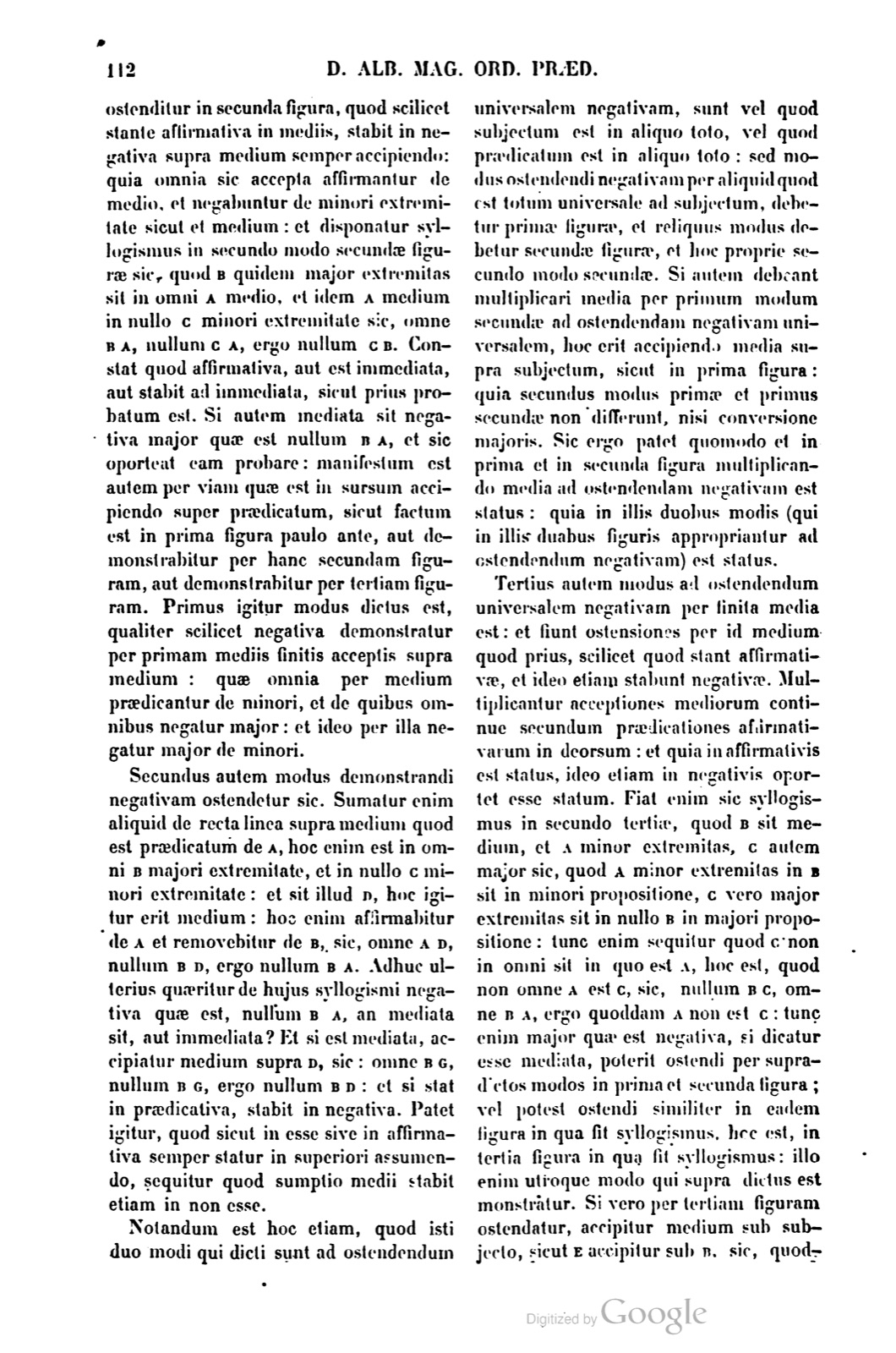
Et in minori propositione hoc iterum ostenditur in secunda figura, quod scilicet stante affirmativa in mediis, stabit in negativa supra medium semper accipiendo: quia omnia sic accepta affirmantur de medio, et negabuntur de minori extremitate sicut et medium: et disponatur syllogismus in secundo modo secundae figurae sic, quod B quidem major extremitas sit in omni A medio, et idem A medium in nullo C minori extremitate sic, omne B A, nullum C A, ergo nullum C B. Constat quod affirmativa, aut est immediata, aut stabit ad immediata, sicut prius probatum est. Si autem mediata sit negativa major quae est nullum B A, et sic oporteat eam probare: manifestum est autem per viam quae est in sursum accipiendo super praedicatum, sicut factum est in prima figura paulo ante, aut demonstrabitur per hanc secundam figuram, aut demonstrabitur per tertiam figuram. Primus igitur modus dictus est, qualiter scilicet negativa demonstratur per primam mediis finitis acceptis supra medium: quae omnia per medium praedicantur de minori, et de quibus omnibus negatur major: et ideo per illa negatur major de minori.
Secundus autem modus demonstrandi negativam ostendetur sic. Sumatur enim aliquid de recta linea supra medium quod est praedicatum de A, hoc enim est in omni B majori extremitate, et in nullo C minori extremitate: et sit illud D, hoc igitur erit medium: hoc enim affirmabitur de A et removebitur de B, sic, omne A D, nullum B D, ergo nullum B A. Adhuc ulterius quaeritur de hujus syllogismi negativa quae est, nullum B A, an mediata sit, aut immediata? Et si est mediata, accipiatur medium supra D, sic: omne B G, nullum B G, ergo nullum B D: et si stat in praedicativa, stabit in negativa. Patet igitur, quod sicut in esse sive in affirmativa semper statur in superiori assumendo, sequitur quod sumptio medii stabit etiam in non esse.
Notandum est hoc etiam, quod isti duo modi qui dicti sunt ad ostendendum universalem negativam, sunt vel quod subjectum est in aliquo toto, vel quod praedicatum est in aliquo toto: sed modus ostendendi negativam per aliquid quod est totum universale ad subjectum, debetur primae figurae, et reliquus modus debetur secundae figurae, et hoc proprie secundo modo secundae. Si autem debeant multiplicari media per primum modum secundae ad ostendendam negativam universalem, hoc erit accipiendo media supra subjectum, sicut in prima figura: quia secundus modus primae et primus secundae non differunt, nisi conversione majoris. Sic ergo patet quomodo et in prima et in secunda figura multiplicando media ad ostendendam negativam est status: quia in illis duobus modis (qui in illis duabus figuris appropriantur ad ostendendum negativam) est status.
And this is again shown in the minor proposition in the second figure, namely that, when the affirmative stands in the middles, the negative will stand by always accepting above the middle, because all things so accepted are affirmed of the middle and will be denied of the minor extreme just as also the middle is. And let the syllogism be disposed in the second mode of the second figure thus: let B indeed be the major extreme in every A, the middle, and let the same A, the middle, be in no C, the minor extreme, thus: every B is A; no C is A; therefore no C is B. It is agreed that the affirmative is either immediate or will stand at immediate things, as was proved before. But if the negative major, which is no B is A, is mediate, and thus it is necessary to prove it, then it is manifest either through the way which is in ascending by accepting above the predicate, as was done a little before in the first figure, or it will be demonstrated through this second figure, or it will be demonstrated through the third figure. Therefore the first mode has been stated, namely how the negative is demonstrated through the first figure, with finite middles accepted above the middle, all of which are predicated of the minor through the middle, and of all of which the major is denied; and therefore through those the major is denied of the minor.
But the second mode of demonstrating the negative will be shown thus. Let something be taken from the straight line above the middle which is the predicate of A, for this is in every B the major extreme and in no C the minor extreme; and let that be D. Therefore this will be the middle, for this will be affirmed of A and removed from B, thus: every A is D; no B is D; therefore no B is A. Further still, concerning the negative of this syllogism, which is no B is A, it is asked whether it is mediate or immediate. And if it is mediate, let a middle be accepted above D thus: every B is G; no B is G; therefore no B is D; and if there is a stand in the predicative, there will be a stand in the negative. Therefore it is clear that, just as in being or in the affirmative one always stands by assuming a superior, it follows that the taking of a middle will also stand in not-being.
This also must be noted, that those two modes which have been stated for showing a universal negative are either because the subject is in some whole, or because the predicate is in some whole. But the mode of showing a negative through something which is a universal whole in relation to the subject is owed to the first figure, and the remaining mode is owed to the second figure, and this properly to the second mode of the second. But if the middles must be multiplied through the first mode of the second figure for showing a universal negative, this will be by accepting middles above the subject, as in the first figure, because the second mode of the first and the first of the second do not differ except by conversion of the major. Thus, therefore, it is clear how, both in the first and in the second figure, in multiplying middles for showing the negative, there is a stand, because in those two modes which are appropriated in those two figures for showing the negative, there is a stand.
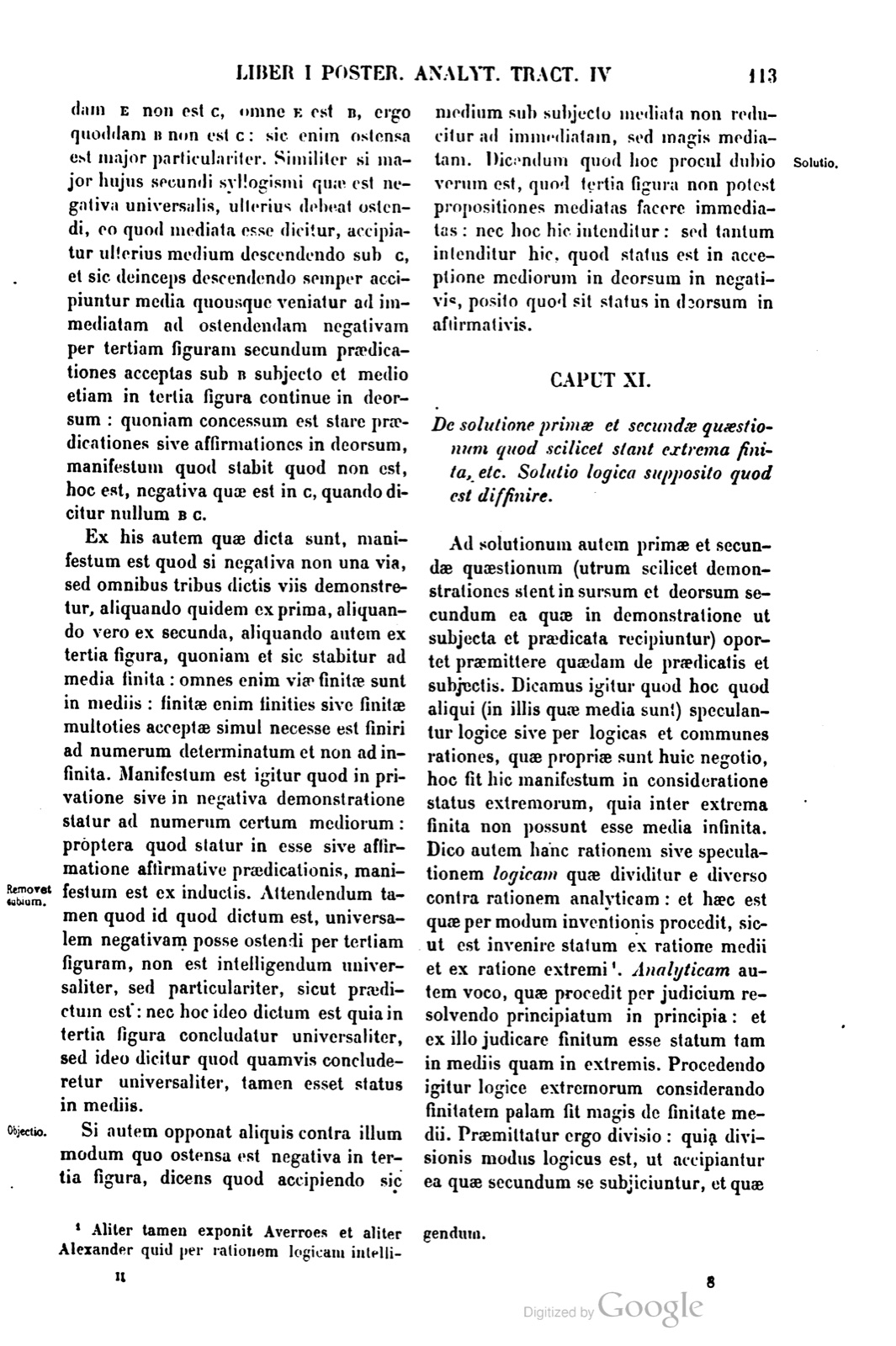
Tertius autem modus ad ostendendum universalem negativam per finita media est: et fiunt ostensiones per id medium quod prius, scilicet quod stant affirmativae, et ideo etiam stabunt negativae. Multiplicantur acceptiones mediorum continue secundum praedicationes affirmativarum in deorsum: et quia in affirmativis est status, ideo etiam in negativis oportet esse statum. Fiat enim sic syllogismus in secundo tertiae, quod B sit medium, et A minor extremitas, C autem major sic, quod A minor extremitas in B sit in minori propositione, C vero major extremitas sit in nullo B in majori propositione: tunc enim sequitur quod C non in omni sit in quo est A, hoc est, quod non omne A est C, sic, nullum B C, omne B A, ergo quoddam A non est C: tunc enim major quae est negativa, si dicatur esse mediata, poterit ostendi per supradictos modos in prima et secunda figura; vel potest ostendi similiter in eadem figura in qua fit syllogismus, hoc est, in tertia figura in qua fit syllogismus: illo enim utroque modo qui supra dictus est monstratur. Si vero per tertiam figuram ostendatur, accipitur medium sub subjecto, sicut E accipitur sub B, sic, quoddam E non est C, omne E est B, ergo quoddam B non est C: sic enim ostensa est major particulariter. Similiter si major hujus secundi syllogismi quae est negativa universalis, ulterius debeat ostendi, eo quod mediata esse dicitur, accipiatur ulterius medium descendendo sub C, et sic deinceps descendendo semper accipiuntur media quousque veniatur ad immediatam ad ostendendam negativam per tertiam figuram secundum praedicationes acceptas sub B subjecto et medio etiam in tertia figura continue in deorsum: quoniam concessum est stare praedicationes sive affirmationes in deorsum, manifestum quod stabit quod non est, hoc est, negativa quae est in C, quando dicitur nullum B C.
Ex his autem quae dicta sunt, manifestum est quod si negativa non una via, sed omnibus tribus dictis viis demonstretur, aliquando quidem ex prima, aliquando vero ex secunda, aliquando autem ex tertia figura, quoniam et sic stabitur ad media finita: omnes enim viae finitae sunt in mediis: finitae enim finities sive finitae multoties acceptae simul necesse est finiri ad numerum determinatum et non ad infinita. Manifestum est igitur quod in privatione sive in negativa demonstratione statur ad numerum certum mediorum: propterea quod statur in esse sive affirmatione affirmativae praedicationis, manifestum est ex inductis. Attendendum tamen quod id quod dictum est, universalem negativam posse ostendi per tertiam figuram, non est intelligendum universaliter, sed particulariter, sicut praedictum est: nec hoc ideo dictum est quia in tertia figura concludatur universaliter, sed ideo dicitur quod quamvis concluderetur universaliter, tamen esset status in mediis.
Si autem opponat aliquis contra illum modum quo ostensa est negativa in tertia figura, dicens quod accipiendo sic medium sub subjecto mediata non reducitur ad immediatam, sed magis mediatam. Dicendum quod hoc procul dubio verum est, quod tertia figura non potest propositiones mediatas facere immediatas: nec hoc hic intenditur: sed tantum intenditur hic, quod status est in acceptione mediorum in deorsum in negativis, posito quod sit status in deorsum in affirmativis.
But the third mode for showing a universal negative through finite middles is this: and the showings are made through the same middle as before, namely because affirmatives stand, and therefore negatives too will stand. The acceptances of middles are multiplied continuously according to the predications of affirmatives downward; and because in affirmatives there is a stand, therefore in negatives also there must be a stand. For let a syllogism be made thus in the second mode of the third figure, that B is the middle, A the minor extreme, but C the major, in such a way that A the minor extreme is in B in the minor proposition, but C the major extreme is in no B in the major proposition. For then it follows that C is not in every thing in which A is, that is, that not every A is C, thus: no B is C; every B is A; therefore some A is not C. For then the major, which is negative, if it is said to be mediate, can be shown through the aforesaid modes in the first and second figure; or it can similarly be shown in the same figure in which the syllogism is made, that is, in the third figure in which the syllogism is made. For it is shown in both those ways which were stated above. But if it is shown through the third figure, a middle is accepted under the subject, as E is accepted under B, thus: some E is not C; every E is B; therefore some B is not C. For in this way the major has been shown particularly. Similarly, if the major of this second syllogism, which is a universal negative, ought to be shown further, because it is said to be mediate, let a further middle be accepted by descending under C; and so thereafter, by descending, middles are always accepted until one comes to an immediate proposition for showing the negative through the third figure according to predications accepted under B, the subject and also the middle, continuously in the third figure downward. Since it has been conceded that predications or affirmations stand downward, it is manifest that what is not, that is, the negative which is in C, will stand when it is said, no B is C.
But from those things which have been said, it is manifest that, if the negative is demonstrated not in one way but in all the three stated ways, at one time indeed from the first, at another time from the second, and at another time from the third figure, since in this way too there will be a stand at finite middles; for all the ways are finite in middles. For finite things finitely, or finite things accepted many times together, must necessarily be bounded to a determinate number and not to infinite things. Therefore it is manifest that in privation or in negative demonstration one stands at a certain number of middles, because one stands in being or affirmation of affirmative predication; this is manifest from the things introduced. Yet attention must be given that what has been said, that a universal negative can be shown through the third figure, must not be understood universally, but particularly, as has been said before. Nor was this said for the reason that in the third figure something is concluded universally, but it is said for this reason, that even if it were concluded universally, nevertheless there would be a stand in the middles.
But if someone objects against that mode by which the negative has been shown in the third figure, saying that by accepting the middle thus under the subject, the mediate is not reduced to the immediate but rather to the mediate, one must say that this without doubt is true: the third figure cannot make mediate propositions immediate, nor is this intended here. But only this is intended here, that there is a stand in the acceptance of middles downward in negatives, when it has been posited that there is a stand downward in affirmatives.
If a page does not appear, its photograph has not been uploaded yet.