Works › Posterior Analytics, Books I–II
Volume 2 · pp. 117–118
Treatise IV, Chapter XII. That One Stands In The Highest And Lowest If Knowing Through Demonstrations Is Supposed
A marker with ≈ is an approximate page boundary, placed by measure of the text; the page photographs remain the authority. In the paired views, clicking a page marker brings that page into view.
Quod statur in summo et infimo si scire per demonstrationes supponatur.
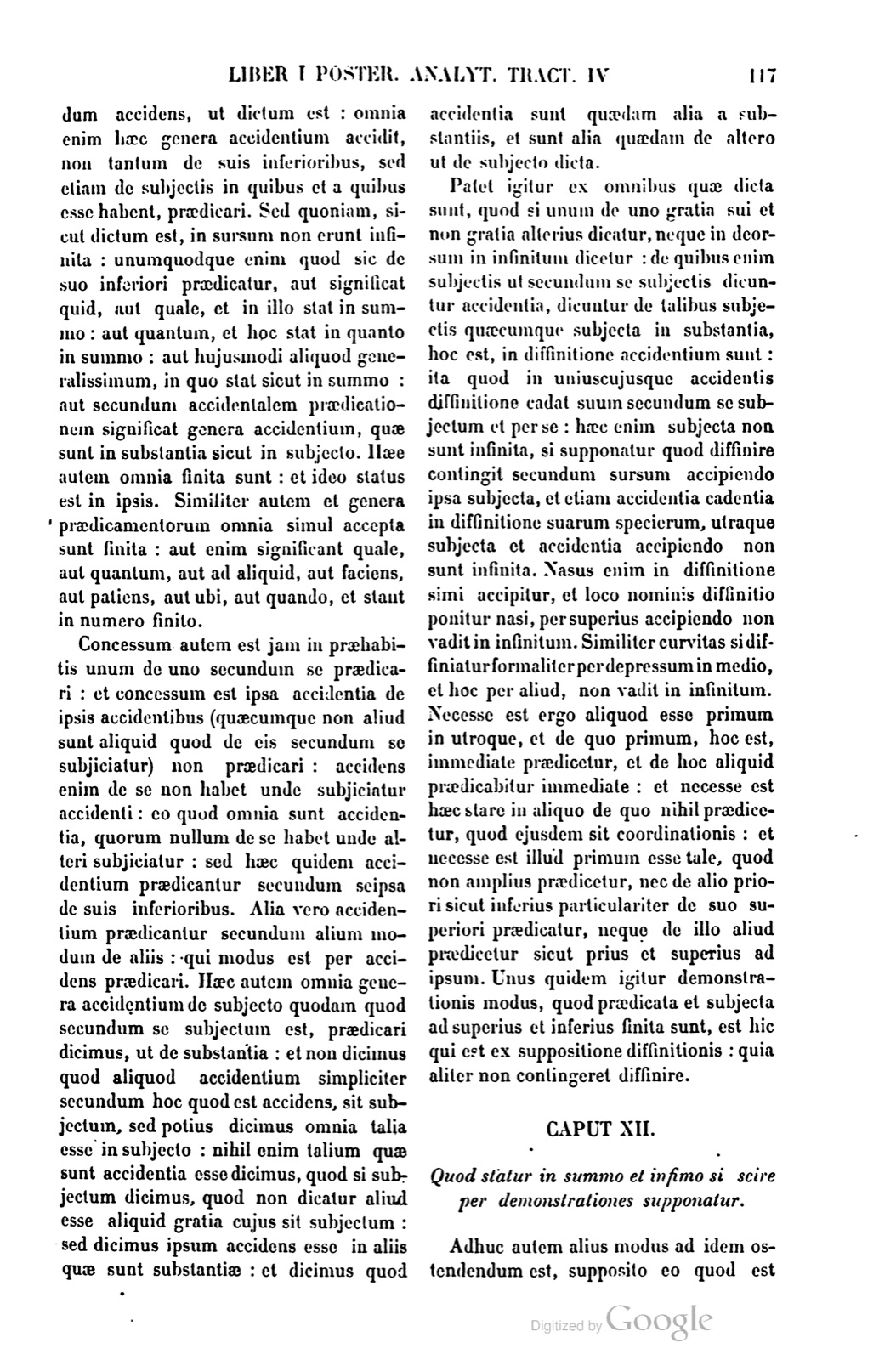
Adhuc autem alius modus ad idem ostendendum est, supposito eo quod est scire per demonstrationem. Si enim erit demonstratio de subjectis, de quibus quaedam passiones demonstrantur quae scire faciunt: tunc aliquod potius, hoc est, potiorem aliquem habitum ad ipsa concipienda habebimus quam scientiam factam per demonstrationem, ut dicit cavillator, hoc est, de his mediis et propositionibus sive per haec, alia quaedam priora praedicantur, per quae illorum fit demonstratio: neque aliqui possunt ad illa principia quae praedicantur de mediis et propositionibus demonstrationis concipienda aliquid habere potius, hoc est, potiorem habitum quam scire scientiae factae per demonstrationem, eo quod scire, ut dicit cavillator, non est per demonstrationem. Si autem hoc est, hoc est conclusio, per hoc principium notum est hoc quod est principium, ut dicit cavillator: et ad hoc sciendum, non habemus aliquid melius, hoc est, meliorem habitum quam scire per demonstrationem, neque per hoc quod est scire per demonstrationem hoc principium notum factum sciemus: tunc sequitur pro certo, quod aut nihil scimus nisi ex suppositione si prima vera sunt, aut omnium erit demonstratio, aut abibit in infinitum et nunquam stabit, neque in sursum, neque in deorsum. Si ergo, a destructione consequentis, est aliquid scire per demonstrationem, sicut in ante habitis probatum est: et non contingit vere scire ex aliquibus, hoc est, ex particularibus quae aliquando sunt et aliquando non sunt: neque est vere scire ex suppositione, ut dicatur conclusio esse vera si praemissae verae sunt: tunc manifestum est quod stant et finita sunt praedicamenta sive praedicata quae media sunt ad concludendum hanc vel illam conclusionem.
That there is a stand in the highest and in the lowest if knowing through demonstrations is supposed.
Moreover, there is still another mode for showing the same thing, with this supposed, namely that there is knowing through demonstration. For if there will be demonstration concerning subjects, concerning which certain properties are demonstrated which make one know, then, as the caviller says, we shall have something stronger, that is, some stronger habit for conceiving those very things, than science made through demonstration; that is, concerning these middles and propositions, or through these things, certain other prior things are predicated, through which demonstration of them is made. Nor can any persons have, for conceiving those principles which are predicated of the middles and propositions of demonstration, something stronger, that is, a stronger habit, than knowing with the knowledge of science made through demonstration, because knowing, as the caviller says, is not through demonstration. But if this is so, that is, if this is the conclusion, through this known principle that which is a principle is known, as the caviller says; and for knowing this we do not have something better, that is, a better habit, than knowing through demonstration, nor through the fact that there is knowing through demonstration shall we know this principle as having been made known. Then it follows with certainty that either we know nothing except from supposition, if the first things are true, or there will be demonstration of all things, or it will go away into infinity and never stand, neither upward nor downward. Therefore if, by destruction of the consequent, there is some knowing through demonstration, as was proved in the things had before, and it does not happen truly to know from certain things, that is, from particulars which sometimes are and sometimes are not, nor is there truly knowing from supposition, so that the conclusion is said to be true if the premises are true, then it is manifest that the predicaments or predicates which are middles for concluding this conclusion or that conclusion stand and are finite.
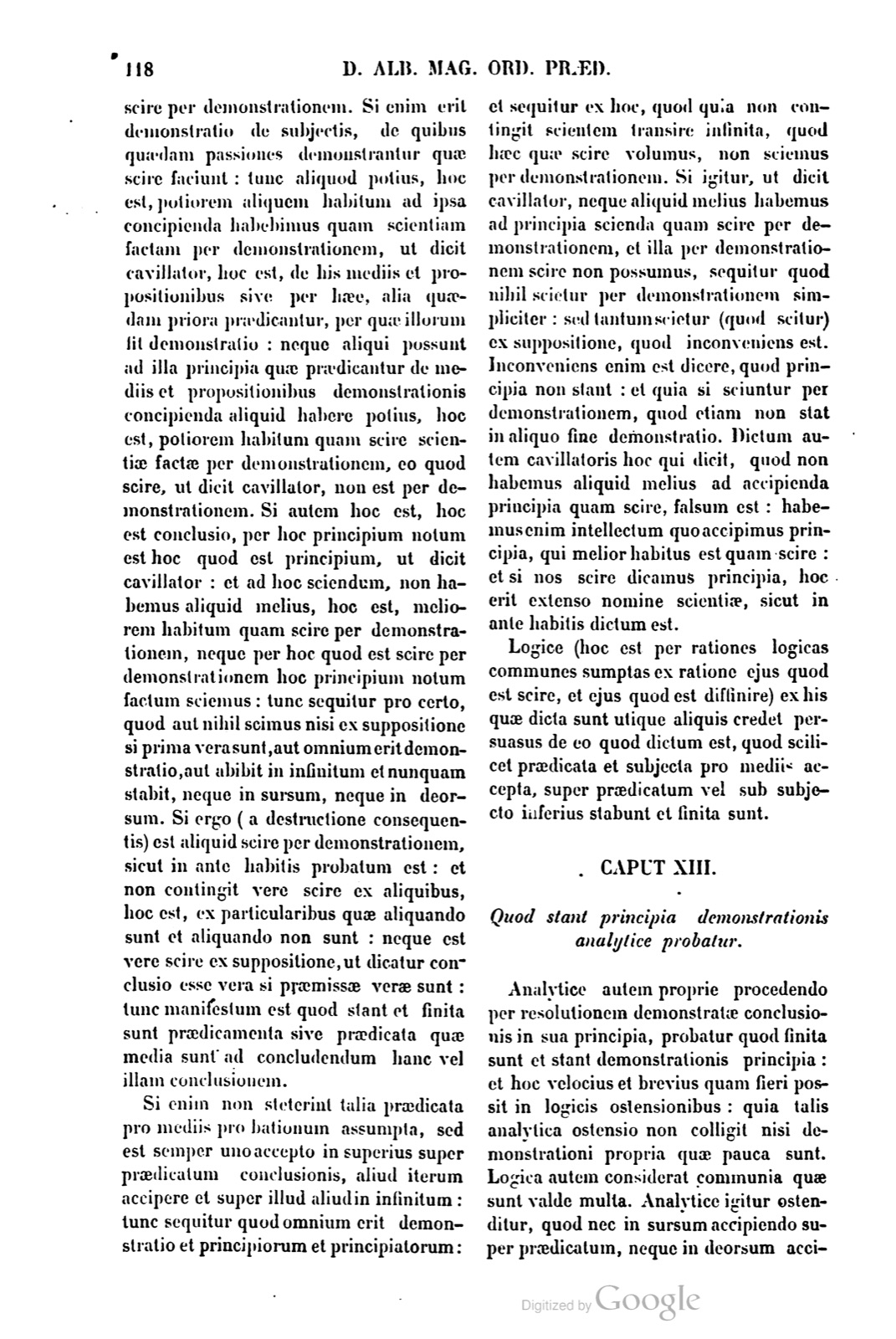
Si enim non steterint talia praedicata pro mediis probationum assumpta, sed est semper uno accepto in superius super praedicatum conclusionis, aliud iterum accipere et super illud aliud in infinitum: tunc sequitur quod omnium erit demonstratio et principiorum et principiatorum: et sequitur ex hoc, quod quia non contingit scientem transire infinita, quod haec quae scire volumus, non sciemus per demonstrationem. Si igitur, ut dicit cavillator, neque aliquid melius habemus ad principia scienda quam scire per demonstrationem, et illa per demonstrationem scire non possumus, sequitur quod nihil scietur per demonstrationem simpliciter: sed tantum scietur quod scitur ex suppositione, quod inconveniens est. Inconveniens enim est dicere, quod principia non stant: et quia si sciuntur per demonstrationem, quod etiam non stat in aliquo fine demonstratio. Dictum autem cavillatoris hoc qui dicit, quod non habemus aliquid melius ad accipienda principia quam scire, falsum est: habemus enim intellectum quo accipimus principia, qui melior habitus est quam scire: et si nos scire dicamus principia, hoc erit extenso nomine scientiae, sicut in ante habitis dictum est.
Logice, hoc est per rationes logicas communes sumptas ex ratione ejus quod est scire, et ejus quod est diffinire, ex his quae dicta sunt utique aliquis credet persuasus de eo quod dictum est, quod scilicet praedicata et subjecta pro mediis accepta, super praedicatum vel sub subjecto inferius stabunt et finita sunt.
For if such predicates, assumed as middles of proofs, have not stood, but there is always, when one has been accepted higher above the predicate of the conclusion, another again to accept, and above that another into infinity, then it follows that there will be demonstration of all things, both of principles and of things principled. And from this it follows that, because it does not happen that one who knows crosses infinite things, we shall not know through demonstration these things which we wish to know. Therefore if, as the caviller says, we neither have anything better for knowing principles than knowing through demonstration, and we cannot know those principles through demonstration, it follows that nothing will be known simply through demonstration, but only what is known will be known from supposition, which is unsuitable. For it is unsuitable to say both that principles do not stand, and that, if they are known through demonstration, demonstration also does not stand in some end. But this saying of the caviller, who says that we do not have something better for receiving principles than knowing, is false. For we have intellect, by which we receive principles, which is a better habit than knowing; and if we say that we know principles, this will be with the name of science extended, as was said in the things had before.
Logically, that is, through common logical arguments taken from the account of that which is to know and of that which is to define, from the things which have been said someone will indeed believe, having been persuaded concerning that which has been said, namely that predicates and subjects accepted as middles, above the predicate or beneath the subject lower down, will stand and are finite.
If a page does not appear, its photograph has not been uploaded yet.