WELL, or Spring. There is frequent mention of Wells in Scripture, and under this Name Fountains are generally understood, whose Source proceeds out of the Ground, and bubbles up as from the bottom of a Well. Such is the Well spoke of by the Spouse in the Canticles; A Fountain of Gardens, a well of living waters, Cant. iv. 15.and streams from Lebanon. About a League from Tyre they shew a Well of living Water,which they pretend to be the same that the Spouse here describes. Jacob’sJohn iv. 6. Well was neat Shechem, or Sychar, and is sometimes also called the Fountain of Jacob.
Gen. xiv. 10.Heretofore in the Plain or Vale of Siddim, or Sodom, that is, in the Plain now possessed by the Lake of Sodom, there were great numbers of Slime-pits, or Wells of Bitumen, from whence they took Pitch and Bitumen, which is still found in the same Waters of the Lake of Asphaltites.
Gen. xvi. 14.Moses also speaks of the Well called Beer-lahai-roi, or the Well of the Living and Seeing, which is between Kadesh and Bered, and which the Angel shew’d to Hagar in the Wilderness, to quench the Thirst of her Son Ishmael, who was in great danger of dying with Thirst. In that Country, where Water was very scarce, they used to hide their Wells by covering their Mouths with Sand, that Strangers might not see them, nor draw Water from them. Sometimes there has been great quarelling and fighting among the Shepherds, and the Country-people, Genesis xxvi. 15, 20, 21, 32.on account of a Well. See in Genesis, the Contests that arose between the People belonging to Abimelech King of Gerar, and those of Isaac, on the same account.
At Askalon they shew Travellers certain Wells,1 of an admirable Structure, which they pretend to have been built by Abraham and Isaac.
And the Well of Jacob near the City of Shechem, where our Saviour had his John iv. 6.Conversation with the Woman of Samaria. Afterwards they built a Church upon this Fountain: And St. Jerome2 takes notice of it in his Letter called, The Epitaph of St. Paula. Antoninus Martyr saw it afterwards in the sixth Century; Adamnanus in the seventh, and Villibaldus in the eighth.3
The Hebrews call a Well, Beer;4
whence it is that this Word is often found compounded with proper Names: For example, Beer-sheba, Beeroth-bene-jakan, Beeroth, Beerah, &c. which may be seen under their several Articles.
Those that have seen the Wells that are still to be found in the Desarts of Arabia,5 say, that these Wells or Basins are nearly of the same Form. They are Wells dug into the Rock, the Mouths of which are about eighteen Palms, or six Feet in Diameter, and from nineteen to twenty Feet in Depth. Some have affirmed that they made use of the Compass to find them out; because in this Country there are neither Cities nor High-ways, nor any other Land-marks by which they may be found, without a long and constant Acquaintance with them. So that none but the native Arabs of the Country, or those that have been a long time Slaves among them, can discover them. They generally go to ‘em only in the Night-time, because of the Danger of being met by the Arabs; and besides, they must make haste to fill their Vessels, for fear of interrupting some Company that may come after them, with whom they would be obliged to battel it. The Water of these Wells is very clear, and so cool, that they dare not drink it alone. They mingle Wine with it; but it is soon warm in a Climate so hot as this is. It is observed, that it grows sowre as soon as it is carried out of these Desarts, and when they enter into Egypt or India; but it comes to itself again, as soon as it is brought back into its own Climate. Sometimes the Arabians, out of Malice, fill up the Wells, by throwing Sand into them, and sometimes they destroy the Springs, or infect the Waters, by throwing Carrion into them, that they may hinder the Caravans from taking their Supplies of Water from hence.
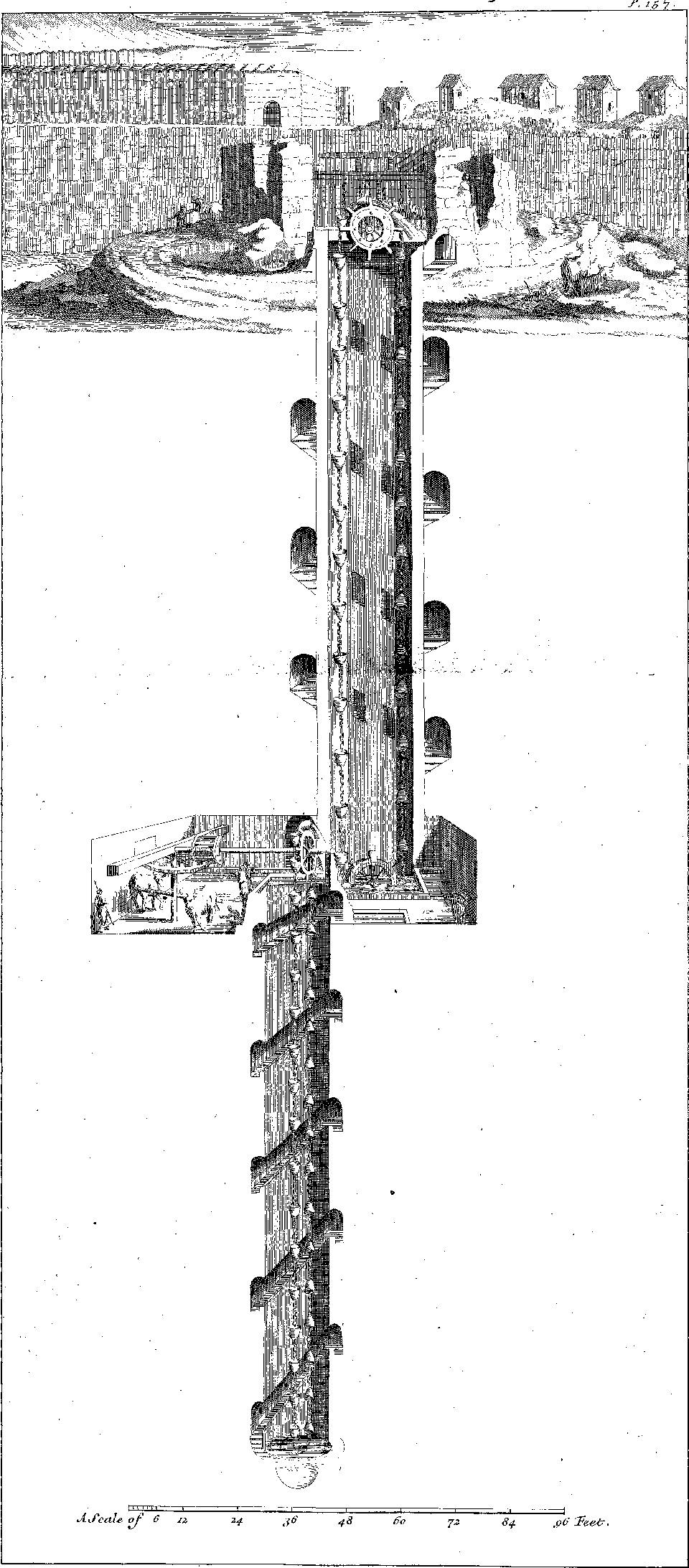
Our Travellers speak with great Admiration of Joseph’s Well, which is still to be seen at Cairo. The Mahometans make no doubt, but that it is the Work of the Patriarch Joseph. It is of an admirable Structure; and it must have cost vast Expences, and an infinite deal of Time in building. a Its whole Depth is as it were divided into two Parts: They go down from the Top about half way by a Stair-case, which winds round the Cavity, and is hewn into the Rock. By this Stair-case they let down the Oxen upon a Platform, from whence they raise the Waters by means of a Wheel, and long Chains, to which are fixed leathern Vessels, that fill and empty themselves alternately, as the Wheel goes round. The Water is drawn up at two different Times, by means of two Wheels placed one upon another. The lowest of them empties the Water into a Reservoir, from whence the second raises it up, and brings it to the Top of the Well.
The Mouth of the Well is about eighteen Feet wide, and twenty-four long; its Depth is two hundred and seventy-six Feet. The Second Part of the Well, or that which is lowest, is but fifteen Foot long, and nine wide. The Stair-case by which the Oxen go down, and which winds about from the top of the Well to the bottom, is six foot wide, and nine
a Paul Lucas, 3 Voiage, t. 2. p. 126.
Foot high. The whole is cut so nicely, that the Rock, which serves as a Rampart to this Descent, is but half a foot thick towards the Well. There are Windows from Space to Space, which let in Light to the Stair-case, and this Light comes from the Mouth of the Well.
At the second Part of the Well, which is not so wide as the former, there is also seen a Gallery, or Stair-case, of the same Figure as the former, but neither so wide nor so high. It is but four foot wide, and six foot high, and has no Parapet on the side, which makes the Descent very dangerous. The Basin, or Source of Water at the bottom of the Well, is not above eight or nine foot deep. The Water tastes a little brackish, for which Reason it is not drunk but out of necessity, and when the Castle or Well are besieged.
They speak also of another Well of Joseph’s, which they think to be that into Saadi. Bibl. Orient.which he was cast by his Brethren. It is shewn upon the Road from Damascus to Jerusalem, ten or twelve Miles from the Land of Canaan. The Mahometans have built a Mosque there, in memory of this Event. But the Situation of this Place is too far distant from Dothaim, where he went to seek his Brethren.
Read this article in its place on the printed pages