TRIBE. Jacob having twelve Sons, who were the Heads of so many great Families, which all together formed a great Nation; every one of these Families was called a Tribe. But Jacob on his Death-bed adopted Ephraim and Manasseh, the Sons of Joseph, and would have them also to constitute two Tribes of Israel. Instead of twelve Tribes, there were now thirteen, that of Joseph being divided into1two. However, in the Distribution of Lands to the People made by Joshua, by the Order of God, they counted but twelve Tribes, and made but twelve Lots. For the Tribe of Levi, which was appointed to the Service of the Tabernacle of the Lord, had no share in the Distribution of the Land, but only some Cities to dwell in, and the first Fruits, Tythes, and Oblations of the People, which was all their Subsistance.
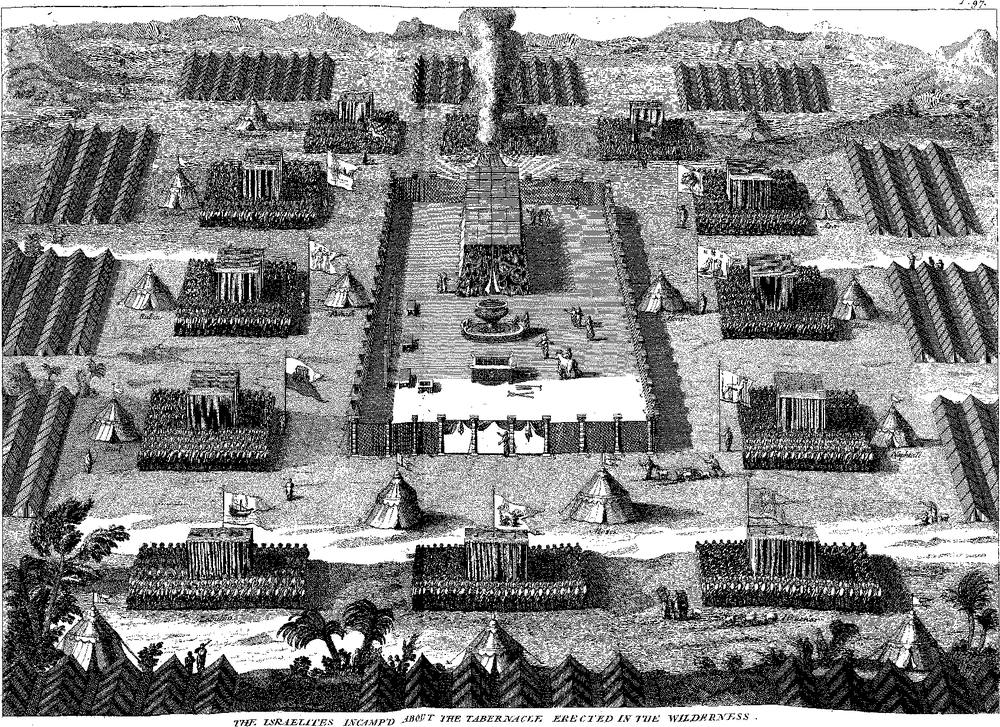
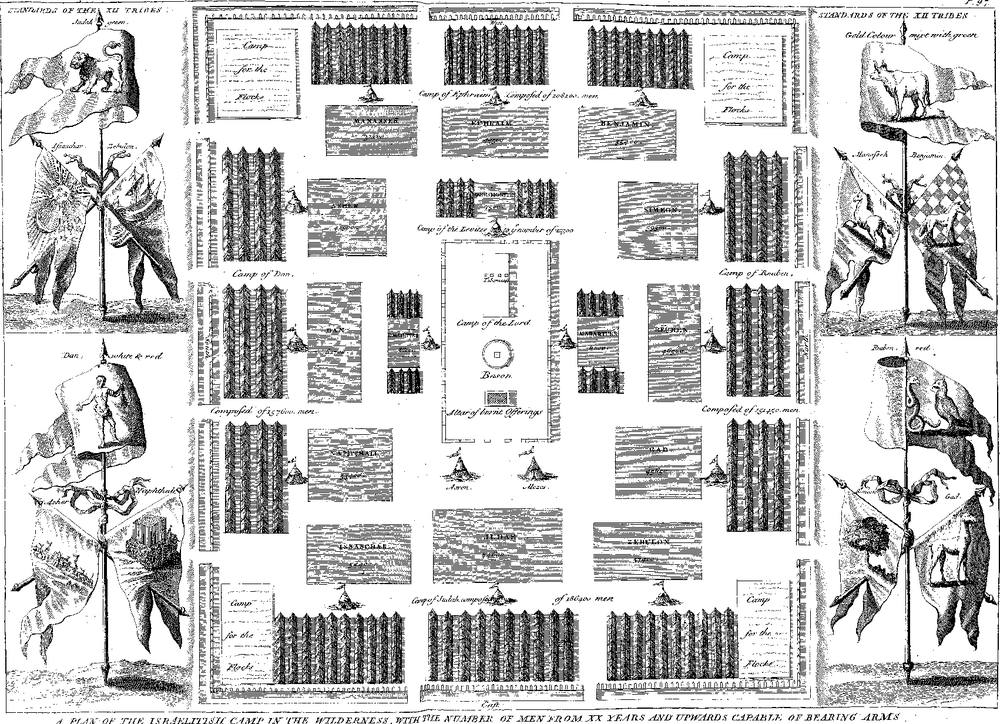
The twelve Tribes, while they were in the Desart, encamped round about the Tabernacle of the Covenant, every one according to its Order. To the East were those of Judah, Zebulun, and Issachar: To the West were Ephraim, Manasseh, and Benjamin: To the South, Reuben, Simeon, and Gad: And to the North were Dan, Asher, and Naphthali. The Levites were distributed round about the Tabernacle, nearer the Holy Place than the other Tribes; so that Moses and Aaron, with their Families, were to the East, Gershom to the West, Kohath to the South, and Merari to the North.
In the Marches of the Army of Israel, the twelve Tribes were divided into four great Bodies, each composed of three Tribes. The first Body, which was the Front of the Army, was made up of the Tribes of Judah, Issachar, and Zebulun: The second was composed of Reuben, Simeon, and Gad. Between the second and third Body of Troops, came the Levites and Priests, with the Ark of the Lord, the Curtain, the Planks, the Pillars, and all the other Furniture of the Tabernacle.
The third Body of the Army of Israel was composed of the Tribes of Ephraim, Manasseh, and Benjamin. The fourth, and last, which brought up the Rear, was made up of the Tribes of Dan, Asher, and Naphthali.
In the Division made by Joshua of the Land of Canaan to the Tribes of Israel, Reuben, Gad, and half of the Tribe of Manasseh, had their Lot beyond Jordan: All the other Tribes, and the other Half of that of Manasseh, had their Distribution on this side the River. Under the Title of each of the twelve Tribes, we have given the History of the Patriarch who was the Head of it, and set down the Particulars relating to his Tribe, their Portion, Adventures, &c. So that the Reader may consult the several Articles of JUDAH, SIMEON, LEVI, BENJAMIN, DAN, EPHRAIM, MANASSEH, REUBEN, GAD, ASHER, ZEBULUN, ISSACHAR, and NAPHTHALI.
The twelve Tribes continued united under one Head, making but one State, one People, and one Monarchy, till after the Death of Solomon. Then ten of the Tribes of Israel revolted from the House of David, and received for their King Jeroboam, the Son of Nebat; and only the Tribes of Judah and Benjamin continued under the Government of Reboboam. This Separation may be looked upon as the chief Cause of those great Misfortunes that afterwards happened to those two Kingdoms, and to the whole Hebrew Nation. For, first, it was the Cause of the Alteration and Change of the old Religion, and of the ancient Worship of their Forefathers. Jeroboam the Son of Nebat substituted the Worship of Golden Calves instead of the Worship of the Lord; which was the Occasion of the ten Tribes forsaking the Temple of the Lord. Secondly, This Schism caused an irreconcileable Hatred between the ten Tribes, and those of Judah and Benjamin, and created an infinite number of Wars and Disputes between them. The Lord being provoked, delivered them up to their Enemies. Tiglath-Pilneser first took away captive the Tribes of Reuben, Gad, Naphthali, and the Half Tribe of Manasseh which were beyond Jordan, and carried them beyond the Euphrates, in the Year of the World 3264, before Christ 736, 2 Kings xv. 29. 1 Chron. v. 26.before the Vulgar Æra 740.
Some Years after, Shalmaneser, King of Assyria, took the City of Samaria, destroyed it, took away the rest of the Inhabitants of Israel, carried them beyond the Euphrates, 2 King xvii. 6. xviii. 10, 11.and sent other Inhabitants into the Country, to cultivate and possess it. Thus ended the Kingdom of the ten Tribes of Israel, in the Year of the World 3283, before Christ 717, before the Vulgar Æra 721. It has been a great Problem among the Fathers and Interpreters to determine whether these ten Tribes still continue in their Settlement beyond the Euphrates, or whether they returned again into their own Country. The greatest part are of opinion, that they never did return; but the contrary Opinion seems to have a better Foundation in Scripture, which in several Places promises the Return of these Tribes, and which represents all Palestine to us as well peopled by the Israelites of all the Tribes, long before the Coming of Christ. However, it must be owned, that this Return is not clearly made out by History, because it was performed by insensible Degrees, and was not so compleat and entire, but that a great number of Israelites still remained beyond the Euphrates; so that St. Peter addresses his First Epistle to the converted Jews that were dispersed in the Provinces of Pontus, of Cappadocia, Bythinia, Asia, &c. The Reader may see our Dissertation upon this Question, Whether or no the ten Tribes C c ever the Second Book of the Chronicles?
As to the Tribes of Judah and Benjamin, who remained under the Government of the Kings of the Family of David, they continued a much longer time in their own Country: But at last, after they had fulfill’d the Measure of their Iniquity, God delivered them up into the hands of their Enemies. Nebuchadnezzar took the City of Jerusalem, entirely ruined it, and burnt the Temple, and took away all the Inhabitants of Judah and Benjamin to Babylon, and to the other Provinces of his Empire.2 This happened in the Year of the World 3416, before Christ 584, before the Vulgar Æra 588.
The Captivity of Judah continued for seventy Years, as the Prophets had foretold Jerem. xxv. 11, 12. xxix. 10.them. The Beginning of it may be fixed in 3398, and the End in 3468, which is the first Year of Cyrus at Babylon. Or else, by putting the Beginning in the Year 3416, which is that of the taking of Jerusalem, and of its Destruction by Nebuchadnezzar, and the End in 3486, which is the Beginning of the Reign of Darius Son of Hystaspes, the Spouse of Queen Esther, and the Protector of the Jewish Nation. The Return of Judah is plainly assigned at the end of the Second Book of the Chronicles, 2 Chron. xxxvi. 20, 21, 22, 23.and in the Books of Ezra and Nehemiah. The Decree of Cyrus, which allows them to return into their County, is in the Year of the World 3468, before Christ 532, before the Vulgar Æra 536.
Read this article in its place on the printed pages