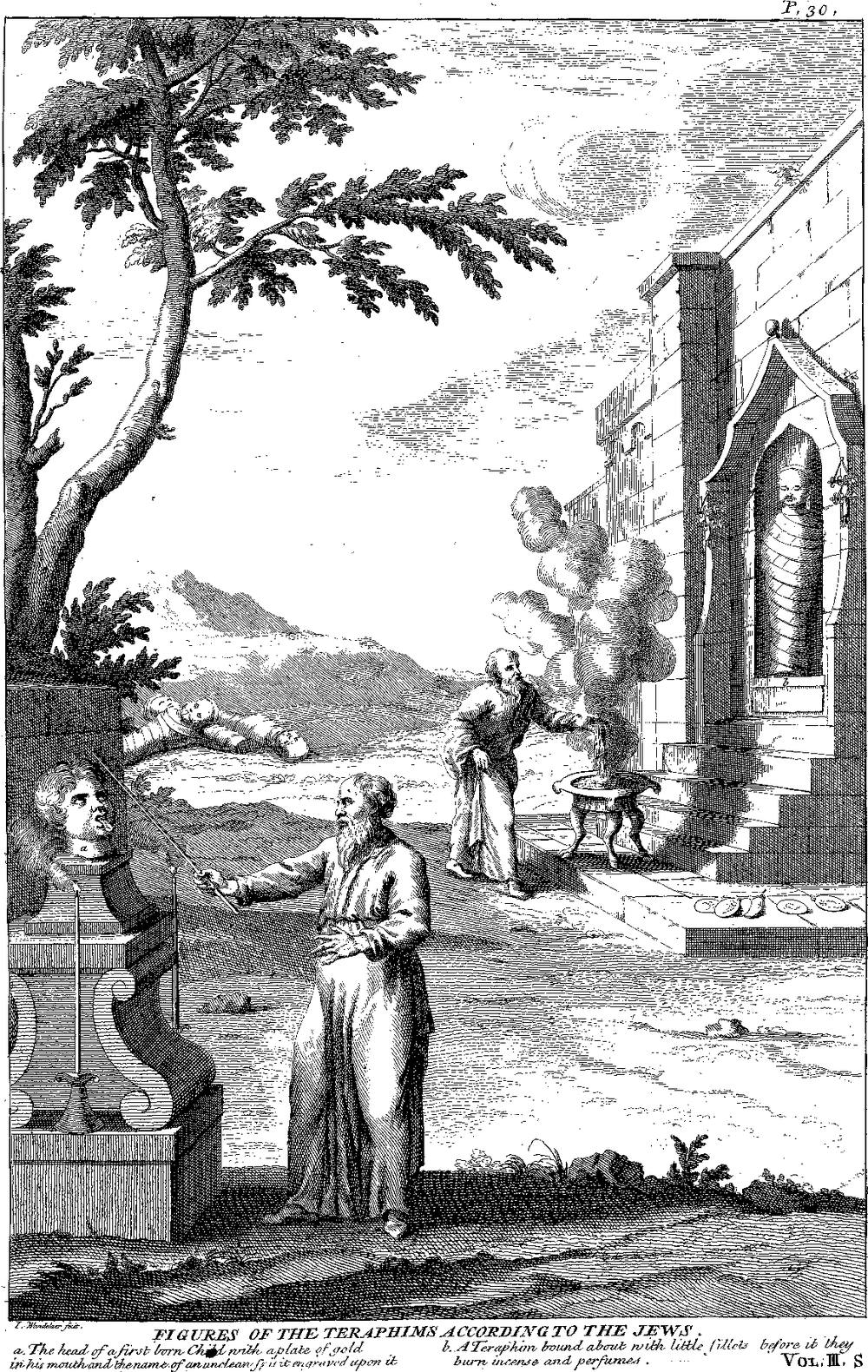
TERAPHIM, or Theraphim. It is said in Genesis, that Rachel had stolen the images Gen. xxxi. 19.that were her father’s: The Hebrew says,1 the Teraphim of her Father. ‘Tis enquired, what these Teraphim were? The Seventy sometimes translate this Word by Oracle,2 and sometimes by vain Figures.3 Aquila generally translates it by Figures.4 It appears indeed from all the Passages in which this Word is used, that they were Idols, or superstitious Figures. The Jews say it was the Head of a Man, taken off from the Trunk, and embalmed; under the Tongue of which was placed a Plate of Gold, with the Name of a false Deity; that this Head was placed in a Nich, that Candles were lighted up to it, and that they pretended to divine by it.
Others think that the Teraphim were Talismans, that is, Figures of Metal, cast and engraved under certain Aspects of the Planets, to which they ascribed extraordinary Effects, but in proportion to the Nature of the Metal, to the Qualities of the Planets, and to the Figures represented upon the Talismans. This Opinion appears the most probable. All the Eastern People are still much addicted to this Superstition of Talismans. The Persians called them Telesim,5 a Name nearly approaching to Teraphim. In that Country no Man is seen without them, and some are even loaded with them. They impute many Virtues to them. They hang some to the Necks of Animals, and to the Cages of Birds. But those of Rachel must be gross Images, and of some precious Metal. See the Commentators upon Gen. xxxi. 19. 1 Sam. xv. 23. Ezek. xxi. 21. Zech. x. 2. where also the Word Teraphim is used for an Idol, or superstitious Figure.
‘Tis asked, Why Rachel stole the Perer. Jansen. alii.Teraphim of her Father Laban? Some have thought it was to make Reparation for the Wrongs she pretended to have received Abenezra.from him. Others imagine, that by this she thought to deprive him of the Means of discovering their Flight, by taking away his Oracles. Others say, that with the Teraphim she thought to take away the Prosperity of her Father’s House, and transfer it to that of her Husband. Some again think,6 that she intended to remove the Occasion of her Father’s superstitious Worship, and hinder him from going on in his Idolatry. Lastly, some believe that both she and her Sister Leah were addicted to this idolatrous Superstition,7 which they had a mind to continue in the Land of Canaan. But Jacob compell’d them to discard all these false Deities, which he afterwards hid under Genesis xxxv. 4.the Oak which was by Schechem.
Besides these superstitious Teraphim, that Rachel stole away from her Father, and the others of the same Nature that we have mentioned, the Scripture speaks of two other kinds. The first are those that Michal put into David’s Bed, pretending he was there sick. And Michal took an image, and laid it in the bed. The Hebrew reads Teraphim for what is here translated an Image. ‘Twas probably a Figure of Sticks, made up in haste, which was dress’d with Cloaths like a great Baby; or like one of those Malkins that Countrymen set up in the Fields to fright away the Birds from their Corn. Michal put it in her Husband’s Bed, to make those believe he was there sick, who were sent by her Father to seek him.
The other sort of Teraphim mention’d in Scripture, were those that the Jews sometime consulted, without imagining that by this they abandon’d the Worship of the Lord. Such was the Teraphim that Judg. xvii. 5, &c.Micah made, and set up in his House, and to which he appointed a Priest of the Race of Levi, with an Ephod, by the Power of which he flatter’d himself that God would bless his House. This Teraphim was taken Judg. xviii. 14, 17, &c.away by the Men of Dan, and set up at their new Settlement in Laish, and continued there till the Israelites were carried away beyond the Euphrates. ‘Twas probably some Hieroglyphical Figure, to which the superstitious Jews attributed the Virtue of an Oracle, and the Power of foretelling things to come. It would be rash to undertake to give a Description of it; but we may imagine, it
was pretty nearly like the Cherubims; that is to say, something made up of the Parts of several Animals, a Collection that did not subsist in Nature, a mere Chimera; for Example, a Man with Wings, having the Feet of an Ox, and the Head of a Bird; or some other Figure of the like nature.
Hos. iii. 4, 5.The Prophet Hosea, threatening the Israelites of the ten Tribes, tells them, the Children of Israel shall abide many days without a king, and without a prince, and without a sacrifice, and without an image, and without an ephod, and without teraphim; that is to say, that during their Captivity they should have no publick Exercise of their Religion. They had indeed before, their Altars, Ephods, Teraphims, while they paid their impious Adoration to the Golden Calves; but after they were led into Captivity beyond the Euphrates, they had no longer any Priests or Altars, Sacrifices or Ephods, Teraphim, Golden Calves, or other superstitious Figures, to whom they might address themselves, or receive Answers from, whether true or false, and which they might any how worship. Hosea adds, Afterwards shall the children of Israel return, and seek the Lord their God, and David their King, and shall fear the Lord, and his goodness in the latter days; which is as much as to say, that after their Return from Captivity they should be re-united to the Tribe of Judah, and should return to the Temple of the Lord at Jerusalem, from which they had before separated themselves by their Schism.
Spencer tract. de Urim & Thummim.Spencer pretends, that the Word Teraphim is Chaldee, and that it is the same thing as Seraphim, by changing the Hebrew Shin into Thau, which is very common; that is, the S into T. He maintains that the Images of Teraphim are derived originally from the Amorites, the Chaldeans, and the Syrians: He adds, that the God Serapis of the Egyptians is the same as Teraphim. It may be added to this, that the Figure of the flying Serpent called Seraph, gave occasion, without doubt, to the naming those Angels Seraphim which appeared to the Prophets, and which are represented to us flying round about the Throne of God. The Heathens gave such kind of Likenesses as these to their superstitious and magical Figures. We know that the Abraxas, which are real Talismans, or Teraphim; are adorned with grotesque Figures formed after a thousand manners. Sometimes there is a Serpent having Antiquity explained. t. 2. p. 2. and elsewhere.a radiating Head. Sometimes there is a Human Figure, with a Cock’s Head, and the Arms terminating in two Serpents, which are instead of Feet and Legs to the Figure. Lastly, the Serpent is there represented after several Manners. The God Serapis is also almost Ibid. t. 2. Suppl. Plate 42.always accompanied by Serpents, which wind about him, or are along with him. There are Figures of Mithras, or of the Sun, having four Wings, like the Seraphims, with the Head of a Lion, over which is the Head of a Serpent, the Body Diarium Italicum, and Antiquity explained, t. 1. Part 2. p. 378.of which surrounds the whole Statue.
All this, in my opinion, very well exhibits the Teraphim. As these superstitious Talismans were common to almost all the Eastern Nations, it is natural to think that every one engraved thereon, and represented, such a Deity as they thought most powerful and favourable. The Sun was worshipped by almost all the World; the Serpent was one of his Symbols: The Sun was a beneficent Deity, the God of good Fortune. The Orientals generally represented him upon their Talismans, sometimes under one Emblem, and sometimes under another. The Jews, who had lived a long time in Egypt, always shewed an Inclination to worship their Gods rather than others. Hence proceeded the Worship of the Golden Calf in the Wilderness, and in the Kingdom of Jeroboam. It is therefore probable that the Teraphim of Laban, which were stolen by Rachel, were Hieroglyphical Figures and Talismans, shaped after the manner of the Syrians; that the Teraphim of Micah were nearly approaching to the Cherubim of Moses, or to the Seraphim described by Isaiah. In a word, that these Figures were by no means uniform, no more than the Cherubim and Seraphim described in Scripture. Every one made them, or caused them to be made, according to his own Fancy and Devotion.
R. David Kimchi.The Rabbins pretend, that the Teraphim were not mere Idols, but they were Idols that gave out Oracles, and foretold future Events. The Rabbi David of Pomire says, that they had a Human Shape, and that when they were once set up and dedicated, they spoke, and gave Answers at certain Hours, and under certain Constellations, by the Influence of the Heavenly Bodies; and that this Influence was communicated to them by the Art of him that made them of a certain Metal, with certain Characters, and under certain Aspects of the Stars.
Rabbi Eliezer pretends, Ch. xxxvi. that the Teraphim spoke. He proves it by those Hos. x. 2.Words of Hosea, The Teraphim speak vain things. To make a Teraphim, this is the way they proceeded according to this Rabbi: They kill’d a first-born Child, they clove his Head open, they sprinkled it with Salt and Oil, they wrote down the Name of some unclean Spirit upon a Plate of Gold, which Plate they put under the Tongue of the dead Child. They set this Head in a Nich in the Wall, where they lighted up Lamps, pray’d to it, ask’d it Questions, and it spoke. See the Figure.
This Account of Eliezer has much of the Air of a Fable; and yet the Rabbi Jonathan. Targum in Gen. xxxi.Tanibuma, and Jonathan the Paraphrast, relate it in the same manner. But, as we said before, we must not imagine that there was but one kind of Teraphim: This Name was given to very different things, as well as to Matter as Figure. The Teraphim that was laid in David’s Bed, to make it be thought that he was there himself, must have been a large Figure. Those that Hosea speaks of, which were consulted by the Israelites of the Ten Tribes, and those of Micah, probably represented either the Cherubim of the Ark of the Covenant, or some other superstitious Figure; but however, such as the Israelites thought that they might reconcile the Worship of them with the Worship of the Lord. The greatest part of the Abraxas, which were certainly a kind of Talismans, or Teraphim, have the Names of Gods assign’d to them, as Iao, Adonai, Elohim, &c.
Kircher. Oedip. Ægypt. Synt. iv. c. 3. p. 259.Father Kircher, and after him Cuneus, in his Republick of the Hebrews, maintain that all the ancient Idolatry came from the Egyptians; and that the use of the Teraphim passed from that Country into the East; for that Ham, or his Son Mizraim, were the Inventers of Statues, which the Egyptians had in such great multitudes, that no City, Village, High-way, or Cross-way, were without them. They ascribed many Virtues to them, especially to such as were formed under the Aspects of certain Stars and Constellations. ‘Twas thought they had the Power of foretelling what was to come to pass, of revealing things concealed, of preventing Evils that were threatened, and of procuring certain Advantages, as that of pleasing, of being lucky at Play, in Trade, &c. The Rabbins own that the Word Teraphim is foreign to the Hebrew Tongue, from whence it is concluded that it is Egyptian, and the same as Serapis. Abenephius assures us, that when Abraham made some Abode in Egypt, his Domesticks were tainted with this kind of Idolatry, and carried it with them into Canaan; from whence it passed into the Family of Laban. All this is very precarious, and it would be very difficult to produce Vouchers for it.
Jurieu Hist. des Cultes.A modern Author has proposed another Conjecture concerning the Teraphim. He conceives that the Teraphim that Rachel stole might be the Dii Penates, the
Ovid. Fast. l. 2.Houshold Gods of Laban. The Gods that were set up in the Highways were also the Guardians of the House. Ovid, speaking of Lariunda, the Mother of the Gods Lares and Viales, says, that she brought forth two Sons who were the tutelar Gods of the Cross-ways and of private Houses:
Fitque gravis, geminosque parit, qui compita servant,
Et vigilant nostrâ semper in æde Lares.
Genesis xxxi. 30.These Lares, and Gods of the Highways, were the Souls of the Heroes of the Families, who had been deified, and then worshipped. Thus the Teraphim of Laban, according to this Author, were the Images of Noah, the Restorer of Mankind, and of Shem, the Head of Laban’s Family. This, according to him, was the first Institution of Domestick Gods. There were but two of them, and their Worship was introduced quickly after the Deluge. Laban does not only complain that Gods or Statues had been stolen from him, in which he put Confidence, and to which he paid a religious Adoration; but he complains that he was deprived of his Gods: Cur juratus es Deos meos? that is to say, the Gods of his Family.
But this Conjecture is not more satisfactory than the preceding. It is not at all credible, that the Worship of the Gods Lares and Penates was known at the time of Laban. And I am much in doubt, whether it was in use among the People of the East for several Ages after this Patriarch.
Nor is it probable that Laban would place among his Gods the Patriarchs Noah and Shem, who had been dead so little a while before: For Noah died in the Year of the World 2006, and Shem in the Year of the World 2158; that is to say, but 87 Years before Jacob came to Laban into Mesopotamia.
Read this article in its place on the printed pages
Footnotes
-
Theraphim. 70. Εἴδωλα. Aqu. Μορφώματα Figuræ. Sym. & Theodot. Θεραφὴν. ↩
-
Hos. ii. 4. Δήλους. Zech. x. 2. Ἀποφθεγγομένους. ↩
-
1 Sam. xix. 13. Κενοταφία. ↩
-
Aqu. Μορφώματα. Alibi Πέμπμαι. Busts. ↩
-
Chardin. Tom. 2. of the Science of the Persians, Ch. x. ↩
-
Theodoret. qu. 90. Nazianz. Orat. de Sancto Pascha. Rab. Salomon. ↩
-
Vide Cyrill. in Genes. l. xi. Chrysost. in Genes. ↩