TABERNACLE, in the Acceptation of a House or Dwelling. The Books of the Old Testament are full of these kinds of Expressions. Israel dwelt in Peace in their Tabernacles. Israel, return to your Tabernacles. Japhet shall dwell in the Tabernacles of Shem. Every one return’d to his own Tabernacle. And this sort of Expressions are to be understood literally in some Cases. For Example: When mention is made of the Patriarchs, that lived in the Land of Canaan before their going into Egypt. Their Dwelling was only in Tents; they built no Houses, and inhabited no Cities. The same is to be understood of an Army in the Field, which abode in Tents or Tabernacles. But in a multitude of other places, by Tent or Tabernacle a House is to be understood. The Hebrews having long dwelt under Tents before they went down into Egypt, and afterwards in their Pilgrimages in the Wilderness, brought this kind of speaking into Use among the People.
This Name is also given to the Temple of Solomon, tho’ it was built of very solid and durable Materials; and that because in its Construction it had a great Resemblance to the Tabernacle set up by Moses. For Example: Psalm cxxxii. 3, 7. Psal. lxx.David says he would not allow himself any Rest, till he had built a Tabernacle to the Lord. Elsewhere the Author of the lxxivth Psalm complains, that the Chaldeans or Syrians had defiled the Tabernacle of the Lord.
Psal. xv. 1. Psal. lxi. 4. Ps. lxxxiv. 1. Luk. xvi. 9. Heb. viii. 2.Tabernacle is sometimes put for Heaven, for the Dwelling-place of the Blessed. Lord, who shall abide in thy Tabernacle? Who shall dwell in thy holy hill? And elsewhere, I will abide in thy Tabernacle for ever. And again, How amiable are thy Tabernacles, O Lord of Hosts! I acknowledge that these Passages may be also literally explain’d of the Temple of Jerusalem. But it appears from the Authors of the New Testament, that the Jews often understood Heaven in such Forms of Speech as these. As for Example: Our Saviour advises us to make Friends of the Mammon of Unrighteousness, that they may receive us into everlasting Tabernacles. And St. Paul says to the Hebrews; of Jesus Christ, that he was a Minister of the Sanctuary, and of the true Tabernacle, which the Lord pitched, and Heb. ix. 11. 2 Cor. v. 4.not Man. And again, But Christ being become an High-priest of good things to come, by a greater and more perfect Tabernacle, not made with hands, that is to say, not of this building. See also Rev. xiii. 6. xxi. 3. The same St. Paul speaks of his own Body, as of a Tent or Tabernacle; For we that are in 2 Pet. i. 13, 14.this Tabernacle do groan, being burthened. And St. Peter; I think it meet, as long as I am in this Tabernacle, to stir you up, by putting you in remembrance, knowing that shortly I must put off this my Tabernacle.
The Tabernacle of David that God was to raise, Amos ix. 11. Acts xv. 16. is no other than the Church of Christ, which is the House of Jesus Christ, the Offspring of David, and Heir of the Promises that were made to this Patriarch.
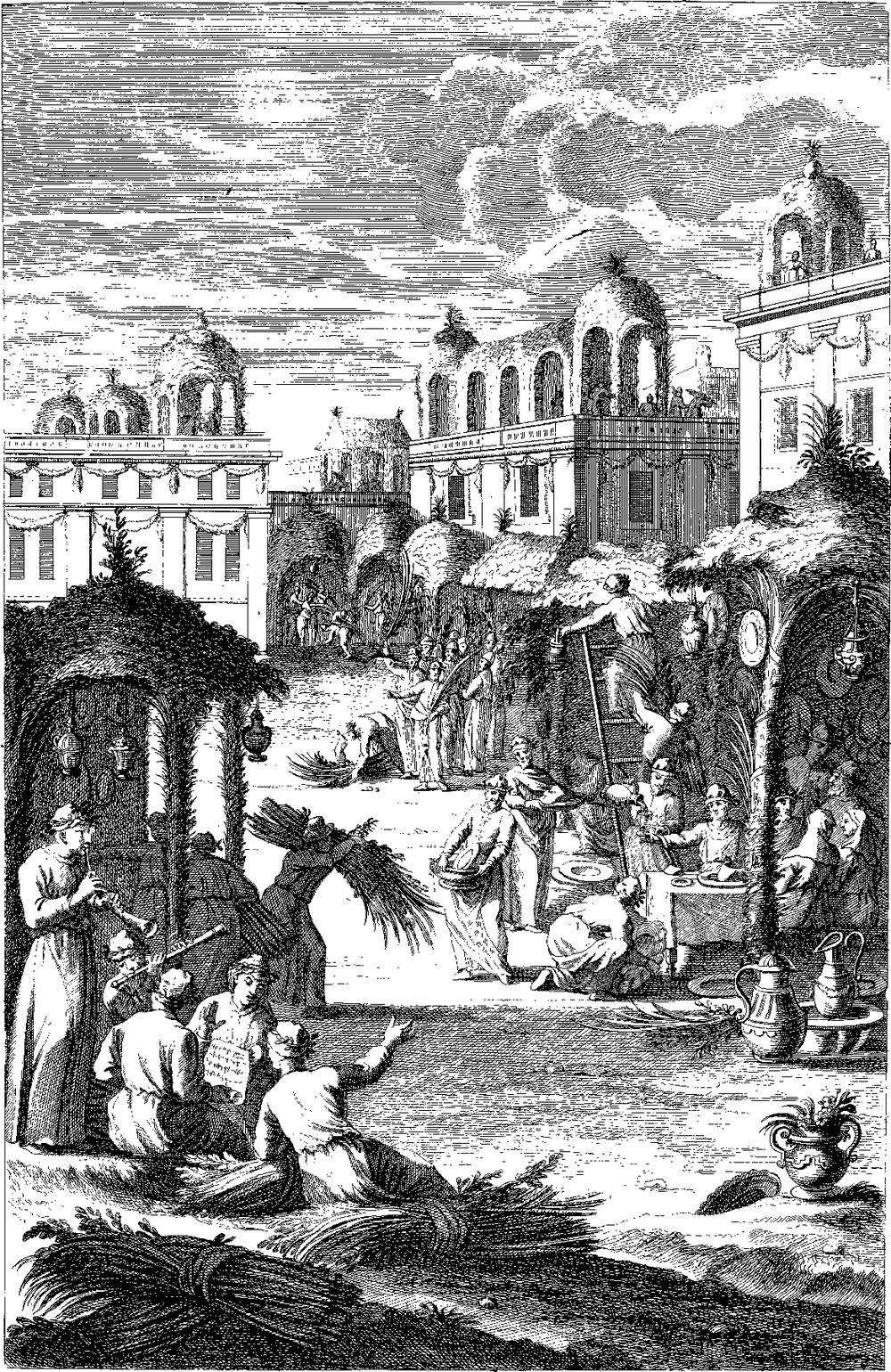
The Feast of TABERNACLES; call’d John vii. 2. Σκηνοπηγία.in the Gospel Scenopegia; which in the Greek signifies the Feast wherein they set up Tents or Tabernacles. The word Scenopegia 1 Macc. x. 21. 2 Macc. i. 8, 18.is also found in the Maccabees. The Hebrews call it Chag-hassuchoth; the Feast of Tents, because it was kept under green Tents or Arbours, in Memory of their dwelling in Tents in their Passage through חג הסכותChaghassucot. Lev. xxiii. 42,43,44.the Wilderness. ‘Twas one of the three great Solemnities of the Hebrews, wherein all the Males were oblig’d to present themselves before the Lord. It was celebrated after Harvest, on the 15th Day of the Month Tizri; which was the first Month of the Civil Year, and answers to the Moon of September. Herein they return’d Thanks to God for the Fruits of the Earth they had then Ex. xxiii. 16.gather’d in. The Feast continu’d eight Days; but the first Day and the last were the most solemn, Levit. xxiii. 34, 35, &c. It was not allow’d to do any Labour on this Feast; and particular Sacrifices were offer’d, of which mention shall be made presently.
Lev. xxiii. 40. Neh. viii. 16.The first Day of the Feast they cut down Branches of the handsomest Trees, with their Fruit, Branches of Palm-trees, and such as were fullest of Leaves, and Boughs of the Willow-trees that grew upon Brook-sides. They made choice of the neatest of these Branches, and carry’d them in Ceremony to the Synagogue, where they perform’d what they call’d Lulab. That is, holding in their right Hand a Branch of a Palm-tree, three Branches of Myrtle, and two of Willow ty’d together; and having in their Left-hand a Branch of a Citron with its Fruit, they brought them together, waving them towards the four Quarters of the World, and singing certain Songs. These Branches were also call’d Hosanna, because when they carried them and waved them, they cry’d Hosanna; not unlike what the Jews did at our Saviour’s Entry into Jerusalem. On the eighth Day they perform’d Matt. xxi. 8, 9.this Ceremony oftner, and with greater Solemnity, than upon the other Days of the Feast. Wherefore they call’d this Day Hosannah Rabbah, or the great Hosanna.
The Jews acquaint us, that every Israelite, upon the Feast-day, in the Morning, was obliged to bring these Branches of Trees now mention’d, upon Penalty of fasting all that Day. Then they made a Procession round the Altar of Burnt-offerings, shaking their Branches and singing. At present they carry these Branches into their Synagogue, and provide themselves with Oranges and Citrons, in Countries where they do not grow, that nothing may be wanting for the Celebration of the Feast. They make it a Part of their Ceremony to take a turn round the Desk in the middle of the Synagogue, once a day at least; and they eat nothing till they have done this.
The Psalm cxviii. O give thanks unto the Lord, for he is good —— Let Israel now say, &c. seems to have been sung at the Feast of Tabernacles. The Psalmist makes a plain Allusion to it, in Ver. 25, 26, 27, &c. Save now, I beseech thee, O Lord; O Lord, I beseech thee send now prosperity. Blessed be he that cometh in the name of the Lord. The Hebrew says, Ana Jehovah, &c. which are the Words that the Jews sing even to this Day, when they make a Procession about their Desk, at the Feast of Tabernacles; and which were sung at our Saviour’s triumphant Entry into Jerusalem. The Psalmist goes on, We have blessed you out of the house of the Lord, &c.
‘Twas probably upon the Occasion of Plutarch. Sympos. Prob. 5.these Ceremonies, that Plutarch says of the Hebrews, that they kept this Feast in Honour of Bacchus. They enter, says he, into their Temple, carrying Vine-branches and Wands in their Hands; but what they do there, I know not. He calls these Feasts Cladophoria, and Thyrsophoria; and as in the Feasts of Bacchus, they carry’d green Branches wrapt about their Wands or Lances, which the Greeks call Thyrsos, he has concluded from thence, that probably the Jews would do Honour to Bacchus in this Solemnity. Josephus1, speaking of this Feast, makes use of the Greek word Eiresione, which signifies a Posy or Bundle, composed of a Branch of Olive wrapt about with Wool, upon which were hung all kinds of Fruits; which a Child, whose Father and Mother were still living, us’d to lay at the Door of Apollo’s Temple. This is what the Greeks understand by Eiresione. But Josephus explains himself by saying, that among the Hebrews it was a Wisp or Posy of Myrtle, Willow, and Sprigs of the Palm-tree, upon which Citrons were hung. It is observable, that tho’ Moses does not expressly mention Myrtle, yet Nehemiah, Neh. viii. 16.Josephus, and after them the Rabbins and the Syriac, take notice of it as necessary in this Ceremony; and the Jews understand of this Tree what Moses says, Levit. xxiii. 40. And ye shall take you, on the first day, the boughs of goodly trees, branches of palm-trees, and the boughs of thick trees, and willows of the brook; and ye shall rejoice before the Lord your God seven days.
Numb. xxix. 12, 13, 14, &c.The first Day of the Feast, besides the ordinary Sacrifices, they offer’d as a Burnt-offering thirteen Calves, two Rams, and fourteen Lambs; with the Offerings of Flower, and the Libations of Wine, that were to accompany them. They offer’d also a Goat for a Sin-offering.
The second Day they offer’d twelve Calves, two Rams, and fourteen Lambs for a Burnt-offering, with their Offerings of Flower, Oil, and Wine, which were always added to these Sacrifices. Besides which, they offer’d a Goat for a Sin-offering; and this without including the ordinary Morning and Evening Sacrifices, which were never interrupted, nor those that the Israelites us’d to offer out of their own private Devotion, or for the Expiation of their Sins. These we now mention were offer’d in the Name of the whole People of Israel. On the third, fourth, fifth, sixth, and seventh Days of the Feast were offer’d the same Sacrifices as on the second Day; with this Difference, that every Day they came short of the former by one Calf; so that on the third Day they offer’d eleven, on the fourth ten, on the fifth nine, on the sixth eight, and on the seventh but seven. As to the other Victims, they offer’d the same Number every Day. But the eighth Day, which was kept with greater Solemnity than the foregoing, they offer’d but one Calf, one Ram, and seven Lambs for a Burnt-offering, and one Goat for a Sin-offering, with the other accustomed Offerings and Libations.
We are assured, that on the eighth Day of the Feast the Jews presented at the Temple the first Fruits of their later Crop, or of such things as were the slowest in coming to Maturity; that they drew Water out of the Fountain of Siloam, which was brought into the Temple, and, being first mingled with Wine, was pour’d out by the Priests at the foot of the Altar of Burnt-Offerings. The People in the mean time sung these Words of the Prophet Isaiah, Isa. xii. 3.Therefore with joy shall ye draw Water out of the Wells of Salvation. ‘Tis pretended that this Ceremony was instituted by Haggai and Zechariah, at the return from the Captivity; and some have believed that Jesus Christ alluded to it, when he cry’d out in the Temple, on the last Day of the Solemnity of the Feast of Tabernacles, If John vii. 37, 38.any man thirst, let him come unto me and drink. He that believeth on me, as the scripture hath said, out of his belly shall flow rivers of living water. By which he meant, according to St. John’s Observation, the Holy Ghost that was to be given to those that believed on him. Some Commentators think, that at this Feast were rehearsed the Psalms entitled Pro torcularibus, for the Presses, which are the xxth, lxxxth, and lxxxiiid, according to the Vulgate. But Leo Leo of Modena, his Ceremonies of the Jews. p. 2. c. 7.of Modena says, that they rehearsed those Psalms whose Titles are Hallelujah, or Praise God, which are, according to the reckoning of the Hebrews, the cxiiith, cxivth, cxvth, cxvith, cxviith, cxviiith, cxixth.
The same Author tells us, that the modern Jews not having now an Opportunity of going to the Temple, nor of performing all the Ceremonies prescribed by Moses, each makes for himself, in some open place, a Bower or Arbour of the Branches of Trees, hung round about, and adorned as much as they can. There they eat and drink, and some even lie there; but at least they pass as much time there as they used to pass in their Houses, and this for the whole eight Days of the Festival. Such as are sick, or worn out with Old Age, are dispensed Munster. in Levit. xxiii.with from observing this Ceremony; and when it rains very hard they are permitted to retire to their Houses; for these Bowers are not made so close as to keep out the Weather. Leo of Modena adds, that tho’ Moses appointed but eight Days for this Feast, yet Custom and the Devotion of the People have added a ninth to them. The two first Days and the two last, are observed very strictly, but the five Days between not so much. On the seventh Day of the Feast, which they call Hosanna Rabba, they quit their Myrtle and Palm Branches, and take only those of Willow, with which they make seven Turns round the Desk in the middle of their Synagogue, singing the xxixth Psalm; Give unto the Lord, O ye mighty, &c. And this Day of the Feast is as solemn again as any of the others. The ninth and last Day, which is an Institution of the Rabbins, is called The Joy of the Law, because on this they compleat the reading of the Pentateuch. The Reader may consult upon this Subject such Authors as have expressly treated on the Festivals of the Jews; the Mishna, under the Title Suca, with its Commentators; such Writers as have composed Treatises on the Republick of the Hebrews, as Sigonius, Bertrand, Cunæus, and Godwin, de Ritibus Hebræorum, l. 5. c. 6. &c.
Read this article in its place on the printed pages
Footnotes
-
Joseph. Antiq. l. iii. c. 10. p. 92. Φέροντας ἐν τῇ χερσὶν εἰρεσιώνην μυρσίνης καὶ ἰτέας σὺν κεράδῃ φοίνικος πεποιημένην, τὸ μῆλον τὸ τῆς πέρσέας περιόν. ↩