Volume II, pages 759–777 of the 1732 edition, from STO to SYR: everything printed on these pages, in order.
Continued from Stones
that was very rare, and which they made use of in their Operations; that is, says he, the Stone that falls with the Thunder. Lotacus speaks of two other Kinds of them, to one of which they imputed the Power of taking Cities, to the other the Power of defeating Fleets. These Stones are to be found very common at this Day in Picardy, Germany, and in the Country of the Morians.
But the true Thunder-Stones are different from all these. ‘Tis pretended they are form’d in the Clouds of a nitrous and sulphureous Matter, which acquires a certain Degree of Consistence by the Agitation of the Clouds, and then takes Fire, and darts forth Plutarch. in Lysandro.with Impetuosity. Plutarch speaks at large of a Thunder-Stone that had fall’n formerly in Thrace. The Philosopher Anaxagoras foretold the Fall of this Stone, and pretended, that it was emitted from the Body of the Diogen. Laert. in Anaxag.Sun. It was seen for seventy-five Days in the Air, toss’d up and down at Random, and from Time to Time it sent forth Pieces of its Substance all on fire, appearing like those Stars that seem to fall from the Sky. At last the Stone itself fell down, and was quite extinguish’d, being much diminish’d in the Bigness that it seem’d to have in the Air. Plin. l. 2. c. 68.Pliny says, that it was preserved even to his Time, was in Bulk as big as a Chariot, and of a dark adust Colour. Qui lapis etiam nunc ostenditur, magnitudine vehis, colore adusto.
Cardan. de varietate. l.14. c. 72.That which is to be seen in the Parish Church of Eurishem in Alsatia, fell down from Heaven in the Year 1492. It is blackish, almost round, uneven, and weighs, as they say, about three hundred Pound Weight. That mention’d by M. Gassendi, a which fell November 29, 1637. was of the Bigness of a Man’s Head, weigh’d fifty-four Pounds, was of a blackish Colour, and extreamly hard; it is kept at Aix in Provence. Count Marcellin, in his Chronicle for the Year 452, speaks of three great Stones that fell from Heaven in Thrace. Cardan relates, that in 1510 there fell in the Country near Abdua, to the Number of twelve hundred Stones, of the Colour of Iron, of a sulphureous Smell, and of an extraordinary Hardness.
Diodor. Sicul. Bibl. l. 11.Some pretend these Stones are not generated in the Air, but that they are broken off from some very high Rocks; that the Sulphur and Nitre in which they are inclosed, are the Cause that they are soon inflamed, and the Flame contributes to their being supported for some Time in the Air: That when the combustible Matter is consumed, with which they are surrounded, they fall down, and are taken for Thunder- Stones. Diodorus Siculus relates, that the Persians attempting to plunder the Temple of Delphos, were repell’d and intirely routed by Thunder, Tempest, and great Fragments of Rocks, that were torn up by the Violence of the Storm. Travellers assure us, that the same thing often happens in America, in certain Places where Hurricanes are frequent. It is very probable, that what they call Thunder- Stones, and what Job and Ezekiel mention by the Name of Gabish, are nothing else but Stones loosen’d from the Mountains, which then obtain’d the Name of Thunder-Stones.
Josh. x. 11.Shower of Stones. Joshua speaks of its raining Stones upon the Canaanites. Thus he expresses himself; And it came to pass as they fled from before Israel*, and were in the* going down to Beth-horon*, that the Lord* cast down great Stones from Heaven upon them unto Azekah*, and they died. They were* more that died with Hailstones, than they whom the Children of Israel slew with the Sword. Opinions are divided about these Hailstones. Some pretend, that this was no more than ordinary Hail, but more violent than the Storms we are us’d to see. Others maintain, that Joshua is to be understood literally, of a Shower of Stones. The Text seems to be express for this Sentiment, and the thing is not at all impossible. We have several Instances of Showers of Stones; and tho’ we had no Example of Things of this Nature, yet it is enough that the Scripture speaks of it as of a supernatural and miraculous Event, to remove all our Scruples about it. We ought not to have recourse to the figurative and metaphorical Sense, but only when the things related in Scripture include some Contradiction in the literal Sense, something contrary to the Idea of God, or inconsistent with the Laws of Nature. In a word, when there is no real Necessity of having recourse to a Figure, we must not depart from the literal Sense.
Deuter. xxviii. 24.As often as the Scripture speaks of these Events, it speaks of ‘em as of a Prodigy. But surely a common Shower of Hail has nothing of a Miracle in it. The best Commentators upon Joshua, as Masius, Bonfrere, Grotius, explain it literally of a Shower of Stones. Moses, in Deuteronomy, speaks of a Shower of Dust and Sand, with which he threatens his People: The Lord shall make the Rain of thy Land Powder and Dust; from Heaven shall it come down upon thee, until thou be destroyed. The Romans, who look’d upon Showers of Stones as something very disastrous, in their Annals have taken notice of a great many Instances of them. Under the Reign of Tullus Hostilius, when it was made known to the People of Rome, that a Shower of Stones had fall’n upon the Mountain1
of Alba, at first it seem’d incredible. They sent out proper Persons to inquire strictly into this Prodigy, and it was found that Stones had fall’n after the same Manner as a Storm of Hail driven by the Wind2. Afterwards the same Prodigy happen’d frequently3. Some Time after the Battle of Cannæ, there was seen upon the same Mountain of Alba, a Shower of Stones, which continued for two Days together. In 1538, near a Village in Italy call’d Tripergola, after some Shocks of an Earthquake, there was seen a Shower of Stones and Dust, which darkned the Air for two Days, after which they observed that a Mountain had rose up in the midst of the Lucrine Lake4.
If therefore Showers of Stones have nothing contrary to the Laws of Nature, there can be no good Reason assign’d why we should depart from the literal Sense in this Place, to seek Refuge in Allegory. This is not to affirm that there was no Miracle here, as there was none in those Showers of Stones mention’d by Livy; but the Miracle consists much less in the Thing itself, than in the Circumstances of Time, and that the Shower should fall only upon the Canaanites, without doing the Israelites any Harm. Our Dissertation may be consulted upon this Subject, printed before our Comment upon Joshua, and other Commentators upon the same Book.
Stone of Offence. This is what we meet with in our Way, and which makes us Isa.viii.14.stumble or fall. He shall be for a Stone of Stumbling, and for a Rock of Offence, to both the Houses of Israel. St. Peter and St. Rom. ix. 33. 1 Pet. ii. 8.Paul have said, that Jesus Christ was a Stumbling-Stone to the Jews who believed not on him.
Moses says, that God would give to the Hebrews a Country, whose Rocks and Stones should supply them with Plenty of Deuter. xxxii. 13. Psal. lxxxi. 16.Honey and Oil: He made him to suck Honey out of the Rock, and Oil out of the flinty Rock. And the Psalmist says, speaking of the Miracle by which Moses drew Water out of the Rock; With Honey out of the Rock should I have satisfied thee. In Palestine the Bees often lay up their Honey in the Holes of the Rocks. ‘Tis to this that the Scripture alludes in this Place. Job xxix. 6.Job says, in the same Sense, that in the Time of his Prosperity, the Rock poured me out Rivers of Oil, because the Olive-trees generally grew upon the Mountains.
Many People bordering upon Palestine, had their Abode in the Rocks and hollow Stones in the Mountains. The People inhabiting upon the Persian Gulph, lived in this Manner. ‘Tis for this Reason that they were call’d Troglodytes, which in Greek is as much as to say, People that dwell in the Caves and hollow Places of the Mountains. Those that inhabited in the Desart about Tikoah, lodged in Caverns dug in the Earth, says St. Jerome. The Idumeans had their ordinary Abodes in the Jer. xlviii. 28.Clefts of the Rocks. O ye that dwell in Moab, leave the Cities and dwell in the Rock, and be like the Dove that maketh her Nest in the Sides of the Hole’s Mouth. Hither the Moabites us’d to retreat in Times of Calamity. The Kenites, who dwelt to the South of the Black-sea, lodg’d Numbers xxiv. 21.after the same manner: And he looked on the Kenites, and took up his Parable and said; Strong is thy Dwelling-place, and thou puttest thy Nest in a Rock.
Isa. li. 1.In Isaiah God says to the Jews; Look unto the Rock whence ye are hewn, and to the Hole of the Pit whence ye are digged; that is, to Abraham and the Patriarchs from whom ye are descended. And in the Gospel, Mat. iii. 9.John the Baptist tells the Pharisees; Think not to say within your selves, We have Abraham to our Father; for I say unto you, that God is able of these Stones to raise up Children unto Abraham. He can convert the most hardned Hearts, and call to him those that are at the greatest Distance. ‘Tis believed, that when he spoke this, the Baptist pointed to the Stones in the Desart, and by that Name understood the People that were yet Infidels and Gentiles.
Ex. iv. 25. Josh. v. 2.The Knives of Stones that were made use of by the Jews in Circumcision, were not enjoin’d by the Law; but the Use of ‘em was founded, either upon Custom, or upon Experience of this kind of Instruments, they being found to be less dangerous than those made of Metal. Zipporah made use of a Stone to circumcise her Sons. Joshua did the same, when he caus’d such of the Israelites to be circumcised at Gilgal, as had not received Circumcision during their Journey in the Wilderness: Fac tibi cultros Lapideos, & circumcide secundo filios Israel. This Expression of Scripture shews, that Knives were not then in common Use. The Egyptians made use of these Knives of Stone to open dead Bodies that Herodot. l. 2. c. 2. Plin. l. 35. c. 12.were to be embalm’d. Pliny assures us, that the Priests of the Mother of the Gods had sharp Stones, with which they cut and slash’d themselves, which they thought they could not do with any thing else without Danger: Nec aliter citra perniciem. Catullus observes,5 that Athys made himself a Eunuch after the same manner.
They made use of Stone Knives to make Incisions in the Tree from whence the Balm distill’d. They also made use of them
formerly instead of Pen-Knives, to cut the Canes for writing withal. Scaliger says, that he had seen at Lyons two of these Stone Knives. We have already spoken of Hatchets, and other cutting Instruments of Stone. The Africans of Morocco, and some Americans, still, at this Day, have them in common Use, of which they make Knives, Lancets, and Razors6. The Oriental Jews commonly us’d them for the Circumcision of their Children, being not unlike Flints for Guns: But the Western Jews use a Razor.D. Joh. de Palafox, c. 12.
Moses forbids the Hebrews to set up in their Country any Stone that is exalted or remarkable. Nec insignem lapidem ponetis in terra vestra. The Hebrew7 may be translated by a Stone for Sight, a Land-mark, that stands on an Eminence, or in some great Road, that it may be seen at a Distance. Strabo mentions these Stones, Strab. l.17.which were to be seen on the High-ways in Egypt. They are raised on high, polish’d, round, and almost of a spherical Figure, made of a kind of a black and hard Stone, of which Mortars are made in that Country. These Stones or Columns are placed upon a larger Stone, or Base, and sometimes have still another lesser Stone over them, serving as a Capital. Some stand alone and separate; the greatest are almost twelve Feet in diameter, and generally they are about half as thick; thus says Strabo. There are also several remarkable and eminent Stones upon Libanus, as the same Author testifies. The Syrians and Egyptians had such a Respect for these Stones, that they almost adored them. They anointed them with Oil, as may be seen from Apuleius, they kiss’d them and saluted them. It is likely that this is what Moses forbid the Hebrews to do.
Prov. xxvi. 8.Solomon says in his Proverbs; As he that bindeth a Stone in a Sling, so is he that giveth Honour to a Fool. Or, as the Vulgate hath it, He that heaps Honours upon a Fool, does like one that throws a Stone upon those Heaps, that us’d to be raised to the Honour of Mercury. Statues of Mercury were generally set up in Crossways, and Heaps of Stones were cast at the Feet of these Statues, out of superstitious Views; pretty much like what is done in this Country, where Persons throw Stones at the Feet of certain Crosses set up in the High-ways. They pretend, that so many Stones cast there, are as a Testimony of the Salutation that is paid to it. It is certain that the Pagans were us’d to make Heaps of Stones at the Feet of the Statue of Mercury, and to his Honour;8 and it can hardly be doubted, but that the Author of the Vulgate had this Custom in View, when he translated that Passage of the Proverbs.
But the Hebrew Text imports;9 Just as a little Stone, (literally, a Fragment of a Stone) thrown upon an Heap of Stones; so is Honour conferr’d upon a Fool. This little Stone does not augment the Heap, nor is so much as seen upon it; so Honour heap’d upon a Fool, does not render him more worthy of Consideration. Others translate it, To tie a Stone in a Piece of Purple, is to give Honour to a Fool. As nothing can be so ill placed as a Stone in a Piece of fine Cloth; so are Honours ill placed upon a Fool. Lastly, the Hebrew may be render’d thus; To give Honours to a Fool, is the same thing as to put a Piece of try’d Silver in a Sling. The Septuagint translate it;10 He that gives Glory to a Fool, is like him that ties a Stone in a Sling; for this is to lose Labour, when the Stone is fastned to the Sling.
Great Heaps of Stones, raised up for a Witness of any memorable Event, and to preserve the Remembrance of some Matter of great Importance, are the most antient Monuments among the Hebrews. In those elder Ages, before the Use of Writing, these Monuments were instead of Inscriptions, Pyramids, Medals, or Histories. Jacob and Laban raised such a Monument upon Mount Gilead in Memory of their Gen. xxxi. 46. Josh. iv. 5, 6, 7. Josh. xxii. 10.Covenant. Joshua erected one at Gilgal, made of Stones taken out of the Jordan, to preserve the Memorial of his miraculous Passage over this River. The Israelites that dwelt beyond Jordan, also rais’d one upon the Banks of the River, as a Testimony that they constituted but one Nation with their Brethren on the other Side.
Josh. vii. 26.Sometimes they heap’d up such a Collection of Stones upon the Burying-place of some odious Persons, as was done in the Case 2 Kings xviii. 17.of Achan and Absalom.
Mention is often made of the Stones wherewith they overwhelm’d such as were stoned to Death. See the Article STONEING.
Rough and unform’d Stones were look’d upon as purer, and fitter for sacred Uses, than those that were hewn. Moses directed an Altar to be raised to the Lord of rough Stones; If thou wilt make me an Altar of Stone, thou shalt not build it of hewn Stone; for if thou lift up thy Tool upon it, thou hast polluted it. God order’d that an Altar of rude Stones should be built to him upon
Deuter. xxvii. 5.Mount Ebal; that it should be cover’d with Mortar, and that the Words of the Covenant should be written upon it. This Josh. viii. 31, 32.was perform’d by Joshua. The Altar of the Temple at Jerusalem, which was built after the Return from the Captivity, was Ezr. v. 8. 1 Macc. iv. 46, 47.also of rude Stones; as likewise was that repair’d by Judas Maccabeus, after the Profanation of it by Antiochus Epiphanes.
In Deuteronomy, Chap. viii. 9. Moses, speaking of Palestine, says, that the Stones of that Country are Iron-Stones; Cujus lapides ferrum sunt. Which signifies, that the Stones of this Country may serve to make Knives, Hatchets, and other Instruments, which are commonly made of Iron; or that the Stones there have the Hardness and Solidity of Iron; or lastly, that the Mountains of this Country will abundantly supply them with Mines of Iron, or Iron-stone.
A Heart of Stone, may be understood several ways. Job, speaking of the BehemothJob xli. 15., or the Elephant, says, that his Heart is as hard as Stone, as impenetrable as an Anvil: Which is as much as to say, that he is of a very extraordinary Strength, Boldness, and Courage. It is said elsewhere, that the Heart of Nabal became as a Stone, when he was told of the Danger he had incurr’d by his Imprudence. His Heart became immoveable like a Stone, it was contracted or convulsed, and this Convulsion was the Occasion of his Death. Ezek. xi. 19. xxxvi. 26.Ezekiel says, that the Lord will take away from his People their Heart of Stone, and give them a Heart of Flesh; that he will convert them, and inspire them with milder and more humane Sentiments. ‘Tis pretty nearly in the same Sense, that John Mat. iii. 9.the Baptist said, that God was able to raise up to Abraham Children from the Stones of the Desart.
Fire produced from Stones by means of a Steel, or even when they are otherwise set on fire, is reckon’d purer and fitter for religious Offices, than any other Fire. At the Consecration of the Altar of the Tabernacle, and at the Dedication of the Temple of Jerusalem, God sent Fire from Heaven, which set fire to the Wood of the Altar. But when Judas Maccabeus11 purified the Temple, he lighted the Fire de ignitis lapidibus igne concepto. He caused Flints to be heated, and extracted Fire from them, to light the Fuel upon the Altar.
A Stone is sometimes put for an Idol of Hab. ii. 19.Stone; Wo unto him that saith to the Wood, Awake, and to the dumb Stone, Arise, it shall teach. The Assyrians threw into the Fire the Isai. xxvii. 19.Gods of the Nations; for they were no Gods, they were only Wood and Jer. ii. 27.Stone. And Jeremiah says, Saying to a Stock, Thou art my Father, and to a Stone, Thou hast brought me forth. To be reduced to an Heap of Stones, is said of a City or House which is entirely ruin’d and demolish’d; Mic. i. 6.I will make Samaria as an Heap of the Field, and as Plantings of a Vineyard. Jer. xvii. 1.Jeremiah says, that Damascus shall cease to be a City, and shall be reduced to an Heap of Stones. Thus also our Saviour, speaking of the Destruction of Jerusalem, Mat. xxiv. 2.says, that one Stone shall not remain upon another.
Daniel, speaking of the Kingdom of the Dan. ii. 34Messiah, compares it to a small Stone loosned from the Mountain, that falls upon the Feet of the Colossus which Nebuchadnezzar saw in his Dream, and which afterwards fill’d the whole Earth.
Ecclus. xxii. 1, 2.The Author of Ecclesiasticus says, that the slothful Man shall be stoned with Stones of Dirt, and Stones of Filth or Dung12. That is, besides the Punishment of being stoned, he shall suffer the Shame of Contempt. He shall be defiled with Dirt, and be look’d upon as defiled with Dung.
Ez. xxviii. 14, 16.Ezekiel compares the King of Tyre to the Cherubim in the Temple, in the midst of the Stones of Fire, or of burning Stones, in medio lapidum ignitorum. The Cherubims were of Gold, the Pavement of the Sanctuary was of Stones and Marble, precious and shining. Thus the King of Tyre was cloathed with magnificent Garments, Gold and precious Stones surrounded him on all Sides, his Apartments were paved with precious Marble, &c.
STONING. To stone, to put to Death by casting Stones. Lapidation was a Punishment very much in Use among the Hebrews, and the Rabbins reckon up a great many Crimes that were subject to this Penalty. These are, in general, all those Criminals that the Law condemns to Death, without expressing the particular kind of Death. For Example, the Incest of a Son with his Mother, or of the Son with his Mother-in-law, or of a Father with his Daughter, or of a Father with his Daughter-in-law; or of a Man that debauches a Woman that is contracted, or of her that is contracted and consents to another; those that are guilty of the Crimes of Sodomy or Bestiality; Idolaters, Blasphemers, Magicians, Conjurers, Breakers of the Sabbath, those that offer their Children to Moloch, those that intice others to Idolatry, a Son rebellious to his Father and condemned by the Judges. The Rabbins tell us, that when a Man was condemned to Death, he was led out of the City, having an Officer before him with a Pike in his Hand, at the Top of
which was a Piece of linen Cloth, to make it distinguish’d afar off, and that those that might have any thing to offer in Vindication of the Criminal, might now propose it before they proceeded any farther. If any such presented themselves, they all stood still, and brought back the Offender to Prison, to hear what could be alledg’d in his Favour. If no one offer’d himself, he was conducted to the Place of Execution, and was exhorted to acknowledge and confess his Fault; because those that confess their Sins, have a Part in the Life to come. After this he was stoned. But Lapidation, as the Rabbins say, was perform’d after two Manners13. The first was when the guilty Person was pelted with Stones till he dy’d, the Witnesses throwing the first Stones at him. The second Manner was, when the Criminal was brought to a steep Place, whose Heighth was at least that of two Men, from whence one of the two Witnesses threw him headlong, and the other roll’d a large Stone upon his Body. If he did not die by the Fall, they dispatch’d him by throwing Stones upon him. We see more than one Instance in Scripture of the first Manner of Stoning; but we have no Example of the second; for that of Jezabel, who was 2 Kings ix. 33.thrown out of a Window, proves nothing at all.
What we have said, that they generally ston’d Criminals out of the City, must only be apply’d to regular Executions. For in other Cases the Jews stoned those they thought deserved it where-ever they found them. For Example, when hurry’d away by a Transport of Zeal, they stoned to Death a Blasphemer, an Adulterer, or an Idolater. Thus, when they brought to Jesus a Woman surprised in Adultery, he said to her Accusers in the Temple, where he then was, Let him that is without Fault cast the first Stone at her. And another Time, the Jews pretending he blasphemed, gather’d up Stones to stone him, even in the Temple. They did the same at John viii. 59.another Time, when he said to them, I and my Father are one. Upon such Occasions they did not stay for the usual Formalities; they follow’d the Instigation of their own Tempers, and the first Transports of their Passion. And this was what they call’d, The Judgment of Zeal.
We are told, that after a Man had been stoned, they fasten’d his Body to a Stake, by tying his Hands together, and left him in this Condition ‘till Sun-set; then they unty’d him, and bury’d him in the Vale of Carcasses, with the Stake to which he had been fasten’d. This was not always done; and they say, it was done only to Blasphemers and Idolaters; and besides, it would be very difficult to prove this Practice by Scripture.
STORAX. Jacob sent a Present of Storax to the Governor of Egypt, whom he did not yet know to be his Son Joseph.14 The Hebrew reads Nechoth, which the Septuagint render by Perfume. St. Jerom has follow’d Aquila, who translates it by Storax. Storax is a Plant, which in Magnitude and Form is somewhat like a Quince-tree. It yields a Liquor also call’d Storax. Its Blossom is white, and its Fruit hangs by long Stalks, cover’d with a thin Skin, round and sharp at the Bottom, of the Bigness of a large Nut, wherein there are little Kernels, from whence the Grain is taken. The Storax is a fat thick Liquor, like Balm, and which has a disagreeable Smell. Some do not distinguish Storax from Stacte, which has been spoke of already. It is not at all certain, that the Hebrew word Nechoth signifies Storax. Saint Jerom in Gen. xxxvii. 24. 2 Kings xx. 13. and Isai. xxix. 2. renders it by Aromata; and in Gen xliii. 11. by Storax. The Seventy have always us’d Aromata. Others think it to be Wax, Rosin, Stacte, Balm, or something in general that is very valuable.
STORK, Ciconia, a kind of Bird well known. The Hebrews call it Chaseda, or Chasida,15 which signifies Pity or Mercy; probably, because of the Tenderness it shews to its Parents, which it never forsakes, but feeds and defends even to Death. The Stork is a Bird of Passage, which in Winter goes into the hot Countries. Jeremiah says, The Stork in the Heaven knoweth her appointed Times, and the Turtle, and the Crane, and the Swallow observe the Time of their coming. St. Jerom and the Septuagint sometimes render the Hebrew word Chasidah by Herodius the Heron, and sometimes by Pelican, or Kite; but Interpreters are pretty well agreed, that it signifies a Stork. Moses places it among unclean Birds. The Psalmist says, As for the Lev. xi. 19. Deut. xiv. 18. Psal. civ. 17.Stork, the Fir-trees are her House. In our Parts of the World, she rather makes her Nest upon some high Tower, or the Top of an House; but in Palestine, where the Coverings of their Houses were flat, she built in the highest Trees. Profane Authors speak much of the Piety of the Stork, and its Gratitude towards its Parents. St. Ambrose says,16 that for this Reason the Romans call’d it Avis pia; and one of their Poets17 calls it Pietatis cultrix :
Ciconia etiam grata, peregrina, hospita,
Pietati-cultrix, gracili-pes, crotalistria.
The Stork has its Beak and its Legs long and red; it feeds upon Serpents, Frogs,
and Insects: Its Plumage would be quite white, if it was not that the Extremity of its Wings are black, and also some small part of its Head and Thighs: It sits for the Space of thirty Days, and lays but four Eggs. Formerly they would not eat the Stork, but at present it is much esteem’d, for the Deliciousness of its Flesh. They go away in the Middle of August, and return at Spring. Bellonius says, that when they go away, that Stork that comes last to the Place of Rendezvous is kill’d upon the Spot. They go away in the Night to the Southern Countries.
Besides the common Stork which we have now described, there is a black one, which the Egyptians call Ibis; which is not a Bird of Passage, but continues always in the Country. We have spoke of it under the Name IBIS.
STRANGE Worship. The Hebrews thus call’d all kinds of Idolatry, Superstition, all Imitation of the Worship of strange Nations and Idolaters, all Sacrilege, all religious Worship that was perform’d, even to the True God, in a Place, and at a Time, or even in a Manner, different from what he had appointed: All this is call’d Strange Worship, because it was not conformable to that of the Patriarchs and the Fathers of their Nation.
I. STRATO; The Tower of Strato. See CESAREA OF PALESTINE This famous City was built by Herod the Great, in the same Place where formerly had been Præfatione Novella 103.the Tower of Strato. ‘Tis said, that Strato was a Grecian, who gave his Name to this Place, where he built a Tower.
II. STRATO; The Tower of Strato; A dark and obscure Place in the Royal Palace of Jerusalem, where Aristobulus, Son of John Hyrcanus King of the Jews, caus’d his Brother Antigonus to be kill’d, at his Return from an Expedition, wherein Antigonus had behaved himself with great Bravery. See the Articles of ANTIGONUS and ARISTOBULUS. One Judas of the Sect of the Essenians,18 who had foretold, that on that Day Antigonus should be put to Death in the Tower of Strato, seeing this young Prince return from the Expedition before mention’d, and knowing the Tower of Strato to be six hundred Furlongs from Jerusalem, resolved to live no longer, that he might not pass for a visionary Person and a false Prophet. But he was not aware that there was a Tower of Strato in the Palace, in which it was known soon after that Antigonus had been assassinated by the Order of his Brother, who thought he was coming to take away his Life.
STRUTHIO, an Ostrich; a certain Bird declared unclean by Moses, Lev. xi. 16. See OSTRICH.
Exod. xiii. 9.STUDIES of the Hebrews. The chief Study of the Hebrews, was always the Law of the Lord. We see the Practice of this recommended throughout the whole Old Testament. Moses commanded, that the Law of the Lord should always be in their Mouths Day and Night; that it should be as a Memento before their Eyes, and a Signal in their Hands: He would have them Deut. vi. 7.engrave it on their Hearts; that they should teach it their Children; that they should always meditate upon it, whether sitting in their Houses, walking in the Fields, in the Night-time, while they slept, and when they awoke in the Morning; that they should wear it as a Bracelet to their Arm, and as a Pendant between their Eyes, and write it upon their Door-posts. This was the Study of the Prophets, the Patriarchs, and all good Israelites.
But their Study was not confined only to their Laws and Ceremonies prescribed by Moses: They studied their Histories, and even their Genealogies; so that the Children of the Jews, according to the Report of St. Hieron.Jerom, knew at their Fingers-ends all the Genealogies that are found in the Chronicles. From their tenderest Infancy, as JosephusJoseph. l. 1. cont. App. tells us, they were accustom’d to study the Laws of God, to learn them by Heart, to practise them; and they were so addicted to them, that they were ready to lay down their Lives for their Observation.
After they had the Writings of the Prophets, they apply’d themselves very earnestly to know the Sense of the Prophecies, and to study the hidden Meaning of them. We see it by Daniel, who apply’d himself with so much Care to unfold the Meaning of his own Revelations, and of Dan. vii. 28. ix. 2, 3, 22, 23, 24. Ecclesiasticus prologus.those of the Prophet Jeremiah, who fix’d the Time for the compleating the Captivity of the People of God. Jesus the Son of Sirach is described to us as a Man of true Learning, who, after he had with great Diligence study’d the Law, the Prophets, and the other Books that had been written in his Nation, apply’d himself to write something that might be of Use to Posterity. And here is the Description that the Son of Sirach himself gives us of a truly learned Man, according Eccius. xxxix. 1, 2, 3.to the Hebrews. “ The “ wise Man who addicts himself to Study, “ and who meditates on the Law of the “ Lord, will search out the Wisdom of “ all the Antients, and will make the “ Prophets his Study. He will lay up in “ his Heart the Discourses of famous Men, “ and at the same Time he will penetrate “ into the Mystery of Parables. He will “ endeavour to dive into the Sense of Proverbs, and obscure Sentences, and will
1 Pet. i. 11.“ feed himself with what is most abstruse “ in Parables. He will enter into the Service of great Men, and will appear before the Governors of Provinces. He “ will travel into the Territory of foreign “ Nations, to prove Good and Evil among “ Men. —— And if it shall please the sovereign Lord, he will be fill’d with the “ Spirit of Understanding: And then he “ will dispense the Words of Wisdom like “ Rain, &c. ” The Apostle St. Peter informs us, what was the Study of the Prophets. They searched what Times and what other Circumstances the Spirit of Jesus Christ, who spoke in them, had mark’d out, when they predicted the Sufferings of our Saviour, and the Glory that was to follow them.
After the Conquests of Alexander the Great, the Jews, who were mingled with the Grecians in the greatest Part of the Provinces of the East, began to have a Taste for their Language and their Studies. In Imitation of the Grecian Philosophers, they divided themselves into different Sects. Some of them, as the Pharisees, espoused some of the Opinions of the Stoicks and Platonicians; others, as the Sadducees, embraced some of the Notions of the Epicureans; others, as the Essenians, says Philo. l. quod omnis probus liber.Philo, had a Contempt for Logick, Physicks, and Metaphysicks; that is to say, whatever is useless, and Matter of meer Curiosity, in the Sciences. They only apply’d themselves to Morality and the Laws of God, which they explain’d after a sublime and allegorical Manner.
In our Saviour’s Time it appears, that the main Study of the Jewish Doctors was chiefly the Traditions of their Fathers. Jesus Christ upbraids them frequently with having forsaken the Law of God, and its true Meaning, to ascribe Meanings and Explications to it, contrary to the Sense of the Law, and the Intention of the Law-giver. St. Paul, who had been bred up in these Principles, shews also the Absurdity of them in his Epistles, always calling back the Laws to their Original; and to their true Sense. But all this was not able to cure the Spirit of the Jews upon this Article; at this Day they are more bigotted to their Traditions than ever, and they make them the greatest Part of their Study. The Reader may see what we have said upon the Articles SCHOOLS, SYNAGOGUES, and TRADITIONS.
STYLE, to write with. It is universally known, that the Antients often made use of Styles or Bodkins to write with upon Tables done over with Wax. These Styles were of Iron, Brass, or Bone, with a sharp Point at one End, and flat at the other, or pointed at one End, and the other form’d like a little round Spoon or Spatula. The sharp End was us’d for writing and making of Letters, and the other expung’d them. This was a great Convenience to the Writer; for he could put out again what he pleased, and yet no Erasure should appear. The flat Part of the Style left no Footsteps of what had been written, and they could write anew as they pleas’d upon the same Place. And this they could do as often as they found Occasion. Upon this was founded that Advice of Horace, of turning the Style, and blotting out often, if you would write what might deserve to be read:
Sæpe stylum vertas iterum quæ digna legi sint Scripturus.
2 Kings xxi. 13.The Scripture alludes to the same Custom in these Words; Delebo Jerusalem sicut deleri solent tabulæ, & delens vertam, & ducam crebrius stylum super faciem ejus: I will blot out Jerusalem as Men blot out Writing from their Writing-tables. I will turn and often rub the Style upon the Wax, till nothing shall appear. I will not leave the least Footsteps of that devoted City.
Isai. viii. 1.Isaiah received Orders from the Lord to write in a great Roll of Parchment, with the Style of a Man, Stylo hominis, what should be dictated to him. ‘Tis asked, What is meant by that Style of a Man? Sure it is, it could not be one of those Styles of Metal that we are speaking of. They were not us’d for writing upon Parchment or Vellum, but upon Wood, Ivory, or Wax. It is therefore probable, that the Style of a Man, in this Place, signifies a Manner of Writing, which is easy, simple, natural, and intelligible, without Figures or any enigmatical Expressions. For generally the Prophets express’d themselves in a parabolical, enigmatical, and obscure Style. Here God intended that Isaiah should not speak or write after the Manner of the Prophets, but as other Men us’d to do.
Job wishes that his Discourses were written or engraved in a Book; with a Style of Iron; or upon a Plate of Lead, or on a Stone, with a Chisel or Engraver: Quis mihi det ut exarentur in libro stylo ferreo & plumbi lamina, vel celte sculpantur in silice? The antient Latin Manuscripts vary about the Word celte. The best and oldest generally read certè, the others celte. Now celte See our Commentary upon Job viii. 24.signifies an Engraver, which is not mention’d in the Hebrew Text, which is thus; Oh that my Words were now written, O that they were printed in a Book! That they were graven with an Iron Pen and Lead, in the Rock for ever! The Iron Pen or Style served also to write upon Lead, as well as upon Wax and Ivory.
Jer. viii. 8.Jeremiah says, that the Style of the Doctors of the Law, is truly a Style of
Error, and which writes nothing but Lyes. The Hebrew has it literally; The Pen of the Scribes is in vain. They have promis’d you Peace, but behold War. Elsewhere he says; a The Sin of Judah is written with a Pen of Iron, and with the Point of a Diamond. It is graven upon the Table of their Heart; or it is engraven upon their Heart, as upon Writing-tables. Instead of the Point of a Diamond, the Hebrew says, a Graver of Shamir. The Shamir is a Stone call’d Smyris, which was made use of to polish precious Stones, and to cut Glass19. See SHAMIR. All these Passages clearly shew the Use that was made of Styles and Writing-tables.
I. SUCCOTH, or Sochoth, the first Encampment of the Israelites, when they came out of Egypt, Exod. xii. 37. Succoth signifies Tents; perhaps the same as Mischenoth, or the Cities of Tents, mention’d Exod. i. 11.20
II. SUCCOTH, a City beyond Jordan, between the Brook Jabok and this River. Jacob at his Return from Mesopotamia, passing over the Brook Jabok, set up his Tents at Succoth,21 where afterwards they Josh. xiii. 27.built a City. Joshua assign’d it to the Tribe of Gad. Solomon cast his large brazen Vessels, which he intended for the Service of the Temple, between Succoth and 1 Kings vii. 46.Zarthan. St. Jerome says,22 that Succoth was within the Canton of Scythopolis. The Jews tell us the Name of Darala23 was afterwards given to Succoth. Gideon tore the Flesh of the principal Men of Succoth with Thorns and Briars, because they return’d him an haughty Answer, when he asked some Refreshments of them for his People, who were then pursuing the Midianites, Judg. viii. 5, 6, &c. In the Year of the World 2759, before Christ 1241, before the vulgar Era 1245.
SUCCOTH-BENOTH. The Scripture 2 Kings xvii. 30.relates, that the Babylonians who were brought into the Country of Samaria by Shalmanesser, or by Esar-haddon King of Assyria, still continu’d the Worship of their false Gods, and made there Succoth-benoth, that is, the Tents of the young Women, or Places of Prostitution, where all young Women once in their lives prostituted themselves, in honour of the Goddess Herodot. l. 1. c. 199.Milytta24. Herodotus says, this was thus practis’d at Babylon. All the young Women of the Country are obliged, once in their lives, to prostitute themselves to a Stranger, in honour of Milytta, who is the same as Venus. Those that are rich present themselves before the Temple in cover’d Chariots, attended by a great Number of Domesticks. They go only out of Ceremony, and do not abandon themselves to Strangers, as the others do. But those of the common Sort stand before the Temple, having Crowns upon their Heads, and are separated from one another by small Cords, which, however, do not hinder Strangers from going in where they are, and choosing which they like best. They throw Money in their Laps, saying; I invoke the Goddess Milytta for you. And these Women must not refuse this Money, be it ever so little, because it is appointed to Uses which they call sacred; nor must they reject such as offer themselves. These lead them away out of Sight of the Temple, and after they have defiled them, they may return to their own Houses. ‘Tis probably this abominable Custom, that the Babylonians brought with them into the Country of Samaria. The Rabbins will have it, that Succoth-benoth signifies a Hen and Chickens. Eusebius and St. Jerome seem to think, that it is a City Euseb. & Hieron. in locis.which these People built in Samaria: Others think it to be a particular Deity that they adored.
SUD, or Sodi, a River of Babylonia, mention’d by Baruch, 1. 4. We know no River by this Name in this Country: It might be some Arm of the Euphrates. Sodi, in Hebrew, signifies Pride; this Name might intimate the Euphrates.
SUDARIUM. This is a Latin Word, which, according to several good Interpreters,25 signifies a Bandage of Cloth, which was wrapp’d about the Head. Sudarium comes from Sudor, because this Linen was chiefly of use to receive and dry up the Sweat. We generally translate Sudarium by Handkerchief or Napkin; but it is certain its proper Signification and proper Use was to wipe off the Sweat of the Head and Face. Hence it is, that they have given the Name of Sudarium to the Linen Coverings of the Heads of dead Bodies in their Graves. The wicked Servant in the Gospel brought back his Master’s Money which he had hid in a Napkin; Quam habui repositam in sudario; instead of putting it out to Use. And in the Acts of the Apostles, we read, that they brought their Sudaria of Linen, which St. Paul had made use of in wiping himself, and which, being apply’d to sick People, restored them to their Health.
The Word Sudarium is chiefly us’d in Ecclesiastical Phrase, to signify the Shrouds in which the Body of our Saviour was wrapp’d in his Sepulchre. They shew at
Besancon, at Turin, at Tholouse, at Sarlat, and at Compeigne, the holy Sudarium or Shroud, in which is imprinted the Image of Jesus Christ. That which is at Tholouse was preserved for near the Space of three Centuries in the Abby of Cadoin, and was removed to Tholouse at the Time of the English Wars. ‘Tis pretended it was recover’d out of the Hands of a Jew of Antioch in the Year 1098.
But these Sudaria are rather mortuary Cloths or Shrouds, than Sudaria properly so call’d. For in the Gospel of St. John, there is express mention made of the Sudarium that was upon the Head of Lazarus, Brother to Mary and Martha,26 and upon the Head of Jesus Christ,27 as they lay in their Tombs. And besides that, they were wrapp’d in Bandages, after the manner of that Country, where they thus wound up the Bodies of such as had been embalmed. Yet I do not pretend to deny, that besides these Bandages, and this Sudarium, there might be still some other Cloths to wrap the Body in. I can see nothing of them in the original Text of the Gospel of St. John; but, however, St. Luke and St. Mark sufficiently take Notice of them, under the Word SINDON. See Luke xxiii. 53. and Mark xv. 46.
SULPHUR. A fat Mineral, inflammable and vitriolick. They distinguish two Sorts of Sulphur; the yellow Sulphur, or common Sort, which is hard, shining, friable, easy to melt and be inflamed. ‘Tis got from Mount Vesuvius, is melted on the Fire, and cast into Moulds to form it into Rouls. The Mines of Sulphur which are at the Foot of Mount Vesuvius, and of other Mountains of the same Nature, I mean burning Mountains or Volcano’s, are the Cause of the Inflammation of the Earth in the Bowels of these Mountains. The other Kind of Sulphur is what they call, Sulphur vivum, which is a grey, fat, bituminous, inflammable Matter, to be found in many Places, and which serves to make the yellow Sulphur.
The Scripture speaks of Sulphur in more Places than one. The Hebrews call it Gophrith גפריתGopher גפרGofrith, a Name which has much relation to the Hebrew Word Gopher, which signifies the Wood which Noah made use of to build his Ark. Moses says, that the Lord caus’d it to rain Fire and Brimstone upon Sodom and Gomorrah: That is to say, he destroy’d Gen. xix. 24.those Cities by sulphureous and fiery Exhalations. And in Deuteronomy xxix. 23. he says, that God consumed them by Sulphur and the burning of Salt. The Hebrews gave the Name of Salt to Nitre, Bitumen, and Sulphur, which are inflammable Substances. It is certain that Fire from Heaven fell down upon those wicked Cities. ‘Tis also known, that the Soil wherein they were situate abounded with Nitre and Bitumen. And even to this Day the Bottom of the Dead-sea, and the Places round about, are plentifully stock’d with them. Therefore it is very probable, that the Fire from Heaven taking hold of this Bitumen, Nitre, or Sulphur, did not only burn to Ashes the five Cities of Pentapolis, but also consumed the whole Soil which at this Day is possess’d by the Lake Asphaltites, or the Dead-sea.
Job xviii. 15.Job, or rather Bildad one of his Friends, says, by way of Imprecation upon the Wicked, that Brimstone shall be scattered upon his Habitation. That Lightning or Thunder shall fall upon his House, and there leave the Scent of Sulphur. Or otherwise, that the Wicked shall be drove out of his House, and those that take Possession of it, should purify it by the Smell of Sulphur. This was a common Fumigation for driving away any bad Air, and for purifying infected Habitations. The Psalmist allots to Psal. x. 7.the Wicked their Portion of Fire, Sulphur, and tempestuous Winds; in a Word, Thunders and Storms: For that is the Meaning of Ignis & sulphur, & spiritus procellarum. Isai. xxx. 33.Isaiah, describing the Burning of the Valley of Tophet, which was defiled by Idolatry, says, that a great Pile is provided for it, to purify it by Fire, and that the Breath of the Lord should inflame it as a Torrent of Sulphur. Flatus Domini sicut torrens sulphuris succendens eam.
Isa. xxxiv. 9.The same Prophet, that he might give a lively Idea of that Vengeance which God should take of the wicked Nations, says, that in his Presence Rivers should be turned into Pitch, the Earth into Sulphur, and burning Pitch; that they should burn Night and Day, and No-body be able to extinguish them; and that their Smoke should ascend to Heaven without ceasing. What Strength is there in these Images! Ezekiel threatens the Army of Gog with the severest Effects of God’s Wrath, the Plague, Blood, violent Rains, Thunder-stones, Fire, Sulphur, should fall upon them. We have already seen a Shower of Sulphur upon Sodom, and we often find it afterwards in the Revelations. Thunder, Lightning, and Fire from Heaven, generally leave after them a sulphureous Smell.
SUN, Sol. This is the great Luminary that God created at the Beginning, to preside over the Day,28 as also he created the Moon to preside over the Night. The
Sun has always been the Object of Worship and Adoration to the greatest Part of the People of the East. We think it to be the Sun that the Phenicians worshipp’d under the Name of Baal, and the Moabites under the Name of Chemosh, and the Ammonites by that of Moloch, and the Israelites by the Name of Baal, and of the King of the Host of Heaven. They did not separate his Worship from that of the Moon, whom they call’d Astarta, and the Queen of Heaven. They pay’d this Worship upon High-places, in Groves, and upon the Roofs of their Houses. Moses gave the Israelites Caution against this Worship: Take ye Deut. iv. 19.therefore good heed unto yourselves, — lest thou lift up thine Eyes unto Heaven, and when thou seest the Sun, and the Moon, and the Stars, even all the Host of Heaven, shouldst be driven to worship them, and serve them, which the Lord thy God hath divided unto all Nations under the whole Heaven. Elsewhere he condemns to Death Deut. xvii. 3, 4, 5.those that shall be perverted to the Worship of strange Gods, of the Sun, or of the Moon. 2 Kings xxiii. 11.Josiah King of Judah took away out of the Temple of the Lord, the Horses, and burn’d the Chariots, that the Kings his Predecessors had consecrated to the Sun. Job says, that Job xxxi. 26, 27, 28,he look’d upon it as a very great Crime, and as renouncing the God that is Above, to kiss his Hand as a Token of Adoration, when he saw the Sun in all its Beauty and Splendour. Ezek. viii. 16.Ezekiel saw in the Spirit, in the Temple of the Lord, five and twenty Men of Judah, who turn’d their Backs upon the Sanctuary, and had their Faces towards the East, worshipping the Sun at his rising.
The Sun furnishes Matter to the greatest Part of the noble Similitudes, that the sacred Authors make use of. To represent a very great Calamity, an extraordinary Misfortune, they say the Sun was obscured, and the Moon withdrew her Light29. They did not believe that the Sun went round about the Earth, or that the Earth turn’d about its own Axis to the Sun; but they imagin’d when the Sun came to its setting, it return’d to the Place of its rising by some unknown Eccles. i. 5, 6.Way. See our Dissertation upon the System of the World, according to the antient Hebrews, printed before the Commentary upon Ecclesiasticus. The Scripture acquaints us with three very extraordinary and miraculous Accidents that happen’d to the Sun. The first was, when it stood still at the Command Josh. x. 12, 13. 2 Kings xx. 11.of Joshua. The second, when it return’d back in the Time of King Hezekiah. And the third was, when it was involved in Darkness, tho’ the Moon was then in the Full, at the Time of our Saviour’s Crucifixion.Matth. xxvii. 45.
Psal. lxxi. 1.To express a long Continuance of any thing that is glorious and illustrious, in Scripture Stile it is said, it shall continue as long as the Sun endures. For Example, it is said of the Reign of the Messiah, Permanebit cum sole, & ante lunam. And elsewhere, that his Throne is as durable as the Psalm lxxxviii. 38. Isai. xxx. 26.Sun; Thronus ejus sicut sol. That under his happy Dominion, the Light of the Moon shall be equal to that of the Sun, and that of the Sun shall be seven times more than ordinary. Jesus Christ is call’d the Sun of Mal. iv. 2.Righteousness; Orietur vobis sol justitiæ.
The Compass of the whole Earth is Psal. xlix. mark’d out by those Words: From the ris- 1. cvi. 3.
cxii. 3, &c. ing of the Sun, to the going down of the same: Or rather, from East to West. To be hung upon a Gibbet in the Eyes of the Sun; to be exposed in the Fields to the Numbers Birds of the Air, to the Heat of the Sun, xxv. 4. Jer.
viii. 2. Bar. expresses a particular Degree of Ignominy ii. 25.. I have beheld all that is done under the Sun, or in the World: A Woman Eccles. i. cloathed with the Sun, and the Moon un- 14, &c. Rev. xii. 1.der her Feet, is the Church personated.
SUNDAY, Dies Dominicus, the Rev. i. 10.Lord’s Day. It is mention’d in the Revelations; I was in the Spirit on the Lord’s Day. From the very Beginning the Day of the Resurrection of our Saviour, which happen’d to be the Day after the Sabbath, was honour’d by the Christians in a very particular Manner. And to preserve the Remembrance of this Day, so glorious to Jesus Christ, and beneficial to his Church, the Apostles thought fit to transfer to the Lord’s Day, that Rest that was observed by the Jews upon their Sabbath. St. BarnabasBarnab. Ep. p. 56. in his Epistle says, that we celebrate the eighth Day with Joy, in Memory of the Resurrection of our Saviour, because it was on this Day that he arose again and ascended into Heaven. St. Ignatius the Martyr, in his Letter to the Magnesians, would have us honour this Day of the Lord, this Day of the Resurrection, as the first and most excellent of Days. St. Justin Martyr30 says, that the Christians assembled together on this Day, because it was the Day of the Creation of the World, and of the Resurrection of Jesus Christ. The same thing may be seen in Irenæus31, Tertullian32, Origen33, and in the Constitutions ascribed to the Apostles.
SUPERHUMERALE. This is the same thing as EPHOD, PECTORAL, and RATIONAL, of which we have already spoke under those Titles.
SUPERSTITION, and Superstitious. These Words are found only in the New Testament. Festus Governor of Judea, speaking to King Agrippa, told him, that
Paul had some Dispute with the other Jews, concerning Matters of their own Superstition.Acts xxv. 19. He spoke like a true Pagan, that was equally ignorant, both of the Christian Religion, and that of the Jews. St. Paul, Colos. ii. 23.writing to the Colossians, recommended to them, not to regard those false Teachers, who would persuade them to a Compliance with human Maxims, which have indeed some Appearance of Wisdom, in an affected Humility and Superstition. Lastly, the same Apostle, speaking to the Athenians, says to Acts xvii. 22.them; I perceive that in all Things ye are too superstitious.
The Latin Word Superstitio, may insinuate, either that a superstitious Person adds something to the ordinary Worship, quod superstat & superfluit, which is redundant and unnecessary; so that superstitio may stand for a superfluous Worship: Or it may intimate, that a superstitious Man looks upon God and Religion as an insupportable Yoke; Horribili super aspectu mortalibus instans, as Lucretius says. The Greeks call it Deisidaimonia, a the Terror of the Gods. For the superstitious Man looks upon God as a severe and rigid Master, and observes with Fear and Trembling what he thinks to be agreeable to him, for fear of provoking his Anger, and drawing his Resentment upon him. Varro said, that the pious Man honour’d and fear’d God, but the superstitious Man dreaded him, and was seized with Terror before him. And Maximus Tyrius tells us, that a Man truly pious looks upon God as a Friend full of Goodness, and the superstitious Man serves him with Sentiments of a base and mean Flattery.
In the Old Testament we find a great many sorts of Superstition prohibited; as all sorts of Divinations, and superstitious Observations of Dreams, and of the Flight of Birds; the several sorts of Idolatry and superstitious Worship of Angels; the sacrificing human Victims; the Pharisaical Traditions concerning Tythes; concerning the Observation of the Sabbath; concerning Purifications; and a vast many others with which Jesus Christ reproaches the Pharisees in the Gospel. St. Paul always vigorously oppos’d those Jewish Teachers, who would introduce their superstitious and vain Practices into Christianity. See Rom. xiv. 1, 2, 3, 4, &c. 1 Cor. viii. 3, 4, 5, &c. Colos. ii. 18, 19, 20, &c.
SUPH. The Sea of Suph, or the Sea of Rushes. This is the Red-sea, which, in the Hebrew, is always call’d the Sea of Suph34.
SUR. The Gate of Sur was in the Temple of the Lord35. It is call’d the Gate of the Foundation in the Chronicles36; Its Situation is not known.
SURENA, or Surenim, or Seranim37. This is the Name that the Philistines gave to those that govern’d them, whom the Scripture generally translates by Satrapa. See the Article SATRAPA. Surena was also very probably a Name of Dignity among the Parthians. The General of the Army of the Parthians, who kill’d Crassus, was call’d Plutarch. in Crasso.Surena.
SUSANCHITES, Susanchæi. A People that came from beyond the Euphrates to inhabit the Country of Samaria. It is very probable their former Dwelling was in Susiana, or the City and Country of Suses, or Shushan.
I. SUSANNA, Daughter of Chelcias, and Wife of Joacim, of the Tribe of Judah.38 She dwelt at Babylon, being carry’d thither in Captivity with her Husband, probably at the same Time as Daniel; that is, in the Year of the World 3398, before Christ 602, before the vulgar Era 606. Susanna was a Woman of an extraordinary Beauty, and of as much Piety and Fear of God. The captive Jews that were then at Babylon, us’d to assemble at Joacim’s House, for the Determination of their Affairs; and every Year they appointed two Judges, for the Decision of such Difficulties as might arise. Every Day about Noon Susanna had a Custom to take a Walk in her Husband’s Garden. The Judges whom we mention’d, who were at Joacim’s House, seeing her go into the Garden, conceived a violent Passion for her. They continued for some time without imparting their Desires to each other; but, at last, having both met in the same Place, to watch for an Opportunity of seeing Susanna, they discover’d their Inclinations to each other, and agreed upon Methods of surprizing her alone in the Garden. They went therefore and hid themselves; and Susanna coming in, and intending to bath herself, she sent her Maids into the House, to fetch Perfumes and such other Things.
Then the two Judges ran to Susanna, own’d their Passion, and threaten’d, if she would not consent to gratify them, that they would accuse her of meeting a young Man in the Garden, and of entertaining herself with him. Susanna fetch’d a deep Sigh, and told them; I see nothing but Danger on both Sides; for if I should do what you desire me, I am a dead Woman; and if I do it not, I cannot escape out of your Hands. But it is better to fall into your Hands, and be innocent, than to sin against the Lord. She then began to cry39
out as loud as she could, and the old Men at the same time cry’d out against her; and one of them ran to the Door of the Garden, and open’d it. The People flock’d thither, and the two Judges telling them, that they had surprized Susanna with her Gallant; all the Servants of Joacim’s House were much amazed at it, as having never before observed any such thing of Susanna.
The Day following, the People being assembled at Joacim’s as usual, the two Judges sent to fetch Susanna, that she might appear before them. She came, accompany’d by her Father, Mother, Children, and all her Family. Then the two Judges stood up, and putting their Hands upon her Head, they testify’d, that they had seen her in the Garden with a young Man, and that they had surprized them in the very Act; that endeavouring to apprehend the Man, he made his Escape from them, but they secur’d Susanna; and confirm’d this Accusation by an Oath. All the Assembly gave Credit to them, as being Elders and Judges of the People, and Susanna was condemned to Death. She address’d herself to God, call’d him to witness her Innocence, and intreated him to make it appear.
The Lord heard her Prayers; and as they were going with her to Execution, a young Man, named Daniel, call’d out with a loud Voice, saying; I am innocent of the Blood of this Woman. Upon this they all stop’d, and Daniel upbraided them with their Credulity, and with making so slight an Enquiry into so weighty an Affair. Return, says he, and try her over again, for they have born false witness against her. When the People were come back to Joacim’s House, Daniel said; Separate the Elders from each other, and let me examine them. After this was done, when the first came to be examin’d, Daniel ask’d him; Under what Tree did you see ‘em confer together? He answer’d,40 Under a Mastick-tree. Daniel said to him; Your Lye is ready to fall upon your own Head, for the Angel of the Lord will quickly saw you in two. Then the other Elder came, to whom he put the same Question. He answer’d, I saw them under an Holm-tree. Daniel told him, he should quickly receive the Reward of his Calumny, for the Angel of the Lord was ready to cut him in two in the Middle. Then all the People shouted for Joy, and made the two Elders suffer the same Penalty as they were going to inflict upon Susanna; that is, they took them forth and stoned them.
The History we have now related is not read in the Hebrew of Daniel, but only in the Greek. Many heretofore have disputed its Canonicalness, pretending it was only a pious Fable, invented as a Sample of a chaste and loyal Spouse. Julius Africanus wrote against the Truth of this History; but Origen41 wrote a good Defence of it. And even St. Jerom, who in some Places is not very favourable to it,42 and proceeds so far as to censure it as a meer Fable, in other Places says, that he only gave the Opinions of others; and that not only the Greeks and Latins, but also the Syrians and Egyptians, received it and admitted it as Scripture43. See our Preface to Daniel, and the Article DANIEL. And as to the Objection which is drawn from the Allusions between the Words SCHINON and SCHISEI,
PRINON and PRISAI, see these Words under their several Articles, and the marginal Note a little before.
Lyran. Salian. Delr. alii.Several Interpreters have thought, that these two Judges or Elders, who were thus convicted of Forgery by Daniel, were Ahab and Zedekiah, false Prophets of Babylon, whom King Nebuchadnezzar caus’d to be roasted in the Fire for their Jer. xxix. 21, 22.Debaucheries: Whom the King of Babylon roasted in the Fire, because they have committed Villany in Israel, and have committed Adultery with their Neighbours Wives. But the History we have now read shews, that Susanna’s Accusers were condemned and put to Death by the People, and very probably stoned, as Susanna was to have been, if Daniel had not defeated their Malice: And the King of Babylon did not intermeddle in this Matter.
II. SUSANNA, was an holy Woman who attended upon Jesus Christ with some other Women, as Mary Magdalen, and Joanna the Wife of Chuza, who administer’d to him of their Substance, and supply’d Necessaries not only to Jesus Christ, Luke viii. 2, 3.but to his Disciples also. This was commonly practised by pious Women among the Jews,44 and no one took Offence at it. We know nothing more of this Susanna; for all that has been said of her Arrival at Marseilles, with Lazarus, Martha, and Mary, is wholly Apocryphal, to say no more.
SUSI, Father of Gaddi, of the Tribe of Manasseh, Numb. xiii. 11.
SWALLOW. Mention is made of the If. xxxviii. 14.Swallow in Isaiah; Like a Crane or a Swallow,
Jer. viii. 7.so did I chatter. And in Jeremiah; The Stork in the Heaven knoweth her appointed Times, and the Turtle, and the Crane, and the Swallow observe the Time of their Coming.Tob. ii. 11. It is observed in Tobit, that the Dung falling from a Swallow’s Nest into the Eyes of this holy Man, was the Occasion of the Loss of his Sight. The Hebrew Word Sis, which is translated by a Swallow, according סיםSis. עגור Hagur.to some Interpreters, signifies a Crane;45 and that which is join’d along with it in Isaiah and Jeremiah, that is, hagur, according to the same Interpreters, stands for a Swallow. The Chaldee and Symmachus translate this Passage of Isaiah thus; I cried as the Swallow which is taken. And Aquila; as the Horse Agur.
The Septuagint, the Vulgate, and Bochart, think that Sis signifies a Swallow. But as for Hagur, the Septuagint, the Vulgate, and Symmachus have took it for a Verb. Bochart thinks it signifies a Crane. It is plain from Jeremiah, that these two Words signify two different Birds. Here are the Reasons that may convince us, that Sis signifies a Swallow. First, The antient Greek Interpreters took it in this Sense. Secondly, The Name Sis answers to the Cry of the Swallow; and the Goddess Isis, as they say, was changed into this Bird. Thirdly, The Swallow is a plaintive Bird, and a Bird of Passage, which perfectly agrees with the Meaning of Isaiah and Jeremiah. As to that Place in Tobit, it is universally agreed to signify a Swallow.
This Bird is black, with some Spots of a dirty Black under her Belly; its Flight is very unequal, and its Sight is very quick. It appears in Spring and Summer, and is gone in Autumn. ‘Tis thought that it passes the Sea, and withdraws into hotter Climates, where it either hides itself in Holes in the Earth, or even in Marshes, and under the Water, where sometimes great Lumps of Swallows have been fish’d up, fix’d one to another by the Claws and Beak; and when they are laid in a warm Place, they move and recover, tho’ before they seem’d to be dead. ‘Tis call’d Chelidon in Greek, whence comes the Name of the Herb Chelidome, in English, Celandine, or Swallow-wort, because it is pretended, that with this Herb the Swallow opens the Eyes of her young ones, tho’ they should even be made blind on purpose. We see by the History of Tobit, how dangerous the Fumes or Dung of the Swallow is to the Eyes. We are assured, that the Flesh of these Birds burnt to Ashes, is excellent for Distempers of the Eyes.
We are told by the Fable, that Philomela or Progne, the Wife of Tereus, was transformed into a Swallow, and that by her Note, which is a very mournful one, she bewails the Loss of Atys, whom she loved. The Swallow is good for nothing; she cannot be kept either in a Cage or an Aviary. She is said to breed twice a Year; once in the Climate to which she transports herself while the Winter governs here, and again in those six Months that she continues in this Country. Their chief Food are the Flies that they catch as they fly. They commonly make their Nests in Chimneys, and every Year return to the same Place. Their Nests are made of Clay or Dirt, with little Bits of Straw or Chaff mingled with it.
The Martins that build their Nests in the Windows of Houses and Churches, are a Species of Swallows; but their Flesh is better, and they are whiter under the Belly than Swallows are.
The River-Swallow makes its Nest in Holes that it finds in the Banks of Rivers.
The great Swallow, or Martin, or the Eaglet, lies in great Holes, or in lofty Buildings, where it lays its Eggs. It feeds upon Flies, Butterflies, May-buggs, which it gobbles up as it flies. Bellon says, that its Eye-sight is so quick, that it perceives a Fly at the Distance of a thousand Paces. There are also Sea-Swallows. I do not find that Moses declares himself concerning the Swallow, whether it is to be reputed clean or unclean.
SWINE, an Animal well known, the Use of which was expresly forbid the Hebrews.Lev. xi. 7. Deut. xiv. 8. They had the Flesh of this Animal in such Detestation, that they would not so much as pronounce its Name, but instead of it said, That Beast, That Thing. When old 2 Macc. vi. 18.Eleazar was taken by the People of Antiochus Epiphanes, he was vehemently urged to taste Swine’s Flesh, or, at least, to pretend to taste it. They open’d his Mouth by force, to compel him to eat of it; but he chose rather to suffer Death, than to break the Law of God, and to give Offence to the weaker People of his Nation. Porphyry Porphyr. de abstin. animal.affirms, that the Hebrews and Phenicians abstain’d from Pork, because there was none in their Country. It had been much more congruous to have said, there was none, or but very little, because they bred no Hogs, by reason of that Abhorrence they had conceived for ‘em: For it is certain they might have had them if they pleas’d, and we know from the Gospel,46 that there were Herds of Swine in our Saviour’s Time. Some antient Authors have thought,47 that the Jews forbore eating the Flesh of this Animal, only because they paid divine Honours to it;
Petron. Satiric. Fragment.Judæus licet & porcinam numen adoret, ; Et Cœli, &c.Vulgo legitur Et Cilli summas advocet auriculas.
But this is a Calumny so notorious, as not to deserve any Confutation. Profane Authors rallied them upon this Abstinence, saying, that the Jews would as soon chuse to kill a Man as a Hog;
Juvenal. Satir. 15. Apud Macrob.Nec distare putant humanâ carne suillam.
Augustus was us’d to say, that it were better to be one of Herod’s Hogs than his Son, because this Prince had put to Death two or three of his Sons. This Abhorrence of Swine’s Flesh was not peculiar to the Jews; for the Egyptians had such an Horror for this Animal, that if any one had touch’d it, tho’ but by chance, he went and plung’d himself in the River, Cloaths and all. They did not allow Swinherds to come into their Temples, nor would have any Correspondence with them. The Arabian Herodot. l. 2. c. 47. Solin. Polyhist.Scenites eat no Pork; and Solinus even assures us, that if Hogs were but carry’d into their Country, they would presently die. ‘Tis observed, that when Adrian rebuilt Jerusalem, he set up the Image of a Hog in bas relief upon the Gates of the City, to drive the Jews away from it, and to express the greater Contempt for that miserable People.
Our Saviour in the Gospel forbids his Disciples to cast their Pearls before Swine, for fear, says he, they should tread them under Foot, and turn against you and tear you. Which is as much as to say, that we must not rashly fall to discourse on divine Matters, and preach up certain Truths before an Audience ill prepared to receive them. This will serve only to provoke them more, and to expose those Truths to be insulted and despised. The same is injoin’d Ecclus. xxxii. 6.in Ecclesiasticus: Do not speak, but when you find a Hearer dispos’d to receive your Doctrine; Ubi auditus non est, ne effundas sermonem. Upon this Maxim is founded the Practice of the antient Fathers of the Church, not to speak of the Mysteries of Christianity before the Pagans, not to speak of ‘em but with great Circumspection, and in the Presence of such as are well dispos’d to revere and entertain them. The Prodigal Son, mention’d by St. Luke, Luke xv. 15.when he had wasted his Patrimony, was reduced to such Distress, as to be glad to feed Swine; and happy was he that he could feed himself with the same Food.
Prov. xi. 22.‘Tis said in the Proverbs; As a Jewel of Gold in a Swine’s Snout, so is a fair Woman which is without Discretion. The Jewish and Arabian Women were sometimes used to wear Rings in their Nostrils to adorn themselves. But nothing can be more ridiculous than to put a gold Ring or a Jewel in a Swine’s Snout.
St. Peter compares those Sinners that frequently relapse into their Sins, to a Swine that as soon as he is wash’d, goes again to wallow in the Mire. ‘Tis a kind of Proverb, that a Hog loves Dirt, and is pleas’d with wallowing in the Mud and Filth.
SWORD. In the Stile of the Hebrews, the Sword is often us’d for War. The Lord shall send the Sword into the Land; he shall cause War to come. The Mouth of the Sword, is the Edge of the Sword. A Man that draws the Sword; educens gladium, is a Soldier by Profession. The Sword of the Job v. 15.Mouth; Gladius oris, is pernicious Discourse, Accusations, Slander, Calumny. Manus gladii, the Hand of an armed Soldier. Psal. lvi. 5. Ps. vii. 12.Their Tongue is a two-edged Sword; the Tongue of the Wicked is more dangerous than the Sword. If he turn not, he will whet his Sword: he will send War, or will strike him with his Wounds. Gladius ancepsPs. cxlix. 6. Ex. xx. 25. Gen. xxvii. 40., a two-edged Sword. To lift the Sword upon the Stones, is to cut them with a Chisel or other Instrument. By thy Sword shalt thou live, thou shalt support thyself by War and Rapine. Nation shall not lift Isa. ii. 4.up Sword against Nation, shall not make War, smite, wound, or kill. They that take the Sword shall perish with the Sword; Mat. xxvi. 52.they that take up the Sword by their own Authority, and would do Justice to themselves, deserve to be put to Death by the Sword of Authority. Or this is a kind of Proverb: Those that take the Sword to smite another, generally suffer by it themselves. The Word of God is quick and powerful, and sharper than any two-edged Sword: It penetrates even to the Bottom of the Soul, and insinuates it self into the Heart and Mind. St. Paul exhorts the Eph. vi. 17.Ephesians, to arm themselves with the Word of God, as with a spiritual Sword, to defend themselves against all the Enemies of their Souls.
SYCOMORE, a Tree call’d the Egyptian Fig-tree; its Name is compos’d of Sycos, a Fig-tree, and Moros, a Mulberry-tree. It partakes of the Nature of each of these Trees; of the Mulberry-tree in its Leaves, and of the Fig-tree in its Fruit, which is pretty like a Fig in its Shape and Bigness. This Fruit grows neither in Clusters, nor at the Ends of the Branches, but sticking to the Trunk of the Tree. Its taste is pretty much like a wild Fig. It does not grow ripe till it is rubb’d with Iron Combs, a after which Rubbing it ripens in48
four Days. Amos shews the same Thing when he says,49 I was no Prophet, neither was I a Prophet’s Son; but I was an Herdman, and a Gatherer of Sycomore-Fruit, or wild Figs. Pliny and other Naturalists observe, that these Figs don’t ripen except they are rubb’d; Scalpendo tantum ferreis unguibus, aliter non maturescit. And Saint Jerome upon Amos says, that without this Management the Figs cannot be eaten, because of their intolerable Bitterness; Sycomori agrestes afferunt ficus, quæ si non vellicentur amarissimas cariculas faciunt.
To make this Tree fruitful, they made Chinks and Clefts in the Bark, through which a kind of milky Liquor continually distils. This causes a little Bough to be form’d, sometimes having six or seven Figs upon it. They are hollow, without Grains, and there is found a little yellow Matter, which is generally a Nest of Grubs. These Figs are sweet, but not good for the Stomach; they weaken it, and create a Nausea, but at the same Time moisten and refresh.
A great many of these Sycomores grow in Egypt, especially about Cairo; and some of ‘em are of such Substance, that three Men can hardly grasp them. There were some also in Judea, since we find Zaccheus climb’d up into a Sycomore to see Jesus Christ pass by; Luke xix. 4.being, it seems, of so low a Stature, that he could not otherwise see him because of the Multitude.
SYENE, a City to the southern Frontiers of Egypt or Ethiopia, between Thebes and the great Cataracts of the Nile. Ezekiel places it at the Extremity of Egypt, opposite to the Eze. xxix. 10. xxx. 6.Land of Cush; A turre Syenes, usque ad terminos Chus. But the Land of Cush is in Arabia petrea, towards the Bay of the Red-sea. But the Hebrew might also be translated in this Manner50; From Migdol to Syene, and to the Frontiers of Cush. The Land of Cush was also Ethiopia properly so call’d, which is above, and to the South of Syene, which is the utmost City of Egypt. Migdol signifies a Tower, and we find in Moses a City by this Name. Ex. xiv. 2. Ezek. xxx. 6.Ezekiel also puts Migdol and Syene as the two Extremities of Egypt; A turre Sienes, gladio cadetis in ea. Or, according to the Hebrew, from Migdol to Syene. Josephus assigns the ממגדול סינהJoseph. de Bello, l. 5. c. 11.Length of Egypt to be two thousand Stadia or Furlongs, from Pelusium to Syene.
As to the City of Syene it self, it was very well known to the Antients,51 who speak of it as the farthest City of Egypt, towards Ethiopia. Pliny says, it is in a Peninsula, upon the Eastern Shore of the Nile; that it is a Mile round, and that it Strab. l. 17. Plin. l. 2. c. 73.had a Roman Garison. Strabo says, that there were three Roman Cohorts, to hinder the Irruptions of the Ethiopians. He adds, that in this City there was a Well, wherein the Sun shone directly to the Bottom; and that here the Sun made no Shadow at Noon, when he is in the Beginning of the Sign Cancer. Pliny also speaks of it; Solstitii die medio nullam umbram jaci. And Lucan;
Lucan. l. 2. v. 587.—— Umbras nusquam flectente Syene.
Joseph. Antiq. l. 16. c. 11. p. 506.SYLLÆUS, an Arabian Prince. He came to Jerusalem with a Commission from Obodas King of Arabia, to treat of some Affairs, and fell in love with Salome the Sister of Herod, who was then Widow to Costobarus. He propos’d the Match to her, and Salome shew’d no Repugnance to it; and it was soon perceiv’d at Herod’s Court, that Salome and Syllæus had no Aversion to each other. Some Time after Syllæus return’d back to Obodas, but was obliged to make a second Journey into Judea, upon the same Account that had brought him thither before. Then he asked of King Herod, that he might have leave to marry his Sister Salome. Herod spoke to her of it, who easily consented to it. But when it was propos’d to Syllæus to make Profession of Judaism, which was to be one of the Conditions of the Marriage, he absolutely refus’d, saying, He should be stoned at his Return into his own Country, if he changed his Religion. And thus he return’d again to Obodas.
This is the same Syllæus,52 who, having engaged to provide Ælius Gallus with Guides and Ammunition for an Expedition he was to make into Arabia, betray’d him, and forfeited his Word. He exercised the same Treachery towards his King Obodas, whom he deprived of his Kingdom, and left him only the Name of King. And when Herod demanded of him sixty Talents, which he had lent him for the Use of Obodas his Master;53 instead of restoring this Sum, as he had promis’d upon Oath in presence of the Governors of Syria, Syllæus went to Rome, where he began to slander Herod to the Emperor Augustus. He, too credulously believing the Insinuations of this Sharper, was in great Wrath against Herod; but Herod afterwards undeceiving him, Augustus remanded Syllæus into the Province, that he might satisfy his Creditors, and be punish’d according to his Merits. He return’d indeed into Judea and Arabia, but perform’d nothing of what the Emperor had
order’d him. He afterwards return’d to Rome, where Antipater the Son of Herod renew’d the same Complaints against him as had been made before54. Besides, he was convicted of attempting to poison Herod, by the Assistance of one Corinthus, who was one of his Guards; so that at last he there received the just Rewards of all his wicked Actions.
SYLVANUS, a Disciple of St. Paul’s. See SILAS.
SYMBOL. This Word comes from the Greek Symbolon,55 which signifies a Mark or Pledge, which is agreed upon to distinguish one another; for Example, among such Persons who were join’d together by the Bands of Friendship or Hospitality. When they went to one another, they carry’d their Symbols or Pledges, to shew they were of such a Family, such a Society, of such a Place, or such a Religion. Symbolum also signifies what each contributed to a Feast or Entertainment, that was made at a common Charge, whether each gave a Piece of Money, or brought Wine, or Provisions. We find the Word Symbolum in this Sense in the Proverbs;56 Noli esse in comessationibus eorum qui carnes ad vescendum conferunt; quia vacantes potibus, & dantes Symbola consumentur. Be not found at the Entertainments of those that bring Provisions to eat together; for passing their Time away in drinking, and in making those Feasts wherein every one supplies his Share of the Charge, and pays his Club, they come to ruin. But the Hebrew says only; Be not amongst Wine-bibbers, amongst riotous Eaters of Flesh: For the Drunkard and the Glutton shall come to Poverty.
In the Language of the Church, that is call’d Symbol which makes the Matter of the Sacraments; which is sensible, and expos’d to the View of the Eyes. Thus in Baptism, Water is the Symbol of this Sacrament, and of that inward Purification, which is represented by this Sacrament. Also in the Eucharist, Bread and Wine are the Symbols of the Body and Blood of Jesus Christ, which are really present in this Sacrament . The Reader may see Suicer in his Thesaurus Ecclesiasticus ex Patribus Græcis, under the Word Symbolum, where he learnedly treats of this Question; tho’ we cannot approve of his Sentiments concerning the Eucharist.
Symbol is also said particularly of the Apostles Creed, which is, as it were, an Epitome of the Doctrine of Jesus Christ and of the Christian Church. It was, as it were, the Badge and Signal by which Christians could distinguish one another. Rufinus says, that he had been inform’d by Tradition, that when the Apostles were Rufin. de Symbol. P. 539.about to separate from each other, they assembled together, and each communicating his Thoughts concerning the principal Articles of Faith, they compos’d this Symbol, which is, as it were, the Abridgement and Compendium of the Christian Faith. St. Jerome also imputes to the Apostles the Symbol or Creed that we have under their Hieron. Ep. 61. c. 9. Leo Ep. 27. P. 491, 492.Name. Leo says, that it contains twelve Articles of the twelve Apostles. Some even pretend,57 that each Apostle contributed his Article, and shew which Article belongs to which Apostle. But there is no sufficient Authority for this Opinion, nor any Agreement among those that have advanced it.
Aug. Confess. l. 8. c. 2. Ambros. Ep. 7.They usually rehearsed the Symbol before Baptism,58 and in some Places they pronounced it publickly from the Gallery of the Church, in Presence of all the People. ‘Twas received from the Apostles without writing, and it was even forbidden to write it down, as several Fathers testify59. It appears from what they relate of it, that it was shorter than that we now have; which makes it probable, that it was not every where the same. Saint Ambrose thinks, that the Church of Rome has for a long time preserved it such as it was at first received, without making any Addition to it. But that we now make use of is longer than that of the Romish Church, as may be seen by what Rufinus says of it, and by the Copies which have been handed down to us. Those Authors may be seen which have expresly treated of this Matter, as Vossius, and Usher de Symbolo, Father Alexander’s Dissertation upon Ecclesiastical History, t. 1. M. du Pin, and the Remarks of the Benedictin Fathers of St. Vann upon his Work. ‘Tis thought it was about the Year 36 of the vulgar Era, that the Apostles, before their Separation, compos’d the Symbol of which we are now speaking.
SYMMACHUS, a famous Translator of the Books of the Old Testament, out of Hebrew into Greek. He was a Samaritan by Birth, and lived at the End of the second Century, under the Emperor Severus. Epiphanius says, that he was in good Reputation Epiphan. de ponder. & mensur.in his own Country, and held a considerable Rank among the learned Men of Samaria. But having an Ambition of becoming the Head and Master of them, and being disgusted at their Refusal of conferring this Dignity upon him, he
left Samaria, and settled among the Jews. He even submitted to the receiving of a second Circumcision from them; for the Animosity between the Jews and Samaritans was carry’d so far, that they obliged all Proselytes from one Religion to the other to be re-circumcised.
After this Symmachus embraced Christianity,60 and herded with the Sect of the Ebionites. It was in Defence of these Hereticks against the Catholicks, that he undertook a new Translation of the Books of the Old Testament into Greek. To which end he gives the most favourable Turn he can to the Text, conformable to the Notions of that Sect, who acknowledged Jesus Christ to be the Messiah, but thought him not to be God, or the Son of God. They likewise deny’d a future Judgment, and maintained several other erroneous Doctrines.
The Method that Symmachus takes in his Translation, is very different from that of Aquila or Theodotion. Aquila endeavours, in a close and servile Manner, to give the literal Sense and Signification of every Word of the Text, without much regarding the Coherence of the Discourse, or the Meaning of the Text; so that his Translation was rather a Dictionary for teaching the literal Signification of the Terms, than a Translation for shewing the Sense of the Text. But Symmachus,61 on the contrary, endeavour’d much more to express what he thought to be the Meaning of the Text, than the Power of every Word. Theodotion keeps the middle Way between Aquila and Symmachus; his Version does not appear to be a Paraphrase, like that of Symmachus; nor a Dictionary, like that of Aquila. He strives to give the Sense of the Hebrew Text in Greek Words answering to the Hebrew, as far as the different Genus’s of the two Languages would allow. We have now only some Fragments of the Versions of these antient Translators, which have been gather’d together by the great Pains of the Reverend Father D. Bernard de Montfaucon, in two Volumes in Folio, intitled, The Hexapla of Origen. The antient Fathers have spoke of certain Hereticks call’d Symmachians, whom some think to have been the Disciples and Followers of Symmachus the Translator, of whom we are now speaking.
SYMPHONY. This Word is taken for the Agreement of several Voices, a and a Concert of several Instruments, or for a particular sort of Instrument. St. Luke takes it Luke xv. 25. Vulg.in the first Sense, when he says, that the Brother of the prodigal Son, returning out of the Field, heard in his Father’s House a Concert of Instruments, and the Rejoycing of those that danced; or the Voices of those that sung; Audivit symphoniam Dan. iii. 5. 7, 10, 15. Rev. ii. 9. iii. 9. Ex. xxxiv. 31. Num. i. 3 4. xvi. 2, &c.& chorum. Daniel takes it in the second Sense, for an Instrument of Musick, which was a Viol, or some Instrument approaching thereto. See our Dissertation upon the Instruments of Musick of the antient Hebrews, printed before the second Tome upon the Psalms.
SYNAGOGUE.62 This Greek Word signifies either an Assembly, or the Place where the Assembly meets. In the first Sense is commonly understood the Church of the Jews, compared or opposed to that of the Christians. Thus we say, that the Synagogue is a Slave, that it is reprobated, that it is the Rival of the Christian Church. St. John in his Revelations, speaking of Hereticks that corrupted the sound Doctrine of Jesus Christ, calls them the Synagogue of Satan.
St. Jerome, in the Latin Text of the Vulgate, gives the Name of Princes of the Synagogue, or of the Assembly, Principes Synagogæ, to those principal Jews who had the Precedence among the People in their Assemblies in the Desart. We find also, Synagoga Deorum, Synagoga potentium, Synagoga peccatorum, Synagoga populi, Synagoga superborum, for the Assembly of the Judges, of great Men, of Sinners, of the People. Mention is made in the Maccabees of the 1 Macc. ii. 42.Synagogue of the Assideans, who probably were a kind of Sect, or Order of the Jews, which made a Profession of stricter Piety.
2 Kings iv. 23. Judith vi. 21. Ps. lxxiv. 8. Ezekiel xxxiii. 31Synagogue most commonly signifies the Place where the Jews assembled to pray, to read, and to hear the reading of the holy Books, and other Instructions. It is often mention’d in the Gospels and the Acts, because Jesus Christ and his Apostles generally went to preach in the Synagogues. The Origin of these Synagogues is not very well known, and many learned Men have thought them a late Institution. Yet we see some Footsteps of them even in the Time of Elisha. Devout Persons in the Time of this Prophet assembled themselves to him on the Sabbath-Day, to hear the Law read to them. Judith pass’d the Night in Prayer, in a Place of Prayer at Bethulia. Her History is commonly placed under Manasseh. The Author of Psalm lxxiv, describing the Havock that the Army of Nebuchadnezzar had made in Jerusalem, says, They have burnt up all the Synagogues of God in the Land. The Captive Jews beyond the Euphrates assembled themselves to Ezekiel, to hear the Word of the Lord. Mordecai made all the Jews of Shushan to come into the Place of Prayer,
to recommend to God the Undertaking of Est. iv. 16. 3 Macc. c. ult. Act. xv. 21.Queen Esther. The Author of the third Book of Maccabees, who lived under Ptolemy Philopator, King of Egypt, a long Time before the Persecution of Antiochus Epiphanes, says, that the Jews of Egypt being deliver’d from the Danger that threaten’d them, set up a Place of Prayer near Alexandria. See PROSEUCHE. Saint James says in the Acts, that Moses of old Time hath in every City them that preach him, being read in the Synagogues every Sabbath-day.
After the Time of the Maccabees, Synagogues became so frequent in Israel, that there were some in almost every Place in the Country. Maimonides says,63 that where-ever any Israelites were found, there they us’d to build a Synagogue. ‘Tis affirm’d, that in the City of Jerusalem alone,64 were no less than four hundred and sixty, or even four hundred and eighty. Every trading Fraternity had one of their own, and even Strangers built some for those of their own Nation. Hence it is, that in the Acts of the Apostles we find the Synagogues of the Alexandrians, of the Asiaticks, of the Cilicians, of the Freed-men, of those of Cyrene, appointed for such of the Inhabitants of these Cities, or of these Nations, as should at any Time be at Jerusalem. We shall speak afterwards of the Synagogue of the Freed-men, or Synagoga Libertinorum.
The Synagogue was a publick Edifice, situate either within or without the City, and generally in an elevated Place. The Jews would have them more eminent than the other Buildings, or private Houses, and always insisted upon this, unless they were hindred by a superior Power. Generally they were cover’d, and thereby distinguish’d from the Proseuches, which were commonly in the Fields, and open to the Heavens. In the midst of the Synagogue was a Desk or Pulpit, upon which the Book or Roll of the Law was read very solemnly. There likewise he stood who intended to harangue the People. At the highest Part of the Synagogue, or towards the East,65 and over-against the Door, which is always to the West, as far as can well be, is the Chest or Press, wherein the Book or Roll of the Law is kept, wrap’d up in some fine embroider’d Cloth. The Women are there distinct from the Men, and seated in a Gallery inclosed with Lattices, so that they may see and hear, but not be seen.
Every Synagogue has its Chief, or perhaps several Chiefs and Officers, more or fewer, according to the Circumstances of Places. There is one call’d Chazan,66 who appoints and chants the Prayers. There is another who keeps the Keys, and is a kind of Church-warden, whom they call Sciamas, or Servant. The Prince of the Synagogue, in the Gospel, call’d Archisynagogus; and the Matth. v, 22, 35.Angel of the Synagogue, or Sage, in Hebrew, Chacham, presides in the Assemblies, and in judicial Affairs that are sometimes there decided, against those who have given any Scandal, and transgress’d the Law in any important Matter; They inflict upon the guilty Person thirty-nine Strokes with a Whip. The same Presidents invite those to speak in the Synagogue, whom they think capable of it, and offer that Honour to Strangers, if there are any that seem to have the Gift of Speaking. Thus our Saviour often spoke in these Assemblies; and St. Paul, Luk.iv.16. Mat.iv.13. ix. 35. & passim. Acts xiii. 13, 14, 15.being at Antioch of Pisidia, was invited by the Princes of the Synagogue, to make a Discourse to them for their Edification.
The Word Synagoga, as signifying a Place of Assembly, is us’d also to express Christian Churches. For Example, Saint Jam. ii. 2.James says, If there come unto your Assembly (or Synagogue) a Man with a Gold Ring, Heb.x.25.&c. And St. Paul says, Not forsaking the assembling of our selves together, as the manner of some is, where the Greek reads Synagogue.
The Synagogue of the Freed-men, Synagoga Libertinorum, was, according to many Acts vi. 9.Interpreters, that of those Jews, who having been led away captive by Pompey and by Sosius,67 had afterwards recover’d their Liberty, and were retired to Jerusalem, when Tiberius drove away the Jews out of Italy.68 Others will have it, that St. Luke wrote Lybistinorum, and not Libertinorum; and that the Lybistini were People of Libya, joining to Egypt. Libertini is not a Greek Word, and Lybistini would better suit with the Tenor of Saint Luke’s Discourse; but the Manuscripts are not favourable to this Conjecture. See the Commentators upon Acts vi. 9.
The Jewish Authors69 give this general Rule for the Construction of Synagogues. Where-ever there are ten Batelnim, a Synagogue ought to be built. The Signification of the Word Batelnim has been much controverted. Buxtorf70 thinks them to be Persons receiving a Stipend for duly assisting at divine Service, that there may be always ten Persons, at least, to assemble together. Lightfoot imagines them to have been Ministers and Officers of the Synagogue. But the most probable Opinion
is, that they were Persons of a mature Age, free, and in a Condition to assist constantly at the Service, on all Days of assembling, which are, at least, two Days a Week, besides the Sabbath. So that always upon these Days there were present that Number of Assistants, without which the Service could not be perform’d. The three Days of assembling were Monday, Friday, and Saturday, without including the Days of Fasting or solemn Festivals. On these Days they repaired three times to the Synagogue, in the Morning, Afternoon, and in the Evening, where they said their Prayers. As for other Days, they also pray’d three times in private. See PRAYERS.
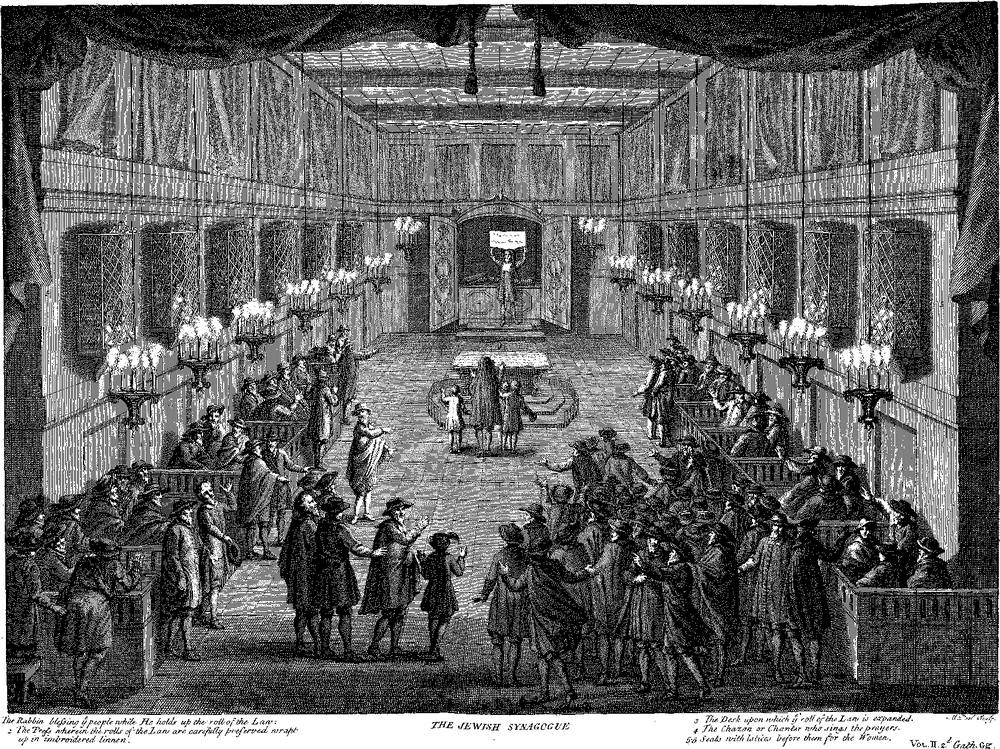
The great Synagogue. The Hebrews a give this Name to a Company of six-score Persons, at the Head of whom was Ezra or Esdras, at their Return from the Babylonish Captivity. This Company was chiefly establish’d for two Reasons. The first was to take Care of restoring the Observation of the Law, according to the antient and approved Practice, that obtained before the Captivity. The second was, to collect all the sacred Books into a Body, and to compose thereof what is call’d the Canon of the Holy Scriptures, and to give an exact and correct Edition of them. They pretend, that after Esdras, Daniel and his three Companions Shadrach, Meshech, and Abednego, held the first Places ; that Simon the Just was at the lower End of the Assembly, and that all these Members were cotemporary.
But this Disposition cannot be supported by Chronology ; for Simon the Just lived a long Time after Daniel and Esdras. But the Hebrew Chronologers do not look so narrowly into Matters. What appears to be most certain in this Affair, is, that Esdras began the Reformation now mention’d ; that it was continued by some of the wiser and more enlightned Jews, and was at last compleated, especially as to the Canon of the Scriptures, under Simon the Just, who was made Highpriest of the Jews in the Year of the World 3702, before Jesus Christ 298, before the vulgar Era 302 ; and who died in the Year of the World 3711, before Christ 289, before the vulgar Era 293.
SYNTYCHE, mention’d by St. Paul Phil. iv. 2.to the Philippians, was a Woman illustrious for her Vertue and good Works, and who was, as it were, at the Head of the Church at Philippi,71 with another Woman call’d Euodias. ‘Tis thought St. Paul speaks of ‘em when he says, Help those Women which laboured with me in the Gospel. But some Difficulties or Disturbances had happen’d between them, and therefore the Apostle exhorts them, that they be of the same Mind in the Lord. We know none of the Particulars of their Lives. Syntyche is set down in the Number of the Saints on July 22, and the Martyrologies insinuate, that her Body rests at Philippi in Macedonia.
Act. xxviii. 12.SYRACUSE, a famous City in Sicily, standing upon the Eastern Coast of this Island. St. Paul went ashore there in his Way to Rome, and continued there three Days. Thence he went to Rhegium, in the 61st Year of the vulgar Era.
Gen. x. 22. Aram.SYRIA, call’d, in Hebrew, Aram, from the Name of the Patriarch who peopled the chief Provinces of it. We have already spoke of him under the Article ARAM. The Arameans, or Syrians, possess’d Mesopotamia, Chaldea, a Part of *Armenia *; Syria, properly so call’d, comprehended between Euphrates towards the East, the Mediterranean towards the West, Cilicia to the North, Phenicia, Judea, and Arabia deserta towards the South. The Hebrews were originally Arameans, since they came out of Mesopotamia, and therefore it is said, that Jacob was a poor Aramean.72 It is certain, however, that he was not descended from Aram, but from Amos ix. 7.Arphaxad, another Son of Shem. Amos seems to say, that the Lord brought up the Assyrians or Aram from Kir, as he had brought up the Philistines from Caphtor. That is to say, that Aram, or his Posterity, came to dwell in Syria, when they quitted the Neighbourhood of the River Cyrus, which is in Armenia.
Syria of the two Rivers, or Mesopotamia of Syria, as it is call’d in the Vulgate, or Aram Naharaim, as it is call’d in the Hebrew, is comprehended between the two Rivers Tigris and Euphrates.
Syria of Damascus, is that of which Damascus was the Capital, and which extended Aram Damashek,eastward along by Mount Libanus. Its Borders are not fixed, but varied according as the Princes that reign’d at Damascus were more or less powerful.
Syria of Zobah, or Soba, or Sobal, as it is call’d by the Septuagint, was probably Cele-syria, or Syria the hollow or flat. Its Capital was Zobah, a City unknown, unless Gen. xiv. 15.it be the same as Hoba or Hobal, to the North of Damascus. See HOBAL or ABILA.
Syria of Maachah, or of Beth-maachah, Aram Naharaim. Aram Tsobah. Aram Maacha.or of Machati, was also towards Libanus. See 2 Sam. x. 6, 8. 1 Kings xiii. 20. 2 Kings xv. 29. It extended beyond Jordan, and was given to Manasseh. Deut. iii. 14. Josh. xii. 4. See MAACHAH.
Syria of Rohob, or Rehob, was that Part Aram Rehob or Rechob.of Syria of which Rehob was the Capital.73
Syria continues on the next page
Footnotes
-
Gassend. l. x. Diogen. Laert. de Meteor. Epicuri. ↩
-
Tit. Liv. l. 1. decad. 1. p. 12. ↩
-
Idem. l. 25, 30, 34, 35. & alibi passim. ↩
-
D. Bern. de Montfaucon, Diar. Italic. c. 21. ↩
-
Catul. carm. de Berecynt. & Athy. Devolvit acuto sibi pondera silice. Exod. xx. 25. ↩
-
Julian. l. 6. Epigram. apud Bonfrer. 1 Jos. v. ↩
-
Levit. xxvi. 1. אבן משכיתLXX. Λίθον σκόπου. ↩
-
Scalig. l. 5. de emend. tempor. Ἱερὸν Ἑρμεία με παρεστῶντες ἔχυεον Ἄνθρωποι λίθινον σωρόν. ↩
-
LXX. Ὃς ἀποδεσμεύει λίθον ἐν σφενδόνῃ, ὅμοιος ↩
-
Prov. xxvi. 8. בצרור אבן במרגמה כן נותן לכסיל כבודἐστι τῷ διδόντι ἄφρονι δόξαν. ↩
-
2 Macc. x. 3. Πυρώσαντες λίθες κỳ πῦρ ἐξ αὐτῶν λαβόντες. ↩
-
Translators’ note. The English Translation thus reads this Passage; A slothful Man is compared to a filthy Stone, and every one will hiss him out to his Disgrace. A slothful Man is compared to the Tuft of a Dunghil; every Man that takes it up will shake his Hand. ↩
-
Rabb. apud Selden. de Synedriis, l. 1. c. 5. l. 2. c. 13. ↩
-
Gen. xliii. 11. The Hebrew is נכאותNechoth. LXX. Θυμίαμα, Aq. στύραξ. ↩
-
חסידהChasida, Ciconia, à חסדMisericordia. ↩
-
Ambros. in Hexaemer. l. 5. c. 16. ↩
-
Publius apud Petron. Vide Bochart. de animal. sacr. t. 2, l. 2. c. 29. ↩
-
Joseph. Antiq. l. 13. c. 19. & de bello, l. 1. c. 3. In the Year of the World 3899, before Christ 101, before the vulgar Era 105. “ feed ↩
-
Bochart. de Animal. sacr. tom. 2. l. 6. c. 11. ↩
-
Translators’ note. Our Translation renders the Cities of Mischenoth by Treasure-cities. ↩
-
Gen. xxxiii. 17. In the Year of the World 2265, before Christ 1735, before the vulgar Era 1739. ↩
-
Hieronym. quæst. Hebr. in Gen. xxxiii. ↩
-
סכות דרעלה Succoth Darala. ↩
-
Vide Selden. de Diis Syr. Syntagm. 2. c. 7. Grot. ad 4 Reg. xvii. 20. Druf. Hamm. Sanct. Lud. de Dieu, in Act. xix. 2. ↩
-
Theophylact. OEcumen. Darala. ↩
-
John xi. 44. Καὶ ἡ ὄψις αὐτοῦ σουδαρίῳ περιεδέδετο. ↩
-
John xx. 7. Καὶ τὸ σουδάριον ὃ ἦν ἐπὶ τῆς κεφαλῆς αὐτοῦ. Sun ↩
-
Gen. i. 16. שמשShemesh. Gr. Ἥλιος, Helios. ↩
-
See Isai. xiii. 10. xxiv. 23. Jerem. xv. 9. Ezek. xxxii. 7. Joel ii. 31. Amos viii. 9. ↩
-
Justin. Martyr. Apolog. 2. ad finem. ↩
-
Iren. apud Author. Resp. ad Orthodox. ↩
-
Tertull. Apologet. & de Anima. ↩
-
Origen. Homil. 6. in Exod. 3 ↩
-
ים סוףJam Suph, Mare junci. ↩
-
שער סורPorta Sur. 2 Kings xi. 6. ↩
-
2 Chron. xxiii. 5. שער היסודPorta hajesod, seu porta fundamenti. ↩
-
Josh. xiii. 3. סרניםSeranim. Vide & Judic. iii. 3. xvi. 5. & passim. ↩
-
Hist. of Susanna. This History happen’d about the Year of the World 3401, before Christ 599, before the vulgar Era 603. ↩
-
Δεισιδαιμονία, inanis terror Deorum. ↩
-
Susan. 54. Ὑπὸ σχῖνον —— ἤδη γὰρ Ἄγγελος τοῦ Θεοῦ σχίσει σε μέσον. 58. Ὑπὸ πρῖνον —— τὴν ῥομφαίαν ἔχων πρίσει σε μέσον. These Allusions, which can only have place in the Greek Tongue, have made it suspected, that this History was never written in Hebrew. But it is not impossible, but that the antient Greek Translator, finding these Allusions in the Hebrew, may have imitated them in Greek, by substituting one Tree for another. ↩
-
Vide Origen. Epist. ad Jul. Afric. & Tract. 31. in Matth. ↩
-
Hieronym. in Jerem. xxxix. 22. & in Jovinian. l. 2. & Præfat. in Daniel. ↩
-
Hieronym. Apolog. Rufin. l. 2. & Præfat. in Daniel. ↩
-
Hieron. ad Matth. xxvii. Beda, Strabus, &c. ↩
-
Pagn. Munster. Buxtorf. Mercer. Rab. Salom. & Kimchi. xv. 15. ↩
-
Matth. viii. 30, 31. Mark v. 11. Luke viii. 32, 33. ↩
-
Plut. Arch. Sympos. l. 4. p. 669. ↩
-
Plin. l. 13. c. 7. Hieronym. in Amos. Theophrast. hist. l. 4. c. 2. Dioscorid. l. 1. ↩
-
Amos vii. 14. בלס שקמיםLXX. Κνίζων συκάμινα. Herodot. Plin. Stephan. alii. ↩
-
ממגדל סונה וערי גבול כוש ↩
-
Strab. Prolom. ↩
-
Strab. l. 10. p. 780, 781. In the Year of the World 3980, before Christ 20, before the vulgar Era 14. ↩
-
Joseph. Antiq. l. 16. c. 13, 14, &c. In the Year of the World 3997, before Christ 3 & 4, and before the vulgar Era 7 & 8. ↩
-
Joseph. Antiq. l. 17. c. 4. In the Year of the World 3999, before Christ 1, before the vulgar Era 5. ↩
-
Συμβολον, Symbolum, derived from συμβαλλω, confero. ↩
-
Prov. xxiii. 20, 21. Μηδὲ ἐν συμβολαῖς. ↩
-
Vide Baron. an. 44. §. 17. Vid. Aug. Serm. 42. apud Lovan. & 241. in Append. nov. edit. t. 5. Hilar. de Trinit. l. 9. ↩
-
Rufin. de Symbolo. Aug. Serm. 58. Leo Ep. 24. ↩
-
Aug. Serm. 212. Hieronym. Ep. 61. Cyrill. Cathech. ↩
-
Euseb. hist. Eccles. l. 6. c. 17. & Demonst. Evang. l. 7. c. 1. in Amos iii. ↩
-
Vid. Hieron. præfat. ad Chronicon. Euseb & ↩
-
Συναγωγὴ, Synagoga. Heb. בית הכנסתDomus Congregationis. ↩
-
Maimon. in Tephilla, c. 11. sect. 1. ↩
-
Gemarr. ad tit. Megillah. c. 3. ad tit. Cethuboth. c. 13. ↩
-
Maimon. apud Joan. Selden. l. 3. c. 16. n. 1. de Synedriis veter. Hebr. ↩
-
Leo of Modena, Ceremonies of the Jews, part. 1. c. 10. ↩
-
Joseph. Antiq. l. 14. c. 7, 8. & de bello, l. 1. c. 5. p. 719. & Antiq. l. 14. c. 28. ↩
-
Tacit. Annal. l. 2. Sueton. in Tiberio, c. 36. & Joseph. Antiq. l. 18. c. 5. ↩
-
Megilla c. 1. §. 3. Maimon. in Tephill. Vide & Lightfoot, Harm. c. 17. & in Matth. iv. 23. ↩
-
Buxtorf. lex. Rab. p. 292. ↩
-
Chrysost. Theodoret. Est. Zanch. Menoc. &c. in Philipp. iv. ↩
-
Deut. xxvi. 5. Syrus persequebatur patrem meum? Heb. Syrus oppressus pater meus. The English reads, A Syrian ready to perish was my Fa- ther. ↩
-
David. Ganz. Chronic. Buxtorf. Tiberius, c. 10. ↩