SINAI, or Sina, a famous Mountain of Arabia Petræa, upon which God gave the Law to Moses a : It stands in a kind of Peninsula, form’d by the two Arms of the Red-sea, one of which stretches out towards the North, and is call’d the Gulph of Kolsum ; the other extends towards the East, and is call’d the Gulph of Elan, or the Elanitich-sea. At this Day the Arabians call Mount Sinai by the Name of Tor, that is, the Mountain, by way of Excellence ; or Gibel Mousa, the Mountain of Moses : It is two hundred and sixty Miles from Cairo, and generally it requires a Journey of ten Days to travel thither. The Wilderness of Sinai, where the Israelites continued incamped for almost a Year, and Coppin’s Voyage to Egypt, c. 10.where Moses erected the Tabernacle of the Covenant, is considerably elevated above the rest of the Country ; and the Ascent to it is by a very craggy Way, the greatest Part of which is cut out of the Rock ; then one comes to a large Space of Ground, which is a Plain surrounded on all Sides by Rocks and Eminencies, whose Length is nearly twelve Miles. the North Side, two high Mountains shew themselves, the highest of which is call’d Sinai, and the other Horeb. The Tops of Horeb and Sinai have a very steep Ascent, and do not stand upon much Ground, in comparison to their extraordinary Heighth : That of Sinai is at least one third part higher than the other, and its Ascent is more upright and difficult. After one is come to the Top of the Mountain, it terminates in an uneven and rugged Place, which might contain about sixty Persons. Upon this Eminence is built a little Chapel of St. Catherine’s, where ‘tis thought the Body of this Saint rested for three hundred and sixty Years ; but afterwards it was removed into a Church which is at the Foot of the Mountain. Near this Chapel issues a Fountain of very good fresh Water ; ‘tis look’d upon as miraculous, it not being conceivable how Water can flow from the Brow of so high and barren a Mountain.
Horeb is to the West of Sinai ; so that at Sun-rising the Shadow of Sinai intirely covers Horeb. Besides the little Fountain which is at the Top of Sinai, as we have mention’d, there is another at the Foot of this Mountain, or of Horeb, which supplies Water to the Monastery of St. Catherine. Five or six Paces from thence they shew a Stone, whose Heighth is four or five Feet and Breadth about three, which, they say, is the very Stone from whence Moses caus’d the Water to gush out : Its Colour is of a spotted grey, and it is, as it were, set in a kind of Earth, where no other Rock appears. This Stone has twelve Holes or Chanels, which are about a Foot wide, from whence it is thought the Water came forth for the Israelites to drink. We shall not here enter into the the Particulars of what was done during the Encampment of the Israelites at the Foot of Sinai, but refer the Reader to the Article Moses.
D’Herbel. Bibl. Orient. p.501.The Arabians reckon among the Children of Israel, one call’d Thor or Thour, who gave his Name to the Mountain of Sinai, which they call Thour-Sinai. They also give the Name of Thour to the City which is at the Foot of the same Mountain, upon the Shore of the Red-sea. Mahomet begins the Chapter in his Alcoran, call’d the Fig, by this Oath : I swear by the Fig, by the Olive, by Mount Sinai, and by the sure and faithful City. The Fig stands for a Mountain of Palestine call’d Thor-lina, the Mountain of the Fig. The Olive stands for the Mount of Olives near Jerusalem. Mount Sinai is known. The faithful City is Mecca. Sinai is in great Veneration among the Mussulmen, because of the Law which God gave to Men upon1 this Mountain. Also they call it sometimes the Mountain of Moses.
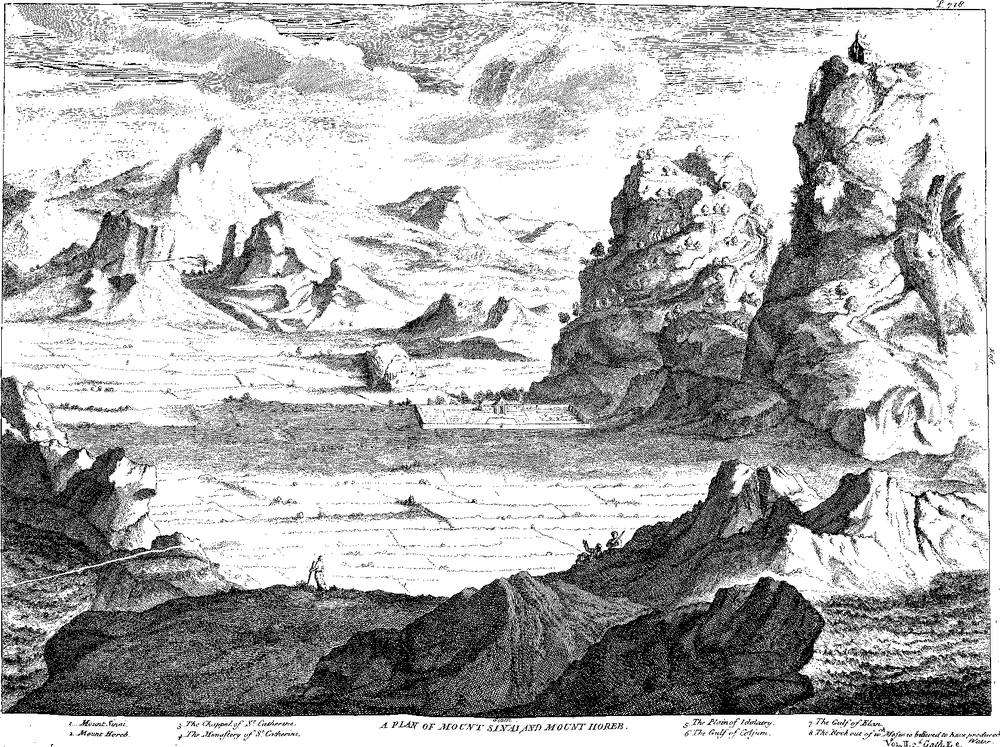
Upon this Mountain there is a Monastery of Greek Monks, who had heretofore only a Tower built near the burning Bush of Moses. But these Monks finding themselves much expos’d to the Insults of the Arabs, who devoured all their Provisions, even so much as the consecrated Bread of the Eucharist; they petition’d the Emperor Justinian to build them a strong Monastery, to secure them from the Depredations of the Arabs. The Emperor comply’d with their Request; but it is said, that he put the Architect to Death, for pitching upon this Place for the Monastery; this he did because of its Nearness to the burning Bush, and for the Conveniency of the Water.
The Name of St. Catherine was given to this Monastery, and to the Mountain itself, because of a Tradition generally received in the Country, that the Body of this Saint was transported hither by the Angels.
Read this article in its place on the printed pages
Footnotes
-
Exod. xix. 1. xxiv. 16. xxxi. 18. xxxiv. 2, 4, &c. Levit. xxv. 1. xxvi. 45, &c. ↩