Gen. iii. 15. נחש Opis Serpens. Eccles. xxv. 15.SERPENT; in Latin, Serpens; in Greek, Ophis; in Hebrew, Nachash. Interpreters have much speculated concerning the Nature of the first Serpent, that tempted Eve. Some have thought, that then the Serpent had two, or four, or many Feet. But there is no Probability that this Animal was otherwise than what it is now. And it cannot be doubted, but that under the Name of the Serpent we are to understand the Devil, who made use of a real Serpent to seduce the first Woman. In the Curse that God gave the Serpent, he told him, that the Seed of the Woman should bruise the Serpent’s Head; because in reality, the Serpent having his Heart under his Throat, and very near his Head, the readiest way to kill him is to squeeze or cut off his Head. Many have suppos’d that his chief Subtilty, or Wisdom, as the Gospel calls it,1 consists in this, that he chuses to expose his whole Body to Danger, that he may save his Head.
Jesus, the Son of Sirach, says, There is no Head above the Head of a Serpent; but by the Word Head in this Place, we should understand the Venom: For the Hebrew Word Rosh, which signifies the Head, signifies See Deut. xxxii. 33.also the Venom of a Serpent, which some place in its Gall, others in its Tongue, and others in its Teeth. The Scripture in different Passages expresses itself, sometimes as supposing the Gall of the Serpent to be its Venom, Job xx. 14. His Meat in his Bowels is turned; it is the Gall of Asps within Psal. cxl. 3. Proverbs xxiii. 32.him. David seems to place it in the Tongue. They have sharpened their Tongues like a Serpent. And Solomon in the Teeth. At the last it biteth like a Serpent, and stingeth like an Adder.
Gen. iii. 14. Isa. lxv. 25. Mic. vii. 17.Another Curse that God gave the Serpent was, that it should feed upon Dust. Dust shalt thou eat all the Days of thy Life. Isaiah says also, that Dust is the Food of the Serpent. Dust shall be the Serpent’s Meat. And Micah; They shall lick the Dust like a Serpent. ‘Tis true, however, that they eat Flesh, Birds, Frogs, Fish, Fruits, Grass, &c. But as they continually creep upon the Earth, it is impossible but that their Food must be often defiled with Dust and Dirt. Some of ‘em may really eat Earth out of Necessity, or at least Earth-worms, which2 they cannot swallow without a good deal of Dirt with them.
The Craft, the Wisdom, the Subtilty of the Serpent, are things insisted on in Scripture, as Qualities that distinguish them from other Animals. Moses intending to prepare the Mind of his Reader for the relation of Eve’s Temptation, begins with affirming, Now the Serpent was more subtil than any Beast of the Field which the Lord God had made. And Jesus Christ himself recommends to his Apostles, to have the Wisdom of the Serpent. They bring several Proofs of this Subtilty of the Serpent. They tell us, that the Cerastes hides himself in the Sand, in order to bite the Horse’s Foot, that he might throw his Rider. Jacob makes an Allusion to this in the Blessing he gave to Dan. Dan shall be a Serpent by the Way, an Adder in the Path, that biteth the Horseheels, so that his Rider shall fall backward. Epiphan. Physiolog.Epiphanius brings four Proofs of the Wisdom of the Serpent. First, When he is old, he has the Secret of growing young again, and of stripping off his old Skin or Slough, by squeezing himself between two Rocks. Secondly, He assaults a Man if he sees him naked, but flees if he finds him cloathed. But it is probable there is a Fault in this Passage of Epiphanius, and that he intends to say the contrary of this. For it is generally affirm’d,3 that the Serpent is afraid of a naked Man, but attacks him if he has his Cloaths on. Thirdly, When he is assaulted, his chief Care is to secure his Head. This is attested by a great Number of Writers. Lastly, When he goes to drink at a Fountain, he first vomits up all his Poison, for fear of poisoning himself as he is drinking. This Observation is not assented to by every Body, tho’ it has a great many Defenders.
They relate still other Instances of the Serpent’s Subtilty; as, for Example, it stops up its Ears that it may not hear the Voice of the Charmer or Inchanter. The Psalmist takes notice of this piece of Subtilty of the Adder. Like the deaf Adder that stoppeth her Ear, which will not hearken to the Voice of the Charmers, charming never so wisely. ‘Tis said it applies one of its Ears hard to the Ground, and stops up the other with the End of its Tail. We have written a Dissertation upon this, which is put before our second Tome upon the Psalms. See also Bochart, De Animal. sacr. par. 2. l. 3.4. 6. and the Commentators upon Psalm lviii. 4. Others say, the Subtilty of the Serpent consists in its Agility and Suppleness; or in a Secret it has in recovering its Sight by the Juice of Fennil. Lastly, every one proposes his own Conjectures in this matter. Bochart. de animal. sacr. t. 1. l. 3. c. 5.We have particularly spoken of the Serpents mentioned in Scripture, under their proper Articles. There were eleven Kind of Serpents known among the Hebrews;5 1. Ephe, the Viper. 2. Chephir, a sort of Aspick, or a Lion. 3. Acshub, the Aspick. 4. Pethen, the Aspick. 5. Tzeboa, a speckled Serpent, call’d Hyena by the Greeks and Egyptians. 6. Tzimmaon, according to St. Jerome. This is the Serpent call’d Dipsas, because of the Thirst that its Biting produces. But Bochart maintains, that it does not signify a Serpent, but a dry and burnt-up Place. 7. Tzepha, or Tziphoni, a Basilisk: Not the fabulous Serpent or Cockatrice, of which they tell so many foolish Stories, but the true Regulus or Basilisk, which is a Serpent made like others, but more dangerous, and whose Poison is more subtil. See BASILISK, and Bochart de Animal. sacr. p. 2. l. 3. c. 9, 10. 8. The Kippos, which the Septuagint, St. Jerome, and the Chaldee understand of the Urchin or Hedge-hog; but the same Bochart thinks it to be the Serpent call’d by the Greeks Acontias, that is to say, the Dart, so call’d, because it darts itself very far and very high after its Prey. See Bochart, de Animal. sacr. par. 2. l. 3. c. 11, and the Authors he refers to. 9. The Shephiphon, which St. Jerome has translated by Cerastes, Gen. xlix. 17. This Serpent is of the Colour of Sand, in which it hides itself, and where it watches its Prey. The Name of Cerastes is given it, because it has a sort of fleshy Horns, or two Bunches in the Shape of Grains of Barley. Bochart, de Animal. sacr. p. 2. l. 3. c. 12. 10. The tenth sort of Serpents is call’d in Hebrew, Shacal, and is mention’d in Psalm xci. 13. Thou shalt tread upon the Lion and Adder; the young Lion and the Dragon shalt thou trample under Feet. The Septuagint, the Syriack, and the Arabick understand it here; Bochart supports their Opinion,4 and shews, that the Name of Black, for that’s the Signification of Shacal, agrees to several Serpents, and particularly to the Aspick, the Dipsas, the Hydra, &c. but the greatest Part of the more knowing Interpreters are of Opinion, that the Word Shacal, in this place, signifies a Lion, and not a Serpent. And this Sentiment seems to us much more probable. It is certain that this Hebrew Word generally signifies a black Lion, as this Author proves himself. 11. Lastly, the Saraph is a flying Bochart. de animal. sacr. t. 1. l. 3. c. 5.Serpent, and is the only Serpent that we know that has Wings. The Word Saraph properly signifies to burn, and ‘tis thought this Name was given it, either because of its Colour, or because of that Heat and Herodot. l. 2. c. 75, 76.Thirst it creates by its Biting. Herodotus, who had seen of these Serpents, says, they had great resemblance to those which the Greeks and Latins call’d Hydræ. Bochart endeavours to prove they were real Hydræ. The same Herodotus tells us, he went on purpose to the City of Butus, to see those flying Serpents of which he had heard speak. He saw near this City great Heaps of Bones, and the Spines of those Animals, that had been put to Death and devoured by the Ibis. The Place, says he, where they are to be seen is a narrow Neck that widens towards Egypt. When therefore, at the Beginning of the Spring, these Serpents endeavour to come out of Arabia into Egypt, the Bird call’d Ibis sets upon them, and destroys a great Number of them. The Wings of these Serpents are not Feathers, like the Wings of Birds, but rather like to those of Batts.
Idem. l. 3. c.107,108, 109, 110.He says elsewhere, that these Serpents are not large; that they are speckled, or of several Colours; that they are in such great Quantities in Arabia, that the Inhabitants could not subsist for ‘em, if Providence had allow’d them to multiply according to the usual Laws of Nature. But the Arabians affirm, that the Female puts the Male to Death when they engender, and that the young ones at their Birth kill their Mother. They love sweet Smells, and frequent such Trees as bear Spices, and the Marshes where the aromatick Reed (or Casia) grows. The Arabians drive them away from about the Trees by the Smoke of Styrax; and when they go to gather the Reed (or Casia) they cloath themselves with Skins, and cover their Heads, all but their Eyes; then they go into these Marshes, from whence they drive away the winged Serpents, whose Flight has something terrible, and whose Biting is very dangerous.
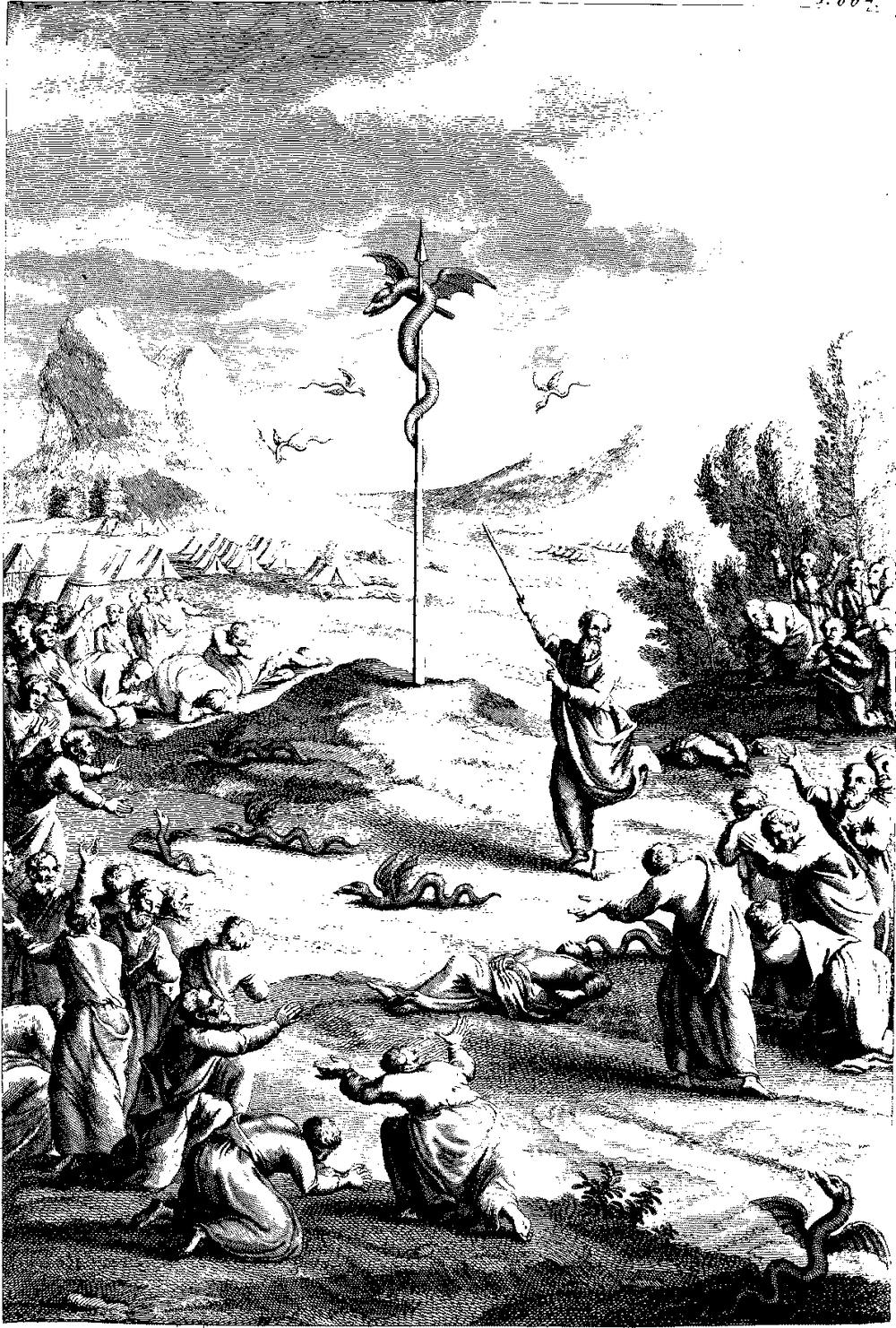
We have a little enlarged upon these Numbers xxi. 9. Isa. vi. 2. xiv. 29. xxx. 6.Serpents, call’d Saraph in Scripture, because it was these Serpents that made so great a Destruction among the Israelites, and were the Death of so many People in the Desart. ‘Twas one of these Saraphs that Moses caus’d to be put up in the Wilderness, at the Sight of which the Israelites were made whole. On this Subject may be read Bochart de Animal. sacr. p. 2. l. 3. c. 13, and Cicero, l. 1. de Natura Deorum; Mela, l. 3. c. 9. Lucan, l. 6. Solinus, c. 32. Ammianus Marcellinus, c. 22. Ælian, l. 2. c. 38. and other of the Moderns, quoted by the same Bochart, who speak of these flying Serpents.
Brazen Serpent. This was a Figure of the Serpent Saraph, of which we have now spoke, which Moses caus’d to be put on the Numbers xxi. 9.Top of a Pike, promising the Hebrews, that all those that should be bit by Serpents, and who should look upon this Image, should be presently healed. The Event was answerable to this Promise. Our Saviour John iii. 14.in the Gospel of St. John informs us, that this Serpent thus rais’d up, was a Representation of his Passion and Crucifixion. As Moses lifted up the Serpent in the Wilderness, even so must the Son of Man be lifted up. This Brazen Serpent was preserved among the Israelites down to the Time of Hezekiah, who being inform’d the People paid a superstitious Worship to it, had it broke in Pieces, and by way of Contempt gave it the Name of Nehushtan, that is to say, a brazen Bawble or Trifle. See 2 Kings xviii. 4.HEZEKIAH and NEHUSHTAN.
The Arrow Serpent, call’d in Greek, Acousias, is a flying Serpent, known to the Bib. Orien. p. 684.Turks by the Name of Ocilan. They are often seen in the Archipelago, and chiefly in the Island of Metelin; they fight with one another in the Air, but do Men no Harm. ‘Twas this kind of Serpent that set upon the Israelites in the Wilderness. A learned English-man pretends6, that the Activity and Splendor accompanying these Animals, may serve for an Emblem to express the Zeal and Purity of the Angels which in Scripture are call’d Seraphim, which is the Name that the Hebrews gave to the Serpents we are speaking of. He thinks that the Angels, when they made their Appearances to Men, assum’d the Form of Seraphs, or of flying Serpents; that the Devil spoke to Eve in the same Shape; that it was this that deceived her, and made her fall into the Snare, imagining him to be a Seraphim or Angel. He adds, that it was this that gave occasion to that odd Thought of some antient Hereticks,7 who pretended, that the Serpent who tempted Eve was the Son of God, or the Christ, very different from Jesus, and that she believed him as such. But to leave these Whimsies;
I think we may put into the same Class another Marsham. Canon. Chronic.Opinion of a learned Man, who imagin’d that the Brazen Serpent was a kind of Talisman, that is to say, one of those Pieces of Metal which are cast and engraven under certain Constellations, from whence they derive an extraordinary Vertue to procure Love, to cure Distempers, and such like. Some impute their Effects to the Devil; others to the Nature of the Metal, and to the Influence of the Constellation. This Author, therefore, would make us believe, that the Brazen Serpent set up by Moses cured the Hebrews when bit by Serpents, just as the Talismans cure certain Distempers by the Sympathy there is between the Metals of which they are made, or the Influence of the Stars under which they are form’d, and the Disease they are to cure. Buxtorf, on the contrary, thinks,8 that the Sight of the Brazen Serpent, ought naturally to increase the Distemper of the Wounded, instead of healing it; and that God shew’d a double Efficacy of his Power, by healing with Means which ought to have had a quite contrary Effect. But it is to little purpose to multiply Miracles here; that which God wrought by the Brazen Serpent is here very manifest.
In the Church of St. Ambrose at Milan they pretend to keep a Brazen Serpent, which they shew for that of Moses; but every one may believe of this as he pleases. The Serpent that is always represented with Esculapius, and with the Goddess Salus, and often with the Egyptian Deities, is a Symbol of Healing or Health, which perhaps is derived from the Brazen Serpent of Moses.
The Worship of the Serpent is observed through all the Pagan Antiquity. The Devil who tempted the first Woman under the Shape of a Serpent, takes a Pleasure to deify this Animal, as a Trophy of his Victory over Mankind. The Babylonians in Daniel’s Time worshipp’d a Dragon, which was demolish’d Bell and Dragon.by this Prophet. ‘Tis well known what Worship was paid to the Serpent at Epidaurus, and the Manner in which it was pretended he was brought to Rome. The Egyptians sometimes represented their Gods with the Bodies of Serpents; and they paid an Idolatrous Worship to these so odious and dangerous Animals. They call’d them their good Genius’s, and look’d upon them as the Symbol of Medicine, of the Sun, of Apollo. They were put into the Charge of Ceres and Proserpine. Herodotus says, that in his time, near Herodot. l. 2. c. 74.Thebes, were to be seen tame Serpents consecrated to Jupiter. They did nobody any harm, and after their Death they were buried in Jupiter’s Temple. They were of the Cerastes, had two Horns, and were but small.
Ælian. de anim. l. xi. c. 22. Idem. l. xi. c. 17.Elian speaks of a sacred Dragon, that was kept in Phrygia, in a Wood dedicated to Diana. He also speaks of domestick Serpents, which were in the Houses of the Egyptians, were there fed, and look’d upon as Houshold-Gods; and of another Serpent worshipp’d in a Tower at Melitus in Egypt. He had a Priest and Officers to attend him. He was served every Day upon a Table or Altar with Meal kneaded up with Honey, which the next Day was found to be eaten up. At this Day Serpents are honour’d in Calecut; the Kings and the Bramins look upon them as sacred Animals, created by God to afflict Men, and to punish them for their Sins.
The Ophites took their Name from Ophis, which, in Greek, signifies a Serpent. These antient Hereticks9 worshipp’d the Serpent that betray’d Eve, and ascribed all sorts of Knowledge to this Animal, of which they thought them to be Masters and Inventors. In a word, they believed the Serpent that tempted Eve was the Christ, which afterwards came down and was incarnate in the Person of Jesus. That it was Jesus, but not the Christ, that suffer’d. For which reason they made all Proselytes to their Sect to renounce Jesus. When their Priests celebrated their Mysteries, they made one of these Creatures to come out of his Hole, and after he had roul’d himself upon the things that were to be offer’d in Sacrifice, they said that Jesus Christ had sanctified them, and then gave them to the People to worship them.
Isa. xxv. 1. נחש ברחSerpent crossing like a Bar; Serpens vectis, Vulgate. This Serpent is found in two Passages of Scripture: First in Isaiah, In die illa visitabit Dominus in gladio suo ——— super Leviathan serpentem vectem,10 & super Leviathan serpentem tortuosum. The Hebrew says, Nachash beriach, and Nachash aktalon. Job11 speaks of the same Serpent; but St. Jerome has translated the Hebrew by serpentem tortuosum. Some render the Hebrew, Nachash beriach, by flying Serpent, or shutting Serpent, as a Bar that shuts a Door. Bochart12 thinks, that this Serpens vectis is no other than the Baratell, a Fish known in Oppian, Elian, Galen, Suidas, under the Name of Zygæna. Its Head is neither round, nor high, nor flat, nor pointed, but swelling on the two Sides, one stretching transversly like a Bar. ‘Tis known that the Hebrews reckon’d Fishes in the Tribe of Reptiles and Serpents, and that the Crocodile or Leviathan is also of this Number.
Job xxvi. 13. Is. xxvii. 1.Serpent is also taken for the Devil. The invisible Serpent that tempted Eve by the Organs of the sensible Serpent, was the Devil, as the Scripture and the Commentators allow. Some also explain of the Devil what Job says of the crooked Serpent, and what Isaiah says of the Serpent like a Bar. See the foregoing Rev. xii. 9, 14.Article. St. John in his Revelation observes plainly, that the Old Serpent is the Devil and Satan. And the great Dragon was cast out, that Old Serpent call’d the Devil and Satan, which deceiveth the whole Word. The Jews also call the Devil, the Old Serpent.
Read this article in its place on the printed pages
Footnotes
-
Matth. x. 16. Vide Epiphan. hæres. 37. & Physiolog. Chrysost. in Psal. cxiv. Isidor. Hispal. Orig. l. 12. c. 4. Peluziot. l. 1. Ep. 126. alii. ↩
-
Nicander. Theriac. v. 372. & Phil. c. 59. Vide Bochart. de animal. sacr. p. 1. l. 1. c. 4. to ↩
-
Eustath. in Hexaemer. Hieronym. seu alius, Ep. ad Præsidium. Isidor. l. 12. c. 4. Origen. &c. ↩
-
Bochart. de animal. sacr. t. 2. l. 3. c. 3. p. 375, 376. Pethen, the Aspick. 5. Tzeboa, a speckled Serpent, call’ ↩ ↩2
-
- אפעה Ephe, a Viper. 2. כפיר Chephir, a sort of Aspick. 3. עכשוב Acshub, an Aspick. 4. פתן Peten, an Aspick. 5. צבוע Tzeboa, a Serpent call’d Hyena. 6. צמאון Tzimmaon, a dry Place. See Boch. de animal. sacr. par. 2. l. 3. c. 8. 7. צפע or צפעני Tzepha or Tziphoni, the Basilisk. 8. קפוז Kippos, the Serpent call’d Acontias, or the Dart. 9. שפיפון Shephiphon; this is the Cerastes or Hæmorrhous. 10. שחל Shacal. LXX, ἀσπίς. 11. שרף Sharaph. Serpens adurens & volucer.
-
Thom. Tennison, Discourse of Idol. c. 14. p. 354. ↩
-
Tertull. de præscript. Hæretic. c. 4, 7. Epiphan. hæres. 37. ↩
-
Buxtorf. fil. Hist. de Serpente æneo. Tertull. de præscript. c. 47. ↩
-
Epiphan. de hæres. 37. tren. l. 1. c. 34. Origen. l. 6. contra Cels. ↩
-
Translators’ note. In our Translation, the piercing Serpent. Serpentem tortuosum. ↩
-
Job xxvi. 13. נחש ברחVulg. ↩
-
Bochart. de animal. sacr. p. 2. l. 5. c. 13. ↩