Volume III, pages 180–200 of the 1732 edition, from WR to ZE: everything printed on these pages, in order.
Continued from Worm
become red as we have before described. Then, if they have time enough, they hatch, and produce a prodigious quantity of little Gnats of a red Colour, which creeping here and there upon the Shrub, that supplied the place of a Matrix to them, they leave thereon against the Year following the Rudiments of those Grains or Pods we mentioned before.
Vermiculatus is found in the Canticles i. 10. Murenulas aureas faciemus tibi vermiculatas argento. We will make you Bracelets of Gold spotted with Silver; according to the Letter, worm-eaten with Silver. For Vermiculari signifies to be worm-eaten; and in a figurative Sense, to be inlaid, studded, spangled, or spotted. The Hebrew has it,1 Collars of Gold, with Holes of Silver; or, Borders of Gold, with Studs of Silver: The Septuagint, We will make you Figures with Points of Silver. St. Jerome,2 in his Letter to Marcella, a Roman Lady, describes those Collars called Murenulæ. He says, they were made of Silver Threads or Rings, interwove one within another. They probably gave them the Name of the Muræna, or Lamprey, because of the Variety of Colours, and the Holes or Eyes that were represented thereon, as we see upon the back of a Lamprey.
WRESTLING of Jacob, with the Angel Genesis xxxii. 24.that appeared to him at Peniel. It is said in Genesis, that when Jacob had made his People to pass over the Brook Jabbok, he was left alone, and there wrestled a man with him, until the breaking of the day. And when he saw that he prevailed not against him, he touched the hollow of his thigh; and the hollow of Jacob’s thigh was out of joint, as he wrestled with him. And he said, Let me go, for the day breaketh: And he said, I will not let thee go, except thou bless me. The Angel blessed him in the same Place, and changed his Name into Israel; and Jacob gave the Name of Peniel to this Place; which is as much as to say, the Appearance of God. Moses gives the Name of Man to him that wrestled with Jacob, but there is no doubt but it was an Angel: And the Prophet Hosea expressly affirms it; He had power over the angel, Hos. xii. 4.and prevailed. Several of the ancient Fathers have thought3 that it was the Son of God, the second Person of the Holy Trinity, who appeared in this Place. Origen4 cites from an Apocryphal Work, that the Angel Israel, the chief of Angels, came into the Body of Jacob, and Uriel, the eighth of the Angels, assuming the Likeness of Jacob, contended with Israel. Some of the Ancients, as is related by Procopius,5 thought that this Man was the Devil under the Shape of Esau, that contended with Jacob. Some of the Rabbins have pretended that it was the Angel of Esau, or rather the Angel of the Country of Esau, who wrestled with Jacob, to compel him to resign up the Right of Primogeniture, which he had obtained from Esau. The Commentators may be consulted upon this Matter.
As to the Sinew of Jacob’s Thigh, which was touched by the Angel, ‘tis thought that the Angel touched his Thigh in that place, where the great Bone enters the Acetabulum of the Os sacrum. He touched him in the thickest and most fleshy Part of the Thigh, and made the Sinews contract, which caused Jacob to be lame. Some say that he only halted for a few Moments; others, that he halted till his Arrival at Shechem; and lastly, others say, that he was lame as long as he lived.
As for what relates to the Jews abstaining from the Sinew of the Thigh: Quam ob causam non comedunt nervum filii Israel, qui emarcuit in femore Jacob, usque in præsentem diem, see the Article SINEW.
‘Tis enquired, whether this Wrestling of Jacob was a real Event, or only a mere Vision? Theodoret,6 and the Rabbin Maimonides,7 were of opinion, that all this passed only in his Mind, and had no other Reality but in Jacob’s Imagination. This Patriarch being strongly possessed with the Danger he was going to encounter, at meeting his Brother Esau, had this Vision to encourage him. God caused him to perceive in a Dream a Man wrestling with him; and, not being able to overcome him, says to him, You shall no longer be called Jacob but Israel, that is to say, he that overpowers God: For, adds he, If you have the better in struggling with God, or with an Angel, much more will you get the Advantage when you strive only against a Man, against your Brother Esau. And as a Proof that this Vision was more than an ordinary Dream, it seemed to him that the Angel touched his Thigh; and in effect, as soon as he
awoke, he found himself lame, probably by the Force of his Imagination.
This is what may be advanced to support that Opinion, which would have all this to pass in a Vision. But the general Sentiment is, and which is best founded,
XALOTH, a Village lying in the great Plain, that bounds the Lower Galilee, towards the South. Joseph. de Bell. Lib. iii. c. 2.
XERXES, Son of Darius, Son of Hystaspes, and his Successor in the Kingdom of Persia: He ascended the Throne in the Year of the World 3519, before Christ 481, before the Vulgar Æra 485. He was Son to Atossa, the Daughter of Cyrus, and Darius his Father declared him King a little before his Death. To him are applied these Words of Daniel; Behold there, shall Dan. ix. 2, 3, &c.stand up yet three kings in Persia, (these three are Cyrus, Cambyses, and Darius Son of Hystaspes) and the fourth shall be far richer than they all. And by his strength, through his riches, he shall stir up all against the Realm of Grecia. And in effect, when Xerxes had subdued the Egyptians, the Phœnicians, the Isle of Cyprus, Cilicia, Pamphylia, Pisidia, Lycia, Caria, Mysia, Troas, the Hellespont, Bythinia, and Pontus, with whom he made War for the Space of three or four Years; he then sent Ambassadors into Greece, to demand Earth and Water, as a Token of their Submission. a But this being refused, he set out the Year following, and set upon the Greeks by Sea and Land, with such a prodigious number of Forces, that the like had never been seen before. It is well known from History how this great Undertaking miscarried. He returned to Susa, and thence to Ecbatana. He was killed in the Year of the World 3531, before Christ 469, before the Vulgar Æra 473; and his Successor was Artaxerxes surnamed Longimanus. Xerxes reigned only twelve Years.
We are informed by Josephus,8 that this Prince confirmed to the Jews all the Privileges that had been granted them by Darius the Son of Hystaspes, his Father,
Vol. III. that this Affair really happened to Jacob. The Account of Moses seems to admit of no other Explication; and Jacob’s Infirmity, which was a Consequence of it, proves that this must be something more than a Dream.
and particularly, that which assigned to them the Tributes of Samaria, for the Charge of the Sacrifices that were to be offered in the Temple of Jerusalem.
In the second Year of his Reign he marched against the Egyptians;9 and having overcome them, he increased the Yoke of their Servitude. He gave the Government of this Kingdom to his Brother Achemenes, and at the end of the Year returned to Shushan.
Proud of the Success of this Expedition, he resolved upon a War against the Grecians, at the Instigation of Mardonius the Son of Gebrias, who had married one of his Sisters.10 Josephus11 thinks, that the Jews were ordered to march with him in this Expedition; and he applies to them what the Poet Chærilus says, in the Description he gives of the several Nations of which the Army of Xerxes was composed. There was a People, says he, that had something extraordinary in their Mein and Dress: Their Language was Phœnician: They inhabit the Mountains of Solymæ, along which there is a great Lake. They wear their Hair cut round. Salmasius12 is of the same Opinion with Josephus. And since the Jews were in Subjection to Xerxes, what Reason could he have to excuse them from going along with him to this War, as well as the other Nations under his Jurisdiction? Yet Scaliger, Bochart, Annæus, and most of the Learned now maintain, that Chærilus intended to speak of the Solymi of Pisidia. See SOLYMI, before.
After his Return from this famous and unfortunate Expedition, Xerxes gave Orders to demolish all the Temples of the Grecian Cities in Asia,13 which was executed accordingly. There were none spared but that of Diana at Ephesus, probably Aaa14
bably by reason of its Magnificence. He did the same in all the Places through which he passed, destroying in the Course of this Expedition all the idolatrous Temples he found on his Way. This was neither out of Aversion towards the People, nor out of any Singularity of Temper, that he was induced to do this: But it was out of Zeal for the Religion of the Magi, in which Zoroaster had instructed him, and had infused into him the utmost Horror of Idols and Images. At his Return he passed through Babylon, where he destroyed Idolatry and Idols,15 by the same Motive that had prevailed with him to pull down the Grecian Temples. Thus the Prophecies of Jeremiah were fulfilled, Jerem. l. 2.who says, Babylon is taken, Bel is confounded, Merodach is broken in pieces, her Idols are confounded, her Images are Jerem. li. 44,47,52.broken in pieces. And again; I will punish Bel in Babylon, and I will bring forth out of his mouth that which he hath swallowed up. I will do judgment upon the graven images of Babylon.
XYLOPHORIA, a Feast of the Hebrews, in which they brought Wood into the Temple with great Solemnity, for the Support of the Sacred Fire that was continually burning upon the Altar of Burnt-Sacrifices. We do not find this Feast mentioned in any Passage of the Scriptures; but Josephus speaks of it, Lib. 2. Ch. xvii. p. 811. of the War of the Jews. Selden will have his Provision to be laid up in the Month Ab, answering nearly to our July. Others place it in the Month Elul, which answers to August. The Rabbins inform us, that they prepared with great care the Wood that was to be burnt upon the Altar, that they made it very clean, and that they permitted no Rottenness, Corruption, or Mouldiness to be amongst it.
YEAR. The Hebrews had always Years, of twelve Months each. But at the Beginning, and in the time of Moses, they were Solar Years, of twelve Months a -piece, having thirty Days to each Month; so that however the Twelfth Month had thirty-five Days. We see by the reckoning that Moses gives us of the Days of the Deluge, Gen. vii.that the Hebrew Year consisted of Three hundred and sixty-five Days. ‘Tis supposed16 that they had an intercalary Month at the End of one hundred and twenty Years; at which time the Beginning of their Year would be out of its Place full thirty Days. But it must be owned, that no mention is made in Scripture of the thirteenth Month, or of any Intercalation. It is probable that Moses retained the Order of the Egyptian Year, since he himself came out of Egypt, was born there, had been instructed and brought up there, and since the People of Israel, whose Chief he was, had been for a long time accustomed to this Year. But the Egyptian Year was Solar, and consisted of twelve Months of thirty Days each, and that for a very long time before; as we have shewn in our Dissertation upon Chronology, before our Commentary upon Genesis.
After the time of Alexander the Great, and the Reign of the Grecians in Asia, the Jews reckoned by Lunar Months, chiefly in what related to Religion, and the Order of the Festivals. He made the Moon Ecclus. xliii. 6. Rev. xi. 2, 3. xii. 6, 14. xiii. 5. Gemin. Isagog. c. 6.also to serve in her season, for a declaration of times, and a sign of the world. From the Moon is the sign of feasts, a light that decreaseth in her perfection, says the Author of Ecclesiasticus. St. John, in his Revelations, assigns but twelve hundred and sixty Days to three Years and an half; and consequently just thirty Days to every Month, and just three hundred and sixty Days to every Year. Maimonides tells us, that the Years of the Jews were Solar, and their Months Lunar; and Geminius makes the same Observation upon the Years of the Greeks: Universi Græci annos juxta solem, menses verò & dies juxta lunam agebant. Since the compleating of the Talmud, they have made use of Years that are purely Lunar, having alternately a full Month of thirty Days, and then a defective Month of twenty-nine Days. And to accommodate this Lunar Year to the Course of the Sun, at the End of three Years they intercalate a whole Month after Adar; which intercalated Month they call Ve-adar, or the second Adar.
The Civil Year of the Hebrews has always begun at Autumn, at the Month they now call Tizri, which answers to
our September, and sometimes enters into October, according as the Lunations happen. But their Sacred Years, by which the Festivals, Assemblies, and all other religious Acts, were regulated, begin in the Spring at the Month Nisan, which answers to March, and sometimes takes up a Part of April, according to the Course of the Moon. Here follows the Order and Names of the present Hebrew Months.
-
Tizri, a compleat Month, of thirty Days, and answers to September.
-
Marschevan, a deficient Month, of only twenty-nine Days, and answers to October.
-
Casleu, a compleat Month, answering to November.
-
Thebet, a deficient Month, answering to December.
-
Sebat, a compleat Month, answering to January.
-
Adar, a deficient Month, answering to February.
-
Nisan, a compleat Month, answering to March.
-
Jiar, a deficient Month, answering to April.
-
Sivan, a compleat Month, answering to May.
-
Thammuz, a deficient Month, answering to June.
-
Ab, a compleat Month, answering to July.
-
Elul, a deficient Month, answering to August.
See the Article MONTH, before, and the Hebrew Calendar, at the End of the Dictionary.
Nothing is more equivocal among the Ancients, than the Term Year. The Year always has been, and still is, a Source of Disputes among the Learned, whether on account of its Duration, its Beginning, or its End. Some think, that from the Beginning of the World to the hundred and sixtieth Year of Enoch, they reckoned only by Weeks; and that it was the Angel Uriel who revealed to Enoch the Use of Months, Years, the Revolutions of the Stars, and the Return of the Seasons. Some People heretofore made their Year to consist of one Month, others of four, others of six, others of ten, and others of twelve. Some have divided one of our Years into two, and have made one Year of Winter, another of Summer. The Beginning of the Year was fixed sometimes at Autumn, sometimes at the Spring, and sometimes at Mid-winter. Some People have used Lunar Months, others Solar. Even the Days have been differently divided: Some People beginning them at Evening, others at Morning, others at Noon, and others at Mid-night. With some the Hours were equal, both in Winter and Summer; with others they were unequal. They counted twelve Hours to the Day, and as many to the Night. In Summer the Hours of the Day were longer than those of the Night; but on the contrary, in Winter the Hours of the Night were longer than those of the Day. See the Article HOUR.
Formerly the Egyptians allowed but one Month to their Year,a then two, then four Months, and, lastly, twelve Months.17 ‘Tis said to have been King Pison who gave it a regular Form of twelve Months and five Days. But this Regulation must have been very ancient, since Moses, who had been educated and instructed in Egypt, knew no other Year than that of twelve Months. The Egyptians began it at the Rising of the Dog-Star,18 or at the Beginning of Autumn:19 For it appears that they made a Variation in this, as well as in the Beginning of their Months; having begun them sometimes in the Evening, sometimes in the Morning.
We know not the Form of the ancient Chaldean Year, because their ancient History is unknown.20 They boasted formerly of a prodigious Antiquity, and pretended to have Astronomical Observations for four hundred and seventy-two thousand Years, according to Diodorus Siculus,21 or for four hundred and seventy thousand Years, according to Cicero;22 or only for seven hundred and twenty thousand, according to Epigenes, quoted by Pliny.23 When Calisthenes was at Babylon, and very inquisitive to know the Truth of this, he sent word to Aristotle,24 that he could find no Observations that were beyond a thousand nine hundred and three Years; which, by proceeding backwards would bring us nearly to the time of the building of Babylon. We are assured, that they began their Day at Sunrising, in honour of their principal Deity.
The Grecians at the Beginning had no fixed Years. Several People of Greece made their Year of four Months:25 Those26
of Arcadia first made it of one Month only, afterwards of three Months: Those of Caria and Acarnania made it sometimes of one Month, and sometimes of six. But from the time of Homer it appears to have been settled at twelve Months. The ancient Year of the Athenians was fixed at three hundred and sixty Days.27 It was afterwards extended to three hundred and sixty-five Days. They began it at the Vernal Equinox: Their Days were reckoned from one Evening to another, and the Year was divided into four Seasons, Spring, Summer, Autumn, and Winter. At the time of Homer they did not yet know the Hours, according to our Manner of speaking. The Word Hour in this Poet signifies the Seasons.28 It was Anaximenes and Anaximander29 who received from the Babylonians the way of reckoning by Hours.
Among the Latins, or People of Italy, the Year was at first no more fixed than among the other Nations now mentioned. Romulus’s Year consisted of ten Months,30 as well as that of the Albans. It had three hundred Days, began in March, and ended in December. King Tarquin is said to have added to it the two Months of January and February.31 As to the Civil Year, the Beginning was fixed in January; because then the Sun approaches towards us;32 but as to the Sacred Year, they continued to begin it in March.
The People of Lavinium made their Year of thirteen Months, or of three hundred and seventy-four Days. Those of Umbria made it consist of fourteen Months. The Albans alotted thirty-six Days to the Month of March; twelve to May; twenty-eight to August; sixteen to September; Those of Tusculum appointed thirty-six Days to July, and thirty-two to October. Those of Aricia made it consist of thirty-nine Days. Neither the Romans, nor any other People of Italy, reckoned by Weeks, as obtained among the Orientals; but they had three Terms for reckoning the Days of every Month. The Kalends were always the first Day of the Month. In the Months of March, May, July, and October, the six first Days belonged to the Nones. The other Months of the Year had but four Days before the Nones. From the Nones to the Ides were always eight Days. What remained after the Ides was reckoned according to its Distance from the following Kalends. For all this matter our Dissertation upon Chronology may be consulted, before the Commentary upon Genesis.
The Hebrews always reckoned by Weeks, as a Memorial of the Creation of the World, which was performed in seven Days. They had Weeks of seven Years apiece, at the Term of which was the Sabbatical Year: As also Weeks of seven times seven Years, that were terminated by the Year of Jubilee; and finally Weeks of seven Days.
The Days were reckoned among them from Evening to Evening, both in their Sacred Levit. xxiii. 32. Matth. xx. 3, 4. John xi. 9.and Civil Accounts. Moses makes no Distinction in this respect between Festival Days and other Days. The Feasts began inter duas vesperas;33 that is to say, between the Declining and Setting of the Sun. After that the Jews were in Subjection to the Greeks, and then to the Romans, they were obliged to conform themselves to their Customs to maintain Order, by beginning their Day at Mid-night, or in the Morning, and by distributing the Day into twelve unequal Hours, as also the Night. This Usage is plainly expressed in St. Matthew and St. John.
YESTERDAY, and to day, are used to denote, one of them all the time past, even at a distance, and the other the present Time, but of a larger Extent than the Day on which one speaks: If the ox was wont to push with his horn in time past; the Hebrew Exod. xxi. 29.says, yesterday. And it came to pass, when all that knew him before time saw; Heb. Yesterday; whereas thou camest but yesterday, 2 Sam. xv. 20. Heb. xiii. 8. Job viii. 9.or lately. Jesus Christ, the same yesterday, and to day, and for ever. His Doctrine admits of no Variation, his Truths are invariable. With him there are neither Yesterday, nor to -morrow, but all is to-day. Job says, We are but of Yesterday, and know nothing; because our Days upon Earth are a Shadow.
ZAANANNIM, or Saananim, a Josh. xix. 33.City of the Tribe of Naphthali. See Micah, i. 11.
1. ZABAD, Son of Nathan, and Father of Ophal, of the Race of Judah, 1 Chron. ii. 36, 37.
2. ZABAD, Son of Tabath, and Father of Shuthelah, of the Tribe of Ephraim, 1 Chron. vii. 20, 21.
3. ZABAD, Son of Shimeath, a Woman of the Country of Ammon; who, with Jehozabad, the Son of Shimrith, a Woman of the Country of Moab, killed Joash King of Judah, 2 Chron. xxiv. 26. in the Year of the World 3165, before Christ 835, before the Vulgar Æra 839.
4. ZABAD. He was one of those who Ezr. x. 27.put away their Wives, which they had taken contrary to the Law.
ZABADEANS, Arabians who dwelt to the East of the Mountains of Gilead. Jonathan the Maccabee overcame them in 3860. See 1 Macc. xii. 31. But it is very probable, that instead of Zabadeans, which is a Name entirely unknown, it ought to be read Nabatheans, as Josephus has done. The Nabatheans are well known.
ZABBAI, Son of Bebai; he was one of those that at the Return from the Captivity, separated themselves from the Wives Ezr. x. 28.they had married against the Law.
ZABBUD, see ZACHUR.
1. ZABDI, or Zabdias; Son of Zerah, and Grandfather of Achan, Josh. vii. 1.
2. ZABDI. Yeoman of the Wine-cellar 1 Chron. xxvii. 27.to King David.
1. ZABDIEL, Father of Jashobeam. He commanded the twenty-four thousand Men who served for the first Month, as the Life-guard of King David, 1 Chron. xxvii. 2.
2. ZABDIEL, King of Arabia: He killed Alexander Balas, King of Syria, who had fled to him for Refuge, and sent his Head to Ptolemy Philometor King of Egypt,34 who was then in Syria, and in Pursuit of Alexander Balas. Diodorus Siculus35 gives the Name of Diocles to this Zabdiel. Profane Historians36 tell this Story with some Variation. They say that the Generals of Alexander Balas, providing for their own Security and Interest, when their Master retired into Cilicia, they treated privately with Demetrius Nicator, the Son-in-law of Ptolemy Philometor, and treacherously slew Alexander, sending his Head to Ptolemy by Zabdiel, whom we have now mentioned.
ZABIANS.37 The Zabians are said to be ancient Chaldeans, addicted to Astrology, and to the Worship of the Stars; and that their chief Employment was to form Talismans under certain Aspects of the Planets. ‘Tis doubted whether the Zabians were a particular People, or a Sect of Philosophers, or if their Name stands for their Religion, their Country, or Situation. On this Matter there are five or six different Opinions.38 Some think the Name Zabians comes from Zaba, or rather Saba, the Son of Cush; or from Zabah, an Army, because they worshipped the Host of Heaven; or from the Arabick Word Tzabin, which signifies the East-wind, because these People were Chaldeans, and known by the Name of Orientals. Spencer,39 who has much examined into this Matter, believes the best Etymology is that of Scaliger,40 who thinks, that Zabiim signifies Orientals, or Chaldeans; but he thinks this Name ought not to be confined to the Chaldeans only, but to be extended to all other People that have followed their Principles; as the Egyptians, the Nabatheans, the Canaanites, the Syrians, and others. So that the Name of Zabian would stand for a sort of Sect that was spread far and wide through all the Eastern Countries.
But what was the Religion and Philosophy of the Zabians? Some think it to have been the most ancient Religion of the World. There are those that place the Original of it under Seth the Son of Adam; others under Noah; others41 under Nabor, the Father of Terah, and Grandfather of Abraham. Maimonides42 thinks, that Abraham followed the Religion and Principles of the Zabians, before he came out of Chaldea. One of the chief Articles of this Religion was, the Worship of the Stars, and a kind of Ma
gick; which makes Spencer say, that they were Pagans, and that their Religion, so much of it as was known to the Jewish and Arabian Authors that mention it, was only a Corruption of Judaism, and that it borrow’d many things from the antient Chaldeans, the Jews, Platonists, and Gnosticks: That they have made a Mixture of all these to compose their Religion. He adds, that the Name of Zabians, and even their Religion itself, as it is now profess’d, is very modern, and does not go beyond the Time of Mahomet; since neither their Name nor Religion is to be found in any antient Author, either Greek or Latin, nor in any Work that was written before the Alcoran.
Mr. Hyde, in his Account of the Religion of the Persians, has endeavour’d to prove, that the antient Zabians were no Gentiles. He pretends that Shem and Elam are the first Authors of their Religion; that if afterwards it became burthen’d with any Superstitions, Abraham reform’d it, and supported its Reformation against Nimrod, who persecuted it: That Zoroaster came afterwards, and re-establish’d the Worship of the true God, which Abraham had taught before. True it is, that the antient Persians or Zabians maintain’d a continual Fire upon their Altars, and in their Temples; but the same thing might be seen at Jerusalem upon the Altar of the Temple, where the Priests took care to keep up a Fire that never went out. They seem’d to worship the Sun; but it is pretended that this is only a secondary Worship, and subordinate to the Worship of the true God. The Remains of the antient Persians, which are still in the East, constantly affirm to those that enquire of them, that the Respect they pay to the Sun is only a Respect of Civility, such as is paid to Kings and their Officers of State.
It is pretended that the Religion of the Zabians is the most antient of all the Religions in the World, after that of Adam and the Patriarchs, which only was the true one. The Unity of God, and the Necessity of a Mediator, was an original Persuasion, and went through the whole Race of Mankind43. The Unity of the Godhead is discoverable by the mere Light of Nature; the Need we have of a Mediator to obtain Access to the supreme Being, is a Consequence of that first Notion. But Men having had no Knowledge of him, or having forgot what had been reveal’d to Adam of the Qualities of the Mediator, they had recourse to Mediators of their own chusing, by means of whom they might address themselves to the supreme God. And this was the first Step towards Idolatry. Then observing nothing in all Nature of greater Perfection than the Stars, in which they imagin’d that certain Intelligences resided, which animated and govern’d those vast Bodies; they thought that none could be fitter for the Office of Mediatorship between God and themselves. And because the Planets, of all the celestial Bodies, were nearest to the Earth, and seem’d to have the greatest Influence over it, they ascribed to them the chief Place among these Mediators, and upon that account made them the Objects of their Worship.
Such was the Origin of all the Idolatry that has prevail’d in the World. First they set up Tents or Chapels to these Powers, and then they represented them by Statues and Images. These Images at first were only look’d upon as sacred Habitations, wherein the Intelligences resided: and those that worshipp’d them only paid them a relative Adoration, with respect to the Planet to which it belong’d. Afterwards they proceeded to make Statues, in which they imagin’d that after their Consecration these Intelligences were as much present by their Influence, as in the Planets themselves, and that the Prayers that were addressed to ‘em were as effectual as if address’d to the others. And this was the Original of the Worship of Statues or Images.
They were invested with the Names of the Planets they represented, which are the same as they still obtain. Thus we find Saturn, Jupiter, Mars, Apollo, Mercury, Venus and Diana, plac’d in the first Order in the Worship of the Antients. These were what they call’d the great Gods. Afterwards an Opinion prevail’d in the Minds of Men, that the Souls of good Men, after their Separation from the Body, might serve as Mediators and Intercessors between God and Man; whence they deify’d many of those whom they thought to have been just and good Men, and worthy of this Honour; by which the Number of Deities increased in the World.
This Religion took its Rise among the Chaldeans: The Knowledge they had acquir’d in Astronomy contributed to incline them to it. This it was that obliged Abraham to abandon Chaldea. From Chaldea this Worship spread through the whole East, from thence into Egypt, from Egypt into Greece, and thence among all the Nations of the West. The first Authors of this Superstition were known in the East by the Name of Zabians, or Sabbeans44. The Remains of this antient Sect are still
subsisting in the East by the Name of Sabbeans, which they pretend to have receiv’d from Sabius the Son of Seth. They have still among them a Book which they ascribe to Seth, which contains the Doctrine of their Sect.
To this Sect of the Sabbeans was diametrically oppos’d that of the Magi, who had Images and Idols in Abhorrence, and worshipp’d God only by Fire. They had their Beginning in Persia, and spread as far as the Indies, where they are still in Being. They acknowledge two Principles, one of Good, the other of Evil. The Reader may see what we have said under the Article MAGI.
To return to the Zabians; As the whole System we have now proposed concerning their Original and Progress, is founded neither upon Matter of Fact, nor upon any Accounts left by antient Historians, nor upon the Credit of any authentick Monuments; we think ourselves obliged to acquaint the Reader, that all this is but an Hypothesis, which is probable indeed, but of small Assurance. We shall now mention something that may be more depended upon, as being extracted from Oriental Authors, who have inform’d us what this Sect of the Zabians is, and what were their Opinions.
The Zabians, or Sabbeans, are not the Name of a particular Nation c, but of a Religion known in the East, and of those that make Profession of it. It is not very certain in what the Religion of the Zabians principally consists. The Orientals themselves are not very consistent upon this Subject. But it is very sure, that this Religion is one of the Three, to which Mahomet gave his Protection, and a kind of Approbation in his Alcoran. These three Religions are, Judaism, Christianity, and Zabeism; because they either have, or pretended to have, Books composed by those Patriarchs and Prophets, which are acknowledged by Mahomet and the Mussulmen.
According to Houssain Vaez, in his Persian Paraphrase upon the Alcoran, the Zabians have several Observances which they derive from Judaism, Christianity, and Mahometanism. They honour Angels with a religious Worship: They read the Psalms of David: They pray turning towards the South, and sometimes towards the North. Some think they have the same Principles as the Sadducees.
They have also a Book, says M. d’Herbelot45, which they ascribe to Adam, and which they look upon as their Bible; the Characters of which are very particular, but the Language is almost entirely Chaldean. They have a great Veneration for a D’Herbelot. Biblioth. Orient. p. 755. Sabi. John the Baptist, whose Disciples they profess to be. They use a kind of Baptism, which has made our Travellers give them the Name of Christians of St. John. See what we have said upon this Article. Their Language is almost all Syrian or Chaldee.
Ben-Schunab, a Persian Author, tells us something more particular of the Zabians, whom he calls Sirians, or Syrians: According to him they are descended from the most ancient Nation of the World, and use even to this Day, at least in their Books, the Language of Adam and his Children; that they have received their Religion and their Law from Seth and Enoch, whose Books they pretend to have at this Day, which are full of moral Instructions, recommending an Abhorrence of Vice, and the Practice of Virtue. They pray to God seven times a day, with so intense an Application, that they mix no other Action with it. They fast for the whole Course of a Moon, from Sun-rising to Sun-set, without either eating or drinking. This Fast always concludes at the Summer Equinox.
They honour the Temple of Mecca, and have also a great Respect for the Pyramids of Egypt; for they think that Sabi Son of Edon, or Enoch, is buried under the third of them. But their chief Pilgrimage is made to a Place near Haram, which is the antient Charræ in Mesopotamia, which some think to be the Place of Abraham’s Birth; and is certainly the Place from whence he departed, when he took all his Family into the Land of Canaan. Some will have it, that the Zabians have a particular Respect for this Place, because of Sabi the Son of Mari, who lived in Abraham’s Time, and from whom they derive their Original with more Probability, and perhaps their Religion, than from Sabi the Son of Enoch, who lived before the Deluge.
Ben-hazem says, that the Religion of the Zabians is not only the first and the most antient, but also the most general, and the only Religion of the World till the Time of Abraham, from whom the other Religions are descended. And in all their Histories the Arabians commonly say, that the antient Persians, Chaldeans, Assyrians, Grecians, Egyptians and Indians, were all Zabians before they embraced Judaism, Christianity, or Mahometanism; and the Oriental Christians make no Difficulty to affirm, that Constantine the Great quitted the Religion of the Zabians to take up that of the Christians.
Some confound the Zabians with the Magians, or Guebres, or Gaures, the Worshippers of Fire in Persia; but those that
are more correct take care to distinguish them.
We do not find the Name of Zabians any where in Scripture; and the Reason that we mention them here is, because the Rabbins and Commentators have often spoke of them, pretending that Moses had them in view in several of his ceremonial Laws, either to contradict them, or to rectify the Customs and Ceremonies of the Zabians. See Spencer in his second Book de Legibus Hebræorum Ritualibus.
ZABINA, one of those that had marry’d strange Wives during the Time of the Captivity, and that were obliged to dis-miss them after their Return, Esr. x. 43.
ZABUD, Son of Nathan, and a Favourite of King Solomon’s, 1 Kings iv. 5.
ZABULUS, or Zabolus, is put for Diabolus, according to the manner of pronouncing in the Dorick Dialect, which puts Tzeta for Delta; Tzaballein for Diaballein, to calumniate.
ZACCAI, or Zachai. His Children return’d from Babylon, to the Number of Ezr. ii. 9.seven hundred and sixty.
1. ZACCHEUS. Judas Maccabeus left Simon, Joseph and Zaccheus, to besiege the Sons of Bean, who had secured themselves in two Towers46. But Simon’s People being bribed with Money, permitted some to escape out of the Towers. Then Judas put these Traytors to Death. It is not plain that Joseph, Simon, or Zaccheus, had any Share in this Treachery.
2. ZACCHEUS, Chief of the Publicans; that is, Farmer-general of the Revenues. When Jesus Christ pass’d thro’ Jericho47, Zaccheus had a great desire to see him, but could not because of the Multitude, and because he was low of Stature. He therefore ran before, and climb’d up into a Sycamore-tree, that he might see him as he pass’d by. When Jesus came to that Place, he lifted up his Eyes, and said to him, Zaccheus, make haste and come down, for to day I must abide at thy house. Zaccheus immediately came down, and receiv’d him with much Joy. But those that saw, murmur’d, and said within themselves, that he was gone to be a guest with a man that is a sinner. In the mean time Zaccheus said to Jesus, Behold, Lord, the half of my goods I give to the poor; and if I have taken any thing from any man by false accusation, I restore him four-fold. For the Roman48 Laws con-
3 demn’d Publicans, when convicted of Extortion, to make Restitution to four times the Value.
Upon which Jesus Christ said to him, This day is salvation come to this house, forasmuch as he also is the son of Abraham. For the Son of man is come to seek and to save that which was lost. And this is all that the Scripture informs us of Zaccheus the Publican. Some49 have thought, that he was a Gentile before his Conversion; but the Opinion of Commentators is, that he was a Jew. There were many of this Nation that exercis’d the Employment of a Publican. Clemens Alexandrinus says50, many did not distinguish Zaccheus from St. Matthew, pretending he was advanced to the Apostleship after the Death of Judas. Others51 have affirm’d, that St. Peter ordain’d him Bishop of Cæsarea in Palestine. But it is probable they confounded him with another Zaccheus Bishop of this Church, who lived in the second Century52.
1. ZACCHUR, Zaccur, Zachur, or Zechur, Father of Shammua, of the Tribe of Reuben, Numb. xiii. 4.
2. ZACCHUR, Son of Hamuel, and Father of Shimei, 1 Chron. iv. 26.
1 Chron. xxiv. 27. 1 Chron. xxv. 2. 1 Chron. v. 7.3. ZACCHUR, a Levite, of the Family of Merari.
4. ZACCHUR, a Levite and Singer, Son of Asaph.
5. ZACCHUR, or Zabbud, Son of Bigvai or Imri; he return’d from the Captivity of Babylon with his Brother Ushai, and seventy Persons of their Family, Ezr. viii. 14. Nehem. iii. 2.
1. ZACHARIAH, Zacharias, or Zechariah; of the Tribe of Reuben, Prince of one of the Families of this Tribe.
2 Kings xiv. 29.2. ZACHARIAH, King of Israel; he succeeded his Father Jeroboam II. in the Year of the World 3220, before Jesus Christ 780, before the vulgar Æra 784. He reign’d but six Months, and did evil in the Sight of the Lord. Shelium the Son of Jabesh conspired against him, set upon him, and kill’d him in publick, and then reign’d in his stead. Thus was fulfill’d what the Lord had foretold to Jehu, that his Children should sit upon the Throne of Israel to the fourth Generation.
3. ZACHARIAH, Son of Meshelemiah, a Porter of the Tabernacle of the Lord. He was of the Race of Korah, 1 Chron. ix. 21.
4. ZACHARIAH, a Levite and Doctor of the Law: He was one of those that were sent by King Jehoshaphat throughout the Cities of Judah to instruct the People, 2 Chron. xvii. 7. In the Year of the World 3092, before Christ 908, before the Vulgar Æra 912.
5. ZACHARIAH, Son of Jehoiada, High-Priest of the Jews; probably the same as Azariah, 1 Chorn. vi. 10, 11. He was put to death by the Order of Joash, in the Year of the World 3164, before Christ 836, before the Vulgar Æra 840. This is what the Scripture says of him: When the People of Judah forsook 2 Chron. xxiv. 20, 21, 22.the Lord, the Spirit of God came upon Zachariah the son of Jehoiada the priest, which stood above the people, and said unto them, Thus saith God, Why transgress ye the commandments of the Lord, that ye cannot prosper? Because ye have forsaken the Lord, he hath also forsaken you. And they conspired against him, and stoned him with stones at the commandment of the king, in the court of the house of the Lord. Thus Joash the king remember’d not the kindness which Jehoiada his father had done to him, but slew his son: And when he died, he said, The Lord look upon it, and require it. The Year following God sent the Army of Syria against Judah, which entered into Jerusalem, put to death the Princes of the People, and sent a great Booty to the King of Damascus, which they had got in this Expedition.
Hieron. in Matth. xxiii.St. Jerome, followed by a great number of Commentators, believed that this Zachariah the Son of Jehoiada was the same of whom our Saviour speaks in these Words; I send Matth. xxiii. 34, 35.unto you prophets, and wise men, and scribes; and some of them ye shall kill and crucify, and some of them shall ye scourge in your Synagogues, and persecute them from city to city. That upon you may come all the righteous blood shed upon the earth, from the blood of righteous Abel, unto the blood of Zacharias Son of Barachias, whom ye slew between the Temple and the Altar. The Difference of Names of the Father of Zachariah Son of Jehoiada, and of Zachariah Son of Barachiah, does not move St. Jerome, or those that follow him: They observe, 1. That in the Hebrew Gospel of St. Matthew, made use of by the Nazarenes, there was read Jehoiada instead of Barachiah. 2. That among the Hebrews nothing was more usual than to have two Names. Examples of this are very common in Scripture; and it is very easy to imagine, that the same Person might have been called Barachiah and Jehoiada.
But to this Opinion three things are objected: 1. That Zachariah Son of Barachiah, according to the Intention of Jesus Christ, seems to have been the last of the Just that were put to Death by the Jews, as the just Abel was the first of Saints that suffered a violent Death. 2. That Zachariah the Son of Jehoiada was stoned in the Court of the House of God, in atrio Domûs Domini; whereas Zachariah the Son of Barachiah was killed between the Temple and the Altar; inter Templum & Altare. 3. Lastly, that tho’ it be true that the Hebrews had often two Names, it is hardly to be thought that Jesus Christ would here omit the Name of Jehoiada, which was so well known, and substitute in its stead that of Barachiah, which was not so familiar. So that in the main we are rather inclined to believe, that our Saviour would point out Zachariah the Son of Baruch, of whom we shall speak afterwards, and who is mentioned by Josephus, in the Fourth Book of the War of the Jews, Chap. 19. according to the Greek, or l. 5. c. 1. p. 883, according to the Latin.
Sozomen53 relates, that under the Empire of Valentinian, near Caphar-Zachary, a Village in the Dependance of Eleutheropolis a City of Palestine, was discovered the Body of the Prophet, or rather High-Priest, Zacharias. This holy Man appeared by Night to one called Calemerus, the Steward of a Lord to whom the Soil belonged, and bid him dig in a certain Place in the Field which he described to him, where he should find two Coffins, one of Wood, and the other of Lead; that of Wood enclosed in the Leaden one; and near the Coffin was an Urn of Glass, full of Water, and two Serpents of a moderate size, but without Venom, and as gentle as if they had been kept tame. Calemerus went to the place described, and, had the Earth dug up; and when the Coffin was opened, there was found Zachariah, clothed with a white Robe as a Priest. At his Feet, and out of the Coffin, was a Child with a Golden Crown upon his Head, Buskins of Gold, and a Royal Habit. And when the learned Men of the Country were at a loss to know who this Child was, the Abbot Zacharias, who then governed the Monastry of Gerara, said that he had found it written in an old Hebrew Book, but which was not Canonical, that when Joash King of Judah, put to death the High-priest Zachariah, as has been said, in seven Days after he lost one of his Sons, who was very dear to him; and that he caused him to be buried at the Feet of the High-Priest, as it were to make an Attonement for the Injury he had done him.
6. ZACHARIAH, the eleventh of the twelve Lesser Prophets. He was Son
of Barachiah, and Grandson of Iddo. He returned from Babylon with Zerubbabel, and begun to prophesy in the Second Year of the Reign of Darius Son of Hystaspes, in the Year of the Word 3484, before Christ 516, before the Vulgar Æra 520, in the eighth Month of the Holy Year, and two Months after Haggai had begun to prophesy. These two Prophets, with united Zeal, encouraged at the same time the People to go on with the Work of the Temple, which had been discontinued for some Years. The Time and Place of the Birth of Zachariah are unknown. Some will have him to have been born at Babylon, during the Captivity. Others think he was born at Jerusalem, before the Tribes of Judah and Benjamin were carried away. Some maintain that he was a Priest, and impute to him what we have said in the foregoing Article of the Discovery of the High-Priest Zachariah. But others affirm that he was no Priest. Many say he was the immediate Son of Iddo. Others believe, with much more Reason, Ezr. v. 1.that he was Son of Barachiah, and Grandson of Iddo.
He has been confounded with one Zachariah the Son of Barachiah, who lived Isai. viii. 2.in the time of Isaiah; and with Zachariah the Father of John the Baptist; which Opinion is plainly incongruous. Lastly, he has been thought to be Zachariah Son of Barachiah, whom our Saviour mentions, and says, he was killed between the Temple and the Altar; though no such thing is any where said of our Prophet. At this Day, at the Foot of the Mount of Olives, they shew a Tomb which they pretend to belong to the Prophet Zachariah. Dorotheus maintains, that he was buried in a Place called Bethariah, an hundred and fifty Furlongs from Jerusalem.
St. Epiphanius ascribes to him some Prophecies which he composed while he was yet at Babylon. He there foretold the Birth of Jesus, or Joshua, the Son of Josedech, and that of Zerubbabel the Son of Salathiel, or Shealtiel; and he declared to Cyrus the Victory he should obtain over Crœsus and Astyages, and that this Prince should set up at Jerusalem the Publick Exercise of Religion. But we make but small account of such Particulars as these, which are not found in Scripture.
Zachariah begins his Prophecy with an Exhortation to the People, to be converted to the Lord, and not to imitate the Stubbornness of their Fathers. Three Months afterwards the Lord caused to appear to him an Angel on Horseback, in the midst of a Myrtle Grove, standing by the Side of a River. Several other Angels come to the first, and acquaint him, that the whole Country was at peace, and abounded with Inhabitants. He thence takes occasion to intreat the Lord, that he would have Compassion on the Cities of Judah. The Lord gives him a gracious and comfortable Answer, and complies with his Request. Then the Prophet saw four Horns, and four Men going to break them in pieces with Hammers; and he was told that these four Horns denoted so many Powers that had oppressed his People; but that the time was come wherein they should be overthrown and broke to pieces. Thus we read in the first Chapter.
In the second Chapter God causes him to see a Man measuring Jerusalem with a Line; and Zachariah is told, that henceforth Jerusalem should be so well peopled, as not to be able to contain its Inhabitants. He relates in the third Chapter, that he saw the High-Priest Jesus the Son of Josedech standing upright before the Angel of the Lord, and Satan accusing him: Of which Accusation Jesus was acquitted, and raised to Honour. God told him that he was going to bring forth the Branch, that is, his Servant the Messiah, and that he should be as a precious Stone, upon which were seven Eyes.
He had afterwards a Vision of a Candlestick with seven Branches, placed between two Olive-trees, from whence Oil trickled into the Lamps of the Candlestick. This is what we find in the fourth Chapter. In the following Chapter the Prophet saw a flying Roll, wherein was written the Curse of the whole Earth; and a Vessel wherein sat a Woman, upon whom a Mass of Lead fell down, and closed up the Mouth of the Vessel. Then he saw two Women with Wings, who lifted up the Vessel between Heaven and Earth. The Woman enclosed in the Vessel denoted the Iniquity of Babylon; the Mass of Lead that fell down upon her was the Vengeance of the Lord; and the two Women that lifted her up into the Air were the Medes and Persians, who destroyed the Empire of Babylon.
In the sixth Chapter God shews Zachariah four Chariots, which came forth from between two brazen Mountains, and which represented the Persians, Greeks, Egyptians, and Syrians, each of which were to be made use of in their turns, to execute the Wrath of the Lord against the Countries of the North and South. After this Zachariah receives from Heldai, Tobijah, and Jedaiah, a certain Quantity of Gold, of which he makes two Crowns; one for the High-Priest Joshua, and the other for the Branch, or Zerubbabel, as being the Type of the Messiah.
In the fourth Year of Darius, of the World 3486, before Christ 514, before the Vulgar Æra 518, on the fourth Day of the ninth Month, the Prophet was consulted by Sherezer, Regem-melech, and some others, whether they ought to continue to fast on the fifth Month, as they had hitherto done, since the Ruin of the Temple? He gave them this Answer, That these Fasts were of their own Invention, and that what God chiefly required of them, was, to practise Piety and Justice; and that, finally, their Days of Fasting should be soon changed into Days of Joy and Thanksgiving. This we read in the seventh and eighth Chapters.
The ninth Chapter contains menacing Prophecies against the Countries of Hadrach, Syria, and the Philistines. Then he foretels, in a very express manner, the Coming of Jesus Christ, a Saviour, poor, and sitting upon an Ass, and a Colt the Foal of an Ass. In the ninth Chapter he speaks of the Reign of the Messiah, and of the Vengeance that the Lord will pour out upon the Persecutors of Israel. Lastly, in the eleventh Chapter he speaks of the War of the Romans against the Jews, of the breach of the Covenant between God and his People; of thirty Pieces of Silver given for a Recompence to the Shepherd; of three Shepherds put to death in one Month.
In the twelfth Chapter he describes the War of Antiochus Epiphanes against the Jews, the Victories of the Maccabees, the Mourning for the Death of Judas Maccabeus. In the thirteenth Chapter he describes the flourishing Estate of the Jews after the Death of Antiochus Epiphanes, to that of the Messiah. In the seventh, and the two following Verses, we see the Calamities that were to fall upon the Jews after the Death of Jesus Christ; and he continues the same Subject in the Chapter following. He describes the Siege of Jerusalem by the Romans; he foretels the great Extent of the Christian Church, the Conversion of the Gentiles, the Prosecutions raised against the Faithful, and the Punishment that God inflicts upon these Persecutors.
Zachary is the longest and the most obscure of all the Twelve Lesser Prophets.a His Style is interrupted and without Connexion. His Prophecies concerning the Messiah are more particular and express than those of the other Prophets. Some modern Criticks, as Mede,54 and Hammond,55 have been of opinion, that Chap. ix. x. xi. of this Prophet were written by Jeremiah; because in Matthew xxvii. 9; 10. under the Name of Jeremiah we find quoted Zach. xi. 12. and as the aforesaid Chapters make but one continued Discourse, they concluded from thence, that all three belonged to Jeremiah. But it is much more natural to suppose, that the Name of Jeremiah, by some unlucky Mistake, has slipt into the Text of St. Matthew, instead of that of Zachariah.
Isai. xlviii. 20.The Prophet Zachariah foretold in a very punctual manner the Siege of Babylon by Darius Son of Hystaspes. This Prince laid Siege to this rebellious City at the Beginning of the fifth Year of his Reign,56 and reduced it at the End of twenty Months. The Prophets Isaiah and Jeremiah had foretold this Calamity, and had admonished the Jews that inhabited there, to make their Escape when they perceived the time draw nigh. Isaiah says to them, Go ye forth of Babylon; flee from the Chaldeans; with a voice of singing declare ye, tell this, utter it even to the End of the Earth: Say ye, the Lord hath redeemed his servant Jacob. And Jeremiah says, Remove out of the midst of Jerem. i. 8.Babylon, and go forth out of the land of the Chaldeans, and be as the He-goats before the flocks. And elsewhere, Flee out of the midst Jerem. li. 6, 9, 45.of Babylon, and deliver every Man his soul; be not cut off in her iniquity; for this is the time of the Lord’s vengeance, he will render unto her a recompence. Lastly, Zachariah, a little before the time of her Fall, writes thus to the Jews, that were still in this City; Ho, ho, come forth, and flee from the land of the Zech. ii. 6, 7, 9.North, saith the Lord; for I have spread you abroad as the four winds of the heaven, saith the Lord. Deliver thy self, O Sion, that dwellest with the daughter of Babylon. For thus saith the Lord of Hosts, after the glory hath he sent me unto the nations which spoiled you, for he that toucheth you, toucheth the apple of his eye. For, behold, I will shake mine hand upon them, and they shall be spoil to their servants; and ye shall know that the Lord of Hosts hath sent me. There is great Probability that the Jews made their Advantage of these Admonitions, and returned from Babylon into their own Country, or, at least, withdrew into a Place of more Security, till the City was taken. We cannot perceive, either from History, or the Prophecies, that they suffered any thing by this Siege, or that Darius the Son of Hystaspes bore them any Grudge for the Revolt of Babylon; which seems to insinuate that they had no share in it.
The Mahometans do not distinguish between the Prophet Zachary, and Zachary the Father of John the Baptist.57 Some of them make him to be descended from David;58
David, and others from Levi. By an Anachronism that is still more insupportable, these confound Mary the Mother of Jesus Christ, with Mary, or Miriam, the Sister of Moses, which they derive even from the Alcoran itself. The Author of Tarik Monshekeb relates, that when Jesus Christ was born of the Virgin, the Prophet Zachariah could not believe that a Child could be born without a Father; and that declaring his Sentiments, upon this Point, the Jews entertained a Suspicion of him, and obliged him to betake himself to Flight. He withdrew upon this, and hid himself in a hollow Oak, which the Jews sawed in two. Such is the Ignorance of the Mussulmen in the History of both the Old and New Testament.
7. ZACHARIAH, Son of Barachiah, or Jeberechiah, of whom mention is made Isaiah viii. 2.; or, according to St. Hieron. in Isa. viii.Jerome, this is the Prophet mentioned in the Chronicles, under the Reign 2 Chron. xxvi. 5.of Hezekiah, or rather under the Reign of Azariah or Uzziah. And he sought God in the days of Zachariah, who had understanding in the visions of God. This Zachariah might live to the Reign of Abaz, in the Year 3262, when the Lord said to him, Take thee a great roll, and write in it with a man’s pen, concerning Maher-shalal-hash-baz. Isaiah adds, And I took unto me faithful witnesses to record, Uriah the priest, and Zachariah the son of Jeberechia. These two Persons might give Testimony, that at such a time he had foretold that he should have a Son, and that before this Son should be able to call his Father or Mother, Resin and Pekah, the two Enemies of Judah, should be utterly destroyed.
8. ZACHARIAH, Father of Abi, or Abijah, the Mother of King Hezekiah, 2 Kings xviii. 2. 2 Chron. xxix. 1.
2 Chron. xxix. 13.9. ZACHARIAH, a Levite, of the Race of Asaph.
10. ZACHARIAH, the Father of Joseph, in the time of the Maccabees, 1 Macc. v. 18. 56.
11. ZACHARIAH, a Priest, of the Family of Abia, the Father of John the Luke i. 5, 12, &c.Baptist, and Husband to Elizabeth. This is what we are told in the Gospel: Zacharias and Elizabeth were both righteous before God, walking in all the commandments and ordinances of the Lord blameless. And they had no child, because that Elizabeth was barren, and they both were now well stricken in years. But in the Year of the World 3999, about fifteen Months before the Birth of Jesus Christ, as Zachariah was waiting his Week, and performing the Functions of Priest in the Temple, according to the custom of the priest’s office, his lot was to burn Incense when he went into the temple of the Lord, upon the Altar of Gold which was in the Holy Place. And there appeared unto him an Angel of the Lord, standing on the right side of the altar of incense. And when Zacharias saw him, he was troubled, and fear fell upon him. But the Angel said unto him, Fear not, Zacharias, for thy prayer is heard, and thy wife Elizabeth shall bear thee a son, and thou shalt call his Name John.---And Zacharias said unto the Angel; whereby shall I know this? for I am an old man, and my wife well stricken in years. And the Angel answering, said unto him, I am Gabriel that stand in the presence of God, and am sent to speak unto thee, and to shew thee these glad tidings. And behold, thou shalt be dumb, and not able to speak, until the day that these things shall be performed, because thou believedst not my words, which shall be fulfilled in their season.
In the mean while all the People were waiting till Zachariah came forth out of the Holy Place, and they were surprized at his long Delay. But when he came out he was not able to speak; and by making Signs to them, that they might understand him, they found that he had had a Vision in the Temple, and was become dumb. When the Days of his Ministry were compleated, that is, at the End of the Week, he returned to his own House; and his Wife Elizabeth conceived a Son, of whom she was happily delivered in its due time. Her Neighbours and Kinsfolks came to congratulate with her on this account; and on the eighth Day they circumcised the Child, calling his Name Zachariah, after the Name of his Father: But Elizabeth then interposed, and said, No; His Name is John. They then desired a Token from his Father, how he would have him named; and, making Signs for a Tablebook, he wrote in it, that his Name is John; which was a Cause of Admiration to all that were present.
At this Instant his Mouth was opened, his Tongue was untied, and he spoke, praising God. All that lived thereabouts were filled with Fear and Astonishment. And Zachariah, being filled with the Holy Ghost, prophesied, saying, Blessed be the Lord God of Israel, for he hath visited and redeemed his people: And hath raised up an horn of salvation for us, in the house of his servant David; as he spake by the mouth of his holy prophets, which have been since the world began. He then directs his Speech to little John the Baptist, to whom he foretold, that he should be a Prophet, and the Forerunner of the Messiah, to prepare his way before him, and to teach his People the Knowledge of Salvation. This is what we find in Scripture concerning
the Person of Zachariah. The other Particulars of his Life and Death are altogether unknown to us.
St. Chrysostom, and several others, have thought that Zachariah was High-Priest, upon a false Supposition, that the offering of Incense was reserved to the High-Priest only: But it appears from St. Luke himself, that he was but an ordinary Priest, of the Family or Course of Abia; and it is certain besides, that the ordinary Priests went every Day into the Sanctum. The Protevangelium of St. James, and the spurious Gospel of the Nativity of the Virgin, affirm, or at least suppose, that Zachariah, the Father of John the Baptist, was High-Priest: But the Authority of such Pieces is very inconsiderable.
The same Protevangelium of St. James61 insinuates, that when Herod caus’d the young John Baptist to be searched for, in order to put him to death with the other Children of Bethlehem, and not being able to find him, because his Mother Elizabeth had sent him into the Wilderness; the King sent to Zachary, who was then attending upon his Ministry at the Altar, to enquire of him where his Son was. Zachariah sent word, that he knew nothing of him. Herod sent the Soldiers back, with Orders to kill him, if he would not discover where his Son was. But Zachary still protested to them with an Oath, that he knew nothing of him; whereupon they kill’d him between the Porch and the Altar, and in the Inclosure that surrounded the Altar of Burnt-Sacrifices. Neither the Priests, nor the other Israelites, knew when he was kill’d; and one of the Priests finding he stay’d too long, enter’d into the Temple, found him dead, and his Blood congealed upon the Ground. At the same time he heard a Voice that said to him, Zachary has been put to Death, and his Blood shall not be wiped out till his Revenger comes.
‘Twas doubtless upon this Foundation, that many of the Antients thought62, that Zachariah, the Father of John the Baptist, was that Zachariah, Son of Barachiah, mention’d by Jesus Christ in the Gospel, whose Blood was shed between the Temple and the Altar. Tertullian63 speaks of the Blood of Zachariah, the Marks of which were still to be seen upon the Pavement of the Temple. These Marks were yet pretended to be visible in the time of St. Jerom64, who gave but little Credit to them, as plainly appears by his Commentary upon St. Matthew. Eustathius of Antioch, and several Antients, as Origen, St. Basil, and Gregory of Nyssa, quoted as above,65 thought that in the Temple there was a Place set apart for the young Women, between the Temple and the Altar; that the holy Virgin intending to place herself there as before, after the Birth of Jesus Christ, the Priests would put her out of it: But Zachary insisted that she ought to be there still, as continuing still a Virgin. This was the Occasion that the People stoned him, even in the Temple itself. Others66 believed that Zachariah was put to death, for having declared the coming of the Messiah in his Canticle.
The Greeks honour Zachary on the fifth of September, as a Priest, a Prophet, and a Martyr. Usuard, Ado, and other Latins, honour him also as a Prophet on the fifth of November. The Roman Martyrology joins Elizabeth with him. Baronius says, that the Head of St. Zachary was preserved at Rome, in the Church of St. John de Lateran; and it is pretended, that heretofore Blood came from it.
12. ZACHARIAH, Son of Baruch67, was a great Enemy to all Injustice and Evil, and the greatest Stickler for the Liberty of his Country. The Zealots being resolved to make away with him, as being a great Opposer of their Designs, and being also very rich and very powerful, they would however observe some sort of Formality in his Condemnation; they convened seventy Judges of the most considerable of the People, to compose a kind of Tribunal or Sanhedrim, where they made Zachariah the Son of Baruch appear before them, and accused him of a Design of delivering up the City to the Romans. But of this Conspiracy they could produce neither Proofs nor Tokens.
Zachariah seeing that his Accusers were resolved upon his Destruction, and that he could by no means escape out of their Hands; instead of being discourag’d by the Danger he was in, he found himself more than ordinarily animated. And first having briefly confuted the Accusations of his Enemies, he then began to lay open their Iniquity, and to shew what they were doing to disturb the publick Tranquillity. At this the Zealots were incensed with Rage, and could hardly contain themselves. But thinking it best to hold out to the end,
that they might give this Trial some Appearance of Justice, they suffer’d the seventy Judges to pronounce their Sentence. This they did by unanimously acquitting Zachariah.
At these Words the Zealots cry’d out with Rage and Fury, and two of those Wretches flying upon Zachariah, kill’d him in the midst of the Temple, insulting over his dead Body with these Words, “ Receive now this Absolution that we “ give thee, which is much more safe “ than the other.” Then they threw forth his Body into the Valley that was below the Temple. This happen’d in the 67th Year of the Vulgar Æra, three Years before the taking of Jerusalem, and the Destruction of the Temple.
Many learned Commentators68 have thought, that this was the Zachariah, Son of Barachiah, mention’d by Jesus Christ in the Gospel; where he tells the Jews, that he should send them Prophets and wise Men, whom they should slay and crucify. - - - That the blood of all the righteous men, from the blood of Abel to that of Zachariah, whom they slew between the temple and the altar, should fall upon them. Christ spoke in the manner of the Prophets, and us’d the time past instead of the future. This Account seems the most probable of any that have been proposed for the explaining this Passage.
It is objected against the Opinion of those who think this to be the Person of whom our Saviour speaks in St. Matthew, Unto the Matth. xxiii. 35.blood of Zacharias, son of Barachias, whom ye slew between the temple and the altar: First, That our Saviour foretels to the Jews, that they shall bear the blame of the Death of these just Men. But God does not punish for a Crime before it is committed. The Jews to whom he spake not knowing this Zacharias, and being ignorant of his Death that was to come, it would be impertinent to menace them upon this account. In this Passage of St. Matthew, he spoke only of such Offences as were already past, and of what had happen’d before his coming. Secondly, Zachariah the Son of Baruch, kill’d by the Zealots, was a Jew, and, according to all Appearances, an unbelieving Jew. Josephus says not one word that insinuates he had embraced Christianity. The old Ecclesiastical Writers did not own him as such. The Zealots that put him to death had no regard to his Religion, but to his great Riches. They were afraid that by his great Interest he might drive them away, and therefore accused him of keeping Correspondence with the Romans. The new Christians at Jerusalem were hardly in a Condition of provoking Jealousy, or of giving any Disturbance to the Malecontents; either because of their Substance, or their great Authority in the City. They look’d upon themselves happy enough, if they could avoid Persecution. Thirdly, The Christians of Jerusalem had made their Escape out of the City, and were retired to Pella beyond Jordan, as is thought, about the Year 66 of the Vulgar Æra. If Zacharias had been of their Number, it is not probable that he would have been in the City a Year afterwards; that is, in the Year 67 of the same Æra, in which he was put to death by the Zealots.
These Reasons however are reply’d to, as well as those which have prevail’d with some learned Men to believe, as we have taken notice already, that this Zachariah was he, of whom Jesus Christ speaks in the Gospel. ‘Tis allow’d, that Men cannot ordinarily be threaten’d with Crimes which are not yet committed; but it is no rare thing to observe in the Prophets, that the Destruction of a City is foretold, the Calamity of a People, the Death of a Prince, as if their Crimes were already come to their full Measure, altho’ they may not yet be arrived to the Height of their Iniquities, and their Punishment be still at a Distance. It is true indeed, that neither Josephus, nor any other antient Writer has said, that Zachariah was a Christian; neither have they said the contrary. Josephus speaks of St. James Minor put to Death by Amanus, as a Jew. At that time Christians were look’d upon as a Sect of Jews. Though generally Christians were neither rich, nor powerful, nor in Credit; yet however there were some, even in the Life-time of Jesus Christ, who had much Wealth, and who had considerable Employments; as Joseph of Arimathea, Nicodemus, Gamaliel. And lastly, Tho’ the Christians of Jerusalem might have begun to withdraw themselves to Pella, about the Year 66 of Jesus Christ, and four Years before the Siege of that City; yet it was time enough to do it in the Year 67, two Years before the City was invested. So that hitherto nothing can hinder, but that Zachariah, Son of Baruch, might have been a Christian, and that Jesus Christ might have mention’d him as the last of those just Men that were put to death in Jerusalem, and in whom the Measure of their Iniquities was now full.
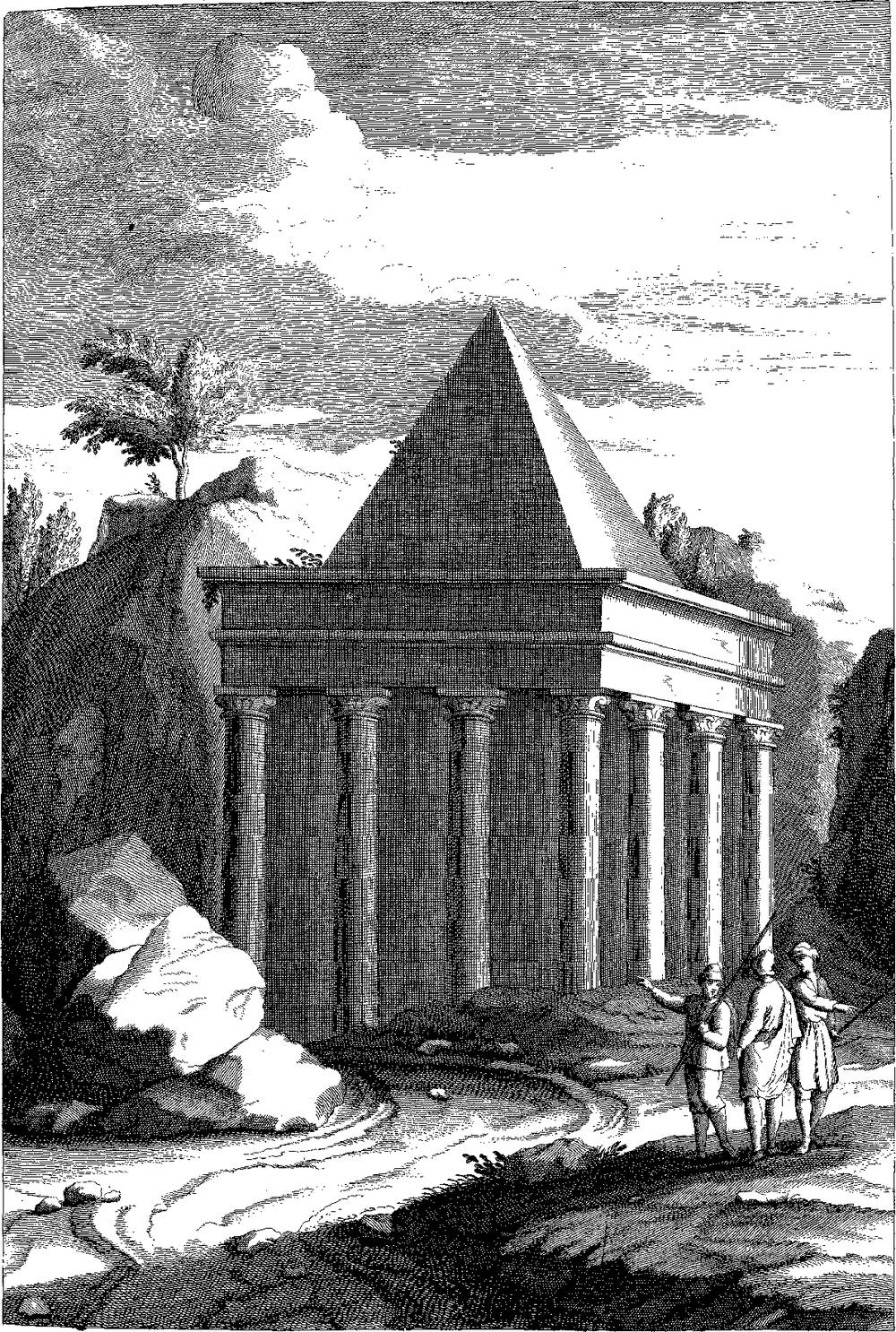
In the Valley of Jehoshaphat, over-against Jerusalem, is to be seen a Monument, which is said to be the Tomb of Zachariah. It is cut in a Rock; has four Pillars on each Side, which bear upon their Capitals a Roof rising to a Point, and which makes a kind of Pyramid. This
Monument is square, and is fourscore Feet in Circumference. There is a little Window behind, through which there are seen within only a few Stones upon one another.
ZACHEUS. The false Gospel of the Infancy of Jesus Christ provides a Master for our Saviour, whose Name was Zacheus69. St. Irenæus also mentions this Master70, who having bid Jesus Christ to pronounce A, he did so accordingly. The Master then bid him pronounce B; but he answer’d, First teach me what is the Meaning of A, and then I will tell you the Meaning of B. He would insinuate by this, says St. Irenæus, that he alone knew the Mystery that was conceal’d under the Letter A. The Gospel of the Infancy which we have in Greek intimates, that Zacheus having bid Jesus to pronounce Aleph, Jesus answer’d Beth, Gimel, and the rest of the Alphabet without Hesitation; and that afterwards he explain’d to his Master the Writings of the Prophets in such a manner, as fill’d him with Admiration. The Gospel of the Infancy printed in Latin relates almost the same thing, but in a more ample manner. It calls also this Master Zacheus.
1. ZADOK, or Sadoc, Son of Abitub, High-Priest of the Jews, of the Race of Eleazar. From the Time of Eli the High-Priesthood had been in the Family of Ithamar, but was restored to the Family of Eleazar in the Time of Saul, in the Person of Zadok, who was put in the place of Ahimelech, or Abiathar, put to death by 1 Sam. xxii. 17, 18.Saul, in the Year of the World 2944, before Christ 1056. At the same time that Zadok perform’d the Function of the Priesthood with Saul, Abiathar, otherwise call’d Ahimelech, perform’d it with David; so that till the Reign of Solomon there were two High-Priests in Israel; one of the Race of Eleazar, which was Zadok; and another of the Race of Ithamar, which was Abiathar. For after the Death of Saul and Ishbosheth, David thought fit to confirm the Priesthood to Zadok, tho’ he had been of the Party of Saul.
This is what we know in particular of Zadok. When David was forc’d to quit Jerusalem on account of the Rebellion of his Son Absalom, Zadok and Abiathar would have accompany’d him with the Ark of the Lord71. But David would not suffer them to follow him into his Retreat, saying, If I find Favour in the Sight of God, he will bring me back to Jerusalem; if not, let him do what he pleases, I am ready to comply with his Will. Then directing his Discourse to Zadok, he said, O Seer, return into the City with Abimaash your Son, and let Abiathar and his Son Jonathan return also, As for me, I will conceal myself in the Country, till you send me News of what passes. Zadok and Abiathar return’d therefore to Jerusalem; but their two Sons Abimaash and Jonathan hid themselves near the Fountain of Rogel, that they might be ready to give Intelligence to David of all the Transactions of Absalom. At last, when Hushai the Friend of David had defeated the Counsel of Achitophel, and informed Zadok and Abiathar of it, they communicated this Advice to David, by means of the two young Priests now mention’d72.
After the Defeat of Absalom, David 2 Sam. viii. 17.sent word to Zadok and Abiathar, saying, ” Give notice to the Elders of Judah to ” come forth speedily to meet the King, ” to bring him back to Jerusalem; why ” do you suffer the other Tribes to be before you?” The two High-Priests obey’d the King’s Commands, and persuaded the Elders of Judah to shew their Zeal for the King, by making haste to come and invite his Return into his Metropolis.
Finally, the High-Priest Zadok did not engage in the Party of Adonijah, who aspired at the Kingdom to the Exclusion of Solomon73; and when the Prophet Nathan had prevail’d with David to declare his Will as to his Successor, the King sent Zadok along with Nathan, and the chief Officers of his Court, to give the royal Unction to Solomon, and to proclaim him King instead of his Father, or at least to associate him with him in the Kingdom. This was perform’d the same Day; and while Adonijah and those of his Party were at an Assembly near the Fountain of Rogel, where they had an Entertainment, and in their Mirth were saluting Adonijah as already King.
After the Death of David74, Solomon excluded Abiathar from the High-Priesthood, because he had espoused the Party of Adonijah, and made Zadok High-Priest alone. ‘Tis not very well known when he dy’d; but his Successor was his Son Ahimash, who enjoy’d the High-Priesthood under Rehoboam.
2. ZADOK, Son of Abitub, and Father of Shellum, High-Priest of the
Jews. The time when he lived is not exactly known; but he lived under the Reign of Jotham King of Judah.
ZAHAM, or Zoom, Son of Rehoboam, and of Abihail the Daughter of Eliab, 2 Chron. xi. 19.
ZAIR, or Seira. This is the same as the Country or Mountain of Seir, inhabited by the Idumeans, 2 Kings viii. 21.75 So Joram went over to Zair, and smote the Edomites. Zeirah, instead of Zeir, according to the Rules of the Hebrew Language, insinuates a Motion towards Zeir, or Zair. The Hebrew reads Zeira; but we think it to be a Fault, and that it ought to be read Seira.
ZALMON, Salmon, or Selmon,76 a Mountain in the Neighbourhood of Shechem, Judg. ix. 48. Mention is made of the Snow of Mount Zalmon in Psalm lxviii. 14.
Judg. viii. 5. Numb. xxxiii. 41.ZALMONAH, or Salmona, or Selmona, an Encampment of the Israelites in the Desart. Some think it was in this Place that Moses set up the Brazen Serpent. See what is said upon PHUNON.
ZALMUNNA, or Salmana, one of the Princes of the Midianates, who were defeated by Gideon, in the Year of the World 2759, before Christ 1241, before the Vulgar Æra 1245.
ZAMZUMMIM, Zomzomim, or Zumims; ancient Giants who dwelt beyond Jordan, in the Country afterwards inhabited by the Ammonites, Deut. ii. 20.
ZANOAH, or Zanoe, Son of Jekuthiel. But I rather think that Zanoah was a City built or inhabited by Jekuthiel and his Posterity, 1 Chron. iv. 18.
ZAPHNATH-PAANEAH, or Pseuthophanech. ‘Tis thus the Septuagint,77 and after them Josephus, express the Name that Pharoah gave Joseph. Moses says,78 he called him Zaphnath-paaneah, which St. Jerome translated by Salvatorem mundi; but the greatest part of Interpreters by one that discovers hidden things.
ZAPHON, Saphon, or Sophan; a City of the Tribe of Gad, Josh. xiii. 27.
ZARAH, Son of Judah and Tamar. When his Mother was just upon the Point of being delivered, Zarah presented his Hand, and the Midwife tied a red Ribbon about it, saying, This will be the First-born. But the Child with-drawing his Hand again, his Brother was born first, and was called Pharez.79 Zarah had five 1 Chron. ii. 6.Sons, Ethan, Zimri, Heman, Calcol, and Dara.
ZARA, a City of Moab. Josephus says,80 that Alexander Jannæus took this City.
ZARED, or Zered, a Brook beyond Jordan, and on the Frontier of the Moabites. It discharges it self into the Dead Sea. See Numb. xxi. 12. Deut. ii. 13, 14.
ZAREPHATH, or Sarepta, a City of the Sidonians, situate in Phœnicia, between Tyre and Sidon, upon the Coast of the Mediterranean Sea. Pliny and Stephanus call it Sarapta; and the Arabians, Tzarphaud; Josephus, and the Greeks, Sarephta, or Saraphta; the Jews, Zarphat. The Arabian Geographer Scherifibnidris places it twenty Miles from Tyre, and ten Miles from Sidon. Sidon is to the North, and Tyre to the South. It was 1 Kings xvii. 9, 10.remarkable for being the Place of the Dwelling of the Prophet Elijah, with a poor Woman there, while there was a Famine in the Land of Israel. In the time of St. Jerome, and a good while after, they used to shew the Place where the Prophet dwelt, which was a little Tower. Afterwards they built a Church in the same Place, in the midst of the City. The Wine of Sarepta was not unknown to the Ancients:81
-------- Et dulcia Bacchi
Munera, quæ Sarepta ferax, quæ Gaza creârat.
A certain Author82 says, that the Wines of Sarepta were so heady that the stoutest Drinkers could not drink above a Sextarius in a Month: But the Sextarius is no more than the Pint of Paris, according to Budeus. At this time Sarepta is only a small Village, standing upon a Hill, at about fifteen hundred Paces from the Sea. Some have thought, that the Name Zarephath, or Sarepta came from the Metals or Glass that were melted in this Place; for Zaraph in Hebrew signifies to melt Metals, or such other Substances. It was from the City of Sarepta, that Jupiter in the Shape of a Bull ran away with Europa.
ZARESH-SHAHAR, or Saratasar, a City of the Tribe of Reuben, beyond Jordan, Josh. xiii. 19.
ZATTHU,
ZATTHU, or Zethu: He was one of those who renewed and signed the Covenant with the Lord, after the Return from the Captivity of Babylon, Nehem. x. 14. In the Year of the World 3551, before Christ 449; before the Vulgar Æra 453.
ZATTU, or Zethua, returned from the Captivity of Babylon with nine hundred and forty Persons of his Family. He is very probably the same as Zatthu, in the foregoing Article.
ZAZA, or Ziza, Son of Jonathan, of the Race of Jerahmeel, Son of Hezron, of the Tribe of Judah.
1 Chron. ii. 33.ZEAL, in Latin, Zelus; in Hebrew, Kanah.83 It is taken, 1. For the Eagerness with which we pursue any thing. I have been very jealous (or zealous) for the Lord 1 Kings xix. 10, 14.God of Hosts; I burn with Zeal for the God of Armies. Phinehas is commended for having expressed much Zeal against those wicked Persons that violated the Law of the Lord. He was zealous for his God, and made an attonement for the children Numb. xxv. 13.of Israel. Judith said, that Simeon and his Brethren were filled with the Zeal of the Lord, to revenge the Injury that had Judith, ix. 4.been done to their Sister: Which were moved with thy Zeal.
-
Zeal is put for Anger: The zeal of 2 Kings xix. 21.the Lord of Hosts shall do this; that is, the Anger: How long, Lord, wilt thou be angry? Psalm lxxix. 5.for ever? shall thy jealousy, or Zeal, burn like fire? the whole land shall be devoured Zeph. i. 18. iii. 8.by the fire of his jealousy, or Zeal.
-
Zeal is also put for Jealousy. JealousyProv. vi. 34., or Zeal, is the rage of a man, therefore he will not spare in the day of vengeance. The jealousy of an husband in fury will not forgive. Thus saith the Lord of Hosts, I Zech. i. 14. viii. 2.was jealous for Zion with great jealousy, and I was jealous for her with great fury.
-
Zeal is put for Envy. Fret not thy Psalm xxxvii. 1.self because of evil doers, neither be thou (zealous or) envious against the workers of iniquity. That is, envy not their Appearance of Happiness. For whereas there is among you envying (Vulg. zelus) and strife, are ye not carnal, and walk as men? See also James iii. 6. Bitter envying and strife, James iii. 14. (Zelus amarus, Vulg.) is opposed to the Zeal of Charity, which, as the Apostle says, suffereth long, is kind, and envieth 1 Cor. xiii. 4, 5.not. But blind and false Zeal, and Zeal of Bitterness, is full of Contention and Animosity.
Zeal, or the Judgment of Zeal: Among the Hebrews this Name was given to the Action of an Israelite, who being transported with Zeal, without staying for the Sentence of the Judges, and with-
Vol. III. out observing the common Forms of Justice, put to death a Jew, whom he found in the open and scandalous Violation of some important Point of the Law, or whom he heard to utter some Blasphemy against the Name of God, or against his Temple, or his People. In such Cases it was allowed any Israelite to pursue him, to fall upon him, and to put him to death, if he could. In like manner, if the Priests in the Temple should see any of their Brethren performing his Functions in a State of Uncleanness, they were authorized by Custom, to drag him out of the Holy Place, to draw him out of the Court, and to knock him on the Head with Clubs.84 But that this Liberty might not be abused, it was necessary that the Crime should be committed in the Presence of ten Israelites at least; and that he that committed it must persevere in it, and did not withdraw himself when he was warned of it, and set upon for it. For if he desisted from his Crime, they were not allowed to kill him, till he had first been condemned in a judicial manner.
They founded this Right upon a Tradition which they pretended to have received from Moses, and upon the Example Numb. xxv. 7, 8.of Phinehas, who, transported by an holy Zeal, pierced through, at one Blow, Zimri, a Prince of the Tribe of Simeon, and Cozbi, Daughter to a Prince of Midian. ‘Twas by vertue of the same Power that Matthias, 1 Macc. ii. 24.the Father of the Maccabees, slew Apelles, whom the King of Syria had sent to Modin, to compel the Jews to sacrifice. ‘Tis referred to the same Custom, that the Jews 3 Macc. cap. ult.of Egypt took Vengeance of three hundred of their Brethren, who had basely apostatized from their Religion. Lastly, we may say, that it was through the same Zeal that our Saviour drove the Money-changers and Bankers out of the Temple, and those that sold Doves and other Animals for Sacrifices. Matth. xxi. 12. John ii. 14, 15.The Evangelist observes, that upon this occasion the Apostles called to mind these Words of Scripture, The zeal of thine house hath eaten me up. See Grotius, De Jure Belli & Pacis, l. 2. c. 20. sect. 8. Selden. De Jure Nat. & Gent. l. 4. c. 4, 5.
The Idol of Zeal, Idolum zeli, mentioned by Ezekiel,85 is thought to be the false God Adonis, justly called the Idol of jealousy, because he was beloved of Venus; and therefore Mars, provoked with Jealousy, sent a wild Boar against him, which killed him with his Tush. Besides, in pursuing the Discourse of Ezekiel, we see that the same Idol which at the fifth
Verse is called the Idol of Jealousy, is also callel Thammuz at the fourteenth Verse; in honour of whom the Women made Lamentations, as is well known they did at the Feast of Adonis. St. Jerome,86 who is followed by several Commentators, thinks that the Idol of Jealousy is the God Baal, which being set up in the Temple of the Lord by King Manasseh, was afterwards taken away by Josiah. Others think, that under the Name Image of Jealousy, that excites to Jealousy, the Prophet meant all Sorts of Idols, which provoke the Anger of God, and inflame his Zeal against their Worshippers.
The Ear of zeal hears all things: Auris zeli audit omnia. God is, as it were, a jealous Husband, who hearkens to every thing, and is attentive to all the Discourses of the Wicked, that he may reprove and reclaim them.
Nolite zelare mortem in errore vitæ vestræ: Forbear to seek Death with so much Eagerness; shew not so much Zeal for your own Destruction. Otherwise, accuse not Death; charge not your Misfortune upon it. The Verb zelare, is sometimes put for taking vengeance. Phinehas was transported with Zeal against the Numb. xxv. 11.Offenders, he took up Weapons to put them to death. Saul put the Gibeonites to death with an unseasonable Zeal, to revenge the Trick they had put upon Israel: Valuit Saul percutere eos zelo, quasi pro filiis 2 Sam. xxi. 2. Wisd. v. 18.Israel & Juda. The Author of the Book of Wisdom represents the Lord to us as arming himself with Zeal against his Enemies; that is, as going to take vengeance on their Maliciousness. Isaiah says, that Ephraim shall no longer make War against Judah, and that these two Kingdoms shall live together in Peace: Auferetur zelus Ephraim, & hostes Juda peribunt; Ephraim non æmulabitur Judam, & Judas non pugnabit contra Ephraim. Where we see that zelari and æmulari are put as synonymous Terms with hostis & pugnare. vorce her, to reject her, and to take into her Place another People, which does not deserve the Name of a People, to excite in her, by this Comparison, a Spirit of Zeal and Jealousy, of Vexation and Despair. This was compleatly accomplished in the Reprobation of the People of the Jews, and the Call of the Gentiles to the Christian Religion.
1 Chron. viii. 15, 16.1. ZEBADIAH, Zabadia, or Zebedia, Son of Beriah.
2. ZEBADIAH, Son of Elpaal, 1 Chron. viii. 16, 17.
3. ZEBADIAH, Son of Jeroham, of the City of Gedor. He was one of those that adhered to the Party of David, while he was persecuted by Saul, 1 Chron. xii. 7.
4. ZEBADIAH, a Levite, Son of Meshelemiah, a Porter of the Temple, 1 Chron. xxvi. 2.
Ezr. viii. 8.5. ZEBADIAH, Son of Michael; he returned from the Captivity of Babylon with fourscore Men.
ZEBAH. He was a Prince of the Midiantes, whom Gideon himself thrust through with a Sword, Judg. viii. 5, 21. Psal. lxxxiii, 11. In the Year of the World 2753, before Christ 1247, before the Vulgar Æra 1251. When Gideon took Zebah and Zalmunna in their Flight, he asked them, What sort of Men were they that you put to death upon Mount Tabor? They answered, they were like you, and one of them was like a King’s Son. Then answered Gideon, They were my Brethren, and Sons of my Mother: As the Lord lives, if you had spared them, I would not have put you to death. Then he said to his eldest Son Jether, Fall upon them, and kill them. But he did not draw his Sword, because he was but a Child, and was afraid. Then Zebah and Zalmunna said to Gibeon, Kill us your self. Upon which he drew his Sword, Nehem. xi. 17.fell upon them, and slew them.
1. ZEBEDEE, Son of Asaph, and Father of Micah. He was an Ezek. xxxix. 25.Ezekiel says, that the Lord shall revenge excellent Musician, belonging to the Temple. the Affront done to his Name: Assumant zelum pro nomine sancto meo.
In Deuteronomy God says, that the ingrateful Deut. xxxii. 21.and faithless Israelites would move him to Jealousy, or Zeal, by worshipping Gods that are no Gods; and I, says the Lord, will provoke their Zeal and Jealousy, by loving another which is no People. I will vex them, by substituting in their stead a foolish Nation; as a Husband, moved with Jealousy against an unfaithful Spouse, who has abandoned herself to unworthy Lovers, in contempt of a Husband that was infinitely more deserving of Respect. He threatens to di-
2. ZEBEDEE, Father of the Apostles St. James and St. John the Evangelist. We know nothing in particular, or that can be relied on, concerning the Person or Actions of Zebedee, but only that he was a Fisherman by Profession, that his Wife was called Salome, and that his two Sons left him to follow our Saviour. See Matth. iv. 21.
ZEBOIM, or Seboim, one of the four Cities of Pentapolis, that were consumed Gen. xix. 24.by Fire from Heaven. Eusebius and St. Jerome speak of Zeboim,87 as of a City remaining in their time, upon the
Western Shore of the Dead Sea. Therefore after the Time of Lot and Abraham this City must have been rebuilt about the same Place it was before. Mention is made of the Valley of Zoboim, 1 Sam. xiii. 18. and of a City of the same Name in the Tribe of Benjamin, Nehem. xi. 34.
ZEBUDAH, or Zebida, the Mother of Jehoiakim King of Judah. She was Daughter of Pedaiah of Rumah, 2 Kings xxiii. 36.
ZEBUL; He was made Governor of the City of Shechem88 by Abimelech the Son of Gideon. Gaal the Son of Ebed having prevailed with the Shechemites to revolt, Zebul sent Intelligence of it to Abimelech, who marching all Night, appeared next Morning upon the Hills near Shechem. Gaal going forth out of the City, and being at the Gate with Zebul, he said to him, See, a great multitude comes down from the Mountains. Zebul answered him, They are only the Shadows of the Hills, which seem to you to be Men. But as the Troops of Abimelech advanced farther, and it could no longer be doubted but that they were Men, Zebul said to Gaal, Where is now that Confidence with which you was used to ask, who is Abimelech that we should be subject to him? Are not those the People that you are used to contemn? Go out therefore, and fight with them. He then put himself at the Head of the Shechemites, and went out to give Battel to Abimelech, but was soon overcome by him.
1. ZEBULUN, or Zabulon, the sixth Gen. xxx. 20.Son of Jacob and Leah. He was born in Mesopotamia, about the Year of the World 2256, before Christ 1744, before the Vulgar Æra 1748. His Sons were Sered, Elon, and Gen. xlvi. 14.Jableel. Moses acquaints us with none of the Particulars of the Life of this Patriarch; but Jacob, on his Death-bed, when he gave his last Blessing to his Sons, said to Zebulun, Gen xlix. 13.Zebulun shall dwell at the haven of the sea, and he shall be for a haven of ships, and his border shall be unto Zidon. This plainly shewed, that the Portion of Zebulun was to extend, as it did in effect, along the Coast of the Mediterranean Sea, one End of it bordering upon this Sea, and the other extending to the Sea of Tiberias. In the last Words that Moses addresses to the Tribes of Israel, he joins Zebulun and Issachar together; saying, Rejoice, Zebulun in thy going Deut. xxxiii. 18.out, and Issachar in thy tents. They shall call the people unto the mountain, there they shall offer sacrifices of righteousness. For they shall suck of the abundance of the seas, and of treasures hid in the sands. By which he meant, that these two Tribes being at the greatest Distance towards the North, should come together to the Temple at Jerusalem, to the holy Mountain, and should bring with them such of the other Tribes as lay in their way; and that being by their Situation upon the Coast of the Mediterranean Sea, they should apply themselves to Trade and Navigation, and to the melting of Metals and Glass, denoted by those Words, Treasures hid in the Sand. The River Belus, whose Sand was very fit for the making of Glass, was in the Tribe of Zebulun.
When the Tribe of Zebulun came out of Egypt, it had for its Head or Chief89 Eliab the Son of Elon, and comprehended fiftyseven thousand four hundred Men able to bear Arms. In another Review that was made nine and thirty years after the former,90 this Tribe amounted to sixty thousand five hundred Men, that were at Age to bear Arms. The Tribes of Zebulun and Naphthali very much distinguished themselves in the War of Barak and Deborah91 against Sisera, the General of the Armies of Jabin. ‘Tis thought the same Tribes were the first that were carried away into Captivity beyond the Euphrates, by Pul and 1 Chron. v. 26.Tiglath-pilneser, Kings of Assyria; but they had also the Advantage of hearing and seeing Jesus Christ in their Country, oftner and longer than any other of the Tribes.92 This is what we are informed by Scripture, concerning the Tribe of Zebulun in particular.
The Testament of the twelve Patriarchs, an ancient, tho’ Apocryphal Book, and which we have frequently quoted, tells us, that when Zebulun was at the Point of Death, being an hundred and fourteen Years old, thirty-two Years after the Death of Joseph, he made his Sons come to him, and declared to them, that he had no share in the Crime that his Brethren committed, when they sold Joseph: And that he did every thing in his power to divert them from that Resolution, and that he had a great mind to acquaint his Father Jacob with it, but that the Fear of his Brethren had prevented him. He told them also, that while his Family sojourned in the Land of Canaan, he invented and built a Vessel, to which he applied a Rudder, a Mast, and Sails: And
that he applied himself to Fishing with such Success, that he abundantly supplied the whole House of his Father with Fish, and even Strangers too, during the Summer Season; and that in Winter he went along with his Brethren to feed the Flocks of his Father. He adds, “I have read in the Writings of my Fathers, that in the later Ages your Posterity shall separate themselves from the Lord, that they shall be divided in Israel, and shall follow two Kings. They shall abandon themselves to the Abominations of Idolatry, their Enemies shall lead them away captive, and they shall dwell among the Heathen, being oppressed with Troubles and Afflictions. After this they shall again remember the Lord, and repent, and the Lord will bring them back, because he is full of Mercy. After which, God himself, the Sun of Righteousness, shall rise upon them, with healing in his wings. He shall Mal. iv. 2.redeem the Children of Men, which Belial holds in Servitude; every Spirit of Error shall be trodden under Foot, the Lord shall convert all Nations, and you shall see God himself in an Human Form, because the Lord has chosen Jerusalem, and his Name is the Lord. Lastly, they shall again provoke him, and they will be finally rejected, to the Consummation of Ages.” In all this are to be seen the Sins of the Tribe of Zebulun, the Schism of the Ten Tribes, their Captivity and Return, the Coming of the Messiah, the Salvation of Men, the Incredulity and Reprobation of the Jews.
2. ZEBULUN, a City of the Tribe of Josh. xix. 27.Asher, but which probably was afterwards yielded to the Tribe of Zebulun, from whence it took its Name. It was not far from Ptolemais, since Josephus93 makes the Length of Lower Galilee to be from Tiberias to Ptolemais. It had the Name of Zabulon andrôn given it, or Zebulun of Men, probably because of its great Populousness.94 When Cestius entered to it, he gave the Plunder of it to his Soldiers, and then set fire to it, though he admired the Beauty of it; for its Houses were built like those of Tyre, Sidon, and Berytus. Thus saith Josephus, l. 2. c. 22. p.817. de Bell. Elon, the Judge of Israel, was of the Tribe of Zebulun, and was buried in this City, Judg. xii. 12.
ZECHARIAH. See ZACHARIAH.
ZEDAD, or Sedada, a City of Syria, which was to the most Northren Parts of the Land of Promise. See Numb. xxxiv. 8. Ezek. xlvii. 15.
1. ZEDEKIAH, or Sedecias, or Mattaniah, the last King of Judah, before the Captivity of Babylon. He was the Son of Josiah, and Uncle to Jeconiah his Predecessor in the Kingdom. When Nebuchadnezzar2 Kings xxiv. 17, 19. took Jerusalem from Jeconiah, he carried this King to Babylon, with his Wives, Children, Officers, and all the best Artificers in Judea, and put in his place his Uncle Mattaniah, whose Name he changed to Zedekiah,95 and made him promise, with an Oath, that he would continue in Fidelity to him.96 He was one and twenty Years old when he began to reign at Jerusalem, and he reigned there eleven Years. His Mother’s Name was Hamutal, the Daughter of Jeremiah of Libnah. He did Evil in the Sight of the Lord, committing the same Crimes as Jehoiakim.97 He regarded not the Menaces that were made to him by the Prophet Jeremiah, who spoke to him from the Lord; but he hardened his Heart the more, instead of being converted to God. The Princes of the People, and the Inhabitants of Jerusalem, imitated his Impiety, and abandoned themselves to all the Abominations of the Gentiles, profaning the Temple of God. This so far provoked the Lord, that he resolved upon their utter Destruction.
In the first Year of his Reign Zedekiah sent to Babylon98 Elasah, the Son of Shaphan, and Gemariah the Son of Hilkiah, probably to carry his Tributes to Nebuchadnezzar. By these Messengers Jeremiah sent a Letter to the Captives at Babylon. Four Years afterwards,99 either Zedekiah went thither himself, or at least he sent thither; for the Hebrew Text may admit of either of these two Interpretations. See before, the Article of SERAIAH VII. The chief Design of this Deputation was to intreat Nebuchadnezzar, that he would please to return the sacred Vessels of the Temple, Baruch i. 8. Lastly, in the ninth Year of his Reign,100 he revolted against Nebuchadnezzar. It was in a Sabbatical Year, in which the People set their Slaves at liberty, according to the Law.101 Then King Nebuchadnezzar marched his Army
Zedekiah (1) continues on the next page
Footnotes
-
Cant. i. 10. 70 . .חורי זהב עם נקדות הכסףὁμοιώματα χρυσίου - - - μετὰ στιγμάτων τοῦ ἀργυρίου. ↩
-
Hieron. ad Marcell. Ep. 15. ↩
-
Justin. Dialog. cum Tryphone. Clem. Alex. l. 1. Pædag. Tertull. contra Praxeam. Hilar. l. 5. & 15. de Trinit. Athanas. Orat. 3. contra Arian. &c. ↩
-
Origen. Tom. 5. in Joan. & Homil. 11. in Numer. ↩
-
Procop. in Genes. xxxii. Vide & Hieron. in Ephes. c. vi. & Origen. l. 3. de Principiis. ↩
-
Theodoret. Quæst. 1. 92. in Deut. ↩
-
Maimon. in Mose Nebochim. Par. 2. c. 42. ↩
-
Joseph. Antiq. l. xi. c. 5. About the Year of the World 3520, before Christ 480, before the Vulgar Æra 484. ↩
-
Herodot. l. 7. In the Year of the World 3521. ↩
-
Herodot. l. 7. ↩
-
Joseph. contra Appion. l. 1. ↩
-
Salmas. Offileg. linguæ Hellenisticæ. ↩
-
Strab. l. 14. Cicero de legib. l. 2. Æschyl. in Persis. Herodot. l. 8. ↩
-
Herodot. l. 7. c. 25, &c. In the Year of the Word 3523, before Christ 477, before the Vulgar Æra 481. ↩
-
Strab. l. 16. Herodot. l. 1. Diodor. l. 2. Arrian, de Expedit. Alex. l. 7. ↩
-
Vide Scaliger. de Emendat. Temporum, l. 3. ↩
-
Id. de die Natali. ↩
-
Porphyr. de Nymphæ antro. ↩
-
Plutarch. de Iside. ↩
-
See our Dissertation upon Chronology, before Genesis. ↩
-
Diodor. l. 11. p. 83. ↩
-
Cicero, l. 2. de Divinat. ↩
-
Plin. l. 7. c. 56. The Printed Books read only 720; but the Sequel of the Discourse shews that it ought to be 720,000. ↩
-
Apud Simplic. l. 3. de Cœlo. ↩
-
Censorin. de die Natali. ↩
-
Censorin. l. 7. c. 48. ↩
-
Plin. l. 34. c. 6. ↩
-
Censorin. c. 19. ↩
-
Laertius ex Phavorino. ↩
-
Ovid. Fast. ↩
-
Junius apud Censorin. ↩
-
Ovid. Principium capiunt Phœbus & annus idem. ↩
-
Exod. xxix. 14. בין ערביםVulg. ad vesperam. Hebr. inter duas vesperas. ↩
-
1 Macc. xi. 17. In the Year of the World 3869, before Christ 141, before the Vulgar Æra 145. ↩
-
Didor. Sicul. l. 32. ↩
-
Polyb. Diodor. apud Usser. ad An. M. 3859. ↩
-
צבויםTsabiim. ↩
-
Vide Spencer de Legib. Hebr. ritual. l. 2. c. 1. de Zabiis. ↩
-
Spencer, loco cit. ↩
-
Scaliger Epist. l. 1. Ep. 62. ↩
-
Seides Batricid. ↩
-
Maimonid. Morê Nevoch. l. 3. p. 411. ↩
-
See Prideaux Connect. p. 1. l. 3. and the Authors whom he quotes. ↩
-
Maimon. Moreh. Nebochim. Pocock. Specimen. Histor. Arab. Thom. Hyde Hist. Relig. veter. Persarum. ↩
-
D’Herbelot. Biblioth. Orient. p. 755. Sabi. ↩
-
2 Macc. x. 19. 1 Macc. v. 4, 5. In the Year of the World 3840, before Christ 160, before the Vulgar Æra 164. ↩
-
Luke xix. 1, 2, 3, &c. In the Year of Christ 37, of the Vulgar Æra 33, a little time before the Death of our Saviour. ↩
-
L. hoc edicto in fine digesti de Publican. ↩
-
Cyprian. l. 2. Ep. 3. & lib. de opere & eleemosyn. Tertul. l. 4. contra Marcion. Chrysost. Homil. de Zachæo. Ambros. in Luc. Beda in Luc. xix. ↩
-
Clem. Alex. Stromat. l. 4. ↩
-
Constit. Clem. l. 7. c. 46. Recognit. l. 3. c. 65, 74. Rufin. Præfat. Recognit. Vide & Chrysolog. homil. de Zachæo. ↩
-
Prædestinat. Serm. c. 11, 13. p. 15. ↩
-
Sozomen. Hist. Eccl. l. 9. c. 17. ↩
-
Med. l. 4. Epist. 31. ↩
-
Hammond. in Matth. ↩
-
Herodot. l. 3. Justin. l. 1. c. 10. Polyœn. l. 7. ↩
-
D’Herbelot, Bibl. Orient. p. 922. ↩
-
Hieronym. Præfat. in l. 1. Zach. ↩
-
Ambros. l. 1. in Luc. Ita Beda, Theophyl. Strab. Brug. in Luc. ↩
-
Aug. in Joan. Homil. 49. ↩
-
Protevangel. Jacob. n. 23. ↩
-
Origen. in Matth. xxvi. Petr. Alex. c. 13. Basil, l. 1. Homil. 25. Nyssen. t. 3. Homil. de Natal. Christ. Epiphan. de vita & morte Prophet. Theophylact, &c. ↩
-
Tertull. Scorpiac. c. 8. ↩
-
Hieron. in Matth. xxiii. 35. Vide, si placet, & Athanas. t. 2. p. 697. ↩
-
Vide Baron. an. 1. §. 53. Menæa 5. Sept. p. 81. Tillemont. Not. 5. upon John the Baptist. ↩
-
Apud Hieron. in Matth. xxiii. ↩
-
Joseph. de bello, l. 4. c. 19. in Græco, seu l. 5. c. 1. in Lat. p. 883. ↩
-
Grotius, Hammond, Louis de Dieu, Constantine l’Emper. Jansen, upon MonuSt. Matthew. ↩
-
Apocryph. N. T. à Fabritio edit. p. 165, 207. ↩
-
Iren. l. 1. c. 17. contra Hæres. & apud Epiphan. Hæres. 34. ↩
-
2 Sam. xv. 24. In the Year of the World 2980, before Christ 1020, before the Vulgar Æra 1024. ↩
-
2 Sam. xxxv. 35, 36. xxxvi. 15, 16, 17, &c. ↩
-
1 Kings i. 8, 9, 10, &c. In the Year of the World 2989, before Christ 1011, before the Vulgar Æra 1015. ↩
-
1 Kings ii. 35. In the Year of the World 2990, before Christ 1010, before the Vulgar Æra 1014. ↩
-
צעירהZeira, instead of שעיר ↩
-
צלמוןZalmon. ↩
-
- Gen. xli. 45. Ψευδοφανεχ. Joseph. Antiq. l. 2. c. 3. p. 44. Ψουδομφανηχον.
-
צפנת פענחZaphnath Paanach. ↩
-
Gen. xxxviii. 28, 29. About the Year of the World 2277, before Christ 1723, before the Vulgar Æra 1727. ↩
-
Joseph. Antiq. l. 13. c. 23. ↩
-
Coripp. l. 3. Vide & Fortunat. de vita S. Martini. -------- Sarepta Lucida perspicuis certantia vina lapillis. ↩
-
Fulgent. Mytholog. l. 2. ↩
-
קנאZelus, zelari. ↩
-
Mishna tit. Sanhedr. c. 9. Gemarr. Babylon. & Jerosol. ibidem, ↩
-
Ezek. viii. 3, 5. סמל הקנאה המקנה ↩
-
Hieron. in Ezech. viii. Ita Cornel. Menoch. Grot. Junius. Vid. Josh. xix. 10, &c. ↩
-
Euseb. & Hierom. in locis Sodoma & Adama. ↩
-
Judg. ix. 28. In the Year of the World 2771, before Christ 1229, before the Vulgar Æra 1233. ↩
-
Numb. i. 8. 30. In the Year of the World 2514, before Christ 1486, before the Vulgar Æra 1490. ↩
-
Numb. xxvi. 26, 27. In the Year of the World 2553, before Christ 1447, before the Vulgar Æra 1451. ↩
-
Judg. iv. 5, 6, 10. v. 4, 18. In the Year of the World 2719, before Christ 1281, before the Vulgar Æra 1285. ↩
-
Isai. ix. 1. Matth. iv. 13, 15. Vide Hieron. & alios in Isai. ix. ↩
-
Joseph. de Bell. l. 3. c, 2. ↩
-
Joseph. de Bell. l. 2. c. 22. ↩
-
In the Year of the World 3405, before Christ 595, before the Vulgar Æra 599. ↩
-
2 Chron. xxxvi. 13. Ezek. xvii. 13, 14, 18. ↩
-
2 Kings xxiv. 18, 19, 20. 2 Chron. xxxvi. 11, 12, 13. ↩
-
Jerem. xxix. 1, 2, ------ 23. In the Year of the World 3405, before Christ 595, before the Vulgar Æra 599. ↩
-
Jerem. li. 54 ----- 59. Baruch. i. 1. Jerem. xxxii. 12. In the Year of the World 3409, before Christ 591, before the Vulgar Æra 595. ↩
-
2 Kings xxv. 1, 2, 3. In the Year of the World 3414, before Christ 586, before the Vulgar Æra 590. ↩
-
Exod. xxi. 2. Deut. xv. 1, 2, 12. Jerem. xxxiv, 8, 9, 10. ↩