Volume II, pages 298–317 of the 1732 edition, from NIM to ONE: everything printed on these pages, in order.
Continued from Nimrod
tempt of scaling Heaven: which is taken from what the Scripture relates concerning the Children of Noah, that they undertook to build a Tower, the Top of which should reach to Heaven. The Author of the Book call’d Malem tells us also this Story. When Nimrod saw that the Fire, in which he had caus’d Abraham to be cast, did him no Damage, he resolved to ascend into Heaven, that he might see that great God, that Abraham reveal’d to him. ‘Twas in vain that his Courtiers endeavoured to divert him from this Design; he was resolved to accomplish it.
At the same Time he gave Orders for the building of a Tower, that might be as high as possible. They worked upon this for three Years together, when he went up to the Top, and was much surprized to see himself as far from Heaven, as when he was upon the Ground. His Confusion was much increased, when they came to inform him the next Morning, that his Tower was fallen to the Ground. He commanded then that another should be built, that might be stronger and higher than the former; but this met with the same Fate. Then he took a ridiculous Resolution, of making himself be carried to Heaven in a Chest or Box, by four of those monstrous Birds, which the antient Eastern Authors call Kerkes, and of which they make Mention in their Romances.
Nimrod therefore had those Birds taught to carry the Box, and then putting himself into it, he wandered and flew for some Time in the Air; but at last the Kerkes dashed him so violently against a Mountain, that his Box was quite overset by the Shock. This Accident did not make him grow wiser, for he still continued to persecute the Saints, and the Worshippers of the true God. For this Reason God took away from him the greatest Part of his Subjects, by the Division that he sent among them, and by the Confusion of Tongues. Those that still continued firm to him were almost all killed by a Cloud of Flies that God sent amongst them. He himself was tormented for four Years by one of those Insects, which entering into his Brain, gave him such exquisite Pain, that he was forced to have his Head beat with a Mallet, that he might obtain some Rest.
‘Tis supposed that Moses makes Nimrod the immediate Son of Cush. The Persians make him to be Son to Canaan, and Brother to Cush. Eutychius, Patriarch of Alexandria, says, that Nimrod was the first Author of the Religion of the Magians, and of the Worshippers of Fire.
NIMSHI, or Namsi, Father of Jehu King of Israel, 1 Kings xix. 16.
NINEVEH, the Capital City of Assyria, founded by Ashur Son of Shem, or by Nimrod Son of Cush; for in the Text of Moses, Gen. x. 11. De terrâ illâ egressus est Assur, & ædificavit Nineven, according to some has Relation to Nimrod1, who was mentioned before; so that it ought to be read: De terrâ illâ (Babylonia Nemrod) egressus est in Assyriam, & ædificavit Niniven. However this be, yet it must be owned, that Nineveh was one of the most antient, the most famous, the most potent, and largest Cities of the World. It is very difficult exactly to assign the Time of its Foundation; but it cannot be long after the building of Babel. It was situate upon the Banks of the Tigris, and in the Time of the Prophet Jonas, who was sent thither under Jeroboam the second, King of Israel2, and, as we judge, under the Reign of Pul, Father of Sardanapalus, King of Assyria; Nineveh was a very great City, its Circuit being three Days Journey. Diodorus Siculus3, who has given us the Dimensions of it, says it had one Hundred and fifty Stadia in Length, four Score and ten Stadia in Breadth, and four Hundred and four Score Stadia in Circuit; that is, to reduce these Measures to our own, it was about seven Leagues long, taking the League at three Thousand Paces, about three Leagues broad, and eighteen Leagues round. Its Walls were an hundred Feet high, and so broad, that three Chariots could drive abreast upon ‘em. Its Towers, of which there were fifteen Hundred, were each two Hundred Feet high.
Jonas iv. 11.Diodorus Siculus places it upon the Euphrates, but all others agree that it was upon the Tigris. Some place it to the West, and others to the East of this River. At the Time of Jonas’s Mission thither, it was so populous, that it was reckoned to contain more than six Score Thousand Persons, who could not distinguish their right Hand from their left; which is generally explained of young Children, that had not yet attained the Use of Reason. So that by this Reckoning, there ought to have been then in Nineveh more than six hundred Thousand Persons.
Nineveh was taken by Arbaces and Belesus, in the Year of the World 3257, before Christ 743, before the vulgar Æra 747, under the Reign of King Sardanapalus4, in the Time of Abaz King of Judah, about the Time of the Foundation of Rome. It was taken a second Time by Astyages and Nabopolassar, from Chinaladan King of Assyria, in the Year of the World 3378, before Christ 622, before the vulgar Æra
626. After this Time Nineveh no more recovered its former Splendor. It was so intirely ruined in the Time of Lucianus Samosatensis5, who lived under the Emperor Adrian, that no Footsteps of it could be found, nor so much as the Place where it stood. However it was rebuilt under the Persians, but was destroyed again by the Saracens about the seventh Age. See Marsham’s Canon. Egypt. sæculo xviii. Tit. Nini excidium, and Usher, upon the Years of the World 3257 and 3378.
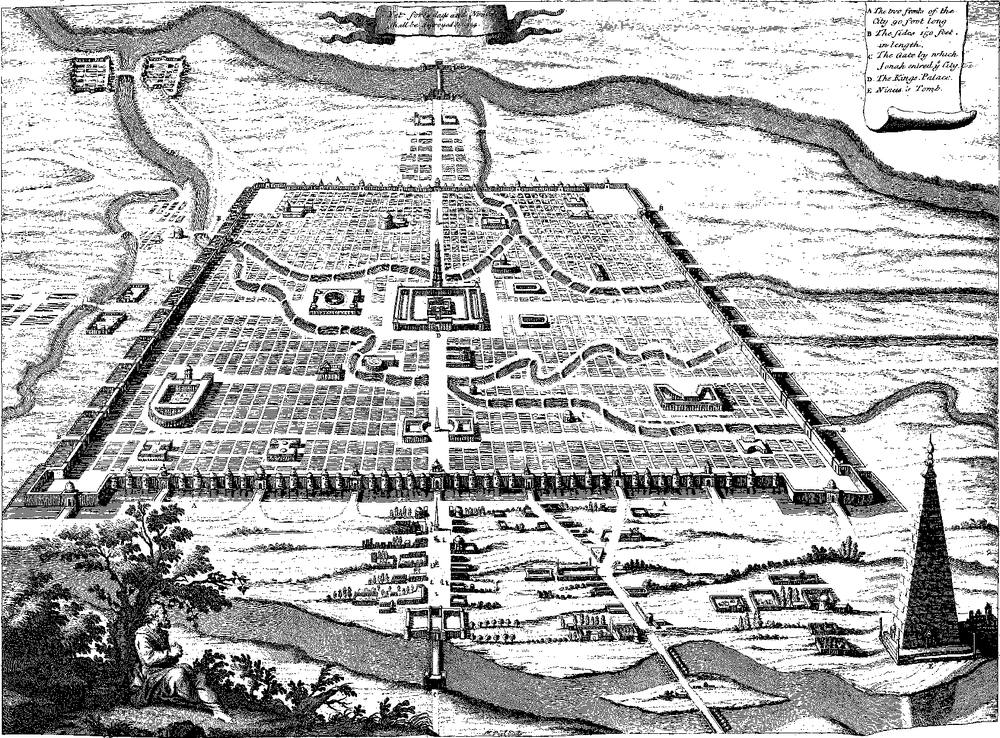
Modern Travellers say, that the Ruines of ancient Nineveh may still be seen on the Eastern Bank of the Tigris, and that on the opposite Side may be seen the City of Mozul or Mozil, which many do not distinguish from Nineveh. Prophane Histories tell us, that Ninus was the first founded Nineveh; but Scripture, which is infinitely of better Authority, assures us it was Assur, or Nimrod, as we have said in the Beginning of this Article. The sacred Authors make frequent Mention of Nineveh. Those Kings Tiglath-pilneser, Sennecharib, Shalmanezzar, and Esar-haddon, famous for the Evils they brought upon the Hebrews, reigned at Nineveh. Tobit lived in this City. Nahum and Zephaniah have foretold its Ruin in a very particular and pathetick Manner6, which Tob. xiv. 4. Matt. xi. 41. Luk. xi. 32.Tobit had also foretold. ‘Tis known what Jonas did at Nineveh, and the signal Repentance of the Ninevites, which is even commended in the Gospel.
I. NINUS, Son of Belus the Assyrian, and Founder of the Assyrian Monarchy, in the Year of the World 2737, before Christ 1263, and before the vulgar Æra 1267; about the Time of the Government of Deborah and Barak Judges of Israel. Herodotus says7, that for an Hundred and twenty Years this Monarchy was in Possession of the upper Egypt. Ctesias, and after him Diodorus Siculus8, Trogus, and Justin, say, that Ninus brought into Subjection to him all the Princes of Asia, except those of India. Zoroaster King of the Bactrians opposed him a good while, but at last was subdued by Ninus. Julius Africanus ascribes to this Prince a Reign of fifty two Years; but Dionysius of Halicarnassus, in the first Book of his Roman Antiquities, shews very well, that the first Kings of Assyria had but a small Part of Asia in their Possession.
II. NINUS, surnamed the younger, succeeded Sardanapalus, in the Kingdom of Assyria. Sardanapalus having been compelled to burn himself in Nineveh; Arbaces and Belesus, on the Dissolution of the Assyrian Monarchy, founded two others, that of the Medes, and that of the Babylonians. The Empire of Assyria, reduced to very narrow Limits, was continued to Ninus, 2 Kings xv. 29. xvi. 7. 10.called in Scripture Tiglath-pilneser, and Thilgamus by Ælian9. Eusebius in his Chronicon, after Castor of Rhodes, allows him a Reign of nineteen Years. He began to reign in the Year of the World 3257, and reigned to 3276. His Successor was Salmanezzar, mentioned in the holy Scriptures.
NISAN, a Month of the Hebrews, answering to our March, and which sometimes takes from February or April, according to the Course of the Moon. It was made the first Month of the sacred Year, at the coming Exod. xii. 2.out of Egypt. Mensis iste principium mensium; primus erit in mensibus anni. It was the seventh Month of the civil Year. In Moses it is called Abib. The Name Nisan is only since the Time of Ezra, and the Return from the Captivity of Babylon. I shall here take Notice of the principal Things observed by the Jews in this Month.
The first Day is the Neomenia. A Fast for the Death of the Children of Aaron, Lev. x. 1, 2, 3.
On the tenth Day was celebrated a Fast for the Death of Miriam the Sister of Moses; and every one provided himself with a Lamb for the Passover. On this Day the Israelites passed over Jordan under the Josh. iv. 19.Conduct of Joshua.
On the fourteenth Day in the Evening they sacrificed the Paschal Lamb, and the Day following, being the fifteenth, was held the solemn Passover, Exod. xii. 18, &c.
The sixteenth they offered the Sheaf of the Ears of Barley, as the First-fruits of the Harvest of that Year, Levit. xxiii. 9, &c.
The twenty-first was the Octave of the Passover, which was solemnized with particular Ceremonies.
The twenty-sixth the Jews fasted in Memory of the Death of Joshua. On this Day they began their Prayers to obtain the Rains of the Spring.
On the twenty-ninth they call to Mind the Fall of the Walls of Jericho.
NISROCH, or Nesroch, a God of the Assyrians. Sennecharib was killed by two of his Sons, while he was paying his Adoration to his God Nisroch in his Temple10, 2 Kings xix. 37. ‘Tis not known who this God Nisroch was. The Seventy call him Mesrach, Josephus calls him Araskes. The Hebrew of Tobit published by Munster calls him Dagon.
The Name of this Deity may be traced in the Words Sarac, and Sargon, Kings of Assyria. And perhaps Sarac is also the same as Sarak. But nothing of this will inform us who this God Nisroch was.
NITOCRIS. Herodotus11 speaks of Queen Nitocris, Mother to King Labynetus, from whom Cyrus took Babylon. But as the Scripture tells us, that the King from whom Babylon was conquered by Cyrus, was Belshazzar King of Babylon, Son or Grandson to Nebuchadnezzar, we must of Necessity allow, that Nitocris was Queen to Nebuchadnezzar the Great, and the same as Amyt Daughter to Astyages King of the Medes. This Princess is celebrated by Herodotus as an Heroine. While the King her Son abandoned himself to his Pleasures, and thought of nothing else but his Diversions, she took the Burthen of the Government upon her, and did all that human Prudence could do, for the Security of the Empire. She compleated with incredible Diligence the Works that Nebuchadnezzar had left unfinished, and particularly the Walls of the City, and Keys of the Rivers. And while they were employed on these Works, and had turned the Course of the Euphrates in Order to furnish these Keys, she caused a subterraneous Gallery to be built in the midst of the Channel of the River, to maintain a Communication with a Castle on the other Side, by a Passage under the Waters of the River.
In the last Year of Belshazzar’s Reign, Dan. v. 1, 2, 3, &c.while Babylon was besieged by Cyrus, Belshazzar made a sacrilegious Feast for his Wives and Concubines, at which he prophaned the holy Vessels of the Temple of Jerusalem; when there appeared upon the Walls of the Room, over against the Candlestick, a Hand that wrote these Words, Mene, Mene, Tekel, Upharsin. The Sight of this Prodigy put the King and all his Company into a great Consternation. Nitocris the Queen-mother no sooner heard of what had happened, but she went into the Hall, and told the King, that there was a Man in his Kingdom called Belteshazzar, who under the Reign of King Nebuchadnezzar had approved himself to be the most skilful of the Magi of Chaldæa, and was made the Head of them, that if he were sent for he would truly explain the Vision that so much troubled the King. Daniel was presently sent for, who gave the King the Explication of it, as may be read under his Article.
Prov. xxv. 20.NITRE. A sort of Salt, or of Salt-petre, very common in Palestine, Arabia, and Egypt. The Hebrews call it Nether, and make Use of this Word to express a Salt proper to take Spots out of Cloaths, and even from the Face. The wise Man says, As he that taketh away a Garment in cold Weather, and as Vinegar upon Nitre; so is he that singeth Songs to an heavy Heart. That is to say, Musick is as serviceable in dispelling Sorrow, and in restoring a chearful Temper, as Nitre dissolved in Vinegar is useful in taking away Blemishes from the Face, or from Cloaths. They always dissolved the Nitre in Vinegar when they applied it to this Use. See the Commentary upon Prov. xxv. 20. Jeremiah12 speaking to his People under the Image of a faithless and abandoned Spouse, has these Words: For though thou wash thee with Nitre, and take thee much Soap, yet thine Iniquity is marked before me, saith the Lord God. Thou art too much polluted in my Eyes ever to be made clean. This Passage proves the Use that was made of Nitre, to purifie from outward Spots and Blemishes.
Nahum vi. 8.NO, or No-ammon, a City of Egypt, which St. Jerom always translates by Alexandria. But it is rather the City of Diospolis in the Delta, between Busiris to the South, and Mendesium to the North. See Jeremiah xlvi. 25. Ezek. xxx. 14, 15, 16. Nahum iii. 8. See what is said of Diospolis and Thebes.
No-ammon signifies the Habitation of Ammon. Several are of Opinion, that Ammon is the same as Ham the Son of Noah, who, as they say, fixed his Dwelling in Egypt.
NOACHIDÆ. This is the Name that is given to the Children of Noah, and in general to all Men that are not of the chosen Race of Abraham. The Rabbins13 pretend, that God gave Noah and his Sons certain general Precepts, which contain according to them, the natural Right which is common to all Men indifferently, and the Observation of which alone will be sufficient to save them. After the Law of Moses, the Hebrews would not suffer any Stranger to dwell in their Country, unless he would conform to the Precepts of the Noachidæ. In War they put to Death without Quarter all that were ignorant of them. These Precepts are eight in Number.
I. Precept. de Judiciis. Obedience is due to Judges, Magistrates, and Princes.
II. De cultu extraneo. The Worship of false Gods, Superstition, and Sacrilege are absolutely forbidden.
III. De maledictione nominis sanctissimi. As also cursing the Name of God, Blasphemies, and false Oaths.
IV. De revelatione turpitudinum. Likewise
all incestuous and unlawful Conjunctions or Copulations; as Sodomy, Bestiality, Crimes against Nature.
V. De sanguinis effusione. The Effusion of the Blood of all Sorts of Animals, Murder, Wounds, and Mutilations.
VI. De rapina. Theft, Cheats, Lying, &c.
VII. De membro animalis viventis. The Parts of an Animal still alive are not to be eaten, as was practised by some Pagans. Arnob.14 Caprorum reclamantium viscera cruentatis oribus dissipant.
Maimonides says, that the first six of these Precepts were given by Adam, and the seventh was added by Noah. Some Rabbins add to these the following Precepts. The Rabbi Chavina. The Prohibition of drawing out the Blood of a living Animal, in Order to drink it. The Rabbi Chidea. The Prohibition of mutilating Animals. The Rabbi Simeon. The Prohibition of Magick and Sorceries. The Rabbi Eliezer. The Prohibition of coupling together Animals of a different Species, and of grafting Trees. This is what is found in Authors concerning this Matter; but what inclines us much to doubt of their Antiquity, is, that no Mention is made of these Precepts, either in Scripture, or in Onkelos, or in Josephus, or in Philo; and that neither St. Jerome, nor Origen, nor any of the antient Fathers have known any Thing of them.
NOADIAH. A false Prophetess employed by the Enemies of Nehemiah, to endeavour to intimidate him, and to make him give over his Enterprize, of rebuilding the Walls of Jerusalem. But Nehemiah would not be influenced by her Advice, but continued and accomplished his Undertaking15.
NOAH, or Noe, Son of Lamech, was born in the Year of the World 1056, before Christ 2944, before the vulgar Æra 2948. Amidst the general Corruption into which all Mankind was fallen at this Time, Noah found Favour in the Eyes of Gen. vi. 8. &c.the Lord. And God seeing that all Flesh had corrupted their Ways, said to Noah16; “ The End of all Flesh is resolved upon “ before me; the Earth is filled with the “ Iniquities of Men, and I will destroy “ them from the Face of the Earth. Make “ an Ark of Wood hewed and smoothed; “ you shall divide it into little Chambers, “ and harden it within and without with “ Pitch and Bitumen. It shall be three “ Hundred Cubits long, fifty wide, and “ thirty high. It shall have three Floors “ of Chambers, and you shall make a “ Door in the Side17. For I shall bring “ upon the Earth the Waters of a Deluge, “ and I shall destroy all the Animals which “ are under Heaven and upon the Face “ of the Earth. I will make a Covenant “ with you, and will preserve you from “ this general Devastation. You shall go “ into the Ark, you, your Wife, your “ three Sons, Shem, Ham, and Japheth, and “ their three Wives with them. You shall “ take with you into the Ark a Couple of “ every kind of Animals, a Male and Female, of the Number of those Animals “ that are impure; and seven Couples of “ pure Animals, Male and Female; and “ you shall carry into the Ark what Provisions are necessary for your own Support, and for the Animals that shall be “ in the Ark with you.
Noah performed whatever the Lord had commanded him; and in the Year of the World 1656, before Christ 2344, before the vulgar Æra 2348, God caused all the Animals to come to Noah, that he might place them in the Ark; after which he ordered him to go in himself, with his Wife, his three Sons, and their Wives, and when they were all entered, he shut the Door on the outside; and presently the Waters of the Deluge began to fall upon the Earth. Noah was then six Hundred Years old. The nineteenth Day of the second Month of this same Year, the Fountains of the great Abyss of Waters were broke open, and the Cataracts of Heaven were opened, and the Rain fell upon the Earth for forty Days and forty Nights. The Waters increased in such a Manner, that they were raised fifteen Cubits above the Tops of the Mountains; and they continued upon the Earth for an hundred and fifty Days without either rising or falling; insomuch that whatever had Life upon the Earth, or in the Air, was destroyed, except such Animals as were with Noah in the Ark.
But the Lord remembring Noah18, sent a Wind upon the Earth, which caused the Waters to diminish; so that on the seventeenth Day of the seventh Month, the Ark rested upon the Mountains of Armenia, or Ararat, as it is in the Hebrew. ‘Tis believed that this is the Mountain Ararat near the City Erivan. The tenth Day of the tenth Month, the Tops of the Mountains began to appear; and after forty Days Noah let go the Raven, who went out of the Ark, and returned according to the Hebrew19, or returned not according to the Septuagint and the Vulgate; or he went out,
and went and came, flying about the Ark, and alighting upon its Roof. Afterwards he sent forth the Dove, which not finding a Place to set his Foot, returned into the Ark again. Seven Days after he sent it out again, and it returned in the Evening, bringing in its Mouth a Branch of an Olive -tree, having green Leaves upon it, which the Tree had brought forth since the assuaging of the Waters. He stayed yet seven Days longer, and then he uncovered the Roof of the Ark; and observing the whole Surface of the Earth was dry, he received Orders from the Lord to go out of the Ark, with all the Animals that were therein. He therefore came out in the six Hundred and first Year of his Age, and the twenty seventh Day of the second Month.
Then he offered as a burnt Sacrifice to the Lord one of all the pure Animals that were in the Ark; and the Lord accepted of his Sacrifice, and said to him: “ I will “ no more pour out my Curse upon the “ whole Earth, and will no more destroy “ all the Animals as I have now done. I “ give you Power over all the brute Creation, and I Gen. ix. 1, 2, &c.deliver them to you to eat “ thereof, as you eat the Herbs and Fruits “ of the Earth. I except only the Blood, “ the Use of which I forbid you. Increase “ and multiply. I shall make a Covenant “ with you, and engage my self no more “ to send an universal Deluge upon the “ Earth; and as a Memorial of my Promise, I shall set my Bow in the Clouds, “ which shall be as a Pledge of the Covenant I make with you.
Noah being an Husbandman, began now to cultivate the Vine; and having made Wine and drank thereof, he unwarily made himself drunk, and fell asleep in his Tent, and happened to uncover himself in an indecent Posture. Ham the Father of Canaan having observed him in this Condition, made himself Sport with him, and acquainted his two Brothers with it, who were without. But they instead of making it a Matter of Sport, turned away from it, and going backwards they covered their Father’s Nakedness, by throwing a Mantle over him. Noah awaking and knowing what Ham had done, said, that Canaan the Son of Ham should be accursed, that he should be a Slave of Slaves in Respect of his Brethren. ‘Tis thought he had a Mind to spare the Person of his Son Ham, for Fear the Curse might light upon the other Children of Ham20, who had no Part in this Action. He cursed Canaan by a Spirit of Prophecy, because the Canaanites his Descendants were hereafter to be rooted out by the Israelites. Noah added, let the Lord the God of Shem be blessed, and let Canaan be the Servant of Shem. And he was so in Effect, in the Person of the Canaanites subdued by the Hebrews. Lastly Noah said, Let God extend the Possession of Japheth; let Japheth dwell in the Tents of Shem, and let Canaan be his Servant. This Prophecy had its Accomplishment, when the Grecians, and afterwards the Romans, being descended from Japheth, made a Conquest of Asia, which was the Portion of Shem.
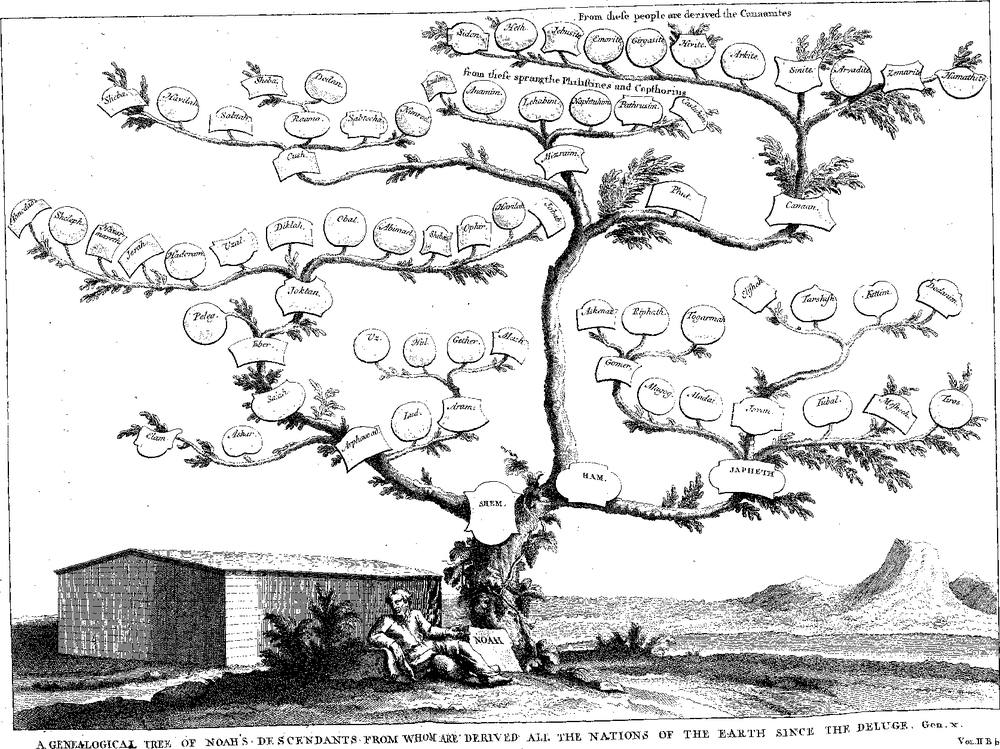
But Noah lived yet after the Deluge three Hundred and fifty Years; and the whole Time of his Life having been nine Hundred and fifty Years, he died in the Year of the World 2006, before Christ 1994, and before the vulgar Æra 1998. He left three Sons, Shem, Ham, and Japheth, of which Mention will be made under their Articles; and according to the common Opinion, he divided the whole World amongst them, in Order to repeople it21. To Shem he gave Asia, to Ham, Africa, and Europe to Japheth. Some22 will have it, that besides these three Sons, he had several others. The spurious Berosus gives him thirty, called Titans, from the Name of their Mother Titæa. They pretend the Teutons or Germans are derived from a Son of Noah called Thuiscon. The false Methodius also makes Mention of Jonithus or Jonicus, a pretended Son of Noah. The Scholastick History of Peter Comestor may be seen, l. i. c. 37. and Tostat upon Genesis. We have spoken already under the Article NOACHIDÆ, of the Precepts that the Rabbins pretend were given by Noah to his Sons and their Descendants.
2 Peter ii. 5.St. Peter calls Noah a Preacher of Righteousness, because before the Deluge he was incessantly preaching and declaring to Men, not only by his Discourses, but by his unblamable Life, and by the building of the Ark, in which he was employed six Score Years, that the Wrath of God was ready to pour upon ‘em. But his Preaching had no Effect, since when the Deluge came, it found Mankind plunged in their old Enormities, and busied in nothing less Matth. xxiv. 37.than in appeasing the Vengeance of God. We find among the Verses of the pretended Sybils, a Piece intitled, A Description of Mankind before the Deluge, and Noah’s preaching to them. Theophilus of Antioch23 seems to believe, that the Name Deucalion, who is the same as Noah, comes from the Greek Deute, and Calein, come and call; because
Noah speaking to Men before the Deluge, used the Words, Come, God calls you to Repentance.
1 Pet. iii. 18, 19, 20.The same St. Peter says, For Christ also hath once suffered for Sins, the just for the unjust, (that he might bring us to God) being put to Death in the Flesh, but quickened by the Spirit: By which also he went and preached unto the Spirits in Prison; which sometime were disobedient, when once the long Suffering of God waited in the Days of Noah, while the Ark was a preparing, wherein few, that is eight Souls, were saved by Water. Several of the antient Fathers24 have taken these Words literally; as if Jesus Christ after his Resurrection, had really preached to those Men, who before the Deluge were disobedient to the Preaching of Noah; that he had delivered some of those that were the least wicked, who believed in him, and were converted. Others25 by the Word Prison understand the Body, which is as it were the Prison of the Soul. Others will have it, that Jesus Christ by his Spirit, with which Noah was replenished, preached by the Mouth of this Patriarch to the Unbelievers before the Deluge, whose Souls were then in the Prison of the Body, but who at the Time that St. Peter wrote were in the Prison of Hell. The Commentators may be consulted for the other Interpretations that are given to this Passage.
The Eastern People26 had a Notion, that Noah received Orders from God to take the Body of Adam, and put it in the Ark, to preserve it from the Waters of the Deluge; and that when he found himself near his Death, he called his Son Shem to him, trusted him with this Depositum, and bid him carry it to Melchisedech the Priest of the most High, that they two might bury it in such Place as the Angel of the Lord should shew them. Shem went therefore to Melchisedech, and they buried Adam upon Mount Calvary, which is the Middle of the Earth. This is a Prayer which, ‘tis said, Noah repeated every Day while he was in the Ark. “ O Lord, thou art truly great, and there is nothing so great “ as that it can be compared to thee. “ Look upon us with an Eye of Mercy, “ and deliver us from this Deluge of Waters. I intreat this of thee for the Love “ of Adam thy first Man, for the Blood “ of Abel thy Saint, for the Righteousness “ of Seth whom thou hast loved. Let us “ not be reckoned in the Number of those “ who have disobeyed thy Commandments, but still extend thy merciful Care “ to us, because thou hast hitherto been “ our Deliverer, and all thy Creatures shall “ declare thy Praise, Amen.
Gen. vi. 9.Several learned Men have observed, that the Pagans have confounded Saturn, Deucalion, Ogyges, the God Cœlus, or Uranus, Janus, Protheus, Prometheus, Vertumnus, Bacchus, Osiris, Vadimon, and Nisuthrus, with Noah. Concerning this the Reader may see M. Bochart, Geograph. Sacr. l. i. c. 1. M. Huet. de concord. Rat. & Fidei, l. ii. Grot. de verit. Relig. Christ. l. i. Natalis Comes. Mytholog. l. viii. c. 17. Octav. Falconer, Dissert. de Numo Apamens. Dikinson, Delphi Phœnicizantes. See also M. Fabricius Apochryph. V. T. p. 247, &c. Also several Writings have been ascribed to Noah. Some Hebrews have thought, that Moses quotes a Work composed by Noah, when he says, These are the Generations of Noah. And elsewhere, Now these are the Gen. x. 1.Generations of the Sons of Noah. The false Berosus ascribes also a Book to him, Of the Secrets of natural Things; and the Cabalists maintain, that this Book was stole from Noah by his Son Ham, and given to Mizraim. W. Postel speaks of it in the Title of his Book called, De originibus, seu de varia ac potissimum orbi Latino ad hanc diem incognita, aut inconsiderata historia, &c. Ex libris Noachi & Hanachi, &c. Lambecius in his Catalogue of the Emperor’s Library, speaks of a Book with this Title: The Method which was revealed to the Prophet Noah by the Angel of the Lord, to discover sixteen Figures, proper to foretel what shall come hereafter. But all these are justly ranged in the Class of Fables and Impostures. There is no Proof that Noah ever wrote any Thing, much less that any Thing of his is preserved to our Times.
The Wife of Noah is called Noriah by the Gnosticks26; Barthenos or Bathenos by Epiphanes27; Noema or Tethiri, by some antient Rabbins28. But this has as little Certainty, as what we now mentioned of Noah’s Works.
We find in the Arabic Explication of Genesis, imputed to St. Hippolytus, and printed in the second Tome of his Works, p. 38. Edit. Fabricii, that the Wife of Shem was called Nahalath Mahnuk, that of Ham, Zetdkath-nabu, and that of Japheth, Arathkah. The Mussulmen give Noah the Title of Father, and of Chief of those that were sent by God, or of all the Prophets. They29
call him also Al-negi, he that was saved himself, and saved others. They add, that he was sent of God to preach Repentance to Men, and to teach the Unity of the Deity, and that he could only convert four Score Persons, who were saved with him in the Ark. That when he began to work upon this famous Vessel, all that saw him derided him, and said; You are building a Ship, if you can bring Water to it, you will be a Prophet as well as a Carpenter. But he made Answer to these Insults, You laugh at me now, but I shall have my Turn to laugh at you. You will learn at your own Cost, that there is a God in Heaven who punishes the wicked.
Ebn-abbas says, that Noah being perplexed about the Figure that he should make the Ark of, God revealed to him, that it must have the Shape of the Belly of a Bird, and that he must make Use of the Timber of a Tree called in Arabic, Sag, which is the Platanus of the Indies. He presently planted it, and in twenty Years it was big enough to furnish the Materials for this whole Vessel, great as it was. It was built in two Years Time, it had three Floors, the highest was for the Birds, the lowest for the wild and tame Beasts, and the Middlemost for Mankind.
When the Time of the Deluge was come, the Oven began to boil up, and to run over. For they affirm, that Noah had succeeded by Inheritance to that Oven, that Eve had made Use of to bake her Bread, and that at the Times of God’s Vengeance it begins to pour out great Floods of running Water. This Oven, called in Hebrew, Tannour, is different from our common Ovens; for it has its Opening at Top, and is generally of Stone or Clay. The Fourscore Believers entered with Noah into the Ark, and none but Canaan the Son of Ham refused to enter. Some of ‘em think that Noah went on Board at Confab, near the Mouth of the Tigris in the Persian Gulf; others at the Place where Babylon was afterwards built.
After the Ark had gone round the World, during the Space of six Months30, God gave his Commands to the Earth, saying, Earth swallow up the Waters; Heaven, drink up those that thou hast poured out. The Water then began immediately to diminish, the Orders of God were performed, the Ark stopped upon the Mountain of Girudi, and this Voice was heard from Heaven, Cursed are the Wicked.
They think that Noah came out of the Ark on the tenth Day of the first Month of the Arabian Year, called Meharram; and that this Patriarch instituted a Fast on that Day, which they still observe, in Commemoration of the Deliverance from the Waters of the Deluge. Then Noah was appointed of God as a new Adam, to re-people the whole World. All Nations derive their Original from his three Sons. Shem was the Father of the Hebrews, the Arabians, the Persians, the Syrians, and the Greeks, Japheth of the Scythians, the Moguls, the Getæ, the Tartars, the Chinese, the Turks, the Hyperboreans, of Gog and Magog. Ham is the Father of the Indians, the Africans, the Blacks, and all the People of the South.
Besides these three Sons of Noah, the Orientals have given him a fourth, called Maghestcn, unknown to the sacred Books of the Hebrews. They say moreover, that God sent Books to Noah, which signifies, according to their Way of speaking, that when he died he left ten Volumes behind him, in which he wrote down the Revelations, and all the Commands he had received from God. But these Books, if ever they were at all in Being, are now lost. ‘Tis said there is a Monastery in Mesopotamia, called Deir Abouna, the Monastery of our Father, near which there is a Castle, where a great Sepulchre is to be seen, which the People of the Country say belonged to the Patriarch Noah: And the Persian Geographer mentions a Place in Arabia, in the most eastern Province of this Country, which bears the Name of Ardh-nough, which falls in very well with the Opinion of those, who will have the Ark to have been built at Confab, of which we have now spoken.
The Fable of Deucalion and his Wife Pyrrha31, is manifestly invented from the History of Noah. Deucalion by the Advice of his Father built an Ark, or a Vessel of Wood, in which he put all Sorts of Provisions necessary for Life, and entered into it with his Wife Pyrrha. This was to secure them from a Deluge, that drowned almost all Greece. All the People almost of this Country were destroyed, none escaped but those that took Refuge upon the Tops of the highest Mountains. As soon as the Flood was over, Deucalion came out of his Ark, and found himself upon Mount Parnassus. There he offered Sacrifices to Jupiter, who sent Mercury to him, to know what he desired. He requested him that he might become the Restorer of Mankind, which Jupiter granted him. He and Pyrrha were ordered to cast Stones behind them, which were immediately changed into so many Men and Women.
The Pagans struck Medals to preserve the Memory of this famous Event32. On
one may be seen the Head of the Emperor Philip, and on another that of Septimius Severus Pertinax, and upon the Reverse of both, an Ark, or oblong square Vessel, in which appeared Deucalion and Pyrrha, or if you please, Noah and his Wife. Without also are seen a Man and Woman, and above the Ark two Birds, one of which brings a small Branch of Olive in its Claws. These Medals were struck at Apamea of Phrygia, where it is thought that Noah’s Ark rested. See APAMEA before, and what is observed upon Noah’s Ark, and the Deluge.
NOARA, Noarath, or Nearath, a City of the Tribe of Ephraim, within five Miles of Jericho, as Eusebius says under the Word NAARATHA.
NOB, or Nobe, or Nomba, a Sacerdodal City of the Tribe of Benjamin or Ephraim. St. Jerome says33, that in his Time it was entirely destroyed, and that the Ruines of it might be seen not far from Diospolis. When David was drove away by Saul, he came to Nob, and asking the High-priest Abimeleck for something to 1 Sam. xxii. 9, &c. xxi. 6, 7, 8, &c.eat, he gave him the Leaves which had been lately taken off the holy Table, and the Sword of Goliab. When Saul was informed of this by Doeg, he caused all the Priests of Nob to be slain, and destroyed their City.
NOBAH, or Nobe, or Chanatha, or Canath, a City beyond Jordan. It took the Name of Nobah after an Israelite of this Name had made a Conquest of it, Numb. xxxii. 42. Gideon pursued the Midianites as far as this City, Judg. viii. 2. Eusebius says, that there is a forsaken Place of this Name about eight Miles from Hesbbon towards the South. But this could not be the Nobah now mentioned, because this was much farther to the North.
NOD, or the Land of Nod. ‘Twas to this Country that Cain withdrew after his Parricide, Gen. iv. 16. The Seventy, as also Josephus, have read Naid instead of Nod, and have taken it for the Name of a Place. It can’t be easily known what Country this was, unless perhaps it was the Country of Nyse or Nysea, towards Hyrcania. St. Jerome and the Chaldee have taken the Word Nod in the Sense of an Apellative, for Vagabond or Fugitive. Habitavit profugus in terra. The Hebrew has it, Habitavit in terra Nod.
NODAB, a Country bordering upon Gen. iv. 16. בארץ נוד 1 Chron. v. 19.Iturea and Idumea, but now unknown. We read in the Chronicles, that the Tribe of Reuben, assisted by those of Gad and Ma nasses, had a War against the Hagarites, the Jeturites, and the People of Nephith and of Nodab, in which the Israelites had the Advantage. But the Time and the other Particulars of this War are unknown.
NOEMA. Some of the Orientals give this Name to Noah’s Wife; others call her Bathenos, or Noria, or Tithæa. Vid. Fabric. Apocryph. Vet. Testam. p. 271. T. i.
NOGAH, or Noge, a Son of David, 1 Chron. iii. 7. xiv. 6.
NOHAH. or Nobaa, the fourth Son of Benjamin, 1 Chron. viii. 2.
NOHESTAN. This is the Name which in the Time of Hezekiah King of Judah34, was given to the Brazen Serpent, that Moses had set up in the Wilderness, and which had been preserved by the Israelites to this Time. The superstitious People having made an Idol of this Serpent, Hezekiah caused it to be burnt, and in Derision gave it the Name of Nobestan; as if he should say, this little brazen Serpent. For in Hebrew, Nabas, or Nachasch, signifies a Serpent, and that of Brass. Even to this Day, in the Church of St. Ambrose at Milan, they shew a brazen Serpent, which they pretend to be the very same that Moses set up in the Wilderness. But ‘tis very well known from the History of Hezekiah, that this was broke to Pieces in his Time. For the Brazen Serpent erected by Moses, see Serpent, and Punon, which is thought to be the Encampment where Moses set up the Brazen Serpent.
NOME, a Canton or Province. This Term is commonly made Use of in the Distribution of lower Egypt into Cantons or Provinces, which was divided into several Nomes, each of which bore the Name of the principal City therein.
NOPHAH, or Nophe, a City of the Moabites, which afterwards belonged to Numb. xxi. 30.the Amorites, and lastly to the Israelites. Nophah was near to Medebah. There is some Probability that it is the same as Nephtis, Esdr. v. 21. or Nebo or Nabo, Nehem. vii. 33. and Ezr. ii. 29, &c. The Situation of the Places agrees perfectly well. Nebo is joined with Medeba in Isai. xvi. 2. xlvi. 1.
Josh. xi. 2. xii. 23.NOPHET, Josh. xvii. 11. and elsewhere, is taken for a Canton or a Province. Often it is joined to Dor as Nophet-dor, the Canton round the City Dor, upon the Mediterranean, to the South of Mount Carmel, and to the North of Cæsarea of Palestine. In the Place of Joshua, where the Vulgate reads35 Tertia pars urbis Nopheth, the Hebrew has only Tertia pars Nopheth,
the third Part of the Canton called Nophet. This Canton was round about Dor, and two thirds of it was possessed by the Tribe of Zebulun, and one third by that of Manasseh.
NOSE. Nasus, Nares. The Hebrews 2 Sam. xxii. 9.commonly place Anger in the Nose. There went up a Smoke out of his Nostrils. And in Deut. xxix. 20.Moses, The Anger of the Lord and his Jealousy shall smoke against that Man. Also Psal. xviii. 8.in the Psalms, There went up a Smoak out of his Nostrils. And Job, Out of his Job. xli. 11.Nostrils goeth Smoke. The antient Greek and Latin Authors speak pretty much after the same Manner e. Thus Persius,
Disce, sed ira cadat naso, rugosaq; sanna.
And Plautus,
Fames & mora bilem in naso conciunt.
The Eastern Women in several Places put golden Rings to one of their Nostrils. Solomon alludes to this Custom when he Prov. xi. 22.says, As a Jewel of Gold in a Swines Snout, so is a fair Woman without Discretion.Ezek. xvi. 12. And Ezekiel, And I put a Jewel on thy Forehead [Heb. Nose,] and Ear-rings in thine Ears and a beautiful Crown upon thine Head.
They also put Rings in the Nostrils of 2 Kings xix. 28.Oxen and Camels, to guide them by. I will put my Hook in thy Nose, and my Bridle in Job. xl. 21. Vulg.thy Lips. And Job; Nunquid ponis circulum in naribus ejus, aut armillâ perforabis maxillam ejus?
NOTHING, Nihilum. Nothing is sometimes put by Way of Opposition to Body, Solidity, or Mass. It is also put for Vacuity, and for what is not sensible. Job says, He Job. xxvi. 7.stretcheth out the North over the empty Place, and hangeth the Earth upon nothing, upon the Vacuum. And Isaiah, that God Isai xl. 22. Vulg.spreads out the Heavens as nothing, extendit tanquam nihilum cœlos; he extends them Wisd ii. 2. Vulg.in the Air, in invisible Spaces. The Wise-man says, we are born of nothing, and in some Sense shall return to nothing again. Ex nihilo nati sumus, & post hoc erimus tanquam non fuerimus. We shall disappear from the Face of the Earth, as if we had never been there. And Isaiah says, Behold Isai. xli. 24.ye are of nothing, and your Work of nought; an Abomination is he that chooseth you.
Idols are often called Nothings, Non-entities. Amos vi. 13.Ye which rejoice in a Thing of nought. And Esther, O Lord, give not thy Esther xiv. 11.Sceptre unto them that be nothing; deliver not over thy People to those Gods that are 1 Cor. vii. 4.nothing. And St. Paul, we know that an Idol is nothing in the World.
To bring to nothing, that is, to exterminate, to destroy, utterly to root out any Thing. Thus in the Psalms, Ad nihilum deductus est in conspectu ejus malignus. And again, Ad nihilum deduces omnes gentes. And elsewhere, Ad nihilum deduces tribulantes nos.
NUMBER. This Word is sometimes taken to signifie a small Number, such as is easy to reckon, and sometimes it signifies the contrary. We are but few in Number, says Jacob to his Sons, when Gen. they had assaulted Shechem. The Letter xxxiv.
- of the Hebrew is, Ego autem viri numeri, Deut. I being few in Number. And Moses says, iv. 27.
Job. Ye shall be left few in Number among the xvi. 23. Heathen. And Job, when a few Years are Psal. come, or according to the Hebrew Years of cv. 12. Number. And the Psalmist, When they were but a few Men in Number; or literally, Men of Number.
Psal. cxlvii. 4.Number sometimes stands for a great Number, or a Multitude. Thus, He telleth the Number of the Stars, or their Multitude, Eccles. ii. 3.as the Septuagint and Vulgate translate it. Solomon says, Quo facto opus est sub sole, numero dierum vitæ suæ.
Rev. xiii. 17, 18.The Number of the Beast, or the Number of the Name of the Beast, in the Revelations, stands for the numerical Value of the Letters that compose his Name.
In Psalm lxxi, (according to the Hebrew) the Prophet says, that he knows not the Numbers thereof. The Septuagint and Vulgate read, nescio literaturam, or according to the most antient Latin Copies, nescio negotiationes. They read in the Greek, Pragmascius, instead of Grammascius. But this is the Signification of the Hebrew. My Mouth shall daily declare thy Justice, and the Favours that thou hast done me, because I know not the Number thereof, or they are innumerable. Otherwise, I will publish every Day the Salvation thou hast procured for me; and though I am ignorant of Letters, or am not learned, I shall not cease to consider thy Power.
NUMBERS. The Book of Numbers is the third of the Pentateuque. The Hebrews call it Vajedabber36, and he spoke, because in the Hebrew it begins with these Words. Some Jews call it Bemiddebar g in the Desert, because it includes the History of what passed during the thirty-nine Years of the Israelites journeying in the Wilderness. Lastly, the Greeks, and after them the Latins, call it the Book of Numbers, because the three first Chapters contain the numbering of the Hebrews and Levites, which e —— Ἀνὰ ῥῖνας δέ οἱ ἤδη Δειμὺ μῆδος περῢτυψε. Homer. Odyss. xxiv. Οἱ ἀεὶ δελμεῖαι χολὰ ποτὶ ῥινὶ κάθηται. Theocrit. f וידברVajedabber. g במדברBemiddebar.
was performed separately after the Erection and Consecration of the Tabernacle.
The People having departed from Sinai on the twentieth Day of the second Month of the second Year after their coming out of Egypt37, went to the Wilderness of Paran, and thence to Kadesh, from whence they sent Commissioners to view the Land of Promise. At their Return the People were discouraged, and fell into Murmuring and Discontent; for which God condemn’d them to die in the Desart, and swore they should not enter into the Land which he had promised to their Fathers. Thus after having continued a good while at Kadesh-barnea, they returned back again; and having journey’d for thirty-nine Years in the Wilderness, they arrived at last at the Plains of Moab, beyond Jordan. All that happen’d during this Interval is to be read in the Book of Numbers. There are found the Wars of Moses with the Kings Sehon and Og, and that of the Midianites, to punish them for sending their Daughters into the Camp of Israel, and thereby tempting the People to Fornication and Idolatry. We there read of several Laws given by Moses during these thirty-nine Years, and of the many Murmurings of the Israelites, and the several Punishments which the Lord inflicted on them for the same.
Matt. xxii. 16, 17, 18, &c.NUMENIUS, Son of Antiochus, was sent by Jonathan Maccabeus38 to renew the Alliance made by the Jews, with the Romans and Lacedemonians. He was again commission’d for the same Purpose some Years after, by Simon Maccabeus the Brother of Jonathan39. It is not easy to know who this Numenius was, but he appears to have been a Person of great Capacity, since he was employed in such Important Negociations, which he always managed with Address. Josephus40 also mentions Letters of the Roman Senate in Favour of Johannes Hyrcanus, given in the ninth Year of his High-priesthood, wherein Numenius the Son of Antiochus is named as Ambassador from the Jews.
NUMISMA CENSUS, or the Tribute- Money. We read in St. Matthew, that the Disciples of the Pharisees and the Herodians, came to tempt Jesus, and ask’d him if it were lawful to pay Tribute to Cæsar, or not. But Jesus knowing their Malice, said to them; Ye Hypocrites, why tempt ye me? Shew me a Piece of the Money, with which the Tribute is paid: Ostendite mihi numisma census. Now ‘tis enquired, what piece of Money this was? and of what Tribute our Saviour here spoke? As to the first of these Questions, the Gospel informs us, that this Piece of Money had upon it the Image and Inscription of Cæsar, or the Roman Emperor. Cujus est imago hæc & superscriptio? Dicunt ei, Cæsaris. ‘Twas therefore a Piece of Money of the Roman Emperor that then reign’d, that is, of Tiberius, or of one of his Predecessors. As to the other Question about the Tribute, there is great Probability that it was a Capitation, or a Tax to be levied at so much a Head. Appian says41, that the Jews paid the Capitation; and Ulpian assures us42, that in the Provinces of Syria, all the Males from the Age of fourteen Years, and all the Females from twelve, till they were sixty-five Years old, were obliged to pay this Tribute or Capitation. And this is the proper Signification of the Census.
NUN, Son of Elishamah, and Father of Joshua, of the Tribe of Ephraim. The Greeks give him the Name of Naue instead of Nun. We know none of the Particulars of his Life, and he is only known in the sacred History, by being the Father of Joshua.
NUTTS, a Fruit well known and very common. It is said in Exodus43, that the Branches of the Golden Candlestick were to be adorned with three Cups or Bowls in form of Nuts , and that between each Cup or Bowl there should be a Knop and a Flower. But the Hebrew Text reads, three Cups which produce Almonds, that is to say, as a Flower of an Almond-Tree, from the midst of which came forth the Branch of the Candlestick as the Fruit comes forth from the midst of the Flower. The only Passage in which mention is made of Nuts, is that in the Song of Solomon44. I went down into the Garden of Nuts, or of Nut-Trees.
NYCTICORAX, an Owl, Scritch-Owl; and literally, a Night-Raven. Nyx in Greek signifies Night, and Corax a Raven. This Bird is prohibited by the Law45; but in Leviticus the Hebrew Word Shalak is translated by Mergulus, a Plungeon or Diver; and in Deuteronomy, an Owl; but its true Signification is a Diver. In Deuteronomy there are some Changes of Place of the Words in the Vulgate, and in those of the Septuagint; which is the Reason we cannot be sure what Hebrew Word is to answer to Nycticorax, which is found in46
the Septuagint and in the Vulgate, Deut. xiv. 17, 18. But in Leviticus the Septuagint read Nycticorax, and the Vulgate Bubo, for the Hebrew Word Cos, which is explain’d of a Pelican, an Hawk, or an Owl. The same Word Cos we meet with in Psal. ciii. 7. where the Septuagint and the Vulgate have Nycticorax. But Bochart thinks47, ‘tis rather the Onocrotalus, which is a kind of Pelican, having a great Pouch under its Beak, and at the upper Part of its Throat. This Pouch is of such a Magnitude, as to contain a whole Child, which has sometimes been found in it, sometimes only a Hand and an Arm, or a Foot and a Thigh. This Bird is common in Egypt, and about Gaza in Palestine. The Hebrew Word Cos signifies a Cup, or a Vessel to drink out of. A Word which may also be us’d to signify the great Pouch of the Onocrotalus mention’d before. This is a solitary Bird as well as the Owl48, call’d Avis Coloss. iv. 15.solitaria in the same Passage of the Psalms.
NYMPHAS. St. Paul writing to the Colossians, salutes Nymphas, and the Church which is in his House. Some Latins have thought49, that Nymphas was here the Name of a Woman: But the Greek Text50 shews plainly it must be a Man. The Greeks keep the Feast of Nymphas on the 28th of February, and give him the Name of an Apostle. They add, that he died in Peace.
OATH. God has prohibited all false Lev. xix. 12. Exod. xx. 7. Deut. vi. 13. Jer. iv. 2. Exod. xxiii. 13.Oaths, and all useless and customary Swearing: But when Necessity and the Importance of the Matter requires it, he allows us to swear by his Name, but not in the Name of any false Gods, or in the Name of inanimate Things; whether on Earth, or in Heaven, or by the Stars, or by the Life of any Man whatever. Our Saviour, who came into the World not to destroy the Law, but to fulfil it, forbids all kinds of Oaths; and Matt. v. 33.the primitive Christians understood and observed this Command in a literal Sense, as O.may be seen from Tertullian, Eusebius, St. Chrysostom, St. Basil, St. Jerom, &c. However, it must be acknowledg’d, that neither the Apostles nor Fathers have absolutely condemn’d Swearing, or the Use of Oaths upon any Occasion, and all Subjects. There are Circumstances wherein we cannot morally be excus’d from it. But we never ought to swear but upon urgent Necessity, and to do some considerable Good by it. We ought to live with such Integrity and Veracity, as not to need to have Recourse to an Oath to confirm what we say, but that our Word may be look’d upon as good as an Oath: Nor must we ever swear but with a strict Regard to Justice and Truth. See St. Augstin, Ep. 157. n. 40 and the Commentators upon St. Matthew, v. 33, 34.
OB, a Spirit of Ob, a Spirit of Python. See PYTHON.
I. OBADIAH, or Obdiah, the second Son of Uzzi, of the Tribe of Issachar. 1 Chron. vii. 3.
II. OBADIAH, Son of Arnan, and Father of Shechaniah, 1 Chron. iii. 21.
III. OBADIAH, Son of Azel, of the Race of Saul. 1 Chron. viii. 38.
IV. OBADIAH, Son of Shemaiah, of the Race of the Levites. 1 Chron. ix. 16.
V. OBADIAH, a valiant Man of David’s Army, who came to join him in the Wilderness, with several others of the Tribe of Gad. 1 Chron. xii. 9. The Text [of the Vulgate] has de Gaddi, but the following Account shews, that it must be understood of the Tribe of Gad. See Verse 14.
VI. OBADIAH; he was one of those whom King Jehoshaphat sent into the Cities of Judah, to instruct the People in their Religion. 2 Chron. xvii. 7.
VII. OBADIAH, one of the principal Men of Judah, who sign’d the Covenant that Nehemiah renewed with the Lord, Obad. xx.Neh. x. 5.
VIII. OBADIAH, the Prophet. He foretold the Return from the Captivity in these Terms according to the Vulgate. The Army of the Children of Israel, who had been transplanted out of their own Country, shall possess all the Land of the Canaanites as far as Sarepta, and the Cities of the South shall be in Subjection to those that had been carried away from Jerusalem as far as the Bosphorus. The Hebrew [and English Translation] read it thus: The Captivity of this Host of the Children of Israel shall possess that of the Canaanites even unto Zarephath; and the Captivity of Jerusalem which is in Sepharad shall possess the Cities of the South. Some Hebrews by the
Name of Canaanites here understand Germany, and France by the Name of Zarephath, and Spain by the Name of Sepharad. The Jew that taught St. Jerom the Hebrew Tongue, by the Name of Sepharad, understood the Bosphorus, which he connected with the Preposition Be, signifying within, and made but one Word of them. But it will be better to follow the Reading of the Septuagint. The Israelites51 at their Return from the Captivity shall possess the Land of the Canaanites, or of the Phenicians, as far as the City of Sarepta, which was near to Tyre and Sidon, the Capital of Phenicia. And the Captives that should return to Jerusalem shall possess the Country that reaches from Ephrata towards the South of the Land of Promise.
Gen. x. 28.OBAL, or Ebal, the eighth Son of Joktan: He is generally thought to have peopled a Part of Arabia. There is found a Canton call’d Abalite or Avalite.
I. OBED, Son of Boaz, and of Ruth, Father of Jesse, and Grandfather of David. Ruth iv. 17.
II. OBED, Son of Ephtal, and Father of Jehu, of the Tribe of Judah. 1 Chron. xi. 37.
1 Chron. xvi. 38. 1 Chron. xxvi. 4.OBED-EDOM, Son of Jedutbun, a Levite, and Father of Shemaiah, Jehozabad, Joah, Sacar, Nathaneel, Ammiel, Issachar, and Peulthai. He had a numerous Family, says the Scripture, because the Lord blessed him; and this is the Occasion of this Blessing. When David tranferr’d the Ark of the Covenant to the City of Jerusalem, Uzzah having rashly laid Hands on the Ark52, which he thought to be in danger of falling, was smitten of God, and died upon the Spot. David terrified at this Accident, durst not remove the Ark into the Place he had provided for it in his own House, but set it up in the House of Obed-Edom, which was near the Place where Uzzah had been struck dead. But the Presence of the Ark not only created no Temporal Misfortune to the Family of this Levite, but on the contrary the Lord heap’d upon him all sorts of Blessings; which encouraged David some Months after, to remove it to the Place he had appointed for it. Afterwards Obed-Edom and 1 Chron. xv. 18. 21. 2 Sam. vi. 10.his Sons were assigned to the keeping of the Doors of the Temple. In the second Book of Samuel Obed-edom is call’d the Gittite, probably because he was of Gath-rimmon, a City of the Levites beyond Jordan. Josh. xxi. 24. 25.
OBIL, or Ubil, an Ishmaelite, Master of the Camels to King David53. David gave the Care of his Camels to an Ishmaelite, probably because these People knew better than others the Manner of rearing and managing these Animals, which were very common in their Country.
OBOLUS is the twentieth Part of a Shekel. Siclus viginti obolos habet. The Exod. xxx. 13.Hebrew reads, The Shekel is twenty Gerabs. The Gerab is the smallest Piece of Hebrew Money, and is in Value about five Farthings of our Money.
OBOTH, an Encampment of the Hebrews in the Wilderness. From Punon they went to Oboth, and from Oboth to Jeabarim. Numb. xxi. 10. xxxiii. 43. Ptolemy speaks of a City call’d Oboda, or Eboda, in Arabia Petræa, which is the same as Oboth. Pliny, and the Geographer Stephanus mention it also. Stephanus makes it belong to the Nabatheans, and Pliny54 to the Helmodeans, a People of Arabia. ‘Twas at Oboth that they worship’d the God Obodos, which Tertullian55 joins with Dusares, another King of this Country.
OBRIZUM. The Gold call’d Obrizum is often mention’d in Scripture. For Example, 2 Chron. iii. v. Laminas auri obrizi. Job xxviii. 15. Non dabitur aurum obrizum pro sapientia. And xxxi. 24. Si obrizo dixi, fiducia mea. And Isai. xiii. 12. Pretiosior erit vir auro, & homo mundo obrizo. And Dan. x. 5. Renes ejus accincti auro obrizo. Pliny says56, that they call Obrizum the Gold that has been several times purify’d in the Fire. Auri experimento ignis est ut simili colore rubeat quo ignis; atque ipsum obrizum vocant. But the Hebrew Text, which is translated by Obrizum, is not always the same. For in the Passage quoted out of the Chronicles, the original Text57 only reads good Gold, and the Septuagint pure Gold. In Job xxviii. 15. Chetem of Ophir, or fine Gold of Ophir. And c. xxxi. he says only Chetem, which signifies fine or purify’d Gold. And in Isai. xiii. 12. I will take a Man more precious than the Phaz, and than the fine Gold of Ophir. And in Daniel, his Reins were girded with the pure Gold of Ophaz. But the Gold of Ophir and the Gold of Phaz or Ophaz, is probably that which was brought from the Country of Ophir, and the River Phasis, or Phison in Cholchis. Abriz in Arabick or Persian signifies fine Gold without Mixture, which the Greeks and Latins call Obrizum.
OBSCURE. We have already spoke of Obscurity as it is put for Adversity, under the Words Night and Darkness. An obscure, dark, or sad Countenance is oppos’d
to a serene and open one. Jesus Christ upbraids the Pharisees, that they had obscure or sad Aspects58 when they fasted. And in Nah. xi. 10.Nahum, speaking of the Destruction of Nineve it is said, Facies omnium ut nigredo ollæ. Their Faces were as black as a Pot. The Hebrew says, as if they had black’d their Faces with Soot. Some Travellers affirm59, that by way of Mourning the Orientals daub their Faces with the black of a Joel xi. 6.Kettle. Joel makes Allusion to this Custom, Omnes vultus redigentur in ollam. And Isai. xiii. 8. Facies combustæ vultus eorum. And Ezek. xx. 47. comburetur or nigrescet omnis facies, ab austro usque ad aquilonem.
Psal. cxlii. 3.Obscure Places denote the Grave. Collocavit me in obscuris, sicut mortuos sæculi. In Ps. lxxiii. 21.another Psalm we read, Repleti sunt qui obscurati sunt terræ domibus iniquitatum: which some understand of the obscure Places of Prisons, wherein Tyrants often keep the Weak and Unfortunate, because the obscure of the Earth, the poor Israelites are reduced to Captivity in the Houses of the Babylonians. Solomon speaks of the obscure, the Poor, as oppos’d to the Great and Prov. xxii. 23.Rich. Vidisti virum velocem in opere suo? coram regibus stabit, nec erit ante ignobiles. The Hebrew says, coram obscuris.
In great Calamities, ‘tis said the Sun was obscur’d, and the Moon cover’d with Darkness. Matt. xxiv. 24 Luke xxiii. 45.Nahum says, Non est obscura contritio tua. Your Wound is not conceal’d. The Hebrew says, it is not bound up or closed. Nah. iii. 10.Jeremiah speaking of the Gates of Jerusalem, Portæ ejus corruerunt & obscuratæ sunt in terra; or according to the Hebrew, they are languishing and cover’d with Mourning upon the Earth. The Gates are put for the City.
The Obscurity of the Heart and of the Rom. i. 21. Eph. iv. 18.Mind, according to St. Paul, are put for the wilful Ignorance and Hardness of the Jews.
OBSERVATION.To observe the Commandments of the Lord, his Laws, his Solemnities, his Covenant, &c. are Expressions that occur very frequently in Scripture. Observa eum, & audi vocem ejus60. Observe him, and hear his Voice. The Hebrew says, be upon your Guard in his Presence, and fear him. You shall not observe Dreams v. The Hebrew is not known. Some translate it by, you shall use no Sorcery; others, you shall cast no Nativities; or you shall not enchant the Eyes, or you shall use no Auguries by the Flight of Birds.
Observare custodias. To keep guard in the Temple, at the Gate of a Prince, in a 1 Sam. ii. 22.Camp, or even to keep watch over a Flock that lye out in the Field. It is said that the Sons of Eli debauched the Women that kept guard in the Tabernacle. Quæ observabant ad ostium tabernaculi.
Eccl. viii. 2. Eccl. xi. 4.To observe the Mouth of any one, to be a Spy upon his Words, in order to surprize him. The Babylonians observed Daniel, that they might have an Opportunity to accuse him to the King. The Pharisees observed Jesus Christ, and endeavoured to catch him in his Discourses. Solomon advises to observe the Mouth of the King, to keep his Ordinances, to be obedient to his Commands. Elsewhere he says, that he that observes the Winds shall not sow. St. Paul Gal. iv. 10. Ezek. xxiii. 4, 5.reproves the Galatians for observing Days and Months, who imitated the Jews in their superstitious Distinction of Days. Ezekiel says, that he that does not observe himself, or takes not care of himself, shall Ps. cxxx. 3.die by the Sword. If thou Lord shouldst mark (or observe) Iniquities, O Lord, who shall stand? If thou shouldst enter into a rigorous Observation of our Faults, who can bear such a Scrutiny, who can stand such an Enquiry?
OBSESSION of the Devil. Obsession is distinguish’d from Possession of the Devil in this; that in Possession the evil one enters into the Body of the Man, and leaves him not, whether he is always tormenting and disturbing him, or whether he does it only by Fits and Intervals. On the contrary Obsession is, when without entering into the Body of the Person, he besieges him without, and torments him, pretty much like a troublesome Guest, who follows and teazes a Man, from whom he is resolved to get some Advantage. Examples of Possession and Obsession are known both in Story and in Holy Scripture.
1 Sam. xvi. 23.In the Class of Obsessions should be placed, I think, what the Books of Samuel tell us about Saul, who from time to time was disturbed by an evil Spirit, and who was greatly comforted by the Sound of the Musical Instruments, which David play’d upon before him. And I think we must put in the same Class the Demon Asmodeus, who put to Death all the Husbands of Tob. iii. 7, 8, 9.Sarah the Daughter of Raguel. This evil Spirit properly obsess’d this young Woman, Matt. iv. 24. xvii. 14.but did not display his Malice but only against those that would have marry’d her. Young Tobias deliver’d her from this Obsession, by the Means of the Liver of the Fish which he burnt in the Chamber where the evil Spirit exercised his Power. There is great Probability that those mention’d in the Gospel, who were61
particularly tormented about the Full and Change of the Moon, were rather obsess’d than possess’d.
Both Possessions and Obsessions by the evil Spirit are justly look’d upon as Punishments sent by the Justice of God, either to punish Sins committed, or for having delivered themselves up to the Power of the Devil, or to exercise the Virtue and Patience of good People. For it is known, that there have been Persons obsess’d, who have liv’d in a very innocent Manner before Men.
Marks of Obsession are there; to be lifted up into the Air, and afterwards to be thrown down with Violence against the Ground, without being hurt; to speak strange Languages that the Person had never learn’d; at the time of Obsession not to be able to come near Holy Things, or the Sacraments, but to have an Aversion to them, not to endure to hear them mention’d, to know and foretel secret Things, to perform things that exceed the Person’s ordinary Strength, to say or to do Things which the Person would not or durst not say or do, if he were not externally moved to it; if the Dispositions of his Body, of his Health, of his Constitution, of his Inclinations, have no natural Proportion to what he is seen to do by the Strength of the Obsession. If the best Remedies avail nothing, if the Patient suffers violent Contorsions of his Limbs, which afterwards are brought to their natural State without Violence or Struggle. All these Symptoms, or some Part of them, may seem to determine, that the Person is really obsess’d of the Devil.
The Church prescribes no other Remedy against this sort of Evils, but Prayer, good Works, and Exorcisms: But it does not disallow natural Means, which may be made use of, to calm the Humours, and to remove the ill Temper of the Body of the Patient; for Example, Melancholy, Sorrow, black Humours, Gall, Want of Transpiration, Obstruction of certain Parts, and whatever may corrupt, thicken, or sour the Blood and the Juices. Thus we find that Musick relieved Saul in a Fit of his Distemper. We have Experiments of the like Cure effected by Herbs, Fumigations, Essences. But it belongs to Physicians to enter into a farther Discussion of these Matters. See the Universal Dictionary under the Title OBSESSIONS: And the Reader may also consult what we shall say hereafter of Possessions of the Devil.
OCCASION. We call Occasion a Circumstance of Place, or Time, or of the 2 Cor. v. 12.Disposition of a Person, to perform any thing. St. Paul says to the Corinthians, We give you occasion to glory on our behalf. Elsewhere he says, Sin taking Occasion by Rom. vii. 8, 11.the Commandment, wrought in me all manner of Concupiscence. Thus the Law or Commandment is not the Cause, but the Occasion of Sin and Prevarication, since it rais’d a Desire of doing what was forbid. Nitimur in vetitum.
Occasion also is often put for Pretence. He that seeks for Occasions, or a Pretence, to put away his Wife. Samson sought an Deut. xxii. 14. Judg. xiv. 4.Occasion against the Philistines. When the King of Israel received a Letter from the King of Syria, requiring of him to get Naaman cured of his Leprosy, he thought that this Prince was only seeking a Pretence 2 Kings v. 7.to make War against him. Videte quod occasiones quærat adversum me. He that has a mind to forsake his Friend seeks Prov. xviii. 1. 1 Thes. ii. 5.Occasions says the Wise Man. The Hebrew is different from this. He that is separated or dissipated, seeks according to his Desire. He that lives in Dissipation, wanders in his Desires, and is meddling with every thing. Otherwise by joining it with what goes before, he that shuts his Lips passes for a Man of Understanding; he is sought for eagerly when he is absent. St. Paul appeals to the Thessalonians as Witnesses, that among them he never sought for Occasions or Pretences to enrich himself by Flattery, or otherwise. Neque in occasione avaritiæ.
OCRAN, or Ochran, Father of Pagiel, of the Tribe of Asher. Numb. i. 13.
ODAIA, of the Race of the Levites. Nehem. ix. 5.
I. ODED, Father of the Prophet Azariah. He is called Obed in some ancient Bibles and Latin Concordances. 2 Chron. xv. 1.
II. ODED, a Prophet of the Lordx, who being at Samaria, when the Israelites of the ten Tribes returned from the War with their King Pekah, and brought Captives with them two hundred thousand of the People of Judah; he went to meet them, and said to them: “ You have seen that the Lord the God of your Fathers was in Wrath against Judah, he has delivered them into your Hands, and you have slain them very inhumanly; so that your Cruelty has ascended even to Heaven. And more than this, you would make Slaves of the Children of Judah, who are your Brethren, and would add this Sin to the many others you have committed. Therefore now hear the Counsel that I give you. Send back these Captives, lest the Lord should pour out his Anger against you ”. Some of the chief of Samaria joined themselves with Oded, and told them, that they should not bring their Captives into the City; for why (said they) would you fill up the Measure
of your old Offences, and draw upon us the dreadful Anger of the Lord?
The Israelites then moved with these Remonstrances, released all the Captives they had taken; and the principal Men of Samaria took care of them, gave them Cloaths and Food, and other necessary Assistances. After which they furnished them with Horses, because the greatest Part of them were so tired and exhausted, that they were not able to walk. Thus they conducted them to Jericho, which was in the Confines of the Land of Judah. This is all that is come to our Knowledge, concerning the Prophet Oded.
ODONARKES, or Odaven, an Ally of Bacchides, the Enemy of the Jews. He was kill’d by Jonathan Maccabeus, together with some others, who in like manner were of the Party of the Syrians. 1 Macc. ix. 66. In the Year of the World 3846, before Christ 154, before the Vulgar Æra 158.
OFFERINGS. The Hebrews had several kinds of Offerings, which they presented at the Temple. Some were Free-will Offerings, and others were of Obligation. The First-Fruits, the Tenths, the Sin -Offerings were of Obligation; the Peace-Offerings, Vows, Offerings of Wine, Oil, Bread, Salt, and other things, which were made to the Temple, or to the Ministers of the Lord, were Offerings of Devotion. The Hebrews called all Offerings in general Corban62. But the Offerings of Bread, Salt, Fruits and Liquors, as Wine and Oil, which were presented to the Temple, they call’d Mincha63. The Sacrifices are not properly Offerings; they are not commonly included in this Name.
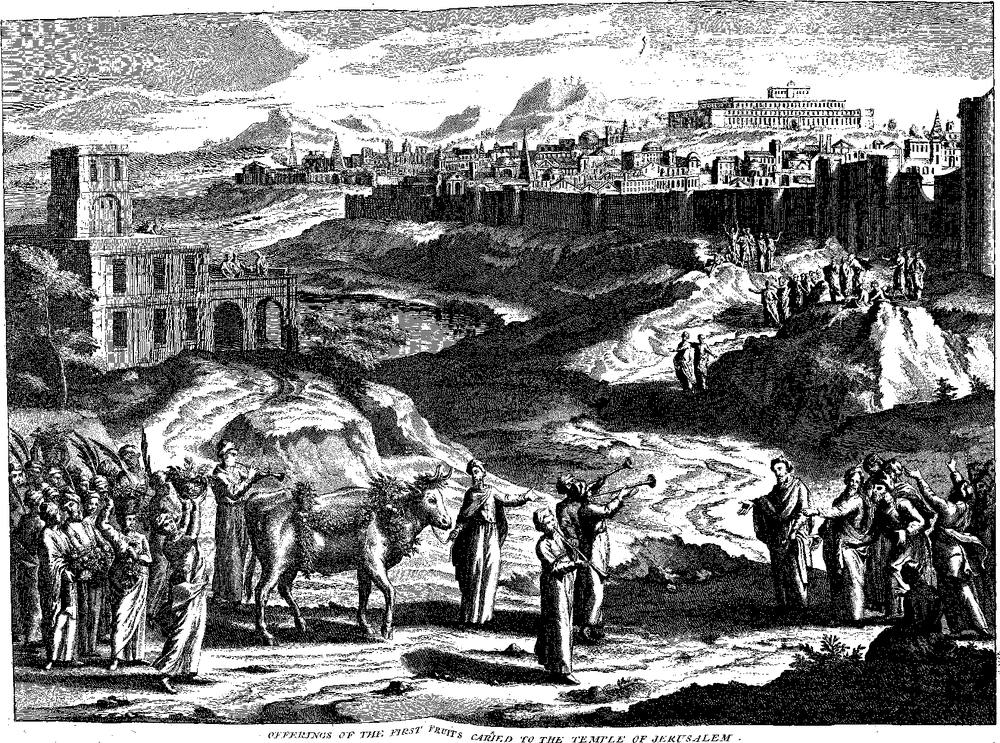
The Offerings of Grain, Meal, Bread, Cakes, Fruits, Wine, Salt, Oil, were common in the Temple. Sometimes these Offerings were alone, and sometimes they accompanied the Sacrifices. Honey was never offered with the Sacrifices, but it might be offered alone, in the Quality of First-Fruits. Now these were the Rules that were observed in the presenting of those Offerings call’d in Hebrew, Mincha64, or Korban Mincha: In the Septuagint, Offerings of Sacrifice, and the same in St. Jerome, oblationem sacrificii. There were five Sorts of these Offerings. First, Fine Flour or Meal. Secondly, Cakes of several Sorts, baked in an Oven. Thirdly, Cakes baked upon a Plate. Fourthly, Another Sort of Cakes, baked upon a Gridiron, or Plate with Holes in it. Fifthly, The First-Fruits of the new Corn, which were offered either pure and without Mixture, or roasted or parched in the Ear, or out of the Ear.
The Cakes were kneaded with Oil-Olive, or fry’d in Oil in a Pan, or only dip’d in Oil after they were bak’d. The Bread offer’d to be presented upon the Altar, was to be without Leaven; for Leaven was never offer’d upon the Altar, nor with the Levit. ii. 11, 12. See Lev. ii. 2, 13. Numb. xv. 4, 5.Sacrifices. But they might make Presents of Common Bread to the Priests and Ministers of the Temple.
The Offerings now mention’d were appointed in Favour of the poorer Sort, who could not go to the Charge of sacrificing Animals. And even those that offer’d living Victims were not excused from giving Meal, Wine, and Salt, which was to go along with the greater Sacrifices. And also those that offer’d only Oblations of Bread, or of Meal, offer’d also Oil, Incense, Salt, and Wine, which were in a manner the seasoning of it. The Priest in waiting received the Offerings from the Hand of him that offer’d them, laid a Part of them upon the Altar, and reserved the rest for his own Subsistence. That was his Right as a Minister of the Lord. Nothing was burnt quite up but the Incense, of which the Priest kept back nothing for his own Share.
When an Israelite offered a Loaf to the Priest, or a whole Cake, the Priest broke the Loaf or the Cake into two Parts, setting that Part aside that he reserved to himself, and broke the other into Crumbs, pour’d Oil upon it, Salt, Wine and Incense, and spread the whole upon the Fire of the Altar. If these Offerings were accompany’d by an Animal for a Sacrifice, it was all thrown upon the Victim, to be consumed along with it.
If these Offerings were the Ears of new Corn, either of Wheat or Barley, these Ears were parched at the Fire, or in the Flame, Levit. ii. 14, 15.and rubb’d in the Hand, and then offer’d to the Priest in a Vessel; over which he put Oil, Incense, Wine, and Salt, and then burnt it upon the Altar, first having taken as much of it as of right belong’d to himself.
The greatest Part of these Offerings were voluntary, and of pure Devotion. But when an Animal was offer’d in Sacrifice, they were not at Liberty to omit these Offerings. Every thing was to be supply’d that was to accompany the Sacrifice, and which served as a seasoning to the Victim. There are some Cases in which the Law requires only Offerings of Corn, or Bread; for Example, when they offer’d the First-Fruits of their Harvest, whether they were offer’d solemnly by the whole Nation, or by the Devotion of private Persons.
As to the Quantity of Meal, Oil, Wine, or Salt, which was to go along with the
Sacrifices, I cannot easily see that the Law had determin’d it. Generally the Priest threw an handful of Meal or Crumbs upon the Fire of the Altar, with Wine, Oil, and Salt in Proportion, and all the Incense. All the rest belong’d to him, the Quantity depended upon the Liberality of the Offerer. I observe in more Places than one, that Moses appoints an Assaron, or the tenth Part of an Ephah of Meal, for those that had not wherewithal to offer the appointed Sin-Offerings. See Levit. v. 11. xiv. 21. In the solemn Offerings of the First-Fruits for the whole Nation, they offer’d an entire Sheaf of Corn, a Lamb of an Year old, two Tenths or two Assarons of fine Meal mix’d with Oil, and a Quarter of an Hin of Wine for the Libation.
Lev. xxiii. 10, 11, 12, &c. Numb. v. 15.In the Sacrifice of Jealousy, when a jealous Husband accused his Wife of Infidelity, the Husband offer’d the tenth Part of a Satum of Barley-meal, without Oil or Incense, because it was a Sacrifice of Jealousy, to discover whether his Wife was guilty or no.
The Offerings of the Fruits of the Earth, of Bread, of Wine, Oil, and Salt, are the most ancient of any that have come to our Knowledge. Cain offer’d to the Lord of the Fruits of the Earth, the First-Fruits of his Labour. Abel offer’d the Firstlings of his Flocks, and of their Fat. The Heathen have nothing more ancient in their Religion, than these sorts of Offerings made to their Gods65. They offer’d clean Wheat, Flour, and Bread.
Farra tamen veteres jaciebant, sarra metebant,
Primitias Cereri sarra refecta dabant.
Numa Pompilius, who first gave Laws, and established the Religion of the Romans66, taught them to offer to the Gods, Fruits, Corn, Meal, or the Crumb of Bread with Salt, Wheat roasted or parched. Numa instituit fruge Deos colere, & molâ salsâ supplicare, atque, ut author est Hemina, far torrere. Before the Use of bloody Sacrifices they offer’d only Corn67.
Ante Deos homini quod conciliare valeret,
Far erat, & puri lucida mica salis.
Theophrastus observes68, that among the Greeks Meal mix’d up with Wine and Oil, which they call Thylemata, was the Matter of the ordinary Sacrifices of the Poor.
The Difference between the Offerings of Meal, Wine, and Salt, with which the Greeks and Latins accompany’d their bloody Sacrifices, and those that the Hebrews made use of in their Temple, consisted chiefly in this, that the Hebrews cast these Oblations upon the Flesh of the Victims, being already offer’d and put upon the Fire, whereas the Greeks put them upon the Head of the Victim whilst alive, and just going to be sacrificed. See LIBATION before.
Deut. iii. 11.OG, King of Bashan, or of that Part of the Land of Promise which is beyond Jordan, between the Mountains of Gilead to the East, Jordan to the West, Libanus and Mount Hermon to the North, and the Brook Jabok to the South. Og was a Giant, of the Race of the Rephaims. We may judge of his Stature by the Length of his Bed, which was preserved for a long time in the City of Rabbath, the Capital of the Ammonites. It was nine Cubits long, and four Cubits broad; that is, fifteen Feet, four Inches and an half long, and six Feet ten Inches broad. The Rabbins say, that Og was one of those ancient Giants that liv’d before the Flood, and that he saved himself from the general Destruction, by getting on the top of the Roof of the Ark, wherein was Noah and his Sons: That Noah furnished him with Provisions, not out of Compassion to him, but that the Men that came after the Deluge might see how great the Power of God was, who had destroyed such Monsters from the Earth.
In the War he made with the Israelites, he lifted up, (say the Rabbins) a Mountain of six Miles in Breadth, in order to throw it on the Camp of the Israelites, and to squeeze them all to pieces at once. But God had so provided, that the Ants had made the Mountain hollow just in that Place where he had put his Head; so that the Mountain fell in upon the Neck of the Giant; presently his Teeth grew in such an extraordinary Manner, and penetrated into the Mountain, that he could by no Means disengage himself. So that Moses striking him upon the Heel, kill’d him without any Difficulty. This is what the Rabbins say. See the Targum of the Son of Uziel upon Gen. xiv. 13. and Numb. xxxv. 21. and the Exercitations of P. Morin, p. 325. l. 2. Exercit. 8. cap. 2. They say the Stature of this Giant was so prodigious, that Moses, who according to them was six Elns high, took a Hatchet of the same Length, and yet was forced to make a Leap of six Elns high, only that he might reach to strike the Ancle of Og’s Foot. In the Decree of Gelasius, which condemns several Apochryphal Books, there is one condemn’d which bore the Name of the Giant Ogias, who had lived before the Deluge, and whom the Hereticks say to have fought against the Dragon.
But let us leave these Dreams, and come
to what the History tells us of this famous Giant. Moses says69, that after having conquer’d Sihon King of the Amorites, he advanced towards the Country of Bashan, wherein King Og reigned: That this Prince marched against him, and advanced as far as Edrei with all his Subjects; that giving them Battle, Og was conquer’d and put to Death, with his Children and all his People. Moses put them all to the Edge of the Sword, without sparing one of them, and took Possession of his Country. Og and Sihon were the only Persons that withstood Moses. Their Country was given to the Tribes of Gad, Reuben, and to half the Tribe of Manasseh.
OHAD, or Abod, the third Son of Simeon; he was one of those that went down into Egypt with Jacob his Grandfather, Gen. xlvi. 10.and Simeon his Father, in the Year of the World 2298, before Christ 1702, before the Vulgar Æra 1706.
OHEL, or Obol, Son of Zerubbabel, and Grandson of Josiah. 1 Chron. iii. 20.
OHOLIBAMA. See AHOLIBAMAH.
OLD, ancient. We say the Old Testament, by way of Contradistinction to the New. Moses was the Minister of the Old Heb. ix. 19, 20.Testament, of the Old-age of the Letter; but Jesus Christ is the Mediator of the New Heb. ix. 15.Testament, or of the New Covenant, which consists not of the Letter, but of the Spirit.
Rom. vi. 5.The old Man, the old Adam, in a moral Sense, is what we derive from corrupted Nature, and which we ought to crucify with Jesus Christ, that the Body of Sin may die in us; vetus homo noster simul crucifixus est, ut destruatur corpus peccati. In another Passage the Apostle enjoins us, to put off the old Man with his Deeds, and to put on the new Man, which is renewed in Knowledge after the Image of him that created him. And again elsewhere, we are to put off the old Man which is corrupt according to the deceitful Lusts.
The old Leaven, is Concupiscence, and an Adherence to the literal and ceremonial Observances of the Law. St. Paul advises; 1 Cor. v. 8.Let us keep the Feast, not with old Leaven, neither with the Leaven of Malice and Wickedness; but with the unleavened Bread of Sincerity and Truth. Jesus Christ expresses almost the same thing, when he Luk. v. 37.says, that no Man putteth new Wine into old Bottles, else the new Wine will burst the Bottles, and be spilled, and the Bottles shall perish.
Hannah, the Mother of Samuel, says in 1 Sam. ii. 3.her Canticle; Recedant vetera de ore vestro. Let the old Reproaches of Barrenness, which you made to me formerly, be now quite banish’d from your Mouths.
The old Fruits and the new, which succeed close after one another, and which are mentioned in Levit. xxv. 2. xxvi. 10. and in the Canticles, vii. 13. represent a very great Abundance. You shall have so much, that to make room for the new you shall be obliged to throw away the old.
OLIVE-TREE. There are two kinds of Olive-Trees, the wild and natural, and those that require Care and Culture. St. Paul distinguishes these in his Epistle to Rom. xi. 24.the Romans. Tu ex naturali excisus oleastro, & contra naturam insertus es in bonam olivam. The wild and uncultivated Olive-Tree he calls natural; naturalis oleaster. The cultivated Olive-Tree is of a moderate Heighth, its Trunk is knotty, its Bark smooth, and of an Ash-colour, its Wood is solid and yellowish, the Leaves are oblong, and almost like those of the Willow, of a green Colour, dark on the upper Side, and white on the under Side. In the Month of June it puts out white Flowers that grow in Bunches. Each Flower is of one Piece, widening upwards, and dividing into four Parts. After the Flower succeeds the Fruit, which is also oblong and plump. It is first green, then pale, and lastly black, when it is quite ripe. In the Flesh of it is inclos’d a hard Stone, full of an oblong Seed. The wild Olive differs from this, in that it is smaller in all its Parts.
When Noah sent forth the Dove out of the Ark, it brought back to him a small Gen. viii. 11.Olive-Branch with its Leaves; which was a Token to the Patriarch, that the Waters of the Deluge were sunk away. Solomon in the Temple of Jerusalem made Cherubims1 Kings vi. 23, 33. Col. iii. 9. Job xv. 33. of the Wood of the Olive; and Gates that parted the Sanctum from the Sanctuary, of the same Wood. Eliphaz in Job compares a wicked Man to a Vine which sheds its Blossoms in the Spring, and to an Olive whose Flowers fall before their Season, and consequently brings no Fruit. The sacred Writers often make use of Similes taken from the Olive.
1 Kings xi. 7.OLIVES. The Mount of Olives was situated to the East of the City of Jerusalem, and parted from the City only by the Brook Kidron, and by the Valley of Jehoshaphat, which stretches out from the North to the South. ‘Twas upon this Mount that Solomon built Temples to the Gods of the Ammonites and of the Moabites, out of Complaisance to his Wives who were Natives of these Nations. Hence it is that the Mount of Olives is call’d the
Mountain
Acts i. 12.Mountain of Corruptiong. Josephus says, that this Mountain is at the Distance of five Stadia (or Furlongs) from Jerusalem70; which make six hundred and twenty five geometrical Paces; or the length of a Sabbath-Days Journey, says St. Luke. The Mount of Olives had three Summits, or was composed of three several Mountains, ranged one after another from North to South. The middle Summit is that from whence our Saviour ascended into Heaven. ‘Twas upon that towards the South that Solomon built Temples to his Idols. The Summit which is most to the North is distant two Furlongs from the middlemost. This is the highest of the three, and is commonly called Galilee71.
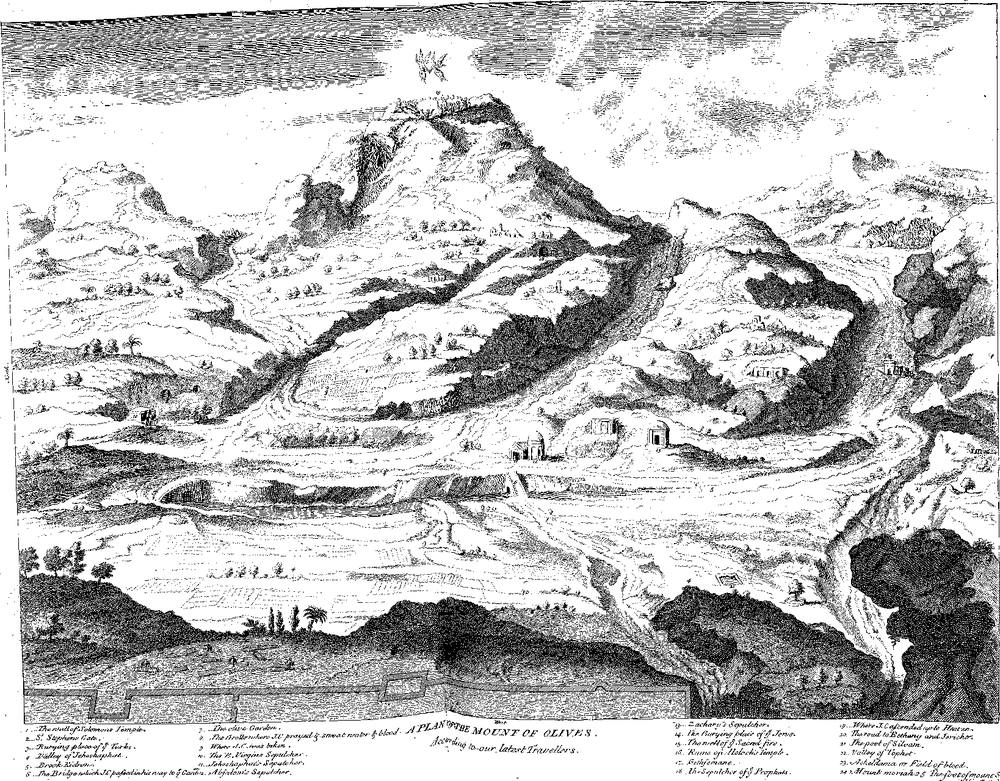
In the Time of King Uzziah72 the Mount of Olives was so shatter’d by an Earthquake, that half of the Earth that was on the Western Side, fell down, and rolled four Furlongs or five hundred Paces from thence, towards the Mountain which was opposite to it on the East; so that the Earth block’d up the Highways, and covered the King’s Gardens. The Modern Travellers may be read on this Point, and particularly John Cotovic, p. 261. to know the Modern State of the Mount of Olives.
This Mountain is become the Object of the Veneration of Christians, since from hence our Saviour ascended into Heaven. Eusebius assures us73, that in the Place of the Ascension, which is the highest of the Mount of Olives, there was a Cavern, where there was a constant Tradition that our Saviour enter’d, to communicate to his Disciples some of his most sacred Mysteries; whether by these Words may be understood the Holy Eucharist, which he gave them before he ascended into Heaven, or the Repast he took with them, of which mention is made Acts i. 4. or lastly, whether he means any particular and secret Instructions, which he imparted to them in this Place. The Fathers74 inform us, that when our Saviour ascended into Heaven, he left his Footsteps imprinted upon the Earth ; that they were to be seen in their Time, and always subsisted, tho’ the Faithful continually carried away the Ground from this Place, by way of Devotion. Zech. xiv. 4.Thus is literally accomplished what Zechariah had said, And his Feet shall stand in that Day upon the Mount of Olives. ‘Tis added75, that the Empress Helena having caused a magnificent Church of the Ascension to be built, in the midst of which was this Place, when they would have paved it with Marble as the rest, they never could do it; every thing that was put there by way of Ornament removed of its own accord, so that they were forced to leave it as it was. Even to this Day is seen the Impression of our Saviour’s Left Foot, sunk into the Rock more than three Fingers Breadth; and they say the Stone, wherein was the Impression of his Right Foot, was taken away at the Time of the Crusado, and placed in a Temple, which at present is one of the principal Turkish Mosques, where it is thought it may still remain: For the Christians have not Liberty to enter therein to inform themselves: St. Jerom76 in more Places than one speaks of a great Cross, that was set up upon the Mount of Olives, and which might be seen afar off. The same Father assures us77, that when they had a Mind to shut up the Cave which answered to the Place where our Saviour ascended into Heaven, they could never accomplish their Design. For which reason they were forced to leave this Place free and open. It must needs be, that the Impressions of our Saviour’s Feet must sink deep into the Mountain, and that the Christians must very nicely have observed the Place, since the tenth Roman Legion encamping upon this Mountain78, at the Siege of the City by Titus, could not efface these sacred Footsteps, nor erase them out of the Memory of the Faithful.
OLURUS, a Village in Idumea, to the South of Judah. Joseph. de Bello, l. v. c. 7. p. 895. B.
Rom. xvi. 15.OLYMPAS, or Olympias; St. Paul writing to the Romans salutes Olympas, who was a Believer of a distinguished Vertue and Merit. The Particulars of his Life are unknown. The Greeks79 honour him on the 10th of November, and say he was beheaded at Rome the same Day that St. Peter was crucified there.
OLYMPIAD, a Space of four Years. The Greeks commonly compute Time by Olympiads. They began to reckon in this Manner chiefly from the 27th Olympiad, in which Chorœbus was Victor; so that it was but one hundred and eight Years after their first Establishment by Iphitus. Before
this Time they kept no exact Register of the Names of the Conquerors at the Olympick Games; and ‘tis thought that Timæus was the first Historian who inserted the Years of the Olympiads into his History. Timæus liv’d in the Age of Ptolemy Philadelphus. After him Eratosthenes and Polybius followed the same Method. But before them the Greek Historians were not very careful to express the Dates of their Chronology. On this Head may be be seen Marsham’s Canon. Ægypt. Sæcul. 15.
The Olympic Games, which were celebrated at Elis every four Years, with a vast Concourse of all the People of Greece, began in the Year of the World 3120, before Christ 880, before the Vulgar Æra 884. But generally the Beginning is taken only from the twenty-eighth Olympiad, wherein Chorœbus was Conqueror, in the Year of the World 3228, before Christ 772, before the Vulgar Æra 776. This is properly the Epocha of the Historical Times among the Grecians; for before that their History had a great Mixture of Fable80. The Term Olympiad is not found in Scripture, in the Sense in which we use it; but it is of so great Use in Matters of Chronology, that we could not but treat of it here. In the Books of the Maccabees the Æra made use of is that of the Seleucidæ, or of the Greeks, which begins in the Spring of the Year of the World 3692, according to the first Book of the Maccabees; or at the Autum of the same Year, according to the second Book of the Maccabees. See under the Articles of the YEAR of the Greeks, or of the ÆRA of the
OLYMPIAN. Jupiter Olympicus. The Grecians often gave to Jupiter, and to their other Gods, the Surname of the Places where they had famous Temples dedicated to them, and where they were chiefly worshipped. So he was called Jupiter Idæus, because of Mount Ida where he was educated. Cretensis, because of the Island Crete where he was born, and where his Sepulchre was to be seen. Jupiter Capitolinus, because of the Temple he had in the Capitol at Rome. Jupiter Fulminator, because of the Thunder he was thought to dispense. Jupiter Hospitalis, because he presided over Hospitality; and so of the rest. Antiochus Epiphanes having prophaned the Temple of Jerusalem, caused the Statue of Jupiter Olympicus to be set up there, where it remained 2 Macc. vi. 2.for three whole Years81, till Judas Maccabeus took it away from thence, and restored the Worship of the Lord. ‘Twas this Idol that Daniel called the Abomination that maketh desolate to be set up. At the same time the same Jupiter was set up in the Temple of Mount Gerizim in the Country of Samaria, but under the Name of Jupiter Hospitalis. See 2 Macc. vi. 2. Josephus says82, that the Samaritans offer’d of their own accord to consecrate their Temple of Gerizim to Græcian Jupiter.
OMAR, the second Son of Eliphaz, and Grandson of Esau. Gen. xxxvi. 11, 15.
OMER, or Gomor83; a Measure of Capacity among the Hebrews, which we estimate at six Pints very nearly. The Omer is the same as the Assaron, or the tenth Part of the Ephah. See ASSARON.
I. OMRI, or Amri, General of the Army of Elab King of Israel. Being at the Siege of Gibbethon, and hearing that his Master Elab was assassinated by Zimri, and that this Murderer had usurped his Kingdom; he immediately raised the Siege of Gibbethon, and being elected King by his Army, he march’d against Zimri, set upon him at Tirzah, whither he had retir’d, and press’d so hard upon him, that he forc’d him to burn himself and all his Family, in the Palace wherein he had shut up himself. Zimri reigned but seven Days, and died in the Year of the World 3075, Seleucidæ. before Christ 925, before the Vulgar Æra 929.
After the Death of Zimri all Israel was divided into two Parties. Half of the People acknowledged Omri for King, and the other half adhered to Tibni the Son of Gineth. This Division continued for four Years; and when Tibni was dead, all the People united again in the Person of Omri, who was owned as King of all Israel, and reigned twelve Years. That is, six Years at Tirzah, and six at Samaria.
Till then Tirzah had been the chief Place of Abode of the Kings of Israel. But when Omri made a Purchase of the Hill of Shomeron84, for the Sum of two Talents of Silver; that is of our Money six hundred and eighty four Pounds seven Shillings and six Pence. He there built a new City, which he called Samaria, from the Name of the first Possessor Shemer or Shomer; and there he fix’d his Royal Seat. From which Time Samaria was always the Capital of the Kingdom of the ten Tribes.
Omri did Evil before the Lord, and his Crimes still exceeded those of his Predecessors. He walk’d in all the Ways of Jeroboam the Son of Nebat. He died at
Samaria in the Year of the World 3086, before Christ 914, before the Vulgar Æra 918. His Successor was Ahab, who still exceeded him in all Kinds of Wickedness.
II. OMRI, Son of Becher, of the Tribe of Issachar. 1 Chron. vii. 8.
III. OMRI, Son of Michael, of the Tribe of Issachar. 1 Chron. xxvii. 18. This Omri was chief of his Tribe in the Time of King David.
ON, a City of Egypt, mentioned in the Hebrew. See HELIOPOLIS.
ONAN, Son of Judah, and Grandson of the Patriarch Jacob. Judah having given a young Woman named Tamar to his eldest Son Er for a Wife, Er died without leaving any Children behind him. Judah then caused his second Son Onan to marry Tamar, that he might revive the Name of his Brother, and raise Successors to him. But Onan seeing that the Children that might be born to him would be deemed to belong to his Brother, by an abominable Action prevented Tamar from becoming a Mother. This was so displeasing to the Lord, that he caused him to die85. The Kind of his Death is unknown, but there is great Probability that he was smote by some extraordinary Malady. The Testament of the twelve Patriarchs, a Book very much Apochryphal, says that Onan lived a Year with Tamar without consummating his Marriage; and that Tamar making her Complaints of this to Judah, he expostulated with Onan about it, who following the Counsel of his Mother who was a Canaanite, and who had no Affection for Tamar, hinder’d her from being a Mother by the Commission of a detestable Action. This was the Occasion of his being struck to Death in an unusual Manner.
ONESIMUS, a Phrygian by Nation, a Slave to Philemon, and lastly a Disciple of the Apostle St. Paul. This is what we find concerning him. Onesimus having run away from the House of his Master, and also having robb’d him of something86, went to Rome about the Year 61 of the common Æra, while St. Paul was there in Prison the first time. As Onesimus knew him by Reputation, for his Master Philemon was a Christian, he took care to find him out, acquainted him with what he had done, own’d his Flight to him, and did him all the Service that Philemon himself could have done him, if he had been at Rome. St. Paul brought him to a Sense of the Greatness of his Crime, disposed him to the receiving of the Gospel, instructed him, converted him, baptized him, and soon after sent him back to his Master Philemon with the Letter that we have among St. Paul’s Epistles, and which is acknowledged as canonical by all the Christian Church.
It may pass for a Master-piece of Eloquence in the persuasive Kind. There St. Paul has Recourse to all the Considerations that Friendship, Religion, Piety, and Tenderness can inspire, to reconcile a Servant to his Master. He mingles even Prayers with Authority, and Praises with Recommendations; and makes a Parallel between Onesimus become a Christian and Child of God, with the same Onesimus an evil Servant and a Fugitive. This Letter had all the good Success he could desire. Philemon not only received Onesimus as a faithful Servant, but rather as a Brother and a Friend. A little time after he sent him back to Rome to St. Paul, that he might continue to be serviceable to him in his Prison. And we see that after this Onesimus was employed to carry such Epistles as the Apostle wrote at that Time. He carried, for Example, that which was written to the Colossians, while St. Paul was yet in his Bonds, in the Year of Christ 62.
From this Time Onesimus’s whole Employment was in the Ministry of the Gospel. The Apostolical Constitutions87 acquaint us that St. Paul made him Bishop of Berea in Macedonia. The Martyrologies give him the Title of Apostle, and say that he ended his Life by Martyrdom. The Roman Martyrology mentions him as being made Bishop of Ephesus by St. Paul after Timothy. Others add, that it was he whom Ignatius the Martyr speaks of, as being Bishop of Ephesus in the Year of Christ 107: But this Opinion has no solid Proof to support it88. The same Martyrology places his Feast upon the 16th of February, and says, that having succeeded Timothy in the Bishoprick of Ephesus, and having been charged by him with the preaching of the Gospel, he was taken into Custody and sent to Rome, where he was stoned for his Faith in Jesus Christ. His Body was buried there, but was afterwards taken up and carried to the Place where he had been Bishop. The Greeks celebrate his Feast on the 15th of December.
ONESIPHORUS, of whom mention is made by St. Paul, in his second Epistle to Timothy, cap. i. v. 16. He came to Rome in the Year of Christ 65, while St. Paul was in Prison there for the Faith, and at a Time when almost every one had forsaken him89. He arrived there from Asia,
Onesiphorus continues on the next page
Footnotes
-
Vide Bochart. Phaleg. l. iv. c. 12. ↩
-
See Jonas iii. 6. and the Commentary upon this Place. ↩
-
Diodor. Sicul. l. ii. Bibl. ↩
-
Diodor. l. ii Athen. l. xii. ex Ctesia. ↩
-
Lucian. in Επιστ. p. 346. ↩
-
Sophon. & Nahum per totum. ↩
-
Herodot. l. i. c. 95. ↩
-
Diodor. Sicul. l. ii. Bibl. ↩
-
Ælian hist. animal. l. xii. c. 21. ↩
-
In the Year of the World 3294, before Christ 706, before the vulgar Æra 710. ↩
-
Herodot. l. i. c. 186, 187, &c. ↩
-
Jerem. ii. 22. ↩
-
Gemar. Babyl. Tit. Sanhedr. c. 7. Vide, si placet, Selden. de Jure Nat. & Gent. l. i. c. ult. ↩
-
Arnob. contra Gentes, l. v. ↩
-
Nehem. vi. 14. In the Year of the World 3550, before Christ 550, before the vulgar Æra 454. ↩
-
In the Year of the World 1536, before Christ 2464, before the vulgar Æra 2468, and before the Deluge 129 Years. ↩
-
See before the Ark of Noah. ↩
-
In the Year of the World 1657, before Christ 2343, before the vulgar Æra 2347. Gen. viii. 1, 2, 3, &c. ↩
-
Gen. viii. 7. יצא יצוא ושוב ↩
-
Filii Cham, Chus, & Mezraim, & Phut, & Chanaan. ↩
-
Euseb. Græc. Chronic. seu Thesauri tempor. p. 10. Philastr. de hæres. c. 70. ↩
-
Cajet. Torniel. ↩
-
Theophil. Antioch. l. iii. ad Autolyc. p. 129. Δόντε, καλεῖ ὑμᾶς ὁ Θεὸς εἰς μετάνοιαν, διὸ οἰκείως Δευκαλείων ἀνλήθη. ↩
-
Vide, si placet, Clem. Alex. l. vi. Stromat. Epiphan. hæres. 46. Ambrosiast. in Ephes. iv. Nazianz. orat. 42. sub finem, & Nicet. ad eundem. Beda, D. Thom. Hugo, Dionys. &c. ↩
-
Aug Epist. olim 99. nunc 162. n. 3. 4. ↩
-
Epiphan. ibidem. ↩
-
Rab. Gedolias & alii ex antiquis, apud Scipion. Sgambat. Archiv. V. T. p. 150. ↩
-
Vide Eutych. Annal. Alex. T. i. p. 44. Catena Arabica in Genes. Vide Is. Gregor. observat. sacr. c. xxv. ↩
-
Alcoran, c. Hod. ↩
-
Apollodor. l. i. 1568. Vide & Kircher de Arcâ Noe, p. 138. ↩
-
Octav. Falconerii inscript. Athlet. Rom. one ↩
-
Hieronym. in Epitaphio Paulæ. Vide Eufeb. in locis, voce, Nombra. ↩
-
2 Kings xviii. 4. In the Year of the World 3278, before Christ 722, before the vulgar Æra 726. ↩
-
Josh. xvii. 11. שלשת הנפתThis Construction proves, that Nophet is not put for a City. The LXX. καὶ τὸ τρίτον τῆς Μαφελα (or Ναφελα) καὶ τὰς κώμας αὐτῆς. The Hebrew makes no Mention of its Villages. the ↩
-
וידבר Vajedabber. ↩
-
Numb. x. 11. In the Year of the World 2514, before Christ 1486, before the Vulgar Æra 1490. ↩
-
1 Macc. xii. 16. In the Year of the World 3860, before Christ 140, before the vulgar Æra 144. ↩
-
1 Macc. xiv. 22. xv. 15, 16. In the Year of the World 3865, before Christ 135, before the vulgar Æra 139. ↩
-
Joseph. Antiq. l. xiv. c. 16. p. 481. ↩
-
Appian. Syriac. ↩
-
Ulpian. l. iii. digest. de Censib. Vide Ficher. de Numism. census. ↩
-
Exod. xxv. 33. * .גבעים משקדיםVulgat. in nucis modum. Our Translation says, made like Almonds. ↩
-
Cant. vi. 11. גן אגוז ↩
-
Deut. xiv. 17. השלךLevit. xi. 17. ↩
-
In the Year of the World 3877, before Christ 123, before the Vulgar Æra 127. ↩
-
Bochart. de Animal. Sacr. par. 2. l. ii. c. 20. ↩
-
Psal. cii. 7. Passer solitarius. Hebr. Avis solitaria. ↩
-
Ambrosiast. Anselm. Lyrand. alii plures. Greek Manuscripts read, Καὶ τὴν κατ’ οἶκον αὐτῶν Ἐκκλησίαν. reading which would leave us in Uncertainty, whether Nymphas was a Man or Woman. ↩
-
Καὶ Νυμφᾶν, καὶ τὴν κατ’ οἶκον αὐτῆς Ἐκκλησίαν. Some The Church which is in their House. A manner of ↩
-
Τῆς μετοικησίας ἡ ἀρχὴ ἄυλη τοῖς ἰδίοις Ἰσραήλ γῆ τῶν χαναναίων ἕως Σαρεπτῶν καὶ ἡ μετοικησία Ἰερυσαλὴμ ἕως Ἐφραθά &c. ↩
-
2 Sam. vi. 10, &c. 1 Chron. xvi. 38. In the Year of the World 2959, before Christ 1041, before the Vulgar Æra 1045. ↩
-
1 Chron. xxvii. 30. אבילObil, Abil, or Ubil. ↩
-
Plin. l. vi. c. 28. ↩
-
Tertul. ad Nation. l. ii. c. 8. ↩
-
Plin. l. xxxiii. c. 3. ↩
-
2 Chron. iii. 5. זהב טובAurum bonum. 70. χρυσίῳ καθαρῷ. ↩
-
Matt. vi. σκυθρωποί. ↩
-
Tavernier, Voiage of Persia, l. ii. c. 7. ↩
-
Exod xxiii. 21. השמע מפניו ↩
-
Levit. xix. 26. לא תעוננו * 2 Chron. xxviii. 9. In the Year of the World 3263, before Christ 737, before the Vulgar Æra 741. ↩
-
קרבןCorban. ↩
-
מנחהMincha, munus, oblatio. ↩
-
Levit. ii. 1. 70 .קרבן מנחהδῶρον θυσίας. Vulg. Oblationem sacri- Sacrifices, ficii. ↩
-
Ovid. Fast. 2. ↩
-
Plin. l. xviii. c. 2. ↩
-
Ovid. Fast. 1. ↩
-
Apud Stobæum. ↩
-
Translators’ note. Numb. xxi. 33, &c. In the Year of the World 2553, before Christ 1447, before the Vulgar Æra Hist. c. 48. Paulin. Epist. 11. Optat. l. vi. p. 95. Augusti. in Joan. Homil. 47. p. 141. Beda loc. sanct. c. 7. t. 3. ↩
-
Joseph. Antiq. l. 20. c. 6. Confer. l. vi. de Bello, c. 3. ↩
-
Vide Reland. Palæst. t. ii. p. 338. ↩
-
Joseph. Antiq. l. ix. c. 11. Zech. xiv. 5. ↩
-
Euseb. de Vita Constant. l. iii. c. 43. p. 583, 504, 505. ↩
-
Vide Hieronym. seu alium in loca Act. Apost. t. iii. p. 297. Sulpit. Sever. l. ii. c. 48. Hist. Eccl. ↩
-
Euseb. de Vita Constant. l. iii. c. 43. Paulin. Epist. 11. Sulpit. Sever. l. ii. g 2 Kings xxiii. 13. הר המשחיתVulg. Mons offensionis. Alii Mons corruptionis. ↩
-
Hieronym. in Epitaph. Paulæ & alibi. ↩
-
Idem loc. in Act. Vide & Bedam de locis sanctis, c. 7. ↩
-
Joseph. l. vi. c. 3. de Bello, p. 908. e. f. ↩
-
Menæa. p. 147, 150, 155. ↩
-
Vide Censorin. Libel. de die natali. ↩
-
From the Year 3837 to 3840, before Christ 150, before the Vulgar Æra 154. ↩
-
Joseph. Antiq. l. xii. c. 7. Περιωαγορευθῆναι Δίος Ἑλληνίου. ↩
-
עמרHomor. 70. Γόμορ. ↩
-
1 Kings xvi. 24. About the Year of the World 3080, before Christ 920, before the Vulgar Æra 924. ↩
-
Gen. xxxviii. 6, 7, &c. The Time of this Affair is wholly uncertain. ↩
-
Ep. ad Philem. v. 18. Chrysost. Prologo. ↩
-
Constitut. l. vii. c. 46. ↩
-
See M. Tillemont, Note 70. upon St. Paul. ↩
-
See 2 Tim. i. 16, 18. and Theodoret. in 2 Tim. ↩