Volume I, pages 609–627 of the 1732 edition, from GIA to GOS: everything printed on these pages, in order.
Continued from Giant
seven inches and two lines royal measure in length: of the bones in the arm one was two feet four inches and two lines in circumference; a man might put his fist into one of them. Every one falling upon the body, in order to get some pieces of it, the principal were carried to the Bashaw, and the Grand Signior. As to the others which remained, the Sieur Quainet, French Consul at Thessalonica, entered an account of them attested by Father Jerom de Rhetel, a Capuchin, and Missionary to the Levant, who saw them. The same Father Jerom sent a relation of this matter to the Reverend Father Jerom de Mousicaux, a Capuchin at Paris in the suburb St. Honoré, and his letter was subscribed by the Consul above-mentioned, by Peter Rosti, Constantine Peronne, Loicheta, Flot a surgeon, and John Attuchi; who having all seen the said bones, signed as witnesses.
In the year 1719, near Salisbury in EnglandThe Gazette of October 1719. 21 Sept. Art. from London., a human skeleton was found which was nine feet four inches long. This discovery was made six miles from Salisbury, in a place called Stonehenge, or Hanging-stones, which the Ancients called The dance of Giants. There is farther to be seen there an inclosure of rough stones, some whereof are fourscore feet high and seven wide, which support others that are placed a-cross. No one has been able hitherto to discover what this ancient monument can be; which seems to be so much the more surprizing, in that throughout all the neighbouring plain there is no stone fit for building to be met with.
The People of Peru affirm, that there came Giants formerly into their country, who from the knees downward equalled the stature of ordinary men. They have the same tradition at Brazil and Mexico, and they shew bones belonging to them of an unmeasurable size. Some also are shewn in the castle of Moulins in the Bourbonnois. Credible witnesses assure us, that in South America there are Giants called Caurahues, who are between nine and ten feet high.
Diction. dela Bible, t.1. p.523, 524.M. Simon, author of the Dictionary of the Bible, printed at Lyons in two Volumes, folio, in 1703, attests, That while he was Curate of the Parish of St. Uzé in Dauphiné, he saw, and since that time received an attestation made in the year 1699, signed by three persons, viz. two Governours, and a Priest, who was Chaplain of the Castle of Molard, in the Diocese of Vienne, in Dauphiné, who all affirm, that they too had seen teeth belonging to a human body found in a meadow in 1667, which weighed each ten pounds; and there was one with part of the lower jaw wherein it was still fixed, that together weighed seventeen pounds. In the same meadow there were several bones found, for the most part rotten and in pieces; but one among the rest was pretty intire, which was seven feet three inches long, and two feet in circumference. After these examples, and many others which we might produce, I think no one ought to dispute the existence of Giants. See our Dissertation upon Giants.
The Arabians and Persians have the same persuasion as other people, with relation to the existence of Giants. Mahomet affirms, that Ad and Schedad, Kings of Syria and Arabia, were of such a prodigious size, that they were forced to use the largest forest-trees in setting up their tents. The Mahometans maintain, that the Amalekites, who, according to them, were the old inhabitants of Palestine, were commonly nine cubits, or eighteen feet high; that the Giant Og, who is mentioned by Moses, surpassed them all in stature, and lived to be three thousand years old. They hold, that all the ancient Giants descended from Ad the son of Amalek, and grandson of Ham; or, according to others, Amalek was the son of Uz, and grandson to Aram, of the race of Shem.
Alcoran, chap. de l’Aurore.They farther acknowledge other Giants, called Dives or Ginns, in Latin, Divi or Genii; who are neither Men nor Angels, but creatures of another species created before Adam, and appointed for the government of the world. They governed it peaceably during the space of seven thousand years. After them came the Peris, who had the administration of it for two thousand years. But both the Divis and Peris rebelling, God set Eblis to be Lord over them; a creature of a superior order, and formed out of the element of fire. Eblis made war with them: some took a good resolution, and submitted to him, the others were extirpated. But at last Eblis himself fell into apostacy; and this is he who is known to us by the name of Satan or Lucifer.
GIBBAR. The children or descendants of Gibbar returned from the captivity of Ezra ii. 20.Babylon, to the number of ninety five.
GIBBETHON, a City in the Tribe of Josh. xxi. 23.Dan, allotted to the Levites. It is in all probability the same as Gabbata. Baasha, the Usurper of the Kingdom of Israel, killed Nadab the son of Jeroboam in the City of Gibbethon, which at that time belonged In the year of the World 3072, before J. C. 928, before the Vulgar Æra 932. Josh. xviii. 24. Ezra ii. 26. Nehem. vii. 30. About the year of the World 2591. before J. C.to the Philistins.
GIBEAH, a City in the Tribe of Benjamina, celebrated upon several occasions. It gave birth to Saul, the first King of Israel; for which reason it is frequently called Gibeah of Saul, or Gibeah the native country of Saul.
It is also famous for its sins; for that particularly which was committed by forcing the young Levite’s wife, who was come to lodge at Gibeah. At first no one offered to receive these strangers, and they con
tinued in the street, till an old man desired them to come into his house. No sooner had they supp’d, but the inhabitants of the Judg. xix.City came and encompassed the old man’s dwelling,demanding with great cries to have the man delivered up to them who was within, saying, that they would know him: under this word concealing an abominable and shameful action. The old man did all he could to divert them from this wicked design; and observing that they did not hearken to him, he said to them, I have a daughter unmarried, and this man has his wife with him; I will bring them to you, and you shall have them to gratify your passion. I only beg of you not to commit a crime so detestable with a man. At the same time the Levite brought his wife to them, and gave her up to be treated by them in the outrageous manner they desired. After they had abused her all the night, they let her go; and the woman returning to the house, where her husband lodged, fell down dead with her arms extended on the threshold.
Her husband having found her in this condition, took her up, and carried her home upon his ass, then cut her into twelve pieces, which he sent to each of the twelve Tribes of Israel. Hereupon there was a convention of eleven Tribes, by whom it was demanded of the Tribe of Benjamin, that the persons who were guilty of this outrage should be delivered up to them, in order to make an example of them: but instead of doing any thing so reasonable, they took up arms to defend the inhabitants of Gibeah; which brought on a war that almost intirely ruined the Tribe of Benjamin. See Judges, ch. xx. xxi.
The Benjamites set an army on foot, consisting of five and twenty thousand men, without reckoning the inhabitants of Gibeah, in number seven hundred, who fought equally with their left as well as with their right hand, and were so expert at their slings, that they could throw a stone Judg. xx. 26.with them to an hair’s breadth. The army of Israel was composed of four hundred thousand men; they met at Shiloh, where the Ark of the Lord was, in order to consult and know, who should be their General. The Lord answered, Let Judah be your General.
The next day, at break of day, the children of Israel having taken the field, came and incamped near Gibeah, and began to batter the City; but the Benjamites made a sally upon them, and killed two and twenty thousand of their men. The Israelites in great consternation wept before the Lord till night, (for the Ark was removed from Shiloh to the Camp before Gibeah.) There they consulted him, saying, Shall we again engage the children of Benjamin our brethren? The Lord answered, before the Vulgar Æra 1413.March against them, and give them battle. The next day therefore they advanced in order of battle towards Gibeah; the inhabitants, together with the Benjamites, sallied out of the town, and fell upon them with so much impetuosity, that they killed again eighteen thousand of their men. Hereupon the children of Israel being intirely discouraged, came before the Ark, and setting themselves down, mourned and fasted there till the evening, offered burnt-offerings and peace-offerings, and once more consulted the Lord by Phinehas, who was at that time High-Priest, and said to him, Shall we again engage our brethren the children of Benjamin, or remain in quiet? The Lord answered them, Go out against them, for to-morrow I will deliver them into your hands.
They divided their army into three bodies; one they placed in ambuscade behind the City, that they might enter it on that side, and set fire to it, as soon as the inhabitants were sallied out: the other, consisting of ten thousand men, was to appear before the City in order to give ground as soon as those of Gibeah were in sight; the third body, which was more considerable, and composed the gross of the army, was concealed in a place called Baal-tamar, and was not to shew itself till the Benjamites were got at a good distance from the town, and were drawn into the open plain by the ten thousand, who were to counterfeit a flight.
The stratagem succeeded, as they had projected; those of Gibeah sallying out with their usual boldness, fell to pursuing the fugitives without taking any precaution for the defence of the City: they therefore who lay in ambuscade behind it, entred without resistance, and set fire to it. Hereupon, the others who had made a shew of flying, observing the smoak of the town, faced about, and being supported by the main body of the army, which lay at Baal-tamar, and appeared at the same time, they fell upon the Benjamites, and made a great slaughter of them: they who endeavoured to return to their City, were hemm’d in, and cut in pieces by those who had been setting it on fire. Upon this occasion there were eighteen thousand Benjamites put to the sword. As their army was dispersed in several places, there were besides five thousand killed in a rencounter, and two thousand in another place; so that the number of the dead this day amounted to five and twenty thousand men. They who were able to make their escape, fled to the rock of Rimmon. The Israelites afterwards entered Gibeah, and put all, men and beasts to the sword, and all the towns and villages of the Tribe of Benjamin were treated in the same manner, and consumed by fire.
Nothing
N othing was more just than this War Observations on the War carried on by the eleven Tribes against the Benjamites at Gibeah. Judg. xx. Judg. xx. 18.of the eleven Tribes, who took arms against that of Benjamin, only to revenge a very enormous and abominable crime. Wherefore when they were at Shiloh, where was the Tabernacle, and the Ark of the Lord, there to consult him, and learn who was to command them in chief, he answered, Let Judah be your General; which was an evident mark, that God approved of this War: however the eleven Tribes, who composed so formidable an army, were twice shamefully beaten before Gibeah, by an army which was infinitely inferior to them, and lost forty thousand men in these two actions. This amazes, and seems surprizing; for God is not the protector of wickedness. The Interpreters disengage themselves as well as they can out of the difficulty, arising from the two victories obtained so near one another by the Benjamites. Dom Calmet in his Comment says, “ That the Israelites did “ not at first desire to know of God, whether it was his pleasure that they should “ make war against their brethren; that “ they met, and took their resolution of “ themselves, which was the cause of their “ bad success. He adds, that we might have “ reason to be surprized, if we did not “ know, that the judgements of God are “ far above those of men, and that oftentimes our most just designs, and most “ holy intentions, are not attended with “ the success which we believe we have a “ right to hope for, that man may learn to “ humble himself, to distrust his own “ strength, and place his confidence, not in “ his own righteousness, or in the force of “ his own arms, but in the mercy and “ protection of the Almighty.” This Morality is excellent, but in a case like this, wherein oppressed innocence, and the blood which was shed cried for vengeance from heaven, and united the minds of all in the desire of punishing a crime which excited horror, what occasion was there to go and consult the Lord? It is true, they had always a custom of consulting him, but this was in things which seemed dubious; as we see in this instance, where the choice of a General was the thing in question: it was necessary that God should name him or appoint See Numb. ix. 9. Judg. xviii. 5, 6. 1 Sam. xiv 37. xxiii. 2, 4, 9. xxx. 8. 2 Sam. ii. 1. v. 19, 23, xxx. 1. 2 Kings xxii. 13, 18. 1 Chr. xiv. 10, 14. 2 Chr. xviii. 4, 5.him, that the other Princes of the Tribes might be submissive to him, and they might not be divided by any inclination to command. Besides, the Scripture does not accuse them of any crime: Phinehas, who was High-Priest, would not have failed to reproach them with it, when they came to him to consult the Lord; they had done nothing against their brethren the Benjamites which was not according to the rules of equity, and the law of nations: they had sent ambassadors to demand of them the persons concerned in the guilt of this wickedness, in order to punish them; but upon their refusal, they saw a necessity of coming to an open rupture. They met together, they went to consult the Lord, they asked a General of him, he named one; was not this desiring his protection, and shewing that they took arms only to vindicate his honour, and punish the authors and abetters of a detestable crime? Notwithstanding, they were beaten, they had recourse to him; he commanded them to engage a second time, and they were again defeated: did God deceive them? I am far from thinking so: I am of the learned Commentator’s opinion, That the judgements of God are far above those of men, and that his ways are incomprehensible. But let us come now to the actions here mentioned.
The Lord having named Judah to command Jugd. xx. 19, 20.the children of Israel, they marched at break of day, and incamped near Gibeah; from thence advancing to encounter the Benjamites, they began to batter the city. I should be inclined to believe, that they at first surrounded the town in order to besiege it, and assault it on every side, attacking it by the way of sapping and scaling: for the method of the Jews, when they designed the siege of any place, was to invest it all round, and draw lines of circumvallation or contravallation, according to their apprehensions from the enemy. The inhabitants of Gibeah, in all appearance, took the advantage of this favourable opportunity to make a general sally, to prevent their having the whole army of the Israelites to engage with; so that they fell upon a part of this prodigious army, which they put to flight, and killed two and twenty thousand of them.
After this defeat, the Israelites retired to their camp. The next day, says the sacred Author, relying upon their forces, and the great number of them, they drew up in order of battle upon the same spot upon which they had fought before. If this verse were not followed by another, which demonstrates to us, that they humbled themselves before the Lord to implore his mercy, the Interpreters would have reason to say, “ That glorying in “ their number, and presuming too much “ on their strength, God permitted them “ to suffer so sensible a loss:” but on the contrary, they first went and mourned before him, and consulted him whether they should again engage in battle with the sons of Benjamin their brethren. The Lord answered them, Go against them, Judg. xx. 23.and give them battle. Was not this an acknowledgement of their impotency, and that notwithstanding their great number, they could do nothing, unless God supported them with his Almighty
Hand; yet they were once more beaten, and lost eighteen thousand men.
Lastly, the children of Israel being in great consternation upon receiving these great checks, had notwithstanding recourse to God only; they came to the Tabernacle; there they lamented, fasted till the evening, offered Burnt-offerings to him, and Peace-offerings, and consulted him by the High-Priest Phinehas, saying, Shall we again fight with our brethren the children of Benjamin, or shall we abandon this undertaking, and return in peace? At length the Lord hearkened to them, and replied to them by the mouth of his servant Phinehas, Judg. xx. 28.March against them, for to-morrow I will deliver them into thine hands.
Afterwards they placed ambuscades round about the city. From this stratagem I am apt to think, they did not invest the place on every side; or else that they collected all their forces together in this last action, making a shew of abandoning the undertaking, and withdrawing their troops, that so the Benjamites might more readily fall into the snare. They therefore divided their army into three bodies; one was placed in ambuscade behind the town, with orders to him who had the command, that he should wait till the Benjamites should sally out; then that they should get possession of it, and set it on fire. The second body, composed of ten thousand men, marched towards the enemy, with an intention of drawing them to some distance from the city. The Benjamites imagining, that the ten thousand men advanced with a design only of covering the main body of the Israelitish army in their retreat, fell upon them. These pretended to give ground by degrees, in order to decoy them into the plain; during which time, the ambuscade which lay behind the Town rising up, made themselves masters of it, and set it on fire. Hereupon the ten thousand, who were flying, faced about: the main body of the army, which was at Baal-tamar, advanced in order of battle, and the ambuscades began to appear, so that the Benjamites were encompassed and attacked on every side. Thus the Lord smote Benjamin before Israel, and the children of Israel destroyed of the Benjamites that day twenty and five thousand and an hundred men; all these drew the sword.
The Scripture remarks, that this happened at a time, when there was no King in Israel, and when every one did that which was right in his own eyes.
Gibeah was about two leagues from Jerusalem1, towards the north, not far from Gibeon and Kirjath-jearim. In St. Jerom’s time2 it was intirely destroyed. Josephus3 places it at the distance of thirty furlongs from Jerusalem; St. Jerom4 but at seven miles from the same City. I take it to be the same as Gibeath in Joshua xviii. 28.
Gibea or Gabaa in Hebrew signifies an Hill; we are not therefore to be surprized to find in a mountainous country, like that of Judæa, so many places going by the names of Gibeah, Gibeon, Gabbatha, Gabbathon, Gabbat, Gabe, all which words signify an eminence; and sometimes proper names called Gabaa, are translated Hills; for example, Zechary xiv. 10. Revertetur omnis terra de colle Remnon ad Austrum Jerusalem. In the Hebrew, All the land shall be turned as a plain from Gaba to Rimmon. And on the contrary, Gabaa or Gibeah in 2 Sam. viii. described as a City, is only the Hill of Kirjath-jearim.
GIBEATH-PHINEHAS, a City situated in the Mountains of Ephraim, which was given upon the division of the lands to Phinehas the son of Eleazar; this was the place where the High-Priest Eleazar was buried5. Josh. xxiv. ult.
Josh. ix. 3, 4, &seq. In the year of the World 2553, before J. C. 1447, before the Vulgar Æra 1451.GIBEON, the capital City of the Gibeonites, who took the advantage of Joshua’s oath and of that which the Elders of Israel likewise swore to them, upon an artificial representation which they made of their belonging to a very remote country, and their desire of making an alliance with the Hebrews. Joshua and the Elders had not the precaution to consult God upon this affair; and too inconsiderately entred into a league with these people: but they soon discovered their mistake; and sending for the Gibeonites, reproached them with their fraud; and without revoking the promise which they had made to them, of giving them their Lives, they condemned them to carry wood and water to the Tabernacle of the Lord, as slaves and captives taken in war; in which state of servitude they remained till the ruin and intire dispersion of the Jewish nation.
Josh. x. 3. &c.Three days after, the Kings of the Canaanties being informed, that the Gibeonites had surrendred to the Hebrews, came and besieged the City of Gibeon. The Gibeonites perceiving that they were not strong enough to resist five Kings, who at once attacked them; for Adoni-zedek King of Jerusalem, Hoham King of Hebron, Piram King of Jarmuth, Japhia King of Lachish, and Debir King of Eglon, were before their City with their armies: they came to Joshua, and desired speedy help
from him against these five Princes. Joshua marched all night with the choice of all the troops of Israel, attacked the five Kings early in the morning, put them to flight, and pursued them as far as the descent to Bethoron. At that time God caused a shower of stones to fall upon them, which destroyed great numbers of them; and Joshua, fearing lest the night might deprive him of part of those advantages which might follow from this victory, begged of God to retard the course of the Sun and Moon, saying, Sun, stand thou still upon Gibeon, and thou Moon in the valley of Ajalon. God heard the voice of Joshua, the Sun and Moon stop’d, and so long a day was never seen. Joshua therefore, and the people of Israel had full leisure to pursue and kill their enemies.
The five Kings were taken, and shut up in a cave, till Joshua, and the people returned from pursuing their enemies. After which they were executed, and hung upon five Gibbets, upon which they remained till the Evening. We do not here enlarge upon this miracle wrought by Joshua, so as to satisfy all the questions, which may be formed concerning it. They, who please, may consult our Dissertation on this Subject prefixed to our Comment upon Joshua.
The Gibeonites were descended from the Hivites, the old inhabitants of that Country, and possessed four cities, whereof Gibeon was the Capital. The Cities were Chephirah, Beeroth, Kirjath-jearim, and Gibeon, which were afterwards given to the Tribe of Benjamin, excepting Kirjath-jearim, which fell to the lot of the Tribe of Judah. The Gibeonites continued ever after subject to those burthens, which Joshua had imposed upon them, and were very faithful to the Israelites. Nevertheless, Saul, through what mistaken zeal we cannot tell, destroyed a very great number of 2 Sam. xxi. 1,2,3, &c.them; imagining perhaps, that it was his duty to extirpate all Remains of the Canaanites out of the land; but God as a punishment of this cruelty, in the reign of David sent a great famine, which made all the country desolate, and lasted three years. David touched with the misfortunes In the year of the World 2983, before J. C. 1017, before the Vulgar Æra 1021.of his people, addressed himself to God; and the Prophets told him, that this calamity would continue as long as that cruelty remained unrevenged, which Saul had exercised against the Gibeonites, to the prejudice of that treaty which Joshua and the Princes of the people had made with them, and confirm’d by oath. Whereupon David asked the Gibeonites, what satisfaction they desired? They answered, Let us have seven of Saul’s sons, whom we will put to death, in order to revenge the blood of our brethren. David therefore delivered up to them, the two sons of Saul by Rizpah, and five sons of Merab the daughter of Saul and Adriel. The Gibeonites crucified them before the Lord. This execution happened in the beginning of spring, when in Palestine they set about the cutting of their barley. Rizpah, the concubine of Saul, continued near the dead bodies, and lay down by them, guarding them from the birds of the air, and all voracious animals, from the beginning of the harvest; till God being appeased by this sacrifice, sent rain upon the earth, and restored it to its fertility.
From this time there is no more mention of the Gibeonites, as composing a sort of separate people. But we are of opinion that they were to be understood by the 1 Chr. ix. 2.word Nethinims, or given, who were publick slaves appointed for the service of the Temple. Afterwards those of the Canaanites, who were subdued, and had their Lives spared, were added to the Ezra viii. 20. Ib. ii. 58. 1 Kings ix. 20, 21.Gibeonites. We see from Scripture, that David, Solomon, and the Princes of Judah gave a good number of them to the Lord, that these Nethinims being carried into captivity with the Tribe of Judah, and the Levites, many of them returned with Ezra, Zorobabel, and Nehemiah, and that after the Captivity they continued as before in the service of the Temple, under the orders of the Priests and Levites6.
Gibeon was seated on an eminence, as is evidenced by its name. It was forty furlongs from Jerusalem, according7to Josephus; that is to say, about two leagues from this city, northward. It is called Gabaa, 2 Sam. v. 25. compared with 1 Chr. xiv. 16. 2 Sam. ii. 13. Joseph. l. 2. de Bello, c. 24.Gabaa and Gibeon have the same literal signification. In some parts of the Scripture there is mention made of the fountain and pool of Gibeon. We neither know when, nor by whom, nor upon what occasion the Tabernacle and Altar of Burnt-sacrifices, which were made by Moses in the wilderness, were removed 1 Chr. xxi. 29, 30.to Gibeon; but this we certainly know, that towards the end of David’s reign, and in the beginning of Solomon’s, they were there. David having seen the Angel of the Lord at Araunah’s threshing-floor, was so terrified, that he had not strength to go so far as Gibeon, there to offer his sacrifice. But Solomon being seated on the throne of David, went to sacrifice at Gibeon; because this was the most considerable of all the high places in the country, where sacrifices were then tolerated, because the Temple was not as yet built.
1 Kings iii. 4. Ezek. xxvii. 9. 1 Kings v. 18.GIBLII, the inhabitants of Gebal or Giblos, called Biblos in prophane authors.
GIBLOS, or Biblos, a city upon the coast of Phœnicia, between Tripoli and Berytus. The Inhabitants of Gebal or
Biblos8 were celebrated for their dexterity in 1 Kings v. 18. Ezek. xxvii. 9.cutting stone or wood, and for their skill in building ships. There are some who think, that they who are called Giblii in Scripture, were inhabitants of Gabala in Phœnicia, between Tortosa and Laodicea. See BIBLOS.
GIDDALTI, the son of Heman the Levite. This family was the twelfth of those 1 Chr. xxv. 4.which served by turns in the Temple.
GIDEON, the son of Joash, of the Tribe of Manasseh. He dwelt in the city of Ophrah, was chosen by God, and had a very extraordinary call to deliver the Israelites from the Judg. vi. 1, 2. From the year of the World 2752, to 2759.oppression of the Midianites, to which they became subject after the death of Barak and Deborah. The Midianites kept the Hebrews in a state of so great humiliation, that they were forced to fly into caves, and fortify themselves in places the most proper for resisting of the Midianites. These, after that the Israelites had sown their corn, came upon their lands, pitched their tents there, destroyed all the encrease of the earth, and killed all the cattle, that fell into their hands. The people of Israel, overwhelmed with so many misfortunes, cried unto the Lord, and the Lord deputed a Prophet to them, who reproached them sharply with their ingratitude: but at the same time God sent his Angel to Gideon, the son of Joash, who dwelt at Ophrah, and was there employed in threshing out his corn privately near a wine-press under an oak, that so the Midianites might have no knowledge of what he was doing, and he might be able to fly away immediately with his corn, as soon as they appeared.
The Angel of the Lord therefore saluted him, and said, The Lord is with thee, O thou mighty man of valour. Gideon answered, How comes it then that all these evils are fallen upon us, if the Lord be with us? Where are the wonders which he wrought formerly in favour of our Fathers? but now he hath forsaken us, and delivered us into the hands of the Midianites. Hereupon the Angel, who spoke to him in the name of God, said, Go in this thy might, and thou shalt save Israel from the power of the Midianites: know that it is I who have sent thee. Gideon excused himself, but the Lord said to him, I will be with thee, and thou shalt beat the Midianites, as if they were but one man. Gideon asked a sign of him, that he might be secured it was no delusion, and desired him to stay a moment under the Oak, till he had offered a sacrifice to him. Gideon therefore made ready a kid, and unleavened cakes, brought the whole under the Oak, and presented it to him. But the Angel said, take the flesh, and unleavened cakes, and put them upon this rock, and pour out the broth: which when Gideon had done, the Angel put forth the end of the staff that was in his hand, and having touched the flesh and unleavened cakes, fire issued out of the rock, and consumed them. At the same time the Angel of the Lord disappeared out of his sight.
Gideon perceiving that it was an Angel, said, Alas! O Lord God, for I have seen an Angel of the Lord face to face. And the Lord said unto him, Peace be unto thee, fear not, thou shalt not die. At that same place he erected an Altar to the Lord, and called it, The peace of the Lord. The night following, God commanded him to cut down the grove, and the Altar that was consecrated to Baal, to build an Altar to the Lord upon the top of the rock, where he had already offered the kid and unleavened cakes, and to make a burnt-sacrifice of one of his father’s two bullocks. Gideon obeyed, and night coming on, he with ten of his servants, set about cutting down the grove, and overthrowing the Altar of Baal. The next day the inhabitants of Ophrah told Joash, Gideon’s father, that nothing less than the death of his son could make satisfaction for the affront offered unto Baal. But Joash answered them, Are ye to defend Baal? if Baal be God, let him himself take vengeance on the person who has destroyed his Altar. From that time Gideon was called Jerobaal9, that is to say, let Baal see, or, let Baal contest with him, who has thrown down his Altar. He is mentioned by the name of Jerobaal or Jerombal, in the spurious Apud. Euseb. Præpar. l. 1.history of Sanchoniathon.
About the same time the Midianites having passed over the Jordan, came and incamped in the valley of Jezree; and Gideon, filled with the spirit of God, sounded the trumpet, assembled the Israelites of the house of Abiezer, who dwelt at Ophrah, and in the neighbouring places, and were of his own family. He likewise sent couriers into the Tribes of Manasseh, Asher, Zebulun, and Naphtali, which lay northward of the land of Canaan. He exhorted them to shake off the yoke of the Midianites, and to join him. These Tribes came with diligence, and in great numbers; so that Gideon, in order to assure them, that God had raised him up for their deliverance, prayed to God to give him some sign of his extraordinary call to this service, and that he
would be pleased to let the dew fall upon a fleece of wool, which he would spread upon the ground, while all the earth beside was dry, and received no part of it. God heard his prayer, and it happened as he wished. After this, he desired another sign of God quite contrary to this, that the fleece of wool might remain dry, while all the earth about it was moist, and abounded with dew; and the effect of this second petition was likewise granted.
Gideon confirmed by all these signs, that it was the will of God he should enter upon this undertaking, marched directly to the Camp of the Midianites, who were in the plain of Jezreel. He halted with his troops at the well of Harod: at which time the Lord commanded him to dismiss part of those who were with him, lest, if the Midianites were delivered into the hands of such a body of troops, the Israelites should say, that they were saved by their own strength. Gideon therefore permitted those who were any way afraid, to return; two and twenty thousand of them took the advantage of this permission, and returned to their own houses, so that ten thousand only remained with him. This number was still too large, and the Lord said to Gideon, Bring the people down unto the water, dismiss all such as shall kneel upon the ground, that they may be more at ease while they are drinking, and retain such only as shall have thrown water with their hands into their mouths, or have lapped it with their tongue like dogs; and the number of the latter amounted but to three hundred. These therefore Gideon retained, and dismissed the rest.
He ordered these three hundred men to hold themselves in readiness, and to take provisions with them for some days; to have every one a trumpet, a lamp or light, and an empty pitcher to conceal the fire of the light. In the mean time, God commanded him to advance towards the enemies camp; without any company. Accordingly he went, and heard a Midianite relating his dream to his companion, and telling him, that he had seen a cake of barley-bread in his dream rolling into the camp of the Midia-nites, and oversetting a tent which lay in its way. The person to whom he was speaking, replied, This is nothing else but the sword of Gideon, into whose hands God hath delivered the camp, and whole Army of the Midianites.
Gideon animated by this dream, and the Midianite’s interpretation of it, returned to his people, encouraged them to attack the enemy, bid them take their lamps, their pitchers, and their trumpets, and do as they should see him do. The watch-word which he gave them, was, The Sword of the Lord and of Gideon. He divided them into three companies of an hundred men Judg. viii. 1, 2, 3, &c.each; and they advanced three different ways towards the camp of the Midianites. At midnight they came to the entrance of it, and Gideon took suddenly his lamp from under his pitcher, threw it on the ground with great noise, and sounded his trumpet; the three hundred men who were with him did the same, and every man stood at his post in three different places of the Midianitish Camp. Hereupon a strange terror spread among the enemies, their whole army was in disorder, they began to fly, to draw their swords against one another, and mutually to kill each other. The Israelites of the neighbouring Tribes of Manasseh, Naphtali and Asher, came in and pursued them. At the same time Gideon sent couriers to the Tribes of Ephraim, to give them notice that they might guard the fords, and prevent the Midianites from repassing Jordan. For his part, he, with his three hundred warriors, passed this river, and followed the Midianites as far as Succoth and Penuel. He overtook them while they were refreshing themselves, and believed they had nothing more to fear, fell upon them, defeated them, took their two Kings Zeba and Zalmunna, and returned towards Succoth and Penuel before Sun-set.
These two cities had refused to supply him with provisions and refreshments, as he passed by them in pursuit of the enemies. But at his return he took vengeance of them in a terrible manner, crushing the Princes of Succoth to death under the thorns and briars of the wilderness, killing the inhabitants of Penuel, and destroying their tower. This done, he put Zeba and Zalmunna to death, the Princes of the Midianites, and took away the ornaments, and golden bosses, which were generally hung about the necks of the King’s Camels. The men of Ephraim murmured, and complained that Gideon had not invited them to take their part in this war; but he appeased them by magnifying the services which they had done in this expedition, in taking Oreb and Zeb, Princes of the Midianites.
Ib. viii. 22, 23, &c.After this victory, the children of Israel said to Gideon, Be thou our Prince, and command us, thou, thy son, and thy son’s son; for thou hast delivered us from the hand of Midian. Gideon answered them, I will not rule over you, neither shall my son rule over you, but the Lord shall be your Prince, and command you. One thing only I request of you, Give me the earrings, which have been part of your booty; for the Midianites had a custom of wearing Gold Pendants in their Ears. They offered them to him with all their hearts, and threw them on a cloak, which they spread upon the ground. They weighed in all seventeen hundred gold shekels, without reckoning the collars, ornaments,
and purple habits, which the Kings of Midian wore, and without the gold Chains, that were about their Camels Necks. Of all these precious materials Gideon made an Ephod, and placed it in the City of Ophrah. This Ephod was an occasion of the Israelites offending God, the cause of Gideon’s ruin, and the destruction of his whole house. Gideon was Judge of Israel from this year, which was that of the World 2759, to the year 2768, which was that of his death, in all nine years. He had seventy sons born of many wives, whom he had married; and besides these, had another, Abimelech, the son of a concubine, who reigned three years at Schechem.
It is very probable that Gideon, otherwise called Jerobaal, or Jerubaal, is the same with Jerombal, Priest to the God Jao, whom Sanchoniathon declares with some ostentation to have consulted concerning the Phœnician Antiquities. Sanchoniathon lived in the reign of Ithobal King of Tyre, much about the same time as Semiramis Queen of Assyria; Apud Eufeb. l. 1. & 10. Præpar.and consequently a little after Jerobaal or Gideon. But the generality of learned men are now convinced, that Sanchoniathon is a fabulous Author, and that he who wrote the Book whereof we have some fragments under his name, was an Impostor, who maliciously intermixed some passages of the Sacred History with the Fables of the Phœnicians, with a design to bring discredit upon the holy Scriptures of the Hebrews. See hereafter SANCHONIATHON. David calls Gideon, Jerubbesheth, instead of Jerobaal, because the Hebrews did not care to pronounce the name of Baal; for which reason they say Mephibosheth, instead of Mephibaal.
2 Sam. xi. 21. in Hebr.GIDEROTH, and Giderothaim. See GADER, GADERA, and GASER, GAZERA.
GIDGAD, a Mountain in the wilderness of Paran. The Hebrews incamped there in their journey through the wilderness. It lies between Bene-jaakan, and Jotbathah. Numb. xxxiii. 32.
GIHON, a fountain to the West of Jerusalem. At this fountain Solomon was anointed King by the High Priest Zadok, and the Prophet Nathan. Hezekiah ordered the upper channel of Gihon to be conveyed into Jerusalem, that the enemy, when the city was besieged, might have no advantage In the year of the World 3291, before J. C. 709, before the Vulgar Æra 713. 2 Chr. xxxii. 30. a Genes. ii. 13. Gichon, or Gihon.of these waters.
GIHON, the name of one of the four rivers, the source whereof was in Paradisea. Many have believed without any probability or grounds, that this was the river Nile; as if the Nile, which rises out of the earth at above six hundred leagues distance from the sources of the Tigris and Euphrates, could be mentioned, as issuing out of the same garden with these two other rivers. The Arabians believe generally, that this is the Oxur, a river which has its rise in the mountains of Imaüs, and runs from East to West: when it comes near the country of Choraruem, it winds much, and seems to return towards the place of its original; but afterwards it turns back, and discharges its waters into the Caspian Sea westward. This river makes the natural separation between the Provinces inhabited by the Eastern Turks and the Persians. Modern Geographers call the Oxur, Abiamu, that is to say, the river Amu; the Arabians name it Gehon, and Neher-Balkh, the river of Balk, because it passes through this city. They believe it to have its rise in Paradise, and that it is one of the four named by Moses.
Others are of opinion, that Gihon is the most western Channel of the two, made by the Tigris and Euphrates, when after their conflux they separate again from one another to enter the Sea. This is the opinion of Calvin, Scaliger, and many moderns; their principal reason is, that the eastern channel is Phison. But the truth is, one is no more certain than the other. Others on the contrary maintain, that Phison is the western channel, that separates the confluence of the Euphrates and the Tigris; and that Gihon is the eastern, which is formed after the union of these two rivers. As a proof of this opinion, they assert, that the land of Cush, wherein the Gihon runs, is Cissia, or the Chuzestan. And this is the judgement of M. Bochart, and M. Huet.
John Hopkinson, who wrote a Dissertation on the Terrestrial Paradise, takes the arm of the Euphrates for the Gihon, which Pliny says, was diverted from the main river by the Chaldæans, in order to water their plains, and was dried up by the great number of Cuts they made of it.
But there needs but one reflexion to overthrow all these Systems, which is this; that Moses doubtless intended to describe the situation of Paradise, by some geographical marks that were existing and known in his time. Now neither the Cut mentioned by Hopkinson, nor the two arms formed by the waters of the Tigris and Euphrates reunited, and then divided in order to empty themselves separately into the Persian Gulf, were as yet in being in the time of Moses: it cannot be said therefore that this Legislator had any of these channels in view, in his description of the Phison and Gihon.
Pliny says expressly, that it was very late before the channels of the Tigris and Euphrates were joined; that anciently they discharged themselves separately into the Persian gulf; and that their mouths, according to some, were five and twenty thousand paces asunder, or seven thousand, according to others. Inter duorum amnium ostia xxv m. passus fuere, aut ut alii tradunt, vii m. Sed longo tempore Euphratem præclusere Orcheni, & accolæ
Idem, l. 6. c. 28. Herod. l. 1.agros rigantes, nec nisi per Tigrim defertur in mare. In another place he says, that they still shew the mouth by which the Euphrates fell into the sea; locus ubi Euphratis ostium fuit. Herodotus ascribes to Queen Nitocris these cuts and drains of the Euphrates, which have made this river, that before was so large and majestick, so weak and destitute of water. This Author10 speaks again of the Euphrates, as falling through its own channel into the Persian gulf, without taking notice of its joining with the Tigris. Pliny11 says, that the drains of the Euphrates were attributed to Gobar Præfect of Babylonia: Sunt qui tradunt Euphratem Gobaris Præfecti opere deductum ubi eum diximus scindi, &c. Now certainly all this is very remote from the time of Moses. We take it to be the Araxes, a celebrated river, which has its source, as well as the Tigris and Euphrates, in the Mountains of Armenia; and running with an almost incredible rapidity, discharges itself into the Caspian Sea. The word Gihon in Hebrew signifies impetuous, rapid, violent. The Author of Ecclesiasticus speaks of the inundations of Gihon in the time of Ecclus. xxiv. 37.vintage, because the Araxes swells towards the latter end of the summer, the snow upon the mountains of Armenia dissolving about that time.
GILBOA, a Mountain, celebrated for the defeat and death of Saul, and his son Jonathan. Eusebius and St. Jerom inform 1 Sam. xxxi. 1, 2, 3, &c.us, that this Mountain was six miles from Bethsan, otherwise Scythopolis, and that there was a large place still to be seen there, called Gelbus. William of Tyre says, Guil. Tyr. l. 22. c. 26.that at the foot of Mount Gilboa there is a spring, which runs near the City of Jezreel. David in that mournful song, which he made in honour of Saul and Jonathan, intimates, that this Mountain was fruitful. Ye Mountains of Gilboa, let 2 Sam. i. 6.there be no dew, neither let there be rain upon you, nor fields of offerings; for there the shield of the mighty is vilely cast away, &c. These Mountains are said at present to be dry and barren.
GILEAD, the son of Machir, and Numb. xxvi. 29.grandson of Manasseh, had his inheritance allotted him in the Mountains of Gilead, beyond Jordan. From thence he took the name of Gilead; for these Mountains were called so, long before he was born. His sons were Jeezer, Helek, Asriel, Schechem, Shemida, and Hepher. See Numb. xxvi. 30, 31.
GILEAD. The Mountains of Gilead which lay eastward of the river Jordan, separated the lands of Ammon, Moab, Reuben, Gad, and Manasseh from Arabia Deserta. Gilead is often put for the whole country which lies beyond Jordan. Eusebius says, that Mount Gilead reached from Libanus northward, as far as the land possessed by Sihon King of the Ammorites, and given to the Tribe of Reuben. This Ridge of Mountains therefore must have been above seventy leagues long from south to north, and included the mountains of Seir and Basan; and perhaps those of the Trachonitis, Auran, and Hermon. Jeremiah seems likewise to say, that Gilead is the beginning of Libanus; Thou art Gilead Jerem. xxii. 6.unto me, and the head of Lebanon. See St. Jerom, and the Interpreters on this place.
Jacob at his return from Mesopotamia came in six days to the Mountains of Gen. xxxi. 21, & seq.Gilead. Laban his father-in-law followed after him, and overtook him while he was incamped there. After some sharp reproaches on both sides, they made a covenant, raised an heap of stones together as a monument of the league, which they had entred into, and gave it, each of them, a name according to the propriety of his language. Laban called it Jegar-Sahadutha, and Jacob, Gal-haed, the heap of witness; from whence came the word Gilead.
As these Mountains were covered with a sort of trees abounding with gum, the Jerem. viii. 21. xlvi. 11. li. 8.Scripture speaks much in commendation of the Balm of Gilead12. The Merchants who bought Joseph, came from Gilead, and were carrying Balm into Egypt.
Gen. xxxvii. 25. Josh. xii. 23.GILGAL. Joshua speaks of a King of Gilgal of the Nations13, who was conquered and killed upon the arrival of the Hebrews in the Land of Promise. It is our opinion, that Gilgal of the Gentiles in this place is the same as Gilgal of the Gentiles in Isaiah ix. 1. and that it signifies Upper Galilee, which extended itself principally beyond Jordan, towards the sources of this river.
II. GILGAL, a celebrated place lying to the west of Jordan, where the Israelites incamped for some time after their passage over this river. A considerable City was afterwards built there, which became famous for many events, the remembrance whereof is preserved in history. Gilgal was about a league from Jordan, and at the like distance from Jericho. This name
was given to it on the score of the people’s being circumcised there. After this operation, Josh. v. 2 3 4, & seq.the Lord said, This day have I taken away the reproach of Egypt from off you; literally, I have rolled away from off you, &c. for Gilgal signifies rolling. As the Ark had been a long time at Gilgal, this place became celebrated afterwards, and the people continued for a great while to go Hos. iv. 15. & xv. 12. & Amos iv. 4. v. 5.thither in pilgrimage. It is thought that Jeroboam, or at least some of the Kings of Israel, his successors, set up one of the golden Calves there, which he made, and 1 Kings xii. 29. LXX. Alexandr. Cyril. in Osee v.obliged his people to worship.
There had been Idols it seems at Gilgal so early as in the time of Ehud, Judge of Israel: for it is said, that Ehud having made his presents to the King, went away Judg. iii. 19.as far as Gilgal; that he returned from thence, and pretended to have some secret to discover to him from God, as if he had received some oracle at Gilgal. At the same place the people met to confirm the 1 Sam. xi. 14, 15.Kingdom to Saul; and, lastly, at Gilgal it was, that Saul had the misfortune to incur God’s displeasure by offering sacrifices before Samuel came; there it was that he received 1 Sam. xiii.the sentence of his rejection for a much more considerable fault, which he had committed in sparing the King of Amalek, with the best and most valuable 1 Sam. xv. Hieron. in Epiraph. Paulæ. Ep. 62. Joseph. l. 3. c. 2. de Bello.part of the spoils. St. Jerom says, that Paula went to Gilgal, and saw there the camp of the Israelites, the hill of the foreskins, and the twelve stones which Joshua had placed there.
GILOH, a City of Judah. Josh. xv. 5. Ahitophel was of Giloh. 2 Sam. xv. 12. xxiii. 34.
GIMZO, a City of Judah, which the Philistins took in the reign of Ahaz. 2 Chron. xxviii. 18.
GINEA, a Village situated in the great Plain, determining the limits between Samaria and Galilee. It is probably the same as Jennin or Ginnim, which modern travellers speak of, and place in the way between Ptolemaïs and Samaria.
GINETH, or Ginath, the father of Tibni. 1 Kings xvi. 21.
GIRDLE. The Hebrews generally wore no Girdle in the house, nor even abroad, unless when they were at work, or upon a journey. At these times they tucked themselves up, and girt their clothes about them, as the eastern people still at this day wear them. This appears from many passages of the Old and New Tob. v. 5.Testament. Tobias having found the Angel Raphael girt about, and as it were ready to go14, desired him to accompany him in his journey. Our Saviour putting himself in a proper condition to wash the feet of his Disciples, girt himself about with a towel. The soldiers likewise had their belts generally girt about them: Thou hast Psal. xviii. John xiii. 4, 5. 40. Prov. xxxi. 24. Plato Alcibiad. Athenæ, l. 1, &c. Rev. i. 13. 2 Kings i. 8. Matth. iii. 4.girded me with strength unto the battle.
Belts were often made of some very precious stuff. The virtuous wife made rich Girdles, and sold them to the Canaanites, that is to say, to the Phœnician merchants. These Girdles were used in common both by men and women: the women’s are more frequently called Zonæ. We may judge of their value by the Kings of Persia giving sometimes Cities and intire Provinces to their wives for the expence of their Girdles. Our Lord in the Revelations appeared to St. John with a Girdle of gold. And in the same book, the seven Angels, who came out of the Temple, are clothed with linnen, and girt about with golden Girdles. On the contrary, the Prophets and Persons who made particular professions of repentance and contempt of the World, wore Girdles made of skin or of meer leather. The Prophet Elijah had one of this sort, as well as St. John Baptist. In times of mourning they used Girdles made of ropes, as marks Isai. iii. 24.of humiliation and sorrow. Isaiah threatens the daughters of Sion, who had offended him with the excess of their ornaments, to reduce them to the wearing of sack-cloth, Isai. xxii. 12. Nehem. iv. 18.and cord-girdles. In another place, he menaces Jerusalem with bringing her into captivity, with cutting off her hair, the instrument of her pride, and obliging her to gird herself about with sack-cloth: Ad planctum, ad calvitium, & ad cingulum sacci.
The military Girdle, or Belt, did not come down over the shoulder, as among the old Greeks; but was worn upon the loins, whence the following expressions have their original, Gladio accinctus renes, or Balteo accinctus renes. These Belts Ezek. xxiii. 15.were generally rich, and sometimes given as rewards to soldiers. Joab tells him who had seen Absalom hanging on a tree, that if he had smitten him to the ground, he would have given him ten shekels of silver and a Girdle. Jonathan the son of Saul 2 Sam. xviii. 4. Matth. x. 9. 1 Sam. xviii. 4. Haggai i. 6. Job xii. 18.made David a present of his Girdle. Job, exalting the power of God, says, That he looseth the bond of Kings, and girdeth their loins with a Girdle.
We shall speak of the Priests Girdle under the Article PRIESTS.
The Girdle was used formerly for a Purse, as we see in the Books of the New Testament, and in several passages of the Ancients. Our Saviour forbids his Apostles to carry money in their Girdles: Neque pecuniam in Zonis vestris. These Girdles were large and hollow, as those of the eastern people are at this day, much like the cast skin of a serpent, or an eel. Haggai, intending to shew the unprofitableness
Hor. Ep. l. 2. 1.of a workman’s labour, says, that he putteth his wages in a Girdle, or Bag, with holes. Horace says, that he who has lost his Girdle, that is to say, his money, is ready to do every thing. Ibit eò quò vis, qui Zonam perdidit.
Women wore likewise a sort of Girdles which bound up their breasts close. Isaiah threatens the daughters of Sion with giving them sack-cloth instead of ribbons Isa. iii. 24. Jer. ii. 32with which they tied up their bosom and their breasts. And Jeremiah asks, whether the Spouse would forget this ornament: An oblivisceter fasciæ pectoralis suæ? The Lord in Ezekiel says, that he has Ezek. xvi. 10.given his Spouse a Girdle of the finest linnen: Cinxi te Byssо.
GIRGASA. See GERGESA.
GIRGASHITES. See GERGESENS.
Joseph. de Bello, l. 4. c. 4.GISCALA, a City of Galilee, which Josephus often mentions in his Books concerning the wars of the Jews. He says it was fortified by his directions, and that the Idem. l. 4. c. 1. Reland. Palæst. l.3.p.813.inhabitants of Gabares, Cabarages, and Tyre took it by force. M. Reland believes it to be the same with that spoken of in Jewish authors, under the name of Gusch- Chaleb, and is placed between Morom and Capharanan.
St. Jerom15 says, that there was a fabulous Tradition of St. Paul’s being originally of the City of Giscala, that his parents dwelt there; but that during the troubles in the Province, when the Romans made war there, they were obliged to retire to Tarsus in Cilicia. He says in another place16, that St. Paul was of the Tribe of Benjamin, and City of Giscala; but that after the taking of this City by the Romans, he was forced to retire with his parents to Tarsus in Cilicia. Nothing was ever worse put together than this fable; for the war, which the Romans carried on against the Jews, was not begun till after the death of St. Paul. This Apostle died in the year 66 of Jesus Christ, and the war against the Jews did not commence till the year 67 or 68.
GISON, or Geison. Thus Josephus calls Antiq. l.8. c.2. p. 262. & de Bello, l.6.p.918.a little wall about breast-high made round the Temple properly so called, and the Altar of Burnt-sacrifices, to keep the people at a distance. In his Books of Antiquities, he makes it to be three cubits high, and but one, in his history of the Jewish war.
GISPA, the place where the NethinimsNehem. xi. 21. dwelt. The Hebrew says, that Gispa was chief of the Nethinims.
GITH, a sort of grain which the Greeks call Melanthion, and the Latins Nigella, because it is black. Isaiah17 says, that Gith is not threshed out with the common instruments of threshing, such as cart-wheels and pointed harrows, but with a flail or rod only.
GITTHA, or Gitthaim. See GATH.
Ps. viii. 1. Pro torcularibus. Item Psal. lxxxi. 1. lxxxiv. 1.GITTITH. This word occurs frequently in the beginning of the Psalms, and is generally translated Wine-presses. The conjectures of Interpreters are various concerning this word Gittith.18 Some think it signifies a sort of musical instrument; others, that the Psalms with this title were sung after the vintage; lastly, others, that the hymns of this kind were invented in the City of Gath. We are rather of opinion, that it was given to the class of young women, or songstresses of Gath, to be sung by them. See the Argument of Psalm viii. Gittith does not signify Wine-presses, but a woman of Gath. If Wine-presses were meant by it, it should be Gitteth.
Ps.xlii. 12. Ib.xvii.41. Ib.iv. 7. Ib. xv.10. Ib. xx. 7. Ib xxvii. 4. Ib.xxx.13. Ib.xxxviii. 9.TO GIVE, Dare. This verb is taken for to put, establish, give, grant, permit, render, deliver. Thou hast delivered us like sheep to the slaughter: Dedisti nos tanquam ovis escarum. Thou hast delivered up mine enemies to me: Inimicos meos dedisti mihi dorsum. Thou hast put joy into my heart: Dedisti lætitiam in corde meo. Thou wilt not suffer thine holy one to see corruption: Non dabis sanctum tuum videre corruptionem. Thou shalt make thy servant a subject of blessing: Dabis eum in benedictionibus dulcedinis. Render unto them according to their works: Da illis secundum opera eorum. I have been forgotten as one dead: Oblivioni datus sum. Thou hast exposed me to the rebuke of the foolish: Opprobrium insipienti dedisti me. He made his voice, his thunder to be heard: Dedit vocem suam. Psalm xlv. 7.
Ib. lxxvii. 46. Ib. lxxx. 2. Ib.cv. 46. Isa.iii. 4. Isa.xli. 19. Isa.xlix. 8.He hath given their fruits to the caterpillar: Dedit ærugini fructus eorum. Sound the trumpet or tympanum: Date tympanum. He hath caused them to find grace and mercy in the sight of their enemies: Dedit eos in misericordiam, &c. May not God suffer thy foot to slip: Non det in commotionem pedem tuum. He will apply himself to the study of the Law: Cor suum dabit, &c. I will appoint children to be their Princes: Dabo pueros Principes eorum. I will reduce the cedars into a wilderness: Dabo in solitudinem cedrum. I have constituted thee to make a covenant with my people: Dedi te in fœdus populi. Do not cease to
publish his praises: Ne detis silentium Jer. xxxi. 33. Antiq. l. 17. c. 15. About the year of J. C. 9 or 10.ei. I will engrave my Law in their heart: Dabo legem meam in visceribus eorum.
GLAPHYRA, the daughter of Archelaus King of Cappadocia: Her first husband was Alexander the son of Herod the Great, whose history we have related in the Article ALEXANDER. Glaphyra had two sons by her husband, Alexander and Tigranes; this last was King of Armenia.
Glaphyra married a second husband, who was Juba King of Mauritania; but he did not live long. Lastly, her third husband was Archelaus Ethnarch of Judæa, the brother of Alexander her first husband. It is said, that five days before her death, her first husband Alexander appeared to her, reproached her sharply with breach of promise by the second and third marriages which she had contracted; and threatned her, that in five days time, he would take her again to himself; which accordingly happened.
GLASS, Vitrum. There were particular places in Palestine where sand was to be had, proper to make Glass with. There are some who think the Greek word Hyalos, Glass, comes from the Hebrew Chol19, which signifies Sand. And it is very probable, that Moses had a regard to the sands, that Glass was made of, when he said to Zebulun, They Deut. xxxiii. 19. Plin. l. 5. c. 19. & l. 36. c. 26.shall suck of the abundance of the seas, and of treasures hid in the sand. In the inheritance of this Tribe, or very near the frontiers of it, was the little river Belus, where was a particular kind of sand of great use in making Glass. Josephus speaks of it at large in the second Book of the wars of the Jews, chap. 17. p.790,79120 See BELUS.
Exod. xxiv. 9, 10, 16, 17. Exod. xvi. 7, 10.GLORY OF GOD. In Moses, the Glory of the Lord denotes generally his presence; when he appeared, for example, on Mount Sinai, or the bright Cloud, which declared his presence, descended upon the Tabernacle of the Congregration. Moses, with Aaron, Nadab, Abihu, and the seventy Elders of Israel, went up Mount Sinai, and saw the Glory of the Lord. Now the Glory of the Lord was, as it were, a burning Fire upon the Mountain; all under his feet was, as it were, the brightness of the sapphirestone, and resembling Heaven itself in clearness. The Glory of the Lord appeared likewise to the Israelites in the Cloud after their murmuring, and when he gave them Manna and Quails. Moses having earnestly begg’d of God, that he would please to reveal Exod. xxxiii. 18, 22.his Glory to him, God said, Thou canst not see my face, for no man is able to support the brightness of it without dying; but I will place thee 1 Sam. iv. 21, 22. Ps. xxvi. 8.at the entrance of a rock, and when my Glory shall pass before it, I will cover thee with my hand, that so thou mayst not be overwhelmed with the weight of my Glory; but when I shall have passed by, I will take away my hand, and thou shalt see my hinder-parts, but my face thou shalt not see.
Ps. xxix. 13.The Ark of God is called the Glory of Israel, and the Glory of God. When the Ark was taken by the Philistins, it is said, Translata est gloria de Israel; and the Psalmist declares, that he loved the House of God tenderly, and the place where his Glory dwelleth.
Exod. xxviii. 2—40.The Psalmist somewhere calls his instruments of musick his Glory: That my Glory may sing praise to thee. Awake up 1 Macc. ii. 9, 12. Psal. cvi. 20.my Glory, awake lute and harp. See also Psalm cix. 3.
The priestly ornaments are called Garments of Glory; and the sacred Vessels, Vessels of Glory. Her vessels of Glory are carried away into captivity … behold our Sanctuary, even our Beauty and our Glory is laid waste, &c. says Mattathias, the father of the Maccabees. Solomon in all his Glory, in all his Lustre, and in his richest Ornaments, was not more beautiful than a Lilly.
When the Israelites forsook God in the wilderness, they changed their Glory into the similitude of a Calf that eateth hay. When the Prophets would describe the Conversion of the Gentiles, they say, that the Glory of the Lord shall fill all the earth; or that the whole earth shall see the Rom. v. 2. vii. 21. & 2 Cor. iv. 4, &c. Josh. vii. 19. John ix. 14. 1 Cor. xi. 7. Numb. xxvii. 12. 1 Thess. ii. 20. Prov. xvii. 6. 4, &c.Glory of the Lord. And St. Paul in several places terms the happiness of Believers, who embraced the Faith of Jesus Christ, the Glory of the sons of God.
When the Hebrews required an oath of any man, they said to him, Give Glory to God: Da gloriam Domino Deo Israel. Confess the truth, give him Glory; confess that God knows the most secret thoughts, and the bottom of your heart.
Childrens children are the Glory of old men; and the Glory of children are their fathers. The woman is the Glory of the man. Ye are our Glory. Every one perceives the emphasis and force of these expressions.
When God thought fit to call his servant Moses to himself, he directed him to go up Mount Abarim, and there resign his breath. Moses hereupon desired of God, that he would provide a man who should be set over the multitude. The Lord therefore commanded him to take Joshua the son of Nun, saying, He is a man who is filled with the spirit; lay thine hands upon him, thou shalt give him thy orders
Acts xxvii. 7.in the presence of the multitude, and communicate part of thy Glory to him. The question is, what Glory this was, which Moses communicated to Joshua. Onkelos, and some of the Rabbins are of opinion, that Moses imparted to him some of that Lustre which appeared upon his countenance, after the conversation which he had Exod. xxxiv. 29.been admitted to with God. He did not give him all his Glory, but only some part of it. Moses, they say, shined like the Sun, and Joshua like the Moon: this was a weak and borrowed brightness. But it may be better understood of that Authority and Empire whereof he stood in need, for the government of the people. Moses laid his hands on him, and by this Ceremony appointed him for his successor in the conduct of the Israelites: He gave him his orders and instructions, that he might acquit himself with honour in this employment.
GNIDUS. St. Paul in his voyage to Italy, whither he was going in order to appear before Nero, passed by Gnidus, a Promontory of Asia minor, over against Crete. Some suppose the Isle of Cnidus to be Grotius & alii quidam. 2 Tim. iii. 2, 3, &c.meant here, lying between the Promontory of Gnidus and the Isle of Crete.
GNOSTICKS. The name of Gnosticks is not to be met with in the sacred Writings either of the Old or New Testament; but the Apostles St. Peter and St. Paul, in their Epistles, frequently attacked the Hereticks of their time, who afterwards were known under the general name of Gnosticks. St. Paul, writing to Timothy, requires 1 Tim. i. 3, 4.him to admonish certain false Teachers not to instruct the people in any doctrine different from his, nor to amuse themselves with fables, and endless genealogies. Some believe, that by these words he intended to describe the Gnosticks, who, in imitation of the ancient Magi, and Platonists, introduced among their followers certain kinds of genealogies, under the name of Æons, whereof they composed their Fulness, or phantastick Deity. They amazed the ignorant with these unknown words, and deceived the simple with a vain ostentation of knowledge.
2 Joh. i. Iren. l. 3. c. 11. Hieron. advers. Lucif. c. 8. Clem. Alex. Strom. l. 7.The same Apostle gives us a description of these old Hereticks, very much resembling them, in his second Epistle to Timothy, where he says, There shall be men, lovers of their own selves, covetous, boasters, proud, blasphemous, disobedient to parents, unthankful, unholy, without natural affection, truce-breakers, false accusers, incontinent, fierce despisers of those that are good, traitorous, heady, high-minded, having a form of godliness, but denying the power thereof … these are men of corrupt minds, reprobate concerning the faith: but they shall proceed no further, &c. And St. John in his second Epistle, Many Ps. cxxi. 8. deceivers are entred into the world, who Acts i. 21. confess not that Jesus Christ is come in the
2 Sam. iii. flesh. In effect, the Gnosticks, or Learned, 25. Disciples of Simon the Magician, maintained, that the Word, that Christ appeared upon earth without being incarnate, without being born of a Virgin, without having a real body, or suffering truly. See the second Epistle of St. Peter, ch. ii. ver. 9, 10, &c. and that of St. Jude, the tenth and following verses; wherein we find the character of these Hereticks very well set forth.
Deut. xxi-
TO GO IN AND OUT, in the style of ii. 1, 2, &c. the Hebrews, signifies all the actions of life. The Lord shall preserve thy going out, and thy coming in. All the time that the Lord Jesus went in and out among us. And elsewhere, That he may know thy coming in, and thy going out.
To enter into the Church or Congregation of the Lord, signifies, to be incorporated into the Jewish nation; to share in the interests, and prerogatives of it. To go into a woman’s chamber, to enter her apartment, Judg. xv. 1. Gen. xxix. 22. xxx. 3. & passim.was allowable only for her husband. To go in unto her, that is to say, to marry her, or use the particular rights which the husband claims over his wife’s person.
GOAT, an Animal very well known to every one. It was one of the clean beasts, which the Israelites might both eat and offer in their sacrifices. They cut off its hair in Palestine, and many other places, as they continue to do still at this day in the East, and make Stuffs of it, which serve for tents. Exod. xxv. 4. xxxv. 6, &c. xxxvii. 14.God commanded Moses to make part of the Veils belonging to the Tabernacle of Goats -hair.
SCAPE-GOAT, the Goat which was set at liberty upon the day of solemn Expiation. See above AZAZEL. The ceremony Levit. xvi. 5, 6, 7, &c.observed with relation to the Scape-Goat was as follows: The High-Priest received from the people two Goats for a Sin-offering; these he presented before the Lord at the door of the Tabernacle, and cast lots upon them, to see which should be sacrificed, and which set at liberty. That which was by lot appointed for the sacrifice, he sacrificed; and as to the other which was to be let go, he presented it alive before the Lord, used certain prayers over it, and putting both his hands upon the Goat’s head, he confessed all the Iniquities of the children of Israel, all their offences, and all their sins, saying, Lord I have been culpable, and have sinned before thee, I and my house: Forgive, O Lord, the sins, faults, and offences which we have committed, I and my house. To which the Priests and all the People answered, Let the venerable Name of his Kingdom be praised for ever and ever.
After having made this confession, and laid
Petron. Satyr. in fine. Herodot. l. 2. c. 39.laid upon the Goat’s head his imprecations, and the penalty of the people’s sins, he sent it into the wilderness by the hands of one prepared for this purpose. This man carried it to some desart and steep place, where he let it loose. After this, he returned to the camp; but was not permitted to come in, till he had washed his body and his clothes in pure water. This is what the Scripture has ordained concerning the Scape-Goat. It is probable enough, that this Goat was of that kind of expiatory Sacrifices, which were loaded with curses, and were thought proper to divert the wrath of God from falling upon men. Of this sort were the men, whom the people of Marseilles threw from the top of a rock; and those beasts, the heads whereof the Egyptians cast into the sea, after having loaded them with imprecations. Some think the Scape-Goat was thrown down the steep place above-mentioned; and others, that it was only let loose, and left to Providence to dispose of, as that should please to appoint. See AZAZEL.
GOATS. Dæmons are sometimes called Goats, or hairy, either from an imagination of their appearing in the shape of Goats, or from the Hebrews worshipping Idols under this form; or, lastly, from their adoring real Goats. In Leviticus21, God commands his people to bring all the animals which he required to be sacrificed, to the door of the Tabernacle: And they shall no more offer their sacrifices unto Devils; literally, to Goats, after whom they have gone a whoring. And in the Chronicles it is 2 Chron. xi. 15. Isa. xiii. 21.said, that Jeroboam established Priests for the High-places, and for the Goats and the Calves which he had made. Isaiah, speaking of the state which Babylon was to be reduced to after its destruction, says, that the Goats shall dance there; and in another Isa. xxxiv. 14.place, that the Goats shall cry to their fellows.
The generality understand this as meaning Devils, Spectres, Satyrs, figures of Goats, to which the Egyptians and idolatrous Hebrews paid their adorations. Herodotus says, that at Mendes in lower Egypt, the He and She-Goat were worshipped; that this Deity was described as the Greeks represent the God Pan, with the face and thighs of a Goat: not that they believed him to be of this figure; for in their opinion he did not at all differ in form from other Gods; but because it was customary with them to represent him thus, Herodot. l. 1. c. 46.and they were persuaded, that the Gods chose to be set before their adorers in the shape of some animals. They paid divine honours also to real Goats, and they are commonly to be seen doing so in the table of Isis. The abominations which were committed during the feasts of these infamous Deities, are but too well known; and the ancient Authors, who speak of them, too apparently justify the terms, Prostitution and Fornication, which are used by Moses, where he mentions the worship which was paid them.
GOATS. Under this name, the Hebrews sometimes understood the Princes of the people. I will visit the Goats, says the Lord in Zechary x. 3. I will begin my vengeance with the Princes of the People. And Isaiah xiv. 9. Hell from beneath is moved for thee to meet thee at thy coming, it stirreth up the dead for thee, even all the great Goats of the earth: all the Kings, all the great Men. And Jeremiah, speaking Jer. l. 8. Matth. xxv. 33.to the Princes of the Jews, Remove out of the midst of Babylon, and be as the He-Goats before the flocks. Our Saviour in the Gospel says, that at the day of Judgement, the Goats, that is to say, the wicked, the reprobated, shall be placed on the left-hand, and condemned to eternal fire.
2 Sam. xxi.18,19.GOB, a Plain wherein two battles were fought between the Hebrews and Philistins. In the first, Sibbechai killed Saph of the race of the Giants : in the second, Elhanan slew the brother of Goliath. In the Chronicles we read Gezer instead of 1 Chron. xx. 4.Gob. The Septuagint in some Copies read Nob instead of Gob; and in others Gath.
GOBOLITE, otherwise Gabalite or Gabalene: this is the most southern part of Judæa, and Idumæa. See above GEBAL.
GOD. This is the name which we give to that eternal, infinite, and incomprehensible Being, the Creator of all things, who preserves and governs every thing by his Almighty Power and Wisdom, and is the only Object of our Worship22. God, properly speaking, can have no name; for as he is one, and not subject to those individual qualities, which distinguish men, and upon which are founded the different denominations that we give them; he has no need of any name to distinguish him from other Gods, nor to put a difference between him and any, since there are none like him. The names therefore which we
ascribe to him, are descriptions, or epithets, which express his divine qualities in terms necessarily ambiguous, because they are such as are borrowed from common use, and given to the creatures as well as him; rather than true names which represent his nature, as it is.
The Hebrews give him generally the name of Jehovah, or Jao or Jaho23, which they never pronounce, but instead of it, make use of that of Adonai or Elohim, which signify Lords, Masters. They likewise call him El, which signifies Strong; or Shaddai, whereby may be meant one, who is Self-sufficient; or, according to another pronunciation, the Destroyer, the Powerful One; or Elion, the most High; or El-sebaoth, the God of Hosts; or Ja, God. In Exodus, the Angel, who spoke in God’s Exod. iii. 13, 14. גלוליםname, said to Moses; If they ask thee, what is his name who sent thee, thou shalt say, I AM hath sent me unto you: I am He who is; or, I shall be He who shall be. See the Article JEHOVAH.
Gen. i. 1.GODS, False Gods. The name of God, in Hebrew, Elohim, is very ambiguous in Scripture. The true God is often called so, as are sometimes Angels, Judges, and Princes, and sometimes Idols, and false אליליםGods: for example, God created the heaven and the earth; the Hebrew, Elohim, denotes Exod. xxii. 20.in this place the true God. Qui immolat diis occidetur: He who sacrifices to false Gods, (Elohim) shall be put to death. And Psal. lxxxv. 8.again, Non est similis tui in Diis, Domine, & non est secundum opera tua. There is no God who resembles thee, or who equals thy works. He is speaking of false Gods. In the Books of Moses, the name of God is often given to Angels; for example, the three Angels are called so, who appeared to Abraham, and preserved Lot; to him who appeared to Moses in the burning bush; and to him who led the Israelites in the wilderness. Lastly, Princes, Magistrates, and Great Men are called Gods in the following Passages: If a slave is desirous to continue Exod. xxi. 6.with his Master, he shall be brought to the Gods, Offeret eum Dominus Diis, to the Magistrates, the Judges, who shall pierce his ear with an awl. And again, Si latet fur, dominus domûs applicabitur ad Deos. If the Exod. xxii. 8.thief is not discovered, the master of the house shall be obliged to appear before the Gods, the Judges, the Magistrates. And in another place24, If one man sin against another, the Gods shall judge them, or reconcile them: they shall plead their cause before the Judges, &c. Thou shalt not speak evil Exod. xxii. 28.of the Gods; Diis non detrahes:Psal. lxxxi. 1. Psal. xlvi. 10. thou shalt not speak against the reputation of Judges, of Great Men. Josephus25 and Philo26 believe it to have been Moses’s design, to forbid in this place the speaking evil of strange Gods. The Psalmist says, that the Lord is seated amidst the Gods, and that he judges with them. Deus stetit in Synagoga deorum, in medio autem Deos dijudicat. And elsewhere, The Gods of the earth are gathered together. And again, Exod. vii. 1.God says to Moses, I have made thee a God Psal. xv. 4.to Pharaoh.
Good Israelites had so great an aversion, and such an extreme contempt for strange Gods, that they scorned even to name them: they disguised and disfigured their names by substituting in the room of them some term of contempt; for example, instead Elilim.of Elohim they called them Elilim, nothings, Gods of no value: instead of Miphibaal, and Meribaal, and Jerubaal, they said Mephibosheth, Meribosheth, and Jeribosheth. Baal signifies master, husband; and Bosheth something to be ashamed of, something apt to put one in confusion. Sometimes likewise they called Idols, Ordures, in Hebrew, Galulim, Stercora, or Dii Stercorei. God forbids the Israelites to Exod. xxiii. 13. Exod. xxiii. 13. Deut. xxix. 26.swear by strange Gods; and to pronounce the names of them in their oaths.
Moses says, the Israelites worshipped strange Gods, whom they knew not, and whom he had not given unto them; that is to say, Gods who were not their Gods, to whom they did not belong: which increases their ingratitude, and the crime of their rebellion. The Hebrew may be translated, strange Gods, and who had given them nothing. When we compare this passage with others of the Scripture, God seems to have abandoned other nations to strange Gods, to the Stars, and Idols, and to have reserved his own people to himself as his inheritance: not that he excuses or forgives the idolatry of other people; but it is without comparison less criminal than that of the Hebrews. Compare Deut. xxix. 26. with Deut. iv. 19. xvii. 3. Acts vii. 42. Jerem. xix. 13. 2 Kings xvii. 16. xxi. 3, 5. 2 Chron. xxxiii. 3, 5. Amos v. 25, 26, 27. and see Clemens Alexandrinus, Stromat. l. 6. p. 669. and S. Justin’s Dial. cum Tryphone, p. 274.
Ezek. xxxviii. 2, 3, &c. xxxix. 1, 2, &c. Rev. xx. 7. Gen. x. 2.GOG and MAGOG. We do not separate these two names, because the Scripture generally joins them. Moses speaks of Magog the son of Japheth, but says nothing of Gog. Gog was Prince of Magog, according to Ezekiel. Magog signifies the country, or 1 Chr. i. 5.people; and Gog the
King of this country. We have shewn upon Genesis, that the generality of the Ancients made Magog the father of the Scythians or Tartars, and the several Interpreters discovered many footsteps of their name in the Provinces of Great Tartary; as in the Provinces of Lug and Mungug, of Cangigu and Gingui, in the cities of Gingui and Cugui, of Corgangui and Caigui.
Others have been of opinion, that the Persians were descendants of Magog. Suidas and Cedrenus say, that they are still called Magog in their own country. We find people there called Magusians, and philosophers called Magoi.
Vide Ambrof. de fide ad Gratian. l. 2. c.4. ad finem.Some have imagined, that the Goths were descended from Gog and Magog, and that the wars described by Ezekiel, and undertaken by Gog against the Saints, are no other than those, which the Goths carried on in the fifth age against the Roman Empire.
Bochart has placed Gog in the neighbourhood of Caucasus. He derives the name of this celebrated Mountain from the Hebrew, Gog-chasan, the fortress of Gog. He shews, that Prometheus, said to be chained to Caucasus by Jupiter, is Gog, and no other. There is a Province in Iberia, to the south of Caucasus, called the Gogarene.
Lastly, the generality believe with great reason, that Gog and Magog, mentioned in Ezekiel and the Revelations, are to be taken in an allegorical sense for such Princes as were enemies to the Church and Saints. Thus many by Gog in Ezekiel understand Antiochus Epiphanes, the persecutor of those Jews who were firm to their Religion; and by the person of the same name in the Revelations, they suppose Antichrist to be meant, the great enemy of the Church and Faithful. We have endeavoured in a Dissertation printed before the prophecies of Ezekiel, to demonstrate that Gog and Cambyses King of Persia, were one and the same person; and in our Comment on the Revelations we have asserted, that Gog and Magog denote all the Enemies of the Church, who should be the persecutors of it to the consummation of Ages.
The Arabians call the descendants of Gog and Magog, Jagiouge and Magiouge, D’Herbelot Bibl. Orient. p. 470. Jagiouge & Magiouge.and believe that they inhabit the most northern parts of Asia, beyond the countries belonging to the Tartars, and Sclaves, or Sclavonians, by the Ancients called Chalybes. It is probable that Gog and Magog, according to the idea of the Arabians, inhabited formerly the Mountains of the Hyperboreans, and that they were known to the Ancients by this name: for they relate, that one Salam, who was sent thither by Vasek, ninth Caliph of Corasan, of the race of the Abastidæ, was in the year of Jesus Christ 842, two years in performing this journey; and that returning after this time, he reported, that at six and thirty days journey from the Caspian sea, northward, he at last found the Cities of the Hyperboreans, which were nothing but ruins without inhabitants; and at seven and twenty days journey from thence, he saw the town of Hasna, so called by the Arabians, because of its almost inaccessible situation. Near this fort were to be seen the remains of a famous rampart built formerly by Alexander the Great, to prevent the barbarous northern nations from making irruptions into the heart of Asia. Salam procured himself to be carried to this place, for there was no approaching it by riding, or any sort of carriages; and he had the satisfaction to find there, all that the old accounts relate of it.
The ancient people of Gog and Magog dwelt, they say, in these Mountains, whither there was no going without difficulties impossible almost to be surmounted. There was a necessity for spending seventeen days in ascending and descending through countries extremely uneven, before they came thither. Whatever was carried thither, was conveyed upon men’s backs, or upon goats, which are very large in this part of the world. The people who dwelt there, were so unsociable, that there was no getting the least knowledge out of any of them relating to this nation, or country. This is what we read in Arabian Authors, concerning the Country of Gog and Magog. This nation is certainly very famous in Antiquity, but we are not acquainted with the place where they anciently abode. We do not at all doubt, but that they were some of the Scythians, and confounded among the Great and Little Tartars, and perhaps among the Muscovites, and other northern people. But as these people have no old Historians, we are absolutely unacquainted with their History.
GOI, or GOIIM. By this word the Gentiles are signified. See above GENTILES. The Jews are used, when they talk with one another, to call Christians Goï or Goiim, and Christian women Goia or Goiath; a name which they give in general to all those, who are uncircumcised. Christianity they term Goiuth or Gentilism, and do not distinguish Christians from Gentiles and Idolaters.
GOLAN. See GAULAN.
GOLGOTHA, or rather Colgoltha, Goata, or Gulgultha27, signifies a Skull. There was a Mountain to the north-west of Jerusalem called by this name, either by reason of its form, which was much like an human Skull; or because criminals were
executed there; or, because it was believed by some, that the first man’s head was buried there28. This Mountain we generally call Calvary, from a word derived from the Latin, Calvaria, which signifies the Skull, as Golgoltha does the same in Hebrew or Syriac. Jesus Christ was crucified there, and buried in the garden belonging to Joseph of Arimathea, in a tomb dug in a rock. The Emperor Adrian, when he rebuilt Jerusalem, and from his own name called it Ælia, prophaned the sacred tomb of our Saviour, filling it up, and placing over it figures of the most infamous Idols. But God having inspired the Empress Helena with so much devotion, as to pay due honour to these holy places, she gave directions for cleaning out our Saviour’s tomb, and building over it a magnificent Church which is still at this day in being. It is a tradition which prevails over all the East, that the first man was buried on Calvary, or Golgotha, where our Saviour suffered death. The Syrians and Arabians call this Mountain Cranion, or Acranion, because of Adam’s Skull which they believe D’Herbe-lot. Bibl. Orient. p. 278. Cranion.was buried there. The Mahometans have a Book wherein there is a Dialogue between Jesus Christ and Adam’s Skull.
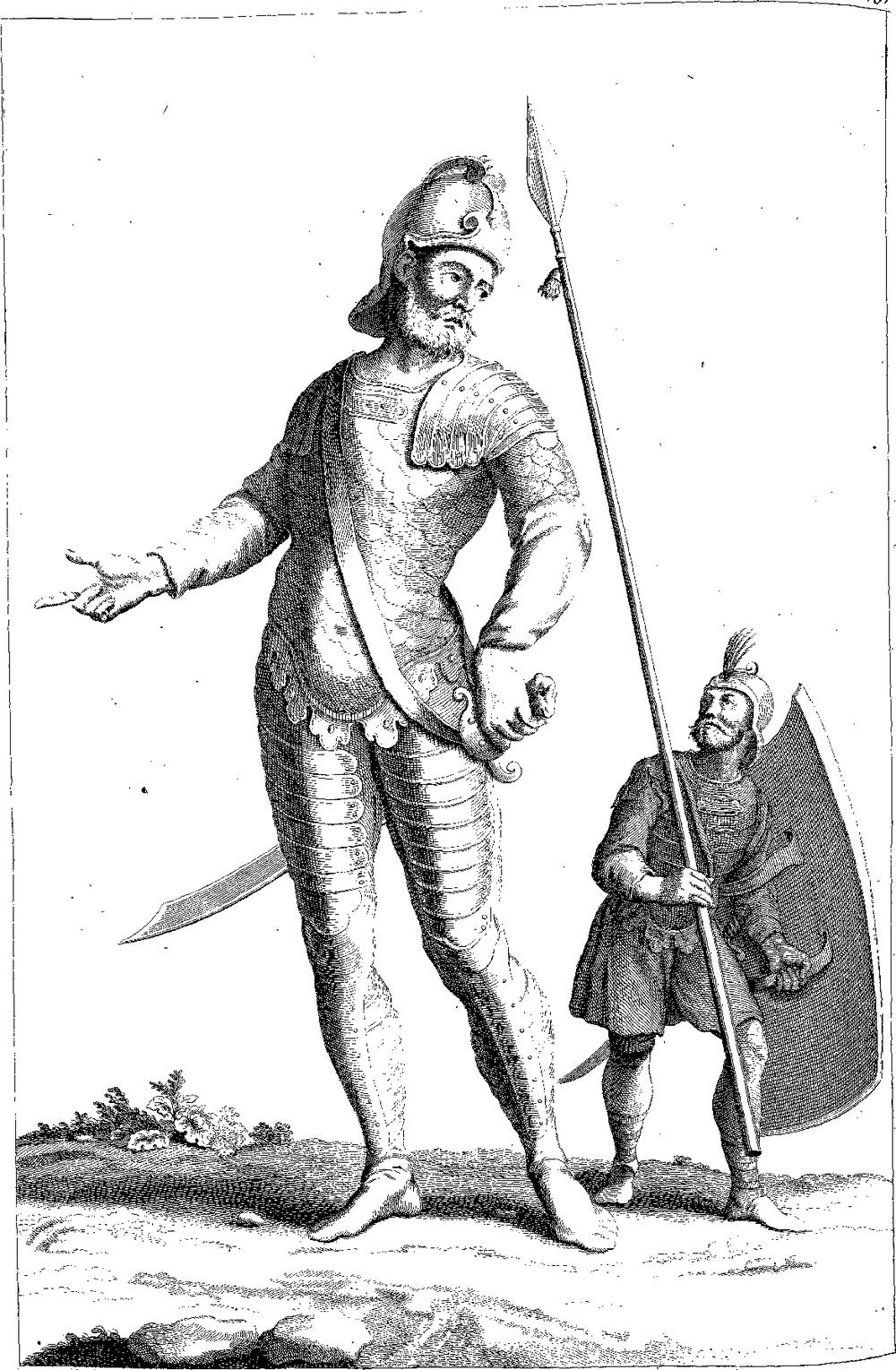
I. GOLIATH, a famous Giant of the City of Gath, one of the five Principalities belonging to the Philistins. Goliath29 1 Sam. xvii. 4, 5, 6, &c.came and presented himself between the two armies of the Philistins and the Hebrews, incamped between Succoth and In the Year of the World 2942, before J.C. 1058, before the Vulgar Æra 1062.Azekah, and defied all the bravest of the Hebrews to encounter him. He was six cubits and a span high, that is to say, about twelve feet and an half, taking a cubit to be twenty inches and a half, and a span to be three inches and a little more. His armour was suitable to his stature, and his insolence every day increased, upon observing that none of the Israelites dared to engage him. The two armies continued in the same place forty days, without coming to blows. At last, David, who was a young man, employed in feeding his father’s flocks, coming to the camp, to bring provisions to his brothers, declared that he would encounter this Giant.
This was immediately reported to the King, who sent for David: but seeing him to be so young, and without arms, he at first could scarce believe him capable of such an undertaking. Nevertheless, he ordered his own armour to be put upon him. But David not being accustomed to it, nor knowing well how to use it, took only his own staff, and chose five pebbles in the brook; so marching against Goliath, he flung a stone at him, which struck the Giant with so much force, that he fell down stunn’d with the blow: whereupon David running in upon him, drew the Giant’s sword, and cut off his head.
Goliath was descended from Arapha, that is to say, from the old Rephaims. He was higher than any two men, and his armour was proportioned to his stature. An Author who has scrupulously examined the weight of his armour, finds, that allowing a proportionable weight to every part which composed it, it must be two hundred and seventy two pounds thirteen ounces. He allows eighteen pounds three quarters for the iron of Goliath’s Spear; to the shaft of this Spear, which must have been six and twenty feet long, at least as much weight as to the iron with which it was bound; to the Helmet fifteen pounds, to the Buckler thirty, to the Sword four pounds and an half, to the Cuirass an hundred fifty six pounds and a quarter: add the Greaves of brass which he wore upon his legs, and the Shield or Lance which was carried by his ‘Squire, and you will find pretty near the weight which he allows for the whole armour.
The defeat of the Giant Goliath by David is an event so extraordinary, that it is not at all surprizing to see how the Eastern people, who naturally love fiction, and telling wonderful stories, should embellish it with some circumstances: they say, Goliath was of such an enormous stature, that his suit of armour compleat weighed a thousand pounds, and that his helmet alone weighed three hundred; that nevertheless David broke his helmet with the stone which he flung at him, and pierced his head, and brain. They further believe, that the Kings of the Philistins, who reigned long in Palestine, were all named Goliath, as the Kings of Egypt were called Pharaoh; and that David, after the defeat of the Giant whom we are speaking of, destroyed the nation of the Philistins, the remains of whom retired into Africk; and that the Barbars, people on the coast of Barbary, are descended from them.
It is believed by some, that David upon this occasion composed the hundred and forty-fourth Psalm; Blessed be the Lord my strength, who teacheth my hands to war, and my fingers to fight.
The Septuagint particularly take notice, that it was composed upon Goliath: but it is well known, that the titles of the Psalms are for the most part of very little authority. In the Greek copies, there is an hundred and fiftieth Psalm, which is not in the Canon, and is written upon the same subject: but there is no argument to prove that David was the Author of it.
II. GOLIATH, another Giant, who was killed by Elhanan, the son of Jair, of Bethlehem. The Author of the Vulgate expresses it thus, Percussit Adeodatus filius Saltûs, polymitarius Bethlehemites, Goliath Getheum. In the Chronicles, where the Text seems to be more correct, we read, Elhanan, the son of Jair, slew Lahmi the brother of Goliath the Gittite. Among the gallant officers belonging to David, there is one Elhanan of Bethlehem, the son of Joab’s uncle by the father’s side. It was probably this Elhanan, who killed the brother of Goliath, whether this Giant really was his brother, or only resembled him in the height of his stature.
I. GOMER, the son of Japheth, was father to the people of Galatia, according to Josephus. The ancient inhabitants of this country were called Gomares, before the Galatians made themselves masters of it. The Chaldee places Gomer in Africk; Bochart, in Phrygia; because Phrygia in Greek has the same signification, viz. a Coal, as Gomer in Hebrew and Syriac. We are of opinion, that the ancient Cimbri or Cimmerians sprung from Gomer. See our Comment upon Genesis x. 2.
It is very probable, that Gomer, or rather the Gomerites his descendants, not only peopled the country of the Cimbri or CimmeriansJoseph. Euseb. Zonar. Isidor. Cluver. Germ. Cambden., but likewise Germany and Gaul; the name of German is not very different from Gomerim. The Gauls, or Galatians, or Celtæ, were derived, they say, from Aschenez, the eldest son of Noah; but Cluver pretends, that the ancient Celtica comprehended Illyria, Germany, Gaul, Spain, and c. 5, 6, 7. Hosea i. 1, 2, &c.the British Isles. His reason for this assertion, is, that all these people anciently spoke the same language. He further supposes, that Gomer, or his family, peopled the countries which lie in Asia between the Paropamisus and the Mountain Imaüs, and between the confluence of the Oxus and the Oby; that from thence these people are called Gomares by Ptolemy, l. 6. c. 17. and Mela, l. 1. c. 2.
II. GOMER, the daughter of Diblaim, before she became the Prophet Hosea’s wife, led the debauched life of a Prostitute. But when she married the Prophet, she forsook this wicked way of living. Hosea received God’s command to take a lewd woman for his wife, to signify the prostitution and disorders of Samaria, which had abandoned God, and given itself up to Idolatry. The Lord enjoins him to give such figurative names to the children, who should be the issue of this marriage, as might express the extremity of his anger; and that his vengeance was upon the point of being executed upon the kingdom of the ten Tribes. This was performed by Hosea, upon the birth of his first son, whom he called Jezreel, and his first daughter, who was named, without mercy , and of his second son whose name was, Ye are no longer my people , &c.
Several Interpreters30, offended at the irregularity which appeared to them in Hosea’s marriage with Gomer, the daughter of Diblaïm, have imagined, that in reality there was no such thing, but that it was only a parable; or that Hosea had only discovered to the people what had happened to him in a vision, but was never truly executed. Nevertheless the whole sequel of this Prophet’s discourse is an evidence, that every thing he said, did literally happen to him: and that his marriage, as well as the birth of his children, were realities.
GOMORRHA. Gomorrha was one of the principal Cities of the Pentapolis; it was consumed by fire from Heaven31, as a punishment of its abominations. The Hebrew32 calls it Amora or Homora: but the Septuagint frequently express the letter Ain by a G. Thus instead of Aza, they say Gaza, &c. It is our opinion, that Gomorrha was the most northern of the five Cities of the Pentapolis; and that they are its ruins which are said to be still seen in the Dead Sea somewhere about Engedi.
GONORRHOEA. This word in Greek signifies a Flux, which Modesty does not permit us to name, and which should happen in the use of marriage only. This sort of Flux, when procured by luxury, or any other more criminal motive, as that upon which Onan acted, is an abominable action, and deserves the severest penalty. The Rabbins place it among the several sorts of 1 Cor. vi. 9.murder; and St. Paul says, that the Effeminate shall not inherit the kingdom of God.
Whenever it happened in the use of marriage, the man became thereby unclean until the evening; that is to say, incapable of partaking in things holy: but it did not exclude him from the use of common things, or the commerce of life.
Deut. xxiii. 10.When it happened while he was asleep, the person whom this accident befel, went out of the camp, and was not to come in again till the evening, after he had bathed in water.
Levit. xv. 1, 2, 3.Lastly, when the Gonorrhœa was a permanent disease, he who was attacked with it, was reckoned unclean as long as this indisposition lasted. Every thing that he touched, or made use of, contracted the same pollution. Whosoever touched him, continued unclean until the evening, and was not restored to his ordinary purity, till he had washed himself and his clothes in water. When this accident was stopped, he who had been under this flux, reckoned seven days from his cure; and after he had washed his body and his clothes in running water, was purified. On the eighth day, he took two turtle-doves or two young pigeons, presented himself before the Lord at the entrance of the Tabernacle, gave them to the Priest, who offered one for a Sin-offering, the other for a Burnt-offering, and prayed for him, that he might be cleansed from his indisposition.
GOOD. This word is used very frequently for beautiful, agreeable; for something perfect in its kind. God beheld every thing that he had created, and it was perfectly Gen. i. 31.Good; Et erant valde bona. Every creature had the goodness, beauty, perfection which it required. This man never prophesieth any thing Good unto me, nothing agreeable. 2 Chr. xviii. 7. 1 Sam. xxv. 8.We came hither in a Good Day, a festival day, a day of joy. If this seemeth Good in your eyes; if it is agreeable to you. Moses’s parents saw that he was a very fine child; literally, that he was Good. Unless I had believed Exod. ii. 2. Psal. xxvii. 13. Jer. vii. 3to see the Goods of the Lord in the land of the living; to enjoy the happiness of heaven. Make good your ways and your inclinations; behave yourselves like good men.
A Good Eye signifies Liberality; an Evil Eye, a covetous, envious Person. See the Article Eyes.
GOPHNA, Guphna, or Gophnith, the principal place of one of the ten Toparchies Plin. l. 5. c 14. Joseph. l. 3. de Bello, c. 4. Euseb. inof Judæa. Josephus reckons eleven, comprehending Jerusalem in the number. He generally joins this Toparchy with the Acrabatene. Eusebius places the City of Gophna at fifteen miles distance from Jerusalem, in the way to Sichem or Naplouse. Josephus says, that Titus coming from Cæsarea to Jerusalem, passed through Samaria and Gophna; and that VespasianDe Bello, l. 6. c. 1. De Bello, l. 5. c. 8. having subdued the Toparchy of Gophna, and the Acrabatene, took Bethel and Ephrem or Ephraim.
GORDIAN, Gordian Mountains. See above Noah’s Ark. Some believe that it settled on the Gordian Mountains.
GORGIAS, an eminent Captain in the Troops of Antiochus Epiphanes, was sent with Lycias into Judæa by Nicanor, at the head of an army consisting of forty thousand foot, and seven thousand horse, with orders to 1 Macc. iii. 38. In the year of the World 3839, before J. C. 161, before the Vulgar Æra 165.ravage the country, as King Antiochus had commanded before his departure; for he was at that time beyond the Euphrates. These two Generals advanced as far as Emmaüs. Judas Maccabæus having likewise gathered his little body of troops together, marched the same way. Gorgias sent a detachment of five thousand foot, and a thousand chosen horse, with an intention to surprize him: but Judas having got intelligence of their design, decamped, and went with his forces to attack 1 Macc. iv. 1, 2, & seq.Nicanor, who continued in his camp with the greatest part of his army. Nicanor was defeated, and his army routed. Gorgias having in vain sought for Maccabæus, returned towards his camp; but seeing it in the possession of the Hebrews, he retreated, and durst not run the hazard of a battle.
In the year of the World 3841, before J. C. 159, before the Vulgar Æra 163. a 2 Macc. xii. 33, 34, 35. b 2 Macc. v. 59. c 2 Macc. xii. 32. d 2 Macc. viii. 9. e See 2 Mac. x. 14, 15. and viii. 9. and 1 Mac. v. 9.Two years after, Gorgias and Judas Maccabæus engaging in Idumæa, a some few of the Jews were killed upon the spot; at which time a trooper, named Dositheus, was upon the point of seizing Gorgias, and taking him alive; but a Thracian horseman, having wounded Dositheus in the shoulder, gave Gorgias an opportunity to escape to Marisa. As Gorgias was Governour of Jamnia b and Idumæa, c and moreover a man of great experience in the trade of war d, there were actions frequently between him, Judas Maccabæus, and his brethren, but almost always with disadvantage on his side e. We know nothing concerning his death.
GORTINA, a City formerly of great note in the Isle of Crete, fifteen miles from Mount Ida. The Roman Senate wrote to this City in favour of the Hebrews, in the year of the World 3865, before Jesus Christ 135, before the Vulgar Æra 139. Gortina at that time was independant, and in alliance with the Romans.
GOSHEN. The Land of Goshen, a Canton of Egypt, which Joseph procured for his father and his brethren, when they came to dwell in Egypt. It was the most fruitful part of the country, and its name seems to be derived from the Hebrew, Geshem, which signifies rain; because this Province lying very near the Mediterranean, was exposed to rains, which were very rare in other Cantons, and more especially in Upper Egypt. We do not question but that Gozen or Goshen, which Joshua makes part of the Tribe of Judah, is the same as the Land of Goshen, which was given to Jacob and his sons by Pharaoh King of Egypt. It is certain that this country lay Gen. xlvii. 6. Josh. x. 41. xi. 16. xv. 51. Gen. xlvi. 28.between Palestine and the City of
Goshen continues on the next page
Footnotes
-
Hieronym. in Osee. c. v. ↩
-
Hieronym. in Epitaph. Paulæ. & in Sophon. ↩
-
Joseph. l. 3. de Bello, c. 2. in Lat. seu 3. in Græc. p. 832. ↩
-
Hieronym. in Osee v. ↩
-
Translators’ note. This place in our English translation is called the Hill that pertained to Phinehas. In the Hebrew it is ,פינחם בגבעתwhich the Septuagint translate Γαβαὰρ, or, as some Copies have it, Γαβαὰθ, or Γαβὰθ φινεές. ↩
-
Vide Esdr. viii. 17. ii. 70. and Nehem. iii. 26. xi. 21. ↩
-
Joseph. Antiq. l. 7. c. 10. In another place he sets it at the distance of 50 furlongs from Jerusalem. L. 1. de Bello, c. 37. ↩
-
Translators’ note. King Hiram made use of the people of this place in preparing materials for Solomon’s Temple, as may be collected from 1 Kings v. 18. where the word which our Translators have rendered Stone-squarers, in the Hebrew is גבליםGiblim, or Giblites, and in the LXX. Βύϐλιοι or men of Byblus; the former using the Hebrew, the latter the Greek name of this place. The same difference may be observed in Ezek. xxvii. 9. The Ancients of Gebal, says our Translation, following the Hebrew; instead of which, we read in the LXX. πρεσβύτεροι Βυϐλίων, the Elders of Byblus. See Maundrel’s Journey to Jerusalem. ↩
-
ירבעלJerobaal, may be de- rived from יראה בעלVideat Baal; or from ירב בעלContendat Baal. ↩
-
Herod. l. 1. Euphrates magnus & altus & celer ex Armeniis in rubrum mare decurrit. ↩
-
Plin. l. 6. c. 26. ↩
-
Translators’ note. If the Zori of the Hebrew text in Gen. xxxvii. 25. and xliii. 2. be the same with the Balsam of Mecca, it will prove the Balsam-tree to have been in Gilead long before it was planted in the gardens of Jericho, and before the Queen of Sheba brought that root of it to King Solomon, which Josephus mentions. For the Ishmaelites traded with it from Gilead to Egypt, when Joseph was sold to them by his brethren. It seems most likely to me, that the Zori of Gilead, which we render in our English Bible by the word Balm, was not the same with the Balsam of Mecca, but only a better sort of Turpentine then in use for the cure of wounds and other diseases. Prid. Connect. &c. P. ii. B. vi. ↩
-
Translators’ note. In the Hebrew text it is מלך גוים לגלגלKing of the nations of Gilgal. LXX Βασιλέα Γὲι τῆς Γαλιλαίας. Vulgate, Rex Gentium Galgal unus. ↩
-
Translators’ note. Thus the Vulgate, Præcinctum & quasi paratum ad ambulandum. But we find nothing answerable to this in the Greek text, nor consequently in our English translation, which is an exact copy from this original. ↩
-
Hieronym. Comment. in Epist. ad Philemon. Quis sit Epaphras concaptivus Pauli, talem fabulam accepimus. Aiunt parentes Apostoli Pauli de Gyscalis regione fecisse Judæos, & eos … in Tharsum Ciliciæ fuisse translatos, &c. ↩
-
Idem lib. de Scriptoribus Eccles. ↩
-
Isai. xxviii. 25, 27. [Hebrew] Gith. Μελάνθιον. By the English translators called Fitches. ↩
-
Translators’ note. Dr. Hammond thinks, that the Psalms with this title were all set to the same tune, and made on Goliah the Gittite. See Hammond on Psalm viii. ↩
-
חלor חולChol. ὕαλος. Vitrum. ↩
-
Translators’ note. And Tacitus takes notice of it in l. 5. Histor. Belus amnis, says he, Judaico mari illabitur: circa cujus os conlectæ arenæ, admixto nitro, in vitrum excoquuntur. ↩
-
Levit. xvii. 7. ולא יזבחו עוד אתזבחיהם שעיריםLXX. τοῖς ματαίοις*, vanis or falsis, supple Diis*. ↩
-
Translators’ note. The modern Jews have a very orthodox notion of God’s Perfections; but their Rabbins are not to be justified, who attribute such actions and expressions to him, as tend to vilify his nature in the opinion of their people, and lessen their respect to the Deity, of whom we cannot conceive too great and noble Ideas. To produce one instance only of the extravagancy of their Doctors. They believe the power of God to be infinite, and illustrate it in this manner: Cæsar, they say, had a mind to see God, and R. Joshua prayed that the effects of his presence might be perceivable. Whereupon God retired 400 leagues from Rome, and bellowed so terribly, that at the noise thereof the city walls fell down, and all the women with child miscarried. God advanced 100 leagues nearer, roaring in the same manner, which so frightned Cæsar, that he fell from his throne, and all the Romans then living lost their rinders. Basnage Histoire des Juifs, l. iv. c. 2. ↩
-
יהוהJehovah. אדניAdonai. אלהיםElohim. Elion. יהJah. אלEl. שדיShaddai. אל צבאות El-Sebaoth. עליון ↩
-
1 Kings ii. 25. אם יחטא איש לאיש יפללו אלהים ↩
-
Joseph. l. 2. contra Appion. Antiq. l. 4. c. 8. ↩
-
Philo, l. 1. de Monarch. & l. 3. de vita Mosis. ↩
-
Κρανίου τόπος, גלגלתאGolgoltha. ↩
-
Ambros. in Luc. lxxiii. Hieron. in Ephes. v. 14. Idem. Epist. ad Marcellam, sub nomine Paulæ, & Eustochii. Origen. in Matth. Epiph. Hæres. 46. Basil. in Isa. v. Chrys. in Joan. Homil. 84. Aug. l. 16. de Civit. c. 32. ↩
-
Translators’ note. In the passage referr’d to above, out of Samuel, it is said, And there went a Champion out of the Camp, &c. In the Septuagint δυνατός. In the Latin translation, Et egressus est vir spurius, a Bastard. Grotius observes, that Giants were so called by the Hebrews; because being contemners of all Laws, they lived without Matrimony, and consequently their Fathers were not known. Grot. in locum. ↩
-
Hieronym. in Osee. Quid. apud Theodoret. Haimo. Isidor. Aben-ezra, Kimchi, Jun. Vat. Figuer. Burgens, &c. ↩
-
Translators’ note. Prophane Au- thors make mention of this destruction of Sodom and Gomorrha, as Tacitus, l. 5. Histor. Haud procul inde campi, quos ferunt olim uberes, fulminum jactu arsisse, &c. & igne cœlesti flagrasse, &c. ↩
-
Genes. x. 19. עמורהLXX. Γόμμαρα, or Γομορά, or Γόμορρα. 21. The Gospel of Marcion. This is the same as that, whereof St. Paul is said to be the au- GOVERNMENT of the Hebrews. See hereafter the Article THEOCRACY. ↩