Volume I, pages 341–359 of the 1732 edition, from CAI to CAP: everything printed on these pages, in order.
Continued from Caius Caligula
he walked. As he came out of it, he asked the Jews with an air of more Moderation, if they had any thing further to say to him? and as they began to speak to him, he left them again, and went into another Hall, where several Pictures had been placed by his Orders. Some time after he dismissed them, saying, these People do not seem to me to be so wicked, as they are foolish and unfortunate, in not believing me to be a God. How he determined the matter of Complaint, we do not know; but we learn from Philo and Josephus, that in his Reign, the Jews of Alexandria were continually oppressed some way or other, and exposed to the Violence of their Enemies.
We do not relate here the particulars of Caius’s Life; it is sufficient for us to take notice of his Actions, so far as they had any respect to the Jewish Nation; which is all that we are concerned about in this Work. This Prince was killed in a tragical manner by Chæreas, one of his Guards, as he was coming out of the Theatre, in the year of Jesus Christ 41, and the fourth of his Reign. He was succeeded by the Emperor Claudius.
Caius enriched King Agrippa, and gave him the Kingdom of Judæa: When this Prince returned to Judæa, his Uncle Herod Antipas, who was Tetrarch of Galilee, envying his good Fortune, and solicited by his Wife Herodias, believed that if he went to Rome, he too should obtain from Caius the Title of King. He therefore undertook this Journey. But Agrippa, who apprehended his succeeding, sent after he was gone, and accused him to the Emperor of carrying on a Correspondence with the King of Parthia against the Romans, and of having in his Arsenals wherewithal to arm seventy thousand Men1. When Herod came to Italy, he went directly to Baiæ, where Caius then was: And while he was there, Fortunatus, once a Slave belonging to Agrippa, but made free by him, arrived there likewise, and presented Letters from his Master to the Emperor. Caius immediately read them; and when he had done, asked Herod if it were true, that he had so large a quantity of Arms in his keeping. Herod could not deny it: Whereupon the Emperor, without giving him any opportunity to justify himself, instead of conferring the Title of King upon him, deprived him of his Tetrarchy, and all his Wealth, and banished him for his whole Life to Lions. Upon Information, that Herodias was Agrippa’s Sister, he was inclined, for her Brother’s sake, to pardon her: But she chose rather to follow her Husband into his Exile, since she had engaged him in this Misfortune. Thus God revenged the Death of John the Baptist, who had been executed at the Sollicitation of Herodias, and by the Command of Herod.
CAKES. The Hebrews had several sorts of Cakes which they offered in the Temple; they were made of the Meal either of Wheat or Barley; they were kneaded sometimes with Oil, and sometimes with Honey; sometimes they only rub’d them over with Oil when they were baked, or fryed them with Oil in a Frying-pan upon the Fire. In the Ceremony of Aaron’s Consecration, they sacrificed a calf and two rams, and offered Exod. xxix. 1, 2.unleavened bread, and cakes unleavened tempered with oil, and wafers unleavened anointed with oil, the whole made of fine wheaten flour.
The Hebrew Text calls all Offerings Mincha2, which were made of Grain of any kind, or of Flour, Paste, Bread, or Cakes, of any nature whatsoever: These Offerings were made either alone, or together with other things. Sometimes fine Flour was Lev. ii. 1. Ibid. v. 4. 5.offered3, similia erit ejus oblatio, sometimes Cakes, or other things that were baked: Sacificium coctum in clibano: At other times Cakes baked in a Frying-pan: Oblatio de sartagine; or in a Frying-pan with holes, or upon a Grid-iron. Oblatio de craticulâ. Lastly, Ibid. v. 7.Ears of Corn were sometimes offered in order to roast them, and so get the Corn out, that it might be afterwards reduced to Meal or All these several Offerings of Paste, Corn, Bread, Cakes or Meal, were instituted principally in favour of the Poor, who were not in a Condition to offer Sacrifices of greater value. This however is to be understood of voluntary Offerings, and such as were not appointed by the Law; for as to Sacrifices which they were oliged to make, the Law exchanged one Animal for another; for instead of two Lambs and an Ewe, it permits the Poor to offer only one Lamb, and two young Pigeons.
Lev. ii. 4, 5.As to the manner of offering these Cakes, it was to be observed in the first place, that they were salted and unleavened; for nothing which was not salted, or which had Leaven in it, was to be offered: But leavened and common Loaves might be given to the Priests for their Sustenance. If therefore the Cakes which were offered, were baked in an Oven, and sprinkled or kneaded with Oil, the whole was presented to the Priest, who waved the offering before the Lord, then took so much of it as was to be burnt upon the Altar, threw it into the Fire, and kept the rest for himself. If the Offering was
a Cake kneaded with Oil, and dressed in a Frying-pan, it was reduced into pieces, and Oil poured upon it, then presented to the Priest, who took his hand full of it, threw it upon the Altar Fire, and the rest was his.
If these Cakes or Loaves were offered together with Sacrifices of Beasts, as was the common Practice, for with the great Sacrifices there were always Offerings of Cakes and Libations of Wine and Oil, the Loaves or Cakes were kneaded with Oil, and offered to the Lord. And the manner was not to pour the Wine and the Oil on the Animal’s Head, which was going to be sacrificed, as was the custom of the Greeks and Romans, but they were spilt upon the Fire wherein the Victim was consumed. The Law regulated the quantity of Meal, Wine and Oil, which was to be used with every Victim; for they had different quantities for the Sacrifices of Bullocks, Sheep, Goats, Ewes and Lambs. To the Sacrifices Numb. xxviii. 1, 2, 3, &c.of Bullocks were added three Assarons of Flour, kneaded with half an Hin of Oil, and as much Wine: To those of Rams two Assarons, or two tenths of an Ephah of Flour, with the third of an Hin of Oil, and as much Wine; to those of Goats and Ewes, of Lambs and Kids, one tenth-deal of Flour kneaded with one fourth part of an Hin of Oil, and another of Wine. The Capacity of the Hin and Assaron may be seen in our Tables, where we reduce the hollow Measures of the Hebrews to our own.
CALAH, a City of Assyria, built by Gen. x. 12.Asher. See Cale.
CALAMUS AROMATICUS, or Odoratus. A sort of Reed or sweet-scented Root. It is spoken of in some places of Exod. xxx. 23. Isai. xliii. 24. Jerem. vi. 20. Ezek. xxvii. 19.Scripture, where there is mention made of the particular Drugs whereof the sacred Perfumes were compounded. It is a knotty Root, redish without, and white within, which puts forth long and narrow Leaves. The true sweet Calamus comes from the Indies. The Prophets speak of it as a foreign Commodity, of great Value. Theophrastus4 and Pliny mention the sweet Calamus, which grows in Syria, beyond Libanus, between this and another small Mountain, in a Lake, the Marshes whereof are dried up in the Summer; this Lake took up the space of above thirty Furlongs, and was an hundred and fifty Furlongs from the Sea: All which Circumstances persuade us, that they meant the Lake Semechon: These sweet scented Reeds have no smell while they are green; but when they are dry only. Their form is not at all different from other Reeds, and their smell is perceived as soon as any one enters the Marshes.
CALAMUS, a sort of Measure; in Ezek. xl. 3. Rev. xi. 1.Hebrew Canna5. Ezekiel and S. John in the Revelations speak of this measuring Reed.6 Ezekiel says, it was six Cubits long, and an Hand-breadth; or rather six Cubits and six Hand-breadths; that is to say, six Hebrew Cubits, every one whereof is larger by an Hand-breadth, than a Babylonish Cubit. The Prophet is obliged thus to determine the Cubit he is speaking of; because he was at that time beyond the Euphrates; and the Measures of that Country were not so large as those of Palestine. The Hebrew Cubit contained four and twenty Inches, or six Hand-breadths; or about twenty Inches and an half, reckoning twelve Lines to the Inch.
Ps. xlv. 2.CALAMUS SCRIPTORIUS, a Reed or Rush to write with. The Antients made use of Styles to write on Tables covered with Wax, or of Reed or Rush to write on Parchment or Egyptian Paper; for our common Paper is of a new Invention. The Psalmist says, his Tongue is the Pen of a ready Writer.7 Lingua mea calamus scribæ. But the Hebrew Text signifies rather a Style, than a Reed to write with. The Author of the third Book of Maccabees says, that the Writers employed in making a list of the Jews who were in Egypt, produced their Reeds quite worn out, declaring, that they were not able to prepare such a Roll as was required of them. Baruch wrote his Prophesies with Jer. xxxvii. 8.Ink, and consequently with the Reeds we have been speaking of; for it does not appear, that the use of Quills was known at that time. S. John in his third Epistle, says, it was not his design to write with 3 Jon v. 13.Pen and Ink, Nolui per atramentum & calamum scribere tibi. This custom was common among the Gentile Nations8.
Inque manus chartæ, nodosaque venit arundo.
The Arabians, Persians, Turks, Greeks, and Armenians still to this day make use of Reeds or Rushes as is testified by Travellers.
CALCOL, or Chalcol, the fourth Son of Mahol the Son of Zerah, a Levite and eminent Musician, 1 Chr. ii. 6. 1 Kings iv. 3
CALE, or Chale, or Calah, or Chalach, a City of Assyria, built by Asher or NimrodGen. x. 11, 12.; for some suppose the Text of Scripture, wherein the Foundation of this City is mentioned, to be ambiguous. But whoever founded it, it is certain that it was at a great distance from Nineveh; and that the City of Resen lay between
Cale and Nineveh. Chale is perhaps the Capital of the Chalacene Province, near the Springs of the River Lycus; or Chala may be the Capital of the Chalenitis, which is separated by mount Zagrus from Media9.
CALEB, the Son of Jephunneh, of the Tribe of Judah, was sent with Joshua, and ten other Deputies, chosen out of the twelve Tribes of Israel, to go and view the Numb. xiii. 2. & seq.Land of Canaan, which God had promised them. The Deputies performed exactly their Commission; they went through the whole Country, and brought some of the finest Fruits which it produced, to shew the Multitude of their Brethren; but some of them, after the Report which they had made of the beauty and goodness of the Country, added, It is indeed a Country flowing with Milk and Honey, but the Inhabitants of it are of an extraordinary Strength, and the Cities belonging to it are large, and inclosed within good Walls. In the mean time, as the People began to murmur, Caleb the Son of Jephunneh said to them; The Country is excellent, let us go boldly and take possession of it. But the In the year of the World 2514, before the vulgar Æra 1490, Caleb was then 40 years of age.other Deputies who had been with him, on the contrary told the People, that they could never make themselves Masters of it; because the Inhabitants, who possessed it, were stronger than they were. We have seen Giants there, said they, in comparison of whom, we appear but as so many Grasshoppers.
Hereupon the People openly declared against this Expedition, and said, Had we not better return into Egypt, than perish, we and our Children, in this Country? let us choose a Captain, and under his Conduct return into Egypt. At these words Moses and Aaron fell on their Faces before the whole multitude then assembled; and Joshua and Caleb rent their Clothes, and began to encourage the Israelites, telling them, that the Country which they had seen was excellent; and that if God were with them, they might easily make a Conquest of it. Only rebel not against the Lord, said they; our Enemies are without any succour, and we shall devour them like Bread. But the People being enraged, made a great outcry, and took up Stones to stone them. Then the Glory of the Lord appeared upon the Tabernacle, and threatned to exterminate the whole Multitude. But Moses prayed for them so earnestly, that God was pleased not to destroy them immediately; but protested with an Oath, that none of those who had murmured against him, should see the Land of Canaan, and that they should all die in the Wilderness. But for my Servant Caleb, added he, who hath faithfully followed me, him will I bring into the Land, and he shall possess it, he and his Children after him.
Josh. xiv. 6, 7.When Joshua therefore had entred into the Land of Canaan, and had conquered a great part of it, Caleb, with those of his Tribe, came as far as Gilgal to see him; and Caleb said to him, Thou knowest what the Lord said to Moses in my Favour, and the promises which he made me. I was forty years old, when Moses the Servant of the In the year of the World 2559, before the vulgar Æra 1445, Caleb was then 85 years of age. Josh. xv. 13, 14.Lord sent me from Kadesh-Barnea, to view the Country into which we are now entered. I made my Report with great Truth, and suppressed as far as I was able the Murmurs of the People. Then the Lord said to me, Thou shalt possess the Land which thou hast visited, thou and thy Posterity after thee, because thou hast followed the Lord. God hath preserved my Life unto this Day; five and forty Years are now past, since the Lord made me these promises; I am now above fourscore, my health and strength are not impaired: Give me, I pray thee, this Mountain, where the Anakims dwell, that I may take Possession of it. Joshua bestowed a great many Blessings on him, and granted him his Request.
Caleb therefore marched with those of his Tribe, against the City of Kirjath-arba, afterwards called Hebron; and having taken it, he killed three Giants of the Race of Anak, viz. Sheshai, Ahiman and Talmai. From thence he went to Debir, otherwise Kirjath-sepher. As this place was extremely strong, Caleb promised, that whoever took it, should marry his Daughter Achsah. Othniel the Son of Kenaz took it, and accordingly had Caleb’s Daughter. This brave Israelite is thought to have survived Joshua. But the time of his death we are not acquainted with.
II. CALEB, The name of a Canton in the Tribe of Judah, wherein the Cities of 1 Sam. xxx. 14.Kirjath-sepher and Hebron were situated, belonging to the Family of Caleb the Son of Jephunneh, of whom we have been speaking.
III. CALEB, or Chelubi, the Son of Hesron, married first Azuba, and afterwards Ephrath. There is some difficulty relating to this matter in the Hebrew Text, which it may be well to consider in the Text itself, 1 Chr. ii. 9. 18, and 24. and in the Commentators.
CALENDS. See Kalends.
Exod. xxxii. 4, 19, 20, &c.GOLDEN CALF, which the Israelites worshipped at the foot of mount Sinai. ” When the People saw that Moses delayed to come down from the Mount, ” they gathered themselves unto Aaron, ” and10
In the year of the world 2513, before J. C. 1487, before the vulgar Æra 1491, in the fourth month of the sacred year.“ and said unto him, Up, make us Gods which shall go before us: For as for this Moses, the Man that brought us up out of the Land of Egypt, we wot not what is become of him. And Aaron said unto them, Break off the golden ear-rings which are in the ears of your Wives, of your Sons, and of your Daughters, and bring them unto me. They brought them to him, and Aaron with the assistance of the Founder’s art formed them into a molten Image. Then the people said, These are thy Gods, O Israel, which brought thee up out of the land of Egypt. Aaron having observed this, built an Altar before the Calf, and made publick proclamation by an herald, To-morrow is a Feast unto the Lord. And the people rose up early on the morrow, and offered Burnt-offerings, and brought Peace-offerings, and they sat down to eat and to drink and rose up to play.
“ The Lord having informed Moses of what the people had done, commanded him to go down from the Mountain, and Moses as he came near the Camp, seeing the people dancing about the Calf, threw the tables of the Law, at that time in his hands, upon the ground and broke them at the foot of the Mountain; then taking the Golden Calf, he threw it into the fire, reduced it to powder, scattered the ashes of it in the water which the people drank, reproached Aaron sharply with his weakness in consenting thus to the people’s request; stood at the gate of the Camp, and said, Who is on the Lord’s side? let him come unto me. And all the Sons of Levi gathered themselves together unto him, took every man his sword, and passing backwards and forwards through the Camp, they killed all whom they met without distinction, and there fell of the people this day “ about three and twenty thousand men.
But the Hebrew, Samaritan, Chaldee, Septuagint, and greatest part of the old Greek and Latin Fathers, instead of three and twenty, read three thousand.
The Hebrews without doubt11 intended upon this occasion to imitate the worship of the God Apis, which they had seen in Egypt12. This false Deity was adored under the figure of a real and living Bull, and under the form of one made artificially; and lastly under the figure of a Man with a Bull’s head: and it is certain, that several of the ancient Fathers13, speaking of the Golden Calf, expressed themselves as if there had been no more than the Head of a Calf or Bull. Aureum caput bovis, says Lactantius, and, bibulum caput, says Tertullian; and, conflatum est bibulum caput. But however this may be, it must be agreed, that they designed to make a superstitious figure, with an intention to pay an idolatrous worship to it, as they sufficiently demonstrate in these words, Behold, Israel, these are the Gods, which brought thee up out of the land of Egypt.
Monceau in his book intitled Aaron purgatus, has endeavoured to shew, that the Golden Calf made by Aaron, was a figure in all respects like the Cherubims, upon which, as he pretends, the Lord sat, when he appeared to Moses on Mount Sinai. These Cherubims, in his account of them, were winged Oxen, after the model whereof Moses afterwards made the Cherubims of the Mercy-seat. This is the particular fancy of this Author. He adds, that Aaron’s sin did not consist so much in making the Golden Calf, whereby he represented the Cherubims, on which the Lord was seated; but in giving the people an opportunity of paying a superstitious and idolatrous Worship: that the people without sin might have adored the Lord at the sight of this Cherub, or Golden Calf; and that his crime lay only in transferring the Worship which was due to God alone, to a creature, and sensible figure. He moreover is of opinion, that the Golden Calves made by Jeroboam, after the separation of the ten Tribes, were real Cherubims, and that neither Jeroboam nor the ten Tribes forsook the Worship of the Lord by receiving that of the Golden Calf; but only made a Schism, by separating from their Brethren, who at Jerusalem worshipped the same God seated on the Cherubims, whom the other Tribes adored as seated on the Golden Calves at Dan and Bethel. This is a very singular opinion, and has been justly censured and opposed by several Authors.
Aaron when he declared the Feast of the Golden Calf, said to the people, To-morrow will be a feast unto the Lord. They who endeavour to excuse this High Priest observe, that he made use of the word Jehovah, to try, say some Interpreters14, whether he could induce the people to worship God in the presence of this Calf, as if this figure had been consecrated to the true God; but the people did not stop there, they paid their adorations to a Calf that eateth hay: Ps. cvi. 19, 20.They made a Calf in Horeb, and worshipped the molten Image: thus they turned their glory into the similitude of a Calf that eateth hay. It is sure very vain to attempt the making any apology
for Aaron upon this occasion: He does not excuse Deut. ix. 20.himself, and we read in Deuteronomy, that God was provoked at his sin, and would have slain him, if Moses had not made use of his prayers to disarm the anger of the Lord.
Some Rabbins15 inform us, that Moses having reduced the Golden Calf to powder, and thrown the dust of it into the brook of Horeb, all, who drank of this water, and were guilty of worshipping this Idol, experienced the same effects, that the waters of jealousy produced upon such women, as were guilty of adultery. They were smitten with ulcers, whereby they were distinguish’d by Moses, and gave him an opportunity of chastising them with the utmost severity. Others16 maintain, that by drinking of this water, the most zealous worshippers of the Golden Calf saw with amazement their beards turn of a goldcolour, and this mark, they say, was transmitted to their Children17.
Nam rutilans auro monstrabat barba nocentes,
Dum patulo latices fluminis ore bibunt.
The Golden Calves of Jeroboam the Son of Nebat. This Prince having been acknowledged King by the ten Tribes of Israel, and intending to separate these Tribes for ever from the house of David, thought fit to provide new Gods for them, whom they might worship in their own Country, without being obliged to go to the Temple of Jerusalem, there to pay their adoration. “ He said in his heart, Now shall “ the 1 Kings xii. 26, 27, 28, &c. In the year of the world 3030, before J. C. 970, before the vulgar Æra 974.Kingdom return to the house of “ David: If this people go up to do sacrifice in the house of the Lord at Jerusalem, then shall the heart of this “ people turn again unto their Lord, even “ unto Rehoboam King of Judah, and they shall kill me, and go again to “ Rehoboam King of Judah. Whereupon he made two Calves of Gold, and “ said unto the people, Behold thy Gods, “ O Israel, which brought thee up out “ of the land of Egypt. And he set the “ one in Bethel, and the other put he in “ Dan, at the two extremities of his Kingdom. And this thing became a sin; “ for the people went to worship before “ these Calves even unto Dan and Bethel.
We have already observed that Monceau18 thought the Golden Calves of Jeroboam were an imitation of the Cherubims, which Moses had placed upon the Ark of the Covenant, and were looked upon as the Lord’s Throne: So that Jeroboam and the Israelites of the ten Tribes were to be considered rather as Schismaticks than Idolaters. And it must be confessed that all Israel did not renounce intirely the Worship and Religion of the Lord, by adopting the Worship of the Golden Calves, and by ceasing to go up to the Temple at Jerusalem. God did not altogether abandon Israel; he sent Prophets to them, and preserved to himself a great number of faithful Worshippers, who were in a capacity to be saved. But when Jezebel, in Ahab’s reign, introduced the Worship of Baal and Astaroth, and other Gods of the Canaanites, then Elijah complained bitterly to God, that all the world had forsaken his Worship, and that he only remained. I have been very jealous for the Lord God of hosts; for the Children of Israel have forsaken thy Covenant, thrown down thine 1 Kings xi. 40. 1 Kings xix. 10. 1 Kings xiv. 9. Hosea x. 5. Vide & xiii. 3. 1 Kings xviii. 21.Altars, and slain thy Prophets with the sword; and I, even I only am left. The God of Israel therefore had before his Prophets and Altars in Ahab’s Kingdom; and when the same Elijah had assembled the people on Mount Carmel, he bad them choose either the Lord or Baal. How long halt ye between two opinions? If the Lord be God, follow him; but if Baal, then follow him. This is what is said to justify the Worship of the Israelites belonging to the ten Tribes.
But S. Jerom19, and the generality of Commentators thought it was Jeroboam’s design with his Golden Calves to imitate the worship of the Ox Apis, which he had seen practised in Egypt during the time of his abode there, towards the end of Solomon’s reign. This Prince’s crime is not any thing of an ambiguous nature; the Scripture reproaches him in an hundred places, with having made Israel to sin, Jeroboam the Son of Nebat, who made Israel to sin. When at any time the Scripture would describe a bad Prince, it says, that he imitated the sin of Jeroboam. It says, that Jeroboam drew Israel from following the Lord, and made them sin a great sin. The Prophet Abijah tells this Prince’s Wife, Thou 2 Kings xvii. 21.hast gone and made thee other Gods, and molten Images, to provoke me to anger, and hast cast me behind thy back. How often did the Prophets bitterly exclaim against the false Worship of the Golden Calves? Hosea by God’s direction threatens them saying, The inhabitants of Samaria *shall fear, because of the Calves of Bethaven *… the high places of Aven, the sin of Israel, shall be destroyed.
I confess there were Saints and Prophets in Israel, who were faithful to the Lord, and might attain to Salvation, but they did not worship the Golden Calves, nor were any ways concerned in the Schism, nor in the new Worship introduced by Jeroboam; either they went privately to the Temple of Jerusalem, as Tobit, or they worshipped Tob. i. 5.God in their houses, and un
2 Kings iv. 23.der the direction of some Prophets, as the woman of Shunam.
The Septuagint and the Greek Fathers generally read Golden Cows instead of Golden Calves; and some speak as if there had been the head only of a Cow or Calf. Some think that Menahem King of Israel was obliged to send one of his Golden Calves to Pul, thereby ingaging him to come to his Hosea x. 5, 6. Vide Osee v. 6. 2 Kings xv. 19, 20.assistance. The20 Rabbins relate, that Hosea King of Israel having been under a necessity of sending one of the Golden Calves to Salmanesèr King of Assyria, in order to make up the sums, which he demanded, the Priests belonging to this idol, instead of the Golden Calf, sent him another of brass well covered over and concealed. The people who knew nothing of their cheat, mourned, and very much lamented the loss of their Golden Calf; but the Priests privately rejoiced, believing their fraud to be well secured from discovery. To this is applied the passage of Hosea, where he says, The people Hosea x. 5.mourned over it, and the Priests thereof rejoiced on it. But Salmanesèr having examined the present, which was sent him, and finding a brazen Calf only instead of a golden one, marched against Samaria, and carried away the Golden Calves with all the people, who adored them.
S. Jerom21 informs us of another Tradition among the Jews, concerning the Golden Calves, in his explanation of these words of Hosea, Divisum est cor eorum. Nunc interibunt. While the people of Israel, and their Kings were agreed upon the Worship of the Golden Calf, God suspended his vengeance: The people had an excuse; they obeyed their King. But Hosea the last King of Israel, being less addicted to the Superstitions of the country than his Predecessors, and declaring that he did not design to force any one, but left them at liberty to go and worship at Jerusalem, the people shewed great opposition, and said they would not use this liberty. This produced a division among them: Divisum est cor eorum. Wherefore the Lord resolved to destroy them: Nunc interibunt.
In the Article of Jeroboam, we shall mention what happened at the ceremony of this Prince’s dedicating the Altar of the Golden 1 Kings xii. 23. xiii. 1, 2, 3, &c.Calf at Bethel; as the Man of God, who was sent from Judah, pronounced this Prophecy against the Altar, “O Altar, Altar, thus saith the Lord, “A Child shall be born unto the house “of David, Josiah by name, and upon “thee shall he offer the Priests of the high “places, that burn incense upon thee, “and mens bones shall be burnt upon thee, “Behold the Altar shall be rent, and “the ashes that are upon it shall be pour- “ed out. The King hereupon stretching out his hand, it immediately dried up; but was restored at the Prophet’s prayer. See 1 Kings xiii. 1, 2, 3, &c. Josephus22 speaks of the Temple of the Golden Calf, which was still in being in his time, somewhere towards Dan, and not near Daphne on the lesser Jordan, as the printed Copies of this Author have it.
Hosea xiii. 2.As the Glory of Israel was their God, their Law, and their Ark; so the Adorers of the Golden Calves consider’d these Idols as theirs. The Priests thereof rejoiced on it for the Glory thereof, because it is departed from them. They valued themselves for worshipping them, which indeed should have overwhelmed them with confusion. Wherefore the Prophets used to say to them in the way of raillery23, Ye who worship Calves, come and sacrifice Men. Can there be any greater madness? Ye adore Calves and sacrifice Men to Moloch and Saturn. The Septuagint, They say, we want Calves, sacrifice Men. We have no more Calves to sacrifice, let them bring us Men. The Hebrew may be interpreted in another sense, Let them who would sacrifice, come and kiss or adore the Calves. This is what Jeroboam said to the Israelites of the ten Tribes.
Hosea viii. 5, 6.Hosea foretold the destruction and captivity of the Calves of Samaria in the following terms; Thy Calf, O Samaria, hath cast thee off, mine anger is kindled against them … It was Israel who invented this Idol. … The Calf of Samaria shall become as contemptible as spiders webs. The Assyrians having got possession of Samaria, carried off the Golden Calves which the people worshipped; these vain Deities were of no more service to them than spiders webs; they could not secure them from the hands of their enemies. The Hebrew Text, which is translated Spiders Webs24, is very intricate. The Septuagint translate it, the Calf of Samaria is deceitful, or mistaken; Symmachus, is inconstant; the fifth Edition, is gone astray, all which is much to the same purpose. The Rabbins; it is as it were dust, sawdust. The generality of modern Interpreters; it is broken to pieces. S. Jerom was inform’d by his Hebrew master, that it signified Spiders Webs, which float in the air and are soon dispersed.
Several Questions are proposed, relating to the Golden Calf formed by Aaron in the Wilderness. Some of the Rabbins are willing to excuse Aaron from the Sin committed by him in making it. They pretend that it was not he, but some Magicians of Egypt, and certain Proselytes of the same Nation, not truly converted, who,
who had it made, contrary to the intention of Aaron. Josephus has concealed the matter, and omitted this story of the Golden Calf. The Septuagint say,25 that Aaron Exod. xxxii. 4.described it with a graving Tool, but that the People made and cast it. Some of the Jews are of opinion, that at first a wooden Calf was formed, and that afterwards it was covered with Golden Plates. Selden26 conjectures, that he used a graving Tool to draw those marks upon the Golden Calf, which distinguished the Ox Apis; that is to say, a Crescent on the side, and a white square spot upon the Forehead.
Some are of Opinion, that his design in casting it, was in order to draw the work out into length, and that the Idol coming out of the Furnace might have nothing beautiful and glittering in its appearance. Others on the contrary will have it, that Aaron left nothing undone to make it as beautiful and perfect as possible; and that for this reason he is said to have used a graving Tool. Formavit opere fusorio. In the Hebrew27, He formed a calf for them with a graving tool. But the Chaldee Paraphrast differs widely from both these Versions: Aaron, he says, received their Ear-rings from them, tied them up in a Purse, and made the Golden Calf of them. Bochart maintains, that this is the best Translation of all, and that the Hebrew Charet signifies a Purse, and not a graving Tool28.
The Mahometans29 have a singular Tradition relating to the Golden Calf: They assert, that this Figure, which was only a Body without a Soul, made a noise like an Ox. Which Fable they dress up in the following manner. The Israelites having borrowed of the Egyptians, before their departure out of Egypt, many Vessels of Gold and Silver, and gathered abundance of rich Spoils belonging to the Egyptians, who were drowned in the Red Sea, and cast upon the Shore, began to traffick among themselves with these Jewels. Sameri, one of the principal Heads of the Hebrews, informed Aaron of it, who commanded in the absence of his Brother Moses, and told him that he did not think this kind of Commerce lawful. He required him therefore to get all these Ornaments immediately together, and keep them safe in his Possession, till the return of Moses, who was then upon Mount Sinai.
Sameri, who was very well skilled in melting down Metals, thought it would be an advantage to have all this Gold and Silver reduced into one mass, that Moses might afterwards imploy it in what man-
Yyyy ner he should judge most proper. He did so, put all these jewels into a Crucible, and without any design of his, there came out a kind of molten Calf. At the sight of this Figure, which chance had produced, the Israelites, who were accustomed to Idolatry in Egypt, conceived some respect for it, and Sameri desirous to increase their veneration for it, took dust, and threw it into the Calf’s Throat, which immediately began to bellow; whereupon the Hebrews fell prostrate before it, and paid their Adorations to it. And how came Sameri by this miraculous Dust! why, he took it, they say, from under the Horse’s Feet belonging to Gabriel the Arch-angel, who marched at the head of the Hebrews in the Wilderness.
The fatted Calf, mentioned in some places of the Scripture, as in Prov. xv. 17. 1 Sam. xxviii. 24. Luke xv. 25. Jer. xxvi. 21. was fatted particularly for some certain Festivals, or extraordinary Sacrifices. The Heathens had the same custom30.
Pascitur in vestrum reditum votiva Juvenca. Calf of Lebanon spoken of in Psal. xxviii. 6. Comminuet eas tanquam vitulum Libani, may be taken simply to be a Calf or young Bullock feeding upon Libanus. The Voice of God, is Thunder, the Tempest breaketh a Cedar of Libanus, with as much ease as it oversets a Calf of Libanus. The Hebrew may be otherwise translated; The voice of the Lord maketh the Cedars of Libanus to skip like a Calf bounding in the meadows: He will shake the mountains of Libanus and Sirion like a young Unicorn.
Hosea xiv. 2.The Calves of the Lips mentioned by Hosea31, We will render the Calves of our Lips, signifies Sacrifices of Praise, Prayers which the Captives of Babylon addressed to God, being no longer in a condition to offer Sacrifices in his Temple. The Septuagint read the Fruit of our Lips, instead of the Bulls of our Lips, and their reading is followed by the Syriac, and by the Apostle to the Hebrews, Ch. xiii. 15.
Jeremiah speaks of a remarkable ceremony, which is not taken notice of in the historical Books of Scripture: The Lord says, I will give the men which have transgressed my Covenant, that have not performed the words of the Covenant which they had made before me, when they cut the calf in twain, and passed between the parts thereof. When this Covenant was sworn to, and upon what occasion, no one can tell: So much however is probable, that it was not of any long date, since they who formerly had sworn to it,
were still living. The custom of cutting a Victim in two, of putting the several moieties upon two different altars, and making those who contracted any Covenant pass between both is well known in Scripture and profane Authors. See Gen. xv. 9, 10, 17.
CALVES. There is very frequent mention in the Scriptures of Calves, because they were made use of commonly for Sacrifices. But Vitulus on several occasions is put for an Heifer, which, according to our way of speaking, would not be termed meerly a Calf. Vitulus de armento, a Calf of the Herd, is in all probability set in opposition to a sucking Calf, still under the care of its Dam. Vitulus is sometimes taken for a grown Bull, Circumdederunt me vituli multi. The fatted Calf, vitulus saginatus, was a Calf fatted particularly Luke xv. 23.for a Wedding, or some religious Feast.
To CALL. This word is taken frequently for to be. He shall be called Wonderful, the Mighty God, Counsellor, and Everlasting Father, &c. He shall possess all these Qualities, he shall be truly wonderful, the mighty God, &c. And in S. Luke, He shall be called the Son of the most High. He shall in reality be so. And again, speaking of John the Baptist, Thou shalt be called the Prophet of the Highest.
To be called by name to the Assemblies, Numb. xvi. 2.was a particular mark of distinction: The People were called thither by a general cry, but the Heads of the Tribes, and Princes of the People were called by name. The Hebrew ¹ imports Men of name, celebrated, noted Men. God called Bezeliel by name: He designed to imploy him in making the Tabernacle. He called Abraham by name; he appointed him for his Service. God called Cyrus by name, &c.
To call in the Sense of a vocation to an Imployment, to the Christian Religion. S. Paul says, that he was called to the Apostleship. Jesus Christ, that many are called, but few are chosen. We are exhorted to live in a manner worthy of the vocation wherewith we are called. And, let every man abide in the calling wherewith he is called; and that he give diligence to make his calling sure, by doing good works. 1 Pet. i. 10.
To call any thing by its name. To give it a name, to fix a name upon it, is an exercise of Authority: The Father names his Son, the Master his Servant. God giveth the Stars a name, and calleth them by their names, Psal. cxlvii. 4.
To call the Name of any one upon ourselves Isai. iv. 1.or another; Let thy name be called upon us. Let us only be in the Quality ¹ 70 .אנשי שםἌνδρες ὀνομαστοί. of thy Wives. Thy name, O Lord, is invoked or called upon us. We are known under the Name of the People of God. Let the name of Jacob be named on them, they Gen. xlviii. 16.shall be esteemed as Sons of Jacob. And the Psalmist, The rich have called their name upon their lands; they have denominated them by their own Names. And in Gen. xxi. Psal. xlix. 11.Genesis, In Isaac shall thy seed be called; the Sons of Isaac shall pass for thy true Posterity.
To call, shews Authority; as a Master calls his Servants. God calleth a Famine upon the Earth, 2 Kings viii. 1. and Psalm 1. God calleth the Earth to judge it. And in Haggai i. 11. The Lord called for a drought upon the Land. And in Amos v. 8. He calleth for the waters of the sea, and poureth them out upon the face of the earth. And Jerem. xxv. 29. He calls for a Sword or War upon the Land, &c. He calleth the stars, and they say, here we be. Baruch iii. 34.
To Call, taken in the sense of an Invitation to a Feast, is commonly met with in the Scripture. And vocati, the called, denotes sometimes the Guests.
To call upon the name of God, to call him to our Assistance, to sue to him in our Necessities. Enos began to call upon the name of the Lord. Others translate the Hebrew, Then the name of God was profaned, by giving it to Idols. See the Article Enos.
Let thy name be called upon us. Let us have the honour to belong to thee, to be Gen. xlviii. 16.called thy People, thy Servants. Let my name be called on them; let them be called the Sons of Israel; let them be reputed to be my Children. Isaiah speaking of a particular time when the Land would be very much deserted, and Men very rare, says in a sort of proverbial manner, Seven women shall take hold of one man, saying, We will eat our own bread and wear our own apparel, only let us be called by thy name; take us for your Wives, and let the World own us in this Quality; free us from the reproach of Celibacy. Come and stand before me in this house, whereupon thy name is called. This Temple known by the name of the Temple of the Lord. O my Dan. ix. 18.God, open thine eyes and behold the city whereupon thy name is called; Jerusalem known by the name of the holy City, the City of the Lord.
To call upon God, is an expression sometimes used to signify all the acts of Religion, for the publick Worship of God. Rom. x. 13.Whosoever shall call upon the name of the Lord shall be saved. Whosoever shall believe, hope, love and pray, as he ought to do, shall be saved. God in some sort takes it for an Honour, that we should
call upon him; he is in some sort jealous of our Adorations; he requires that we should call upon no other God besides himself. Ps. l. 15.Call upon me in the day of trouble; I will deliver thee; and thou shalt glorify me. Thy deliverance, and the confidence which thou hast reposed in me, shall redound to my Glory.
CALLIRHOE, a City beyond Jordan, near the lake Asphaltites. There were springs of hot water there, which were very serviceable to the health of people, and were very agreeable to drink32. These waters discharged themselves into the Dead Sea.
CALLISTHENES, one of the King of Syria’s Officers, who set fire to the Temple -gates in the time of the Maccabees. But on the day, when the Festival was celebrated at Jerusalem, in commemoration of the victories obtained over Antiochus’s Generals by Judas Maccabæus, the people having discovered Callisthenes, who had fled into an house for safety, set fire to it 2 Macc. viii. 33.and burnt him in it.
CALMANA. This is the name which some give Adam and Eve’s eldest Daughter, Cain’s Twin-sister. But there is a very slender degree of certainty in traditions of this nature.
CALNEH, a City in the land of Shinaar, built by Nimrod, and the seat formerly of his Empire, being one of the principal Genes. x. 10. If. x. 9. Ezek. xxvii. 23.Cities in it. We believe it to be the same as Calno mentioned in Isaiah, and Canneh in Ezekiel. It must have been situated in Mesopotamia, since these Prophets join it with Haran, Eden, Assyria, and Chilmad, which carried on a trade with Tyre. Several learned Men are of opinion, that this was Callinicum; but others33 assert, that it was rather Ctesiphon, the Capital of a Province called Chalonitis34.
CALPHI, the Father of Judas. This last commanded part of the Troops belonging to Jonathan Maccabæus; and kept his ground with three others in the Battle which Jonathan fought against the Syrians in the plain of Nasor, near the lake 1 Macc. xi. 70.of Genesareth, in the year of the world 3860, before the vulgar Æra 183.
CALVARY, or Golgotha35, that is to say, the place of Skulls. A little Mountain to the North of Mount Sion36, went by this name, probably by reason of the similitude it bore to the figure of a Skull, or Man’s Head. Many of the Ancients were of opinion37, that this Mountain was called Calvary, because the Head of the first Man in the world was buried there; and that our Saviour was crucified in the same place, that his blood running down upon the body of this person, who was the first of mankind, he might thereby be restored to Life, and the favour of a Resurrection procured by it. To support this Tradition, they tell us, that Noah having put his Body in the Ark, distributed the Relicks of it to his Children, and as a particular favour gave the Skull or Head to Shem, who was to be the Parent of that holy Stock, from which the Messiah was to descend; that Shem with a spirit of foresight buried this Skull at Calvary, where he knew the Messiah would be crucified. But neither the ancient Fathers, nor any modern Authors, that mention these Traditions, were ever well persuaded of the truth of them, and we may, without any disrespect to them, take these to be apocryphal Stories.
Mount Calvary was very near to Jerusalem, and was the place, in all probability, where criminals were generally executed. After the destruction of Jerusalem by the Romans in the reign of Titus, it was by degrees rebuilt, and the Jews were very numerous there, when Barchochebas revolted against the Romans. Adrian, or his Generals were forced to besiege it, and having taken it they entirely destroyed it38. After this Turanus Rufus, or Tinnius Rufus, who was then Governour of Judæa, plowed up the ground, on which the Temple formerly had stood39, to shew that this place was never to be rebuilt, without a particular Decree of the Senate. When the War was ended, Adrian forbad the Jews ever to set footing in Jerusalem, upon pain of death to those who should act contrary to this order40. He settled a Roman Colony in the place, and called the City Ælia Capitolina. This new City was not built upon the ruins of the old, but more to the North; so that Mount Calvary, which before lay out of the City, was almost in the center of Ælia. There was but a small part of old Jerusalem included within this City. Mount Sion, where the Temple stood before, was either cultivated as a field, or was covered with ruins41.
At present the City of Jerusalem is in the same place, where Adrian built it. But whereas this Prince had profaned Mount Calvary, and in particular the place, where Jesus Christ was crucified,
and that where his body had been buried, the Empress Helena, Mother to Constantine the Great, erected there a stately Church, which is still in being, and enriched it with abundance of magnificent ornaments. So that the Cross and Sepulcher of Jesus Christ, and Calvary, are more honoured by all Christians, than old Jerusalem ever was by the Children of the Synagogue .
CALUMNY. Isaac’s herds-men gave the name of Calumny42, or Injustice and Violence, to the Well which they had dug in the neighbourhood of Gerar, and which the Shepherds belonging to Abimelech King of Gerar by force took from them, Genes. xxvi. 20. The word Calumny in the Scripture style is often taken for Injustice, Violence, Fraud, Oppression.
CAMBYSES, the Son of Cyrus, succeeded his Father in the year of the world 3475, before the vulgar Æra 529. This Prince was violent, passionate, and cruel; he had sometimes fits of passion which proceeded to downright madness. We do not here take upon us to set down the History of his whole Life: It is sufficient to observe what may have a relation to the Scripture, and the Jewish History. As soon as he came to the Crown, the Samaritans, who in the reign of Cyrus never ventured to attack the Jews any otherwise than privately, and in an indirect manner, now set upon them directly and openly, and wrote to Ezra iv. 6.Cambyses, whom they call Ahasuerus, to follicit him, that he would forbid the Jews to carry on their works any farther in rebuilding of their Temple. What the motives were, which they made use of, we cannot tell; but it is certain, that Cambyses put a stop to the works, and for the remaining seven years and five months of his life, no one was employed upon this Edifice.
In the second year of his reign, he prepared to make war against Egypt. One of the King of Egypt’s Eunuchs, who betrayed his Master, and delivered up the bridges and avenues of the Country to Cambyses, made his entrance into Egypt, In the year of the world 3478, before the vulgar Æra 526.and the conquest of it easy to him. After five years continuance in this Country, he was obliged to leave it and return to Babylon, where the Magus Pathizites had placed his own Brother Smerdis on the throne of Persia, pretending that he was Smerdis the Brother of Cambyses. Cambyses was at Ecbatane in Palestine, at the foot of Mount Carmel, when news was brought him, that Smerdis had usurp’d the Empire. Whereupon in great transports of rage he mounted his horse with precipitation, and his sword by accident falling out of its scabbard wounded him in the thigh. Twenty days after, seeing himself to be near the point of death, he called the principal men of Persia about him, and told them, that he had put to death his Brother Smerdis, and that he who reigned was an Usurper. He exhorted them that they would not suffer his crime to go unpunished, and that they would hinder Smerdis from translating the Empire from the Persians to the Medes43. For Smerdis was by birth a Mede. After this he died at Ecbatane, as the Oracle had foretold; not at Ecbatane in Media, as he imagined, but at Ecbatane in Syria.
What Ezekiel says of the Wars of Gog and Magog against Israel, and the judgment which God was to exercise against the enemies of his people, we think may be referred to the time of Cambyses. And what the Prophets say of all those misfortunes which were to befal the Israelites after the return from their Captivity, is, probably, all applicable to this event. See for example, Joel ii. 30, 31. iii. 2, 3, 4, 5, 15, 16. Isai. xli. 15, 16. Micah iv. 11, 12, 13. Lastly, some Authors44 refer the History of Judith to the time of Cambyses. The Reader may consult our Dissertation upon Gog and Magog, prefixed to Ezekiel.
CAMEL, an Animal very common in Arabia, Judæa, and the neighbouring Countries. It is called Gamal in Scripture; and as to the signification of its name there is no difficulty. Moses ranks it among those creatures that were unclean. We Deut. xiv. 7. Levit. xi. 4. Ezek. xxxviii. xxxix.may distinguish three sorts of Camels: Some are large and full of flesh, and fit only to carry burthens; it is said that they will carry a thousand pound weight. Others there are, which have two bunches upon their backs, like a natural saddle, which makes them fit either to carry burthens, or for men to ride on. Lastly, there is a third kind, which is leaner, and of a smaller size; these they call Dromedaries, because of their swiftness. These are the Animals generally made use of by men of quality to ride on. The Arabians, Persians, and other people eat the flesh of Camels, and it is served up at the best tables45. But the use of it was forbid the Hebrews, as we have observed already. Eliezer, Abraham’s servant,
vant, made his Camels kneel down to rest themselves near a well of water. Camels keep Water a long time in their Stomach for their Refreshment. Nature has given them for this purpose a very large Ventricle, round about which are many bags closed within the Coats of it, wherein it is very probable that these Animals keep water in reserve. It is confidently said, that they will continue ten or twelve days without either eating or drinking.
But what is usually said of these Bags to be found about the Stomach of Camels, and their reserving water for many days in them, is contradicted by the physical Observations of the Jesuits made in China, where they dissected several Camels, and found nothing like them. As soon as a Camel is born, they tie his four Feet under his Belly, put a Carpet over his Back, and Stones upon the Borders of it, that he may not be able to rise for twenty days together. Thus they teach him the habit of bending his Knees to rest himself, or when he is to be loaded or unloaded. He has a large solid Foot, but not a hard one; in the Spring all his Hair falls off in less than three days time, and his Skin remains quite naked. At such times the Flies are extremely uneasy to him, and there is no remedy besides belabouring his Body. They dress him with a Switch instead of a Curry Comb; with this they beat him as they wou’d a Carpet, to clear it of the dust. When he is upon a Journey, his Master follows him singing and whistling, and the louder he sings, the better the Camel goes.
CAMELEON. Moses forbids the Hebrews to eat the Flesh of a Cameleon, it being an unclean Animal. The Cameleon is a Levit. xi. 30.little creature like a Lizard, but with a larger and longer Head. It has four Feet, and on each Foot three Claws. Its Tail is long; with this as well as with its Feet it fastens itself to the Branches of Trees. Its Tail is flat, its Nose long, and made in an obtuse Point; its Back is sharp, its Skin plaited, and jagged like a Saw from the Neck to the last Joint of the Tail, and upon its Head it has something like a Comb. In other respects it is made like a Fish; that is to say, it has no neck. Some have asserted, that it lives only upon Air; for which reason Tertullian46 calls it a living Skin: But they who have observed it more nearly, take notice that it feeds on Flies, which it catches with its Tongue; its Tongue is about ten lines long, and three large, made of white Flesh, round, and flat at the end; or it is hollow and open in some sort like an Elephant’s Trunk. In like manner it shrinks or grows longer. This Creature darts it upon Flies, draws it back immediately, and there they stick upon it as it were upon Glew.
It is said likewise to assume the colour of those things, to which it is applied;47 that it grows white upon any thing that is white, and black or red on any thing black or red. But our modern Naturalists assure us, that its natural colour when it is at rest, and in the Shade, is a blueish grey. There are some yellow, and others green, which are of the smaller kind. When it is exposed to the Sun, this grey changes into a darker grey, inclining to a dun colour; and its parts which have least of the light upon them, are changed into different colours, which form spots of the bigness of about half an Inch. The grain of its Skin when the light does not shine upon it, is like Clothes mixed with many colours. Sometimes as we handle it, it seems to be speckled with dark spots inclining to green. If it is put upon a black Hat, it appears to be of a Violet colour. Sometimes again, if it is wrapped up in Linen, when it is taken off it is white; but it is not true that it takes the colour of those Stuffs which it is covered with: It changes colour in some parts only of the Body. This is what is said of the Cameleon.
But we very much question, whether the Hebrew term, which the Author of the Vulgate has translated Camelion, and which Moses forbids the Hebrews to eat, as an unclean creature, be truly a Cameleon. Bochart, who has considered with much application what relates to the Animals, which the Scripture mentions, is of opinion, that the Hebrew48 hakoah signifies a sort of large strong Lizard, found often in Arabia, which attacks Serpents in their Holes, drives them out, and kills them. The Arabians call it Aluarlo.
CAMELO-PARDUS, or Camelo- Pardalus, an Animal like a Camel and a Panther; the use whereof the Hebrews Deut. xiv. 5, 6.were allowed by Moses. It derives its name from the resemblance it bears to a Camel in its Size, and a Panther in its Hair, having its Skin speckled with white upon a reddish ground. It is said to be produced by the Copulation of a she Panther with a Camel, or rather of a Panther with a female Camel: But both are equally improbable.
Others translate Camelo-Pardalus, Giraffa, which is a Beast found in the East Indies, beyond the River Ganges. Its Neck is long and slender, about a Fathom in length: Its Ears are slit, and its Feet cloven; its Tail is round, and does not
reach below its Houghs: Its Legs are taller than any other Animal’s, so that it cannot drink without stradling. It is described with two little Horns. Others maintain, that it is a chimerical Animal, which has no real existence any where. Bochart is of opinion that Moses did not intend to mention either the Giraffa or the Camelopardus; because these were Animals which the Hebrews had no knowledge of, and were not to be found any where but in Countries too remote from theirs. Moreover he says, that the Camel being an Animal which was declared unclean by the Law, it is not probable that a Beast compounded of a Camel and a Panther should be allowed of. Lastly, He thinks the Hebrew Zamor signifies a wild Goat. Others translate it an Elk or wild Goat.
Jerem. xxxvi. 22. Exod. ix. 8.CAMINUS, Furnace, Hearth, Chimney49. We are not to imagine, that either the Hebrews or Egyptians had Chimneys like ours, nor that Caminus signifies properly a Chimney made after our manner. In Palestine, Arabia and Egypt, People use very little Fire to warm themselves, because these Countries are very hot; and whenever they do warm themselves, it is at a Hearth or foot Stove filled with Coals. King Jehoiakim was seated in his winter Apartment, with a Fire on the Hearth before him, when Jeremiah’s Roll was presented to him. He cut it with a Pen-knife, and threw it into the Fire which was upon the Hearth. When it is said in Exodus, that Moses took Ashes out of the Chimney, Plenas Ex. ix. 8.manus cineris de camino, the Hebrew reads Furnace50, or Forge, de fornace. The Scripture speaks frequently of Caminus, or the Forge or Crucible wherein Gold or Silver are refined, and Metals are melted; and the sad and deplorable condition of the Poor, of Slaves, and Prov. xvii. 3. Rev. i. 15. Eccl. ii. 5.People under Oppression, is by a Metaphor called, the Furnace of Humility, Poverty and Servitude. Moses says, that God delivered the Hebrews out of the Iron Furnace, out of Egypt; an expression which we find repeated Jer. xlviii. 10. Eccl. ii. 5. Rev. ii. 15. Deut. iv. 20. 1 Kings viii. 35. Jer. xi. 4.in several places of Scripture. See hereafter the Article Punishments for the fiery Furnace into which Daniel was cast.
I. CAMON, a City on this side Jordan, in the great Plain, six Miles from Legio, inclining to the North51. The same perhaps as Cadmon.
II. CAMON, a City beyond Jordan, in the Country of Gilead52. It is in all probability the same Camon as that mentioned by Polybius53, and taken by King Antiochus. Jair Judge of Israel was buried in the City of Camon, belonging to the Tribe of Manasseh, Judg. x. 5.on the other side of Jordan.
CAMP, Incampments, and Marches of the Hebrews. See hereafter Marches.
CANA, in Galilee, a little Town, where Jesus performed his first Miracle. Cana is John ii. 1, 2, &c.said to lye between Sephoris and Nazareth, six Miles westward from Sephoris. In the same Canton we meet with Sepher-Cana, four Miles from Nazareth, northward, a little veering to the East. Josephus speaks likewise of a Town called Cana54: But I should take this rather to be Kenath. Others discover another Cana somewhere towards Sidon; and they pretend, that the Woman of Canaan, Mat. xv. 21.whose Faith was admired by our Saviour, was of this place; but they have no solid Mark vii. 24. Gen. ix. 25.Foundation for this conjecture.
CANAAN, the Son of Ham. The Hebrews55 believe, that Canaan having first discovered Noah’s nakedness, gave notice of it to his Father Ham; that Ham diverted himself with it, and acquainted his Brothers Shem and Japhet with it, who with Respect covered their Father: That Noah when he awoke, having understood what had passed, cursed Canaan, who was the first Author of this indecency. Others are of opinion56, that Noah, not knowing how to do any thing more sensibly displeasing to his Son Ham, than by cursing Canaan, resolved thus to punish him in the person of his Son. Some, instead of Cursed be Canaan, a servant of Servants shall he be unto his brethren, read, Cursed be Ham, &c. or supply, cursed be the Father of Canaan: The effect of Noah’s curse appeared in the Anathema pronounced by God against the Canaanites, and in the severity wherewith he required his People to treat them, when they had made a conquest of their Country. The Canaanites were not reduced only to suffer Vide Deut. vii. 2, 26. xiii. 15. and xx. 17. Vide Lev. xvii. 25. Deut. xviii. 9. and xx. 16, 17. Gen. x. 15, 16, 17.the most cruel slavery, but were intirely extirpated, put to the Sword, or driven out of their own Land.
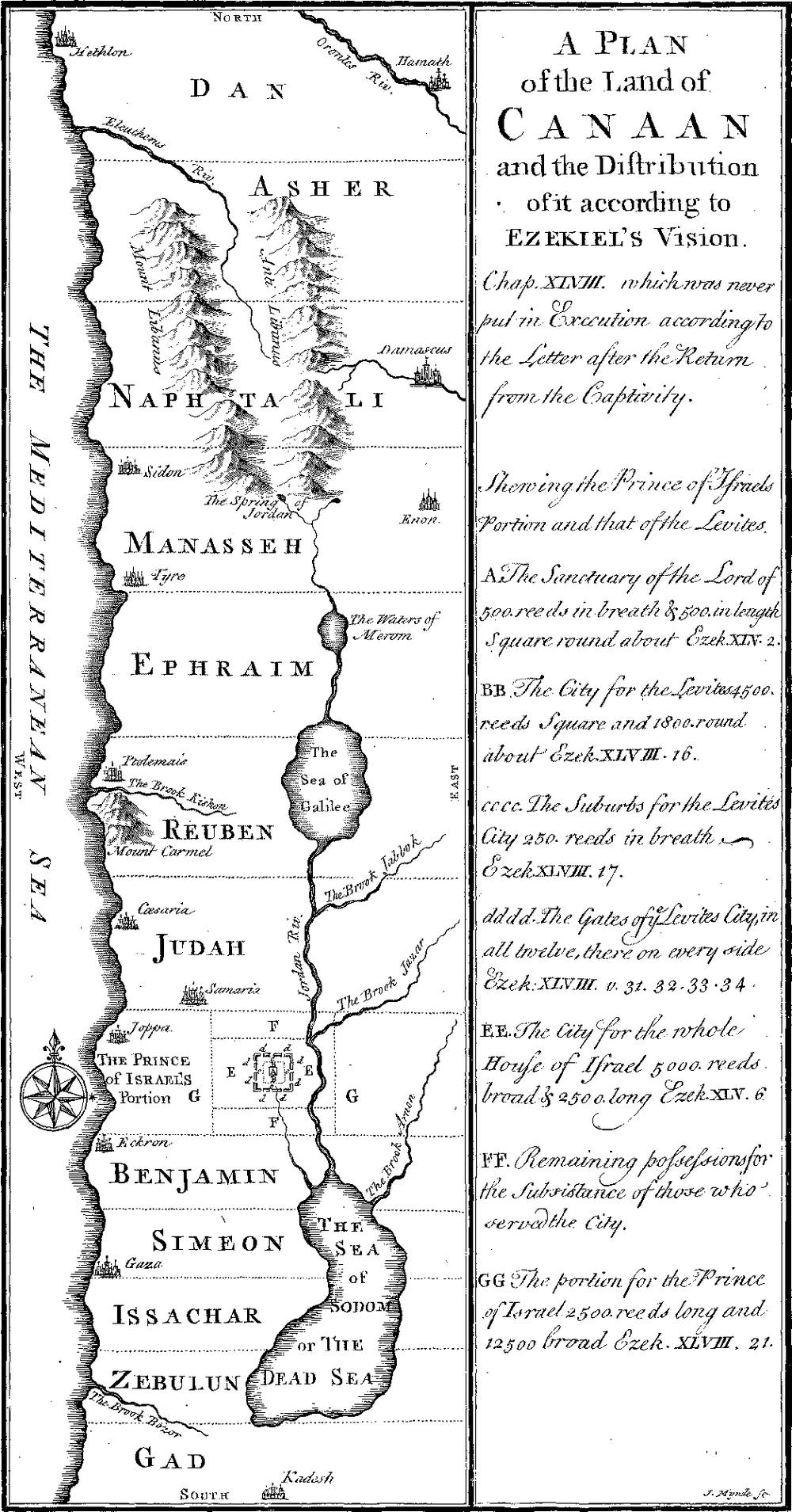
The Posterity of Canaan was very numerous. His eldest Son was Sidon; who at least founded, and peopled the City of Sidon, and was the Father of the Sidonians and Phœnicians. Canaan had besides ten Sons, who were the Fathers of so many People dwelling in Palestine, and in part of Syria, namely the Hittites, the Jebusites, the Amorites, the Girgasites, the Hivites, the Arkites, the Sinites, the Arvadites, the Zemarites, and Hamathites. Of each of these People we shall say something under their particular Articles.
ticles. It is believed, that Canaan lived and died in Palestine, which from his name was commonly called the Land of Canaan, and formerly his Tomb was shewn there, of five and twenty Feet in length, in a Cave belonging to the mountain of Leopards, as they termed it, not far from Jerusalem.
The Mahometans are of Opinion, that Canaan perished by the Waters of the Deluge; he refusing to go into the Ark. Mahomet makes God speak to Noah after the following manner: Take and carry with you into the ark two couples of all creatures male and female, and all your family, excepting Him, who has already been condemned by your own mouth (that is to say Canaan). Receive likewise with you the faithful, and even unbelievers; but of these very few shall enter. In pursuance of this Command Noah admitted fourscore persons into the Ark, and observing that his Grandson Canaan did not embark with him, and as yet not knowing that he was of the number of Unbelievers, he called to him, Come aboard with us, my Son, and be not among Infidels. Canaan replied, I will save my self upon the Mountain, where the water will not reach me. But Noah answered, Nothing but the Mercy of God can save you. While they were thus talking together, a Wave separated them, and covered Canaan, who was immediately drowned. After this manner Mahomet corrupts the holy Scriptures, by mingling his own imaginations with them.
CANAANITES, People descended from Canaan, and the eleven Sons of this Patriarch. Their first habitation was in the Land of Canaan, where they multiplied extremely. Trade and War were their principal Occupations: These gave rise to their great Riches, and the several Colonies scattered by them over almost all the Islands, and maritime Provinces of the Mediterranean. The measure of their Idolatries and Abominations was compleated, when God delivered their Country into the hands of the Israelites, who made a Conquest of it under Joshua. As God had commanded this People, long before cursed by him, to be treated with the utmost rigour, Joshua extirpated great numbers of them, and obliged the rest to fly, some into Africk, others into Greece. Nay, there are some Writers, who seem persuaded, that many of them came into Germany and Sclavonia, and that others retired into America.
But their Opinion seems to be the best founded, who affirm that they withdrew into Africk. The Rabbins assure us, that the Girgasites took this resolution: But they do not inform us to what part of Africk they retired. Procopius57 says, that they first retreated into Egypt; but not thinking themselves to be secure there, they advanced farther into Africk, where they built many cities, and spread themselves over all those vast Regions, which reach as far as Hercules’s Pillars, preserving their old Language, with some little alteration. This Author adds, that in the Province called Tingitana, and in the very antient city of Tingis, which was founded by them, there were two great Pillars to be seen of white Stone, erected near a large Fountain, with an Inscription in Phœnician characters, to this purpose, We are People preserved by flight from that Rover Jesus the Son of Nave, who pursued us. In S. Athanasius’s time the Africans still said, they were descended from the Canaanites; and when they were asked, what was their Original, they answered, Canani58. It is agreed, that the Punic tongue was almost intirely the same as the Canaanitish and Hebrew Language.
The Colonies which Cadmus carried to Thebes in Bœotia, and his Brother Cilix into Cilicia, came from the Stock of Canaan. The Isles of Sicily, Sardinia, Malta, Cyprus, Corfu, Majorca, and Minorca, Gades and Ebusus, are thought to have been peopled by the Canaanites. Bochart, in his large Work, intitled Canaan, has set all this matter in a good light. We too have taken some pains in enquiring particularly to what Country the Canaanites retired, after their expulsion from their own by Joshua, and we have examined the several Arguments produced by those who affirm, that they settled in Armenia. See our Dissertation prefixed to the Comment upon Joshua.
Acts viii. 26.CANDACE, the name of an Ethiopian Queen, whose Eunuch coming to Jerusalem to worship the Lord, was baptized by Philip the Deacon, near Bethsura, in the way to Gaza, as he was returning to his own Country; as we shall relate in the Article of Philip the Deacon. Some are of opinion, that the word Candace signified Sovereign Authority, and that this was the common name of all those Queens, who reigned in the Island, or Peninsula of Meroë; for this is the Country here meant by Ethiopia. Pliny59 testifies, that the Government of this Country was generally in the hands of Women, and that there had already been a great number of this name Candace, who had reigned there. Some of the Fathers were of opinion,60 that the Eunuch’s name was Candace; whether the Copies which they used, might so express it, or that this was a mistake occasioned by forgetfulness.
getfulness, it is said, that Queen Candace was converted, and believed in Jesus Christ, persuaded hereunto by the preaching of her Eunuch.
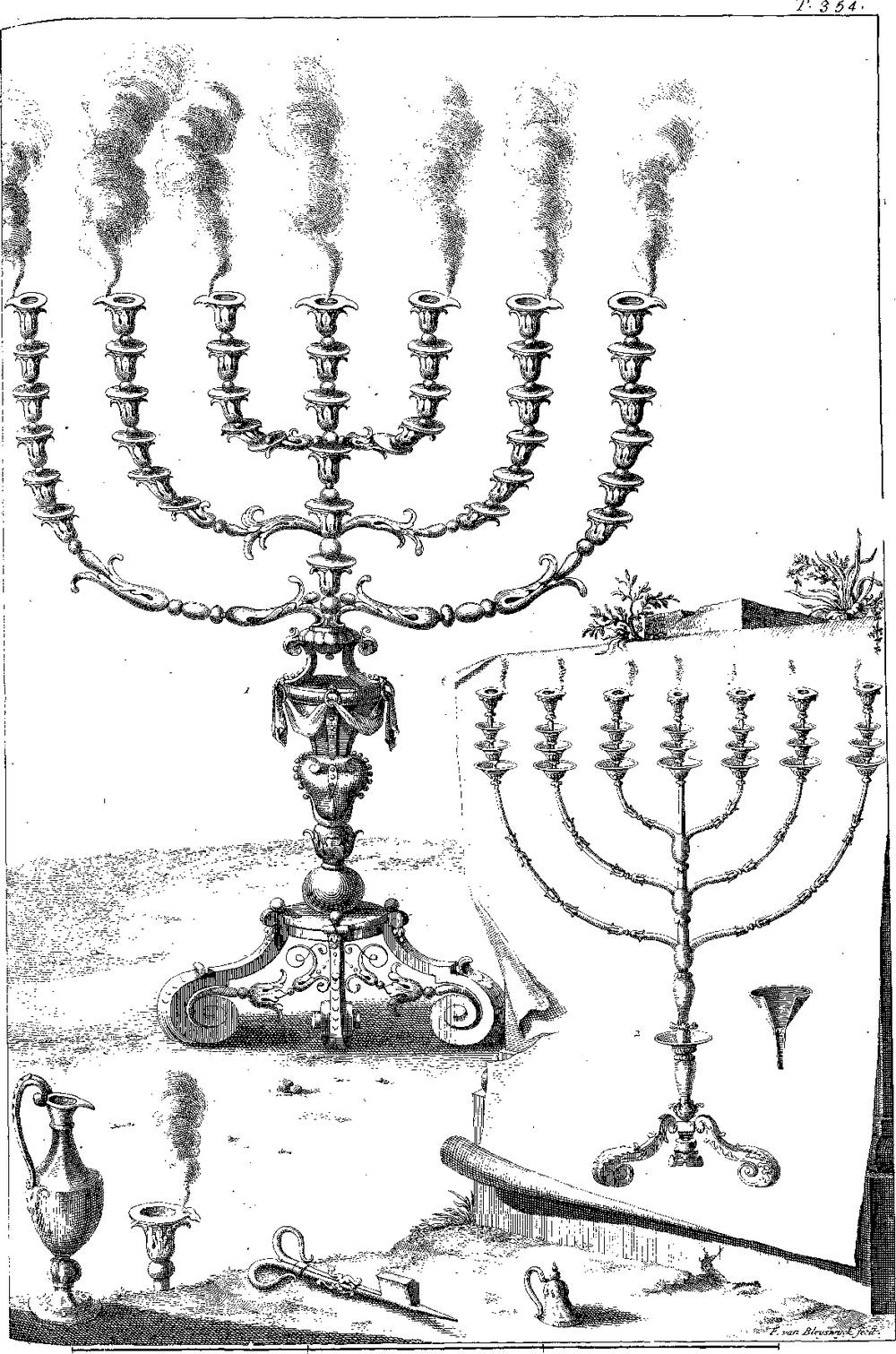
CANDLESTICK of Gold with seven Branches: This was made by Moses to be put into the Tabernacle: It was of hammered Exod. xxv. 31, 32.Gold, a Talent in Weight. It had one Foot of the same Metal, and a Stock with seven Branches, adorned at equal distances with six Flowers, like Lilies, with as many Bowls and Knops placed alternately. Upon the Stock and six Branches of the Candlestick were the golden Lamps which were immoveable, wherein there was put Oil and Cotton. These seven Lamps were lighted every Evening, and extinguished every Morning. The Holy, wherein the Candlestick was placed, was as it were the Antichamber to the Sanctuary, and received no light from any other place, but from the Candlestick. It was placed on the South side in the Holy, and served to illuminate the Altar of Perfume, and the Table of Shew-bread, which were in the same place.
When Solomon had built the Temple of the Lord, he was not satisfied with placing one golden Candlestick there, but had ten put up of the same form and Metal with that described by Moses; five on the North, and five on the South side of the 1 Kings vii. 49.Holy. The Tongs and Snuffers belonging to the golden Candlesticks, as well to that of Moses as to those of Solomon, were of very pure Gold. David seems to have designed Silver for making Silver Candlesticks, as well as Gold for others of this Metal. But we do not find that his Intentions 1 Chr. xxviii. 13.as to this particular were executed; unless Solomon made some of Silver for the use of the Temple, different from the golden ones which were placed in the Holy.
After the Jews returned from their Captivity, the golden Candlestick was again placed in the Temple, as it had been before in the Tabernacle by Moses; and in Zech. iv. 2. 11. 1 Macc. iv. 49, 50.Zechariah there is express mention of it, as well as in the Books of the Maccabees. Josephus says, that after the Romans had destroyed the Temple, the several things which were found within it, were carried in triumph to Rome, viz. the golden Table, and the golden Candlestick with seven Branches. But then he adds, that the Candlestick was fashioned in a different form from that which was used in his Nation; for it was made in the shape of a Pillar, raised upon a Basis, from the shaft of which Pillar there came out as it were six sorts of Sticks, or very slender Branches, which ended in a triangle, and bore each a Lamp. The Table and Candlestick were lodged in the Temple built by Vespasian, and consecrated to Peace; and at the foot of Mount Palatine there is a triumphal Arch still visible, upon which Vespasian’s Triumph is represented, and the several Monuments, which were carried publickly in the Procession, are engraved, among the rest the Candlestick with seven Branches is to be observed on it61.
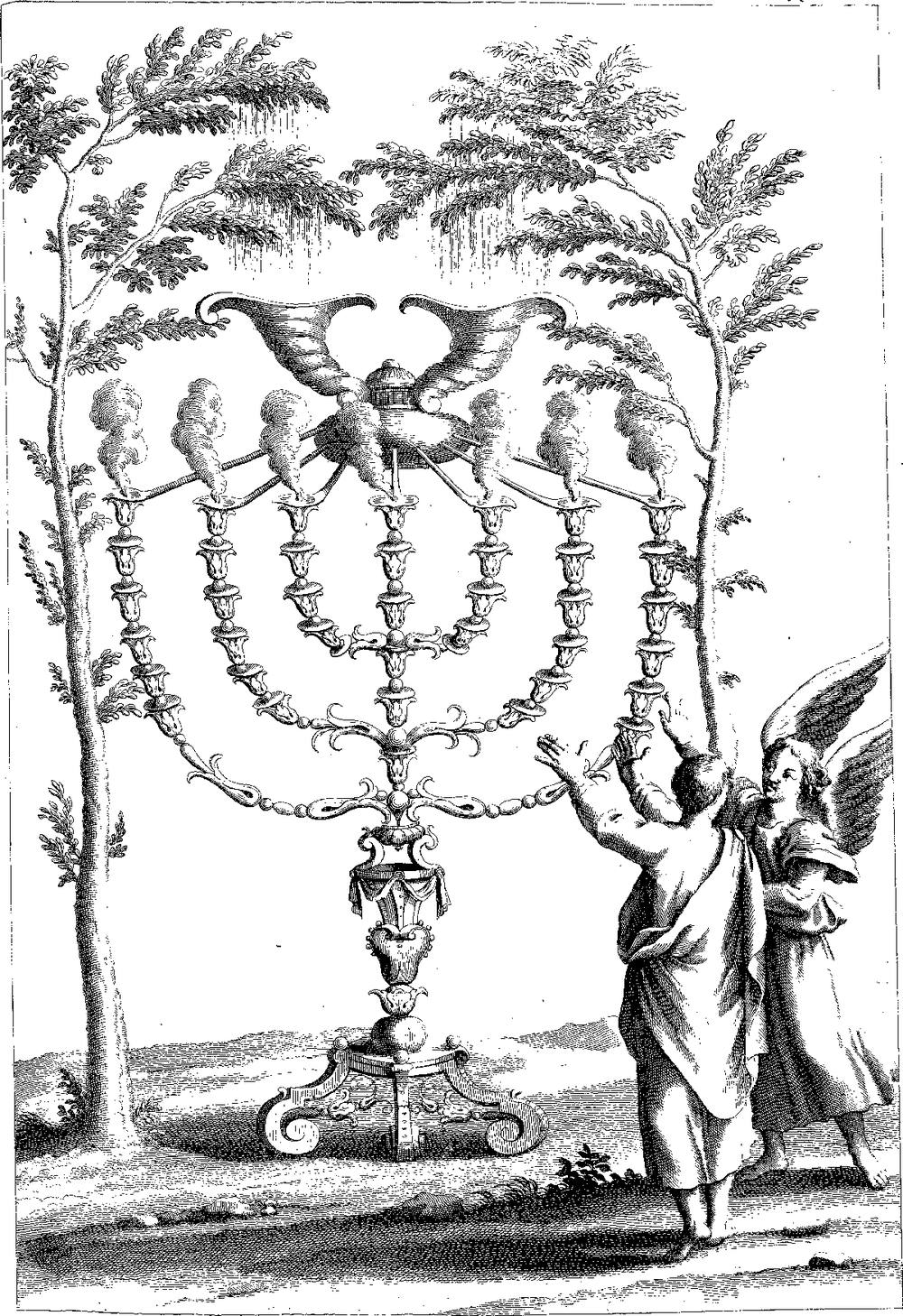
The golden Candlestick with seven Branches seen in a Vision by the Prophet Zech. iv. 2, 3. Exod. xxv. 31. xxxvii. 17, 18. 1 Kings vii. 4.Zechary, was like that of Moses, and those provided by Solomon: All the difference was this only, that in the others the Priests poured the Oil separately into each crystal Glass; in this the Oil was communicated equally to the seven crystal Glasses through seven Pipes, which received it from one common Bottle placed at the head or upper part of the Candlestick; and this Bottle was filled with Oil which dropped down within, through two kinds of Tunnels, which received it from two Olive Trees placed on the two sides of the Candlestick. We do not believe that this Lamp ever was in being: But there is no difficulty in the Composition of it. In our Comment on the Prophet Zechary, we have explained the riddle concealed under the vision of this Candlestick.
CANNEH, in Ezekiel xxvii. 23. the same probably with Calneh, Gen. x. 10. See Calneh.
CANON. This term signifies Rule, according to the import of the Greek: It is particularly used in the language of the Church, to signify such Rules as are prescribed by Councils, concerning Faith, Discipline, and Manners. It is made use of likewise to denote those Books of Scripture, which are received as inspired, and canonical, and to distinguish them from either profane, apocryphal, or disputed Books. For example, we say, that Genesis is part of the sacred Canon of the Scriptures, and is acknowledged to be canonical by both Jews and Christians. On the contrary, the Book of Wisdom is said to be in the Christian Canon, but not in that of the Jews. Lastly, it is said, that particular Books have been for some time contested, and have not been received into the Canon with the unanimous consent of all Christian Churches, till after some ages ; such as Books of Wisdom, Eccle-
Ecclesiasticus, Tobit, Judith, the two first Books of Maccabees and Baruch; and for the New Testament, the Epistle to the Hebrews, the second of S. Peter, the second and third of S. John, and the Revelations.
The Hebrews admit no more than two and twenty Books into their Canon of the Scriptures, or at most but four and twenty, supposing Ruth to be separated from Judges, and the Lamentations from Jeremiah: The manner of their distributing them in their Bible, may be seen under the Article Bible. They believe generally that the Canon of Scripture was not closed, as they term it; that is to say, that the number of inspired Books which it includes, was not fixed in the manner we have related, till the time of Esdras, who, with the consent of the General Council of the whole Nation, collected all the sacred and inspired Books, which were acknowledged as such by the Jews, composed one Body of them, and regulated, what we call the second Canon of the Scripture62. So that ever since the Jews have not admitted any Book among those, which they hold to be canonical: At least they have received none, which have the same degree of Authority with them as the former: This we learn from Josephus63, who tells us, that from Moses to the reign of Artaxerxes King of Persia, the Jews had received two and twenty Books from the Prophets, which they looked upon to be divine,64 and did not dare to make any the least alteration in them; and that after the time of Artaxerxes, they continued with the same diligence to write down every thing memorable, which happened to their Nation; but that the Books which have been so composed, are not allowed to have an equal degree of Authority with the first.
Genebrard and Serranus are of opinion, that after Esdras, the Jews of the great Synagogue admitted Books into the Canon, which were composed after this time; such as Wisom, Ecclesiasticus, Tobit, Judith, and the two Books of the Maccabees; nevertheless, that their Authority was not the same with them, as that of the old ones, tho’ these too were held by them to be inspired. But this is not without some Difficulty; for first, it is very probable, that the Books of Tobit and Judith were written before the Captivity. Secondly, If the Jews thought they were inspired, why did they not receive them into the Canon, and own them to be of equal Authority with the rest? The reason which Josephus gives for it65, which is, that from the time of Artaxerxes, there was no succession, as there had been, of the Prophets, is of no weight: For if they had men among them, who were acknowledged to be inspired, and had written the Books which we are speaking of, could not these inspired persons have added their Books to the Canon, which was composed by Esdras? Had not Mattathias, Judas Maccabeus, Simeon and Jonathan his Brothers, had not they Authority to do so? And John Hircanus, whom Josephus himself declares66 to have been a Man particularly favoured by God, and supernaturally enlightned, could not he too have done the same thing? The Author of the second 2 Macc. ii. 14.Book of Maccabees67 says, that Judas Maccabeus imitated the zeal and care of Nehemiah in collecting those Books, which contained the History of what had happened to the Jews, during the War against the Syrians. Why did not Judas insert these Monuments in the Canon, since he thought them so much to deserve his care and consideration?
It may be perhaps suspected, that the Jews, who retained the use of the Hebrew Tongue, might have expunged these Books out of the Canon, because they were not written in Hebrew, which is the sacred Language. But they received without scruple Daniel and Esdras, wherein there are several large passages to be found, which are written in Chaldee: Now it is certain, that Ecclesiasticus, Tobit and Judith, and at least the first Book of Maccabees, were originally written in this Language. Might not the envy conceived by the Hebraizing Jews, against the Hellenistical part of this People, have been the cause of this diversity, and have induced the Hebraizing Jews to exclude those very Books out of their Canon, which the Hellenists esteemed to be inspired? Or, lastly, the vain superstition of the Jews might have been the reason of their doing so; since out of a mistaken respect for the disposition made by Esdras, they might not venture to touch that Canon of the Scriptures, which he had formed. However this may be, the Christian Church received these Books without doubt from the Jews, and probably from
the Hellenists too, and she certainly would never have received them as inspired, and as such have inserted them into her Canon, if they, from whose hands they were conveyed to her, had not themselves acknowledged them to be inspired and Canonical.
If particular Churches have sometimes deliberated, whether they should range them among the sacred Writings; if some Doctors and Councils have not included them in their Catalogues of the Scriptures; and others have formally rejected them, this ought not to offend any one; for such a conduct is a proof of nothing but the great circumspection, which the Church has used, and the care which it has taken to receive nothing into its Canon, but what really was inspired; and this reserve should be a demonstration to us, that if at last it has determined to receive them, there were good reasons for its doing so. Time was necessary to examine the Tradition of the Churches in order to be well assured of it, and to fix the doubts of such particular Churches, as from the beginning had not received them. Those among the Ancients who did not admit the Books, which we are speaking of to be canonical, kept close to the Canon of the Hebrews, the Christian Church as yet having none solemnly approved of by a general Council. But since the Council of Trent there is a perfect uniformity in the Church , both of language and opinions in this matter.
CANONICAL. Canonical or Catholick Epistles. See hereafter Catholick.
CANTHARA. Simon Canthara the Son of Simon Boethus, was advanced to the dignity of High Priest of the Jews, by the favour of Agrippa, firnamed the Great, by whose procurement he succeeded Theophilus the Son of Jonathan68. He enjoyed this dignity for about two years69 at two several times. The first for one year, having been obliged to resign in favour of Matthias the Son of Ananus70, and the second time he succeeded Elimæus. After the death of Agrippa, Herod King of Chalcis deprived him of this dignity, in order to confer it upon Joseph the Son of Camith71.
Exod. xv. 1, 2, &c.CANTICLES, or Songs. The Hebrews had a custom of composing Songs upon important occasions; for example, Moses made one after the passage of the Red Sea, to thank God for the deliverance of his people, and celebrate the greatness of this Miracle. David composed a mournful Song upon the death of Saul and 2 Sam. i. 18. 2 Sam. iii. 33.Jonathan, and another upon the death of Abner. Jeremiah wrote his Lamentations, which are a Song, wherein he deplores the ruin of Jerusalem; and made another upon the death of Josiah King of Judah. Deborah2 Chron. xxxv. 25. Judg. v. 1, 2, 3, &c. 1 Sam. ii. 1, 2, &c. 2 Sam. xxxviii. 10, 11. & seq. Judith xv. 1. 2. 1 Kings iv. 32. and Barak made a triumphant Hymn after the defeat of Sisera, and Judith after the defeat of Holofernes.
The Canticles, and the xlix Psalm, are Songs to celebrate a wedding, such pieces as the Greeks call Epithalamia. Hannah the Mother of Samuel, and King Hezekiah, returned thanks to God for the favours they had received in solemn and spiritual Songs. The Canticles composed by the Blessed Virgin, by Zachary the Father of John the Baptist, and old Simeon, are of the same nature. They are thanksgivings to God, for blessings received from him. The Scripture says72, that Solomon had composed five thousand Songs, whereof we have that only remaining which is intitled, The Song of Songs, which we shall now speak of in a distinct Article.
II. CANTICLES, or the Songs of Solomon. This is a sacred Book in Scripture, by the Hebrews called Schir Haschirim, the Song of Songs, or the most excellent of all Songs. It is believed that Solomon composed it upon the occasion of his own Marriage with the King of Egypt’s Daughter, and that it is, as it were, his Epithalamium; but they who would penetrate the meaning, and comprehend the whole mystery of it, must raise their conceptions above things relating to flesh and blood, and contemplate in it the espousals of Jesus Christ with human Nature, with the Church, and with good and faithful Souls. This is the Key of this divine Book, which is a continued allegory, wherein under the terms of a common Wedding, a divine and supernatural Marriage is expressed.
Gen. xxix. 22. Judg. xiv. 12, 15, 17. Tob. viii. 23.It is observed that seven nights and seven days are very distinctly set down in this Song; because Weddings among the Hebrews were celebrated for seven days. This Song relates the adventures of these seven days, but in a poetical manner and in a way very different from a common and historical narration. The Hebrews apprehending it might be understood in a gross and carnal manner, very prudently forbad the reading it before the age of thirty73. This rule has been followed even among Christians: and nothing is more dangerous than to read it with carnal thoughts
and dispositions; People not only being liable to the hazard of losing thereby all the esteem which they ought to have for this Book; but of even wounding the Soul instead of edifying it.
The Christian Church as well as the Synagogue, has always received this Book among the Scriptures as generally owned to be canonical74. In all Antiquity we know of none but Theodorus of Mopsuesta that rejected it, and declared it not to be canonical. Some Rabbins questioned whether it were written by inspiration; and the Anabaptists lay it aside as a dangerous composition. But in opposition to these we plead the Authority both of the Synagogue and the Christian Church, which have at all times ranked it among the least dubious parts of Scripture. If it be objected, that neither Christ nor his Apostles have ever cited it, and that the name of God is not once to be found in it, we answer, that there are several other Sacred Books, which our Saviour has not expresly quoted; and that in an allegory, wherein the Son of God is concealed under the figure of an Husband, it is not necessary that he should be expressed by his proper name. If he were by name mentioned, it would cease to be an allegory.
CAPERNAUM, a city celebrated in the Gospels, where Jesus Christ principally abode, during the three years of his preaching. It lay eastward on the Borders Mat. iv. 13. Mark ii. 1. John vi. 17.of the lake Genezareth. We do not now exactly know its situation: But by the Gospel it appears, that it was not far from Bethsaida. It was still to be seen in the seventh and eighth Ages, as is manifest from the travels of Adamnanus, and S. Willibaldus. Adamnanus says, that it extended itself from West to East, having a Mountain to the North, and the lake of Tiberias to the South; our Saviour preached frequently at Capernaum, and wrought many Miracles there: But the Inhabitants were not the better for all his instructions; wherewith he reproaches them sharply, telling them, that tho’ they were exalted unto Heaven, they should be Mat. xi. 23.brought down to Hell; and that if he had done as many Miracles in Tyre and Sidon, as he had performed in that City, Tyre and Sidon, which were heathen places, would have been long before converted. At Capernaum, Jesus Christ called S. Matthew, Mat. ix. 9.and invited him to follow him.
CAPER-NOMA, or Capharnaüm, beyond Jordan, where there was a fine Fountain, which was believed to be a Branch of the Nile, says Josephus75.
CAPHAR, in Hebrew signifies a Field or Village; for which reason we find it often in conjunction with another word; which is the proper name of the Field or Village. We meet with the word Caphar annexed sometimes to the name of a City; because it often happens, that a Village is augmented, and becomes a City.
CAPHAR-ABIS, a Castle in Idumæa mentioned by Josephus76. Cerealis, Tribune of the Roman Troops, took this place with a very small force. The Gemara77 speaks of a considerable Town in the southern part of Idumæa, called Capharbisch. This must have been a large City, and not a Fortress only.
CAPHAR-BARUCHA, that is to say, the Village of Blessings, in the Tribe of Judah. S. Jerom78 says, that S. Paula being at this place, remembred Lot’s Cave, and saw the place where formerly Sodom and Gomorrha stood. It is the opinion of some, that the Patriarch Abraham waited so far on the Angels, whom he had had the honour to receive, and who were going to Sodom. Epiphanius79 fixes this place at three miles distance from Hebron.
CAPHAR-ARIA, the Village or Field of a Lion, between Jerusalem and Askelon, according to Peutinger’s Tables.
CAPHARATH, a Village of Galilee, fortified by Josephus, as he says in his own Life, page 1013.
CAPHAR-DAGON, the Village of Dagon, between Diospolis and Jamnia, says Eusebius80.
CAPHAR-ETHAIA, the place of the Arch-heretick Menander’s birth. It was in Samaria81.
CAPHAR-GAMALA, a place twenty miles distant from Jerusalem. Lucius the Priest, an Author of the fifth Age, who wrote an historical account of the manner wherein S. Stephen came to be found, was of Caphar-Gamala. This place seems to have taken its name from Gamaliel, who was the proprietor of it, and took care to have S. Stephen buried there.
CAPHAR-JAMA82, the same as JabneelJosh. xix. 33., in the Tribe of Naphtali.
CAPHAR-ORSA, a City of Idumæa, to the West of Jordan.
CAPHAR-SABA, Herod built the City of Antipatris, in honour of his Father Antipater, in the Field of Caphar-Saba83.
1 Macc. vii. 31.CAPHAR-SALAMA. or Caphar- Sarama; the same perhaps as Caphar- Semelia, mentioned in the History of the discovery of S. Stephen’s relicks. It was not far from Jerusalem.
Judg. xvi. 4.CAPHAR-SOREK. In S. Jerom’s time there was a Town of this name to the North of Eleutheropolis near Saraa84. Capher-Sorek is thought to have taken its name from the Brook or Valley of Sorek, where Delilah lived.
CAPHAR-TOBA, a Village of Idumæa. Josephus de Bello, l. v. c. 4.
CAPHET-RAMIS, or Caphetra, a city of upper Idumæa, which was demolished by the Tribune Cerealis. Joseph. de Bello. l. v. c. 8.
CAPHTOR, the Island Caphtor, Deut. ii. 23. Jer. xlvii. 4. Amos ix. 7. Gen. x. 14. Deut. ii. 23.whence came the Caphtorims. Otherwise called, Cretims, Cerethims, or Philistines. The generality of Interpreters believe, that by Caphtoris was signified Cappadocia, and by Caphtorims, the Cappadocians; and that the Philistines and Cerethims came from thence. In the first edition of our Comment upon Genesis chap. x. 14. we said, that the Caphtorims came from the Isle of Cyprus. But we have since endeavoured in a particular dissertation printed before the first Book of Samuel, to shew that they were originally of the Isle of Crete. The reasons which persuaded us, that Caphtor is the Isle of Crete, are these following. The Philistines were Strangers in Palestine; this the Scripture observes expressly. The Septuagint Gen. x. 14 Jerem. xlvii. 4. Amos ix. 7. Ezek. xxv. 16.always translate this name Allophuloi; that is to say, Strangers. Their proper name was Cherethims, as we may see by Ezekiel, Zephaniah, and the first Book of Samuel. Ezekiel speaking against the Philistines has these words, I will stretch out mine hand upon the Philistines, and I will cut off the Cherethims, and destroy the remnant of the sea coast. Zephaniah inveighing against the same People, Wo unto Zeph. ii. 5.the inhabitants of the sea coasts, the nation of the Cherethites. And the Sacred Historian says, that the Amalekites made an Irruption, 1 Sam. xxx. 14, 15.into the country of the Cherethites; that is to say, of the Philistines, as the sequel of the discourse proves: And afterwards the Kings of Judah had foreign Guards called Cherethites and Pelethites, who were of the number of the Philistines.
Ezek. xxv. 16. 2 Sam. xv. 18. See the Comment.The Septuagint, under the name of Cherethites, understood the Cretans, and by Chereth, Creteo. Besides, the Scripture says, that the Philistines came from the Isle of Caphtor85. Now we see no Island in the Mediterranean, wherein the marks, whereby the Scripture describes Caphtor and Cherethim, agree better than in the Isle of Crete. The name Cretim or Cherethim is the same with that of Cretenses. We know of a River there called Kairat, of the Goddess Ceres86; of the Curetes who brought up Jupiter on mount Ida; and of Curetis the name given to the whole Island. The Cretans are one of the most antient and celebrated People which inhabited the Islands of the Mediterranean. They pretended to have been produced originally out of their own Soil: This Island was already well peopled in the time of the Trojan War; Homer calls it the Island with a hundred Cities87. The City of Gaza in Palestine went by the name of Minoa88, because of Minos King of Crete, who coming into that Country, called this antient City by his own name.
Herodotus89 acknowledges, that the Cretans were originally all Barbarians, and did not come from Greece. Homer says, that a different Language was spoken in the Isle of Crete, that there were Greeks there, true Cretans, or antient Cretans, Pelasgians, &c. The antient Cretans are the same as the Cherethites, the Pelasgians are the Philistines or Pelethites of the Scripture. Their Language was the same with that of the Canaanites or Phœnicians, that is to say, Hebrew: they were descended as well as Canaan from Gen. x. 6, 13, 14.Ham by Misraim.
The Manners, Arms, Religion and Gods of the Cretans and Philistines were pretty near the same. The Arms of both one and the other were Bows and Arrows. Dagon the God of the Philistines was the same as the Dictimus of the Cretans. Stephen the Geographer says, that Marnas of Gaza, is the Jupiter of the Cretans. The God Belzebub, or the God Fly was in all probability in memory of the Bees which fed Jupiter on mount Ida, and were rewarded by this Deity, with several Prerogatives, particularly he changed their black colour into that of Brass bordering upon Gold90.
It may be objected against our opinion91, that in Abraham’s time the Philistines were already settled in Palestine, and that the Isle of Crete could not then be very well peopled, much less send Colonies into Palestine; I answer, that Abraham’s time, that is to say, the year of the World 2090, or thereabouts, was four hundred and thirty four years from the Deluge, and about three hundred and twenty years from the dispersion of the People at Babel. Mizraim, Grandfather to the Philistines and Caphtorims, had a numerous Family. He was the immediate Son of Ham, and peopled Egypt betimes. The passage from Egypt to the Isle of Crete is neither long nor difficult; and what may not be done
in the space of three or four hundred years? Aptera a City of Crete has a sensible relation to Caphtor; this name was given it by King Apterus. Near this City it was, that the Syrens being conquer’d by the Muses, lost their wings.
Exod. xxx. 30.CAPITATION of the Jews. Moses ordained, that every Israelite should pay by the head half a shekel for his Soul, or for his Redemption, that there might be no plague among the people when they were numbred. And many learned Interpreters are of opinion, that this law was designed by Moses to take place, as often as the people were numbred; and that David having failed in the payment of the half-shekel per Head, when he appointed an enquiry to be made into the number of his subjects, God therefore punished this neglect with the death of so many of them. But the generality maintain, that Moses here laid this tax upon all the people, payable every year, to provide for the expences of keeping up the Tabernacle, for the sacrifices, wood, oil, wine, flour, habits, and subsistence of the Priests and Levites. In our Saviour’s time this Tribute was paid very exactly to the Temple. See hereafter Didrachma.
Nehem. x. 32.The Israelites at their return from the Captivity of Babylon obliged themselves to pay one third part of a Shekel to the Temple, they in all probability not being in a condition at that time, by reason of their poverty, to do more. After the destruction of the Temple by the Romans92, the Jews were compell’d to pay the half Shekel to the Temple of Jupiter Capitolinus, which had been customarily given to the Temple of Jerusalem. They levied it throughout all the Provinces where any of them were settled, and they had Procurators who carried it to Jerusalem. Cicero remarks93, that Flaccus would not suffer that to be conveyed thither which was collected among the Jews in Italy, and Titus speaking to the Jews94, reproaches them with their ingratitude, for employing this tax against their Benefactors, and in carrying on the War with the Romans, which the Emperors of Rome had by a particular indulgence permitted them to levy.
The Rabbins observe, that even the Priests and all the Jews in general, except Women, Children under thirteen years of age, and Slaves, were liable to pay the half Shekel. The Collectors demanded it in the beginning of the month Nisan, but used no compulsion with any one till the Feast of the Passover: then they either constrained those to pay, who had not hitherto complied with the demand, or took security from them. The half Shekel was worth about eighteen pence of our money. Moses says, that it was paid according to the Measure of the Sanctuary, that is to say, according to the justest Measure, the standard whereof was kept in the Temple. See hereafter See 1 Chr. xxiii. 29.Weights of the Sanctuary.
CAPITOLIAS, a City of Palestine, which Peutinger’s Tables place between Gadara and Edrai, or Adraa beyond Jordan.
CAPITOLINA, the firname of Jerusalem, after Adrian had rebuilt it, and given it the name of Ælia Capitolina.
CAPPADOCIANS. This name is frequently met with in the books of the Old Testament. But in all these places the Hebrew reads Caphtorim95, whereby we apprehend some ancient People of Crete to be meant, who removed into Palestine, and were there known by the name of Cerethims, and Philistines.
CAPTIVITY. God generally punished the vices and infidelities of his People, by different Captivities or Servitudes whereinto he permitted them to fall. The first of these Captivities or Bondages is that of Egypt, from which Moses delivered them, and should be considered rather as an effect of Providence, permitting it for the manifestation of his own Glory, than as a punishment of the sins whereof the Israelites were guilty. As to the Duration of this Captivity, see hereafter Exodus.
After this there are reckoned six Bondages or Captivities during the Government of Judges: the first under Chusham-Rishathaïm King of Mesopotamia, which continued about eight years: the second under Eglon King of Moab, from which they were delivered by Ehud: the third under the Philistines, out of which they were rescued by Shamgar: the fourth under Jabin King of Hazor, from which they were delivered by Deborah and Barak: the fifth under the Midianites, from which Gideon freed them: lastly, the sixth under the Ammonites and Philistines, during the Judicatures of Jephthah, Ibzan, Elon, Abdon, Eli, Samson, Samuel.
But the greatest and most remarkable Captivities of the Hebrews were those of Judah and Israel, which happened under 2 Kings xv. 29.the Kings of each of these Kingdoms.
Tiglath-pilezer, in the year of the world 3264, took several Cities belonging to the Kingdom of Israel, and carried away a great number of Captives, principally from the Tribes of Reuben, Gad, and the half Tribe of Manasseh. Next to him Salmanesar took and destroyed Samaria,
Captivity continues on the next page
Footnotes
-
See Joseph. Antiq. l. xviii. c. 8, 9. ↩
-
מנחהMincha. ↩
-
סלת simila. ↩
-
Theophrast. Hist. Plant. l. x. c. 7. Plin. l. xii. c. 22. and l. xiii. c. 11. ↩
-
קנה ↩
-
Translators’ note. See Dr. Arbuthnot on this Subject, where he treats of the Jewish Measures of Length, p. 66. of his Tables of antient Coins, Weights and Measures. ↩
-
לשגיעט ספר ↩
-
Persius Satyr. 3. ↩
-
Strabo l. xi. & l. xxi. ↩
-
Isidor. CharaV o l . I . cen. ↩
-
Philo was of opinion, that the Hebrews intended to adore Typhon, an Egyptian Deity, which this Author generally confounds with Osiris. See de Vita Mos. l. iii. ↩
-
Ambros. Ep. 66. nov. Edit. ad Romul. Hieron. in Osee iv. Aug. l. xxii. c. 39. contra Faust. Alii plures. ↩
-
Lactant. l. iv. c. 10. Tertull. adverf. Jud. c. 1. Hieron. in Osee iv. Aug. in Psal. xli. Ambros. Ep. 66. Optat. Mile vit. l. iii. ↩
-
Vatab. Estius, Lyran. Bochart. Le Clerc. ↩
-
Vide Rabb. apud Moncæum in Aarone purgato, lib. ii. c. 8. ↩
-
Rabb. Ruperr. Petr. Comestor. Naucler. Lyr. ↩
-
Petrus de Riga in Aarone. ↩
-
Moncæus in Aarone purgato. l.i. c. 8. Vide & Grot. in 3 Reg. xii. ↩
-
Hieron. in Osee iv. 25. & in cap. v. ↩
-
Seder. Olam. & Hieronym. ↩
-
Hieronym. in Osee v. 2. ↩
-
Joseph. de Bello, l. iv. c. 1. 863. ↩
-
זבחי אדם עגלים ישקוןΘύετε ἀνθρώπους μόχοι συλλοίπασι. Decipiens. Ita Aqu. & Theod. Symmach. ἀκατασατῶν. quint. Edit. ↩
-
70 .עבבים יהיה שמרוןΠλακιῶν Ῥεμβευῶν Aberrans. ↩
-
- ἔπλασεν αὐτὰ ἐν τῇ γραφίδι.
-
Selden de Diis Syris Syntagm. i. c. 4. ↩
-
ויצר אתו בחרט ↩
-
Bochart. de Animal. Sacr. Part. 1. l. ii. c. 34. ↩
-
D’Herbelot. Bibl. Orient. p. 650. ↩
-
Horat. l. i. Epist. 3. ↩
-
פרים שפתינו 70. Καρπὸν χειλέων ἡμῶν. They read Peri instead of Parim. ↩
-
Joseph. l. xvii. c. 8. de Bello, l. i. c. 21. Plin. l. v. c. 16. Bochart &c. ↩
-
Chaldæi Interpp. Euseb. Hieron. ↩
-
Plin. l. vi. c. 26. ↩
-
Gigoltha, for Golgoltha. Cranium. Syr. ↩
-
Euseb. & Hieronym. in locis. ↩
-
Vide Hieron. in Ephes. v. 14. & Ep. Paulæ & Eustoch. ad Marcellan. Vide & Ambros. in Luc. xxxii. Vide & Tertull. Origen. Cyprian. Euseb. Aug. &c. apud Gretser de Cruce, l. i. c. 18. ↩
-
Euseb. Demonstr. l. vi. c. 18. Hieron. Chronic. an. 124. in Joel, c. 1. & in Jerem. xxxi. in Dan. ix. in Zach. v. &c. Appian. Syriac. p 83. &c. ↩
-
Scaliger. Isag. l. iii. p. 311. & in Euseb. p. 211. ↩
-
Euseb. l. iv. c. 6. Hist. Eccl. Hieronym. in Isai. vi. &c. ↩
-
Euseb. Demonstr. l. vi. c. 13. & l. viii. c. 3. & Cyril. Jerosolym. Catech. 16. ↩
-
Translators’ note. Our English Translation more truly expresses the sense of the original word ,עשקwhich it renders Contention; and thus it is interpreted by Buxtorf. ↩
-
Herodot. l. iii. c. 62, 63, 64, 65, 66. ↩
-
Petr. Comestor. Auth. Hist. Scolast. Dionys. Carthus. ↩
-
Aristot. Hist. l. 6. c. 26. Plin. l. xi. c. 41. Athen. l. iv. Herodot. in Clio. ↩
-
Tertull. de Pallio. c. 3. Pellicula vivit… jejunus scilicet semper, & indefectus, oscitans vescitur, follicans ruminat, de vento cibus. ↩
-
Idem ibidem. Cum illi coloris proprietas una sit, ut quid accessit, inde suffunditur. ↩
-
הכהHachoab. ↩
-
הכבשן ↩
-
Translators’ note. And our English Translation, which adheres gen- erally with more exactness to the Orignal Hebrew, than either the Septuagint or the Latin Vulgate, reads Furnace. ↩
-
Eusеb. in locis. ↩
-
Joseph. Antiq. l. v. c. 8. ↩
-
Polyb. Hist. l. v. p. 414. ↩
-
Antiq. l. xv. c. 6. & de Bello, l. i. c. 14. ↩
-
Beresch. Rabb. Sect. 37. Theodoret. qu. 57. in Genes. ↩
-
Chrysost. homil. 29. in Genes. Ambros. de Noë, & Arca, c. 32. Aug. l. xvi. de Civit. c. 1. ↩
-
Procop. de Bello Vandal. l. ii. c. 10. ↩
-
Aug. Expofit. Inchoata in Epift. ad Rom. Interrogati ruftici noftri, quid fint, Punicè respondent, Chanani. ↩
-
Plin. l. vi. c. 29. vide & Strabo. l. xvii. ↩
-
Athanaf. Sinait. l. vi. Euthym. in Pfal. lxiii. Nazianz. in Sanctum Baptisma. ↩
-
Baron. an. Christi 73. Art. 2. ↩
-
Ita Hebræi communiter. Vide & Iren. l. iii. c. 25. Tertul. de habitu mulierum. c. 3. Hieronym. contra Helvid. c 3. Hilar. Præfat. in Psal. Athenas. in Synopsi. ↩
-
Joseph. loco cit. l. i. contra Appion. ↩
-
Translators’ note. Dr. Prideaux with great appearance of reason says, it is more likely, that the two Books of Chronicles, Ezra, Nehemiah and Esther, as well as Malachi, were afterwards added in the time of Simeon the Just, and that it was not till then, that the Jewish Canon of the holy Scriptures was fully compleated. See Connect. &c. Part i. Book 5. ↩
-
Joseph. l. i. p. 1036. contra Appion. ↩
-
Antiq. l. xiii. c. 18. p. 454, &c. 20. p. 456. ↩
-
Ωσαύτως δὲ καὶ Ἰούδας, τὰ διαπεπτωκότα διὰ τὸν Πόλεμον τὸν γεγονότα ἡμῖν ἐπισυνήγαγε πάντα, καὶ ἔστι παρ’ ἡμῖν. Which we may translate methinks after this manner. He collected those Books which had been either mislaid or lost during the last War: he made search after them, and got them together. But the other sense expressed by us in the Text, is more literal. ↩
-
Antiq. l. xix. c. 5. ↩
-
The first time from 4044 to 4045. and the second in 4048. he was deposed the same year. ↩
-
Joseph. Antiq. l. xix. c. 1. ↩
-
Antiq. l. xx. c. 1. ↩
-
Fuerunt carmina ejus quinque & mille; literally a thousand and five. Josephus construes it five thousand Odes. But the generality explain it by five thousand pieces in verse, or by five thousand verses. ↩
-
Origen & Theodoret. Præfat. in Cant. Hieronym. in Ezech. ↩
-
Concil. Constantinopol. 2. Collat. 4. orat. 58. & Seq. & Epist. Pelag. ii. &c. ↩
-
Joseph. de Bello. l. iii. c. 18. ↩
-
Joseph. de Bello. l. iv. c. 33. ↩
-
Gemar. Babyl. Gittim. 57, i. ↩
-
Hieronym. in Epitaph. Paulæ. ↩
-
Epiphan. contra Hæres. p. 291. ↩
-
Euseb. in Βηδάγιον. ↩
-
Just. Martyr. Apolog. ↩
-
Gemar. Jerosol. Megill. fol. 70. col. 1. ↩
-
Antiq. l. xvi. c. 9. ↩
-
Hieronym. Onomast. in Sorec. 70. πάροικοι Κρηῖῶν. & v. 6. 70. Καὶ ἔσται Κρήτη νομὴ ποιμνίων. ger. xlvii. 4. ↩
-
Callimach. Hymn. in Dianam. ↩
-
Plin. l. iv. c. 10. ↩
-
Homer. catalog. navium. ↩
-
Steph. Bizant. in Gaza. ↩
-
Herodot. l. ii. c. 173. ↩
-
Diodor. l. v. p. 236, 237. ↩
-
Dict. de Trevoux Caphtorim. ↩
-
Xiphilin. in Vespasiano. ↩
-
Cicero Orat. pro Flacco. 5 B ↩
-
Joseph. de Bello, l. vii. c. 13. ↩
-
כפתוריםCaphtorim. ↩