Esther iii. 7.PUR, or Phur, or Purim; that is to say, Lots. This was a very solemn Feast of the Jews, instituted in Memory of the Lots that were cast by Haman, the Enemy of the Jews. These Lots were cast in the first Month of the Year, and mark’d out the twelfth Month of the same Year, for the Execution of Haman’s Design, which was to destroy all the Jews of the Kingdom of Persia. Thus the Superstition of Haman, in casting and pursuing the Event of these Lots, was the Cause of his own Ruin, and of the Preservation of the Jews; who had now Time to avert this Blow, by means of Esther the Spouse of Ahasuerus, and to remove those ill Impressions he had conceived of the Jews. In memory of this so signal and miraculous Deliverance, the Jews instituted a Feast, to which they gave the Name of Pur or Purim. See the Articles HAMAN, ESTHER, and MORDECAI.
The Word Phur or Pur is rather Persian than Hebrew. It properly signifies Lot; and in that Passage of the Vulgate, Missa est sors in urnam, quæ Hebraicè dicitur Phur; the last Word has not relation to urnam but to sors. The Feast of Lots was celebrated among the Jews of Shushan on the 14th Day of Adar, and among the other People of the Persian Empire on the 15th of the same Month, which answers to our February. See Esther ix. 18, 19, 21. and 2 Macc. xv. 39. The Jews have exactly kept this Feast down to our Times,1 and these are the Ceremonies they observe in the Celebration of it. a On the Eve of the Feast, if it is a Day on which they may fast, they keep a strict Fast, in memory of that kept by Esther and Mordecai. If the Day will not allow them to fast, because it may happen to be the Sabboth, or the Eve of the Sabboth, on which they never fast, they anticipate the Fast; that is, instead of fasting on the 13th of Adar, they fast on the 11th of the same Month. According to Rule they should remain without eating for four and twenty Hours, or from one Evening to the next; and from thirteen Years old they are obliged to keep this Fast.
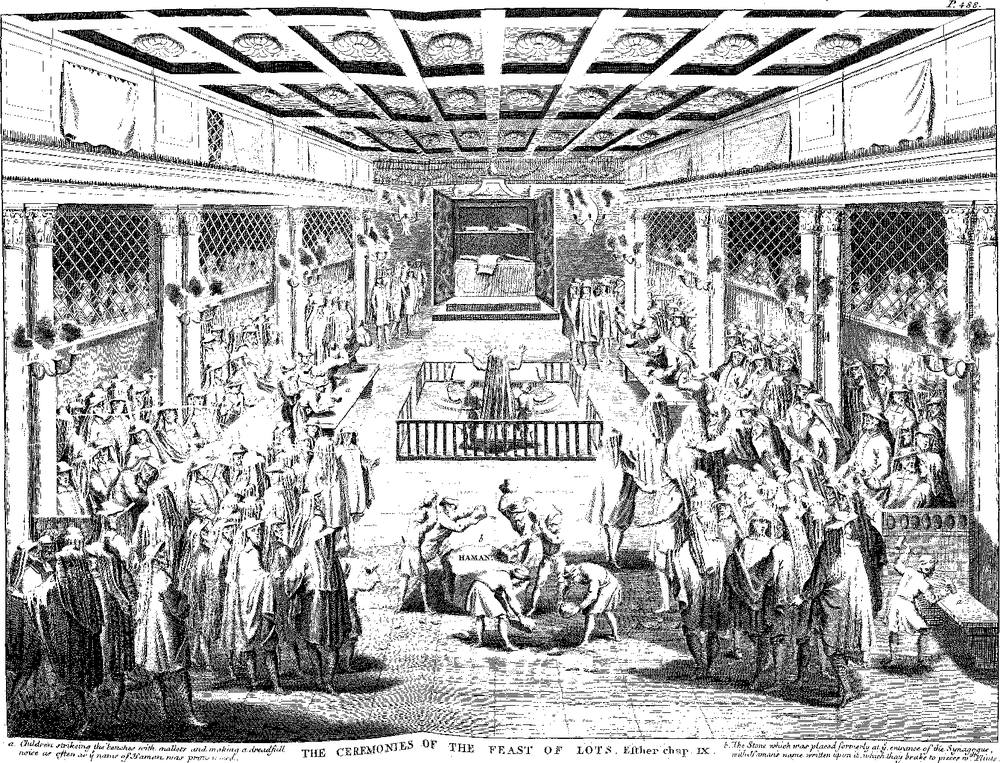
On the Eve of the Feast, they give their Alms liberally to the Poor, that these also may make much of themselves on the Feast of Lots: And on the Day of the Feast they send a Share of what they have at Table, to those that have need. On the Evening of the Thirteenth of Adar, when the Feast begin, they assemble in the Synagogue, and light up their Lamps; and as soon as the Stars begin to appear, they begin to read the Book of Esther. They continue the reading of it from one end to the other. There are five Places in the Text, wherein the Reader raises his Voice with all his Might, and makes such a dreadful Howling, as to frighten the Women and Children. When he comes to the Place that mentions the Names of the ten Sons of Haman, he repeats them very quick without taking Breath, to shew that these ten Persons were destroyed in a Moment. Every time the Name of Haman is pronounced, the Children with great Fury strike against the Benches of the Synagogues with Mallets, or Stones, and make lamentable Cries. ‘Tis said that heretofore they used to bring into their Synagogues a great Stone, with the Name of Haman written upon it, and all the while the Book of Esther was reading, they struck against it with other Stones, till they had beat it to Pieces.
After the Reading was finish’d, they return’d into their Houses, where they made a Meal rather of Milk-meats than of Flesh. The Day following, early in the Morning, they return’d to the Synagogue, where, after they had read that Passage of Exodus, wherein is mention’d the War of Amalek, they begin again to read the Book of Esther with the same Ceremonies as before. After which they return home, and make as good cheer as they can, and pass the rest of the Day in Sports and dissolute Mirth, the Men dressing themselves in Womens Cloaths, and Women in Mens, contrary to an express Deut. xxiii. 5. Cod. de Judæis & Cælicol. L. Jud.Prohibition of the Law. And their Doctors have decided upon this Point,2 that upon this Day they may drink Wine ‘till they cannot distinguish between, Cursed be Haman, and Cursed be Mordecai. Heretofore they used to erect a Gibbet, and upon it to burn a Man made of Straw, which they call’d Haman. But it was thought they had an Intention of insulting the Christians upon the Death of Christ, and therefore the Emperors forbad them to use this Ceremony, on Penalty of forfeiting all their Privileges.
The Feast of Purim, or Lots, in the manner that the Jews observe it, has a good deal of Resemblance to the antient Bacchanalia of the Pagans. Pleasures, Diversions, Joy, good Cheer, make as it were the very Essence of it. The Spirit of Revenge which animated the Jews of Shushan against their Enemies, has pass’d even to their Posterity. They deliver themselves up to it without Measure and without Bounds. They allow themselves the drinking of Wine even to Excess, because, say they, it was by making King Ahasuerus drink, that Esther procured the Deliverance of the Jews. They compel every one to be present at the Synagogue, Man, Woman, Child, and Servant; because all had a Share in the Deliverance, as all were expos’d to the Danger. On this Day Scholars make Presents to Leo of Modena, Ceremonies of the Jews, p. 3. c. 10. Esth. ix. 22.their Masters, Heads of Families to their Domesticks, great ones to those of mean Condition. In a Word, the whole Day is spent in Joyfulness and Feasting. As it is said in the Book of Esther; That they should make them Days of Feasting and Joy, and of sending Portions one to another, and Gifts to the Poor.
This Festival continues for two Days, but only the first of them is kept with Solemnity. During these two Days they may work or do Business; yet they refrain the first Day, though they are not obliged to it. The second Day they read no new Lesson in the Synagogue, and the Feast is not so great; but they however shew some Marks of Festivity. When the Year consists of thirteen Months, and that there are two Adars, that is to say, when at the End of two or three Years there is a supernumerary Month in the Lunar Year, they reckon’d the Month Adar twice over, which they insert between February and March, and then the second Adar is call’d Ve-Adar. See the Articles MONTH and INTERCALATION. When therefore there are two Adars, they celebrate the Feast of Lots twice over; the grand Purim is on the fourteenth of the first Adar, and the lesser Purim is on the fourteenth of the3 second Adar. But this second Feast of Lots Basnage, Hist. of the Jews, t. 5. l. 7. c. 16.is not accompany’d with the Diversions of the first, it has properly nothing but the Name of it.
On the Eve of the Festival they gather the Half-shekel which was formerly paid to the Temple, and which at present they distribute among such as undertake a Journey to Jerusalem, whither several of them repair out of Devotion, and where they covet to be buried; believing that all the Jews are to rendezvous there at the last Judgment, and that they shall even pass thither thro’ the Bowels of the Earth.
They read the Text of Esther, not out of a printed Book, nor out of a Book in Form of ours, but out of a Roll of Vellum, in the antient Manner, which is wrote with a particular kind of Ink. After they have spread open the Volume, they make three Prayers, to thank God for calling them to this Ceremony, for having deliver’d them, and for having continued their Lives to the Celebration of this Festival. On this Day the Reader may sit down while he reads, whereas at other Times he must stand up while he reads the Law. The reading of the Book of Esther is concluded with Curses against Haman and his Wife Seres, with Blessings of Mordecai and Esther, and with Praises to God for having preserved his People. Rest is observed very religiously, especially the first Day; and the Jews tell us, that a Man having sown Flax on this Day, not one Grain of it came up.
It was the Emperor Theodosius II. who Idem. t. 8. l. 8. c. 6. p. 194.forbad the Jews to erect Gibbets, to fix an Image upon them, which they call’d Human, and afterwards to burn them both; because it was not fit that in their Festivals they should insult the Mysteries of the Christian Religion. This Decree was publish’d through the whole East in the Year 408, and directed to Anthemius, who was Prefect there. Yet three Years after, some Jews in the Extravagance of their Passion and Height of their Frolicks, notwithstanding this express Prohibition of the Emperor, fasten’d a young Christian to a Gibbet instead of a Human, whom they whipp’d so cruelly, that he died on the Spot. This Fact was committed in the City of Inmestar, situated in Chalcis and Syria. The Christians in the Country took up Arms; the Fight was bloody, because the Jews were numerous in those Parts. The Governor of the Province having acquainted Theodosius with it, he gave Orders for the Punishment of those that were the Occasion of the Riot, which then was soon appeas’d.
Read this article in its place on the printed pages