PARADISE. This Word comes from the Hebrew, or rather from the Chaldee, Pardes1, of which the Greeks have made Paradisos, and the Latins, Paradisus. According to the Force of the Original, it should properly signifie an Orchard, a Plantation of Fruit-trees, and sometimes a Forest. This Word is found in three Places of the Hebrew Text of the Old Testament. First in Nehem. ii. 8. where Nehemiah desires King Artaxerxes, that Letters may be made out for him to Asaph the Keeper of the King’s Forest, that he might have what Timber was necessary for the Buildings he was about to undertake. In this Place Paradisus is put for a Forest of Trees fit to build with. Secondly, Solomon in Ecclesiastes ii. 5. says, he made him Gardens and Paradises, or Orchards. Thirdly, in the Song of Solomon, iv. 13. he says that the Plants of the Spouse are as an Orchard of Pomegranates, or a Paradise. The Greeks have acknowledged that the Word Paradisus came to them from the Orientals, or Persians, who gave the Name of Paradise to their Fruit-gardens, and their Parks, where they kept all Sorts of wild Creatures. Xenophon and other Greek Authors often made Use of this Word in this Sense.
The Septuagint make Use of the Word Paradisus2 when they speak of the Garden of Eden, which the Lord planted at the Beginning of the World, and placed Adam and Eve therein: And this famous Garden is commonly known by the Name of the Terrestrial Paradise. There have been many anxious Enquiries about its Situation. Some have thought3 that it never existed at all, and that whatever is said of it in Scripture ought to be taken allegorically. Others believed4 it was out of the Confines of this World. Others have pretended5 that it was only in the Beginning, or before the Creation of other material Beings. It has been placed in the third Heaven, in the Orb of the Moon, in the Moon it self, in the middle Region of the Air, above the Earth, under the Earth, in a distant Place concealed from the Knowledge of Men, in the Place which is now possessed by the Caspian Sea, under the Arctick Pole, and to the utmost Southern Regions.
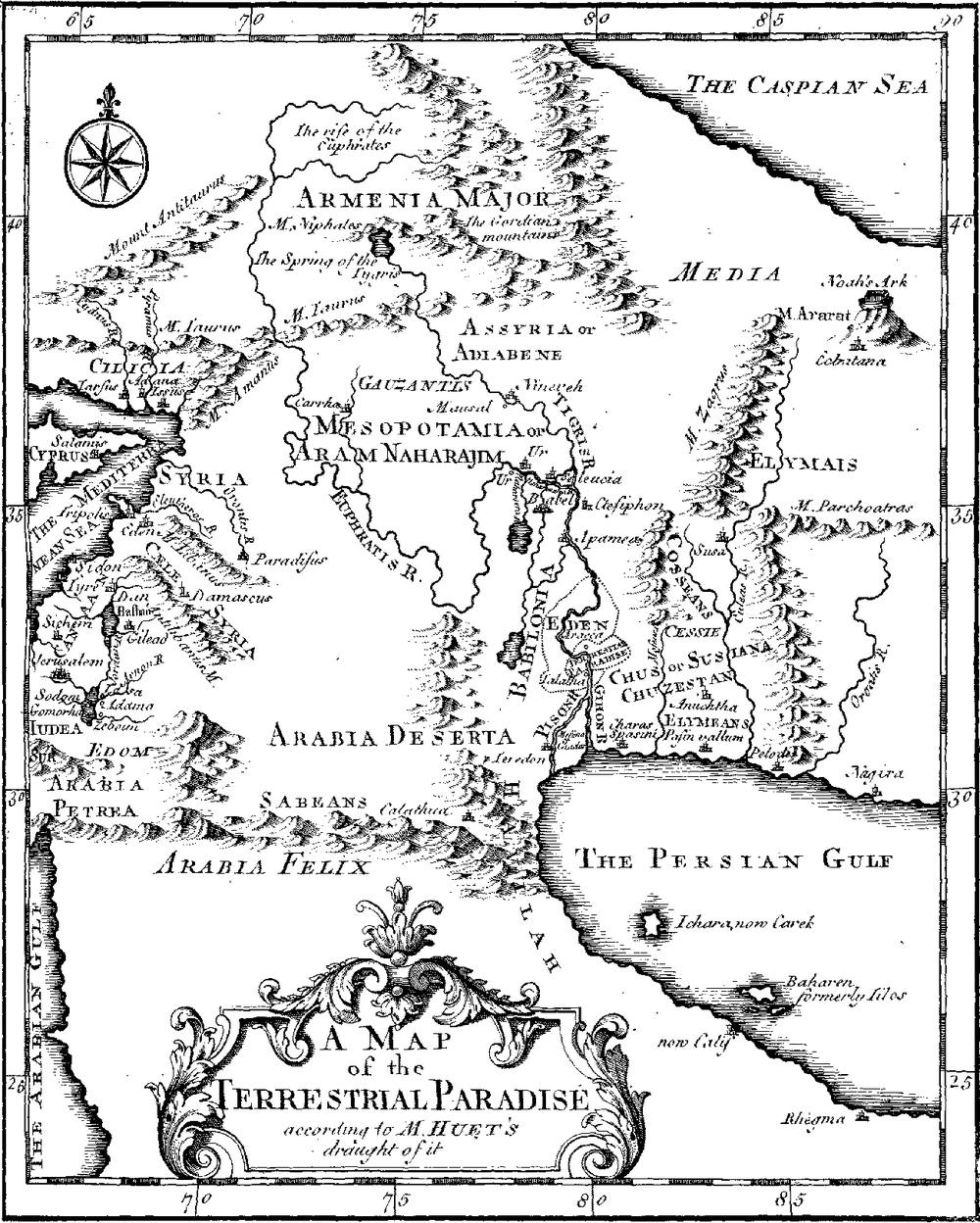
There is hardly any Part of the World, in which it has not been sought for; in Asia, in Africa, in Europe, in America; in Tartary, upon the Banks of the Ganges, in the Indies, in China, in the Island of Ceilon, in Armenia, under the Equator; in Mesopotamia, in Syria, in Persia, in Babylonia, in Arabia, in Palestine, in Ethiopia, where the Mountains of the Moon are; near the Mountains of Libanus, Antilibanus, and Damascus6. M. Huet places it upon the River that is produced by the Conjunction of the Tigris and Euphrates, which now is called the River of the Arabs; between this Conjunction and the Division made by the same River, before it falls into the Persian Sea. He puts it upon the Eastern Shore of this River, which being considered (says he) according to the Disposition of its Channel, and not according to the Course of its Stream, was divided into four Heads, or four different Openings. These four Branches make four Rivers; two upwards, which are Tigris and Euphrates, and two below, which are Pison and Gibon. The Pison, according to him, is the Western Channel, and the Gibon is the Eastern Channel of the Tigris, which discharges it self into the Persian Gulph. ‘Tis said that M. Bochart was pretty much of the same Opinion, as may be gathered from some Passages in his Writings7.
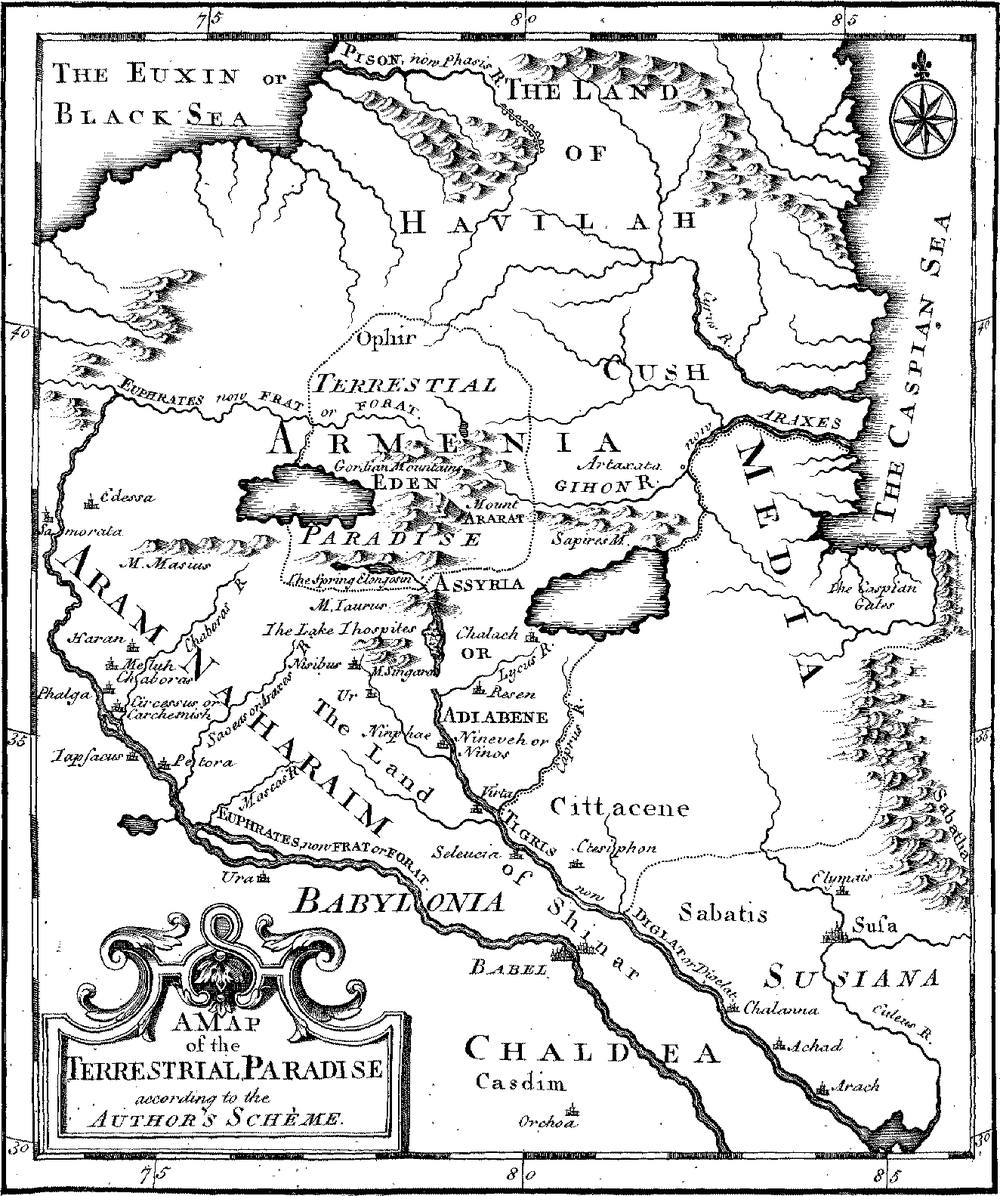
Other skilful Men have placed the terrestrial Paradise in Armenia, between the Sources of the Rivers Tigris and Euphrates, Araxis and Phasis, which we take to be the four Rivers described by Moses. Euphrates is expresly mentioned; the Hiddekel is the Tigris, which is still called Diglito. The Phasis is Pison, in which the Resemblance of the Words is apparent. The Gibon is the Araxes. Araxes in Greek signifies rapid or impetuous, just as Gibon in Hebrew; and there is no River known in the World more rapid than the Araxes. The Land of Eden was in this Country, as far as can be judged by some Traces of it, that are to be found in the holy Scriptures. The Land of Cush is the antient Scythia situate upon the Araxes. Havilah is plainly Cholchis, a Country very famous for its Gold. Our Commentary upon Gen. ii. 8. may be consulted, where we have endeavoured to establish this Hypothesis by all the Proofs that we could gather. Travellers that have visited this Country give sufficient Testimony of its great Fruitfulness, and there is still a Tradition among the Inhabitants, that the earthly Paradise was in their Province.
Ecclus. xliv. 16The Author of Ecclesiasticus says, that Enoch being found agreeable to God was translated into Paradise. Henoch placuit Deo, & translatus est in Paradisum, ut det gentibus pænitentiam. The Latin Fathers, who have read the Word Paradise in the Text of the Vulgate, thought that this Patriarch was transported into Paradise, that is, into Heaven according to some8 or into the earthly Paradise according to others9. But the Greek Fathers, who have not read the Word Paradisus in the Greek Text of Ecclesiasticus, have not determined the Place to which Enoch was translated10. St. Jerome has often put the Word Paradisus into the Vulgate, in Imitation of the Septuagint; but it is not to be found in the Hebrew Text of the Old Testament, except in the four Places that we have mentioned in the Beginning. Generally he translates the Hebrew Word Gan by Paradisus; but Gan only signifies a Garden, whether it be understood of a Kitchen-garden, an Orchard, or a Park.
In the Books of the New Testament the Word Paradise is put for a Place of Delight, where the Souls of the blessed enjoy Luke xxiii. 43.everlasting Happiness. Thus Jesus Christ tells the Penitent Thief upon the Cross, To Day shalt thou be with me in Paradise, that is, in the State of the Blessed And St. Paul speaking of himself in the third Person says, 2 Cor. xii. 4.I knew a Man that was caught up into Paradise, and heard unspeakable Words, which it is not lawful for a Man to utter. Lastly, Jesus Christ in the Revelations says, To him Rev. ii. 7.that overcometh will I give to eat of the Tree of Life, which is in the midst of the Paradise of God: Where Allusion is made to the Tree of Life that grew in the terrestrial Paradise. The Jews commonly call Paradise the Garden of Eden; and they imagine, that at the coming of the Messiah they shall here enjoy an earthly Felicity, in the midst of all Sorts of Delights; and till the Resurrection and the coming of the Messiah, they think their Souls shall abide here in a State of Rest
Read this article in its place on the printed pages
Footnotes
-
פרדסΠαράδεισος, Paradisus. ↩
-
Gen. ii. 8. ויטע יהוה אלהים גן בעדןΠαράδεισον ἐν Ἐδέν. Vulg. Paradisum voluptatis. ↩
-
The Seleucians, Origen, Philo. See St. Austin. l. viii. c. 1. de Genesi ad literam. ↩
-
See the several Opinions collected together in M. Huet’s Dissertation concerning the Situation of the earthly Paradise. ↩
-
Hebræi apud Hieronym. Quæst. Hebr. in Genes. ↩
-
See M. le Clerc’s Commentaries upon Genesis. ↩
-
Bochart. Phaleg. l. i. c. 4. de anim. sacr. parte ii. l. v. c. 6. ↩
-
Hieronym. in Amos viii. Ambros. l. de Paradiso, c. 3. Doroth. in Synopsi. ↩
-
Iren. l. v. c. 5. Auth. Quæst. ad Orthodox. qu. 85. Aug. contra Julian. l. vi. operis imperfecti, n. 30. ↩
-
Vide Chrysostom. homil. 21. in Genes. Theodor. qu. 25. in Genes. &c. ↩