1 Kings xi. 7.OLIVES. The Mount of Olives was situated to the East of the City of Jerusalem, and parted from the City only by the Brook Kidron, and by the Valley of Jehoshaphat, which stretches out from the North to the South. ‘Twas upon this Mount that Solomon built Temples to the Gods of the Ammonites and of the Moabites, out of Complaisance to his Wives who were Natives of these Nations. Hence it is that the Mount of Olives is call’d the
Mountain Acts i. 12.Mountain of Corruptiong. Josephus says, that this Mountain is at the Distance of five Stadia (or Furlongs) from Jerusalem1; which make six hundred and twenty five geometrical Paces; or the length of a Sabbath-Days Journey, says St. Luke. The Mount of Olives had three Summits, or was composed of three several Mountains, ranged one after another from North to South. The middle Summit is that from whence our Saviour ascended into Heaven. ‘Twas upon that towards the South that Solomon built Temples to his Idols. The Summit which is most to the North is distant two Furlongs from the middlemost. This is the highest of the three, and is commonly called Galilee2.
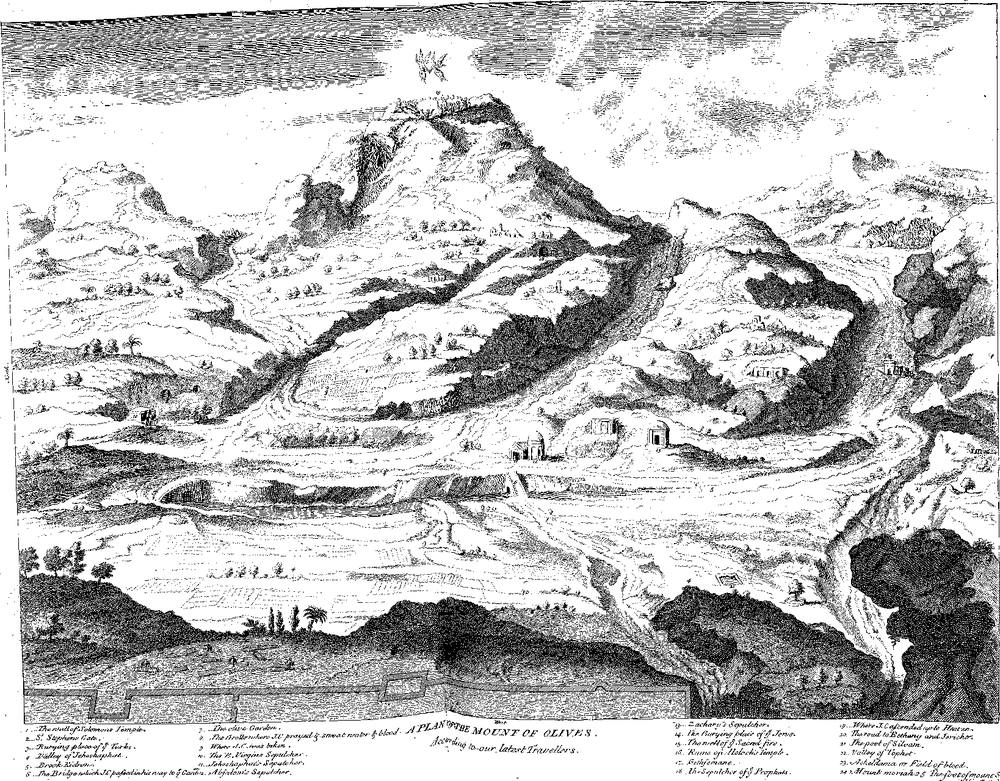
In the Time of King Uzziah3 the Mount of Olives was so shatter’d by an Earthquake, that half of the Earth that was on the Western Side, fell down, and rolled four Furlongs or five hundred Paces from thence, towards the Mountain which was opposite to it on the East; so that the Earth block’d up the Highways, and covered the King’s Gardens. The Modern Travellers may be read on this Point, and particularly John Cotovic, p. 261. to know the Modern State of the Mount of Olives.
This Mountain is become the Object of the Veneration of Christians, since from hence our Saviour ascended into Heaven. Eusebius assures us4, that in the Place of the Ascension, which is the highest of the Mount of Olives, there was a Cavern, where there was a constant Tradition that our Saviour enter’d, to communicate to his Disciples some of his most sacred Mysteries; whether by these Words may be understood the Holy Eucharist, which he gave them before he ascended into Heaven, or the Repast he took with them, of which mention is made Acts i. 4. or lastly, whether he means any particular and secret Instructions, which he imparted to them in this Place. The Fathers5 inform us, that when our Saviour ascended into Heaven, he left his Footsteps imprinted upon the Earth ; that they were to be seen in their Time, and always subsisted, tho’ the Faithful continually carried away the Ground from this Place, by way of Devotion. Zech. xiv. 4.Thus is literally accomplished what Zechariah had said, And his Feet shall stand in that Day upon the Mount of Olives. ‘Tis added6, that the Empress Helena having caused a magnificent Church of the Ascension to be built, in the midst of which was this Place, when they would have paved it with Marble as the rest, they never could do it; every thing that was put there by way of Ornament removed of its own accord, so that they were forced to leave it as it was. Even to this Day is seen the Impression of our Saviour’s Left Foot, sunk into the Rock more than three Fingers Breadth; and they say the Stone, wherein was the Impression of his Right Foot, was taken away at the Time of the Crusado, and placed in a Temple, which at present is one of the principal Turkish Mosques, where it is thought it may still remain: For the Christians have not Liberty to enter therein to inform themselves: St. Jerom7 in more Places than one speaks of a great Cross, that was set up upon the Mount of Olives, and which might be seen afar off. The same Father assures us8, that when they had a Mind to shut up the Cave which answered to the Place where our Saviour ascended into Heaven, they could never accomplish their Design. For which reason they were forced to leave this Place free and open. It must needs be, that the Impressions of our Saviour’s Feet must sink deep into the Mountain, and that the Christians must very nicely have observed the Place, since the tenth Roman Legion encamping upon this Mountain9, at the Siege of the City by Titus, could not efface these sacred Footsteps, nor erase them out of the Memory of the Faithful.
Read this article in its place on the printed pages
Footnotes
-
Joseph. Antiq. l. 20. c. 6. Confer. l. vi. de Bello, c. 3. ↩
-
Vide Reland. Palæst. t. ii. p. 338. ↩
-
Joseph. Antiq. l. ix. c. 11. Zech. xiv. 5. ↩
-
Euseb. de Vita Constant. l. iii. c. 43. p. 583, 504, 505. ↩
-
Vide Hieronym. seu alium in loca Act. Apost. t. iii. p. 297. Sulpit. Sever. l. ii. c. 48. Hist. Eccl. ↩
-
Euseb. de Vita Constant. l. iii. c. 43. Paulin. Epist. 11. Sulpit. Sever. l. ii. g 2 Kings xxiii. 13. הר המשחיתVulg. Mons offensionis. Alii Mons corruptionis. ↩
-
Hieronym. in Epitaph. Paulæ & alibi. ↩
-
Idem loc. in Act. Vide & Bedam de locis sanctis, c. 7. ↩
-
Joseph. l. vi. c. 3. de Bello, p. 908. e. f. ↩