NINEVEH, the Capital City of Assyria, founded by Ashur Son of Shem, or by Nimrod Son of Cush; for in the Text of Moses, Gen. x. 11. De terrâ illâ egressus est Assur, & ædificavit Nineven, according to some has Relation to Nimrod1, who was mentioned before; so that it ought to be read: De terrâ illâ (Babylonia Nemrod) egressus est in Assyriam, & ædificavit Niniven. However this be, yet it must be owned, that Nineveh was one of the most antient, the most famous, the most potent, and largest Cities of the World. It is very difficult exactly to assign the Time of its Foundation; but it cannot be long after the building of Babel. It was situate upon the Banks of the Tigris, and in the Time of the Prophet Jonas, who was sent thither under Jeroboam the second, King of Israel2, and, as we judge, under the Reign of Pul, Father of Sardanapalus, King of Assyria; Nineveh was a very great City, its Circuit being three Days Journey. Diodorus Siculus3, who has given us the Dimensions of it, says it had one Hundred and fifty Stadia in Length, four Score and ten Stadia in Breadth, and four Hundred and four Score Stadia in Circuit; that is, to reduce these Measures to our own, it was about seven Leagues long, taking the League at three Thousand Paces, about three Leagues broad, and eighteen Leagues round. Its Walls were an hundred Feet high, and so broad, that three Chariots could drive abreast upon ‘em. Its Towers, of which there were fifteen Hundred, were each two Hundred Feet high.
Jonas iv. 11.Diodorus Siculus places it upon the Euphrates, but all others agree that it was upon the Tigris. Some place it to the West, and others to the East of this River. At the Time of Jonas’s Mission thither, it was so populous, that it was reckoned to contain more than six Score Thousand Persons, who could not distinguish their right Hand from their left; which is generally explained of young Children, that had not yet attained the Use of Reason. So that by this Reckoning, there ought to have been then in Nineveh more than six hundred Thousand Persons.
Nineveh was taken by Arbaces and Belesus, in the Year of the World 3257, before Christ 743, before the vulgar Æra 747, under the Reign of King Sardanapalus4, in the Time of Abaz King of Judah, about the Time of the Foundation of Rome. It was taken a second Time by Astyages and Nabopolassar, from Chinaladan King of Assyria, in the Year of the World 3378, before Christ 622, before the vulgar Æra 626. After this Time Nineveh no more recovered its former Splendor. It was so intirely ruined in the Time of Lucianus Samosatensis5, who lived under the Emperor Adrian, that no Footsteps of it could be found, nor so much as the Place where it stood. However it was rebuilt under the Persians, but was destroyed again by the Saracens about the seventh Age. See Marsham’s Canon. Egypt. sæculo xviii. Tit. Nini excidium, and Usher, upon the Years of the World 3257 and 3378.
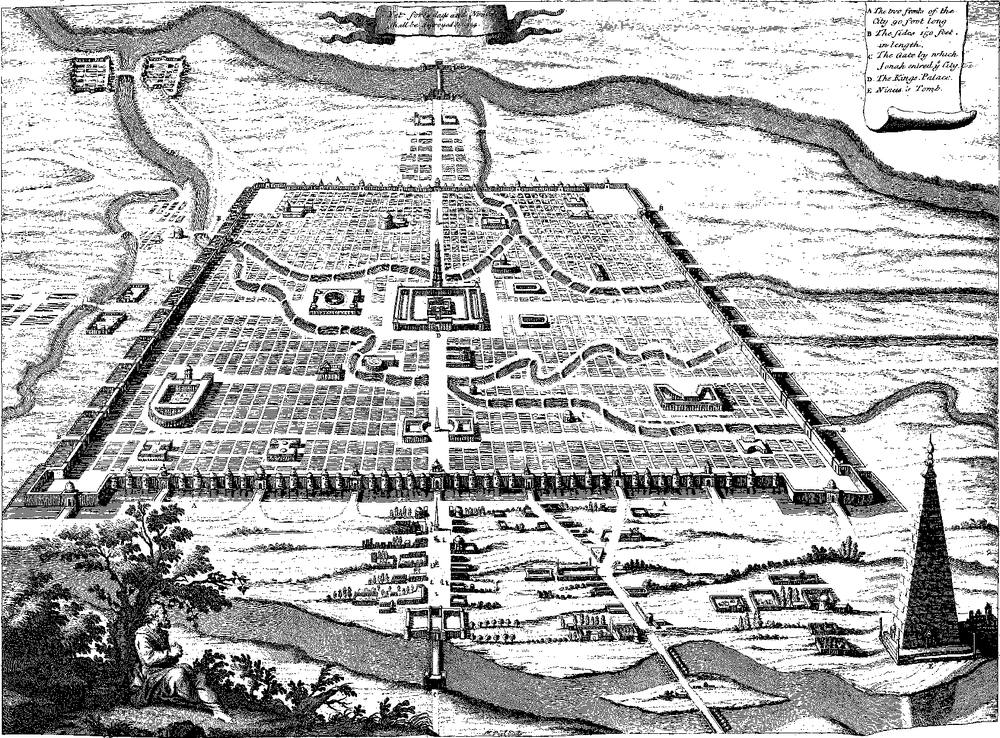
Modern Travellers say, that the Ruines of ancient Nineveh may still be seen on the Eastern Bank of the Tigris, and that on the opposite Side may be seen the City of Mozul or Mozil, which many do not distinguish from Nineveh. Prophane Histories tell us, that Ninus was the first founded Nineveh; but Scripture, which is infinitely of better Authority, assures us it was Assur, or Nimrod, as we have said in the Beginning of this Article. The sacred Authors make frequent Mention of Nineveh. Those Kings Tiglath-pilneser, Sennecharib, Shalmanezzar, and Esar-haddon, famous for the Evils they brought upon the Hebrews, reigned at Nineveh. Tobit lived in this City. Nahum and Zephaniah have foretold its Ruin in a very particular and pathetick Manner6, which Tob. xiv. 4. Matt. xi. 41. Luk. xi. 32.Tobit had also foretold. ‘Tis known what Jonas did at Nineveh, and the signal Repentance of the Ninevites, which is even commended in the Gospel.
Read this article in its place on the printed pages