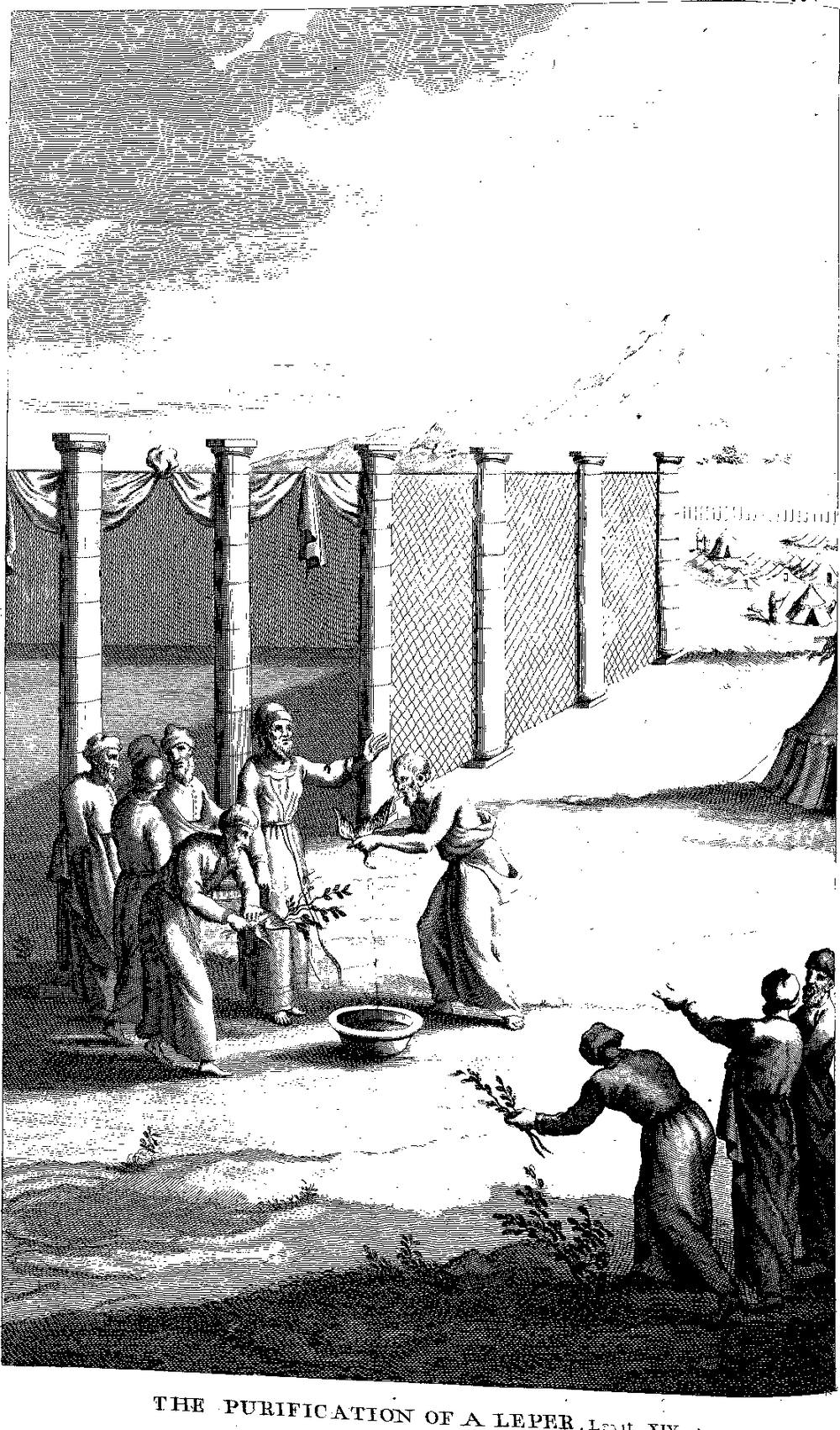
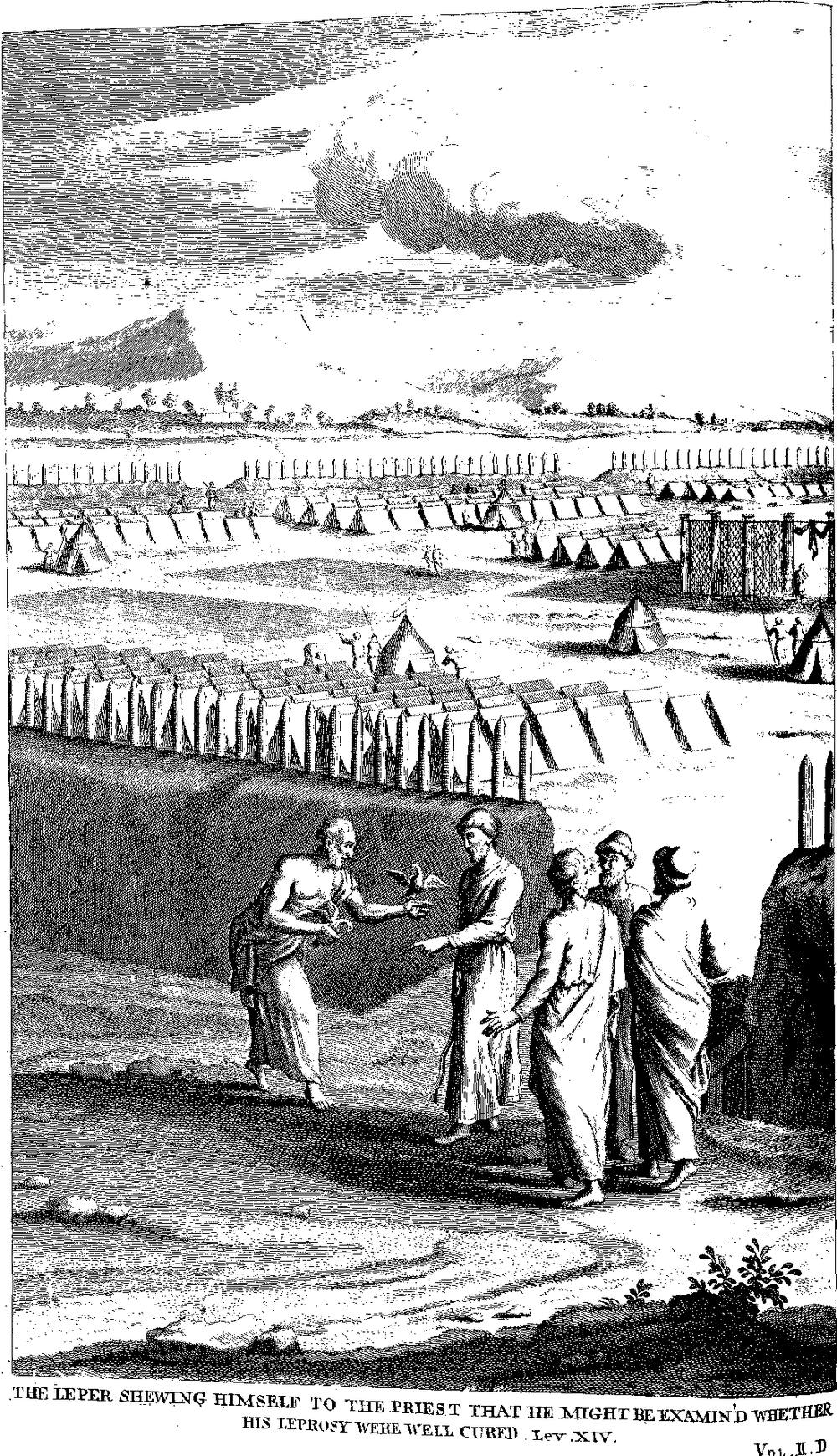
LEPER. The Law excluded Lepers from the Conversation of Mankind. It banished them into the Countrey, and Places uninhabited: Lev. xiii. 45, 46.Many Persons attacked with this Disease often got together, and composed a kind of Society. We see Examples of it in the four Lepers who were without the City of 2 Kings vii. 3, 8. Luke xvii. 12.Samaria, while Ben-hadad King of Syria besieged it; and in the ten Lepers who came to Jesus Christ, and desired to be healed by him. This Particular was observed so punctually, that even the Kings themselves were put out of their Palace, shut out of Society, and deprived of the Government, whenever this Disease laid hold of them; as in the Instance of Uzziah, or Azariah, King of Judah, who was afflicted with this Malady, for attempting 2 Kings xv. 5, 2 Chr. xxvi. 27. Lev. xiv. 1, 2, 3, 4 &c.to offer Incense in the Temple. When a Leper was cured he appeared at the City Gate, and the Priest examined whether he was truly healed or not. After this he went to the Temple, took two pure Birds, made a Whisp with a Branch of Cedar,and another of Hyssop, tied together with a Scarlet Ribbon made of Wool; an earthen Vessel was filled with Water, and one of these Birds fastened alive to the Wisp which we have mentioned. The Leper who was cured killed the other Bird, and let the Blood of it run into the Vessel filled with Water. After this the Priest took the Wisp with the live Bird, dipped both in the Water tinged with the Blood of one of the Birds, and sprinkled the Leper with it. After this the live Bird was let loose, and the Person healed and purified in this Manner, was again admitted to the Society of the healthy, and to the Use of Things sacred.
Lepers were formerly very frequent in Europe. Some are of Opinion, that the Commerce which People carried on with the the Jews, who abounded in this Quarter of the World, contributed to the spreading Leprosies. Others maintain, that they proceeded from the frequent Voyages which were made to Palestine in the Time of the Croisades. These Lepers were called Ladres in French, and abundance of Lazarettoes were built for them, consecrated to Saint Ladre, or Lazarus, Brother to Mary and Martha, or to Saint Job. Matthew Paris says, there were nine Thousand Hospitals in Europe for these People. They were separated from the Conversation of others, and obliged to keep close in their Lazarettoes; they had Marks fixed upon them whereby they might be known. They generally carried Clappers about them, that they might be distinguished and avoided.
For these last two hundred Years Leprosies have almost entirely ceased in Europe, at least this Disease has changed its Name; and as it was before thought incurable, People have found out Remedies for it. The ablest Physicians have believed, that it differed only in Name from the venereal Disease. M. Tournefort, who saw several Lepers in his Voyage to the Levant, makes no Doubt of what we have just now said. There are some incurable, because their Distemper is inveterate, and has corrupted the whole Mass of Blood and Humours; but there are others capable of being healed, by treating them in the same Manner as they do those who have the Pox. Many are of Opinion, that Job’s Disease was a Leprosy, but in a Degree of Malignity which rendered it incurable, and so produced a Complication of other Diseases with it.
Manetho the Egyptian1, Lysimachus, Molon, Appion the Grammarian, Tacitus, and Justin, affirm seriously, that the Jews left Egypt on the Score of the Leprosy. Each of these Historians relates the Matter after his own Manner, and adds some Circumstances to it of his own framing: But they all agree in saying, that the Hebrews, who departed out of Egypt, were attacked with a Leprosy. Tacitus’s Account of the Matter is as follows. “ Several Authors agree, “ that the Distemper of the Leprosy having “ spread itself very much in Egypt, King “ Bocchoris consulted the Oracle of Ammon, “ to learn a Remedy for this Indisposition. “ The Oracle told him, that he must purge “ the Kingdom of this sort of People, and “ remove them out of the Countrey as “ hateful to the Gods. Bocchoris thereupon gathered all those together who had “ this Disease upon them, and ordered “ them to be conducted into a vast Wilderness, there to perish with Want. These “ unhappy Wretches being reduced to this “ Condition, and not knowing what to “ do, were continually weeping and bemoaning themselves; but Moses who was “ more resolute and considerate than they, “ told them that it was to no Purpose to “ implore Assistance from either Gods or “ Men, because they were detestable to “ one and the other; but if they would “ have Confidence in him, and follow him, “ as a Guide sent from Heaven, they might “ under his Conduct come into a Place of “ Rest; they followed him therefore at all “ Hazards. And as they were extremely “ incommoded with Thirst, and expected “ nothing but Death, Moses perceived a “ Company of wild Asses, which had just “ been feeding, he followed them, and having met them in a Place covered with “ green Grass, he conjectured that underneath it there might be a Spring of Water; he ordered them to dig, and found “ enough to satisfy the Thirst of all the “ Multitude which followed him.
“ After seven Days March they came “ into Judæa, and made themselves Masters of it. They observed Rest upon the “ seventh Day, as the End of their Journey and Calamities. They honoured an “ Ass, as that which had saved their Lives “ by shewing them the Spring of Water. “ They preserved a great Aversion to “ Hog’s Flesh, in Memory of the Leprosy “ with which they had been afflicted, and “ to which this Animal is said to be very “ subject.”
There are almost as many Mistakes as Words in this Recital of Tacitus: Nevertheless other Authors, who have discoursed of the Original of the Jews, speak of it in a still more wretched Manner. The Leprosy wherewith they are said to have been attacked, is what has engaged us here to take Notice of it. But if they had been all Lepers, how came they to have so great an Aversion to those who had this Disease upon them? The Reader may see Josephus against Appion.
Read this article in its place on the printed pages
Footnotes
-
Appio apud Joseph. l. i. contra Appion. l. ii. initio & Tacit. l. v. Hist. Justin. l. xxxvi. ↩