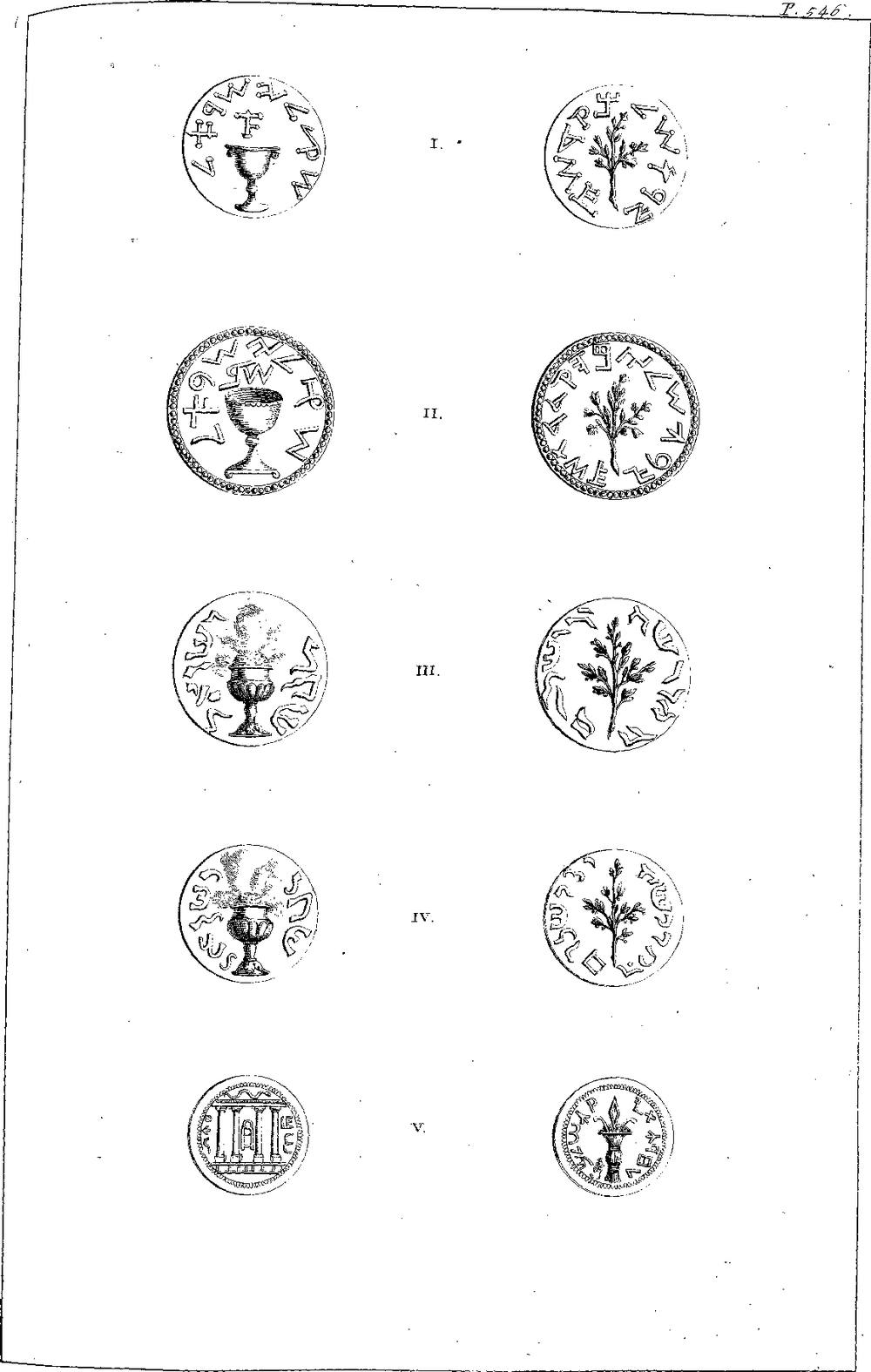
I. THE Shekel of Silver, of the Weight of four Attick Drachmæ, having on one side a Cup or Measure, call’d the Gomor, or Omer, to represent that which was preserved in the Tabernacle full of Manna, and over it an Aleph, to denote the first Year of the Deliverance of Jerusalem or Sion; and its Legend is in Samaritan, Schekel Israel, the Shekel of Israel. On the Reverse of the Shekel is a Branch of an Almond-tree in blossom, in memory of that of Aaron, with this Legend, Jerusalem kadoshah, Jerusalem the holy.
II. Another Shekel of Silver of the same Weight, having the same Impression as most of the others; but differing in this, that instead of the Aleph over the Cup, there is a Shin and a Beth, to denote the second Year of the Deliverance of Israel. The Legend on one side is, the Shekel of Israel; on the other, Jerusalem the holy.
III. and IV. Other Shekels of Silver, having a fuming Censer on one side, probably to represent that which the High-priest placed every day upon the Altar of Incense in the Tabernacle; and for its Legend, The Shekel of Israel. On the other side is Aaron’s Rod, a Branch of an Olive-tree, with this Legend, Jerusalem the holy.
These two Medals are counterfeit, and forged by the modern Jews. The Character also is in modern Hebrew.
V. Another Shekel of Copper, having on one side the Front of a Building, with a Row of Columns; its Legend, Simeon. On the other side, a Sheaf bound up, and a kind of an Ear or Leaf that proceeds from it. On one side a Bunch of Grapes, or the Leaf of a Vine, the Point turning upwards; its Legend, for the Deliverance of Jerusalem. This Piece belongs to Simeon, Brother to Judas Maccabeus. The Building represents the magnificent Tomb which he erected in the City of Modin, in honour to his Father and his Brethren. The Legend on the other side denotes, that he had caused this Monument to be erected, as an Acknowledgment that the Lord had made use of them, for the Deliverance of Jerusalem from its Enemies, the Greeks, or the Syrians.
VI. and VII. Shekels of Copper of the same Simeon, having on one side a Palm-tree with its Fruit, call’d Spadix; and for its Legend upon the first Piece, Simeon; upon the second, the two last Letters are wanting. On the other side, a Vine-leaf, and for a Legend upon the first Piece, Jerusalem; the rest is obliterated. Upon the second are read Letters that signify the second Year of the Deliverance of Israel.
VIII. A Demi-shekel, of the Weight of two Drachmæ, having the same Impression as the first Shekel, which is engraved above. It denotes the first Year of the Deliverance of Jerusalem; and its Legend on one side is, Jerusalem the holy, and on the other, chazi haschekel, that is, half a Shekel.
IX. Another Demi-shekel, like to the former, except that the Legend, of which some of the Letters are blotted out, denotes the first Year. Jerusalem the holy. And on the Reverse, half a Shekel.
X. Another Demi-shekel, which is also like to the former, except that there is a Beth over the Cup, instead of an Aleph. The second Year of the Deliverance of Jerusalem. Jerusalem the holy.
XI. Another Demi-shekel of Copper, which on one side has two Sheaves standing upright, with an Ear above the rest, and a Vine-leaf between, or a Bunch of Grapes. Its Legend is, Demi-shekel; the second Word is almost blotted out. On the other side is a Palm-tree with its Fruit; Fruit; on the side are two Measures full of Corn; or two Towers with their Battlements, and its Legend to deliver. The rest is not legible.
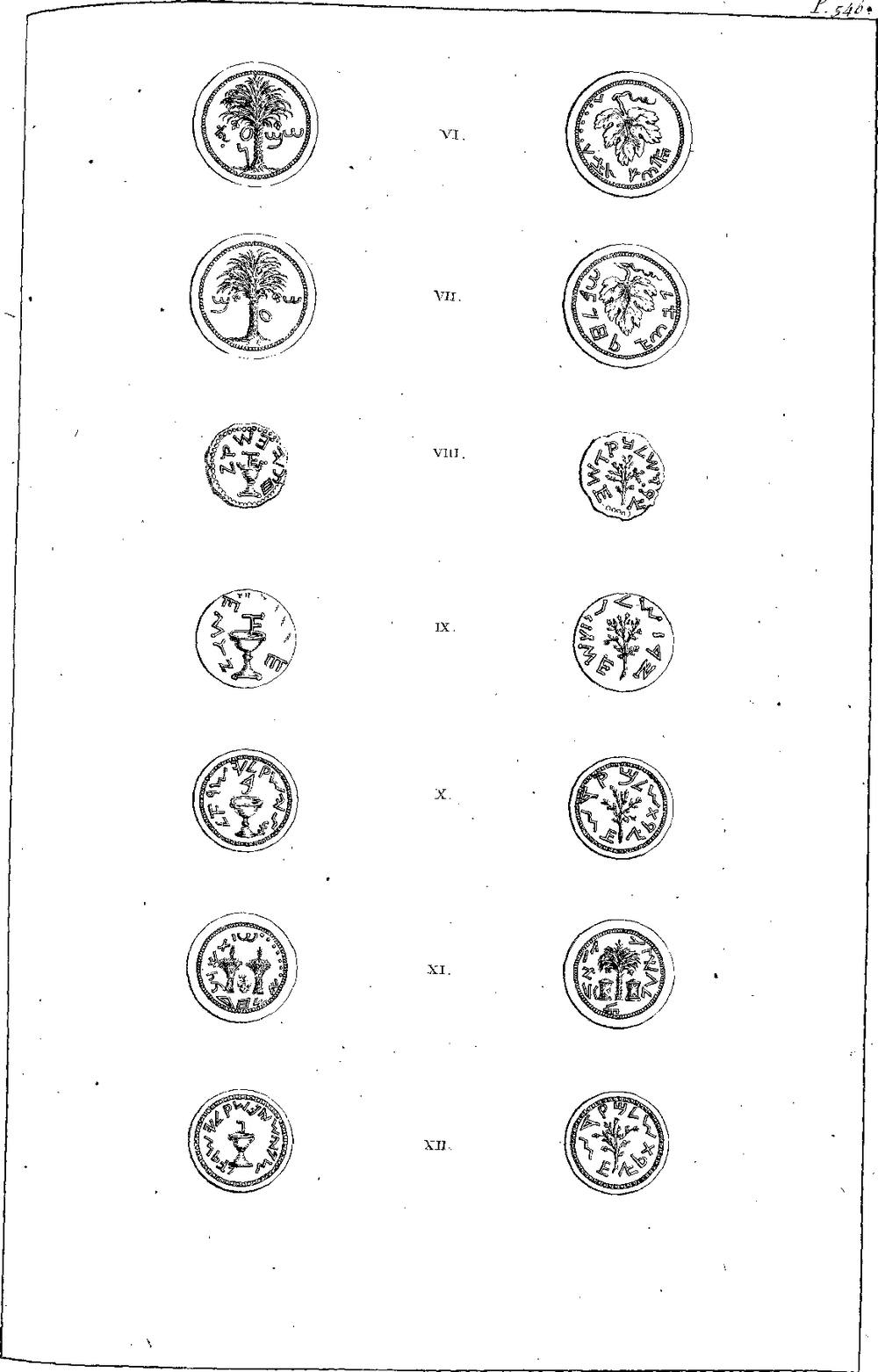
The Sheaves and Ears of Corn may be the Tokens of the Fertility of Judea, the Bunch of Grapes may signify those of the Land of Promise. The Palm-tree, on the other side, is the Symbol of Judea. XII. The third part of a Shekel. This was the Tax that Nehemiah laid upon the People, Nehem. x. 32. It has on one side a Gimel, which signifies the third Year, and these Words, For the Deliverance of Israel. On the other side the Legend is, Jerusalem the holy.
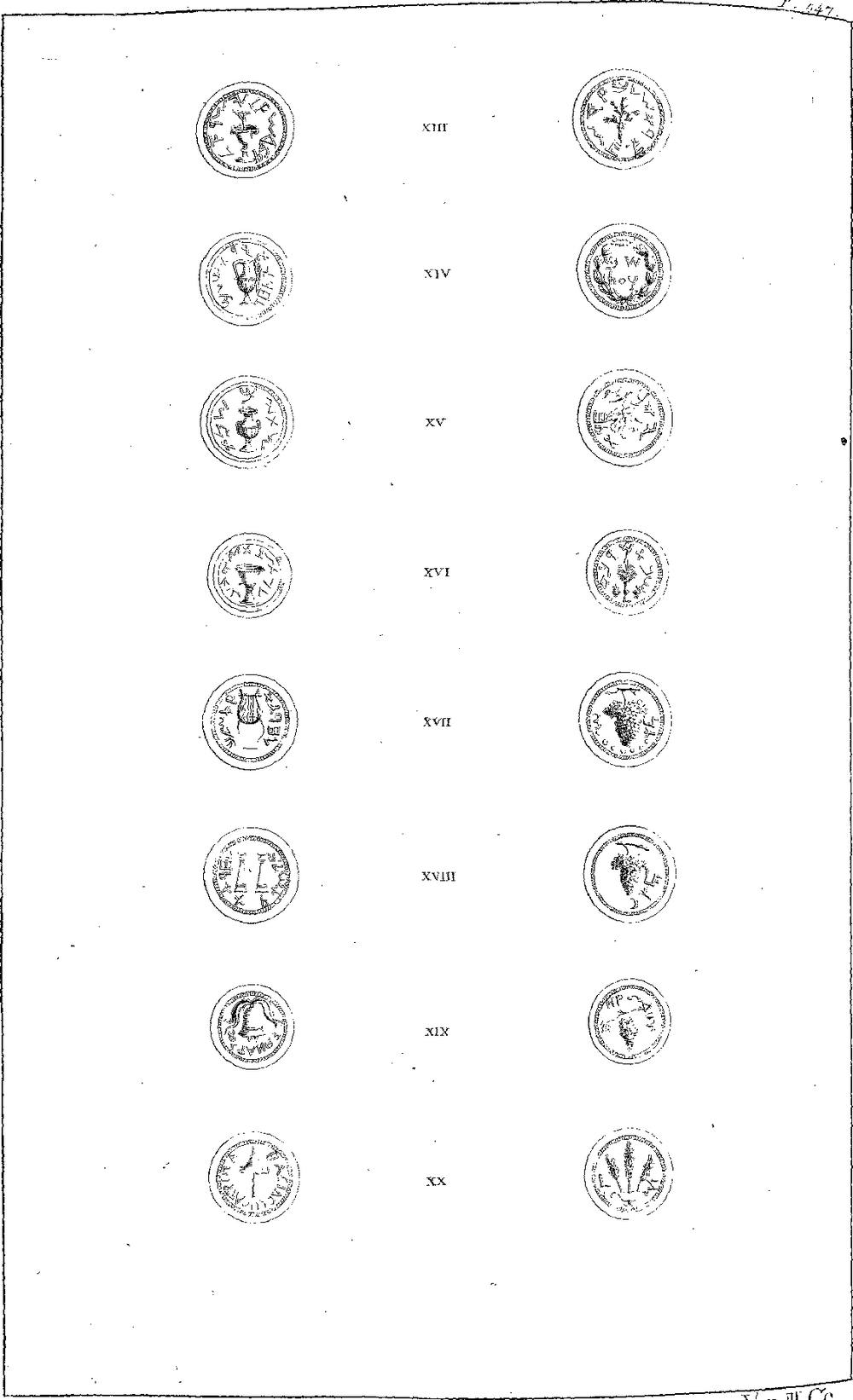
XIII. A fourth part of a Shekel, of which mention is made, Isa. ix. 8. It has also for its Impression on one side a Cup, with a Daleth over it, which denotes the fourth Year; and these Words, For the Deliverance of Jerusalem. And upon the Reverse, Jerusalem the holy.
XIV. Another quarter of a Shekel of Brass, having an Urn on one side, or an ancient Pitcher, with a Palm. The Legend is, for the Deliverance of Jerusalem. On the Reverse is a Crown of Lawrels knotted, and join’d above by a Collar of Pearls, and in the middle is this Legend, Simeon; but the last Syllable is but obscure.
For the right Explication of this Piece, the xiiith and xvth Chapters of the first Book of the Maccabees, may be consulted. In the xvth it is related, that Demetrius Son of Antiochus, wrote to Simeon the Brother of Judas Maccabeus, who was then High-priest and Prince of the Jews, and allow’d him the Privilege of coining Money in his own Country. Permitto tibi facere percussuram proprii numismatis in regione tua. And xiii. 36. he gives him thanks for having sent him the Crown of Gold, and the golden Branch of a Palm-tree, which was the usual Tribute. This Present of Simeon so won upon Demetrius, that he made Peace with the Jews, and exempted them not only from the ordinary Tribute, but also from the Crown of Gold which was us’d to be sent every Year. Therefore Simeon, who was High-priest, Chief, and Prince of the Jews, caused these Pieces to be struck, with his Name surrounded by a Crown; and on the other side the Palm and the Urn, which were then the usual Mark of the Shekel, and the Symbol of the Priesthood.
XV. Another quarter of a Shekel of Copper, having an Urn on one side, and for a Legend, the second Year. On the other side is the Leaf of a Vine, and its Legend, of the Deliverance of Sion.
XVI. Another, having on one side a Sheaf upright, and two Bunches of Grapes; for its Legend, the fourth Year. On the other side is a Cup; its Legend, of the Redemption of Sion.
XVII. Another quarter of a Shekel of Silver, having an Harp on one side, and for a Legend, for the Deliverance of Jerusalem. On the other side is a Bunch of Grapes, and its Legend the first and the two last Letters of the Name Simeon, the second and third being effaced.
This Piece is Simeon’s also; the Occasion of it is taken notice of in the first Book of the Maccabees, xiii. 51. where it is said, that having taken the Fortress which was near the Temple, he drove the Enemy from thence, and enter’d it with Palm-branches in their Hands, with the Sound of Harps, Cymbals and Viols, &c. The Bunch of Grapes, on the Reverse, may represent the Grapes hanging on the golden Vines, which served as an Ornament to the Gate of the Temple. Or if you please, it may represent that which was brought from the Land of Promise by Joshua and Caleb, which was engraved upon many of the Jewish Coins. ‘Tis perhaps upon this Account, that the Pagans, who knew not the Mysteries and History of the Jews, accused them of the worship of Bacchus.
XVIII. Another quarter of a Shekel of Silver of the same Simeon, having two Pillars on one side, and its Legend, for the Deliverance of Jerusalem. On the other side the Bunch of Grapes, and about it the three last Letters of the Name Simeon.
These two Columns may represent those which were set upon the Mountain of Sion, by the whole Assembly of Israel, on which were engraven, in two Tables of Brass, the chief Obligations that this People had, not only to Simeon, but to his Father and Brothers; in acknowledgment of which they chose him for their Pontif, and for Prince of their Nation, himself and his Successors for ever. Conferunt eum esse ducem, & summum sacerdotem in aeternum, donec surgat Propheta fidelis.—— 1 Macc. xiv. 41.
XIX. A Piece of Copper, having on one side an Helmet, with a Tuft of Horse-hair, after the ancient manner; and for Legend, ΕΘΝΑΡ. ϗ. On the other side, a Bunch of Grapes growing to its Stock with a Leaf; and for Legend, ΗΡΩΔΟΥ. This Piece is of Herod Ascalonites, or of Herod his Son, surnamed Antipas. It is probable, that to soften the Minds of the Jews, he would not take upon himself the Quality of King, but only of Prince of the Nation; which was something more popular, and a Title more agreeable to the Jews, having themselves already given it to Simeon, as was observed before.
XX. Another Piece of Copper, having on one side a kind of Tent or Pavillion, and its Legend, ΒΑΣΙΛΕΩΣ ΑΓΡΙΠΠΑ. On the other side was three Branches of Trees with their Leaves on ; or three Ears of Corn with a L and a ς.
This Piece belongs to Agrippa; the Tent has relation to the Feast of Tabernacles, so famous among the Jews. The three Branches, and their Leaves, which are on the Reverse, are a Confirmation of the matter. Yet I think them, however, to be three Ears of Corn, to express the Feast of the Passover, when they offer’d to the Lord Ears of Corn, and the First-fruits of the Earth.
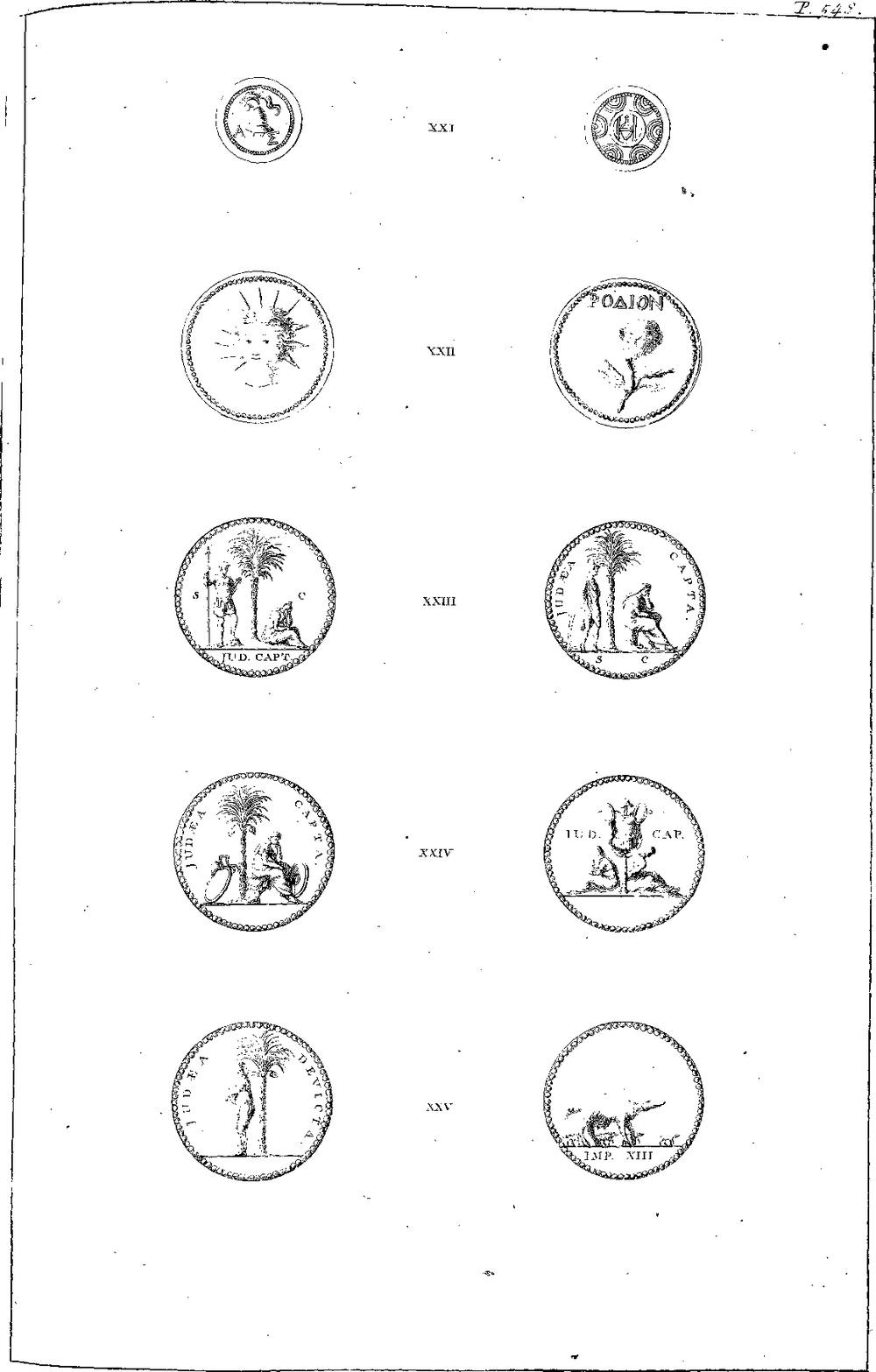
XXI. Another, having an Helmet with its Tuft of Horse-hair, after the ancient manner, with an Α and a Σ. On the other side is a kind of Tripos, or a Cypher of Letters in the midst of a Shield. The Helmet may again cause it to be ascribed to Agrippa, and the Letters may signify ΑΓΡΙΠΠΑ ΣΕΒΑΣΤΟΣ, Agrippa Augustus. But I think it may rather be ascribed to Antiochus Soter. In this case the Mark of the Shield should rather be a Tripos, than any thing else.
XXII. A piece of Silver, which they pretend to be one of that sort that were given to Judas, as the Price of our Saviour. The Head of the Sun, or of the Colossus of Rhodes, which is seen on one side, and the Rose on the other side, with this Legend, ΡΟΔΙΟΝ, shew it to be an ancient Coin of the Rhodians, which might have been current among the Romans. See the Dictionary, in the Article Rhodium.
XXIII. XXIV. XXV. These Medals were struck after the taking of Judea by the Romans, as may be seen by their Inscriptions, JUDÆA CAPTA, JUDÆA DEVICTA.