THE Year of the Hebrews is composed of twelve Lunar Months, of which the first has thirty Days, and the second nine and twenty; and so of the rest successively, and alternately. This Year begins in Autumn, as to the Civil Year, and in the Spring, as to the Sacred Year. The Jews had Calendars anciently, wherein were set down all the Feasts, all the Fasts, and all the Days on which they celebrated the Memory of any great Events that happen’d to the Nation1. These ancient Calendars are sometimes quoted in the Talmud2; but the Rabbins acknowledge that they are not now in being3. Those that we have now, whether printed or in Manuscript, are not very ancient4. That which passes for the oldest, is one whose Title is Megillath Thaanith, the Volume of Affliction, which contains the Days of Feasting and Fasting that were heretofore in use among the Jews; but which are now no longer observed, and are not to be found now in the common Calendars. We shall here set down the chief historical Events, taken as well from this Volume Thaanith, as from the other Calendars; and for brevity, we shall omit such Articles as contain nothing but the Lectures that were read in the Synagogues.
Ofthetizri
The first Month of the Civil Year, and the seventh of the Sacred Year.
It has 30 Days, and answers to the Moon of September.
I. Day. NEW-Moon. Beginning of the Civil Year. The Feast of Trumpets. Levit. xxiii. 34. Numb. xxix. 1, 2. III. A Fast for the Death of Gedaliah. 2 Kings xxv. 25. Jerem. xli. 2. The same Day, the Abolition of written Contracts. The wicked Kings having forbid the Israelites to pronounce the Name of God; when they were restor’d to Liberty, the Asmoneans or Maccabees ordain’d, that the Name of God should be written in Contracts after this manner: In such a Year of the High-priest N, who is the Minister of the most high God, &c. And the Judges to whom these kind of Writings were presented, decreed they should be satisfy’d; saying, for example, On such a Day such a Debtor shall pay such a Sum, according to his Promise, after which the Schedule shall be torn. But it was found, that the Name of God was taken away out of the Writing; and thus the whole became useless and ineffectual. For which reason they abolish’d all these written Contracts, and appointed a Festival-day in memory of it. Megil. Taanith. c. 7. V. The Death of twenty Israelites. The Rabbi Akiba, Son of Joseph, dies in Prison.
VII. A Fast appointed because of the worshipping the Golden Calf, and of the Sentence that God pronounced against the Israelites, in consequence of that Crime. Exod. xxxii. 6, 7, 8, 34.
X. A Fast of Expiation. Levit. xxiii. 19, &c.
XV. The Feast of Tabernacles, with its Octave. Levit. xxiii. 34.
XXI. Hosanna-Rabba. The seventh Day of the Feast of Tabernacles, or the Feast of Branches.
XXII. The Octave of the Feast of Tabernacles.
XXIII. The Rejoicing for the Law; a Solemnity instituted in memory of the Covenant that the Lord made with the Hebrews, in giving them the Law by the Mediation of Moses.
On this same Day the Dedication of Solomon’s Temple was completed. 1 Kings viii. 65, 66.
XXX. The first New-Moon of the Month Marchsevan. For the Jews, for fear of mistaking, always keep two Days for the New-Moon.
Marchsevan
The second Month of the Civil Year, and the eighth of the Sacred Year.
It has but twenty-nine Days, and an- swers to the Moon of October.
I. Day. THE second New-Moon, or first day of the Month. VI. A Fast, because Nebuchadnezzar put out the Eyes of Zedekiah, after he had put his Children to death before his Face. 2 Kings xxv. 7. Jerem. lii. 10.
XIX. A Fast on Monday and Tuesday; and the Monday following, to expiate the Faults committed on the occasion of the Feast of Tabernacles. Vid. Calendar. à Bartoloccio editum.
XXIII. A Feast, or Memorial of the Stones of the Altar, profaned by the Greeks, which were hid in expectation that a Prophet might arise, and declare what use they were to be apply’d to. 1 Macc. iv. 46. Megillath. c. 8.
XXV. A Feast in memory of some Places possess’d by the Cuthites, and which the Israelites recover’d at their Return from the Captivity.
XXVI. A Dispute of Rabbin Jochanan, Son of Zachai, against the Sadduces, who pretended that the Loaves of the First-fruits mention’d Levit. xxiii. 17, 18. were not to be offer’d upon the Altar, but that they were to be eaten hot. Megillat. c. 9.
XXIX. First New-Moon of the Month Cisleu.
Cisleu
The third Month of the Civil Year, and the ninth of the Sacred Year.
It has thirty Days, and answers to our Moon of November.
I. Day. NEW-Moon, or the first day of the Month.
II. Prayers for Rain. Calendar. Bartolocci.
III. A Feast instituted in memory of the Idols, which the Asmoneans threw out of the Courts, where the Gentiles had placed them. Megil. Taanith.
VI. A Fast in memory of the Book of Jeremiah, that was torn and burnt by King Jehoiakim. Jerem. xxxvi. 23.
VII. A Feast in memory of the Death of Herod the Great, Son of Antipater, who was always an Enemy to the Sages. Megillat. c. 11.
XXI. The Feast of Mount Gerizim. The Jews acquaint us, that when their High-priest Simon, with all his Clergy, went out to meet Alexander the Great, the Cutheans or Samaritans went also, and desired of this Prince to give up to them the Temple of Jerusalem, and to sell them a part of Mount Moriah: Which Request Alexander granted to them. But the High-priest of the Jews afterwards presenting himself, and Alexander asking him what he desir’d of him; Simon intreated him not to suffer the Samaritans to destroy the Temple. The King reply’d to him, that he deliver’d up this People into his Hands, and he might do what he pleas’d with them. Then the High-priest, and the other Inhabitants of Jerusalem, took the Samaritans, bored a Hole thro’ their Heels, and tying them to their Horses Tails, drag’d them along to Mount Gerizim, which they plow’d and sow’d with Tares; just as the Samaritans had intended to do to the Temple of Jerusalem. Wherefore, in memory of this Event, they instituted this Festival.
XXV. The
XXV. The Dedication, or Renewing of the Temple, profaned by the Order of Antiochus Epiphanes, and purified by Judas Maccabeus; 1 Macc. iv. 52. 2 Macc. ii. 16. John x. 22. This Feast is kept with its Octave. Josephus says, that in his time it was call’d the Feast of Lights; perhaps, says he, because this good fortune, of restoring the Temple to its ancient use, appear’d to the Jews as a new Day. Antiq. l. 12. c. ii. p. 416. But the Jewish Authors give another reason for the Name of Lights. They tell us, that when they were at work in cleaning the Temple, after it had been profaned by the Greeks, they found there only one small Phial of Oil, sealed up by the High-priest, and which would hardly suffice to keep in the Lamps for so much as one Night; but God permitted that it should last for several Days, till they had time to make more: In memory of which the Jews are accustomed to light up several Lamps in their Synagogues, and at the Doors of their Houses. See Selden, de Syned. l. 3. c. 13. Others will have it, as the scholastical History, Thomas Aquinas, Cardinal Hugues, in 1 Macc. iv. 52. that the Appellation of the Feast of Lights proceeded from hence, that Fire from Heaven gave light to the Wood which was upon the Altar of Burnt-offerings, as is related 2 Macc. i. 22.
Some will have this Feast of the Dedication to be instituted in memory of Judith5. But it is doubted whether it ought to be understood of Judith the Daughter of Merari, who kill’d Holofernes; or of another Judith, Daughter of Mattathias, and Sister of Judas Maccabeus, who slew Nicanor, as they tell us6. This last Judith is only known in the Writings of the Rabbins, and is not mention’d either in the Books of the Maccabees, or in Josephus. But there is great likelihood that the Jews have alter’d our History of Judith, to place it in the time of Judas Maccabeus.
A Prayer for Rain. Then began their time of Sowing in Judea.
XXX. First New-Moon of the Month Tebeth.
Tebeth
The fourth Month of the Civil, and the tenth of the Ecclesiastical Year.
It has twenty nine Days, and answers to the Moon of December.
I. Day. NEW-Moon. VIII. A Fast, because of the Translation of the Law out of Hebrew into Greek. This Day, and the three following Days, were overcast by thick Darkness.
The Fast of the tenth Month. Calend. Bartolocci.
IX. A Fast, for which the Rabbins do not declare the reason.
X. A Fast in memory of the Siege of Jerusalem by Nebuchadnezzar. 2 Kings xxv. 1.
XXVIII. A Feast instituted in memory of the Exclusion of the Sadduces out of the Sanhedrim, where they had all the Power in the time of King Alexander Janneus. The Rabbi Simeon, Son of Shatach, found means of excluding them one after another, and of substituting Pharisees in their room. Megillat. Taanith.
XXIX. First New-Moon of the Month Shebeth.
Shebeth
The fifth Month of the Civil Year, and the eleventh of the Sacred Year.
It has thirty Days, and answers to the Moon of January.
I. Day. NEW-Moon, or the first Day of the Month.
II. A Rejoicing for the Death of King Alexander Janneus, a great Enemy to the Pharisees. Megill.
IV, or V. A Fast in memory of the Death of the Elders, who succeeded Joshua. Judg. ii. 10.
XV. The beginning of the Year of Trees. That is to say, they then began to count the four Years, during which the Trees were judg’d unclean, from the time of their planting. Levit. xix. 23, 24, 25. Some place the beginning of these four Years on the first day of the Month.
XXII. A Feast in memory of the Death of one call’d Niskalenus, who had given orders for placing Images or Figures in the Temple, which were forbid by the Law. But he dy’d, and his Orders were not executed. The Jews place this under the High-priest Simon the Just. ‘Tis not known who this Niskalenus was. Megill. c. 11.
XXIII. A Fast for the War that the ten Tribes made against that of Benjamin, because of the Outrage committed upon the Body of the Levite’s Wife. Judg. xx.
They also call to remembrance the Idol of Micah. Judg. xviii.
XXIX. A Memorial of the Death of Antiochus Epiphanes, an Enemy of the Jews. 1 Macc. vi. 1. Megillat.
XXX. First New-moon of the Month Adar.
Adar
The sixth Month of the Civil Year, and the twelfth of the Ecclesiastical Year.
It has but twenty nine Days, and an- swers to the Moon of February.
I. Day. THE New-Moon. VII. A Fast because of the Death of Moses. Deut. xxxiv. 5.
VIII, IX. The Trumpet was sounded by way of Thanksgiving for the Rain that fell in this Month, and to pray for it for the future. Megillat. Taanith.
IX. A Fast in memory of the Schism that divided the Schools of Shammai and Hillel.
XII. A Feast in memory of the Death of two Proselytes, Hollianus and Pipus his Brother, that one Tyrinus or Turianus would have compell’d to break the Law, in the City of Laodicea; but they chose rather to die, than to do any thing contrary to the Law. Selden de Synedr. 1. 3. c. 13. ex Megill. Taanith.
XIII. Esther’s Fast; probably in memory of that of Esther, Esth. iv. 16. Geneb. Bartolocci.
A Feast in memory of the Death of Nicanor, an Enemy of the Jews. 1 Macc. vii. 44. 2 Macc. xv. 30, &c. Some of the Hebrews will have it, that Nicanor was kill’d by Judith, the Sister of Judas Maccabeus.
XIV. The first Purim, or lesser Feast of Lots. Esth. ix. 21. The Jews dispers’d in the Provinces ceas’d from the Slaughter of their Enemies on the 14th of Nisan, and on that Day made great Rejoycing. But the Jews of Shushan continu’d their Slaughter on the 14th, and did not leave off till the 15th. Therefore Mordecai settled the Feast of Lots on the 14th, and 15th of this Month.
XV. The great Feast of Purim, or Lots; or the second Purim. These three Days, the 13th, 14th, and 15th, are commonly call’d the Days of Mordecai, tho the Feast for the Death of Nicanor has no relation either to Esther or Mordecai.
The Collectors of the Half-Shekel, paid by every Israelite to the Lord, Exod. xxx. 13. received it on the 15th of Adar, in the Cities; and on the 25th in the Temple. Talmud. Tract. Schekalim. XVII. The deliverance of the Sages of Israel, who flying from the Persecution of Alexander Janneus, King of the Jews, retired into the City of Koslik in Arabia; but finding themselves in danger of being sacrificed by the Gentiles, who were the Inhabitants of the Place, they made their escape by night. This Feast was established in commemoration of this Escape. Megillat. Taanith.
XX. A Feast in memory of the Rain obtain’d from God, by one call’d Onias Hammagel, during a great Drought that happen’d in the time of Alexander Janneus. Megillat. Taanith.
XXIII. The Dedication of the Temple of Zerubbabel, Ezr. vi. 16. The Day is not very well known. Some put it on the 16th, and the Calendar of Sigonius on the 23d.
XXVIII. A Feast in commemoration of the Repeal of the Decree, by which the Kings of Greece had forbidden the Jews to circumcise their Children, to observe the Sabbath, and to decline foreign Worship. Megillat. Taanith. & Gemar. ut Tit. Thainith. c. 2. XXIX. First New-Moon of the Month Nisan.
When the Year consists of thirteen Lunar Months, they place here, by way of Intercalation, the second Month of Adar, or Ve-adar. The JEWISH CALENDAR.
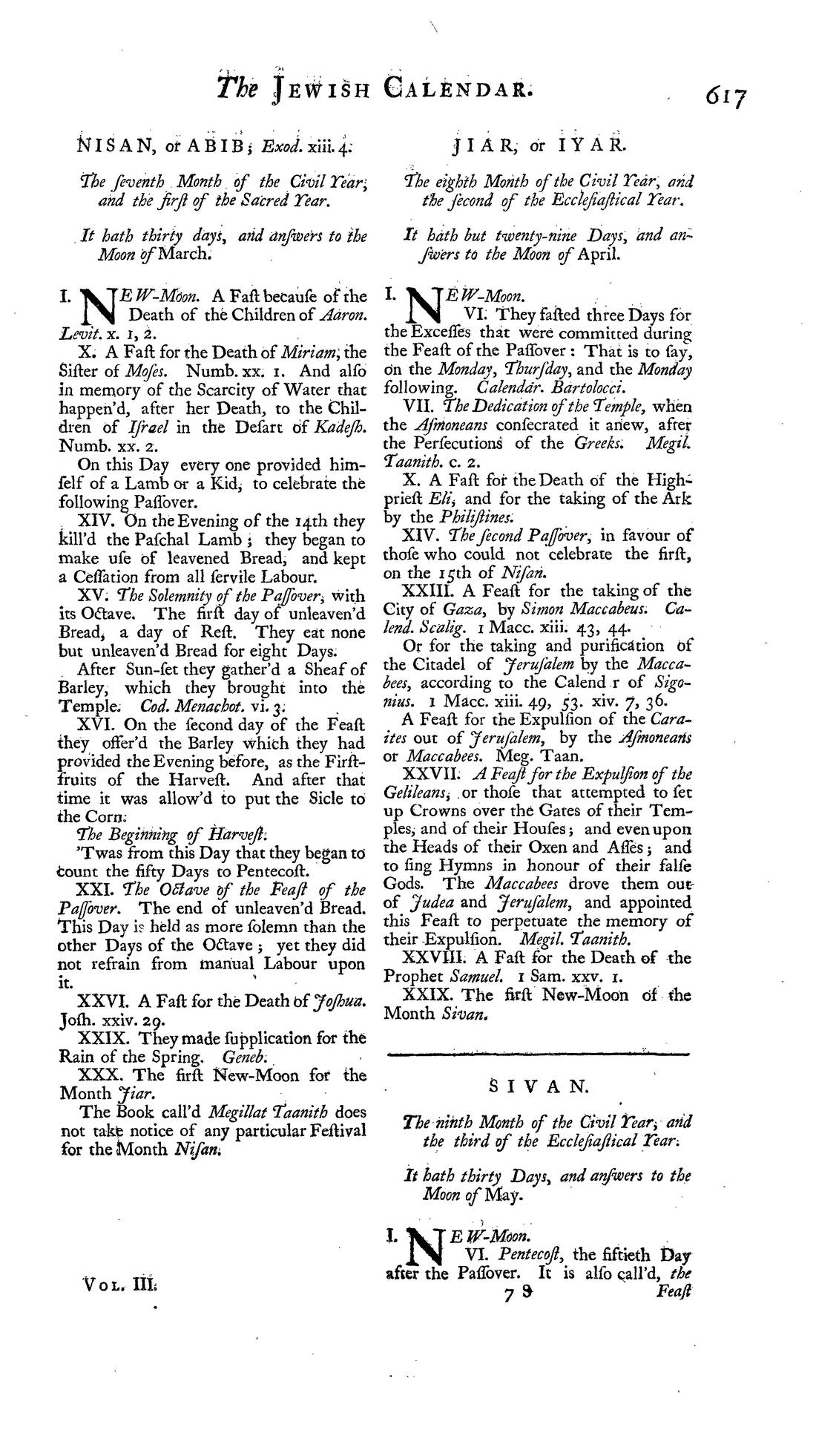
NISAN, or ABIB; Exod. xiii. 4.
The seventh Month of the Civil Year; and the first of the Sacred Year.
It hath thirty days, and answers to the Moon of March.
I. NEW-Moon. A Fast because of the Death of the Children of Aaron. Levit. x. 1, 2.
X. A Fast for the Death of Miriam, the Sister of Moses. Numb. xx. 1. And also in memory of the Scarcity of Water that happen’d, after her Death, to the Children of Israel in the Desart of Kadesh. Numb. xx. 2.
On this Day every one provided himself of a Lamb or a Kid, to celebrate the following Passover.
XIV. On the Evening of the 14th they kill’d the Paschal Lamb; they began to make use of leavened Bread, and kept a Cessation from all servile Labour.
XV. The Solemnity of the Passover, with its Octave. The first day of unleaven’d Bread, a day of Rest. They eat none but unleaven’d Bread for eight Days.
After Sun-set they gather’d a Sheaf of Barley, which they brought into the Temple. Cod. Menachot. vi. 3.
XVI. On the second day of the Feast they offer’d the Barley which they had provided the Evening before, as the First-fruits of the Harvest. And after that time it was allow’d to put the Sicle to the Corn. The Beginning of Harvest:
‘Twas from this Day that they began to count the fifty Days to Pentecost.
XXI. The Octave of the Feast of the Passover. The end of unleaven’d Bread. This Day is held as more solemn than the other Days of the Octave; yet they did not refrain from manual Labour upon it.
XXVI. A Fast for the Death of Joshua. Josh. xxiv. 29.
XXIX. They made supplication for the Rain of the Spring. Geneb.
XXX. The first New-Moon for the Month Jiar. The Book call’d Megillat Taanith does not take notice of any particular Festival for the Month Nisan.
Jiar, or Iyar
The eighth Month of the Civil Year, and the second of the Ecclesiastical Year.
It hath but twenty-nine Days, and answers to the Moon of April.
I. NEW-Moon.
VI. They fasted three Days for the Excesses that were committed during the Feast of the Passover: That is to say, on the Monday, Thursday, and the Monday following. Calendar. Bartolocci.
VII. The Dedication of the Temple, when the Asmoneans consecrated it anew, after the Persecutions of the Greeks. Megil. Taanith. c. 2.
X. A Fast for the Death of the High-priest Eli, and for the taking of the Ark by the Philistines.
XIV. The second Passover, in favour of those who could not celebrate the first, on the 15th of Nisan.
XXIII. A Feast for the taking of the City of Gaza, by Simon Maccabeus. Calend. Scalig. 1 Macc. xiii. 43, 44.
Or for the taking and purification of the Citadel of Jerusalem by the Maccabees, according to the Calendar of Sigonius. 1 Macc. xiii. 49, 53. xiv. 7, 36.
A Feast for the Expulsion of the Caraites out of Jerusalem, by the Asmoneans or Maccabees. Meg. Taan.
XXVII. A Feast for the Expulsion of the Galileans; or those that attempted to set up Crowns over the Gates of their Temples, and of their Houses; and even upon the Heads of their Oxen and Asses; and to sing Hymns in honour of their false Gods. The Maccabees drove them out of Judea and Jerusalem, and appointed this Feast to perpetuate the memory of their Expulsion. Megil. Taanith.
XXVIII. A Fast for the Death of the Prophet Samuel. 1 Sam. xxv. 1.
XXIX. The first New-Moon of the Month Sivan.
Sivan
The ninth Month of the Civil Year; and the third of the Ecclesiastical Year.
It hath thirty Days, and answers to the Moon of May. I. NEW-Moon.
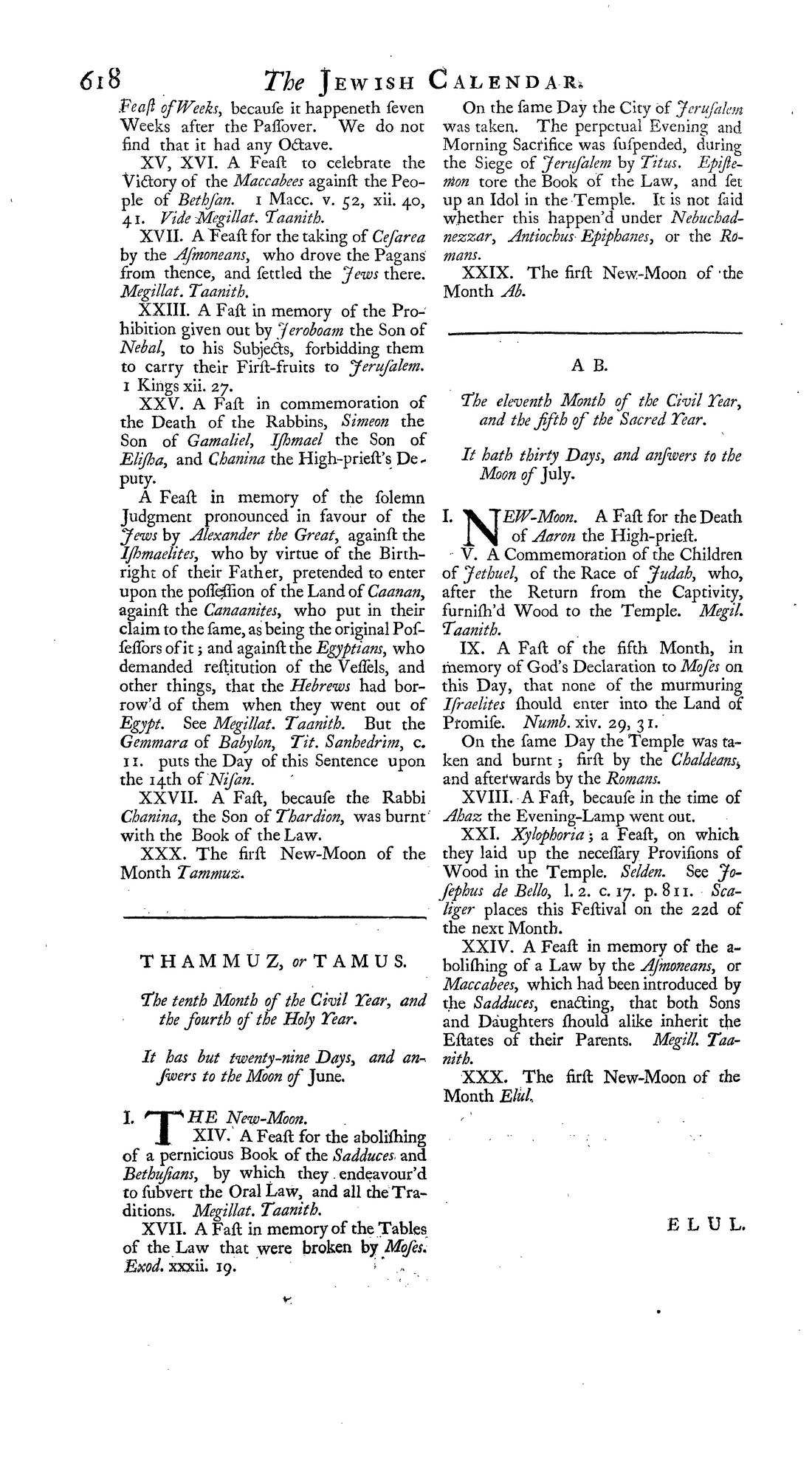
VI. Pentecost, the fiftieth Day after the Passover. It is also call’d, the Feast Feast of Weeks, because it happeneth seven Weeks after the Passover. We do not find that it had any Octave.
XV, XVI. A Feast to celebrate the Victory of the Maccabees against the People of Bethsan. 1 Macc. v. 52, xii. 40, 41. Vide Megillat. Taanith.
XVII. A Feast for the taking of Cesarea by the Asmoneans, who drove the Pagans from thence, and settled the Jews there. Megillat. Taanith.
XXIII. A Fast in memory of the Prohibition given out by Jeroboam the Son of Nebal, to his Subjects, forbidding them to carry their First-fruits to Jerusalem. 1 Kings xii. 27.
XXV. A Fast in commemoration of the Death of the Rabbins, Simeon the Son of Gamaliel, Ishmael the Son of Elisha, and Chanina the High-priest’s Deputy.
A Feast in memory of the solemn Judgment pronounced in favour of the Jews by Alexander the Great, against the Ishmaelites, who by virtue of the Birth-right of their Father, pretended to enter upon the possession of the Land of Caanan, against the Canaanites, who put in their claim to the same, as being the original Possessors of it; and against the Egyptians, who demanded restitution of the Vessels, and other things, that the Hebrews had borrow’d of them when they went out of Egypt. See Megillat. Taanith. But the Gemmara of Babylon, Tit. Sanhedrim, c. 11. puts the Day of this Sentence upon the 14th of Nisan.
XXVII. A Fast, because the Rabbi Chanina, the Son of Thardion, was burnt with the Book of the Law.
XXX. The first New-Moon of the Month Tammuz.
Thammuz, or Tamus
The tenth Month of the Civil Year, and the fourth of the Holy Year.
It has but twenty-nine Days, and answers to the Moon of June.
I. THE New-Moon.
XIV. A Feast for the abolishing of a pernicious Book of the Sadduces and Bethusians, by which they endeavour’d to subvert the Oral Law, and all the Traditions. Megillat. Taanith.
XVII. A Fast in memory of the Tables of the Law that were broken by Moses. Exod. xxxii. 19.
On the same Day the City of Jerusalem was taken. The perpetual Evening and Morning Sacrifice was suspended, during the Siege of Jerusalem by Titus. Episte-mon tore the Book of the Law, and set up an Idol in the Temple. It is not said whether this happen’d under Nebuchadnezzar, Antiochus Epiphanes, or the Romans.
XXIX. The first New-Moon of the Month Ab.
Ab
The eleventh Month of the Civil Year, and the fifth of the Sacred Year.
It hath thirty Days, and answers to the Moon of July.
I. NEW-Moon. A Fast for the Death of Aaron the High-priest.
V. A Commemoration of the Children of Jethuel, of the Race of Judah, who, after the Return from the Captivity, furnish’d Wood to the Temple. Megil. Taanith.
IX. A Fast of the fifth Month, in memory of God’s Declaration to Moses on this Day, that none of the murmuring Israelites should enter into the Land of Promise. Numb. xiv. 29, 31.
On the same Day the Temple was taken and burnt; first by the Chaldeans, and afterwards by the Romans.
XVIII. A Fast, because in the time of Abaz the Evening-Lamp went out.
XXI. Xylophoria; a Feast, on which they laid up the necessary Provisions of Wood in the Temple. Selden. See Josephus de Bello, l. 2. c. 17. p. 811. Scaliger places this Festival on the 22d of the next Month.
XXIV. A Feast in memory of the abolishing of a Law by the Asmoneans, or Maccabees, which had been introduced by the Sadduces, enacting, that both Sons and Daughters should alike inherit the Estates of their Parents. Megill. Taanith.
XXX. The first New-Moon of the Month Elul.
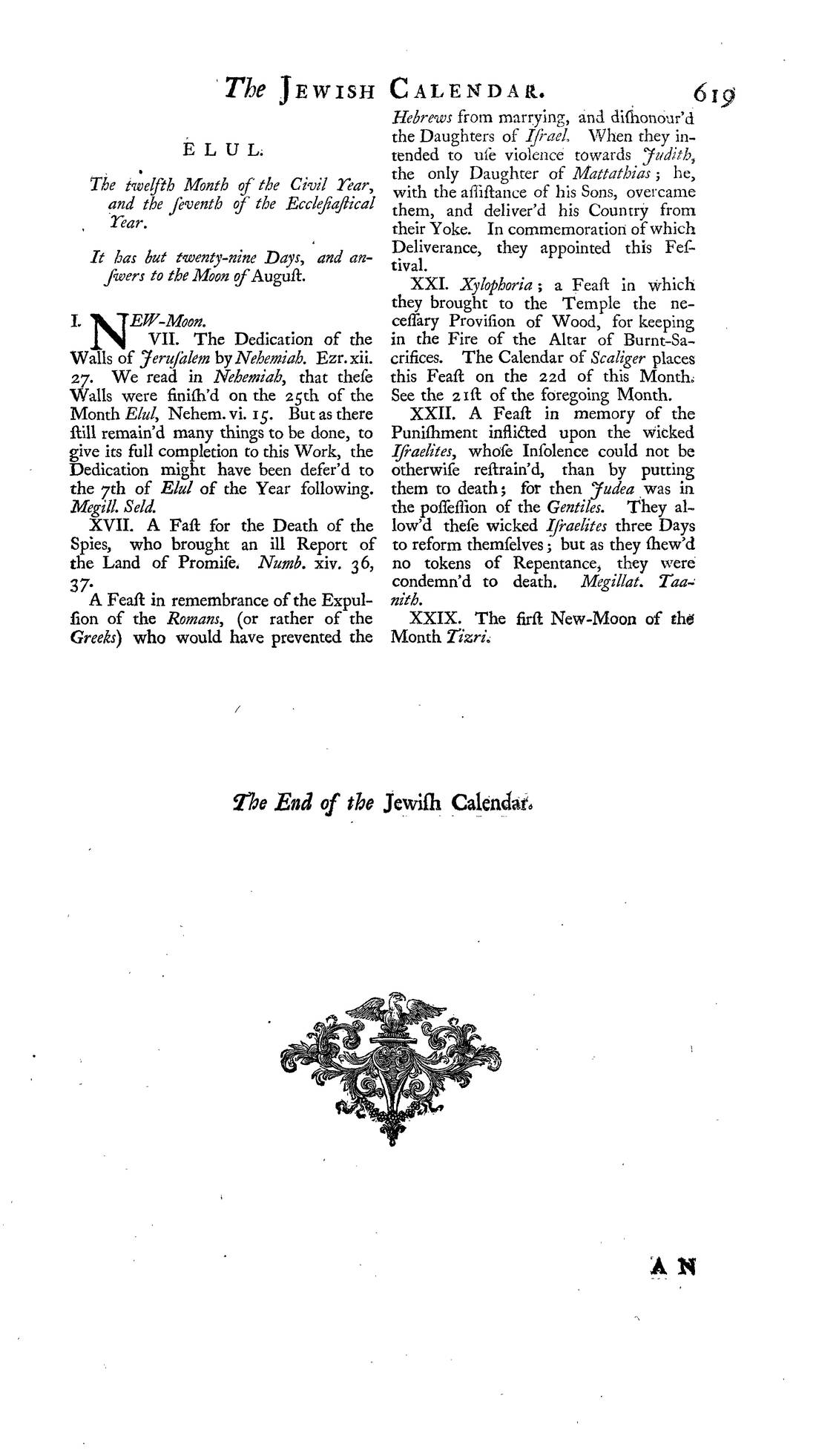
The twelfth Month of the Civil Year, and the seventh of the Ecclesiastical Year.
It has but twenty-nine Days, and answers to the Moon of August.
NEW-Moon. VII. The Dedication of the Walls of Jerusalem by Nehemiah. Ezr. xii. 27. We read in Nehemiah, that these Walls were finish’d on the 25th of the Month Elul, Nehem. vi. 15. But as there still remain’d many things to be done, to give its full completion to this Work, the Dedication might have been defer’d to the 7th of Elul of the Year following. Megill. Seld.
XVII. A Fast for the Death of the Spies, who brought an ill Report of the Land of Promise. Numb. xiv. 36, 37.
A Feast in remembrance of the Expulsion of the Romans, (or rather of the Greeks) who would have prevented the Hebrews from marrying, and dishonour’d the Daughters of Israel. When they intended to use violence towards Judith, the only Daughter of Mattathias; he, with the assistance of his Sons, overcame them, and deliver’d his Country from their Yoke. In commemoration of which Deliverance, they appointed this Festival.
XXI. Xylophoria; a Feast in which they brought to the Temple the necessary Provision of Wood, for keeping in the Fire of the Altar of Burnt-Sacrifices. The Calendar of Scaliger places this Feast on the 22d of this Month. See the 21st of the foregoing Month.
XXII. A Feast in memory of the Punishment inflicted upon the wicked Israelites, whose Insolence could not be otherwise restrain’d, than by putting them to death; for then Judea was in the possession of the Gentiles. They allow’d these wicked Israelites three Days to reform themselves; but as they shew’d no tokens of Repentance, they were condemn’d to death. Megillat. Taanith.
XXIX. The first New-Moon of the Month Tizri.
The pages of the Calendar as printed in 1732
See this page as printed in 1732
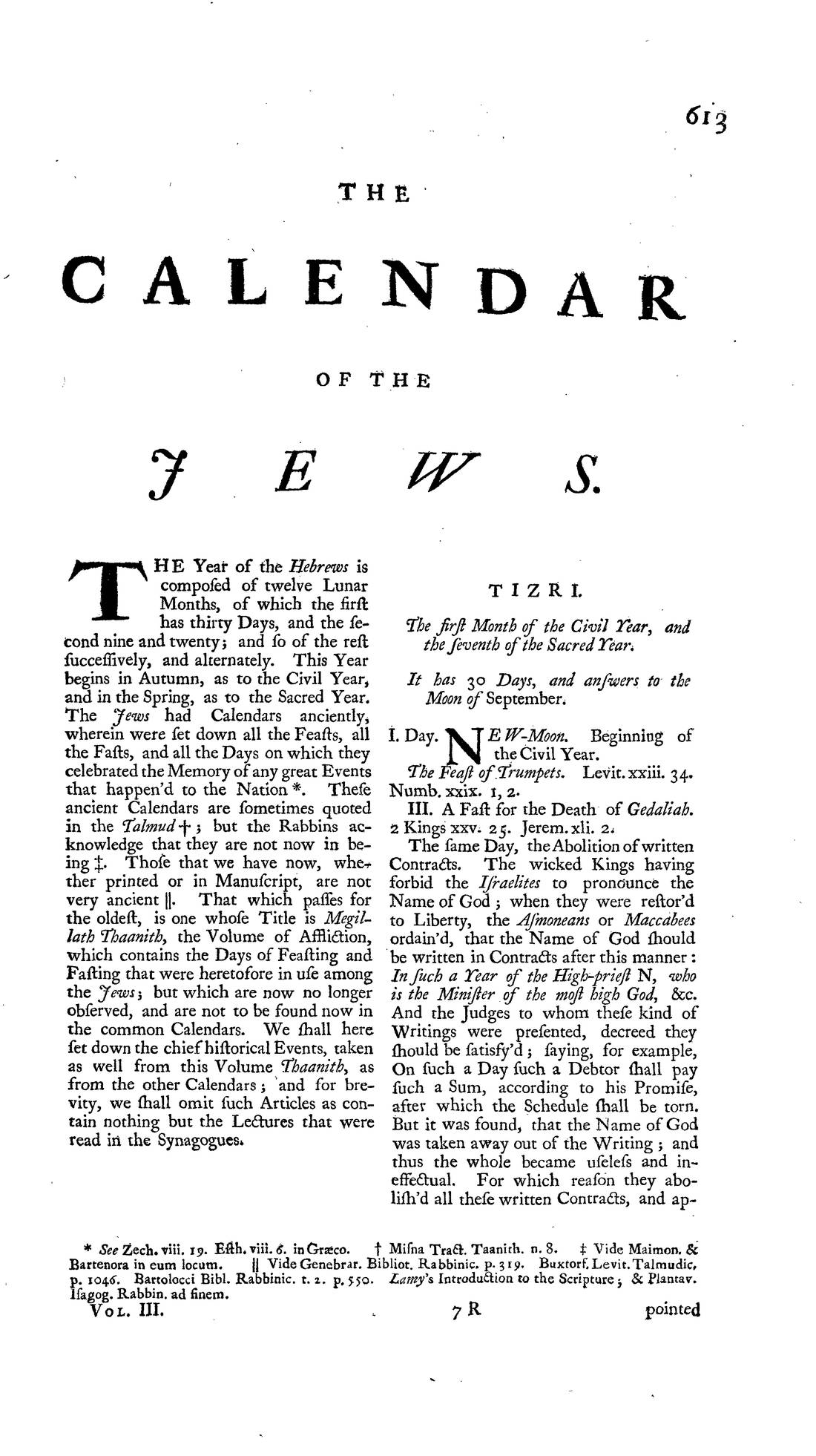
See this page as printed in 1732
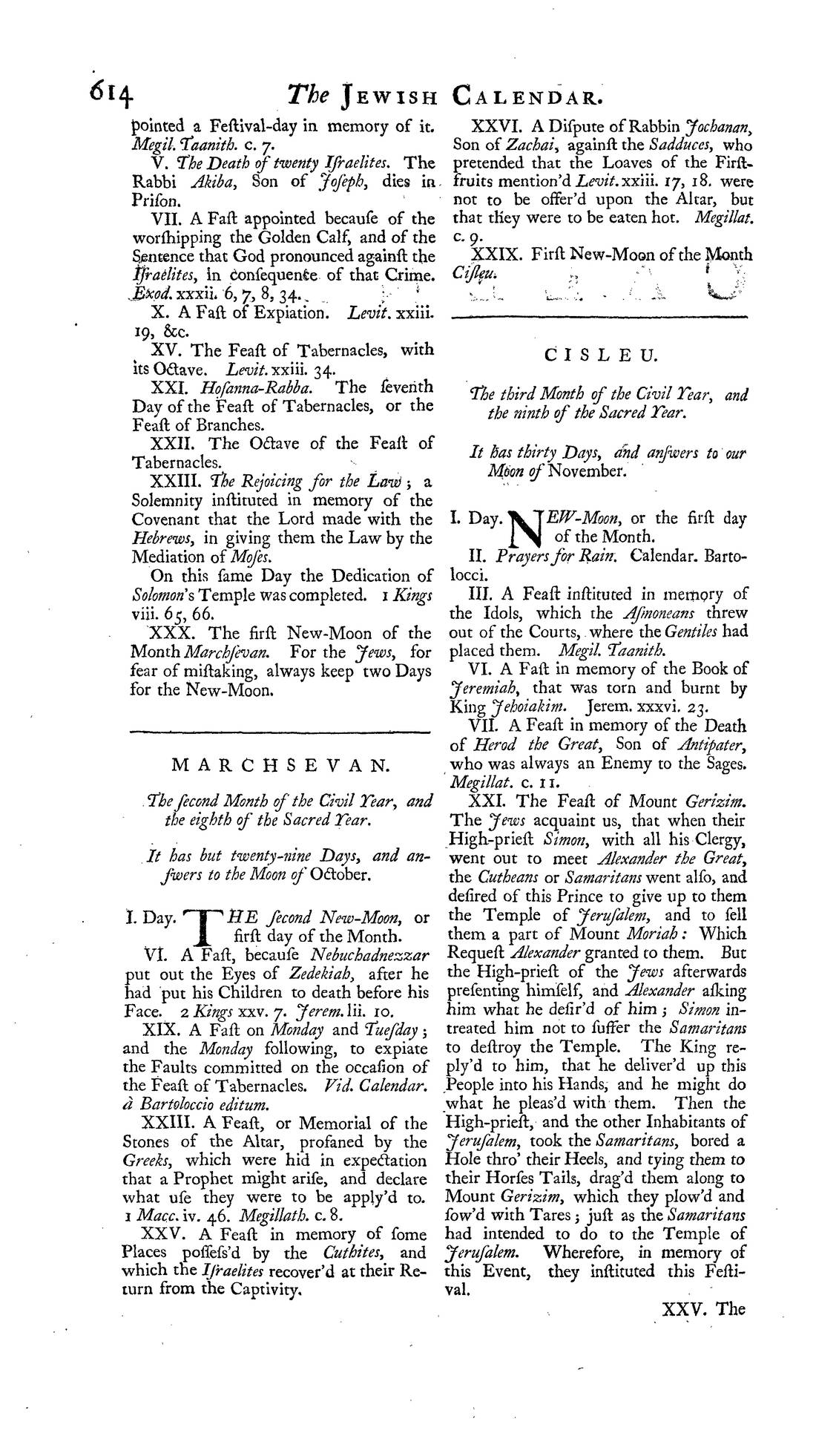
See this page as printed in 1732
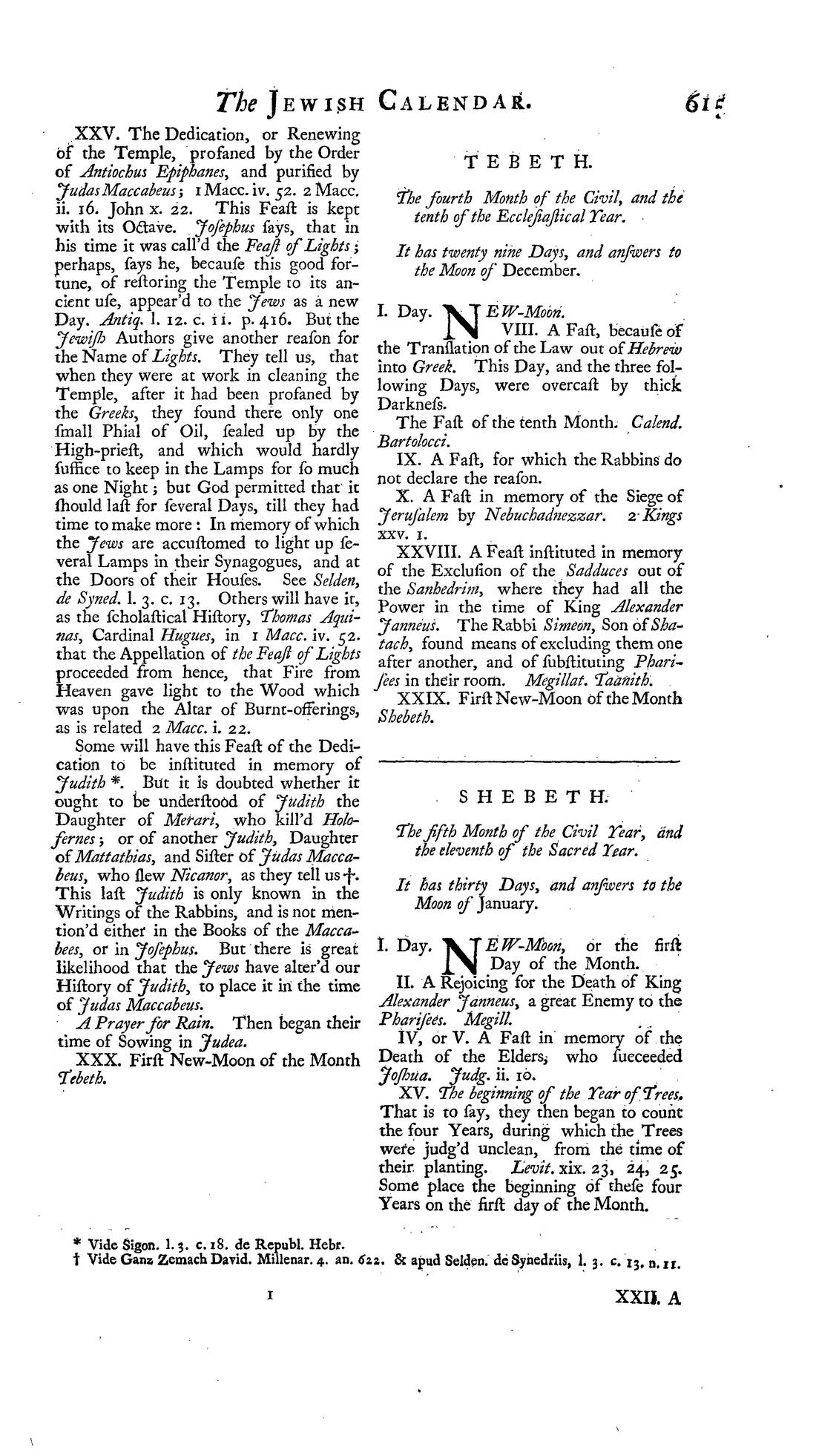
See this page as printed in 1732
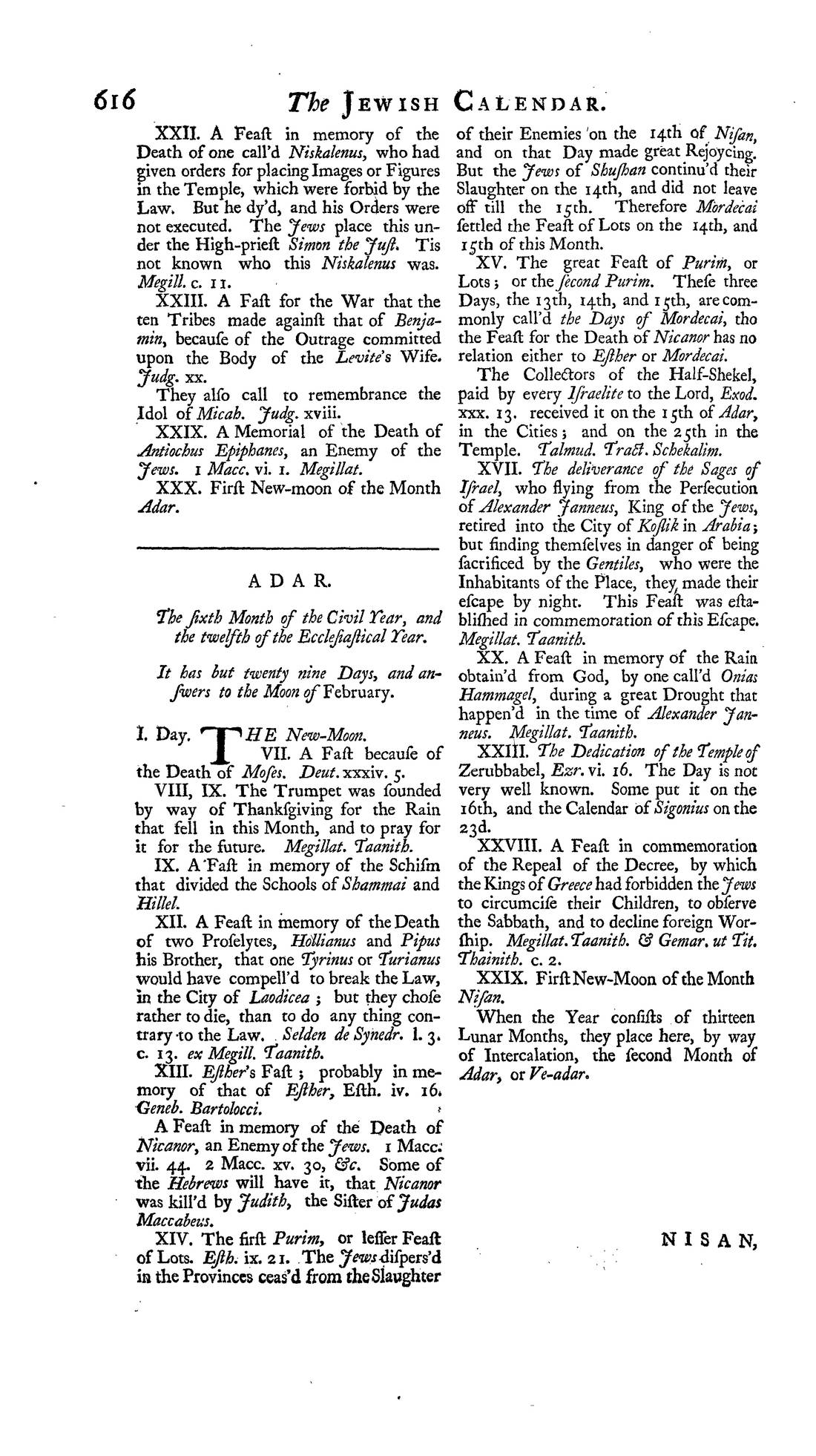
See this page as printed in 1732
See this page as printed in 1732
See this page as printed in 1732
Footnotes
-
See Zech. viii. 19. Esth. viii. 6. in Graeco. ↩
-
Misna Tract. Taanith. n. 8. ↩
-
Vide Maimon. & Bartenora in eum locum. ↩
-
Vide Genebrar. Bibliot. Rabbinic. p. 319. Buxtorf. Levit. Talmudic. p. 1046. Bartolocci Bibl. Rabbinic. t. 2. p. 550. Lamy’s Introduction to the Scripture; & Plantav. Isagog. Rabbin. ad finem. ↩
-
Vide Sigon. l. 3. c. 18. de Republ. Hebr. ↩
-
Vide Ganz Zemach David. Millenar. 4. an. 622. & apud Selden. de Synedriis, l. 3. c. 13. n. 11. ↩