XI. JONATHAN, firnamed Apphus, 1 Macc. ii. 5.the son of Matathias, and brother to Judas the Maccabee. After the death of Judas, he was appointed to be head of the people, and General of the troops of Israel. 1 Macc. ix. 28, 29.Bacchides was soon informed of it1. Jonathan fled immediately into the country bordering upon the lake As-
1 Macc. ix. 43, &c. phaltites; and at last passed the river Jordan, and observing that Bacchides, commander of the troops belonging to Demetrius Soter, was advancing towards 1 Macc. ix. 44,45,46.him with a powerful army, in order to give him battle on the sabbath day; and being withal posted in such a manner, that he had the enemy before him, Jordan at his back, and woods and marshes at his right and left; he exhorted his people to implore the assistance of Heaven, and represented to them the necessity they were in, of either conquering or dying, since there was no way left for their escape. He therefore immediately gave battle, and being within the reach of Bacchides, he stretched out his arm in order to have run him thro’; but Bacchides had the dexterity to avoid the blow by retiring backwards. At length Jonathan and his people having laid a thousand of their enemies dead upon the spot, and being apprehensive that they should be overwhelmed with numbers; threw themselves into the river Jordan, and swam over it in the presence of their enemies without their daring to persue them; and this being done they retreated to Jerusalem.
Observations on the battle between Bacchides and Jonathan, 1 Macc. ix, 44, &c.The Author of the first book of Maccabees is so succinct in his account of this action between Jonathan and Bacchides, that it is difficult to comprehend him; but for the better illustration of what he says, we must resume the affair a little higher. Jonathan having received the command upon the death of his brother Judas, Bacchides sought all opportunities to kill him. but Jonathan and his brother Simon, and all who accompanied them, knowing his intentions, retired into the desart of Tekoah. Bacchides had intelligence of this, and marched with his whole army on the sabbath day beyond Jordan: so that it appears at first sight by these circumstances, that Jonathan was on one side of the river, and Bacchides on the other. Hereupon Jonathan sent his brother John to the Nabathæans their friends, entreating them to secure their baggage, whereof there was a great quantity which imbarassed them very much. But the sons of Jambri coming out of Medaba, took John, in all probability killed him, and went away with all he had. Jonathan and his brother Simon understanding what had happened, and that the sons of Jambri were conducting a new bride in great pomp from Medaba, who was daughter to one of the most considerable Princes in Canaan, and withal having much at heart the blood of their brother, which had been shed by these people, went and posted themselves behind a mountain, which was a good cover to them, with a design doubtless of revenging the death of their brother, and making themselves reparation for the robbery which had been committed on them. Now the wilderness of Tekoah, whither they at first retired, lay to the east of Jordan, and Medaba to the west, and on the other side of the river, consequently Jonathan and his people passed the Jordan to get into the road to Medaba, where they revenged themselves on the sons of Jambri: and it was without doubt upon their return from this expedition, that Jonathan found he was surprized between Bacchides and the Jordan. All the difficulty consisted only in the sacred author’s omitting the circumstance of the foregoing passage over Jordan, and this way it is intirely removed.
Jonathan’s harangue is very beautiful and pathetical Let us go up now, says he to his troops, and fight for our lives, for it standeth not with us to day as in times past. For behold the battle is before us and behind us, and the water of Jordan on this side and that side, the marsh likewise and wood, neither is there place for us to turn aside. Wherefore cry ye now unto Heaven, that ye may be delivered from the hand of your enemies. Every one who reads this discourse, must feel the effect which it must produce upon the hearts of soldiers in such a situation. Nothing can be more magnificent and affecting; in a word, it may be said, this is a master piece in the kind. With that they joined battle, and Jonathan stretched forth his hand to smite Bacchides, but he turned back from him. This passage shews us, that the two Generals were each at the head of their armies, and near enough personally to engage with one another. A thousand men of Bacchides’s army were killed that day upon the spot: at last Jonathan and they that were were with him, leapt into Jordan, and swam over unto the further land. Jonathan observing, that with all his efforts he was not able to break his enemies, and could no longer resist their number, took a resolution to run the hazard of passing the river in their presence, that so he might preserve, if possible, his little army. This expedient succeeded, and Bacchides surprized at the boldness of his enemy, did not venture to persue him.
This action of the Jewish General’s is much to be admired; he behaved with unparallel’d prudence, he was the weakest, yet had the art to disengage himself with glory, and even with advantage, out of so dangerous a circumstance. The conduct of Bacchides was not much for his honour; he was much superior to his enemy, he might have hem’d him in with the great number of his troops, if he had attacked him in any other place than between two marshes, and two woods, where he could draw up his forces in a front no larger than Jonathan’s: for to range in many lines is but bad management; one alone when of a good depth, well ordered, and well conducted, with the boldness of a few resolute soldiers, reduced to the necessity of overcoming or dying, one only, I say, every way so disposed, is sufficient to obtain a victory, since there is nothing more to do than to break the enemy’s first line, whose retreat is rendered impossible by their defeat: for besides that the crowd of runaways produces disorder and confusion in the second line, besides this, the people of Asia as well as the Greeks, fought in Phalanx’s without intervals between the several bodies, or so small, that it would be very difficult for those who were just before routed, to escape without breaking the second line. We do not observe that the Asiaticks drew up in two Phalanx’s when they engaged; and the Greeks when the ground would not permit them to extend themselves in a large front, doubled or tripled their phalanx’s, and formed but one body with sometimes a hundred in file. Polyb. Hist. l. 15.Hannibal drew up in three Phalanx’s, at Zama, which had never been practised: and altho he was at the head of an army consisting of fifty thousand men, he was beaten by Scipio, who had not above two and twenty thousand, and who drew up in a line of columns; for he knew very well, that the victory depended only on the defeat of the first line; thus he routed the great Hannibal in Africk, whom no one could conquer in Italy.
In a word, to return to the order of battle between the Jews and Bacchides; the Jews I suppose to be ranged in two bodies, which filled the space between the marshes and the woods. As to Bacchides, he could do no otherwise than range his infantry in two lines, with his cavalry upon the wings. This is all I am able to conjecture about the matter, according to the situation of places, and the common method of the Jews, and other people of Asia.
After this affair Bacchides returned into Syria. But they who were averse to peace having prevailed with him once more to come back from thence, with the hopes of destroying Jonathan, at a time when he least thought of it, Jonathan prevented them, took an hundred and fifty of the most wicked authors of this design, killed them, and then retired with his brother Simon into the fortress of Bethbasi in the wilderness2. This is Beth-agla, in the wilderness of Jericho. Here Bacchides besieged him: but Jonathan after a vigorous Defense made a sally out of the place, defeated Odonarkes and Phasiron, and killed a great number of the enemy. On the other side his brother Simon having made a sally, burnt the enemies machines, attacked the army of Bacchides, and routed it. So that Bacchides directed his indignation against those who advised him to this undertaking, put them to death, and made preparations to return with the broken remains of his army.
Jonathan then sent to him and made proposals of peace, which Bacchides accepted, went back to Syria, and came no more into Judea. Jonathan dwelt at Machmas, where he governed the people, and extirpated the ungodly out of Israel, he did not fix his residence at Jerusalem, because the troops of Demetrius Nicator King of Syria were in possession of the Citadel. Some years after3 Alexander Balas and Demetrius Soter, who contended for the kingdom of Syria, wrote to Jonathan, desiring his friendship, and endeavouring by their promises and the marks of their esteem and confidence, which they shewed him, to ingage him in 1 Macc. x. 1,2,3,&c.their party. Jonathan accepted the offers of Alexander Balas, and declared for him against Demetrius. The first time of his putting on the High Priest’s ornaments was upon the Feast of Tabernacles, in the year 160 of the Greeks, which is much about the year of the world 3852, before J. C. 148, before the vulgar Æra 152. It was after his receit of Alexander Balas’s letter, who gave him his dignity, that the people importuned him to accept it, and he solemnly performed the functions belonging to it.
Two years after4, Alexander Balas having celebrated his marriage with the king of Egypt’s daughter at Ptolemais, Jonathan was invited thither, and appeared there with royal magnificence. Some of his enemies having shewed an inclination to accuse him to the king, he would not hear them, but clothed him in purple, obliged him to sit near him, and strictly forbad any the least complaint to be brought against him. Jonathan returned to Jerusalem, and there abode for some time in peace. But at the end of two years5 Demetrius Nicator, the son of Demetrius Soter king of Syria, of whom we have made mention, coming into Syria,
1 Macc. x. 67, &c. sent Apollonius General of his troops to Jamnia in Palestine, to defy Jonathan to give him battle, telling him, that he trusted only to his rocks and mountains, where he kept close without daring to descend into the plain. Jonathan stung with these reproaches, got together ten thousand chosen men, laid Siege to Joppa, and carried it with ease. From thence he marched against Apollonius, defeated him, killed eight thousand of his men, and returned loaded with booty to Jerusalem. Alexander Balas hearing of this good success, heaped new honours on him, and gave him fresh marks of his esteem.
Alexander Balas was killed some years after6, whereupon Demetrius Nicator was 1 Macc. xi.advanced to the throne of Syria. Jonathan taking his advantage of the troubles in Syria, besieged the citadel of Jerusalem. But some ill designing persons having informed Demetrius of it, he sent for Jonathan to Ptolemais, to answer such accusations as were prefer’d against him. He went thither, and by his rich presents procured the King’s friendship, and the confusion of his accusers. Demetrius confirmed him in the enjoyment of what he had already in possession, and besides, added new favours. Sometime after7, Jonathan having desired Demetrius to recal his troops which he had lodged in the citadel of Jerusalem; this prince answered him, that he would not only perform what he requested, but wou’d besides do more for the advancement of his, and of his people’s reputation, provided he would send him succours to reduce the inhabitants of Antioch, who had rebelled against him. 1 Macc. xi. 41, 42, &c. 1 Macc. xi. 53, 54, &c.Jonathan sent him three thousand chosen men; who rescued him from the danger he was exposed to; for his people had besieged him in his palace. Those of Antioch were obliged to have recourse to his clemency, and desire peace of him.
Demetrius was not so grateful as he might have been, for such an eminent piece of service. He in a very short time quarrelled with Jonathan, and did him all the mischief he could. His ingratitude was the cause of Jonathan’s declaring for young Antiochus, whom Tryphon had set upon the throne of Syria8. Jonathan fought several battles with Demetrius’s generals, wherein he always had the advantage. About the same time he renewed his alliance with the 1 Macc. xii. 1, 2, &c.Romans, and Lacedemonians. Afterwards upon intelligence, that Demetrius’s Generals were upon their march against him, he went as far as Syria to meet them: but they not daring to engage him, he retreated. Jonathan marched with his army against the Zabadean Arabians, or Nabatheans; he defeated them, and returned to Jerusalem loaded with a good booty. He undertook to rebuild the walls of Jerusalem, and to raise a wall between the fortress, which was in the hands of the Syrians, and the city.
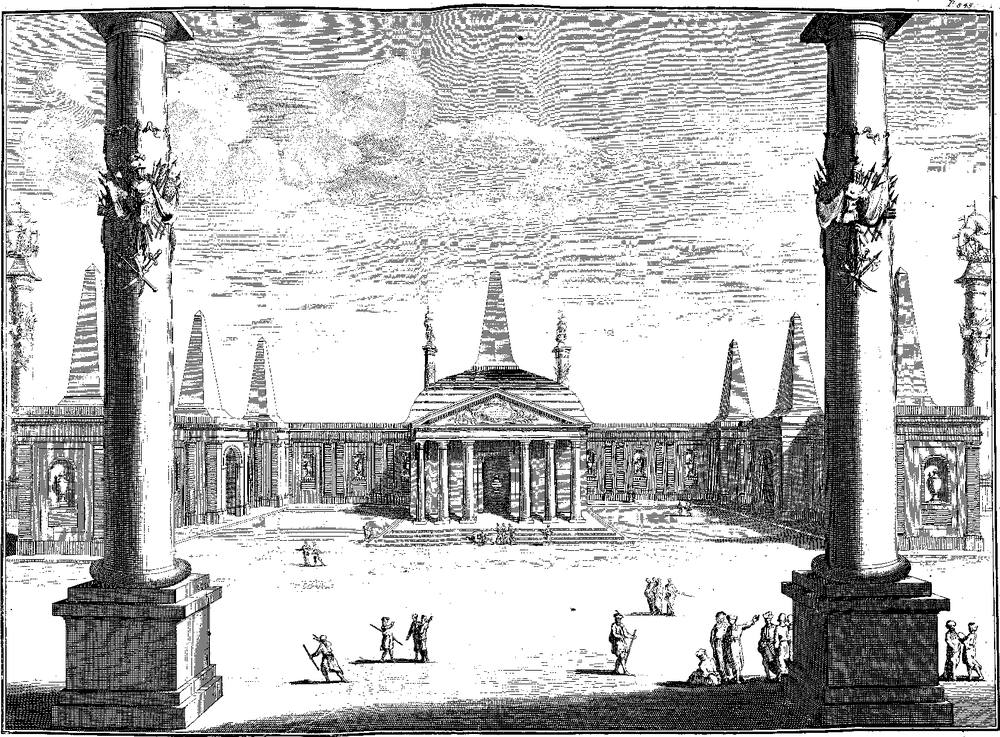
1 Macc. xiii. 1, 2, 3, 4, &c.In the mean time Tryphon having conceived the design of dispatching young Antiochus, and stepping into his throne, thought it in the first place necessary to secure the person of Jonathan. He persuaded him to come to Ptolemais, and having not above a thousand men with him, the inhabitants, as soon as he was entred into the city, shut the gates, killed the Jews who attended Jonathan, seized on him himself, and put him in chains. Tryphon afterwards marched against Simon, Jonathan’s brother, who was appointed governor of the people in his place. Simon put himself in a condition to make a good defense. But Tryphon not daring to run the hazard of a battle, sent word to Simon, that he had seized on Jonathan for certain sums of money only, which he owed the king; that if he would send him an hundred talents in silver, and Jonathan’s two sons for hostages he would give him his liberty. Simon easily understood, that these proposals were not sincere: nevertheless that he might be liable to no reproaches from the people, he sent to Tryphon what he had demanded. But Tryphon did not keep his word: he killed Jonathan and his sons some time after9 at Bascama, perhaps Besek, not far from Bethsan. Simon sent and enquired after the bones of Jonathan his brother, and buried them at Modin in a magnificent mausoleum, which he there erected, in memory of his father 1 Macc. xiii. 27.and his brothers. This was a lofty edifice built both within and without of polished stones. He set up seven pyramids there, one for his father, one for his mother, and four for his four brothers. He adorned the edifice with large columns, and upon them placed arms and ships in carved work, which were seen at a distance by those who sailed near this coast. This sepulchre was still to be seen in the time of Eusebius and S. Jerom. There was a general and great mourning over all Israel for Jonathan, and the people lamented him for many days.
Read this article in its place on the printed pages
Footnotes
-
In the year of the world 3843, before J.C. 157, before the vulgar Æra 161. ↩
-
1 Macc. ix. 59, 60, 61, &c. In the year of the world 3846, before J.C. 154, before the vulgar Æra 158. ↩
-
In the years of the world 3851, and 3852. ↩
-
In the year of the world 3854, before J.C. 146, before the vulgar Æra 150. ↩
-
In the year of the world 3856, before J.C. 144, before the vulgar Æra 148. sent ↩
-
In the year of the world 3858, before J. C. 142, before the vulgar Æra 146. ↩
-
In the year of the world 3860, before J. C. 140, before the vulgar Æra 144. ↩
-
In the year of the world 3860, before J. C. 140, before the vulgar Æra 144. ↩
-
In the year of the world 3861, before J. C. 139, before the vulgar Æra 143. 2 ↩