Volume I, pages 685–702 of the 1732 edition, from HER to HON: everything printed on these pages, in order.
Continued from Herodians
that it was their duty to submit to it. 2. That in the present circumstances they might with a good conscience follow many of the heathen modes and usages. It is certain Antiq. l. 15. c. 12.that these were Herod’s Principles, since he excuses himself on the score of the necessity of the times for acting in many things against the maxims of the Jewish Religion.
Acts v. 37.Having now laid before you these several opinions relating to the Herodians, it remains for us to chuse our side of the question. We see from the Gospel, 1. That this was a Sect formed and actually subsisting among the Jews in our Saviour’s time. 2. That it differed from the Pharisees, Sadducees, and Essenians. We have made it appear, that the argument produced to shew, that they and the Sadducees were the same, is not solid. 3. They were seen always with the Pharisees. 4. They were very much concerned to know whether it were necessary to pay tribute to the Romans, or not. 5. They had some dangerous principles, since our Saviour admonishes his hearers to take care of their leaven. Now I see none but the Disciples of Judas the Gaulonite or Galilæan, in whom all these characters concur. They composed a Sect, which is particularly taken notice of in Joseph. Antiq. l. 18. c. 1, & 2.Josephus; they agreed in all things with the Pharisees; the only instance which distinguished them, was their excessive love of liberty, they being fully persuaded, that men were to pay obedience to God only. This Sect was in all its vigour when our Saviour appeared; after the destruction of Jerusalem, when the nation was dispersed and reduced to slavery, it sunk and was intirely lost.
Judas Gaulonites, or the Galilæan, appeared at the time when all the people were taxed by order of Augustus, in the year of Antiq. l. 18. c. 1. p. 616.Jesus Christ 10, and of the Vulgar Æra 14, ten years after the first taxation which was made at the birth of Jesus Christ. This Judas pretended, that the true Israelites, being the people of God, were to be subject to no man. He had a great number of Disciples, whom some called Galilæans, because Gaulon is in Upper Galilee; and others Herodians, because this City belonged to Herod Antipas’s kingdom. Josephus gives them no particular name; he says only, that they were followers of Judas the Gaulonite, great lovers of Liberty, and maintained the same opinions as the PhariseesAntiq. l. 18. c. 1. & de Bello, l. 2. c. 12. Hieron. in Ep. ad Tit. c. 3.. All that the Gospel tells us of the Herodians agrees perfectly with the idea, which Josephus gives us of the Disciples of Judas Gaulonites. St. Jerom makes no question, but that St. Paul in his Epistles has these Hereticks in view, when he recommends submission to the secular Powers established by God. See our Dissertation concerning the Sects of Antiq. l. 18. c. 7.the Jews, prefixed to our Comment on St. Mark.
HERODIAS, the daughter of Aristobulus and Berenice, sister to King Agrippa, and grand-daughter to Herod the Great. Her first husband was her uncle Herod Philip, by whom she had Salome. Herodias having hearkened to the propositions which were made to her by Herod Antipas her uncle, Tetrarch of Galilee, of marrying her at his return from Rome, she removed from Philip’s house into that of Antipas, together with her daughter Salome. And as St. John the Baptist at all opportunities Matth. xiv. 3.censured this incestuous marriage, Antipas ordered him to be put in prison, and some Mark vi. 17. Hieron. in Rufin. l. 3. c. 11. p. 247.time after Herodias suggested to her daughter Salome to ask John the Baptist’s head of the King. Thus this holy man was beheaded; and St. Jerom relates, that this woman, holding his head in her hands, pierced his tongue with her bodkin, in like manner as Antony’s wife served Cicero’s.
Antiq. l. 18. c. 9. In the year of Jesus Christ 39.Herodias not enduring with patience to see her husband Tetrarch only, while her brother Agrippa, whom she had known in a state of indigence and humiliation, was honoured with the title of King, persuaded her husband Antipas to go to Rome, and desire the Emperor Caïus to grant him the same favour, which he had bestowed upon Agrippa. But Agrippa, moved by a still meaner degree of jealousy, at the same time sent his servant with letters to the Emperor, importing that Herod had in his arsenals wherewithal to arm seventy thousand men. Antipas not being able to deny this fact, was immediately banished to Lions. Caïus understanding that Herodias, who had accompanied her husband in this journey, was sister to Agrippa, shewed an inclination to pardon her: but she chose rather to follow her husband in the calamity which she had brought upon him, than to owe any thing to her brother’s fortune. See the Article HEROD ANTIPAS, that of AGRIPPA, and that of HEROD PHILIP.
Rom. xvi. 11. Menæa. 8. April. Bolland. viii. April.HERODION, St. Paul’s cousin. The modern Greeks tell a great many stories of St. Herodion. They reckon him among the seventy-two Disciples and Apostles; and say, that notwithstanding, out of humility he was content to be a servant to all the Apostles. He was ordained Priest, then Bishop of Patræ, probably in Achaia. He is the same perhaps as St. Rhodion, whose head, they say, was cut off at Rome, the same day as St. Peter’s and St. Paul’s.
Antiq. l. 14. c. 25. & 16. 1. De Bello, l. 1. c. 21. De Bello, l. 5. c. 7.HERODION, a Castle built by Herod upon the spot where he had defeated his enemies in his flight. This Castle was sixty furlongs from Jerusalem, and here this Prince desired to be buried. It was not far from Tekoah. M. Reland believes,
that Herod built another of the same name towards the Mountains of Arabia, and, as he conjectures, beyond Jordan. For it must be confessed, that a Castle built sixty furlongs, or three leagues from Jerusalem, cannot naturally be supposed to mean a Fortress built towards the Mountains of Arabia.
HEROON, a City at the northern extremity or point of the Red Sea. It is in all probability the same which we at present call Suez. The Ancients call it likewise Heroopolis, and the Gulf of Suez, Sinus Heroopoliticus.
HESER, a City of Judah, built or fortified by Solomon, 1 Kings ix. 15. It is in all probability the same as the City of Asor or Hazor.
HESHBON, a celebrated City beyond Jordan, otherwise called Esbus, Chesbon, Chasphon, Chascor. It was, as Eusebius says, twenty miles eastward from Jordan. Josh. xiii. 17.It was given to the Tribe of Reuben; but was probably made over to that of Gad, since we meet with it among the cities which this Tribe gave the Levites for their Josh. xxi. 37. 2 Chr. vi. 8.abode. It belonged at first to the Moabites, from whom King Sihon conquered it. It was retaken by the Israelites a little before the death of Moses. Lastly, after the ten Tribes were transplanted into the Country beyond Jordan, the Moabites made themselves Jerem. xlviii. 2.masters of it. Pliny makes it belong to Arabia. Solomon in his Song speaks of Plin. l. 5. c. 11.the waters of Heshbon; and the second Cant. vii. 4.book of Maccabees says, that the Lake of Caspis or Heshbon was two furlongs, or 2 Macc. xii. 16.three hundred paces broad.
HESRAI, of Carmel, one of David’s brave Officers. 2 Sam. xxiii. 35.
I. HESRON, the third son of Reuben, Gen. xlvi. 9. Head of the Family of the Hesronites. Numb. xxvi. 6.
II. HESRON, the son of Pharez, and grandson of Judah. 1 Chr. ii. 5. Gen. xlvi. 12.
HETH, the father of the Hittites, was the eldest son of Canaan, and dwelt southward of the Promised Land, at Hebron and thereabouts. Ephron, an inhabitant of Hebron, was of the race of Heth, and this whole city in Abraham’s time was peopled by the children of Heth. There are some, who maintain, that there was a city called Heth; but we find no footsteps of it in the Scripture.
HETHLON, a city mentioned in Ezekiel, as limiting the Land of Promise on the north side. Ezek. xlvii. 15. xlviii. 1.
l. 1. c. 16.HEXAPLA. This is the name of a large work composed by Origen, wherein he collected all the Greek Versions of the Scripture, which had been made till that time: namely, those of the Septuagint, Aquila, Symmachus, Theodotion, and a fifth found at Jericho in 217, together with a sixth found at Nicopolis in 228. These six Versions were disposed in six columns opposite to one another, that it might be observed at one view, where they agreed or disagreed; and to confront them more easily with the Hebrew, Origen placed the Hebrew in Hebrew letters at the head of them, and the same text in Greek letters in two columns answerable to the six columns before mentioned. So that there were in all eight columns; two for the Hebrew, and six for the six Greek Versions. There was even a seventh Version, which contained the Psalms only: but of this no notice was taken in the denomination of the Hexapla. From these two columns of the Hebrew, the work was sometimes called Octapla, by reason of the eight columns.
It is not now in being intire, and the loss of such an immense performance is the greatest the Church ever has sustained. The ancient Fathers have preserved several fragments of it. Eusebius, St. Chrysostom, Theodoret, and the other Greek Fathers, and among the Latins, St. Jerom, have often cited the Hexapla, and confronted the passages of Scripture according to the several Versions contained in this work. Some of the moderns have collected the fragments of it: among others, Drusius has given us a large Volume of them in 8vo. But the R. F. De Montfaucon, a Benedictine of the Congregation of St. Maur has carried his enquiries much farther, and given us two Volumes of them in folio, printed in 1713. To these he has added Prolegomena, wherein he explains the form and history of the Hexapla1.
Origen, before he wrote his Hexapla, had composed the Tetrapla; that is to say, a collection of the four principal Versions of the Scripture, which are those of the Septuagint, Aquila, Symmachus, and Theodotion. Tetrapla signifies properly a compound of four rows, or four folds.
Origen is thought to have begun this great work of his Hexapla about the year 231, but we cannot tell exactly when he finished it. So large an undertaking must have required a great deal of time in the execution of it.
I. HEZEKIAH, King of Judah, the son of Ahaz and Abi, was born in the year
of the World 3251, Ahaz his father being 2 Kings xvi. 1. compar’d with 2 Kings xviii. 1. See our Comment upon 2 Kings xvi. 1, &c.then no more than eleven years of age. There is some difficulty with respect to this particular; but the Scripture asserting, that Ahaz was but twenty years old when he began to reign, and that he reigned but sixteen years, it follows, that he lived but six and thirty. Now the same Scripture says, that Hezekiah was five and twenty years old, when he began to reign: we must conclude therefore, that Ahaz his father had him, when he was but yet eleven years old: which is indeed very extraordinary, but not at all impossible.
Hezekiah succeeded his father Ahaz in the year of the World 3277, or 3278, before Jesus Christ 722, before the Vulgar Æra 726. He did that which was good 2 Kings xviii.and agreeable to God. He destroyed the High-places, cut down the prophane Groves, and broke the Statues which the people adored in the reign of Ahaz. He broke in pieces the brazen Serpent which Moses had made, because the Children of Israel burnt incense to it. In the first 2 Chr. xxix. 3.month of the first year of his reign, he ordered the great doors of the Lord’s House to be opened, and repaired them: he convened the Priests and Levites, and exhorted them to purify and cleanse the Temple, and to put it into a condition to have Sacrifices offered in it as formerly. The Priests and Levites having executed the King’s commands, they began to offer Sin-offerings and Burnt-sacrifices upon the Altar of the Temple; which Sacrifices were furnished by the King. After this, the Princes of the people offered again abundance of Victims, and the Worship of God was perfectly restored in his House.
As the Feast of the Passover had been hitherto neglected, Hezekiah invited not only all his own people to it, but those 2 Chr. xxx.likewise of the kingdom of Israel. Some ridiculed the proposal; but many came into it: and this was the most solemn Passover that had been observed for a long time. After this, the people began generally to destroy all the remains of Idolatry, which were still subsisting not only in the territories subject to Hezekiah, but in those likewise belonging to Hosea, the last King of Israel; who saw his people, without jealousy, returning to the worship of the Lord. Hezekiah took all necessary care to keep up the good regulations, which he had 2 Chr. xxxi.established in the Temple, and to provide sustenance for the Priests and other Ministers of the Lord, together with such other things as were requisite for their support. All the people brought their Tythes, and First-fruits, in so large a quantity, that there was some left.
In the year of the World 3290, or 3291. 2 Kings xviii. 7. 2 Chr. xxxii. 1, 2, 3, &c.Some years after, Hezekiah shook off the Assyrian yoke, and refused to pay the accustomed tribute to that King. He defeated the Philistins, and destroyed all their country from the Tower of the watchmen to the fenced Cities. He set about repairing the Walls of Jerusalem, and fortified it by building Towers about it. He laid in stores of arms and provisions, set good commanders over his troops, stopp’d up the springs which were without the city, and omitted nothing which was necessary to put himself into a condition of making a vigorous resistance.
In the mean time, Sennacherib King of Assyria marched against him; entred the territories of Judah, and made himself master of almost all the towns in it. Hezekiah observing that the Kings of Egypt and Cush, with whom he had made 2 Kings xviii. 24. xix. 9.an alliance, did not come to his assistance, and being sensible, that he was not of himself strong enough to resist so powerful an enemy, he sent Ambassadors to him, desiring him to retire out of his dominions, and promising to submit to such terms, as he should think fit to impose upon him.
Sennacherib demanded of him three hundred talents of silver, and thirty talents of gold2; and to raise this sum, Hezekiah was obliged to exhaust all his treasures, and to pull off the gold plates, which he had put formerly upon the Temple-doors. But Sennacherib having received this money, instead of returning, and leaving Hezekiah in peace, sent three principal Officers of his Court to him from Lachish, which he was besieging, to Jerusalem, with a summons to him to surrender. These Officers desired to speak with Hezekiah; but the King did not think it proper to go out of the city: he sent Eliakim, Shebna, and Joah to them, whom Rabshakeh spoke to in an insolent manner, aggravating the power of his master, and saying, that Hezekiah was not able to furnish him with a thousand men to mount a thousand horses, which Sennacherib should supply him with: he added, that the Jews in vain placed their confidence in the King of Egypt; that Pharaoh would be to them as it were a bruised reed, which breaks under him who would rest
upon it, and pierces his hand: that Sennacherib was come into Judæa in obedience purely to the Lord’s Order, who had said to him, Go up against this Land, and destroy it.
And as Rabshakeh spoke Hebrew, and the people of Jerusalem were upon the walls and heard him, the Deputies appointed by Hezekiah desired him to speak Syriac, because they understood this language, and not Hebrew, before all the people who heard them from the walls. Rabshakeh answered, Did my Lord send me hither to speak to you only and your master? or to these men rather, who hear me from the walls; and whom you would reduce to the necessity of drinking their own urine and eating their own excrements? At the same time he raised his voice, and exhorted the people to surrender to his master; adding, that as there were no Gods who were able to rescue the nations out of his hands, which he had subdued, so the Lord could not preserve them from the arms of the Assyrian King.
Hezekiah having heard these blasphemies, rent his clothes, covered himself with sackcloth, went to the House of the Lord, and sent a message to the Prophet Isaiah, with an account of what Rabshakeh had said. But Isaiah said, thus saith the Lord, fear not the menacing and blasphemous discourses which you have heard, I will send out the spirit of fear against Sennacherib, which will oblige him to return to his own country, where he shall perish by the sword. Accordingly this King having broke up the siege of Lachish, and setting down before Libnah, was informed that Tirhakah King of Cush, was marching against him, with a design to engage him. He left the siege of this place therefore, to go and meet Tirhakah; and at the same time sent letters to Hezekiah, wherein he told him, that he ought not to place his confidence in his God; that this would never secure him from his power, no more than the Gods of other nations had been able to protect them against his arms.
Hezekiah having received these letters, went up to the Temple, spread them before the Lord, and begg’d of God to deliver him out of the hands of this insolent and proud enemy. The Lord heard his prayer, and sent the Prophet Isaiah to tell him, that he should not fear Sennacherib’s threats; that this Prince would be soon obliged to return home; that he should not lay siege to Jerusalem and attack it, and that the Lord would protect and defend the city and his people. Accordingly, the very night after this Prediction, the Angel of the Lord came down into the camp of the Assyrians, and killed there an hundred fourscore and five thousand men of Sennacherib’s army; so that this Prince was obliged to retire immediately to Niniveh, where two of his sons smote him with the sword, as he was worshipping in the Temple of Nisroch his God. He was succeeded by Esar-haddon, in the year of the World 3291, before Jesus Christ 709, before the Vulgar Æra 713.
2 Kings xxi. 23, &c. and Isai. xxxviii. & 2 Chron. xxxii. 29, 30. Rabb. apud Hieronym. in Isai. xxxix. 2 Chron. xxxii. 24.Soon after this war, and in the very year of Sennacherib’s invading the territories of Judah, which was the fourteenth year of Hezekiah, this Prince fell very dangerously sick. His disease was probably an imposthume or an ulcer. The Rabbins are of opinion, that God afflicted him with this indisposition to punish his neglect, because he had not composed a song of thanksgiving for his deliverance from Sennacherib’s war. But the second book of Chronicles seems to attribute this disease to the elevation of Hezekiah’s heart, and his not acknowledging sufficiently, that his deliverance was owing to the pure favour of God. However this may be, the Prophet Isaiah came to him, and said, Set the affairs of thine house in order, for thou shalt live no longer, but shalt die. Hezekiah, turning his face to the wall, addressed his prayer to God with abundance of tears. Isaiah was not got above half way the court, when the Lord commanded him to return to Hezekiah. He did so, and said to him, Thus saith the Lord, I have heard thy prayer, and have seen thy tears. I have healed thee, and in three days thou shalt go to the Temple, and I will add still fifteen years to thy life. Besides, I will protect thee against the King of the Assyrians, and will defend Jerusalem from his insults. At the same time, Isaiah ordered some figs to be brought, which he put upon the King’s ulcer and he was cured.
But Hezekiah had before said to him, what sign shall I have, that the Lord will heal me? Isaiah answered him, would you have the shadow of the sun advance ten degrees, or retire ten degrees in the dial of Ahaz? Hezekiah desired, that the shadow might go back ten degrees, for this seemed to him most difficult; and the Prophet calling upon the Lord, the shadow, as he had promised, returned ten degrees backward. It is very probable, that this retrogradation, which was very sensible and real in the dial of Ahaz, was caused by some reflection of the sun’s rays, without a necessity of there being any real retrogradation of this Luminary. Hezekiah, after his recovery, composed a song of thanksgiving to the Lord, which the Prophet Isaiah has preserveda.
a Isai. xxxviii. 10, 11, &c. b In the Year of the World 3291, before J.C. 709, before the VulgarAt this time b Merodach or Berodach- Baladan King of Babylon, sent letters and presents to Hezekiah c, because he understood that he had been sick, and knew that at the time of his cure, some great proprodigy
2 Chr. xxxii. 31.had happened at Jerusalem. Hezekiah was mightily delighted with this Ambassy; he shewed the King of Babylon’s Envoys all his treasures, his spices, his rich vessels; in a word, he concealed nothing in his palace from them. The Prophet Isaiah came afterwards to the King; and having understood what had passed, told him as from God, that a time would come, when all that was in his house, and his fathers had amassed together to that day, would be removed to Babylon: that his sons would be made Eunuchs to serve in the palace of the King of Babylon. Hezekiah answered, The Will of God be done: whatever he hath ordained is just: let peace and truth reign during the remaining days of my life. This Prince passed the latter years of his life with great tranquillity, laid up great riches, conveyed water into the city, and died in the year of the World 3306, before Jesus Christ 694, before the Vulgar Æra 698. He was succeeded by Manasseh, who inherited neither his wisdom nor his piety. The Sacred Writings evidence upon many occasions, the piety and merit of Hezekiah; and Jesus the son of Sirach, Author of the book of Ecclesiasticus, hath dedicated an Encomium to him in the xlviiith Chapter of his work.
II. HEZEKIAH, the second son of Neariah, a descendant of Zerubbabel. 1 Chr. iii. 23.
III. HEZEKIAH, the son of Shallum, was one of those that opposed the Israelites, who had carried a great number of their brethren, belonging to the Tribe of Judah, into captivity; and obliged them to set them at liberty. 2 Chr. xxviii. 12.
IV. HEZEKIAH returned from Babylon with ninety eight persons of his family. Neh. vii. 21.
HEZIR, Head of the seventeenth sacerdotal Family. 1 Chr. xxiv. 15.
HIADES. See HYADES.
HIC-SOS, Shepherd-Kings. See above EXODUS, and below SHEPHERDS.
HIDDAI, one of the brave Officers in David’s army. He was of the Valley or Brook of Gaash. 2 Sam. xxiii. 30.
TO HIDE, To Hide one’s self. To hide one’s face, to turn from any one, are expressions which shew some aversion and estrangement. The Prophet beseeches God not to turn his face from him, not to hide himself before him; that is to say, he begs of him to hear him, to look favourably upon him. In another place he says, that he hides his friends in the secret of his presence: in some secret place, where he sees them in the Ps. xxxi. 20. Psal. cxix. 19.inner part of his Palace. He prays to God not to hide his commandments from him; to discover to him the sense of them. St. Paul says, that the Sacrament, Col. i. 26. See likewise Eph. iii. 9. Ps. lxxxiii. 3. על צפוניךor mystery of our salvation hath been hid from ages and from generations, but is now made manifest to his Saints in the times of the new Covenant.
To HIDE is often used for to protect. The Saints are sometimes called the hidden ones. In the Psalms, Cogitaverunt adversus sanctos suos; in the Hebrew, Adversus absconditos suos.
1 Kings xvi. 34. Josh. vi. 26.HIEL, of the city of Bethel, rebuilt Jericho, notwithstanding the curse denounced by Joshua against the person who should attempt to do so. Wherefore he experienced the effects of Joshua’s curse; for God suffered him to lose his eldest son Abiram, while he was laying the Foundations of Jericho; and his youngest son Segub, when he was hanging up the Gates.
Coloss. iv. 13.HIERAPOLIS. St. Paul writing to the Colossians, testifies of Epaphras, and says, that he abounds with zeal and affection for those of Laodicæa and Hierapolis, as well as for those of Colossæ. Hierapolis was in Phrygia, and in the neighbourhood of Colossæ and Laodicæa.
HIERONYMUS, Demophon, Timotheus, and some others, whom Lysias had left in Judæa, after the agreement made between the Jews and the young King Antiochus Eupator, did what they could to oblige the Jews by their ill treatment of 2 Macc. xii. 2.them, to break the treaty.
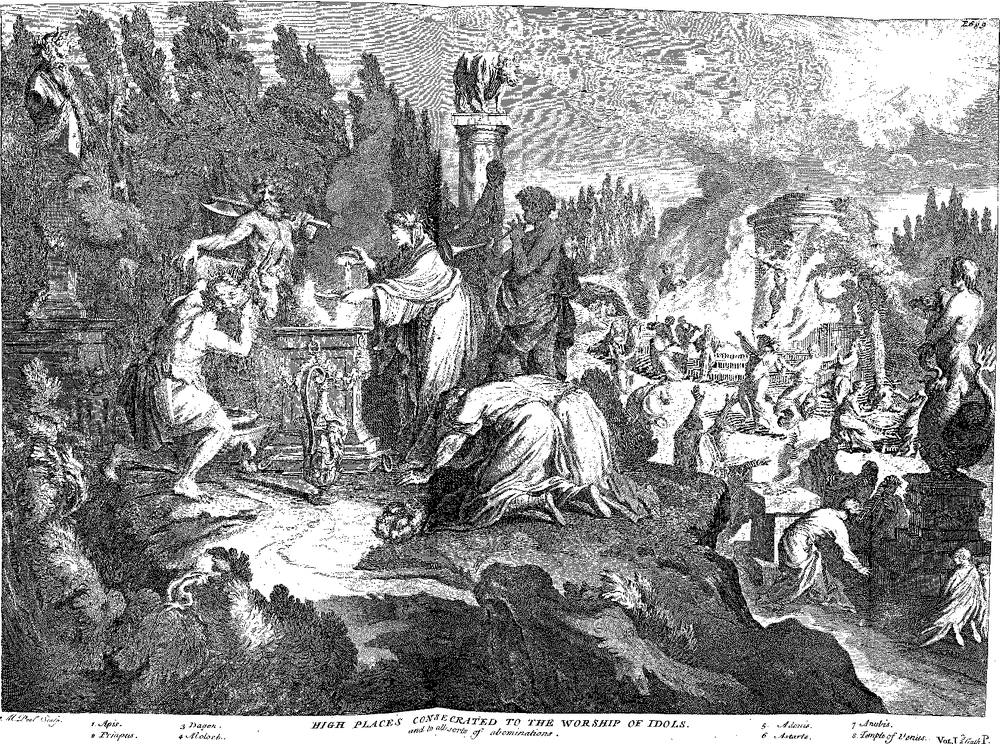
HIGH PLACES, in Hebrew, Bamoth, and in Latin, Excelsa. They are often spoken of in Scripture3; and the Prophets reproach the Israelites for nothing with so much zeal, as for worshipping upon the High Places. The destroying of these High Places is a commendation given but to few Princes in the Scripture; and many of them, though otherwise zealous for the observance of the Law, had not the courage to ruin these Eminences, and prevent the people from sacrificing upon them.
While the Temple was not built, there was nothing in the High Places very contrary to the Law, provided God only was adored there, and that no Incense or Victims were offered to Idols. Under the Judges they seem to have been tolerated; and Samuel offered Sacrifices in several places besides the Tabernacle, where the Ark was not present. Even in David’s time they sacrificed to the Lord at Shilo, Jerusalem, and Gibeon. But after that, the Temple was built, and a place prepared for the fixed settlement of the Ark, it was no more allowed of to sacrifice out of Jerusalem. Solomon in the beginning of his reign went a pilgrimage to Gibeon. But from that time we see no lawful Sacrifices offered out of the Temple.
The High Places4 were very much frequented in the kingdom of Israel. The superstitious people went sometimes upon Mountains sanctified by the presence of Patriarchs and Prophets, and by the appearances of God, in order to worship the true God there. There was nothing wanting in this worship to make it lawful besides the place which the Lord had chosen. But upon these Hills they often adored Idols, and committed a thousand abominations in Groves, and Caves, and in Tents set apart for prostitution. This was what inflamed the zeal of pious Kings and Prophets, to suppress and destroy the High Places.
HILEN, a City in the Tribe of Judah, which was given to the Levites. It is the same probably as Cholon or Olon. Joshua xv. 51.
I. HILKIAH, the father of Eliakim. 2 Kings xviii. 18.
II. HILKIAH, the son of Amaziah, a Levite of Merari’s Family. 1 Chr. vi. 45.
III. HILKIAH, the father of Jeremiah, Jerem. i. 1. Some5 will have it, that this Hilkiah was the High-Priest of this name, who lived in the reign of Josiah, 2 Kings xxiii. 4, 8, 10. but their opinion wants good proofs.
IV. HILKIAH, the High-Priest, grandson to Shallum, and father of Azariah, who succeeded him in the High-Priesthood. Under the Pontificate of Hilkiah the book of the Law was found in the 2 Kings xxii. xxiii. 2 Chr. xxiv. In the year of the World 3380, before J. C. 620, before the Vulgar Æra 624. Baruch i. 7. 2 Kings xviii. 18, 26, 37.Treasury of the Temple; which ingaged King Josiah to reform Religion, and resettle it, after it had sunk so low in his dominions, through the impiety of the preceding reigns. We are of opinion, that he is the same as Eliakim or Joachim, who lived in the reign of Manasseh, and governed at the time when Holofernes laid siege to Bethulia in 3347, before Jesus Christ 653, before the Vulgar Æra 657.
V. HILKIAH, father of the preceding Hilkiah. He lived in the reign of Hezekiah. See our Dissertation concerning the succession of the Hebrew High-Priests, prefixed to our Comment upon Judith.
HILLEL, a famous Rabbin, who lived, says St. Jerom, a little before Jesus Christ. Hieron. in Isa. viii. l. 3.He was the Disciple of Sameas or Schamai, and became the Head of one of the most celebrated Schools of the Jews. I am surprized that Josephus, who, in several places, speaks of Sameas, has said nothing of Hillel his Disciple, unless he has called him by some other name; for he makes mention of Pollio a famous Pharisee, Herod’s friend, and Sameas’s master. Antiq. l. 15. c. 1. & 13. p. 541. and of Ananel, whom Herod sent for from Babylon to be High-Priest. Hillel perhaps may be one or other of these two men. Sameas lived in the Antiq. l. 14. c. 17. p. 484. Zachutus in Juchafin. Gedaliah in Schalschelet Hucc. belu. David Ganz in Zemach David.time of Hircanus, and saw the beginnings of Herod. Hillel therefore must have flourished under the reign of this Prince6.
This Rabbin was born at Babylon, and there abode till he was forty years of age: then he went to Jerusalem, where he applied himself seriously to the study of the Law, wherein he so much distinguished himself, that after forty years he was made Head of the Sanhedrim, at the age consequently of fourscore. He lived there forty years longer, as the Jews say; so that according to their calculation he must have lived an hundred and twenty years. He entred upon his office an hundred years, as they tell us, after the taking of Jerusalem. This Chronology is not exact; but the Rabbins are not very curious in this point.
They pretend, that by the mother’s side he descended from David, for she was of the race of Sephata the son of David and Abital; of the father’s side he was of the Tribe of Benjamin. All the Jewish writers look upon him as the most eminent among the ancient Doctors of their nation: his son and grandsons discharged the Office of President of the Sanhedrim with great honour, for the space of ten generations. All this is related upon the credit of the Rabbins.
Joseph. Antiq. l. 14. c. 17. & l. 15. c. 1.We are of opinion, that the celebrated Doctor Hillel is described by the Historian Josephus, under the name of Pollio. This Historian tells us, that Herod the Great laying siege to Jerusalem, with expectations, that if this city were taken, all Judæa would be compelled to acknowledge him for King; the whole body of the Sanhedrim violently opposed his design, and cried with all their might, The Temple of the Lord, the Temple of the Lord, the Temple of the Lord! as if God, whom they supposed to be concerned for the glory and preservation of his Temple, were obliged to hinder the holy City’s falling into the hands of Herod, whom they looked upon as a stranger; but that Pollio and Sameas always opposed the other Counsellors, and declared, that it was
necessary for them to receive Herod for their King, and surrender the city to him; representing to the people, that the measure of their sins was compleatly filled up; and that God intended to punish them by delivering them up to Herod, so that all their endeavours to resist him would be vain. Their remonstrances made no impression on the minds of those who heard them. Herod made himself master of the city by force, and put to death all the Members of the Sanhedrim, except Pollio and Sameas, or Hillel and Sameas, according to those who believe Pollio to be the same as Hillel.
These are the two Rabbins mentioned in the Mishna, or Deuterosis, or second Law of the Jews: these are the principal Masters of the Jewish Traditions included in the Mishna. These two Rabbins being divided in their opinions, and their Disciples engaging in their quarrel, there was blood shed, and several persons killed on both sides; but Hillel’s school had at last the superiority, and the decision was pronounced by a pretended Voice from heaven, which they call Bath-kol, or the Daughter of the Voice, that put an end to all disorders. Hillel was of a gentle, peaceable humour, and Shammai or Sameas, on the contrary, was of a sharp and violent temper; nevertheless he grew weary of the dispute, and very readily submitted to a voice, which they heard, and gave out to be a kind of oracle. The Jews blame Sameas, and extol Hillel to the heavens.
The latter of these two brought up above a thousand Pupils in the knowledge of the Law; and among these there were fourscore of great distinction; for the Jewish Authors observe, that thirty of them were of such eminence as to be worthy of having the Glory of God to rest upon them, as it had rested formerly on Moses; thirty who were able to stop the course of the Sun, like Joshua; the other twenty were a little inferiour to the first, but superiour to the second. The most eminent of all was Jonathan, the son of Uzziel, Author of the Chaldee Paraphrase upon the Prophets.
The Jews say, that Hillel was so poor, as to be forced to work with his own hands for a livelihood; and that to satisfy the ardent inclination to Learning, with which he was transported, he gave one half of his profit to the University-Porter, and subsisted upon the other. As he wanted work, and so grew unable to prevail, as usual, with the Porter, he got to the window, that he might hear there; and having continued Prid. Connect. Part II. B. 8. there all night, he was found the next morning covered with snow. Sameas having observed him in this condition, admired his affection for study, and believed it excusable to violate the Sabbath in order to warm him.
He became Head of a celebrated School, and had a great number of famous Disciples. The Jews bestow abundance of very high encomiums on him. They call him Prince of the Sanhedrim, Chief of the Pharisees, the Defender of Traditions7. He did not follow all the sentiments of his master Sameas. St. See Basnage Hist. of the Jews, t. 2. l. 4. c. 3. p. 26, 27. Edit. Par. About 30 years before the birth of Jesus Christ. Hieron. in Isai viii.Jerom says, that these two great Men formed two parties among the Jews, and were Masters of the Scribes and Pharisees. Akiba succeeded them, and Meïr Akiba. He adds, that the Hebrews make Shammai and Hillel to be the Authors of their Mishna and their Deuteroses8. The Rabbins relate, that Hillel coming from Babylon to Jerusalem, was consulted concerning the celebration of the Passover, which fell that year upon a Saturday; and that his answer gave so much satisfaction, that he was made the Patriarch of his Nation, and that his Posterity succeeded him till the fifth Age of the Church.
He was succeeded by his son Simeon, who has been confounded with old Simeon, who received our Saviour, when Joseph and the Blessed Virgin presented him at the Temple. But this conjecture is absolutely destroyed by observing, that Hillel, having been forty years Patriarch, lived about ten years after the birth of Jesus Christ; so that Simeon and his son could be then neither High-Priest nor Patriarch of the Jews, nor of an age so far advanced as St. Luke intimates. The name of Hillel is not to be met with in the Scripture; and we place it here, only because it is very much celebrated in the writings of the Jews, and he is said to be the father of old Simeon. There was besides another Hillel very famous among the Jews, who lived, according to the Rabbins, about the year of Jesus Christ 240.
II. HILLEL, the son of Judas the Holy, was a celebrated Rabbi among the Jews, Basnage Hist. des Juifs, t. 2. l. 4. c. 6.and of great reputation even among Christians. He is thought to be the person who fixed the Epoch of the Creation of the World, and computed the years from thence, as the Jews do still at this day. Before, they made use of different Epochs; the departure out of Egypt was the Æra of some; the Law delivered on Mount Sinai, was that of others. Some computed their years from the Dedication of the Temple; others from their Return
from the Babylonish Captivity; nay, there were some who borrowed their Epoch from the Entrance of Alexander the Great into Jerusalem. But Hillel introduced the custom of reckoning their Years from the beginning of the World, a custom which has been regularly followed since the completion of the Gemara; and according to the calculation made by it, Jesus Christ was born in the year of the World 3760; whereas according to ours, he was born in the year 4000 from the creation of the World.
The Jews are accused with having designedly abridged the Chronology of the Old Testament, and diminished the number of years which had run out before Jesus Christ, that so they might be the better able to elude the prophecies which spoke of the Messiah’s coming. The incredulous Jews were perplexed with them, and particularly they were attacked with the prediction of one Elias, who affirmed, that the Messiah would be born, and the Law abolished, at the end of the fourth Millenary of the World: for he reckoned two thousand years under the Law of Nature, two thousand under the Law of Moses, and two thousand under the Messiah; after which the World was to have a conclusion. As this Tradition came from the Jews, and many of them were staggered at it, and became converts to Christianity; the second Hillel thought he should do an essential service to his Nation, in lessening the number of years which had expired from the creation of the World to the birth of Jesus Christ.
The Jews farther assert, that Hillel whom we are speaking of, composed a Cycle of nineteen years, whereby he reconciled the course of the Sun with that of the Moon, by the help of seven intercalations. He inserted a month at the third year, at the sixth, eighth, eleventh, fourteenth, seventeenth, and nineteenth. The Jews received this Cycle with so much the more readiness, as he was Prince Bartolocci Bibl. Rabbin. t. 2. p. 416, 548. Basnage Hist. des Juifs, t. 2. l. 4. c. 5. art. 15.of the captivity in the West, and he was always followed, till Sid reformed the Calendar in Spain, by King Alphonzo’s order. Hillel reformed likewise the Tekupha, that is to say, the Revolution of the year, by fixing the Solstices and Æquinoxes in a more exact manner than had been hitherto done; for example, the Autumnal Æquinox had been misplaced on the 7th of October: he resettled it at the 24th of December.
He is believed to have wrote a famous Bible with his own hand, which was preserved till the sixteenth Century. Kimchi says, that the Pentateuch belonging to it was kept at Toledo.
Origen. Epiphan.Origen was acquainted with Hillel II. and frequently consulted him. St. Epiphanius assures us, that before his death he was converted to Christianity; which particular is related after the following manner, as he learnt it from the mouth of Joseph, who had been an intimate friend of Hillel’s, Tutor to his son, and one of his Disciples. Eusebius of Verceil and St. Epiphanius going to see Joseph at Scythopolis, he told them, that Hillel, who was a descendant from Gamaliel, and had been Patriarch of the Jews, perceiving his end to be drawing near, sent for the Bishop of Tiberias, under pretence of consulting him about his disease, as a Physician of good experience; but ordering his servants to retire out of the room, he was at his own request privately baptized. This is thought to have happened about the year of Jesus Christ 310 or 312. He left a son under age in the tuition of two friends, who brought him up in the principles of the Jewish Religion: he was Patriarch or Prince, as his father had been before him. Joseph, one of his guardians, becoming a convert to Christianity, related these particulars to Epiphanius and Eusebius of Verceil, as we have before observed.
III. HILLEL, the father of Abdon, Judge of Israel. Judg. xii. 13.
HIMENÆUS, 1 Tim. i. 20. and 2 Tim. ii. 17. See hereafter HYMENÆUS.
HIN, an hollow measure of the Hebrews. It was half an Hebrew Seah, or the sixth part of a Bath. It held one gallon and two pints9.
HIND. The import of the Hebrew Text is often Hind, where we read in the Vulgate Stag: for example, Gen. xlix. 21. Naphtali is a Hind let loose. And in the Psalms, Psal. xviii. 33. He maketh my feet like Hind’s feet. The Hind is a gentle, amiable Creature, Prov. v. 19. The wise man compares a regular man’s wife to a Hind and a Fawn: Cerva charissima & gratissimus hinnulus: in the Hebrew, Cerva amorum, & hinnulus gratiæ.
Lev. iv. 22.TO HINDER. Prohibeo is used for to forbid. Quod Domini lege prohibetur: or for, 1 Sam. xxv. 33. Psal. xl. 9.to divert from. Blessed be thou which hast kept me this day from coming to shed blood: and for to refrain, I will
not refrain my lips: I will not cease to praise thee. Prohibe linguam tuam a malo: Keep thy tongue from evil. Mortuo non prohibeas gratiam: Shew thy gratitude to the dead. Ps. xxxiv. 13. Ecclus. vii. 33.Haggai, chap. i. ver. 10. Prohibiti sunt cœli ne darent terræ pluviam: God hath not permitted the heavens to give rain unto the earth, Ecclus. xlvi. 9. Prohibere gentem a peccatis: To divert the people from sin. Jeremiah xlviii. 10. Cursed be he that keepeth back his sword from blood: Maledictus qui prohibet gladium suum a sanguine.
HINNOM. The Valley Gehennom, or the Valley of the sons of Hinnom, so called from Hinnom. This Valley lies to the East Josh. xv. 8. xxiii. 16. 2 Kings xxiii. 10. Neh. xi. 30. Jerem. vii. 31.of Jerusalem. It is also called the Valley of Topheth. It is believed, that the God Moloch was worshipped there, and that a perpetual fire was kept up there in honour of him. See what we have said on GEHENNA.
HIPPICOS, a Tower of the City of Jerusalem, built by Herod the Great, and demolished by the Romans.
HIPPOPOTAMUS. We do not meet with this word in the Text of the Old Bochart. de animal. sacr. parte 2. l. 5. c. 15. Job xl. 10. הנה נא בהמותTestament. But as Bochart, and some others before him, have asserted, that the Hebrew Behemoth, which signifies Animals in general, did in particular denote the Hippopotamus, in the Text of Job, ch. xl. vs. 10, &c. we shall here give the description of it. The word Hippopotamus, according to the Greek import of it, signifies a River-horse. It is to be found principally in the Nile, in the Indus, and other great rivers. The feet of it are said to grow forked like an ox’s; in its back, mane, and tail it resembles an horse, and neighs like one. It has the teeth of a boar, but not so sharp; its hide, when it is not moistened, resists all sorts of weapons.
Thevenot, who had seen one, describes it Thevenot. Voyage, partie 2. c. 72.after the following manner: It is as it were of a dun colour, and resembles a buffle very much behind; but its legs are shorter and larger. It is about the size of a camel, and its muzzle like that of an ox. The body of it is twice as large as an ox’s, its head like that of an horse, its eyes and ears small, its nostrils very wide, has no chest, its feet very big, and almost round, with four claws on each, like those of a crocodile, the tail small like that of an elephant, the skin bare, and almost without hair. In its lower jaw, it has four great teeth half a foot long, two whereof are hooked, and about the size of an ox’s horns. It has one on each side its mouth: the two others which are strait, jut forward, and grow long out of its mouth. It was killed with musket-shot by some Janizaries, who found it upon land where it was come to feed. They shot at it several times without piercing through its skin; but at last, being wounded in the jaw, it fell.
This Author confesses, that many took this Animal for a Sea-buffle, but he with some others discovered it to be a Sea-horse: yet I question whether this is the true Hippopotamus. However, let this be as it will, we have interpreted the Hebrew, Behemoth, by Elephant. The Reader may see what we have said of it under the Title belonging to it. Some are of opinion, that the species of the Hippopotami is extinct in the Nile.
HIPPOS, a City of note in the time of Josephus the Historian, and Capital of a small Canton called Hippene. This City was situated beyond the Lake of Tiberias, thirty furlongs from Tiberias, and sixty from Gadara. The Plains of Hippos and Scythopolis were adjacent to one another. The Hippene, Gadara, and the Gaulanitis were the southern boundaries of Galilee. Hippos was an Episcopal City, and we find some of its Bishops among the subscribers to particular Councils. What its ancient name was, we do not know; for Hippos is a Greek word, which signifies an horse.
I. HIRAM, King of Tyre, the son of Abibal, mentioned even by profane Authors, distinguished himself by his magnificence, and adorned the city of Tyre with many fine works. As soon as David was seated on the throne, and acknowledged King by all Israel, Hiram sent Ambassadors About the year of the World 2958, before J. C. 1052, before the Vulg. Æra 1046.to him with artificers, carpenters, and stone-cutters, together with cedar, to build a palace for David. The same Hiram sent Ambassadors to Solomon, as soon as he heard that he was anointed King in his father’s room a, to congratulate him upon his accession to the crown. And Solomon on his part sent to him, to desire timber and stones of him for building the Temple of the Lord, together with labourers to hew both the timber and stones. Hiram promised Solomon all that he desired, provided he would ingage to furnish Hiram’s family In the year of the World 2992, before J. C. 1008, before the Vulgar Æra 1012.with a certain quantity of corn and oil.
These two Princes had all their lives a good understanding with each other; and Dius, who wrote the Annals of Tyre, relates, that they held a correspondence by letters; and in Josephus’s time, Hiram’s letters were still to be seen, with Solomon’s answers. Menander of Ephesus, and the same Dius, speak of certain riddles, which these two Princes proposed one to the other. Dius says, that Solomon first sent some to Hiram, which the latter was not able to resolve, and therefore paid a great sum of money to Solomon; but that afterwards he explained them with the assistance of one Abdemon; and then proposing others to Solomon which he could not resolve, Hiram received a much larger sum of money than he himself had paid upon the like occasion.
After that Solomon had finished all his works, he made a present to Hiram of
year of the World 3012, before J. C. 988, before the Vulgar Æra 1992. 1 Kings ix. 10, &c. 1 Kings ix. 14.twenty towns in Galilee. Hiram went to view these places: but was not pleased with them, and he called them the land of Chabul, saying, Are these, my brother, the towns which you have given me? Josephus says, that Chabul signifies something that displeases. Others translate it, a land full of briars; and others, too strong, too moist a soil. See CHABUL, where we have examined the situation of these twenty cities. The Scripture remarks, that Hiram lent Solomon an hundred and twenty talents of gold, while he was imployed in building; which hundred and twenty talents of gold make six hundred and fifty seven thousand pounds sterling. This is what we learn from Scripture concerning Hiram, King of Tyre.
II. HIRAM, the son of a Tyrian, whose name we are unacquainted with, and a Jewish mother of the tribe of Naphtali, according 1 Kings vii. 13, 14. 2 Chron. ii. 14.to the book of Kings; or of a Tyrian father, and a mother of the Tribe of Dan, according to the book of Chronicles. This Hiram was an excellent Artificer in all sorts of works in brass or copper. He understood not only how to execute, but likewise to invent the finest works. He made two large columns of brass for Solomon, which were placed at the entrance of the Temple-Porch, one whereof was called Jachin, the other Booz. He moreover made that large Bason, called the Brazen-Sea, wherein water was kept for the use of the Temple; and ten brazen Basons of a lesser size, with their bases, for the use of the Priests.
HIRAS, a Canaanite of the city of Adullam, father-in-law to Judah the son of Jacob, who married his daughter Shuah. Gen. xxxviii. 1, 2.
I. HIRCANUS, John Hircanus, the son of Simon Maccabæus. It is believed that he was called Hircanus, according to the Memoirs which are printed in Arabic at the end of M. le Jeay’s Polyglot, by reason of the victory obtained by him over Hircanus, whom the books of the Maccabees10 and Josephus11 call Cendebeus. Josephus the son of Gorion12 says, that Simon’s eldest son was called Hircanus, and that after his death, the same name was given to John his second. Eusebius13, Sulpicius Severus14, and others were of opinion, that he had the name of Hircanus from a victory obtained over the Hircanians, perhaps in the expedition, wherein he accompanied Antiochus Sidetes beyond the Euphrates: all which is very uncertain. It is very sure, that the name of Hircanus was not at that time unknown, or new Vide 2 Macc. iii. 11. & Joseph. Antiq. l. 12. c. 4.among the Hebrews.
The High-Priest Simon, who was also Prince of the Jews, made his son John Hircanus Governour of the frontiers of 1 Macc. xiii. 54. In the year of the World 3865, before J. C. 135, before the Vulgar Æra 139. 1 Macc. xv. 38, 39, 40. 1 Macc. xv. 1, 2, &c. In the year of the World 3866, before J. C. 134, before the Vulgar Æra 138. In the year of the World 3869, before J. C. 131, before the Vulgar Æra 135. Joseph. Antiq. l. 13. c. 14. and the fourth of the Maccabees. 1 Macc. xvi. 11, &c. 4 Macc. & Joseph. Antiq. l. 13. c. 16. In the year of the World 3869, before J. C. 131, before the Vulgar Æra 135. Antiq. l. 13. c. 16. 4 Macc. ii. Antiq. l. 13. c. 19.Judæa upon the Sea-coast. Hircanus’s quarters were generally at Gazara; and King Antiochus Sidetes coming to besiege Dora, whither Tryphon had escaped, sent Cendebeus, one of his Generals, against the Jews, with orders to seize on Gazara, and reduce the Jews to obedience. John Hircanus immediately gave notice of this to his father Simon, who was at Jerusalem. Hereupon Simon sending his two sons John Hircanus and Judas, gave them twenty thousand horse and foot, and sent them against Cendebeus. As soon as the two armies were in fight, and the sacred Trumpets were sounded in the Jewish army, Cendebeus fled with all his forces. John and Judas pursued them, and killed great numbers of them.
Some time after15, Simon having been unhappily killed in a treacherous manner by Ptolemy his son-in-law16, John Hircanus and Judas had seasonable notice of it, to prevent the snares which he had laid for them, and hinder him from making himself master of Jerusalem. They went and besieged him in the castle of Docus, near Jericho, where he had assassinated Simon; but Ptolemy commanding the mother and two brothers of John and Simon to be scourged, when they intended to assault the place, compassion and tenderness hindered them from pressing the siege closely, and the Sabbatical year coming on, they withdrew; and Ptolemy escaped to Philadelphia: this is Josephus’s relation. But some learned Criticks look upon this whole recital to be fabulous.
But however this may be, it is certain, that after the death of Simon, John Hircanus was acknowledged Prince and High-Priest of his Nation. And King Antiochus Sidetes having been informed, that Simon was no longer at the head of the Jewish affairs, prepared to march against Jerusalem. He laid siege to it, and incamped near the north part of the city, which was the only place, at which it was accessible. Hircanus made a vigorous defence, and in a sally, drove the enemy to a good distance from the city, and ruined the towers and works.
The Feast of Tabernacles coming on, Hircanus sent to the King, desiring a suspension of arms till the solemnity was over. Antiochus granted it, and sent even Sacrifices and rich Presents. This liberality ingaged Hircanus to make proposals of peace to him. The propositions were agreed to. Antiochus came into the city, and Hircanus gave him a great sum of money. Josephus says, that the King ordered the battlements of the walls to be pulled down, and obliged the Jews to pay him certain tributes. It is said, that Hircanus upon
this occasion ordered David’s tomb to be searched narrowly, and that he took out great riches from thence. See what we have said concerning David’s tomb, at the end of the Article relating to this Prince.
Three years after the return of Antiochus Sidetes into his own country, he resolved to make war with Phraates King of Parthia. He invited Hircanus to go with him. a The In the year of the World 3873, before J. C. 127, before the Vulgar Æra 131. a 4 Macc. Joseph. Antiq. l. 13. alii.beginnings of this war were very successful to Antiochus; he worsted the Parthians three times, and took Babylon: but his troops having rendred themselves odious and insupportable by their excesses, the people rose, and put the King’s forces to the sword, which lay dispersed in winter-quarters. It is observed, that during this war the King’s army was obliged to stay two days in one place, by reason of the Jews, who required to rest upon the Sabbath-day. Hircanus seeing the defeat of Antiochus’s army, returned into Syria, and took Alep, Medaba, 4 Macc. ii. Nicol. Damasc. apud Joseph. Antiq. l. 15. c. 16. In the year of the World 3875, before J. C. 125, before the Vulgar Æra 129. b Antiq. l. 13. c. 17.Samega, Sichem, and Gerizim, came back very happily to Jerusalem, shook off the Syrian yoke, and recovered an intire liberty.
The year following, he made war with the Idumæans, conquered them, obliged them to receive circumcision, and other Jewish ceremonies; b the use whereof they continued till after the destruction of Jerusalem and the Temple by the Romans c. He afterwards deputed Ambassadors to Rome, to renew the Alliance with the Roman people d: and some years e after, he undertook the siege of Samaria, the conduct whereof he trusted to his sons Antigonus and Aristobulus, who gave great proofs in this war of their valour and prudence. Samaria was taken after about a year’s siege. Hircanus ordered the city to be demolished f, c 4 Macc. ii. d Antiq. l. 13. c. 17. & 4 Macc. ii. In the year of the World 3877, before J. C. 123, before the Vulgar Æra 127. e In the year of the World 3894, before J. C. 106, before the Vulgar Æra 110. f Antiq. l. 13. c. 18. & 4 Macc. iv. Joseph. Antiq. l. 13. c. 18.and it was not repaired till long after, under Gabinius. Hircanus died in the year of the World 3898, before Jesus Christ 102, before the Vulgar Æra 106, after having governed the Commonwealth of the Jews for nine and twenty years. Aristobulus his son succeeded him. Josephus says, that John Hircanus received the Spirit of Prophecy from God.
After the reduction of Samaria, he was master of all Judæa, Samaria, Galilee, and several frontier places, and thereby became one of the most powerful Princes thereabouts; no one of his neighbours durst any more attack him, and the rest of his days he passed in perfect repose, as to affairs abroad, but at home he met with some trouble from the Pharisees. This Sect had acquired such a reputation, as gave them a great ascendant over the people. Hircanus had endeavoured by all sorts of means to bring them over to his interest; he had been brought up among them, had always professed himself to be of their Sect, and upon all occasions gave them proofs of his benevolence.
He one day invited the Leaders of them to a magnificent entertainment, and when the banquet was over, desired them to tell him, if he had done any thing in the conduct of his life which was contrary to Justice or Religion, according to the Maxims received and taught among them. As soon as he had ended his discourse, all began to praise his Administration, and give him the commendations due to a brave Man, and a just and worthy Governour. Hircanus received with joy these applauses from the Pharisees, which he believed he had merited by his behaviour.
But when the rest had ceased speaking, Eleazar, who hitherto had said nothing, rose up, and directing his discourse to Hircanus, said, Since you desire to have the truth freely told you, if you would shew yourself a just man, resign the High-Priesthood, and content yourself with the Civil Government of the Nation. Hircanus asked what reasons he had for giving this advice? Because, replied he, we know upon the testimony of some among us, who are advanced in years, that your mother was a captive, and that, as the son of a strange woman, you are by the Law incapable of possessing this office.
Josephus assures us, that the fact was false, and that all who were present extremely blamed him, who had affirmed it, and declared their indignation in strong terms against him. Hircanus was so incensed at it, that he resolved to be revenged in a most signal manner. Jonathan, his intimate friend and a zealous Sadducee, taking the advantage of the disposition he was then in, animated him vigorously against the party of the Pharisees, and persuaded him to desert it, and embrace that of the Sadducees. The measures which he took for effecting his design, were these: he intimated to Hircanus, that this was no sally of Eleazar’s, but an act concerted by the whole Cabal, whereof Eleazar was but the organ; and for his further conviction, he had nothing more to do, than to consult them how to punish the false accuser; that if he would please to make the experiment, he would find, by their regard to the criminal, that they were all his accomplices.
Hircanus followed his advice, and consulted the chief leaders of the Pharisees, with relation to the penalty which he deserved, who had thus slandered the Prince and High-Priest of his Nation; expecting, without doubt, that they would condemn him to death. But their answer was, that calumny was no capital crime, and that all the punishment it merited could be only whipping and imprisonment. This gentleness in a case of so grievous a nature, per
suaded Hircanus that all Jonathan had intimated to him was true, and he became a mortal enemy to the whole Sect of Pharisees, and forbad the observance of such commands as were founded only on their pretended Traditions; inflicted penalties on those who acted contrary to his orders, and entirely forsook their party, to embrace that of the Sadducees.
Hircanus did not long survive this storm, for he died the year following, after having enjoyed the High-Priesthood nine and twenty years. Josephus says, that he was favoured with the gift of prophecy, and foretold, that his two eldest sons Aristobulus and Antigonus should not long outlive him, and that the succession should fall to Alexander his third son. He knew likewise by revelation the very moment wherein Antiochus of Cyzicus became victorious over his two sons who were then at war with him, though he was two days journey from the place where the battle was fought.
Antiq. l. 18. c. 6.The castle called Baris is likewise said to have been built by him, which was afterwards made use of as a Palace for the Asmonæan Princes, as long as the sovereignty over the Jews continued in their hands. This Palace was built upon a steep rock fifty cubits high, without the inclosure of the Temple-square, and upon the same mountain. It was square, and two furlongs about. Here the Pontifical Robes were kept, which the High-Priest wore in great solemnities. Here too Herod the Great afterwards built the tower Antonia. See above BARIS.
II. HIRCANUS, the son of Joseph, and grandson to Onias II. the High-Priest. Joseph his father was Receiver of the King of Egypt’s Revenues, and had many sons; but he principally loved Hircanus, because he found more wit and industry in him, than in his other children. Joseph had this son by his own niece: the matter, as it is reported by Josephus the Historian, is as follows. Joseph Antiq. l. 12. c. 4.going to Alexandria, upon affairs relating to his office of Receiver, was accompanied thither by his brother Solymius, who carried one of his daughters with him, whom he designed to marry at Alexandria, if he could find a suitable match for her among the Jews of that place. When they were arrived there, Joseph fell passionately in love with a young woman whom he saw dancing. He owned his weakness to his brother, and desired his assistance to procure this young girl for him, but to manage the matter so secretly, that he might not suffer in his reputation. Solymius promised him: but instead of the dancer, he put his own daughter into his brother’s bed, who having drunk a little, did not perceive that she was his niece. This intrigue lasted for some time, without Joseph’s making a discovery; his passion instead of diminishing, was every day still more inflamed. He confessed to his brother, that he was apprehensive he should not be able to get the better of himself in this particular, and his great uneasiness was, Exod. xxxiv. 16. Deut. vii. 3. 1 Kings xi. 2. Nehem. x. 30. and xiv. 25. Ezra ix. 10.that the Law would not allow him to marry this young woman, because she was a stranger; and that if the Law would permit it, the King would never consent to it.
Hereupon his brother discovered the whole affair to him, and told him, that the person whom he was so passionately fond of, was his own niece, that it was in his power to marry her when he pleased; that what he had done was to prevent his committing so scandalous a sin, as that of having such a commerce with a strange woman as was forbidden by the Law; that he had chosen rather to injure his own daughter, than expose him to this infamy. Joseph was extremely affected with his brother’s friendship, expressed his gratitude to him, and at the same time married his daughter, by whom the year following he had the Hircanus we are here speaking of.
Levit. xviii. 12, 13. xx. 19. Antiq. l. 12. c. 4. p. 404, & seq.The Law of Moses does indeed forbid the marriage of the aunt with her nephew, but not the uncle’s with his niece. The reason which the Jewish writers give for it, is, that the aunt with respect to the nephew being in the same line as the mother, has naturally the superiority over him, which natural superiority could not subsist in marriage, in which state the woman is a degree lower: wherefore the nephew’s marrying his aunt would in a manner overthrow the order of nature; but the marriage of the uncle with the niece is not liable to the same inconveniences; for each still continues in that rank of order with respect to one another, wherein nature had placed them.
In the year of the World 3795, before J. C. 205, before the Vulgar Æra 209.Joseph at a particular time sent Hircanus to the distance of seven days journey from his house, with three hundred yoke of oxen, and servants to sow a large piece of ground. But to make a trial of his son’s wit, he took away the traces, wherewith the oxen were fastened to the plow; so that when they were come to the place appointed, the plowmen finding no traces, would have sent immediately to their master for them; but Hircanus rejected this proposal, ordered ten pair of oxen to be killed, distributed the flesh of them among his labourers, and made use of the hides in preparing bands and traces for his plows. At his return, his father commended his wisdom, and was pleased with what he had done.
Some time after, Ptolemy Philopater King of Egypt, having had a son by his wife Eurydice, all the Governours of Provinces, and Receivers of the King’s Revenues, went to Alexandria, to make their complements and presents upon the birth
of young Prince Ptolemy Epiphanes. Joseph sent his youngest son Hircanus thither, with Joseph. Antiq. l. 12. c. 4. p. 404, 405.letters directed to Arion his Agent at Alexandria, that he might furnish him with something wherewithal to make a present to the King and Queen. The other persons who had been sent with this commission, gave some more, some less: but none had offered any thing above the value of twenty talents. Hircanus designing to excel them all in liberality, compelled Arion to give him a thousand talents, with which he bought an hundred young lads, whom he presented to the King, and as many handsome young girls, whom he presented to the Queen.
His present was very well received; and when he proposed to go away, the King gave him letters of recommendation for his father and brothers, who being provoked with the excessive expence he had been at, at Alexandria, laid an ambush for him in the way; but he defended himself so well, that he killed two of his brothers, and dispersed those who had formed designs upon his life.
When he came to Jerusalem, and saw no one would receive him, he retired to the other side of Jordan, where he passed the remainder of his life in a very fine house, which he had built for himself in a place called Tyre, imploying himself in levying contributions upon the Arabians, compelling them to pay by force of arms, and making war upon them. Here he continued during the seven last years of Seleucus Philopater’s reign. But In the year of the World 3829, before J. C. 171, before the Vulgar Æra 175.when he saw that Antiochus Epiphanes had got possession of the kingdom, he was afraid lest this Prince should hunt him out, by reason of the mischief, which he had done the Arabians; he therefore killed himself, and Antiochus Epiphanes confiscated his fortune.
Antiq. l. 12. c. 15.This Hircanus is spoken of in the second 2 Macc. iii. 11.book of Maccabees, and is called Hircanus the son of Tobias; because in reality he was the grandson of Tobias, and Joseph’s own son. When Heliodorus proposed to carry off the treasures of the Temple by the order of King Seleucus, he was told, that the greatest part of the riches which were lodged there, were left in trust by Hircanus the son of Tobias, Receiver of the King’s Revenues.
III. HIRCANUS, eldest son of Alexander Janneus King of the Jews, and brother to Aristobulus, of the Asmonæan race. After the death of Alexander Janneus, his wife In the Year of the World 3926, before J.C. 74, before the Vulgar Æra 78.Alexandra, or Salome, got possession of the Regency, which she enjoyed nine years, gave the High-Priesthood to Hircanus, and left Aristobulus, without imployment. As soon as she was dead17, Aristobulus got together some troops, and made himself master of the principal forts in Antiq. l. 13. c. ult.the country; so that he wanted nothing, as we may say, but the Royal Ornaments and Name of King. Notwithstanding, Hircanus continued three years, or, as Josephus somewhere says, three months, in possession of the regal Power.b After a battle which was fought near Jericho between the forces of Hircanus and Aristobulus, wherein those of Hircanus were defeated, the latter retired to the Cittadel of Jerusalem, and they who were of his party into the Temple; but Aristobulus entring Jerusalem, soon made himself master of the Temple, and a Treaty of peace was set on foot between the two brothers. It was agreed, that Aristobulus should enjoy the honours of the Crown and High-Priesthood, and that Hircanus should continue a private person, with the peaceable enjoyment of his fortune.
But this peace was of no long duration; Antipater, Hircanus’s friend, never ceased solliciting him, to secure himself from the snares, which Aristobulus was laying for him, till he had determined him to put himself under the protection of the Arabian King. Some time after, he returned to Jerusalem, Æra 65.and taking Hircanus with him, carried him to Aretas King of Arabia, then at Petra. Antipater afterwards was often pressing Aretas to resettle Hircanus upon the throne of Judæa. To this end he made use of presents, prayers, and promises; and Aretas at last resolved to espouse his cause, and declare war against Aristobulus. A battle was fought, wherein Aristobulus was overcome, and forced to fly for safety to Jerusalem, and afterwards to secure himself in the Temple, where he was besieged by Hircanus and the Arabian army.
In the mean time Scaurus, Commander of the Roman army, came to Damascus, and having received Embassies both from Hircanus and Aristobulus, who desired his assistance, and offered him large sums of money; he embraced the party of Aristobulus, who proposed to give him four hundred talents, rather than that of Hircanus, who made less offers to him, and wrote both to Hircanus and Aretas, threatning them with Pompey’s, and the Roman arms, if they did not without delay retire from Jerusalem. Aretas obeyed without making any difficulty of it, and Aristobulus having sallied upon the troops of Hircanus, killed about seven thousand of his men.
The next year, Pompey came himself to Damascus c, where he received Embassies from Aristobulus and Hircanus. Pompey commanded these two Princes to come in person, and give an account to him of their conduct. After he had heard them, he dismissed them, and told them,
he would come himself into their country, and decide their difference. Accordingly he came thither soon after, and laid siege to Jerusalem, Hircanus supplying the Roman Antiq. l. 14. c. 8.troops with plenty of all necessaries. The siege lasted three months, and the City and Temple were taken upon the 20th of December, in the year of the World 3940, before Jesus Christ 60, before the Vulgar Æra 64. Pompey restored the High-Priesthood to Hircanus, and the Dignity of Prince of the Jews; but without allowing him to use the Diadem; and subjected the Jews to the payment of a tribute to the Romans.
After Julius Cæsar had reduced all Syria and Egypt to his obedience, he confirmed the High-Priesthood to Hircanus, together with the Government of his Nation, and declared him Ethnarch, and the Roman people’s In the year of the World 3957, before J. C. 43, before the Vulgar Æra 47.friend. (Antiq xiv. 17.) Thus Hircanus continued in the peaceable possession of these two Dignities, from the year of the World 3940, when he received them from Pompey, to the year of the World 3964, before Jesus Christ 36, before the Vulgar Æra 40, when he was taken prisoner by the Parthians, and carried to Babylon. But as Antiq. l. 14. c. 24, 25. & de Bello, l. 1. c. 11.he was naturally stupid and lazy, Antipater had the principal share in the government of Affairs, and left Hircanus, as we may say, the name only of Prince of the Jews. He engaged Hircanus to marry Mariamne the daughter of Alexandra, and grand-daughter of Hircanus, to his son Herod; and procured the Government or Intendancy of the two principal parts of Hircanus’s Dominions for his sons Herod and Phasaël; Galilee for Herod; Jerusalem and the territories adjacent for Phasaël. The Grandees among the Antiq. l. 14. c. 16, 17. & de Bello, l. 1. c. 8.Jews grew jealous of Antipater and his sons, and even accused Herod of having very much exceeded his power in some things, that he had done in Galilee. But Hircanus, who favoured Herod, advised him secretly In the year of the World 3958, before J. C. 42, before the Vulgar Æra 46. a Antiq. l. 14. c. 17. b In the year of the World 3964, before J. C. 36, before the Vulgar Æra 40. Antiq. l. 14. c. 24, 25.to fly in the night-time from Jerusalem, and return to his Government a. Antigonus, the son of Aristobulus, having ingaged the Parthians, who were then in Syria b, by great promises, to come and restore his father to his throne; Pacorus, the King of Parthia’s son, went to Jerusalem; and having been received by Phasaël, Herod’s brother, as a Guest, persuaded him to come with Hircanus to Barzaphernes, who commanded the Parthian army, that they might bring things to an accommodation. But Barzaphernes ordered Hircanus and Phasaël to be seized; conducted Antigonus to Jerusalem, and put Hircanus and Phasaël into his hands. Antigonus fearing lest Hircanus might some time or other be restored by the interest of the people, to the High-Priesthood, ordered his ears to be cut Levit. xxi. 17,18, &c.off, that so for the future he might be rendred incapable of this Dignity: the Law of Moses excluding all such from it, as are any way maimed. After this he gave him up to the Parthians, who carried him in fetters beyond the Euphrates.
Antiq. l. 15. c. 2, 3.He continued there till the year of the World 3968, before Jesus Christ 32, before the Vulgar Æra 36. Herod was at that time King of the Jews; and this artificial Prince apprehending always some revolution, desired to have Hircanus in his power, to watch him, and prevent his giving him disturbance. Hircanus therefore sollicited thereto by Herod, and pressed by the natural inclination, which all men have to see their native country, procured permission from Phraates King of Persia, to return into Judæa. Herod at first loaded him with honours: but he had not been there long, before he saw that all the caresses of Herod were feigned.
In the year of the World 3974, before J. C. 26, before the Vulgar Æra 30.After the defeat of Antony, Alexandra, Mariamne’s mother, and the daughter of Hircanus, believed that Herod, who had always adhered to the interest of Antony, would feel the effects of Augustus’s resentment; she imagined it possible for Hircanus to be once more placed upon the throne of Judæa; she endeavoured to inspire him with these hopes, and sollicited him to ask of Malchus King of Arabia, that he would allow him a retreat at his court. Hircanus, who had no ambition, at first rejected these proposals; but at last overcome by the importunities of his daughter, he wrote to Malchus, desiring him to send a detachment of horse, which might conduct him as far as the lake Asphaltites, a frontier of Arabia, to secure him from the ill-will and treachery Antiq. l. 15. c. 9.of Herod.
Dositheus, who was charged with these letters, discovered the whole design of Hircanus to Herod. Herod desired Dositheus to carry the letters sealed to Malchus, and bring his answer. Malchus answered, that he would very willingly furnish him with horses and every thing necessary, and offered him a secure sanctuary in his dominions. As soon as Herod had received these letters, he sent for Hircanus, and asked him, what correspondence he carried on with Malchus? Hircanus would not own any; but Herod producing the letters, and convicting him, put him to death, in the year of the World 3974, before Jesus Christ 26, before the Vulgar Æra 30.
HIRCANION, a very strong Castle and Town in Judæa. Joseph. de Bello, l. 1. c. 14. p. 742.
HIR-SHEMESH, a City in the Tribe עיר שמש Urbs Solis.of Dan. Josh. xix. 41. This name signifies, The City of the Sun.
HIRELING. Moses requires, that the Hireling should be paid as soon as
Levit. xix. 13.his work is over : The wages of him that is hired shall not abide with thee all night unto the morning. An Hireling’s days or year is a kind of Proverb, signifying a full year, without abating any thing of it. His days are like the days of an Hireling, Job vii. 1. The days of man are like those of an Hireling; as nothing is deducted from them, so nothing likewise is added to them. And again, chap. xiv. 6. Till he shall accomplish as an Hireling his day: to the time of his death which he waits for as the Hireling for the end of the day. See likewise Isai. xxi. 16. Within a year, according to the year of an Hireling. And xvi. 14. Within three years, as the years of an Hireling.
HIRELING, in Moses, is taken sometimes for a Labourer, or strange Servant who was not a Jew: for example, he forbids Exod. xii. 45. Levit. xxii. 10.the Stranger to eat the Passover. In another place, by this word is meant an hired Jew who is not a Priest: he is not allowed to eat of meat sanctified and sacrificed John x. 12, 13.to the Lord. In the Gospel, the Hireling is set in opposition to the true Shepherd; the first neglects the sheep, the second loves and guides them carefully.
The Hirelings whom the Father of the family (that is to say, God) sends into his Vineyard, are the Prophets and Apostles, Jews and Christians; the second succeed the first, and all receive their reward when Matth. xx. 28.their work is done.
The Labourer or the Hireling is worthy of his hire, or wages; this is a Proverb, Matth. x. 10. and 1 Tim. v. 18.
TO HISS, is a kind of insult and contempt: All they, who shall see the destruction 1 Kings ix. 8.of this Temple, shall be astonished, and shall hiss, and say, How comes it that the Lord hath treated thus this City? And Job, speaking of the wicked under humiliation, Job xxvii. 23.says, that they shall clap their hands at him, and shall hiss him out of his place. I will make this City the subject of ridicule Jer. xix. 8.and scorn; I will make it desolate and an hissing; every one that passeth thereby shall be astonished and hiss, because of all the plagues thereof. Jeremiah repeats this very expression in several other places. See Jerem. xlix. 17. l. 13. Lam. ii. 15, 16. See likewise Ezek. xxviii. 36. Zeph. ii. 15.
To Hiss, to call any one with hissing, is a mark of power and authority. The Lord says, that in his anger, he shall hiss, and call the enemy against Jerusalem: He will hiss unto them from the end of the earth. He Isa. v. 26. Isai. vii. 18.will bring them with an hiss from the very extremities of the earth. And in another place, The Lord shall hiss for the fly, and shall bring it to him, that is in the uttermost part of the rivers of Egypt, and for the bee that is in the land of Assyria. The two flies which God will bring thus with a hiss, are the Kings of Egypt and Assyria. They shall come with their troops into the territories of Israel, and shall disperse themselves over the whole country. Theodoret and St. Cyril of Alexandria writing upon Isaiah, remark, that in Syria and Palestine, they who looked after bees, drew them out of their hives, carried them into the fields, and brought them back again with the sound of a flute, and the noise of hissing. Zachary, speaking of the return from the Babylonish Zach. x. 8.captivity, says, That the Lord will gather the House of Judah, as it were, with an hiss, and bring them back into their country; which shews the ease and authority with which he will perform this great work; Sibilabo eis, & congregabo illos.
Ptolem. l. 5. c. 16. & 17. Antiq. l. 14. c. 2.HITTITES, the Land of the Hittites, spoken of in chap. i. of Judges, vs. 26. A man of Bethel went into the Land of the Hittites, and built a city, and called the name thereof Luz. It is our opinion, that this man retired into the Land of the Hittites, southward of the Tribe of Judah, and that he there built Lusa, Elysa, or Lussa, which the Geographers speak of. Josephus says, that the Jews took the city of Lussa from the Arabians. It was in memory of his native place, that this man of Bethel called his new city by the name of Lusa. The Hittites were the descendants of Heth.
HIVITES, a People descended from Hevæus, the son of Canaan. They dwelt at first in the country which was afterwards possessed by the Caphtorims, or Philistins. Deut. ii. 23. Josh. xiii. 4.The Scripture says expressly, that the Caphtorims drove out the Hivites, who dwelt from Haserim unto Gaza. There were Hivites likewise at Schechem, and Gibeon, and consequently in the centre of the promised Land; for the inhabitants of Schechem, and the Josh. xi. 19. Genes. xxxiv. 2. Josh. xi. 3.Gibeonites were Hivites. Lastly, there were some beyond Jordan, at the foot of mount Hermon. Bochart is of opinion, that Cadmus, who carried a Colony of Phœnicians into Greece, was an Hivite. His name, Cadmus, comes from the Hebrew, Kedem, the East, because he was of the Eastern part of the land of Canaan. The name of his wife Hermione, comes from mount Hermon, at the foot whereof the Hivites had their dwelling. The metamorphosis of Cadmus’s companions into serpents is grounded on the signification of the name Hivites, which in Phœnician signifies Serpents. See AVIMS.
HOBAB, the son of Jethro, and brother -in-law to Moses. Moses being upon the point of departing from mount Sinai to go to the conquest of the promised Land, said Numb. x. 29.to Hobab, we are journeying unto the place, of which the Lord said, I will give it you: come thou with us, and we will do thee good. Hobab answered, That he could not go, and would return into his own country. But Moses insisted, and entreated
him so earnestly, that he at last yielded to his request. Some think the Kenites, who dwelt southward of Judah, were the descendants 1 Sam. xv. 6. Gen. xiv. 15.of Hobab the Midianite.
HOBAH, Hobal, Shoba, or Shobal. It is said in the book of Genesis, that Abraham pursued Chedorlaomer, and the other confederated Kings, as far as Hobah to the left, or to the north of Damascus. We are of opinion, that this is the city of Abila, in the valley lying between Libanus and Antilibanus.
HODAVIAH, 1 Chron. v. 24. was of the Tribe of Manasseh, and distinguished for his valour.
2 Sam. xxiv. 6.HODOVIAH, a Levite, the father of Dimeel. He returned from the Babylonish captivity. Ezra ii. 40.
Josh. x. 1, 2, 3, &c.HODSHI, or Chodshi, a place in the Land of Gilead. It is said, that Joab going by David’s order to number the people, came to Gad, and to the Mountain of18 Hodshi. We do not know the situation of this place.
HOHAM, King of Hebron, one of the five who laid siege to Gibeon: after the loss of the battle he was taken, put to death, and hanged by Joshua’s orders.
HOGLAH, the daughter of Zelophehad, of the Tribe of Manasseh, Numb. xxvi. 33. Hoglah signifies an Heifer.
In the year of the World 2553, before J. C. 1447, before the Vulgar Æra 1451. עלהAscendit, seu Holocaustum.HOLOCAUST, comes from the Greek, Holocauston19, which signifies intirely burnt, because all the flesh of Burnt-offerings was consumed by fire upon the Altars, herein differing from the Sacrifices for Sin and other Sacrifices, some parts whereof, which were not consumed upon the Altar, were reserved. The Hebrew word Halah, which is translated Holocaust, or Burnt-offering, is derived from a root, that signifies to go up: because the whole Sacrifice, which is thus offered, is made to ascend and evaporate in smoke. The oldest Sacrifices whereof we have any knowledge, are Burnt-offerings; and it is very probable, that before the Law, no others were offered, and that even the Sacrifices for Sin, and Thanksgiving were Holocausts. See hereafter the Article SACRIFICE. After the erection of the Tabernacle, or at least after the building of the Temple, or the time when the Tabernacle was fixed in one place, two Lambs were offered every day as Burnt-offerings upon the brazen Altar, one in the morning, the other in the evening: the first before all the other Sacrifices; and the second, after all those of the day.
In the year of the World 3347, before J. C. 653, before the Vulgar Æra 657. Judith ii. iii.HOLOFERNES, Lieutenant-General of Nebuchadonozar, the King of Assyria’s armies. In the Article NEBUCHADNEZZAR, we shall shew who this Prince was. See also ARPHAXAD. Nebuchadonozar Judg. i. 16. Judith v.therefore having in a remarkable encounter overcome Arphaxad King of the Medes; sent to all the Nations with an intention of obliging them this way to submit themselves to his Empire20, pretending that there could be no power capable of resisting him. Notwithstanding, the people, to whom he deputed his Ambassadors, refused to obey him; whereupon he sent Holofernes against them at the head of a powerful army. This General passed the Euphrates, entred Cilicia and Syria, and subdued almost all the people of these Provinces, some voluntarily submitting, others being compelled by force to surrender; the General every where exercizing a thousand cruelties, and endeavouring every where to have his master worshipped In the year of the World 3348, before J. C. 652, before the Vulgar Æra 656. Judith vi. Judith vii.as a God.
Having resolved to make a conquest of Egypt, he advanced towards Judæa, which is the common road into that country, and little expected to meet with any resistance from the Jews. In the mean time he was informed, that they were preparing to oppose him; and Achior commander of the Ammonites, who had already submitted to Holofernes, and were as auxiliary troops in his army, represented to him what sort of persons the Hebrews were, and told him, that they were a people protected in a particular manner by Almighty God, who rendred them invincible as long as they were obedient to him; and therefore he should not flatter himself with the expectation of overcoming them, unless they had committed some offence against God, whereby they might become unworthy of his protection. Holofernes provoked at this discourse, said to him, since you have acted so well the Prophet, I will shew you that there is no other God besides Nebuchadnezzar; and that you shall perish together with the Hebrews, whose God, and whose power you have so gloriously described to us. At the same time he commanded Achior to be taken and carried towards Bethulia, and delivered into the hands of the Hebrews. The servants therefore of Holofernes took Achior, and having conveyed him within sight of, and pretty near to the walls of Bethulia, they tied him to a tree, and left him there, whither the Jews soon came and loosed him, and were informed from his mouth of all that had passed.
In the mean time, Holofernes formed the siege of Bethulia; and having cut off the water which supplied the city, and set guards at the only fountain which the besieged had near the walls, the inhabitants of the city were soon reduced to extremity, and resolved to surrender, if God did not send them succours in five days. Judith being informed of their resolution, con
ceived the design of killing Holofernes in Judith viii. ix. x. xi.his camp. She took her finest clothes, and went out of Bethulia with her maid-servant; and being brought to the General, she pretended that she could no longer endure the sins and excesses of the Jews, and that God had inspired her with the design of surrendering herself to him.
As soon as Holofernes saw her, he was taken with her beauty; and some days after invited her to a great feast, which he prepared for the principal Officers of his army. But he drank so much wine, that sleep and drunkenness hindred him from satisfying his passion. Judith, who in the night was left alone in his tent, cut off his Judith xii. xiii.head with his own sword; and departing with her servant from the camp, she returned to Bethulia, with the head of Holofernes. As soon as it was day, the besieged made a sally upon the enemies, who going into their General’s tent, found his headless carcass wallowing in its own blood. They then discerned that Judith had deceived them, and fled with precipitation, leaving the camp abounding with rich spoils: the Jews pursued them, killed a great number of them, and returned loaded with booty.
There is a great diversity of opinions concerning the time when this war between Holofernes and the Jews happened. Some date it from the captivity of Babylon, in the reign of Manasseh, and Pontificate of Eliakim the High-Priest. Others place it at some time after the captivity. All which may be seen more at large in the Article JUDITH. We suppose it to have happened before the captivity, in the year of the World 3348, before Jesus Christ 652, before the Vulgar Æra 656.
HOLON, Cholon, Olon, or Helon, a Josh. xv. 51. Josh. xxi. 15. 1 Chron. vi. 69.City of Refuge belonging to the Priests, and situated in the mountains of Judah.
HOLY, Holiness. By these words is sometimes meant Holiness and outward Purity, and sometimes they are taken in the sense of Holiness merely internal; God is Holy in a transcendent and infinitely perfect manner. He is the Fountain of Holiness, Purity, and Innocency. He sanctifies his Saints, his People, his Priests. He requires perfect Holiness in those who approach him; and to be sanctified and honoured by his servants. He rejects all worship which is not found and pure. In order to come near to his Altars, it is not sufficient to have inward Holiness. He demands of the Israelites an exemption from legal pollutions. Be holy, says he to them, for I am holy.
Isai. i. 4. v. 9. x. 20. xxix. 19. xxxvii. 27. xli. 14, 16, &c.The Prophets call the Lord, The Holy one of Israel, as if the name of Holy were synonymous with that of God. They provoked the Holy One of Israel to anger; and in another place, Let the counsel of the Holy One of Israel draw nigh and Psal. xvi. 10. Isai. xli. 14. Luke iv. 34. Luke i. 35. Acts iii. 14.come: and again, The poor man shall rejoice in the Holy One of Israel. The Messiah in like manner is called the Holy One; Thou shalt not suffer thine Holy One to see corruption. And in Isaiah, Thy Redeemer is the Holy One of Israel. And in the Gospel, I know thee who thou art; the Holy One of God. And again, The Holy thing which shall be born of thee, shall be called the Son of God. Jesus Christ is called simply, the Holy One in the Acts; Ye denied the Holy One and the Just, and desired a murderer to be granted to you. Lastly, Holy is the common Epithet given to the third Person of the Trinity, Holy Ghost.
The Israelites are generally called Holy in the Scripture, because they are the Lord’s, who sanctifies them; they profess the true Religion, are called to Holiness, which they should labour to acquire, and which many in reality did attain to under Exod. xix. 6. Exod. xxii. 31. Levit. xi. 44, 45. Numb. xvi. 3. Tobit ii. 18.the old Law. Ye shall be an holy Nation. Ye shall be holy Men unto me. And again, Be holy, for I am holy; and elsewhere, All the Congregation are holy every one of them. We are, said Tobit to his son, filii sanctorum.
From the infinite Holiness of God, it naturally followed, that every thing belonging to him should be styled Holy; his Temple, his Ministers, his Solemnities, the Country which he gave to his people; we every moment find expressions to this purpose: This day is holy and solemn; holy Garments, holy Oil, holy Field, holy Land, holy City, holy Day, holy Name, holy Souls, &c.
Acts ix. 13. Acts ix. 31, 41.Christians are still more particularly declared Holy, as being called to, and designed for a more holy Perfection, and a more excellent Holiness, they having received the Earnests of the Holy Spirit in a more plentiful and perfect manner. St. Luke in the Acts, and St. Paul in his Epistles generally describe Christians under the name of Saints: Lord, I have heard, by many of this man, how much evil he hath done thy Saints. St. Peter came down to the Saints which dwelt at Lydda; he raised Tabitha from the dead, and presented her to the Saints. St. Paul directs his Epistle to the Romans, To the beloved of God called to be Saints. St. Paul speaks in twenty places of his gatherings for the Saints.
The Holy is used sometimes for the whole Temple, and even for Heaven; which is the place of the Almighty’s abode. For example; Behold, the blood of it was not brought in within the Holy place; ye should indeed have eaten it in the Holy place: where Holy place signifies the Temple, or the Court of the Priests, which is called Holy compared with the Court of the people; as in Ezek. xlii. 14. The Priests
shall not go out of the holy place into the utter court. And in 1 Macc. iv. 36. Ascendamus nunc mundare sancta: Let us go and purify the Temple.
By Holy are likewise understood in general all things holy, and consecrated to God; and Holy of Holies, such things as are in a particular manner consecrated to him: for example, The Altar of Burnt-offerings is called Sanctum Sanctorum, the most Holy, Exod. xxix. 36. In like manner, the perfumed oil with which Aaron anointed the Altar, and sacred Vessels, Ex. xxx. 10. In a word, all the utensils of the Holy and the Sanctuary are mentioned in the same style; as are the Offerings and Sacrifices, the use whereof was reserved to Aaron and his sons. See Exod. xxx. 36. Levit. ii. 3, 10. vi. 17, 25. and in other places.
Holy is used sometimes for Heaven; The Lord send thee help from the Holy, the Sanctuary, Psal. xx. 2. from Heaven. As for thee, O Lord, thy dwelling is in the Holy: Tu autem in sancto habitas, Psal. xxi. 4. He hath looked down from the height of his Holy, his Sanctuary; from Heaven did he behold the Earth, &c.
HOMONÆUS, the name of a place in Galilee, thirty furlongs from Tiberias. Joseph. de vita sua, pag. 1020.
HONESTUS, Honestas, are often used Wisd. vii. 11.to signify riches: All good things together came to me, with wisdom and innumerable riches in her hands: Innumerabilis honestas per manus illius. And in another passage, In Wisd. viii. 18.operibus manuum illius honestas sine defectione. And speaking of Jacob, honestavit Wisd. x. 10.illum in laboribus: Wisdom made him rich in his travels, it made him rich, honestum fecit illum.
HONEY. Bees are some of the smallest Ecclus. xi. 3.creatures that fly, says Ecclesiasticus, and the Produce of them is the sweetest thing in the world. The Scripture describing a troop of enemies pursuing with obstinacy and warmth, makes use of the similitude of Deut. i. 44.Bees: And chased them as Bees do. And in another place; Like Bees they closed me in Pf. cxvii. 12.on every side. God, in order to give us an idea of his Omnipotency, says, That he will Isai. vii. 18.hiss for the fly that is in the uttermost part of the rivers of Egypt, and for the Bee, that is in the land of Assyria. By the Fly and the Bee here, are meant the Kings of Egypt and Assyria. See above BEELZEBUB and FLY, where we speak of the worship which the Philistins paid the Fly.
As to Honey, we see in Leviticus, that God did not permit any to be offered to him Levit. ii. 11.upon his Altar: Ye shall burn no leaven, nor any honey, in any offering of the Lord made by fire. There are many reasons given for the expediency of this Law: for example, that Honey does not agree well Levit. xi. 20. Herodot. l. 2. Vide Bochart. de Animal. Sacr. part. 1. l. 4. c. 11. Vide & Ezech. xvi. 18, 19. דבשDebasch. Μέλι, Mel.with other things, which are offered in the way of Sacrifice, that it makes bread sower, and is not good with roast meat; or because Bees are insects which are judged to be unclean; or because Honey is the symbol of carnal pleasures; or lastly, to keep at a distance from the customs of the Heathens, who were used to offer Honey in their Sacrifices.
But at the same time that God forbids any Honey to be offered to him in Sacrifice, he commands the first-fruits of it to be presented to him: Primitias tantum eorum offeretis & munera. These first-fruits and offerings were designed for the support and sustenance of the Priests, and were not offered upon the Altar. Moreover, by the word Honey, the Rabbins and Authors of Hebrew Dictionaries, understand not only the Honey of Bees, but likewise the Honey of Dates, or the Fruits of the Palm-tree, or the Dates themselves, from which Honey is extracted; and when God injoins the first-fruits of Honey to be offered to him, the first-fruits of Dates seem to be meant by this expression; for we know very well that generally the first produce only of fruits was offered.
Exod. iii. 8. xiii. 5. & passim. Deut. xxxii. 13. Vide & Psal. lxxx. 17.Every one knows, that Honey was formerly very common in Palestine. The expressions of Scripture, which import so frequently that this country was a land flowing with Milk and Honey, are a good proof of this. Moses says, that the Lord has brought his people into a Land, the rocks whereof drop Oil, and the stones produce Honey in abundance. Honey ran upon the ground in the forest, where Jonathan dip’d the end of his staff in this liquor, and conveyed 2 Sam. xiv. 25, 26, 27.it to his mouth. Travellers observe, that it is still at this day in great plenty there, and that the inhabitants of the country mix it in all their sauces. John the Baptist fed upon wild Honey, which was Math. iii. 4.to be found in rocks up and down the country, or in hollow trees. Children were fed with Milk, Cream, and Honey. Butter and Honey shall he eat, that he may know to refuse the evil, and chuse the good. This Isai. vii. 15.was the sweetest and most delicious thing which was then known before the invention and preparation of Sugar. God complains of Jerusalem for offering that Bread, Oil, and Honey to Idols, which he had given to the inhabitants thereof for their nourishment. Lastly, too great a quantity of Honey is hurtful to the stomach, and Prov. xxv. 16.creates a loathing. Hast thou found Honey, says the wise Man, eat so much as is sufficient for thee, lest thou be filled therewith, and vomit it.
HONOUR, To Honour. Honour, in the Scripture-style, is taken not only for the inward or outward respect which people have and pay to persons, who are superior to them; and to whom we owe
Honour continues on the next page
Footnotes
-
Translators’ note. St. Jerom*, in his Epistle to* Marcella*, calls* Origen, Adamantius, the indefatigable, one not to be overcome with labour; and indeed, says Dr. Prideaux*, it was not without indefatigable labour, that he compleated this and the* other works which he published. The same learned Doctor is very particular in his description of the Hexapla*; and* speaking of Father Montfaucon’s Edition of it, he says, that it is as bulky as the Hexapla*, and a very pompous edi-* tion of it hath made us expect concerning this matter much more than is performed. See Dr. Prideaux’s Connection, &c. Part II. Book I. ↩
-
Translators’ note. An Hebrew talent, according to the Scripture, (Exod. xxxviii. 25, 26, 27. containing 3000 shekels, and every shekel three shillings of our money, these 300 talents of silver must contain of our money 135000 pounds; and the thirty talents of gold two hundred and sixteen thousand pounds. So the whole sum here paid by Hezekiah, amounted to three hundred fifty one thousand pounds of our money. Prid. Connect. &c. P. 1. B. 1. ↩
-
1 Kings iii. 2, 4. xii. 31, 32. xiii. 2. xiv. 23, &c. במותBamoth, Excelsa. ↩
-
Translators’ note. Dr. Prideaux thinks it probable, that the Proseuchæ, which, he says, were open Courts built like those in which the peo- ple prayed at the Tabernacle, and at the Temple, and in one of which our Saviour is said to have continued all night at his devotions, Luke vi. 12. were the same, which in the Old Testament are called High Places. And he is confirmed in this opinion, in that the Proseuchæ had Groves in or about them, in the same manner as the High Places had, &c. Connect. P. 1. B. VI. ↩
-
Clem. Alex. l. 1. Strom. Hieron. seu Author. Tradit. Hebr. in Paral. Brug. Tostat. alii. ↩
-
Translators’ note. Sammai & Hillel non multò prius quàm Dominus nasceretur orti sunt in Judæa. Hieronym. in Isai. viii. 14. See more of these two eminent Doctors in Buxtorf’s Lexicon Rabbinicum, David Ganz in Zemach David, and Dr. Prideaux’s Con- nect. &c. P. 2. B. VIII. Rabbins upon Pirke Avoth, or the Sentences of the Fathers, the Scribes are called Scripturists or Textu- ↩
-
Translators’ note. Hillel was Nasi, or President of the great Sanhedrim, aries, in opposition to Eliezar, Abarbanel and Mai- and Shammai Ab Beth Din, that is Vice-President of the monides, who were so many Deuterotes or Para- same. Nasi in Hebrew, signifies Prince, and Ab Beth Din, phrasts and Commentators of Holy Scripture. See Father of the House of Judgment. ↩
-
Translators’ note. By Deuteroses are Basnage Hist. des Juifs, t. 2. p. 424. See likewise meant Paraphrases and Comments upon Scripture: whence in an old Comment composed by ten ↩
-
Translators’ note. Hin was a liquid Measure; as of Oil, for instance; Exod. xxx. Ezek. xlv. 46. or of Wine, Exod. xxix. Levit. xxiii. Ac- cording to Josephus, it contained two Attick Congii, lib. 3. cap. 9, & 10. Therefore it was the sixth part of an Ephah. Josephus writes, lib. 3. ἀρχαιολ*. that they offered with an Ox, the half of an* Hin of oil; or, in English measure, according to Josephus, 6 pints 25,698 solid inches; according to the Tables, 5 pints 1,267 solid inches. With a Ram they offered the third part of a Hin, or 3 pints, 10,469 solid inches. And with a Lamb, the fourth part, or 2 pints, 15,071 solid inches. The Prophet Ezekiel was commanded to drink water to the quantity of the sixth part of an Hin, that is 1 pint, 19,672 solid inches. The LXX render Hin falsly χοῦν, or one Congius, Levit. xix. and with a much greater difference from the truth, the Latin Version renders it Sextarius. Epiphanius makes a twofold Hin; the greater of 18 Sextarii, the lesser of 9. Arbuthnot, Tables of Ancient Coins, Weights, and Measures. ↩
-
1 M. cc. xv. 38, 39. ↩
-
Joseph. Antiq. l. 13. c. 13. ↩
-
Ben-Gorion. l. 4. c. 2. ↩
-
Euseb. in Chronico. ↩
-
Sulpit. Sever. t. 2. Hist. Cedren. alii. ↩
-
In the year of the World 3869, before J. C. 131, before the Vulgar Æra 135. ↩
-
1 Macc. xvi. 11, &c. ↩
-
In the year of the World 3935, before Jesus Christ 65, before the Vulgar Æra 69. ↩
-
Translators’ note. In the Hebrew Text ואל ארץ תחתים חדשיIn terram inferiorem Hodsi. English, To the nether Land newly inhabited. ↩
-
Ὁλόκαυστον ab ὅλος totus & καίω accendo. ↩
-
Judith i. ↩