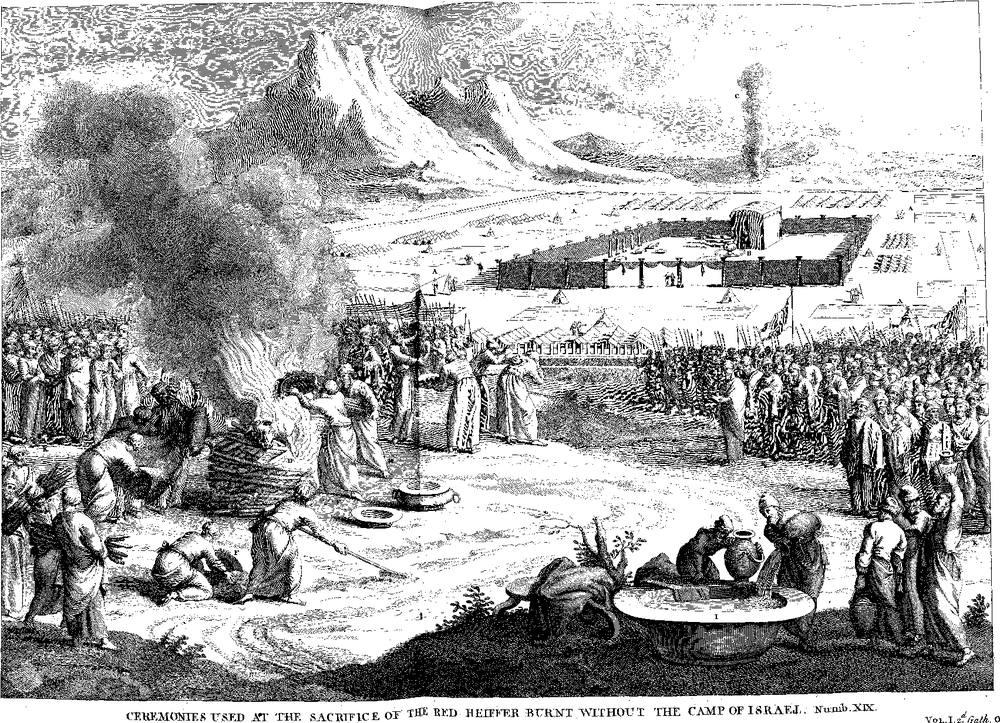
Numb. xix. 2, 3, 4, &c.HEIFER, Red Heifer. The Lord said unto Moses, “ Command the Children “ of Israel to bring unto thee a Red Heifer “ intire, and without blemish, and that has never borne the yoke. Ye shall put it into the hands of Eleazar the Priest, who shall bring it forth without the Camp, and slay it before all the people. He shall dip his finger in the blood of it, and sprinkle it seven times towards the entrance of the Tabernacle, then burn the Heifer, putting the skin and flesh, the blood and excrements of it, in the flames. The Priest likewise shall throw a bundle composed of cedar-wood, hyssop, and scarlet twice dyed, into the fire that consumes the Heifer; and having washed his body and his clothes, he shall return to the Camp, and remain unclean until the even.
“ He likewise who burnt the Heifer shall wash his body and clothes, and remain unclean until the Evening. One that is clean shall gather up the ashes of the Heifer, and carry them out of the Camp into some clean place, that the Israelites may take of them, may carefully preserve them, and make use of them for Water of Separation, because this Heifer was burnt for sin. He who carries the ashes of it, shall wash his body and his clothes, and shall be unclean until the evening. This Ordinance shall be holy and inviolably observed by the Children of Israel, and the strangers that are among them.
“ He that toucheth the body of a dead man, and for this reason contracts pollution for seven days, shall be sprinkled with this water the third and seventh day, and so shall be purified. But if he receives no aspersion on the third day, (but on the sixth day only) he cannot be purified on the seventh, (but on the tenth or eleventh only.) Whosoever toucheth the dead body of a man, and is not sprinkled with water mingled with the ashes of the Red Heifer, will defile the Tabernacle of the Lord, (if he appears there in this condition) he shall be unclean, because he was not cleansed with the water of Separation, and his Impurity shall continue upon him.”
Spencer. l. 2. c. 15. de Leg. Hebr. rit.This is what Moses has ordained relating to this matter; whereupon the Commentators have made the following reflexions. Spencer believes this Ceremony to have been instituted in opposition to the Egyptian Superstitions. The Egyptians never sacrificed Heifers, and the Hebrews generally male creatures only. The former abhor’d red hair, and all animals of the same colour. The Hebrews made no distinction in the colour of Victims but upon this occasion. St. Jerom, Hieron. Ep. 27.and many others are of opinion, that the Red Heifer was sacrificed every year, and the ashes of it distributed throughout all the towns and cities belonging to the Israelites. Some of the Rabbins maintain, that there was but one burnt from Moses to the time of Esdras; and that from Esdras to the destruction of the Temple by the Romans, there were but six, or at most nine sacrificed. The same St. Jerom informs us, that this Ceremony was performed always upon the Mount of Olives, directly over against the Temple, from the time that the Ark was fixed at Jerusalem; and the Jews tell us, that after the building of the Temple, the High-Priest always sacrificed this Victim.
There are Authors who suppose the Sacrifice of the Red Heifer to be one of those which were offered in the name of all the people. It was required that it should be Numb. xix. 2.without blemish or defect, as well as the Victims used in other sacrifices; that the blood of it should be sprinkled seven times Ibid. vs. 4. Ibid. vs. 13.towards the entrance of the Tabernacle; that it should be burnt intirely, and the ashes which remained made use of in purifying people from pollutions contracted on the occasion of any dead body, and to prevent their defiling the Sanctuary and Holy Things.
The Red Heifer, says Abrabanel, was a Sacrifice for the Sins of the whole people of Israel. It may be said, I think, to be a Sacrifice for Sin, but it cannot, in my opinion, be called an Oblation, because this is a name given only to what was offered solemnly to God upon the Altar of Burnt-offerings. The same judgment should be made of that other Heifer, the head whereof was cut off, for the expiation of any murder committed by unknown Deut. xxi. 1,—9.persons. This Sacrifice cannot be called an Oblation, because it was not made upon the Altar of Burnt-offerings; nevertheless it was a real Sacrifice for Sin, since by it an atonement was made for murder.
Hebr. ix. 13.The Red Heifer which was sacrificed without the Camp, was the Figure of Jesus Christ, whose Blood cleanses our Consciences from all our Sins. For if the blood of bulls and of goats, and the ashes of an Heifer sprinkling the unclean, sanctifieth to the purifying of the flesh; how much more shall the blood of Jesus Christ, who through the eternal Spirit offered himself without spot to God, purge your conscience from dead works to serve the living God? See the Commentators upon Numbers, chap. xix.
An Explanation of the Plate which represents the Ceremony of the Sacrifice of the Red Heifer without the Camp of Israel.
A A A A. The Camp of Israel. B. The Tabernacle of the Congregation
C. The Pillar of Cloud which in the day-time was dark, and light by night, and rested upon the Tabernacle as long as they were to continue encamped.
D. The Pile of wood on which the Red Heifer was burnt after it was slain and flay’d.
E. The High-Priest sprinkling the blood of the Red Heifer seven times before the Tabernacle of the Congregation.
F F. The Priests gathering up the blood and excrements of the Heifer, and throwing them into the fire.
G. Others burning the skin of the Red Heifer.
H. Another bringing a bundle of Cedar-wood and Hyssop, tied together with a woollen-string of a purple colour, in order to throw it into the fire.
I. The great Bason wherein the Priests, after the Sacrifice of the Red Heifer, washed themselves and their clothes before they returned into the Camp.
K. All the people of Israel assembled at the Ceremony of sacrificing the Red Heifer, the Ashes whereof were carefully collected and kept, in order to make the Water of Separation, which was used in Purifications, and Expiations of Uncleanness contracted from some dead body, to prevent the polluting of the Sanctuary, and things holy, &c.