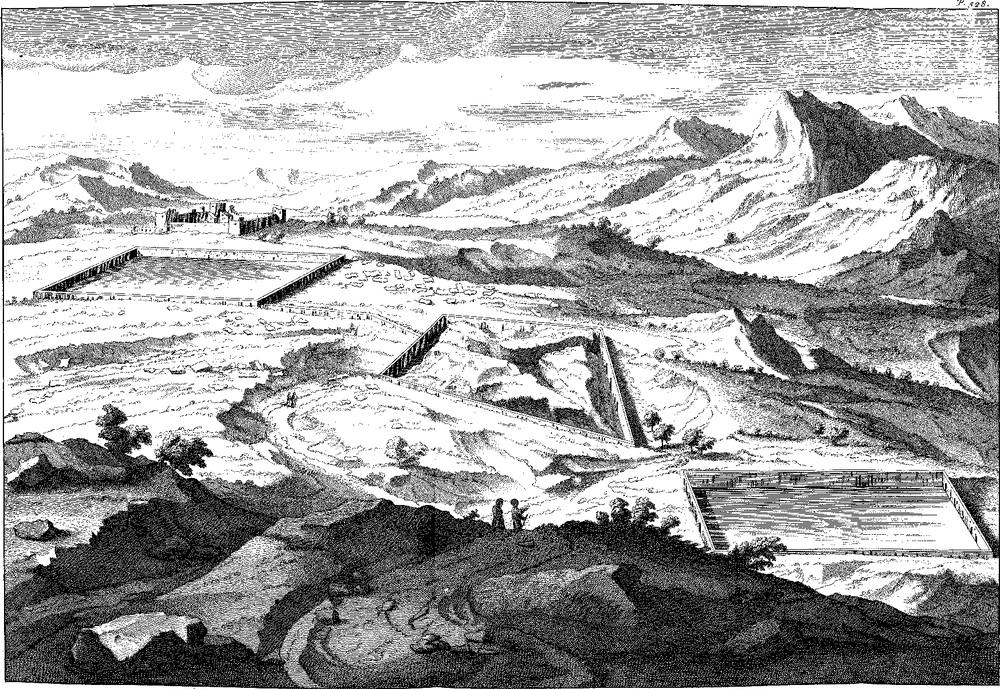
ETAN, Aitham, or Ethan, in the tribe of Judah1. It appears by the second book of Chronicles xi. 6. that Etan lay between Bethlehem and Tekoah. Josephus2 speaks of a place of pleasure called Hethan, at the distance of two Schænos’s from Jerusalem, that is to say, five leagues from that city3, whither Solomon went frequently, because this place was very agreeable for its fine gardens and waters. It was from thence probably, that Pilate some few years before the destruction of Jerusalem, brought water through aqueducts into the city, at great expence; in accomplishing which work, he was forced to take a large compass by reason of the mountains lying in the way4. Travellers speak of the fine water, and vast basons, that are still at this day to be seen in the neighbourhood of Bethlehem, which the people by tradition believe, and with a great deal of reason, to have been made by Solomon. These basons are a very magnificent work, and the water in them very fine, and in great plenty. There are three basons, the first is two hundred paces long, and an hundred wide; the second is an hundred and ninety paces long, an hundred and fifteen wide, and sixty in depth; the third is two hundred fourscore and nine paces long, an hundred ninetyseven wide, and an hundred and four in depth. The remains likewise of the aqueduct are to be seen, through which this water was convey’d to Jerusalem.
Read this article in its place on the printed pages