ערות דברἌχημον χρῆμα. Deut. xxiv. 1, 2, 3, &c.DIVORCE, or Repudiation. Moses tolerated Divorces for very good reasons. Here are his words: “ When a man hath “ taken a wife and married her, and it “ come to pass that she find no favour in “ his eyes, because he hath found some uncleanness in her; then let him write her “ a bill of divorcement, and give it in her “ hand, and send her out of his house. “ And when she is departed out of his house, “ she may go and be another man’s wife. “ And if the latter husband hate her, and “ write her a bill of divorcement, and giveth it in her hand, and sendeth her out “ of his house; or if the latter husband die, “ which took her to be his wife, her former husband which sent her away, may “ not take her again to be his wife, after “ that she is defiled, for that is abomination before the Lord.” The Commentators are very much divided concerning the sense of these words, because he hath found some uncleanness, or as the Hebrew has it, matter of nakedness in her.
The school of Shammah, who lived a little Vide Selden. Uxor Hebraïca, l. 3. c. 18. & 20.before our Saviour, taught that a man could not lawfully be divorced from his wife, unless he had found her guilty of some action which was really infamous, and contrary to the rules of virtue. But the school of Hillel, who was Shammah’s disciple, taught on the contrary, that the least reasons were sufficient to authorize a man to put away his wife: for example, if she did not dress his meat well, or if he found any other woman whom he liked better. He translated Moses’s text thus, If he hath found any thing in her, or an uncleanness. * Steph. Δίον πόλις κοιλῆς Συρίας, κτίσμα Ἀλεξάνδρου.Akiba, another famous Rabbin, was still more indulgent than Hillel; for he affirmed, that it was sufficient cause for a man to put away his wife, if she were not agreeable to her husband. After this manner he explained the text of Moses; If she find no favour in his eyes; this was the first reason: the second was, If he find any uncleanness in Joseph. Antiq. l. 4. c. 8. & lib. de vita sua ad finem. Philo de Special Legib. præcept. 6. & 7. Leo Mutin. cerem. Jud. parte 4. c. 6. Matth. v. 31, 32. Origen. Homil. 7. in Matth.her. Josephus and Philo shew sufficiently, that in their time the Jews believed Divorce to be lawful upon very trivial causes. The Hebrews at this day hold the same principles. Although a woman, says Leo of Modena, were to give her husband no occasion of complaint, he may put her away, if he be ever so little displeased with her.
But our Lord Jesus Christ has limited the permission of divorce to the single case of Adultery. It hath been said by them of old time, says he, whosoever shall put away his wife, let him give her a writing of divorcement. But I say unto you, that whosoever shall put away his wife, saving for the cause of fornication, causeth her to commit adultery; and whosoever shall marry her that is divorced, committeth adultery. Words which have been interpreted many different ways. Some by the word Adultery or Fornication have understood all sorts of great crimes, such as Idolatry, Infidelity, &c. which are sometimes mentioned in Scripture under the name of Fornication. Others have determined the meaning of this word to the single crime of real Adultery and Infidelity.
Origen is of opinion, that the Son of God named Fornication, not as the only case wherein Divorce is lawful, but as an example of those other crimes and instances, wherein this power may be used. But almost all the other Fathers and Interpreters have taken our Saviour’s words in their strict and rigorous meaning, and the practice of the Church, which is the truest Expositor of the Law, has always been agreeable to this last opinion. As to the crime of Infidelity, see St. Paul’s explanation 1 Cor. vii. 12, 13, 15.of it: As to what relates to those who are converted to Christianity, not the Lord, but I speak, If any brother hath a wife that believeth not, and she be pleased to dwell with him, let him not put her away. And the woman which hath an husband, that believeth not, and she be pleased to dwell with her, let her not leave him. But if the unbelieving depart, let him depart; a brother or a sister is not under bondage in such cases.
Another difficulty formed upon the subject of Divorce, consists in knowing whether persons separated by divorce, are at full liberty to marry again. The Law of Moses did not forbid the parties separated to marry again; and the Laws of the first Christian Emperors expressly did allow it.
Ter- Tertull. l. 4. contra Marcion. & lib. de Monogamia, &c.Tertullian believes the bond of marriage to be dissolved by Adultery, and that the woman, who is put away, may marry another man. Origen says, that in his time some Bishops Origen. Homil. 7. in Matth.gave such permission to those who were under their government. And several Councils, particularly of the Gallican Churches1, are cited, which suppose or authorize the same Custom.
But though these things have sometimes been practised, they have been almost always Concil. Eliber. c. 8, 9. Canon. Apost. 48.condemned. The Council of Elvira owns this abuse, disapproves and censures it. The Canons ascribed to the Apostles expressly enjoin, that no man who has put away his wife, shall marry another in the former wife’s life-time. The several Popes Siricius, Innocent I. Leo, Stephen, and Zachary, in their decretal Epistles do plainly proscribe these marriages, and treat them as adulteries. Lastly, the Latin Church hath always taught, that the bond of marriage still subsists, notwithstanding the most legal divorce; and the Council of Concil. Trident. Sess. 24. can. 7.Trent hath pronounced an Anathema against all those, who shall dare to say, that the Church errs, when it teaches, that the bond of marriage is not dissolved by the adultery of either party ; that the party which is innocent is obliged to live single, during the life of the other ; and that he or she who marries, after being divorced, committeth adultery. See our Dissertation on Divorces, prefixed to our Comment upon Deuteronomy.
There is all the probability imaginable, that Divorces were in use among the Hebrews before the Law, since the Son of God Matth.xix. 8. Mark x. 5.says, that Moses permitted them by reason only of the hardness of their hearts; that is to say, because they were accustomed to this abuse, and to hinder or prevent greater evils. In effect, we see that Abraham dismissed Hagar on the score of her insolence, and at the request of Sarah. Onkelos, and the Jerusalem Paraphrast, and several of the Rabbins, believe the cause of Aaron and Numb. xii. 1.Miriam’s murmuring against Moses, to have been founded on Moses’s divorcing Zipporah, as some say; or, as others, Tharbis, daughter to the King of Ethiopia. Others are of opinion, that their murmuring proceeded not from his having divorced her, but from his receiving her again after having been once divorced from her. But the truth is, that he only sent her back to Jethro, his father-in-law, for a time, and without any design of separating altogether from her. We find no example of a Divorce in all the Books of the Old Testament written since the time of Moses. The Jews them Judges xv. 2. Judges xix. 2, 3. Matth. xiv. 3. Mark vi. 17. Joseph. Antiq. l. 15. c. 11. Joseph. Antiq. l. 18. c. 7. Joseph. lib. de vita sua.selves tell us, that David was not permitted to divorce any of his wives, to marry Abishag; and that he was obliged to take her under the title of concubine, or wife of the second rank, because he had already eighteen wives, the number which by custom was allowed. The same Prince kept as long as he lived all those of his wives who had been publickly dishonoured by his son Absalom. He did not dismiss, but was content with shutting them up till their death. It is certain however, that they made too frequent use of that indulgence which the law allowed them, and that they separated from their wives upon too trifling occasions. Sampson’s father-in-law understood his daughter to have been divorced by him, since he gave her to another. The Levite’s young wife, who was dishonoured at Gibeah, had forsaken her husband, and never would have returned, if he had not gone in pursuit of her. Solomon speaks of a libertine woman, who had forsaken her husband the director of her youth, and forgotten the covenant of her God. The Prov. ii. 16, 17. Mal. ii. 15. Micah ii. 9.Prophet Malachi commends Abraham for not divorcing Sarah though she was barren; and inveighs against the Jews, who had abandoned and despised the wife of their youth; and Micah reproaches them with having cast out their wives from their pleasant houses, and taken away the glory of God from their children for ever. Ezra and Nehemiah obliged a great number of the Jews to dismiss the foreign women whom they had married, contrary to the disposition of the Law; and Solomon declares, That he who divorces Ezra xi. Nehem. xiii. 23, 24—26, 30. Prov.xviii. 22.an honest woman, deprives himself of an happiness; and that he who retains an adulteress, is a fool and a mad man2. All which proves that Divorces were not so uncommon at that time.
Josephus the Historian was of opinion, that the Laws of Moses did not permit women to divorce themselves from their husbands, and prohibited those who had so separated themselves from marrying others, without first receiving letters of divorce from their former husband. This Author believes Salome, sister to Herod the Great, to be the first who took the liberty to put away her husband. Herodias, who is mentioned in the Gospel, did likewise dismiss her husband, as is infer’d from the relation of Josephus. This Author tells us, that his own wife forsook him some little time after he had been made free by the Emperor Vespasian. The three sisters of young Agrippa, who was first King of Chalcis, and afterwards of the Trachonitis and Batanæa, used the privilege of divorcing their husbands. Berenice the Eldest put away Polemo King of Pontus, some time after she had married him. Mariamne, her sister, quitted Archelaus her first husband, to marry Demetrius, Alabarch of the Jews in Alexandria. Lastly, Drusilla the Third forsook Aziz King of Emesa, to marry Felix Joseph. Antiq. l. 20. c. 15.Governour of Judæa.
It has been a question in the Christian Church, whether women have the same privilege as men in this point, and are permitted to put away their husbands in cases of adultery. St. Basil in his Canonical Letter Basilii Ep. ad Amphiloc. c. 9.to Amphilochus owns, that the Law which permits men to put away their wives for adultery, is observed religiously; but that custom required the women to continue with their husbands, tho’ they were guilty of the same disorder. The Greeks, who have explained In Canonem 8. Apostolorum.the Apostolical Canons, pretend it is a custom which has always been observed amongst them, that the wife cannot leave her husband for adultery. We have before taken notice, that Josephus the Historian did not believe the women to have any liberty from the law of Moses to forsake their Husbands. In consequence of these principles, some of the primitive Christians3 allowed a man, who had put away his wife, to marry another, but they did not grant the woman the same privilege.
But others4 indulge the same liberty to both the man and woman of divorcing, and even of proceeding to a second marriage. St. Justin the Martyr speaks of a Christian woman who sent letters of divorce to her husband, who lived in a disorderly manner. St. Jerom mentions Fabiola a Roman Lady, who forsook her Husband on the score of his irregularities. The Greeks still at this day have a custom of divorcing in the particular case intimated in the Gospel, and even after Matth. v. 32.this to marry, as if the bond of marriage were dissolved by adultery; and the Fathers of the Trentin Council, upon the remonstrances Concil. Trident. Can. 6. Vide Fra. Paolo Hist. Concil. Trident. l. 8.of the Venetians, who had many Greeks in their dominions that observed this custom, condescended to prepare their Canon in such a manner, as, without approving marriages of this kind, salves the doctrine of the Latin Church, which follows a contrary usage. Anathema to all such as dare affirm, that the Church errs in teaching according to the doctrine of the Gospel, and the Apostles, that the band of marriage is not dissolved by the adultery of either of the parties; and that each of the parties, even the innocent one, is obliged to continue single during the life of the other, and that he or she who marries after a divorce, committeth adultery.
Prov. xviii. 22. Concil. Neocæsar. c. 8.The wise man seems to make a precept of Divorce in cases of adultery, saying, He who lives with an adulteress, that is to say, who does not procure to be divorced from her, is a fool and a mad man. The Council of Neocæsarea enjoins a Priest to put away his wife, if she is guilty of adultery after her husband’s ordination. St. Austin seems to Aug. l. 2. Retract. c. 19.have understood the same passage in the Proverbs, as containing a precept. St. Jerom explains himself much in the same sense, in his Comment on St. Matthew. But St. Paul in advising the wife to be reconciled 2 Cor. vii. 10, 11.to her husband, shews sufficiently what the intention of our Saviour was, and the generality of the Fathers have always dissuaded divorcing, and recommended reconciliation.
Among the Jews, Divorces have become much more uncommon, since their dispersion among nations, which do not permit the dissolution of marriages upon light occasions: Leon. de Modene, partie 4. c. 4, & 6. See likewise Basnage Hist. des Juifs, l. 7. c. 22. art. 20.nevertheless, there are still at this day some Divorces to be observed among the Jews and their wives. A jealous husband at first requires his wife to forbear seeing the man of whom he is suspicious; if after this there is a current report that she continues to converse with her gallant, and they are found together, particularly in the fact, then the Rabbins enjoin him to divorce her for ever, whether he is willing or not: notwithstanding, the woman is at liberty to marry again, as she shall think proper; provided it be not with the person who gave occasion for the Divorce.
A young girl under ten years of age, whether she has or has not a father, after she has married a husband, if this husband be not agreeable to her, may be unmarried, till she comes to the age of twelve years and a day, at which time she is reputed a woman. It is sufficient for her to declare, that she is not willing to have such an one for her husband, and takes two witnesses of this declaration, who set it down in writing; after which, she may marry whom she pleases.
To prevent the abuses which the Jewish men might make of this liberty of divorcing, the Rabbins have appointed many formalities to be observed, which waste much time, and give the married couple leisure to be reconciled, and live well together. Where there is no hope of accommodation, a woman, a deaf man, or a Notary draws the letter of divorce. He writes it in the presence of one or more Rabbins; it must be written on vellum ruled, containing only twelve lines in square letters, and abundance of little trifling particulars are to be observed, as well in the characters as in the manner of writing, and in the names and surnames of the husband and wife. Besides, he who pens it, the Rabbins and the witnesses ought not to be relations, either to the husband or wife, or to one another.
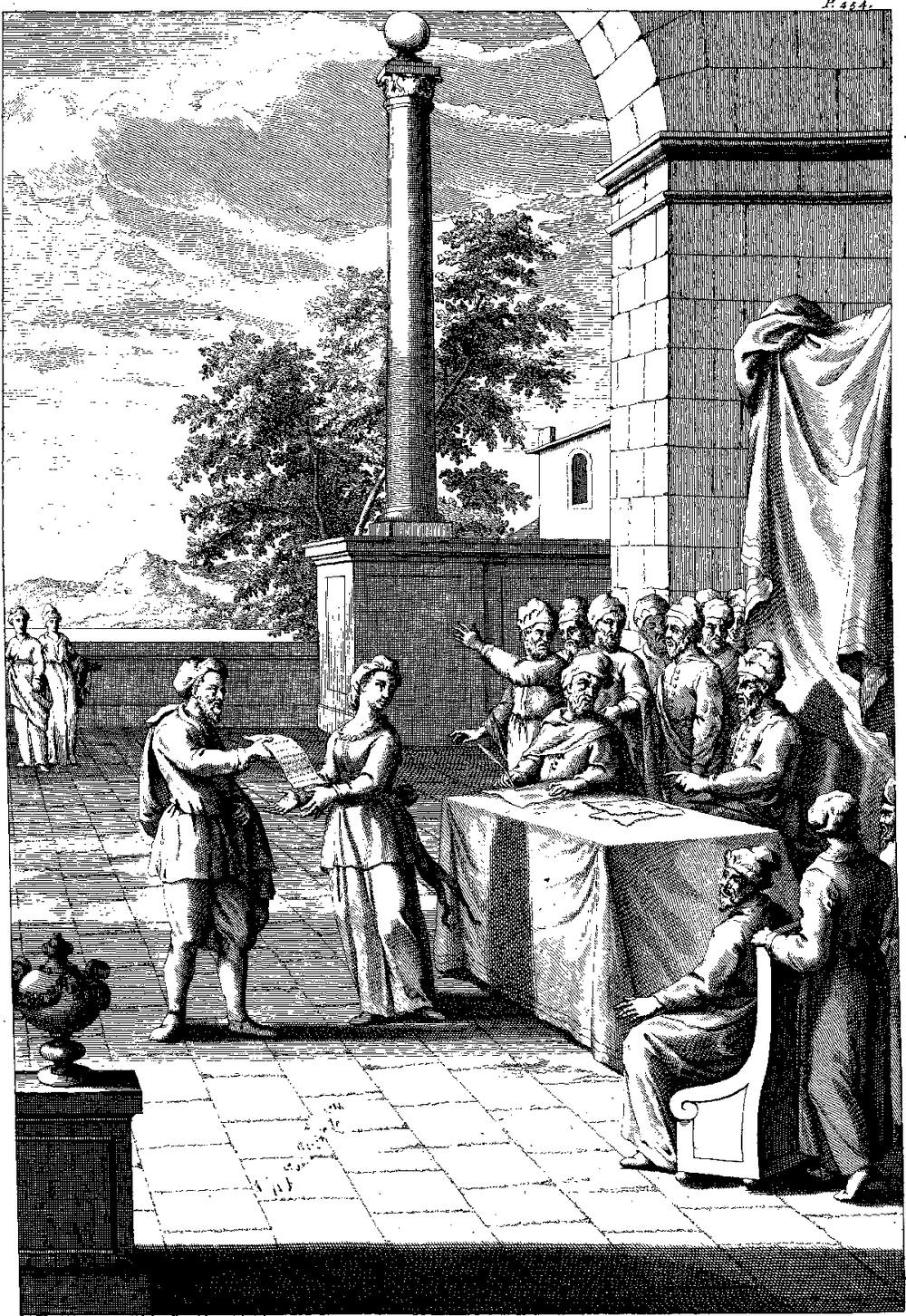
The substance of this Letter, which they call Gheth, is as follows: On such a day, month, year, and place, I N. divorce you voluntarily, put you away, restore you to your liberty, even you N. who were heretofore my wife, and I permit you to marry whom you please. The Letter being written, the Rabbi examines the husband closely, in order to learn whether he is voluntarily inclined to do what he has done. They endeavour to have at least ten persons present at the action, without reckoning the two witnesses who sign, and two other witnesses to the date. After which, the Rabbi commands the wife to open her hands, and bring them close to one another, in order to receive this deed, left it fall to the ground; and after having examined her over again, the husband gives her the parchment, and says to her, Here is thy divorce, I put thee away from me, and leave thee at liberty to marry whom thou pleasest. The wife takes it, and gives it to the Rabbi, who reads it once more, after which she is free. Many little circumstances are omitted, which were invented only to make this action more difficult. Afterwards the Rabbi cautions the Woman against marrying within three months, lest she should be with child. From this time the man and woman are not to continue alone in any place, and each of them may marry again.
Read this article in its place on the printed pages
Footnotes
-
Concil. Arelat. 1. Can. 10. Concil. Aurelian. 2. c. 11. Vermer. c. 5, 6, 11, 17, 20. Compendiens. c. 16. Synod. Hibern. S. Patricii an. 314. c. 16. ↩
-
Translators’ note. The Passage here cited by the Author is taken from the Vulgate; we find it in this Version and the Septuagint, but in the Hebrew original there is not one word of it; consequently it is not to be sought for in our English translation, which keeps punctually to the Hebrew. ↩
-
See St. Basil to Amphilochus, c. 9. Ambrosiast. in 1 Cor. viii. 10, 11. Concil. Eliberit. c. 9. ↩
-
Const. Apost. l. 3. c. 1. Epiphan. hæres. 59. Origen. in Matt. xix. 8. Pollent. apud Aug. l. 1. de adulterin. conjug. c. 6. ↩