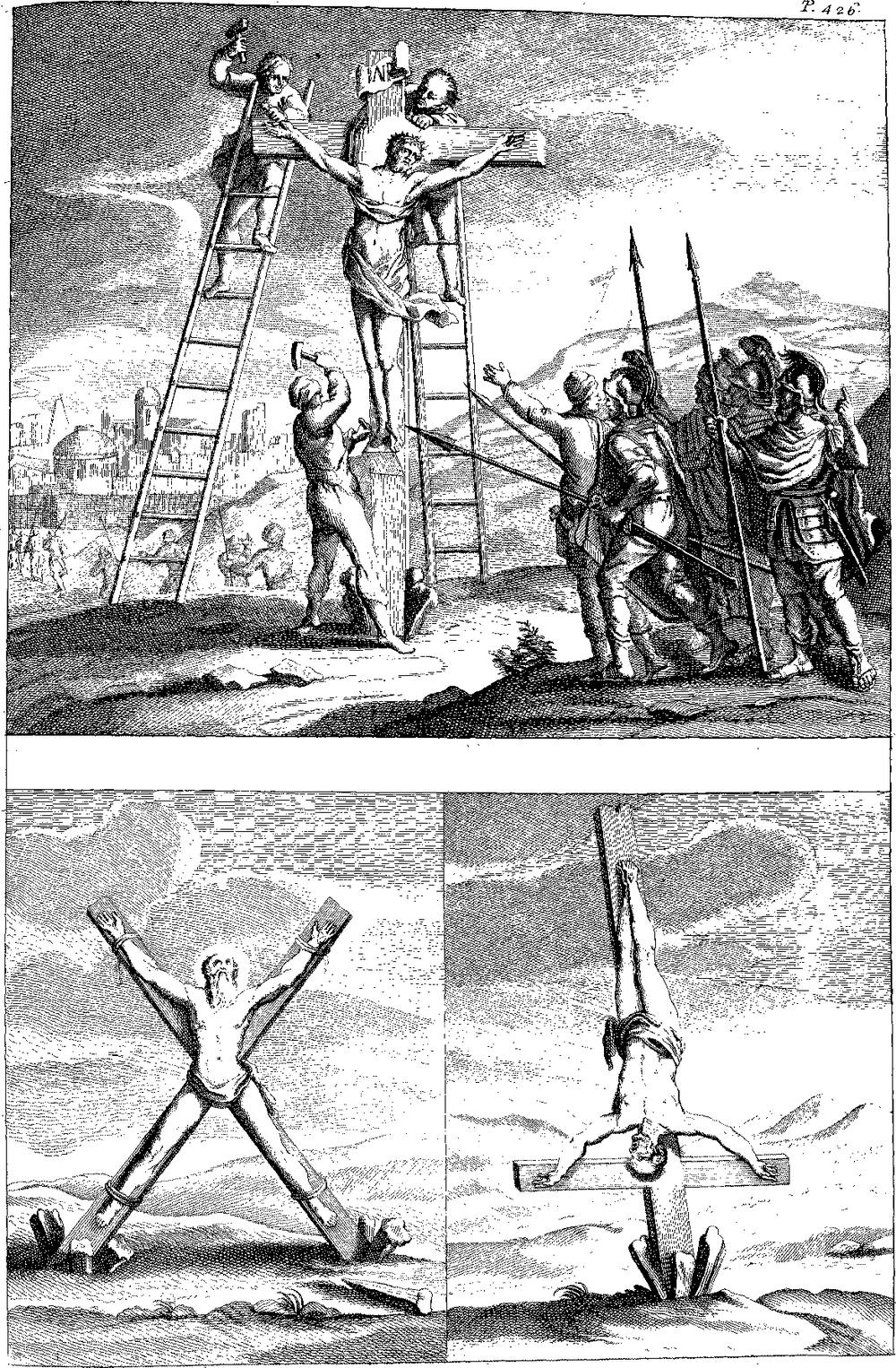
CROSS. By the word Cross, we understand a Gibbet made of two pieces of wood put cross-wise; whether they cross with right Angles at the top of one of them, or in the middle of their length, or like a S. Andrew’s Cross, or fork-wise. The Greek, Stauros, which signifies a Cross, is put often for a piece of Wood only fixed in the Ground, by the Latins called Palus or Vallum: But the Cross properly speaking, resembles a T, and the Cross which Jesus Christ was nailed to, is commonly believed to have been of this sort. The Cross was the punishment of the vilest Slaves; it was called Servile supplicium1. To be crucified was a great mark of Infamy to Soldiers, Officers, and Men of Quality. This Penalty was so common among the Romans, that Pains, Afflictions, Troubles, and unprosperous Affairs were called Crosses, and the verb cruciare was used for all sorts of Chastisements, and Pains of Body and Mind.
The Punishment of the Cross was common among the Syrians, Egyptians, Persians, Africans, Greeks, Romans and Jews. Pharaoh’s chief Baker was beheaded, according to Joseph’s prediction, and his Carcase afterwards fastened to the Cross. Haman prepared a great Cross to hang Mordecai upon, but he was himself executed upon it. Joshua gave orders for hanging the King of Ai upon a Cross. Moses in like manner hung the Princes of Israel upon Stakes or Crosses, who had fallen into the abominations of Baal-peor. Numb. xxv. 4.Every one knows, that this Punishment was very common among the Greeks and Romans, and it is needless to produce proofs and examples of it; which are every where to be met with in History.
The Jews confess, that indeed they crucified People in their Nation, but deny that they inflicted this Punishment on any alive: They first put them to death, and then fastned them to the Cross, either by the hands or neck; accordingly many instances are to be met with of Men thus hung upon a Stake after death. But there are indisputable proofs to be produced, of their crucifying men frequently alive. The worshippers of Baal-peor and the King of Ai, whom we have mentioned, were hung up alive, and so were the Descendants of Saul, who were put into the 2 Sam. xxi. 9. Psal. xxii. 17. Zech. xii. 10.hands of the Gibeonites. The Psalmist speaking of the death of the Messiah, says, They pierced my hands and my feet, I may tell all my bones. The Prophet Zechary says, that at the day of Judgment, the Jews shall look upon him whom they have pierced with Nails. Aspicient ad me quem confixerunt. Josephus2 relates, that Alexander King of the Jews having ordered eight hundred of his rebellious Subjects to be crucified, commanded their Wives and Children to be executed before their Eyes at the foot of their Cross, while they were yet living. See our Dissertation on the capital Punishments of the Jews, prefixed to the Comment upon Deuteronomy, p. xlii, &c.
Deut. xxi. 22.The Law ordained, that the persons executed should not be left upon the Cross after Sun-set, because he that is hanged in this manner is cursed by God. His Body shall not remain all night upon the tree, but thou shalt in any wise bury him that day; for he that is hanged is accursed of God. The King of Ai having been crucified by Joshua’s Orders, his Body was left upon Josh. viii. 29, 30.the Cross no longer than till the evening. The Jews3 believe, that the Souls of those who remain upon the Gibbet, and without burial, enjoy no peace, and receive no benefit from the Prayers of other People, but wander up and down till their Bodies are buried; which agrees with the notion which the Greeks and Romans had of this matter. Homer Iliad 4. and Virgil’s Æneid. 6.
Nec ripas datur horrendas & rauca fluenta
Transportare prius quam sedibus ossa quierint.
The Cross which our Saviour was nailed to, was made in the form of a T, that is to say, of the old Samaritan Tau4, which resembled the Greek Tau, and not that of the present Hebrews. But we are not to understand it so rigorously; for the Tau is one line drawn over another at right Angles, whereas our Saviour’s Cross represented a line crossing another at right Angles, and traversing it. . Thus old Monuments, the Coins of the Emperor Constantine, and the antient Crosses describe it to us. S. Jerom v compares it to a Bird flying, a Man swimming, or praying with his Arms extended like a Cross. Besides the Trunk therefore, and the Arms, there was a piece of Wood which rose above them: And on this Pilate ordered the following words to be inscribed, Jesus of Nazareth King of the Jews, which exposed the Crime whereof our Saviour was supposed to be guilty.
Sometimes the Criminal was crucified on a Tree, and fastened to it with Cords: After this manner Tiberius ordered the Priests of Saturn to be crucified at Carthage upon Trees, before the Temple of their God: w Saturni sacerdotes in eisdem arboribus templi sui obumbratricibus scelerum, votivis crucibus exposuit. Ausonius5 after this manner describes Cupid crucified on a Tree.
Hujus in excelso suspensum stipite Amorem Devinctum post terga manus, substrictaq; plantis Vincula mœrentem, nullo moderamine pœnæ Affigunt.
Sometimes he that suffered was fastned with his Head downwards: Thus S. Peter chose to be crucified, out of respect to his Master Jesus Christ, not thinking himself worthy to be fixed to the Cross like him6. Seneca speaks of this punishment7, Alios converso capite in terram supendere.
Eusebius8 remarks, that in Egypt the same Punishment was inflicted upon several Martyrs. Sometimes a Fire was kindled at the foot of the Cross, that so the Sufferer might perish by the Smoak and Flame. The Emperor Alexander Severus, commanded one to be executed in this manner, who was a Cheat, a Quack, and a dealer in Smoak, that by this means there might be some relation between his Crime and his Penalty9. Præcone dicente: fumo punitur qui fumum vendidit.
The common way of crucifying was by fastening the Criminal with Nails, one at each Hand, and one at both his Feet, or one at each of them; for this was not always performed in the same manner; the Antients representing Jesus Christ to us, as sometimes crucified with four Nails10, and sometimes with three11: They were likewise bound frequently with Cords; and this Penalty which seems in one sense gentler, because it occasions less pain, in another was more cruel, because the condemned Person by this means was made to languish for a longer time. Arbori infelici recte suspendite12. S. Andrew is said to have been thus fastened to the Cross with Cords;13 he continued also three days alive upon it. Our Saviour in the following words, foretold, that S. Peter would die upon a Cross. When thou wast young thou girdest thyselfand walkedst whither thou wouldest: But when thou shalt be old, thou shalt stretch forth thy hands, and another shall gird thee, and carry thee whither thou wouldest not. They who were going to be nailed in this manner to the Cross, were so girt about:14 Tunc Petrus ab altero cingitur, cum cruci adstringitur. They were loaded with Fetters, and so led to the place of Execution, where they were fastened to the Cross with Cords15.
Sometimes they used both Nails and Cords. Lucan speaking of one who had been crucified, who was afterwards taken down from the Cross, says16,
Laqueum nodosq; nocentes Ore suo rupit. Insertam manibus chalybem, nigramq; per artus Stillantis tabi saniem, virusq; coactum Sustulit.
Altho’ the condemned person was generally fixed to the Cross with Nails; yet sometimes it was otherwise. The holy Martyr Pionius having been sentenced to undergo this Punishment, stript himself, extended himself upon the Tree, and gave his Members to the Soldiers to be fastened with Nails. When they used both Cords and Nails, there was no inconveniency in lifting up the Person who was to suffer together with the Cross, he was sufficiently upheld by the Cords, and people concerned themselves very little about lessening the Pains and Torments of a Malefactor condemned to die in this manner.
Before they nailed him to the Cross, they generally scourged him with Whips, or leathern Lashes, which was thought to be severer, and more infamous than to be scourged with Cords. Sometimes little Bones, or pieces of Bones were tied to these Scourges, that so the condemned person might suffer more severely. Our Saviour was cruelly scourged during his Passion. Pilate having pronounced Sentence against him, ordered him to be scourged, and delivered him up to be crucified. Mat. xxvii. 26.Slaves when guilty of any great Crime, were often fastened to a Gibbet or a Cross; and in this condition they were led about the City, and beaten with Rods.17 After this manner our Saviour was loaded with his Cross; and as he sunk under the burthen, Simon the Cyrenian was constrained to bear it after him, and with him.
The Criminal was crucified quite naked18. The Saviour of the World in all probability, was not used more tenderly than others, upon whom this Punishment was inflicted. The Soldiers divided his Cloaths among them, and cast Lots for his Mat. xxvii. 3. John xix. 23, 24.Tunick, which is an under Garment, worn over the Flesh like a Shirt. Christians out of respect, and a principle of Modesty, have represented Jesus Christ covered in a decent manner, sometimes dress’d intirely,19 sometimes covered from his Loins to his Knees, and sometimes with those parts only covered with a Vail which Modesty requires us to conceal: But this does by no means prove the general practice to be such, nor that they had this regard to Jesus Christ, whom they did not know, and whose design it was to load himself with the Shame and Punishment of our Sins.
Several Questions have been started concerning our Saviour’s Cross. Some20 think that it was made of four different pieces of Wood, viz. Cypress, Cedar, Pine and Box. S. Bernard21 says, it was made of Cypress, Cedar, Olive and Palm Wood. The Foot or Basis of it was of Cypress, the Top of it of Cedar, the Chapiter of it, if it may be so called, was of the Olive Tree, and the Arms of the Palm Tree. Proba Falconia in her Rhapsodies, says, it was made of Oak.
Ingentem quercum divisis undique ramis Constituunt.
The Author of Historia Scholastica, and many others after him, tell us, that the Queen of Sheba, as she entered Solomon’s Palace, which was called the House of Cedar, took notice of a Beam there, which, as she foretold, would at some time or other be made use of in the execution of a Man, who should cause the Destruction of all Israel. Solomon, to prevent this Misfortune, ordered, as they say, that this Beam should be buried in that very spot where the Pool was in the Sheep-Market, which is taken notice of in S. John. At the time John v. 2, 3, 4.of our Saviour’s Passion, this piece of Wood was discovered, and used in making up his Cross. Others not content with these Fables, add further, that Seth, the third Son of Adam, going to Paradise, procured of the Angel, who kept guard there, three kernels of the Tree of Life, which he planted on his Father’s Grave. From these three Kernels sprung three little Wands, which joined together, formed the Beam of Solomon’s Palace lately mentioned tioned, which was afterwards used in the Crucifixion of our Saviour. But the bare relating of such Fables, is doing them too much Honour.
Some say, this Cross was fifteen Foot high; that the Arms of it were seven or eight Foot long; that the Top on which the Title or Sentence of Christ’s Condemnation was fastened, was a piece of Wood added afterwards, with a Board on which these words were written, Jesus of Nazareth King of the Jews. But it is not easy to get any certain knowledge of these matters, which neither the sacred Writers, nor the primitive Fathers take any notice of. Those Authors who have spoken of them, are too modern to prove a matter of fact of this Nature.
Painters commonly represent the Cross to be pulled down, when our Saviour is fastened to it, and afterwards to be set up again, and the Body of our Saviour to be raised with it: Speculative persons make use of these Considerations to aggravate the excess of pain which he endured at his Crucifixion. But this opinion is not at all probable. Is it common to have the Gibbet first pulled down, when the Criminal is to be hang’d upon it, in order afterwards to put it up again, when the person to be executed is fastened to it? The shaking and motion of the Cross, together with the weight of the Body, might, without any thing else, have broken the crucified person’s Hands and Feet, and have loosened him from the Cross with inexplicable Pains. Nonnus, Author of the Tragedy intitled, The suffering Jesus; S. Austin, and the most learned Interpreters22, are of opinion, that J. C. was nailed to the Cross, as it stood already erected.
It has been the opinion of some23, that below the crucified Person’s Feet, there was a kind of Footstool, or piece of Wood jutting out, upon which his Feet were laid and fastened. S. Gregory of Tours24 particularly intimates this, and there are many Crosses to be seen made after this manner. It must be confessed, that without this the Criminal could not continue long nailed to the Cross, the whole weight of his Body bearing upon his Hands. But others assert25, that there are no marks of this Footstool to be seen in the descriptions of the Cross, which the most antient Greek and Latin Writers have left us. But they speak of a kind of wooden Horse, upon which the suffering person was, as it were, mounted, that so his Hands might not be torn asunder by the weight of his Body. This was a large Peg fixed about half way the Cross: As appears very clearly in Justin26, Irenæus27, and Tertullian28: And the same is asserted by several able criticks29.
In the Article Wine, we shall speak of the Wine made of Myrrh, which was given our Saviour to drink upon the Cross. Sometimes they who were fastened upon the Cross, lived a good while in that Condition; S. Andrew is believed to have continued three days alive upon it. Eusebius speaks of certain Martyrs in Egypt30, who were kept upon the Cross till they were starved to death. It is said, that S. Victorinus the Martyr lived three days upon the Cross31, and that the Saints Timotheus and Maanes lived nine days upon it32. Pilate was amazed at Jesus Christ’s dying so soon, because naturally he must have lived Mark xv. 44.longer, if it had not been in his Power to have laid down his Life, and to take it up again. The Thighs of the two Thieves were broken, in order to hasten their death, that their Bodies might not remain upon the Cross on the Sabbath day, and to comply with the Law of Moses, which forbids John xix. 31, 32, 33. Deut. xxi. 22.the Bodies to be left there after Sun-set.
But among other Nations they were suffered to continue there a long time. Sometimes they were devoured alive by Birds and Beasts of Prey33.
———Cruxillum tollat in auras,
Viventesque oculos offerat alitibus.
And generally they were devoured after their death by Wolves, Dogs, and Birds: If the Crosses were higher than usual, they either were a prey to the Birds, or putrified, and fell in Pieces. Guards were appointed to observe, that none of their Friends or Relations should take them down, and bury them34. The History of the Ephesian Matron, and the Soldier who was set to guard the Crosses, is very well known. The Roman Soldiers, who had crucified Jesus Christ and the two Thieves, continued near the Crosses, till the Bodies were taken down from thence.
The Hebrews do not pray for those of their Nation who are left hanging on the Gibbet, or at least they do not pray for them in publick, and in the Synagogue, as is the practice for other dead persons during eleven Months immediately after their decease35. Besides, they did not permit the Relations of the Persons executed to place their Kinsmen in the Tombs belonging to their Families, till their Flesh had been first consumed in the publick Sepulchres36: Then they were allowed to remove their Bones into private Sepulchres. It was perhaps for this reason, that Joseph of Arimathea desired leave from Pilate, to lodge the Body of Jesus in his own Tomb, that he might not be thrown into the publick Burying-place appointed for Criminals.
Gal. ii. 19. Idem vi. 14.Jesus Christ says often in his Gospel, that he who would be his Disciple, must take up his Cross and follow him: The Cross is the sign of Ignominy and Sufferings; it is, as I may say, Gal. v. 24.the Device and Glory of Christians. S. Paul says, that he is crucified with Jesus Christ, and that he glories only in the Cross of Christ; that they who are Christ’s have crucified the flesh with the affections and lusts. Jesus Christ is the way that we are to follow: There is no attaining to that Glory and Happiness which is promised to us by any other means than by the Exod. xxv. 11. & xxviii. 36, 37.Cross.
Read this article in its place on the printed pages
Footnotes
-
Lipsius de cruce, l. i. c. x. 12. ↩
-
Joseph. l. xiii. c. 22. Antiq. ↩
-
Talmud, tract. Sanhedr. Rab. BarNachman in Berefchith Rabba c. 22. ↩
-
Hieronym. in Ezek. c. ix. v Idem in Marc. xi. w Tertull. in Apolog. c. 8. ↩
-
Auson. in Cupidine affixo. ↩
-
Chrysost. in Petr. & Paul. Abdias in Petro, &c. ↩
-
Senec. Consol. ad Matr. c. ↩
-
Euseb. Hist. Eccl. l. viii. c. 8. ↩
-
Lamprid. in Alexan20. dro. ↩
-
Cyprian de Passione: clavis ↩
-
Greg. Naz. carm. de Christo Pasacros pedes terebrantibus. tiente. ↩
-
Tit. Liv. l. i. ↩
-
Abdias l. iii. Hist. Apostol. ↩
-
Tertull. in Scorpiac. ↩
-
Theophylact. in Joan. ↩
-
Lucan l. vi. de Magâ Thessalâ. ↩
-
Lips. l. iii. c. 5 de cruce & l. ii. c. 2, 3. ↩
-
Lips. l. ii. de cruce c. 7. Artemidor. Γυμνοὶ γὰρ σταυροῦνται. ↩
-
I have seen in the House of Refuge belonging to the Abby of Epternach at Luxemburg, a Manuscript Volume containing the four Gospels in Gold Letters, of a Royal Magnificence and Beauty, given by the Emperor Otho, and the Empress Theophania, wherein our Saviour and the Thieves are represented upon the Cross dress’d in all their Cloaths. ↩
-
Chrysost. seu alius Serm. de cruce Beda in Collectam. ↩
-
Bernard in Cant. vii. v. 8. ↩
-
Vide Bynæum de morte Christi l. ix. c. 6. art. 7. Lips. de cruce l. ii. c. 7. ↩
-
Lips. not. in l. ii. de cruce c. 10. Fuardent. not. in Iren. l. ii. c. 42. Neus. in Nonni Par. in Joan. xx. 18. ↩
-
Gregor. Turon. de Gloria Martyr. l. i. c. 9. ↩
-
Scaliger. Anim. in Euseb. digress. de litter. Gonicar. origine lit. T. Bynæus de morte Christi, l. iii. c. 5. art. 11, 12, 13. ↩
-
Justin. Dial. cum Tryphone. ↩
-
Iren. l. i. c. 46. ↩
-
Tertull. l. ii. contra Nationes. ↩
-
Scaliger. loco citato. Salmas. de cruce. Bartholin. de latere Christi aperto, & de cruce. Bynæus t. iii. c. 5. art. 12. ↩
-
Euseb. l. 8. c. 8. τηρούμενοι τε ζῶντες εἰσὶν καὶ ἐπ’ αὐτῶν θηρίων λιμῷ διαφθαρεῖεν. ↩
-
Martyrol. 5. Sept. ↩
-
3 Maii Martyrolog. ↩
-
Prudent. περὶ στεφάν. Cor. xi. ↩
-
Vide Lips. de cruce l. ii. c. 15, 16. ↩
-
Bar. Nachman in Bereschit. Rab. c. 22. Thalmud. ↩
-
Mishna c. 6, 4, 14, 15. ↩