CONFESSION. The publick or private Declaration which any one makes of his Sins to a Minister, who has the power of absolving, in order to receive Penance and Absolution, is called Confession. S. Matthew Mat. iii. 6.says, that the Jews came from all parts to confess their Sins to John the Baptist, and receive Baptism; S. James requires us to confess our Sins to one another, that so we may be saved; and S. John says, that if we confess our Sins, God is faithful and just to forgive them.
The Confession required by S. John Baptist, of those who desired to be partakers of his Baptism, was not only a general Declaration, whereby they acknowledged themselves to be sinners, or an indefinite Confession of faults committed by them in thought or deed, or by omissions; but it was a definite and particular Declaration of such Offences as they might have committed against the Law, like that which the Hebrews made when they put their hands upon the head of the Sin-offering. Moreover, the Baptism of John did not really remit the Sins which were thus confessed: he only promised the forgiveness of them, which was received by the Baptism of Jesus Christ. Ut ab eo baptizatis in spe remitterentur peccata, re-ipsa vero in Domini baptismo id fieret1. He was not satisfied even with this Confession, and the inward Sorrow which was to accompany it, he required Mat. iii. 8. Acts xix. 18.fruits meet for repentance.
We see in the Acts of the Apostles, that the Gentiles who were converted, came and confessed their Sins at the feet of the Apostles: Multi credentes veniebant confitentes & annuntiantes actus suos. The Jews at present confess much after the same manner as the Romanists on their Death-bed2. The most ignorant have a general form of Confession, which they repeat. Others express their Sins more particularly. They confess likewise their Sins in the beginning of the year, standing in a Tub full of water. There are two and twenty words in their form of Confession, as many as there are Letters in the Alphabet; and as often as they pronounce any word in the Confession, one who is present thrusts their Heads into the water, and the Penitent smites his Breast with his right Hand3.
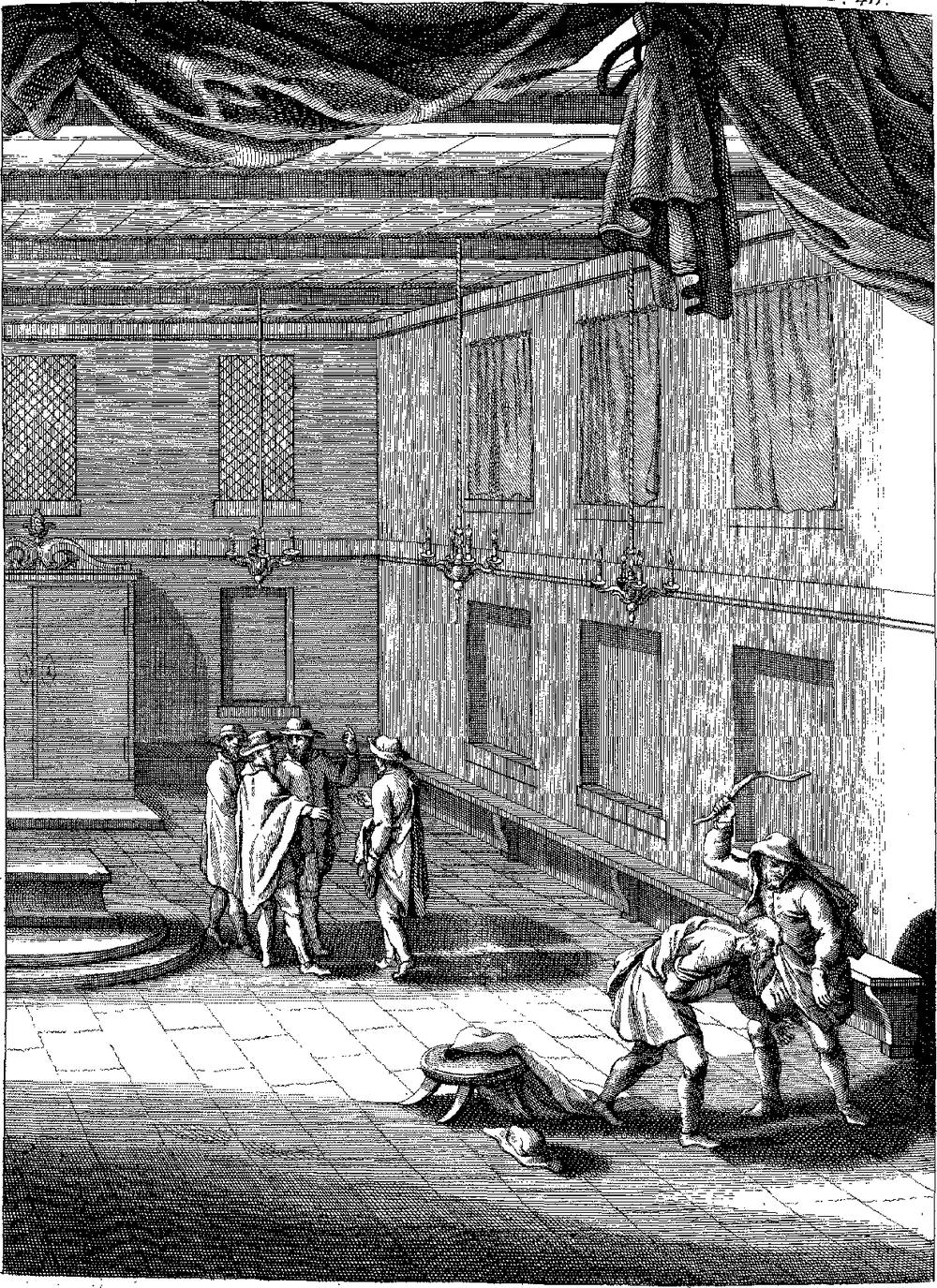
Upon the great day of Expiation, they confess themselves after the following manner4. Two Jews retire into a corner of the Synagogue, one bows very low before the other, with his Face turned towards the North: He who performs the Office of Confessor, gives the Penitent nine and thirty blows upon the back with a leathern strap, repeating these words, God being full of Ps. lxxvii. 38.Compassion, forgave their iniquity, and destroyed them not; yea many a time turned he his Anger away, and did not stir up all his Wrath: And as there are but thirteen words in this verse recited in the Hebrew, he repeats it three times, and at every word strikes one blow; which makes nine and thirty words, and as many Lashes. In the mean time the Penitent declares his Sins, and at the Confession of every one, beats himself upon his Breast. This done, he who has performed the Office of Confessor, prostrates himself on the ground, and receives nine and thirty Lashes from his Penitent.
Grotius5 on S. Matthew explains himself in a remarkable manner, with relation to private Confession. As to the Question, says he, which is proposed among learned Men, namely, whether the Passages in Numbers and Leviticus, wherein mention is made of Confession, refer to a Man’s confessing himself to God only, or whether every one ought to declare his Sins to the Priests: I hold their opinion to be very probable, who maintain, that a particular Confession was made by every one of his Sins to the Priests, in cases which did not expose the guilty to the penalty of Death; for in other cases it was sufficient for them to accuse themselves in general; and it is very credible, that the same thing was observed with still more Piety and Confidence, by those who came to John the Baptist, who was both Priest and Prophet; and besides, one whose fidelity was very well known .
Read this article in its place on the printed pages