I. BETH-LEHEM, or Beth-lechem, the house of bread, a City in the Tribe of Josh. xvii. 7.Judah, generally called Bethlehem of Judah, to distinguish it from another of the Josh. xix. 15.same name in the Tribe of Zebulun. It is called likewise Ephratah, and its inhabitants Genes. xlviii. 7. Mich. v. 2. Ruth i. 2. and 1 Sam. xvii. 12.Ephrateans. This City was not at all considerable for its extent or riches, but was infinitely so on the score of the Messiah’s Birth. Micah extolling this advantage peculiar to Bethlehem, says, Thou Bethlehem Ephratah, though thou be little among the thousands of Judah, yet out of thee shall he come forth unto me, that is to be Ruler in Israel1. He had no design certainly of describing David, who was born at Bethlehem so many Ages before; but Jesus Christ who came into the world here many Ages after.
Several difficulties are proposed relating to the Prophecy of Micah, which foretells the Birth of the Messiah at Bethlehem. Matth. xi. 6. Micah v. 2.In the first place S. Matthew reads, And thou Bethlehem of Judah art not the least of the Cities of Judah; whereas the Text of Micah runs thus, And thou Bethlehem though thou be little among the thousands of Judah. And secondly Micah says, Out of Judah shall he come forth unto me, that is to be the Ruler in Israel, whose goings forth have been from of old, from everlasting. It is objected therefore that there is a contrariety between S. Matthew and Micah, one of whom says that Bethlehem is too small to be reckoned among the most considerable Cities of Judah; the other on the contrary says, that it is not one of the smaller Cities of Judah.
But to this it is answered, that S. Matthew might have read the Text of Micah with an interrogation, in this manner, And thou Bethlehem, art thou too small to be ranked with the great Cities of Judah? Thus he had very well explained the sense of the Prophet, Thou art not one of the small Cities of Judah. Besides some Criticks2 maintain, that the Hebrew, Zehir, which is generally translated small, signifies likewise the contrary, and for a proof of it, Jeremiah is cited xlviii. 4. xlix. 20. Zach. xiii. 7. where Zehir3, as the Jews agree, signifies Heads, Principal of the people. Micah v. 2.Lastly, S. Jerom4, and several others after him, are of opinion, that S. Matthew produced the passage in Micah historically, not as it was written in that Prophet, but as it had been proposed by the Priests, with an intention by the way, of reflecting on their ignorance and negligence.
As to the second difficulty, the Jews are generally very ready to acknowledge, that the Messiah should come out of Bethlehem, but they maintain, that this Messiah is not Jesus, and that the Prophecy of Micah has no regard either to Jesus or the Messiah. He whom Micah speaks of, shall be Ruler in Israel: And ver. 3. The remnant of his Brethren shall be converted, and reunited with the children of Israel. Jesus never reigned over Israel, and if he is God, can have no Brethren. Besides, to confine the Kingdom of the Messiah to Israel would be too much a limitation of it. Ex te egredietur, qui sit dominator in Israel. The answer to this is, that Jesus, as God, had no Brethren, but as the Son of Mary he had. The Prophet in this place very well distinguishes his temporal Birth at Bethlehem, and his eternal Birth, His goings forth have been from of old, from everlasting. It is no more contrary to the greatness of the Messiah to say, that he will reign over Israel; than it is for God to call himself in so many places the God of Israel. This does not exclude the dominion either of the one, or of the other over the rest of mankind, and over other creatures.
Bethlehem is situated upon the declivity of a hill, six miles5 or two leagues from Jerusalem. Josephus6 seems to place it at the distance only of thirty furlongs, or three miles and seven hundred and fifty paces from Jerusalem: Justin Martyr7 at five and thirty furlongs, which make four miles three hundred and seventy five paces. But it is very probable, that the cyphers which denote this distance, are changed in these two Authors; for all others, as well ancients as moderns, constantly describe the distance to be two leagues between Jerusalem and Bethlehem. S. Jerom8 makes it six and forty miles from Joppa to Bethlehem.
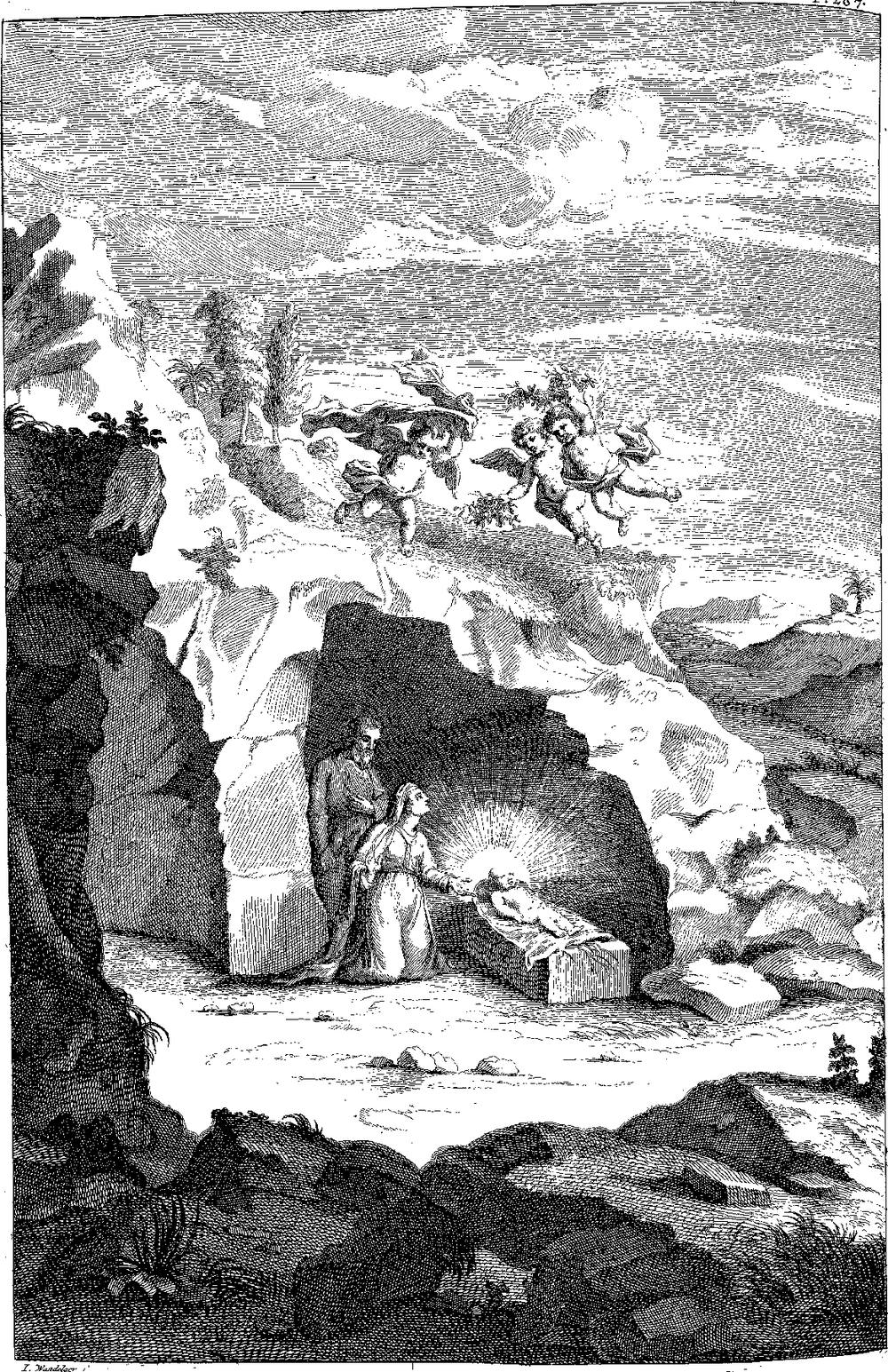
Josh. xix. 15.The Cave where our Saviour was born is not exactly in the City, but rather without Bethlehem. S. Jerom9 says it was on the South side. Justin Martyr10, and Eusebius11, say no more, than that it was without the city, and in the fields. The Inn whither the Virgin Mary and Joseph retired, was probably a caravanseras or publick house, where guests were received gratis; where nothing was allowed but shelter. But as the crowd was great, when Joseph and Mary came thither, they were oblig’d to get into a cave, which served as a stable for the caravanseras. It is certain, that the Ancients mention the Birth of Jesus Christ to have happened in a cave12. Travellers tell us, that the place where our Saviour was born was about forty foot deep, and twelve wide, growing narrower towards the roof. S. Jerom informs us13, that the Emperor Adrian, in order to erase the memory of the place, where Jesus Christ was born, planted over the cave a grove of tall trees in honour of Tammuz or Adonis; so that when the Festivals of this infamous Deity were celebrated, the holy Grotto was heard to echo with the lamentations, which were made in commemoration of Venus’s lover. In specie ubi quondam Christus parvulus vagiit, Veneris Amasius plangitur.
Read this article in its place on the printed pages
Footnotes
-
Translators’ note. Pocock Hottinger. Frisohmath. Hammond. Mill. in Matth. ii. ↩
-
Pocock Hottinger. Frisohmath. Hammond. Mill. in Matth. ii. ↩
-
צעיר להיות באלפי יהודה ↩
-
Hieronym. in Mich. v. D. Thom. in Matt. Melchior Can. l. ii. c. 14 Maldonat. Jun. &c. Or the Messiah, as the Chaldee Paraphrast has translated it. See Jonathanis Targum, Bibl. Polyg. Lond. ↩
-
Ita Euseb. Hieron. Sulpitius Severus, Phocas, alii. ↩
-
Joseph. Antiq. l. v. c. 2. ↩
-
Justin. Martyr. Apolog. 2. ↩
-
Hieronym. Ep. ad Dardanum. ↩
-
Hieronym. Ep. 24. ad Marcel. ↩
-
Just. Mart. dialog. cum Tryphone. ↩
-
Euseb. l. ii. c. 4. Demonstr. Evangel. ↩
-
Origen. l. i. contra Celsum. Hieron. sæpe. Epiphan. hæres. c. 1. Nyssen. orat. de S. Christi Nativitate. Athanas. Theodoret. &c. ↩
-
Hieronym. Ep. ad Paulin. ↩