Volume I, pages 280–300 of the 1732 edition, from BEN to BIB: everything printed on these pages, in order.
Continued from Ben-Hadad (II)
of his recovery. Hazael departed therefore from Damascus with forty camels loaded with the most valuable things that were to be procured in that City, and said to Elisha, Ben-hadad, thy Son, King of Syria, would be glad to know of thee, whether he shall recover of his illness. Elisha answered, Go, tell him, Thou mayest certainly recover, however the Lord hath shewed me, that he shall surely die. At the same time Elisha foretold to Hazael, that he should himself reign at Damascus, and would do infinite mischief to Israel. Hazael therefore returning to Damascus, told Ben-hadad, that his health would be restored; but the next day he took a thick cloth, which he dipp’d in water, then spread it over the King’s face and stifled him. After which he took possession of the Kingdom, and reigned at Damascus according to the prediction of Elisha. Such was the end of Ben -hadad.
2 Kings xiii. 3, 24, 25. In the year of the World 3168.III. BEN-HADAD, the Son of Hazael, whom we have been speaking of. Jehoash King of Israel recovered all from Ben -hadad, that Hazael had taken from Jehoahaz King of Israel, his Predecessor. Jehoash beat him three several times, and compell’d him to surrender all the Country beyond Jordan, that is to say, the lands belonging to Gad, Reuben, and Manasseh, which Hazael had made himself master of in the foregoing reigns.
Josephus1 calls these two last Princes Hadad, who in Scripture have the name of Ben-hadad, or Son of Hadad; and adds that2 the Syrians of Damascus paid divine honours to the last Hadad, and Hazael in consideration of the benefits of their Government, and particularly because they adorn’d the City of Damascus with magnificent Temples. They carried their Statues every day in procession, and boast of their Antiquity, tho’ they are by no means ancient, and it is not eleven hundred years from their time to ours, says Josephus. But according to our Chronology, from the death of the second Ben-hadad and beginning of Hazael’s reign, to the Death of Jesus Christ, there are not above nine hundred and seventeen years.
BEN-HAIL, was one of those whom Jehoshaphat sent to the several cities of his Dominions, in order to instruct the people, and recover them from Idolatry. 2 Chr. xvii. 7.
BEN-HENNON, or Ben-hinnon, or Gehhinnon, or Geh-bene-hinnon, the Valley of Josh. xv. 8. 2 Kings xxiii. 10.the Children of Hinnon. It lay South East of Jerusalem3. Some say it was the Sink to Jerusalem, and an emblem of Hell; for which reason Hell is called Gehenna, derived from Gehennon the Valley of Hinnon. See Gehenna. This Valley was likewise called Tophet. See under the name of Tophet.
BEN-HESED, was Governor of Socoh and the Canton of Hepher, in the reign of Solomon. 1 Kings iv. 10.
BEN-HUR, was Governor of the Province of Ephraim in the reign of Solomon. 1 Kings iv. 8.
BEN-JAMIN, the youngest Son of Jacob and Rachel. Jacob being upon his journey from Mesopotamia, as he was proceeding Southward with Rachel in his company, she was surprized with the pains of child-bearing, about a quarter of a league from Bethlehem4, and died after the delivery of a Son, whom with her last Genes. xxxv. 16, 17, &c.breath she named Ben-oni, that is to say, the Son of my sorrow. But Jacob changed this name, and called him Ben-jamin, the Son of my right hand. He is often called in Scripture Jemini only, that is my right hand.
During the great famine which laid waste the land of Canaan and the Countries round about, Jacob having sent his Genes. xlii. xliii.Sons into Egypt to buy corn there, kept Benjamin at home, to be a comfort to him, and to prevent any misfortune, which might happen to him in the way. Joseph knew very well his Brethren, tho’ they did not discover who he was, and seeing Benjamin was not among them, he enquired in a very artificial manner, whether he were living, and would give them no corn but upon condition they would bring him to him; and for the better security of their promise, detained Simeon in custody till their return. Jacob with all the uneasiness in the world at last permitted Benjamin to undertake this journey; the extremities he was reduced to by famine, and the sollicitations of his Sons with great difficulty prevailed; he committed him therefore to their care, and they set out for Egypt.
Gen. xliii. 16, 17, &c.Joseph seeing Benjamin with the rest of his Brethren, carried them to his house, made them eat with him, but not at his own table, because he was not willing to discover himself as yet to them, nor that the Egyptians should eat with the Hebrews. Joseph appointed his Brethren to be placed according to their age, and in the distribution which he made of the meat he sent to them, took care that Benjamin’s portion should be five times larger than that of any of the rest. After this, Joseph, as a trial of their fidelity and friendship for their Brother Benjamin, commanded his Steward Gen. xliv. 1, 2, 3, &c.to fill their sacks with corn, and in that belonging to the
youngest of them, to put the silver cup which he made use of, and the money which Benjamin brought to pay for the quantity of corn he was to purchase. This order was executed; and when Joseph’s Brethren were gone out of the City, he sent his Steward after them; who reproached them with robbery, and told them they had carried off his Lord’s cup with them. They excused themselves, and declar’d that they were with all their hearts consenting, that he who should appear to be guilty of this theft, should immediately be put to death, and that the rest should become Joseph’s Slaves. The Steward answered, that he had to do with him only, who had committed this fact, and for the rest, they were at liberty to pursue their journey.
At the same time he searched all the sacks, and in that of Benjamin the cup was found. Then they rent their clothes, and returned to the City. Joseph reproached them with their treachery; and Judah said what he could to excuse it. He conjured Joseph to detain him as his slave in the room of his Brother; told him, that their Father was an old Man, and would never be able to survive the loss of his Son; that moreover he had charged himself with him, and was to be responsible for him. Hereupon Joseph could no longer contain his tears, revealed himself to them, fell on Benjamin’s neck and kissed Gen. xlv.him, and all his Brethren after him. He invited them to come and settle in Egypt, and bring their Father thither. He gave to each of them two suits of raiment, that is to say, two coats and two cloaks, but to Benjamin five suits, with three hundred pieces of silver. He gave them likewise presents for his Father, and so dismissed them, recommending peace and union to them.
From this time the Scripture says nothing particularly of Benjamin’s person; for that I count for nothing which is related in the Testament of the twelve Patriarchs, which, as is very well known, is an apocryphal piece and of no authority. Jacob on his death-bed says to Benjamin; Benjamin shall ravin as a wolf, in the morning he shall devour the prey, and at night he shall divide the spoil. And Moses in his last Song says of Benjamin, The beloved of the Lord shall dwell in safety by Deut. xxxiii. 12.him; and the Lord shall cover him all the day long, and he shall dwell between his shoulders. These words, Benjamin is a ravening wolf, are generally explained either of S. Paul, who was of the Tribe of Benjamin, or of the valour of those, belonging to this Tribe, who carried on a War against all the other Tribes, in defence of the crime committed by the inhabitants of Gibeah, that violated the Levite’s Wife, as she passed through their City.
BENJAMIN of Tudela, a celebrated Jew, originally of the Kingdom of Navarre, and a native of Tudela; he lived in the twelfth Century. He travelled to all places where he thought that there were Synagogues, in order to make himself acquainted with the state of his Nation. After he had employed many years in his travels, he returned to France in the reign of Lewis the Young, and in 1173 went to Castile, where he died the same year. He has written an account of his travels, wherein we find several particulars relating to the Jewish Nation; but he is very unaccurate, a bad Geographer, and oftentimes a fabulous Historian. Notwithstanding which he is very proper to give us a general idea of the Jews and their condition, as well in the East as West, during the twelfth Century. He is reproached with very strong prejudices in favour of his Nation. His work was first of all printed in Hebrew at Constantinople in the year 1543. Arias Montanus translated it into Latin, and had it printed at Antwerp in 1575. Constantine L’Empereur has since re-printed it with Annotations at Leyden in 1633. See Fabricius de Apocryphis veteris Testamenti p. 1168. and a Criticism of this Author by M. Basnage, in his History of the Jews, tom. iii. l. v. c. 6. p. 111, &c. of the Paris Edition.
BENONI, the Son of my Sorrow. This is the name which Rachel gave her Son, who was called Benjamin by Jacob. Gen. xxxv. 18.
BEON-ZOHETH, the Son of Ishi. 1 Chr. iv. 20.
BEON, Numb. xxxii. 3. otherwise Bean 1 Macc. v. 4, 6. a City beyond Jordan, Eusebius says it belonged to the Tribe of Reuben. Euseb. ad Βαισὰν.
BEOR, the Father of Bela King of Dinhabah in Edom. Genes. xxxvi. 32.
Gen. xiv.BERA, King of Sodom, lived in the time of Abraham. This Prince was tributary to Chedorlaomer King of Elam. We do not know by what accident this King of Elam, who was so remote from Palestine, subdued the Kings of Pentapolis. But however this might be, Bera and four other Kings of the neighbouring Cities supported probably by the people round about them, shook off the yoke of the Elamites. Chedorlaomer having entred into a confederacy with three other Kings, came and attacked Sodom, Gomorrah, Admah, Zeboïm, and Zohar, took, plundered them, and carried off the spoil as far as Hobak, a little beyond the springs of Jordan. Abraham pursued, overtook, and dispersed them, recovered the booty, and restored to Bera, and the other Kings of Pentapolis, what had been taken from them. This is the first War, whereof there is any express mention in the Scripture. It happened
in the year of the world 2092, before J. C. 1908, before the vulgar Æra 1912.
II. BERA, or rather Beera. Eusebius places a City of this name at eight miles distance from Eleutheropolis, towards the North. See Beer.
BERÆA, or Beroe, a City of Macedonia, where S. Paul preached the Gospel with great Success. Acts xvii. 10, 13.
BERED, a City in the Tribe of Judah situated in the neighbourhood of Kadesh. The Chaldee calls it Agara the Syriac, Gedar, the Arabic Jader. It is the same perhaps as Arad or Arada5, mentioned Numb. xxxiv. 4. in the Southern part of Judah.
I. BERENICE, the Daughter of Agrippa, sirnamed the Great, King of the Jews, and Sister to young Agrippa, King also of the Jews. She was first of all betrothed to Mark the Son of Alexander Lysimachus, Alabarch of Alexandria; afterwards she married Herod King of Chalcis, her own Uncle by the Father’s side6. The death of Herod King of Chalcis happened in the year of J. C. 48.After the death of Herod a proposal was made with her consent to Polemon King of Pontus, and part of Cilicia, that upon condition he would be circumcised, she would marry him. Polemon accepted this offer, and the match was consummated. But Berenice did not continue long with him. She returned to her Brother Agrippa, with whom she lived after such a manner, as made all the world talk of her7. She was one day present with her Brother Agrippa, and heard the discourse which S. Paul made before Acts xv. 13---25.Festus at Cæsarea of Palestine. Titus the Son of Vespasian had a friendship for Berenice, and Vespasian himself made her large presents8.
II. BERENICE. Many are of opinion, that this is the name of a Holy Lady, commonly called Veronica, who presented her handkerchief to our Saviour, as he was going to Mount Calvary; he wiped his face with it, and imprinted his picture upon it. This is believed to be the very image preserved at Rome, and called the Holy Face, or the Veronica. All that has been published hitherto concerning Veronica, as her journey with S. Martial to Gaul, and afterwards to Rome to see S. Peter; and lastly her return to Bourdeaux to S. Martial, never seemed to deserve much credit with understanding Criticks. There are some who believe, that there never was any Berenice or Veronica that received the impression of our Saviour’s Face upon her handkerchief, and that the Veronica, as it is called, is only Vera Icon, the true Image, which some imprudently have made a person, whom others of the moderns have ranked among the Saints, and observe her Festival on the fourth day of February, or upon other days. But she is not inserted in the Roman Martyrology, tho’ it is pretended that she died at Rome. Some will have it, that this is she, who in some places is honoured under the corrupt name of S. Venice9.
BERESCHITH. This is the name, which the Hebrews give the book of Genesis, because it begins with the word Bereschith10, which in Hebrew signifies11, In the Beginning .
BERI, the Son of Zophah, of the Tribe of Asher. 1 Chr. vii. 36.
BERIA, the Son of Asher, and Father of Heber and Malchiel. Gen. xlvi. 17. The Family of the Beriites so called from him. Numb. xxvi. 44.
BERITH or Baruth, a City of Phœnicia, lying upon the Mediterranean, between Biblos and Sidon, four hundred furlongs Northward from this last City12.
It is a question whether the Scripture speaks at all of this place. Some are of opinion, that the God Berith, taken notice of above by us, under the name of Baalberith, was worshipped here, and gave this City its appellation; others derive it from Beroe, the Daughter of Venus and Adonis, who was the Deity most honoured in this Country; others again think the word Berith comes from Bearoth, Wells or Springs. There are more Cities than one of this name in 2 Sam. viii. 8.Palestine. David carried off a great deal of brass from the towns of Betah and Berothac in Syria.
BERODACH BALADAN, the Son of Baladan King of Babylon. He sent Ambassadors to Hezekiah King of Judah13
2 Kings xx. 1, 2, 3, &c. In the Year of the World 2292, before J. C. 708, before the vulgar Æra 712.with letters and presents, upon receiving information, that he had been sick, and was recovered in a miraculous manner, the Sun or at least the shadow of it, with drawing ten lines backward to confirm the truth to him of Isaiah’s promises; who assured him that his health would be restored, and he live fifteen years longer. Hezekiah was extremely pleased with the arrival of these Ambassadors; and shewed them all that was rich and beautiful in his Palace. God disapproved of his conduct in this particular, and sent Isaiah to tell him, that every thing in his Palace, and all the riches which he and the Kings his Predecessors had amassed together, with the sight whereof he had entertained these foreigners, would be carried to Babylon.
BEROSUS, the Babylonish Historian, was by nation a Chaldean, and Priest of Belus, the God of Babylon. Tatian14 says, he lived in the time of Alexander the Great, and that he dedicated his work to King Antiochus, the third after Alexander, that is to say, to Antiochus Theus; for Seleucus Nicanor was the first King of Syria, Antiochus Soter the second, and Antiochus Theus the third. If any would include Alexander the Great in the number of the three, it would be necessary to say, that Berosus lived under Antiochus Soter; and indeed the many years elapsed between Alexander and Antiochus Theus (for some reckon 64 from the death of Alexander to the first year of Antiochus Theus) might induce one to believe, that in reality we should understand it in this sense. But let this be as it will, Berosus having learned the Greek tongue, went first to the Isle of Cos15, where he set up a School, and taught Astronomy and Astrology; from thence he came to Athens, where he acquired so much reputation by his astrological predictions, that in the Gymnasium, where the youth performed their exercises, a Statue with a golden tongue was erected for him. Josephus16 and Eusebius have preserved some excellent fragments of Berosus’s History, which give great light to many places in the Old Testament, and without which it would be difficult to produce an exact Series of the Kings of Babylon.
BEROTH. See 2 Sam. viii. 8. a City conquered by David. This is probably Beroe of Syria, or Berytus in Phœnicia, otherwise called Baruth.
Ezek. xlvii. 16.BEROTHAH or Berothai, between Hethalon and Emesa, is perhaps Berytus or Beroth, which David obtained by conquest from Hadadezer King of Syria.
BERSABA, a town in Galilee. It lay to the South of upper Galilee, and to the North of lower Galilee17. Josephus the Historian procured this town to be repaired and fortified.
BERYL, the eighth Stone belonging to Exod xxviii. 10.the High-Priest’s Pectoral. The Vulgate and the Septuagint call it Beryl, and the Hebrew, Jasphe. It has been already observed, that the proper signification of the Hebrew names of precious stones was for the most part unknown to the Hebrews and the Commentators.
BESARA or Bezara, a City in the neighbourhood of Ptolemaïs18 twenty furlongs from Gibeah19.
BESETHA, one of the mountains on which the City of Jerusalem was built. It lay on the North side with respect to the Temple s.
BESIMOTH, the same with Beth-Jesimoth beyond Jordan.
BESIRA, the same as the Well of Sirah mentioned in the second book of Samuel. 2 Sam. iii. 26.Josephus places Besira20 at twenty furlongs, or seven leagues distance from Hebron.
BESODEIAH, the Father of Meshullam. Nehem. iii. 6.
BESOR, or Bosor, a Brook which falls into the Mediterranean, between Gaza and Rhinocorura; or rather between Rhinocorura and Egypt, according to S. Jerom, on the sixth Chapter of Amos. This is the brook of the wilderness, which many have taken unadvisedly for the brook or river of Egypt, which is spoken of in some places of Scripture, and is no other than the Nile, or the most Eastern branch of this river.
Amos vi. 14. Josh. xv. 4, 47. 2 Chron. vii. 8.BETAH, or Beten, a City of Syria, taken by David from Hadadezer. It is the same possibly with Beten, which Joshua sets down as belonging to the Tribe of Asher; or Bathne in Syria, between Berœa and Hierapolis.
BETHABARA. At this place beyond Jordan S. John the Baptist baptized. The Latin Text of S. John instead of Bethabara reads Bethania; but the true reading is Bethabara, as Origen v, S. Chrysostom w, and Epiphanius21 observe. Bethabara, which in Hebrew signifies the House of Passage, is thought to be the place where the Israelites passed the river Jordan under Joshuah, and that there was the common ford of this river.
BETHACAD, a village fifteen miles from Legio, in the great plain y.
Jerem. vi. 1.BETH-ACHARA, or Beth-haccerim, Jerem. vi. 1. a City situated on an eminence between Jerusalem and Tekoa. Malchiah
the Son of Rechab, was Prince of Bethacara. Nehem. iii. 14.
BETH-AGABRA, or methogabri, or Bethogabria. Peutinger’s Tables place Bethogabri between Askelon and Jerusalem. Ptolemy puts down Bethogotria at 65½. degree of latitude, and the 31½ of longitude. Josephus22 fixes Begabris in the midst of Idumæa. William of Tyre says, that the Arabians called Beersheba, Bethgabril, and that it was twelve miles from Askelon. Benjamin tells us, that Bethgaberin is five parasangs from Hebron, and is the same as Maresa; and the acts of S. Ananias place it in the territory of Eleutheropolis. All these characters joined together, determine us to set it down between Eleutheropolis and Hebron.
BETHANATH, a city in the Tribe of Jof. xix. 38. John xi. 18.Naphtali.
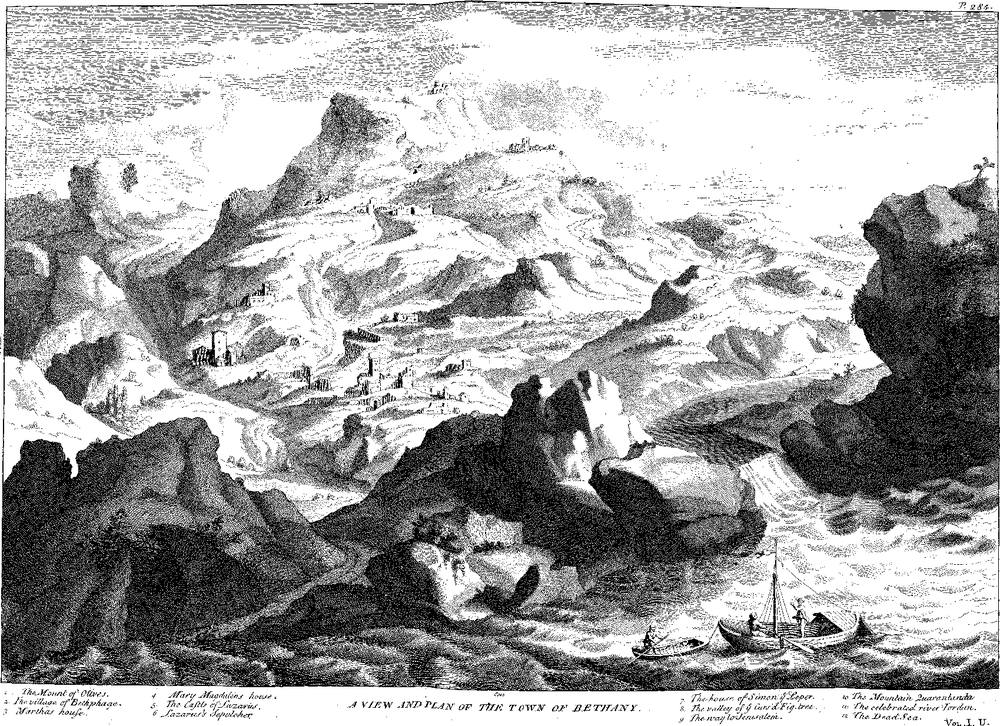
BETHANY, was fifteen furlongs, or about two miles from Jerusalem, at the foot of the Mount of Olives, eastward of Jerusalem, on the way from Jericho to Jerusalem. There it was that Martha and Mary dwelt with their brother Lazarus, whom Jesus Christ rais’d from the dead. There it was likewise, that Mary pour’d out the perfume upon our Saviour’s Head. We have already taken notice in the article of Bethabara, that the Latin copies of S. John, ch. i. 28. read Bethania instead of Bethabara. See Suidas on Bethania; several Greek as well as Latin copies are in this place altered.
BETHANIM, a village four miles from Hebron, and two from Abraham’s turpentine tree23.
BETH-ARABAH, a city belonging to the Tribe of Judah, Joshua. xv. 6. and afterwards given to that of Benjamin. Joshua xviii. 22.
Jof. xiii. 27. Numb. xxxii. 36.BETHARAN, or Beth-haram, or Betharamphta, afterwards called Livias, beyond the Jordan, towards the Dead-sea. Antiq. l. xviii. c. 3.
BETHAVEN, the same as Bethel. After Jeroboam the Son of Nebat had set up his golden calves at Bethel, the Hebrews, who were in the interest of the house of David, in derision called this city Bethaven24; that is to say, the house of nothing, or the house of iniquity, instead of Bethel, the House of God, the name which Jacob formerly gave it, when he had the vision there of the mysterious Ladder, made use of by the Angels in ascending and descending from Heaven to Earth. See hereafter Bethel.
BETH-BAAL-MEON. Joshua xiii. 17. The same as Baal-meon. Numb. xxxii. 37.
BETH-BARAH, a place beyond the river Jordan, Judg. vii. 24. It is probably the same as Bethabara, whereof we have before said something.
BETH-BASI, a city in the Tribe of Judah, which the two Maccabees, Simon and Jonathan fortified; and where Bacchides besieged them without any success.
BETH-CAR, a city in the Tribe of Dan, 1 Sam. vii. 11.
I. BETH-DAGON, a city in the Tribe of Asher, Josh. xix. 27. Beth-dagon signifies the house or temple of Dagon.
II. BETH-DAGON, a city in the Tribe of Judah; so called, in all probability, because there was a temple of Dagon there, before the Israelites possessed it.
BETHEKED or Beth-akad, which some construe in a general sense, to signify a Shearing-house, or the House of Shepherds binding Sheep25. But the Septuagint, and several good Interpreters, explain it to be a place situated between Jezreel and Samaria. It is the same perhaps as Bethker.
BETHEL, a city to the west of Hai, upon the confines of the Tribes of Ephraim and Benjamin. The Patriarch Jacob flying from the anger of his brother Esau, and going into Mesopotamia, arrived at sun-set in a certain place, where he had a mind to pass the night, and taking one of the stones that lay there, he placed it under his head and fell asleep. While he was thus sleeping, he dreamed that he saw a ladder, the bottom whereof rested on the Earth, and the top of it reached to Heaven, and Angels ascending and descending by this ladder. Upon the upper part of it he saw the Lord, who said to him, I am the Lord, the God of Abraham, and the God of Isaac, I will give to you and your posterity, the land wherein you now are sleeping. Your generation shall be as numerous as the sea sand, and all nations shall be blessed in you, and in him who shall issue from you. I will be your Conductor wheresoever you go, and will bring you again into this land. Jacob waking after this vision, said, surely the Lord is in this place, and I knew it not; and he was afraid and said, how dreadful is this place? this is none other but the House of God, and this is the Gate of Heaven.
He rose up therefore early in the morning, and took the stone which he had made his bolster, and set it up for a pillar, poured oil upon the top of it, and called the name of that place Bethel, the name whereof before was Luz; that is to say, the wilderness, wherein he passed the night, he called Bethel; and this was near a village named Luz, which the Hebrews called Bethel, when they made themselves
masters of the land of Canaan. Eusebius says26, that Bethel was twelve miles or four leagues from Jerusalem, in the way to Sichem.
The Rabbins tell us, that the stone on which Jacob rested his head at Bethel, was put into the sanctuary of the temple, which was built after the return from the Captivity; that the Ark of the Covenant was placed upon this stone; and that long after the ruin of the temple, the Jews had a custom of lamenting their calamities upon it. The Mahometans believe their temple of Mecca to be founded on this very stone, and have a great veneration for it. From Jacob’s pouring oil upon the stone of Bethel, came up the superstition of the ancients for the Betuli, which were stones anointed and consecrated to the memory of great men after their death. Sanchoniathon, or rather Porphyry, the Author of the Fragment which Eusebius has preserv’d27 under the name of Sanchoniathon, attributes the invention of these Betuli to Saturn. Damascius, who is cited in Photius’s Bibliotheca, says, that these Betuli were consecrated to the heathen Gods, to Saturn, the Sun, and other Deities. And Hesychius assures us, that the ancients called the stone Betulus, which Saturn swallowed, thinking to devour his son Jupiter. Asclepiades, who is cited by Damascius, relates many surprizing things of the Betuli dedicated to Venus of Aphek.
BETHELLA, in the neighbourhood of Gaza. See Bethulia.
BETH-EMEK, a frontier city of Asher. Joshua xix. 27.
BETHER. There is mention of the Mountains of Bether in the Song of Solomon28. The Author of the Vulgate reads the mountains of perfume, Cant. viii. 14. and several Latin copies read Bethel instead of Bether, Cant. ii. 17. But the Hebrew in both places reads Bether. Enquiry has been made, what this Bether is, and how it is situated. Some take it to be Bethoron, called Bether in Eusebius, Bethara in Josephus, and Bethra in an old Itinerary. There is frequent mention of Bether in the writings of the Hebrews; it was taken by the Emperor Adrian in Barchochebas’s rebellion. The number of Jews inclosed in it was so great, says the Gemara29, That the blood which run from the dead bodies into the Sea, carried stones along with it as large as four Seahs, (the Seah or Satum30 was a hollow measure which held a peck and a pint) and that it ran four miles into the Sea: you will say perhaps, that it was a maritime Town, no, it was four miles distant from the sea. Several, as we have observed, are of opinion, that it is the same as Bethoron. Others will have it to be Betharis, between Cæsarea and Diospolis, set down in the antient Itinerary, which we have spoken of; or lastly to be Bæther, mentioned in the Septuagint, Jos. xv. 60. among the cities of Judah. For my part, I take it to be Upper Bethoron or Bethora, between Diospolis and Cæsarea. Eusebius31 speaks of Betharim near Diospolis, and when he mentions Bether, which was taken by Adrian, he says it was in the neighbourhood of Jerusalem32. Hist. l. iv. c. 6.
The Rabbins33 say, that in this one city only, there were four hundred Colleges, in every College four hundred Professors, and that every Professor had four hundred Scholars, who when assembled together composed a large army. They stood the first shocks of the Siege, tho’ they had no other weapons besides bodkins, which they used in writing upon table books covered with wax after the manner of those times. A famous Rabbin, whose name was Tryphon, having spoke something of surrendering the city, was put to death by Barchochebas; notwithstanding his resistance and that of the besieged, the city was taken, Barchochebas killed, the Scholars, who had so well defended the place, were tied up with their books and cast into the fire. The Massacre, ‘tis added, was so great, that more perished in this war than came out of Egypt with Moses; and that upon one stone were found the Skulls of three hundred Infants that had been dashed to pieces against it.
BETHESDA, or, as it is called in the copies of the Vulgate, Bethzaida, or Piscina John v. 2.probatica34, because the sheep were washed in it, which were appointed for the Sacrifices, and were called in Greek, probata. Bethesda, as many Interpreters expound it, signifies35 the House of Mercy, probably by reason of the Sick, who lay under the porticos that surrounded it; or as others explain it36 the sink house or drain, because the waters which came from the temple, and the place where the victims were washed, flowed hither. Eusebius and S. Jerom say, that in their time there were two fish-pools, or a kind of double reservoir, shewn at Jerusalem. One of
which conservatories of water was filled every year with rain water; the other with water of a deep red colour, as if some of the blood of such victims as formerly were washed there, were still remaining. The Gospel informs us, that there were five galleries about this fish-pool, probably because it was made in the figure of a pentagon; and many sick persons were always waiting there in order to descend into it, when the water was stir’d; for the Angel of the Lord came down at some certain time and stir’d the water; and the first sick person that then plunged into it, was cured, let his disease be what it would. Travellers tell us, that this fish-pool was to the East of Jerusalem.
BETHEZOBA, the native place of the Woman mentioned by Josephus37, who during the last siege of Jerusalem by the Romans eat her own Child.
BETH-GABRIS, or Beth-gabril. See above Beth-agabra.
BETH-GADER, the name of a Man, who was of Caleb’s Family. 1 Chr. ii. 51.
BETH-GAMUL, a City of the Moabites, in the Tribe of Reuben. See Jerem. xlviii. 23.
BETH-JESHIMOTH. A City in the Tribe of Reuben. Joshua xiii. 20. It was afterwards possessed by the Moabites. Ezekiel foretold the destruction of this and Ezek xxv. 9.other Cities of Moab. Eusebius says, Beth- Jeshimoth is ten miles from the river Jordan. But it is very probable that he confounds it with Jeshimon, mentioned in 1 Sam. xxiii. 24. which lay on this side Jordan.
BETH-LEBAOTH, a City in the Tribe of Simeon. Josh. xix. 6. It is sometimes called Lebaoth. Josh. xv. 32.
I. BETH-LEHEM, or Beth-lechem, the house of bread, a City in the Tribe of Josh. xvii. 7.Judah, generally called Bethlehem of Judah, to distinguish it from another of the Josh. xix. 15.same name in the Tribe of Zebulun. It is called likewise Ephratah, and its inhabitants Genes. xlviii. 7. Mich. v. 2. Ruth i. 2. and 1 Sam. xvii. 12.Ephrateans. This City was not at all considerable for its extent or riches, but was infinitely so on the score of the Messiah’s Birth. Micah extolling this advantage peculiar to Bethlehem, says, Thou Bethlehem Ephratah, though thou be little among the thousands of Judah, yet out of thee shall he come forth unto me, that is to be Ruler in Israel38. He had no design certainly of describing David, who was born at Bethlehem so many Ages before; but Jesus Christ who came into the world here many Ages after.
Several difficulties are proposed relating to the Prophecy of Micah, which foretells the Birth of the Messiah at Bethlehem. Matth. xi. 6. Micah v. 2.In the first place S. Matthew reads, And thou Bethlehem of Judah art not the least of the Cities of Judah; whereas the Text of Micah runs thus, And thou Bethlehem though thou be little among the thousands of Judah. And secondly Micah says, Out of Judah shall he come forth unto me, that is to be the Ruler in Israel, whose goings forth have been from of old, from everlasting. It is objected therefore that there is a contrariety between S. Matthew and Micah, one of whom says that Bethlehem is too small to be reckoned among the most considerable Cities of Judah; the other on the contrary says, that it is not one of the smaller Cities of Judah.
But to this it is answered, that S. Matthew might have read the Text of Micah with an interrogation, in this manner, And thou Bethlehem, art thou too small to be ranked with the great Cities of Judah? Thus he had very well explained the sense of the Prophet, Thou art not one of the small Cities of Judah. Besides some Criticks39 maintain, that the Hebrew, Zehir, which is generally translated small, signifies likewise the contrary, and for a proof of it, Jeremiah is cited xlviii. 4. xlix. 20. Zach. xiii. 7. where Zehir40, as the Jews agree, signifies Heads, Principal of the people. Micah v. 2.Lastly, S. Jerom41, and several others after him, are of opinion, that S. Matthew produced the passage in Micah historically, not as it was written in that Prophet, but as it had been proposed by the Priests, with an intention by the way, of reflecting on their ignorance and negligence.
As to the second difficulty, the Jews are generally very ready to acknowledge, that the Messiah should come out of Bethlehem, but they maintain, that this Messiah is not Jesus, and that the Prophecy of Micah has no regard either to Jesus or the Messiah. He whom Micah speaks of, shall be Ruler in Israel: And ver. 3. The remnant of his Brethren shall be converted, and reunited with the children of Israel. Jesus never reigned over Israel, and if he is God, can have no Brethren. Besides, to confine the Kingdom of the Messiah to Israel would be too much a limitation of it. Ex te egredietur, qui sit dominator in Israel. The answer to this is, that Jesus, as God, had no Brethren, but as the Son of Mary he had. The Prophet in this place very well distinguishes his temporal Birth at Bethlehem, and his eternal Birth, His goings forth have been from of old, from everlasting. It is no more contrary to the greatness of the Messiah to say, that he will reign over Israel; than it is for
God to call himself in so many places the God of Israel. This does not exclude the dominion either of the one, or of the other over the rest of mankind, and over other creatures.
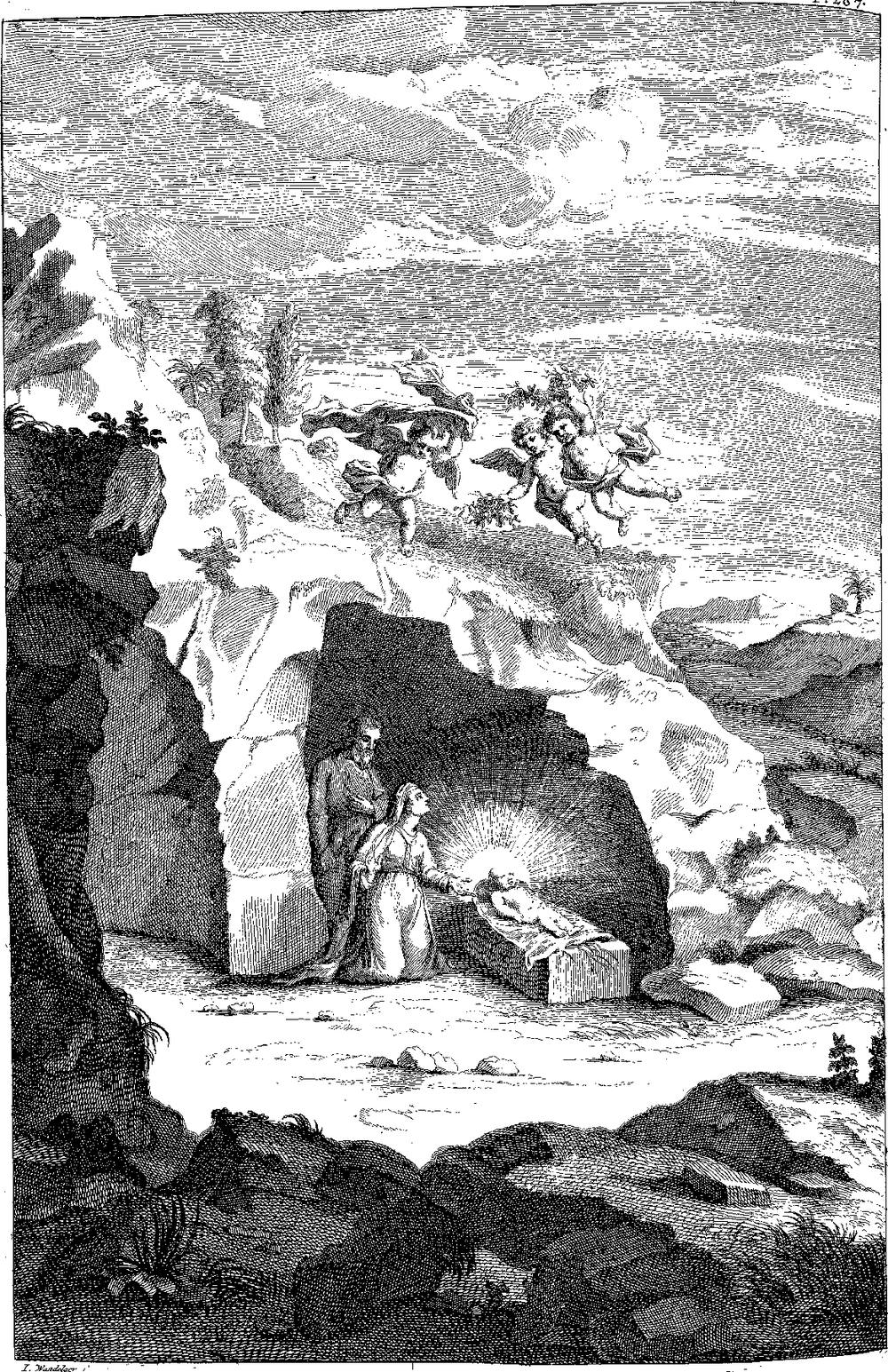
Bethlehem is situated upon the declivity of a hill, six miles42 or two leagues from Jerusalem. Josephus43 seems to place it at the distance only of thirty furlongs, or three miles and seven hundred and fifty paces from Jerusalem: Justin Martyr44 at five and thirty furlongs, which make four miles three hundred and seventy five paces. But it is very probable, that the cyphers which denote this distance, are changed in these two Authors; for all others, as well ancients as moderns, constantly describe the distance to be two leagues between Jerusalem and Bethlehem. S. Jerom45 makes it six and forty miles from Joppa to Bethlehem.
Josh. xix. 15.The Cave where our Saviour was born is not exactly in the City, but rather without Bethlehem. S. Jerom46 says it was on the South side. Justin Martyr47, and Eusebius48, say no more, than that it was without the city, and in the fields. The Inn whither the Virgin Mary and Joseph retired, was probably a caravanseras or publick house, where guests were received gratis; where nothing was allowed but shelter. But as the crowd was great, when Joseph and Mary came thither, they were oblig’d to get into a cave, which served as a stable for the caravanseras. It is certain, that the Ancients mention the Birth of Jesus Christ to have happened in a cave49. Travellers tell us, that the place where our Saviour was born was about forty foot deep, and twelve wide, growing narrower towards the roof. S. Jerom informs us50, that the Emperor Adrian, in order to erase the memory of the place, where Jesus Christ was born, planted over the cave a grove of tall trees in honour of Tammuz or Adonis; so that when the Festivals of this infamous Deity were celebrated, the holy Grotto was heard to echo with the lamentations, which were made in commemoration of Venus’s lover. In specie ubi quondam Christus parvulus vagiit, Veneris Amasius plangitur.
II. BETH-LEHEM, of the Tribe of Zebulun, is scarce known but by its bearing the same name as that City which gave birth to King David, and Jesus Christ the King of Kings.
BETH-LEPHTHEPHA, a City and Toparchy of Judæa, mentioned in Josephus51 and Pliny52. It lay South of Jerusalem, and may very well be the same with Beth-lebaoth spoken of above.
BETH-MAAKA, or Abel-maacha, or Abel-beth-maacha. See Abel-maacha.
BETH-MAON, a City belonging to the Moabites in the Tribe of Reuben. Jerem. xlviii. 23.
BETH-MARCHABOTH, a City in the Tribe of Simeon.
BETH-MAUS, in Galilee, between Sephoris and Tiberias, five furlongs from this last City. Joseph. lib. de Vita sua, pag. 10. This place is called Beth-meon in the Talmud, as is observed by Lightfoot53.
BETH-MILLO, a place near Shechem. 2 Kings xii. 20.
BETH-NABRIS, beyond the lake of Gennesareth, five miles North from Bethzaida54.
BETH-NIMRAH, a City in the Tribe of Gad, Numb. xxxii. 36. I should take it to be the same as Nimrim, Jerem. xlviii. 34. or Bethnabris whereof we have been speaking, which was five miles Northward from Livias. The difficulty lies, in extending the Tribe of Gad so far as Nimrim to the South, or to Bethnabris, Northward.
BETHOANNABA, or Beth-hannaba. Eusebius says, it is a town four miles Eastward from Diospolis. S. Jerom, that it is placed by many at eight miles distance from Diospolis. Bethoannaba seems to preserve still some remains of the word Nob, where the Tabernacle continued for some 1 Sam: xxi. 1.time in the reign of Saul. S. Jerom in S. Paula’s Epitaph, says that Nob was not far from Diospolis.
BETHOGLA. There are two places of this name; one fixed by Eusebius55 at eight miles distance from Gaza; the other by S. Jerom56 two miles from Jordan. Joshua makes Bethogla to be part of the Tribe of Judah. Joshua xv. 6. This probably is the place mentioned by Eusebius. And the same Joshua xviii. 21. makes another Bethogla, which S. Jerom speaks of, to belong to Benjamin.
BETHOM, or rather Bethora, or Bethoran, otherwise Julias the birth-place of the Prophet Joel57.
BETHOME, a City belonging to the Jews, which having rebel’d against Alexander Jannæus58, was taken, and its inhabitants sent captives to Jerusalem. It is the same as Bethom.
BETHONEA, or Beth-oanea, fifteen miles from Cæsarea Eastward, where Eusebius
febius and S. Jerom say, that there are hot baths, very beneficial to the health of those who use them59.
BETHORA. The same probably as Bethoron. See Joseph. Antiq. l. v. c. 1. & lib. xii. c. 10.
BETHORON. The same in all probability as Bethora, Bethra, Bether and Bitthar. The Scripture mentions two cities of this name, one called Upper Bethoron, the other Lower Bethoron. The Israelites of the Tribe of Ephraim, having received Bethoron as part of their allotment, made a Jos. xxi. 22.cession of it to the Levites. It was, according to Eusebius, twelve thousand paces, or four leagues from Jerusalem, towards Sichem or Naplouse, that is to say, to the north of Jerusalem. He adds, that the upper Bethoron was built by Solomon, and the lower resigned to the Levites for their habitation. Josephus places Bethoron at about an hundred furlongs from Jerusalem60. S. Jerom says, that S. Paula passed through both the Bethorons in her way from Naplouse to Jerusalem.
BETH-PALET, or Beth-peleth, a city situated in the most southern part of the Tribe of Judah, Jos. xv. 27. Nehemiah, xi. 26. This city was one of those which were yielded up to the Tribe of Simeon.
BETH-PAZZEZ, a city in the Tribe of Issachar, Jos. xix. 21.
BETH-PEOR, a city of Moab, given to Deut. iv. 46.the Tribe of Reuben. There the God Peor was worshipped.
BETHPHAGE, a little village at the foot of the Mount of Olives, between Bethany and Jerusalem. Jesus Christ being come from Bethany to Bethphage, commanded his Disciples to seek an Ass for Matt. xxi. 1. Mark ii. 2.him, that he might make use of it at his triumphant entrance into Jerusalem. The distance between Bethphage and Jerusalem, John xii. 14.is computed at fifteen furlongs, or eighteen hundred and seventy five paces61.
BETHRAPHA, the son of Eshton of the Tribe of Judah, 1 Chron. iv. 12.
BETHSAIDA. The Latin copies of S. John read Bethzaida, instead of Bethesda, speaking of the fish-pool near the sheep market in Jerusalem. But the true reading is Bethesda, as we have observed in the article belonging to this word. There are some who believe, that Jeremiah and the Priests hid the sacred fire in this pool, then without water, where in the time of Nehemiah, instead of fire was found thick water, 2 Macc. i. 20, 21, 22.which being poured upon the Altar of Burnt-offerings, took fire as soon as the sun began to shine upon it. But this opinion is without any solid foundation.
BETH-SHALISHA, probably the same as Baal-salisa. Beth-shalisha in Eusebius’s account1 is fifteen miles from Diospolis northward, in the Canton of Thamna.
BETH-SHAN, more generally known by the name of Scythopolis. The second book of Maccabees, xii. 29. places it at six hundred furlongs distance from Jerusalem, or seventy five miles, which make two and twenty leagues, at three miles to the league. Josephus says62, it was an hundred and twenty furlongs from Tiberias; according to which computation it cannot be so near the lake of Tiberias, as some Geographers pretend it is. It lay on this side Jordan westward, at the extremity of the great Plain. Abulfeda says, there is a small river, which falls into the river Jordan at Scythopolis. The name of Scythopolis, or the city of the Scythians, came, according to George Syncellus63, from the Scythians, who made an irruption into Palestine in the reign of Josiah, Son of Amos, King of Judah. Stephens the Geographer and Pliny call it likewise Nysa. In the Hebrew text of the Old Testament it is named Bethshan. But the Septuagint Judg. i. 27. read Bethshan, otherwise called the city of the Scythians. And in the books of Maccabees and Josephus, it goes very frequently by the name of Scythopolis. After the battle of Gilboa, the Philistines having taken the bodies of Saul and Jonathan, hung them upon the walls of Bethshan. But the inhabitants of Jabesh-Gilead, on the other side of Jordan, came in the night, carried off the bodies, and interr’d them honourably, under a grove of Oaks, near their city.
1 Sam. xxxi. 10, &c. Jos. xxi. 16. 1 Sam. vi. 12. 2 Kings xiv. 11. 1 Kings iv. 9. 1 Chron. vi. 59.I. BETHSHEMESH, a city belonging to the Priests, and in the Tribe of Judah. In Eusebius’s64 account, it is ten miles from Eleutheropolis, eastward, in the way to Nicopolis, or Emaüs. M. Reland thinks we should distinguish Hir-schemesh in the Tribe of Dan, from Beth-shemesh in the Tribe of Judah; but his reasons are not persuasive. The very passages which he produces out of Joshua, xix. 41. compared with 1 Kings iv. 7. where Hir-schemesh is placed as parallel to Beth-shemesh, convince us, that it is not the same city. Hir-shemesh, signifies the city of the Sun, and Bethshemesh, the House of the Sun. As the Tribes of Dan and Judah are adjacent, the same city is set down sometimes as belonging to one, sometimes to another. The Philistines having sent back the Ark of the Lord, it was brought to Beth-shemesh; and some of the people being desirous to look with too much
curiosity into it, the Lord destroyed seventy of the principal men in the city, and fifty thousand of the common people.
II. BETH-SHEMESH, a city in the Tribe of Issachar, Joshua xix. 22. There are some who take notice of a third in the Tribe of Naphtali. Jos. xix. 38. Judg. i. 33.
BETH-SHITTAH. Gideon pursued the Midianites to this place, Judges vii. 22.
BETHSURA. See Bethzur.
BETH-TAPPUA, that is to say the apple or orchard house, a city in the Tribe Jos. xv. 58.of Judah. Eusebius ° says, that Beth-tappua is the last city of Palestine in the way to Egypt, and is situated fourteen miles from Raphia.
BETHUEL, the Son of Nahor and Milcah, was Abraham’s Nephew, and father to Laban and Rebekah, Isaac’s wife. Bethuel does not appear in all this affair, but Laban only, Gen. xxiv. 50.
BETHUL, or Bethuel, a city in the Tribe of Simeon, Jos. xix. 4. the same probably as Bethelia, which Sozomen speaks of in his history. He says it is a town belonging to the inhabitants of Gaza, that it is very well peopled, and has several Temples in it remarkable for their structure and antiquity. Particularly there is a Pantheon there, or Temple, dedicated to all the Gods, situated on an eminence made of earth, brought thither for that purpose, which commanded the whole city. It is my conjecture, continues Sozomen, that the name of Bethelia, which signifies the House of God, was given to this place, by reason of this Temple consecrated to all the Gods. S. Jerom, in his life of S. Hilarion, speaks likewise of Bethelia, and says, that from thence to Pelusium was five short days journey. Lastly we find a Bishop of Bethelia among the Bishops of Palestine65.
BETHULIA, a city celebrated for the siege Holofernes laid to it, at which he was Judith vi. 7.killed by Judith. We have said in our Comment upon Judith66, that this city was no other than that of Bethel or Bethuel, whereof we have been speaking. Judith and her Husband, and the principal men of Bethulia, were of the Tribe of Simeon. Judith vi. 11. & viii. 1, 2, 3. & ix. 2.Holofernes’s design was to go into Egypt. He had subdued all Galilee, all beyond the brook Kison, and even the mountains which separated the kingdom of Judah from the territories of Samaria. He had nothing more therefore to conquer besides the lands of Judah and Simeon, and so open a passage into Egypt.
But, it will be objected, how can this be Judith iv. 3. vii. 3.reconciled with Scripture? which Judith vii. 1, 2. Judith iv. 5.says, that Bethulia was near Dothaim and Esdraelon, cities in the great plain and country round about, very remote from Bethulia. I answer, that in this place, the Author of the book of Judith describes the march of Holofernes’s Army, and the camp which he left when he broke up to go and undertake the siege of Bethulia, not the camp which he took possession of when he set down before this place. Holofernes commanded all his people, that they should remove their camp against Bethulia. They prepared therefore to make war against the children of Israel. And they camped in the valley near unto Bethulia, and they spread themselves in breadth over Dothaim. Their camp extended from Belmaim unto Cyamon which is overagainst Esdraelon. The High- Priest Joacim wrote to all those who were overagainst Esdraelon, toward the open country near to Dothaim. Hitherto there is nothing contrary to our account of Bethulia, situated towards Gaza in the Tribe of Simeon.
It is true, travellers tell us of a city of this name situated in the Tribe of Zebulun, a league from Tiberias at the same distance from Abilene, three leagues from Dothaim, and to the north of Scythopolis: but this city was not known to any of the antients. Neither Joshua, nor Josephus, nor Eusebius, nor S. Jerom, had any knowledge of a Bethulia in this place; which persuades me, that the city of this name, which has been shewn there, since the Croisades, was fixed there only by conjecture. Travellers having often given old names at random to places, which they imagined to be upon the spot, where old cities stood, that were known to them in history. We shall relate the history of the siege of Bethulia in the article of Judith.
BETHZAIDA, a city lying beyond the river Jordan, upon the Sea of Tiberias, in the place almost where the Jordan discharges itself into this Sea. Philip the Tetrarch inlarged and adorned the city of Bethzaida, and called it Julias. Josephus takes notice particularly, that Bethzaida was in the Gaulonitis, and on the other side of Jordan67. In our Dissertation on the Geography of the Holy Land, we have examined the arguments which are produced to shew on the contrary, that Bethzaida lies to the west, and not to the east, of the Sea of Tiberias68.
Bethzaida is not known by the name of Julias in the New Testament. The Apostles S. Peter, Andrew, and Philip Mark viii. 22.were of this City. Our Saviour was there frequently: he cured a blind man there, by putting spittle on his eyes, he led him out of the town, and laying his hands up69
on him, asked him if he saw any thing. He said he saw men walking, who appeared to him like trees; and Jesus putting once more his hands upon his eyes, the blind man was so perfectly cured, that he saw all things distinctly. Our Saviour wrought a great many miracles here; but the inhabitants were not benefited by the instructions which he gave them, nor by the miracles which they saw performed by him: the consideration whereof obliged him one day to say, Woe unto thee Chorazin, woe unto Luke x. 13.thee Bethzaida; for if the mighty works which had been done in you, had been done in Tyre and Sidon, they had a great while ago repented, sitting in sackcloth and ashes. The Hebrew word Bethzaida, signifies the hunting or the fishing-house.
BETH-ZECHA, the same probably as Bezek, or Bazek, Bassah, &c. See above.
BETH-ZUR, or Bethsura, a fortress of great consequence, principally in the time of the Maccabees. Rehoboam King of Judah2 Chron. xi. 7. had it fortified. Lysias, Regent of the Kingdom of Syria under young Antiochus, the Son of Antiochus Epiphanes, laid siege to Bethzur with an Army of sixty thousand foot and five thousand horse. Judas Maccabæus coming to succour the place, Lysias was obliged to raise the siege. Judas 1 Mac. iv. 28. vi. 7.put his Army to flight which was very strong, and afterwards making the best use of the arms and booty which were found in the enemy’s camp after their rout, the Jews hereupon became stronger and more 1 Mac. iv. 6.formidable.
Judas Maccabæus was too experienced a Observations on the rout of Lysias’s army by that of Judas Maccabæus.General not to engage Nicanor and Gorgias before their forces were joined; he attacked them therefore separately, and routed them: Lysias being in a consternation upon receiving so dishonourable a defeat, levied an Army of sixty thousand foot all chosen men, and five thousand horse in order to extirpate the Jews, says the Author of the Maccabees. This Army marched into Judæa, encamped near Bethsura70, and Judas met them with ten thousand men. The party, my readers will say, was not equal; and I should think so too, if a General of but a moderate degree of courage and understanding had attacked another of greater skill than himself; but here the case is otherwise, and an excellent Commander, bold and enterprizing, attacks one of no capacity, tho’ six times stronger in the number of troops; and miracles of this kind are very common without there being any necessity for the interposition of the Deity to produce them. Ancient and modern History furnish us with Victories in great abundance of this sort, and much more surprizing than any obtained by the Maccabees. For the contempt of a weak enemy, whose forces are so disproportionate to the numerous Army which opposes them, is one of the greatest dangers that can be in War; because people are less upon their guard, and do not think their enemy capable of daring to undertake any thing against them, or even of appearing in the field; witness the Action of Uladus Prince of Walachia, who attacked Mahomet the Second’s Army, tho’ a hundred thousand strong, taking the advantage of a night, when the Moon did not shine, tho’ he had not more than between five and six thousand horse; notwithstanding which he struck a prodigious Army with terror and consternation, and put it into such confusion and disorder, that if a body of Janizaries had not stood their ground resolutely, and given the rest an opportunity to recover out of their fright, this Army had been routed.
Judas, who saw that Lysias had entered Judæa, marched directly to his camp under Bethsura. The Author, contrary to his custom in an affair of this importance, tells us nothing of the disposition and distribution of the troops in both armies; but as we cannot be mistaken in the method of the Jews, and in their manner of fighting, when their weakness would not allow them to attack with a front equal to the enemy’s, that is to say, with a perfect phalanx, and particularly the Maccabees, who were never at the head of such a number of troops as might be called an Army, we shall have recourse to their common method. Judas, it is probable, divided his ten thousand men into four or five bodies, drawn up very deep, as always was the practice of the Maccabees in all the battles they were concerned in. The Author makes no mention of horse; and it is certain that the Maccabees scarce ever had any, their way of fighting, as it were in columns, not making them so necessary. If Judas had been provided with cavalry, the Scripture would not have failed to have inform’d us of it, since it takes notice of that belonging to Lysias, and particularly specifies the number. As the people of Asia and others threw their horse upon the wings, and the infantry into the center, I range Lysias’s army in the same order; and it is probable that he covered the wings of his foot with his horse. They joined battle, says the Author, and five thousand men
of Lysias’s Army were cut in pieces. To have only five thousand men killed in an army of sixty five thousand, is a very inconsiderable matter. This Victory has all the air of a defeat given to people levied in haste rather than true soldiers; which makes me suspect that the Author of the Maccabees, with respect to the number of the enemy, may enlarge a little.
The year following, being that of the world 3841. before J. C. 159. before the vulgar Æra 163. Lysias attacking it again, 1 Mac. vi. 31, 32. & seq. 1 Mac. xi. 65. 1 Mac. iv. 61. 2 Macc. xiii. 19.took it, and it continued in the possession of the Syrians, till the government of Jonathan Maccabæus, who by conquest got it from them, in the year of the world 3860. before J. C. 140. before the vulgar Æra 144.
Bethzur belonged to the Tribe of Judah, Joshua. xv. 38. It lay opposite to south Edom, that is to say, it defended the passages into Judea from the side of Edom. We read in the second book of Maccabees, Chap. xi. 5. that Bethzur was five furlongs from Jerusalem; but this is a visible mistake. Eusebius places it at the distance of twenty miles or seven leagues from Jerusalem, in the way towards Hebron. At the foot of Mount Bethzur there is a fountain shewn, wherein some assert, that Queen Candace’s Eunuch was baptized71.
BETOMESTHAM, a city so called in Judith, iv. 6. xv. 3. Instead of the Greek Betomesthon, the Latin reads Esthamo, which is a city of Judah.
Jos. xiii. 26.BETONIM, a city in the Tribe of Gad, towards the north extremity of this Tribe, and bordering on Manasseh.
BETROTHING. See Marriages, where we shall say something likewise of Betrothing.
BEYOND, Trans. The Hebrew word Heber72, which is generally translated trans, signifies likewise, on this side; at least we find it in several places, wherein by the sequel of the discourse it seems, that we should read on this side. For example, Gen. I. 10. Ad aream Athad, quæ sita est trans Jordanem, The floor of Atad was to the west of Jordan; it looks therefore as if it ought to be translated cis Jordanem, on this side of the river with relation to Palestine, where the Jews dwelt; and again Numb. xxii. 1. Trans Jordanem, Jericho fixa est, Jericho is situated beyond Jordan: We know that this city lay to the west of this river.
It may be said, that Moses when he wrote these things, was eastward of Jordan, and consequently that with respect to him Atad and Jericho were trans Jordanem. Joshua who dwelt on this side, and westward of this river, expresses himself in the same manner. He calls, as well the country which lay on this side, as that which was beyond Jordan, trans Jordanem, See Chap. xii. 1. Hi sunt Reges quos percusserunt filij Israel trans Jordanem ad solis ortum. After this he names Sehon and Og, whose dominions were beyond Jordan; and to the east of it. In the same Chapter ver. 7. Hi sunt Reges quos percussit Joshua trans Jordanem ad occidentalem plagam. Then he names the Kings of Jericho, Jarmuth, Eglon, Debir, and the others who dwelt westward on this side Jordan, whence I conclude, that the Hebrew Heber, is taken both for in and trans; or rather that it signifies ultra, beyond, and only the passage of the river, without our being able to conclude that it means this or the other side, unless the Author further explains himself.
BEZEK, or Beseca, Bezeca, Bezaca, or Bezecath. Some are of opinion that Adonibezek, who was taken and put to Judg. i. 4, 5, 6, 7.death by the Children of Judah, and valued himself upon his cruel treatment of the seventy Kings, the extremities of whose hands and feet were cut off by his order, was king of Bezek, and that this city was the capital of his Kingdom. Saul before he marched against Jabesh Gilead, reviewed his army at 1 Sam. xi. 8.Bezek. Eusebius says, that there are two cities of this name pretty near one another, seven miles distant from Sichem, in the way to Scythopolis. We are of opinion, that Bezek or Bezekat, was indeed situated somewhere near the passage of the river Jordan, which was at Scythopolis, or thereabouts.
Deut. iv. 44.BEZER, or Bozra, or Bostra, a city beyond Jordan, given by Moses to the Tribe of Reuben; was designed by Joshua to be made a city of refuge to those who had Jos. xx. 8, xxi. 6. Jos. xxi. 27.committed involuntary murder. It was made over to the Levites of Gershom’s family, to be a place of habitation for them. As often as the scripture speaks of Bezer, it adds always in the wilderness; because it lay in Arabia Deserta, and the eastern part of Edom, encompassed on all sides with desarts. Isaiah threatens Bozra Isa. xxxiv. 16. Isai. lxiii. 1. 1 Mac. v. 26, 27, 28.with very great misfortunes, and describes a Conqueror coming from Bozra, with his cloaths all covered with Blood. This Conqueror is believed to be Judas Maccabæus, who took Bezer or Bozra, and made great ravages in it. He killed all the males he found there, plundered the city, and then set fire to it. Jerem. xlviii. 24, 25. xlix. 13, 22, &c.Jeremiah likewise threatens Bozra in a terrible manner, and we believe his menaces were then accomplished, when Nebuchadnezzar carried his arms into Edom and the neighbouring Provinces73, five
years after the taking and desolation of Jerusalem. Eusebius74 places Bozra at four and twenty miles distance from Adraa or Edrai. This city is said to belong sometimes to Reuben, sometimes to Moab, and again to Edom; because as it was a frontier to these three Provinces, it sometimes was in the hands of one, sometimes of the other, as force and the chance of war decided. There are medals found belonging to this place, which was celebrated among the antients. There are Bishops of Bostra, whose names were subscribed to the Decree of several Councils. It is sometimes made part of the land of Gilead, sometimes of the Trachonitis, at others again of the Auranitis, and most frequently of Arabia or Idumæa. Some Geographers allow of several cities of this name, but we see no necessity to multiply them.
1 Macc. vii. 19.BEZETH, a city on this side Jordan, which Bacchides surprized, and threw all the inhabitants into a great pit; it is probably the same as Bezecath.
BEZETHA or Betzeta, a particular part of Jerusalem, situated on a mountain, and incompassed with good walls. It was as it were a new city added to the old. Betzeta was to the north of Jerusalem and the Temple75.
BIBLE. This word comes from the Greek Biblos, which signifies a book. We give this name to the collections of the Sacred Writings, and call it Bible or Book in the way of eminency and distinction: The Hebrews call it Mikra76, which signifies Lesson, Lecture or Scripture. They acknowledge no more than two and twenty books of the Bible to be Canonical, which we shall here set down in their order.
| The Law | 1 Genesis, in the Hebrew Bereschith. In principio. 2 Exodus, in Hebrew, Veelle Schemoth. Et hæc sunt nomina. 3 Leviticus, in Hebrew, Vaiikra. Et vocavit. 4 Numbers, in Hebrew, Bammidbar. In deserto. 5 Deuteronomy, in Hebrew, Elle haddebarim. Hæc sunt verba. |
| The first Prophets. | 6 Joshua. 7 Judges. 8 The first and second book of Samuel, of both which the Hebrews make but one. 9 The first and second book of Kings, of these the Hebrews make but one. |
| The last Prophets. | 10 Isaiah. 11 Jeremiah and Baruch. 12 Ezekiel. 13 The twelve small Prophets make but one Book, viz. Hosea. Joel. Amos. Obadiah. Jonah. Micah. Nahum. Habakkuk. Zephaniah. Haggai. Zechariah. Malachi. |
| The Sacred Books, or Hagiographa. | 14 The Psalms. These the Hebrews divide into five Books. 15 Proverbs. 16 Job. 17 Solomon’s Song. The Jews place the Lamentations and the book of Ruth after the Song of Solomon. 18 Ecclesiastes. 19 Esther. 20 Daniel. 21 Ezra and Nehemiah. 22 The two Books of Chronicles. |
Here follows a Catalogue of the Sacred Writings, as they are received by the Jews, taken from Origen, tom. 1. Edit. Huet. p. 47.
2 Exodus.
3 Leviticus.
4 Numbers.
5 Deuteronomy.
6 Joshua.
7 Judges and Ruth.
8 The first and second Book of Samuel.
9 The first and second Book of Kings.
10 The first and second Book of Chronicles.
11 The first and second Book of Esdras.
12 The Psalms.
13 The Book of Proverbs.
14 Ecclesiastes.
15 Solomon's Song.
16 Isaiah.
17 Jeremiah, and the Lamentations, and the Epistle to the Captives.
18 Daniel.
20 Job.
21 Esther.
22 The small Prophets.
The order and division of the Books of the Bible, as well of the Old as the New Testament, according to the division made by the Council of Trent. Session iv. Decree 1.
Genesis. Exodus. Leviticus. Numbers. Deuteronomy. Joshua. Judges and Ruth. The first Book of Kings. The second Book of Kings. The third Book of Kings The fourth Book of Kings. The first Book of Chronicles. The second Book of Chronicles. The first Book of Esdras. The second Book of Esdras, or Nehemiah, Tobit. Judith. Esther. Job. The Psalms. The Proverbs. Ecclesiastes. The Song of Solomon. The Book of Wisdom. Ecclesiasticus. Isaiah. Jeremiah and Baruch. Ezekiel. Daniel. Hosea. Joel. Amos. Obadiah. Nahum. Jonah. Micah. Habakkuk. Zephaniah. Haggai. Zechariah. Malachi. The first Book of Maccabees. The second Book of Maccabees.
The Books of the New Testament, are The Gospel of S. Matthew. The Gospel of S. Mark. The Gospel of S. Luke. The Gospel of S. John. The Acts of the Apostles.
The Epistles of S. Paul. The Epistle of St. Paul to the Romans. The first Epistle of S. Paul to the Corinthians. The second Epistle to the Corinthians. The Epistle to the Galatians.
———to the Ephesians. ———to the Philippians. ———to the Colossians. The first Epistle to the Thessalonians. The second Epistle to the Thessalonians. The first Epistle to Timothy. The second Epistle to Timothy. The Epistle to Titus.
———to Philemon. ———to the Hebrews.
Catholick or general Epistles. The Epistle of S. James. The first Epistle of S. Peter. The second Epistle of S. Peter. The first Epistle of S. John. The second Epistle of S. John. The third Epistle of S. John. The Epistle of Jude. The Revelations of S. John.
Of the Apocryphal Books of the Bible. The Apocryphal Books of the Old Vid. Jude 14.Testament are, the Book of Enoch, the third and fourth Books of Esdras, the third and fourth Books of the Maccabees, the Prayer of Manasseh, the Testament of the twelve Patriarchs, the Psalter of Solomon, and some other Pieces of this nature .
The Books which are now lost and are cited in the Old Testament, are these; the Book of the Righteous, Jos. x. 13. and 1 Sam. xvii. 18. the Book of the Wars of the Lord, quoted Numb. xxi. 14. the Annals of the Kings of Judah and Israel, so often cited in the Books of Kings and Chronicles. The Authors of these Annals were the Prophets who lived in the kingdoms of Judah and Israel. We have likewise but a part of Solomon’s three thousand Proverbs, 1 Kings iv. 32. 1 Kings iv. 33.and his thousand and five Songs. And we have intirely lost what he wrote upon Plants, Animals, Birds, Fishes, and Reptiles. The Prophet Jeremiah’s writing is 2 Mac. ii. 1.not extant, wherein he injoined the Captives who went to Babylon, to take the Sacred Fire and conceal it; nor the precepts which he gave them to secure themselves from Idolatry. Lastly, It is a question, whether we have the Lamentations which he composed upon the death of Josiah King of Judah; for the taking of Jerusalem, and the destruction of it by Nebuchadnezzer77, seem to be the objects of those, which we have remaining of this Prophet.
The Apochryphal Books of the New Testament are, the Epistle of S. Barnabas, the pretended Epistle of S. Paul to the Laodiceans, several spurious Gospels, Acts of the Apostles, and Revelations, the Book of Hermas, intitled, The Shepherd, Jesus Christ’s letter to Abgarus, the Epistles of S. Paul to Seneca, and several other pieces of the like nature, which may be seen in the collection of the Apochryphal Writings of the New Testament made by Fabricius.
Of the Language wherein the Books of the Bible were written.
The Books of the Old Testament were written for the most part in Hebrew. There are
Ezra iv. 7, 8. v, vi. 1.-19. vii. 1, 2.— 34. Dan. ii. 12.—27. 4. & seq. Dan. iv. iii. 14, 15. & v. 17. &c. vi 21, &c.are some places of Esdras, and Daniel, which are written in Chaldee; Tobit, Judith, the Maccabees, and Ecclesiasticus were likewise written in this Language, or in Syriac; but for the Book of Wisdom, it was never written in any other than in Greek. The Reader may consult our Prefaces upon all these Books in particular.
The Books of the New Testament were all written in Greek, except S. Matthew, which was written in Hebrew, that is to say in Syriac, which was the language spoken at that time in Judæa. It is disputed, whether S. Mark wrote in Greek or Latin, and whether the Epistle to the Hebrews was not at first written in Hebrew. But we think that we have shewn very clearly in our several Prefaces to these Books, that they were originally composed in Greek.
Of the Translations of the Books of the Bible.
The Hebrews were at first very reserved in communicating themselves to strangers78. As they despised and shun’d the Gentiles, they would not condescend to disclose any thing to them, of those treasures which were concealed in the Holy Scriptures; and the people bordering upon the Jews, such as the Egyptians, Arabians and Phœnicians, for their parts, were not very curious to know the Laws or History of a people whom they reciprocally hated and contemned. It was not till after the several Captivities of the Jews, that foreigners admiring the singularity of their Laws and Ceremonies, were inclined to have a more particular knowledge of them.
Josephus, who studied the Antiquities of his Country with an almost incredible diligence, could discover only some slight footsteps of the Jewish History, interspersed in the Egyptian, Chaldean and Phœnician History. Nor has he there observed any notice to be taken of their Laws or Religion, except in times very modern, compared with the Antiquity of the Hebrews. The Author was so sensible of this, that he thought himself obliged to enquire into the reasons, why foreign writers were so silent in affairs relating to his Nation79. And all he has to say after this consideration is, that they never read books written by the Hebrews. He adds, that Demetrius Phalereus, Philo the Elder, and Eupolemus, did indeed speak of the Jews, but with very little accuracy and success, because they were not able to apply themselves with all necessary care to the reading of their History; which want of opportunity to use such application proceeded from hence, viz. that the Sacred Books were not as yet translated into Greek, nor known to the writers of that Nation.
Aristeas indeed says, there was a translation, tho’ an imperfect one, of the Jewish Scriptures before the time of Demetrius Phalereus, and that Theopompus intending to insert something of them in his verses, was deprived of his understanding; but all this is affirmed by Aristeas without any proof or probability. For whose use could this version have been made? Not sure for the heathen Greeks, for there were none of them in the East, who could be any way concerned to have this done. And the Jews themselves had still less occasion for any such Translation of their Sacred Books. It was sometime therefore after Alexander the Great, that the Jews who dwelt in great numbers in the Provinces, and had not a sufficient understanding of the Hebrew, desired a Greek Translation of their Scriptures. To this we may add, that the Curiosity of the Philosophers, and learned Heathens, and if you please the great inclination of the Egyptian Kings to embellish and enrich their Library, produced the first Translations of the Scripture. These are the true reasons which first induced the undertakers to think of translating the Jewish Scriptures out of Hebrew into Greek.
The Greek Bible of the Septuagint.
In the article of the Septuagint, we shall examine the History of Aristeas, and what he says of the Version80 procured by Demetrius Phalereus, Library-keeper to Ptolemy Philadelphus. In the mean time we take this opportunity to declare, that we are not inclinable to believe the Greek Version attributed to the Septuagint, to be much later than the reign of Ptolemy; and further we believe, that there is not any more antient. Nor can we be easily persuaded, that the whole Bible was at once translated into Greek. It is very certain, that the Translations of the other Books of Scripture are not near so correct and exact as that of the five Books of Moses; and that in the other Books the Criticks observe considerable differences as to the style, and ways of expressing, and translating the same term.
Chaldee Translations.
The Chaldee translations of the Scripture are thought generally to be antient, and there are some Criticks, who believe them to be made before the time of Jesus Christ. But they are certainly of a later date, as
may be seen in F. Morinus’s critical Comments on the Bible, l. ii. Exercit. 8. c. 2. They are not plain literal Translations of the Hebrew Text, but rather Paraphrases or Expositions. We shall speak of them more at large in the article Targum, or Chaldee Paraphrases.
The Syriack Bible.
The Syrians have in their Language a Translation of the Old Testament out of Hebrew, which they give out to be of great antiquity. They pretend, that a great part of this Version was made in Solomon’s time, and the rest in the time of Abgarus King of Edessa. Hiram King of Tyre, and Solomon’s Friend, desir’d, as they say, this Prince to communicate the use of Letters, and writing to the Syrians, and to translate for them the Sacred Books of the Hebrews, which were then in being, into Syriac; namely, the Pentateuch, Joshua, Judges, Ruth, the two Books of Samuel, the Psalms, Proverbs, Ecclesiastes, Solomon’s Song, and Job. Solomon granted very readily the favour which Hiram requested of him; and from this Prince’s reign to the time of Jesus Christ, the Syrians had no other Books of Scripture than those which we have just now mentioned. But after the preaching of S. Thaddæus, (not the Apostle of this name, who was sent to them after the Ascension of our Saviour) they received all the other Books of Scripture, which were then translated into Syriac by the care of Abgarus King of Edessa, who had a knowledge of Jesus Christ, even before his Passion, and embraced Christianity. This is the Tradition of the Maronites relating to their translation of the Scripture out of Hebrew.
But all that they say of their Translation made in the time of Solomon and Hiram, is looked upon as fabulous. Nor is it agreed that even the Syriac Translation, which we now have, was of Abgarus’s time; tho’ we must allow it to be very antient81, since it is very frequently cited by the Fathers. Who the Author of it was we cannot tell, nor in what time particularly it was made. Pocock82 quotes a Syriac Version by one Thomas of Heraclea, but he confesses that there was one very antient before it. Abbot Renaudot says, Thomas was a Jacobite, or of Dioscorus’s Sect; and that when he came into Egypt, he took the pains to compare the Syriac Bible with the old Copies, which were preserved in the Monastery of S. Antonius. From that time therefore all the Sacred Writings of the Syrians are collated with and corrected from this Edition of Thomas of Heraclea, which is esteemed to be the most accurate and correct of all. But there is no proof that he himself ever composed any Translation.
Besides this old Syriac Version from the Hebrew, which is printed in the Polyglotts of Paris and England, the Syrians have another made from the Greek. The original of it is not distinctly known. Masius83 says, that he had in his possession, Deuteronomy, Joshua, Judges, Kings, Chronicles, Esdras, Judith and Tobit, translated in the Year of J. C. 615. from the Greek Copies corrected by Origen. But these Versions, which Masius speaks of, have never yet appeared, and several doubts as to this point must necessarily arise, when we consider the extreme difference between the Greek and Syriac Languages, and the impossibility of placing all Origen’s Obelisks and Asterisks in a Language, wherein are none of those articles or other particles which are in the Greek. One Syriac Version from the Greek we know of, and we know too that one Mar-Abba84 was the Author of it.
Latin Bibles.
The Latin Translation of the Bible is one of the most antient; but does not exceed the beginning of Christianity: The Jews who liv’d in the Roman Empire, never thought of translating the Old Testament into Latin; because they all understood Greek or Hebrew; and as they came out of Asia or Greece, Greek was very well known among them: But as soon as Christianity began to prevail, several Heathens, who understood the Latin tongue only, having embraced the Faith of Jesus Christ; there was a necessity to procure for them a translation of the Scripture in this language. The Author or rather Authors, for there were several imployed about it85, are not known; and their manner of translating the Greek into Latin, shews rather, that they themselves were not masters of all the delicacies of the Latin tongue, or that they for whose use they made it, were plain, ignorant and illiterate people. And it is certain, that there were many of this sort upon the first prevalency 1 Cor. i. 26, 27.of Christianity86. Now, scarce any besides these had occasion for a Latin Translation: for persons of qua
lity and learning, and they who were of any rank in the world, understood Greek, and had no occasion to consult Translators: besides, the first Christians in general despised the charms of worldly Wisdom; solid truth was what they aimed at: all that they sought for in the Sacred Writings, was to be edified and made better men, not to be diverted or amused with the beauty of words, and the order and disposition of a discourse.
The first Latin version of the Old Testament was made from the Greek of the Septuagint, which was the only one that the Latin Translators had any knowledge of. There were no thoughts of translating the Old Testament from the Hebrew, till Saint Jerom’s time: Among the many Latin Editions, which were extant before S. Jerom, the old or the Italick was always distinguished, as the cleareft and most literal interpretation.87 But after S. Jerom had finished his Translation from the Hebrew, the whole Latin Church insensibly forsook the old Italick, and adopted that of this Father, which is at this day in our printed and manuscript Bibles.
The old Italick is nowhere, that we know of, to be found intire; but some fragments of it are preserved in our common Bibles; for example, The Psalter, the book of Wisdom, Ecclesiasticus, and the additions to Daniel, and the book of Esther, Baruch, the Maccabees, and the Epistle of Jeremiah. As to the New Testament, the same S. Jerom translated it intirely from the Greek; and the Church at this day makes use of his Translation, which was declared authentick by the Council of Trent.
The old Italick of the New Testament is not intirely lost, nor would it be impossible to recover it. The four Gospels according to this Version, were found in a very old Manuscript at Corbie; indorsed 195, the various readings whereof have been produced by us in our Supplement printed at the end of the Revelations. F. Martianay has published the Gospel of S. Matthew from other old Manuscripts, as well as the Epistle of S. James. Luke of Bruges says, he88 had an antient Latin Manuscript in his possession, belonging to the Abby of Malmedy, that contained the old Italick, which was in use before S. Jerom’s time. To these we may add the Greek and Latin Manuscript of S. Paul’s Epistles, whereof there is a copy in the King’s Library, and another in that of St. Germain des Prez, the Latin column whereof contains the old Vulgate. I make no question but that if diligent search were made in Libraries, all this old Version might be found. But we are not to imagine that it would be all uniform, since S. Jerome and S. Austin inform us89, that the old Copies differ’d very much from one another.
We shall have another opportunity to speak of the Latin Translation of the Bible under the article Vulgate.
Arabic Bibles.
Pocock and Walton observe, that there are two Arabic Versions of the old Testament in use among the eastern Christians, one in the Church of Alexandria, the other in that of Antioch, and in the Churches which depend upon these two principal Metropolis’s of the East. Cornelius a Lapide thought he had discovered Copies of them both in the great Duke of Tuscany’s Library90; but Abbot Renaudot91 assures us, that the Greek Church of Alexandria makes use of the Greek language in its Office, and of the Version of the Septuagint; and that in private, where the publick Offices are not used, it makes use of the Arabic Translation of the Septuagint. But the Coptic, or heretical Egyptian Church of the same Country, uses the Coptic language in the publick Office, tho’ it be no longer common in Egypt.
The same Abbot adds, that the Greeks of Antioch, or Syrian Melchites, who follow the Greek Ritual, perform the Office, and administer all the Sacraments in Greek; but the Syrian Jacobites or Nestorians use the Syriac Version in their publick Office, and an Arabic Translation from the Syriac in private, and consequently one pretty near the Hebrew, from which the Syriac itself was formed. This is what Walton and Pocock were not very particularly acquainted with. M. Renaudot farther remarks, that tho’ the Syrians have likewise a Syriac Translation from the Greek, they never make use of it in the Office of the Church, nor in their theological Disputes.
Besides the Arabic Translation from the Syriac, there is another from the Septuagint by Hareth the Son of Senan. The diversity to be observed between the several Copies of this Version is so great that it is impossible to reconcile it. The use of it is not general in the East, but is limited to some Churches of the Melchites, or orthodox Greeks, who perform the Office in Greek, and in private read the Scripture in Arabic, according to the Version of the Septuagint. The Coptites have also an
Arabic Version, made either immediately from the Greek, or from the Coptic itself, which is translated from the Greek; for this is a particular which still seems dubious to Abbot Renaudot, who has furnished us with these remarks.
The Arabic Translations printed in the Polyglotts of Paris and London, are in all points different from the Arabic Versions used in the East; and what is very singular, no eastern Church could know its own Translation by those which we have been speaking of. The Arabic Version of the Pentateuch, printed in the Polyglotts, is taken for the most part from that which Saadias Gaon a Jew of Egypt, made from the Hebrew Text, for the service of his Brethren. But the Christians having interpolated, and fashioned it for their own particular use, Gabriel Sionita, who had the chief direction of the edition of the Arabic in the Polyglott of Paris, made use of this Translation thus changed and interpolated: The other Books of Scripture are Translations by different hands; and the Arabic Versions are made sometimes from the Greek, and sometimes from the Syriac; they who had the care of this edition, concerning themselves no further than to provide an Arabic Version of such or such a book, without giving themselves the trouble to examin it with a critical exactness. So that these Arabic Versions are of no Authority among the eastern Christians.
The Jews have likewise several Arabic Translations of the Scripture, some whereof are to be met with in Libraries; but they are not very antient, and considered by themselves are of no authority. Some are written in Arabic, others in Hebrew characters; that of Saadias Gaon is perhaps the first of all those which have been made from the Hebrew; but it would be convenient to have it all intire in its purity.
Ethiopic Bibles.
The Ethiopic Version of the Old Testament is made immediately from the Greek Text, or from the Coptic or Arabic Text, which are themselves translated from the Greek of the Septuagint. M. Ludolphus92 observes, that there is a very sensible agreement between this Translation and the Alexandrian Manuscript. The order of the chapters, the inscriptions of the Psalms, and every thing besides, are all together alike. The Ethiopians attribute their Version of the Scripture to Salama, who is thought to be the same as Frumentius the Apostle of Ethiopia, sent into this Country by S. Athanasius. The Martyrology of the Abyssinians, supposes him to be the Author of it. But others93 believe it to be the work of the nine first Apostles of this Nation, and that it was made from the Arabic. But M. Ludolphus is of opinion, that under the name of Sacred Books, we are to understand the Apostolical Canons and Constitutions, which are indeed translated from the Arabic into Ethiopic.
But Mr. Renaudot94 and M. Simon, maintain,95 that the Ethiopic Version of the whole Scripture, both of the Old and New Testament, is made from the Coptick or Egyptian. Thus the Egyptian Version being made from the Septuagint, and old Copies agreeing with the Alexandrian Manuscript, it is not at all surprising, that there should be observed to be so much conformity between the Ethiopic Version and that of the Septuagint in this Manuscript. It is certain, that since the Mahometans have been masters of Egypt, the Church of Ethiopia has been always subject to the Church of the Jacobites in Egypt; and so it is not strange, that it should take from thence the Text of Scripture, from which it procured that Translation to be made into the Ethiopic language, which is in use among the Christians of this Country.
Coptic or Egyptian Bibles.
The word Coptic is formed from that of Egyptos, or Aiguptos; and the Coptic Version is the Translation into the Egyptian tongue. Learned men agree, that this Version is made from the Greek of the Septuagint, that it expresses literally the sense of these Interpreters; and M. Renaudot96 observes something particular to this purpose, which is, that the Egyptians were so punctual in preserving the old Greek Version of the Septuagint, which their Church of Alexandria had made use of from the beginning, that they refused to take any advantage from the labours of Origen or others, who had been at great pains in comparing the Greek Version with the Hebrew Text; and we read in the life of Demetrius Archbishop of Alexandria, that Origen quite destroyed the old prophecies relating to the Messiah, and after being excommunicated by his Bishop, retired among the Jews. Such was the idea which the Egyptians had of Origen.
There are disputes concerning the antiquity of the Egyptian Version. Some are of opinion, that from the beginning of Christianity, there was a Translation of
the Scripture in this language, made by S. Mark, for the service of such Christians, as did not understand Greek. Athanasius observes97, that S. Antony, who understood no Language but the Egyptian98, having one day heard these words read in the Church, Mat. xix. 31.Go, sell that ye have and give it to the poor, supposed them to be directed to himself only, and immediately resolved upon putting them in practice. From hence it is concluded, that there was therefore at that time an Egyptian Translation of the Scripture, which was read publickly in the Church. But others are of opinion, that S. Antony heard these words from the Priest who explained that in Egyptian, which he had read in the publick Office in Greek; for it is certain, that in Egypt99, from the beginning, the Liturgy was read in Greek, as some particular parts of the Office still shew, which are recited in this Language: This however does not hinder, but that the common Prayers of the Church might be celebrated in Coptic in upper Egypt, where Greek was not so generally known, and in the mean time continued in Greek at Alexandria, and in lower Egypt w.
However this may be, the original of the Coptic Version is what we are not acquainted with, nor do we know whether that which we have at this day, be that very antient one which is presum’d to have been used when S. Antony was living, and in the following ages, wherein we see the Councils of Ephesus and Chalcedon subscribed by some Bishops in Egyptian, who knew not how to write in Greek, wherein too there were many Monks and Abbots living, who understood no other Language but Egyptian. Now it is not at all credible, that so many Bishops and Religious should have lived without reading or explaining Holy Scripture. There was therefore at that time an Egyptian Translation. But, as I said, we have reason to doubt, whether that which we now have, is this old Version, or whether it be one more modern. I should be more inclinable to believe it is the old one; for to what purpose should a new one have been made, if there already was another? Besides if any one had undertaken to make a new Translation since the seventh and eighth Ages, we should in all probability have known the Author, and the particular time of its production; but as we are ignorant of both, it is very reasonable to believe, that the Version which we have, is the old one.
T he Coptic Language, which is that of the Egyptian Version, is the primitive Egyptian Language100, at least as to the ground and substance of it: but it is blended with many words and phrases in imitation of the Greek. The very character is copied from the Greek. Altho’ the Coptic is now no longer common in Egypt, and this language is not understood by the people, yet the publick Prayers are still performed in it, but the Gospel and Epistle are explained in Arabic, which is the vulgar Language of the country.
Persian Bibles.
There are several Persian Translations both of the Old and New Testament, composed by different Authors, for the most part unknown, who have performed some one part, some another. But there is not one intirely made by one Author only, and acknowledged as authentick by all those who use the Persian Language. Among those which we meet with in Libraries, some are in Hebrew Characters; these in all probability were made purely for the service of the Jews, others in Persian Characters, and the greatest part of them are still in Manuscript101.
There is a Version of the Psalms in Persian by one Father John, a Carmelite, and another of the same Book made from the Latin by the Jesuits. We have the Gospels likewise in Persian, copied in the Year 1388. from an Original of greater antiquity. Walton in the London Polyglott has published the Gospels translated from the Syriac, by one Simon the Son of Joseph, a Christian of Persia, who lived in 1341. This Walton made choice of as the best and oldest of all those which we know any thing of in this Language102. Wheelock, in 1657. printed a Persian Translation of the Gospel, which is different from that of Simon the Son of Joseph, of Tabriz; but it is made from the Greek, as well as those printed in the London Polyglott, except the Translation of the Pentateuch, which was made from the Hebrew, by one Jacob a Jew, the Son of Joseph of Tavas.
Bibles in the Turkish, Armenian and Georgian Languages.
We have some manuscript Translations of the Scripture in the Turkish Language. For example, John Vugnadius procured a Translation of the whole Bible to be made into this Language, as Thuanus tells us in his History of what was transacted in the year 1565. Albert Bobavius, a Polish Renegade, after his Abjuration called Alibeg, made likewise a Turkish Version of the Scripture, at the instance of Levinus Varnerius. We have no knowledge of any thing printed in this Language from the Old Testament; but in the Year 1666. there was a Turkish Translation of the New Testament printed
at London, which differs from the pure Arabick and Persian.
The Armenians have an Old Translation of the Bible in their Language taken from the Greek of the Septuagint. Gregory, Bishop of Alexandria, who lived in 620. says, that while S. Chrysostom was in exile at Cucusa, a city of Armenia, he there very fortunately found out some persons who understood Greek, and ingaged them to undertake an Armenian Translation of the New Testament and Psalter, for the service of the common people103. But the truth of this fact is very disputable, as well as the sincerity of Gregory of Alexandria, whom Photius accuses with having sometimes advanced facts against the truth of History.
We are assured104 that the first Translations, which were seen, of Scripture in Armenian, were of the Emperor Arcadius’s time and S. John Chrysostom’s. Three learned Armenians were imployed about them, viz. Moses, sirnamed the Grammarian, David the Philosopher, and Mampræus, these translated most of the Books both of the Old and New Testament out of Greek into Armenian.
Others attribute the honour of this performance to Abbot Mesropus, assisted by his two Disciples John and Joseph, in the time of Theodosius the younger. Gretzer cites a Greek Fragment, which tells us, that in the time of Theodosius the Great, and Bahram King of Armenia, who lived about the Year 380. some persons translated the Psalms into Armenian, at which Theodosius was offended, and complained, that the Tradition received by the Armenians from Gregory their Apostle, was neglected by them. See Gretzer, Defens. Bellarm. l. ii. c. 16. col. 881. But the truth of this relation is very much to be questioned; the eastern people are not very exact, nor very scrupulous in their accounts of historical Facts.
We are told likewise105, that Bartholomew le Petit, and John l’ Ange, two preaching Friars, with two Armenians, whose names where John and James, translated the whole Bible out of Latin into Armenian, in the Year of J.C. 1316. But this particular too is very dubious, and attested by no antient Author.
The Armenians in 1666. procured an Impression of the Bible in their Language, to be made at Amsterdam, under the direction of an Armenian Bishop, who had the principal care of this Edition. It was translated from the Greek of the Septuagint, and not very well liked by the Armenians. Another therefore was printed at Antwerp in 1670. by the care and procurement of Theodorus Petræus; and the New Testament separately in 1668 and 1669. M. Pique, Doctor of the Sorbonne, was of opinion, that the Armenian Translation was of great Antiquity, and might be very useful in correcting the Greek Text, from which this Version was made.
The Georgians106 have likewise a Translation of the Bible in the old Georgian Language; but as this Language is known to very few persons, and the people of the country are extremely ignorant, there is scarce any one to be found, who either reads or understands this Version, except some women, who have learned some historical Passages of the Gospel by rote out of it.
French Bibles.
We shall not enlarge much on the French Translations of the Bible; there are already several Books printed on this Subject, which may be consulted by those who would have a more particular knowledge of it. The first French Bible, whereof we have any certain and distinct knowledge, is that of Peter de Vaux, the Author, and principal of the Waldenses, who lived about the Year 1160. We do not know whether there are any Copies of it still remaining or not in some old Libraries107.
Innocent III. in a Letter to Bertram Bishop of Metz, tells him108, that several Laymen, who were desirous of reading Holy Scripture, had procured a French Translation of the Gospels, S. Paul’s Epistles, the Psalter, Job’s Morals, and several other Books. This Epistle of Innocent III. was written in the Year 1200.
Several modern Writers have ascribed an old French Translation of the Bible to Nicholas Oresme; but F. le Long109 maintains, that Oresme was not the Author of the Bible translated into French under Charles V. King of France, but Raoul de Presle, who set about it by the King’s command, as he declares expressly in his Epistle Dedicatory to this Prince, sirnamed the Wise. This Translation was finished about the Year 1380.
And consequently it is later than Guiard des Moulins, which was compleated in 1294. as he himself says in his Preface. This Translation is to be found in Manuscript in several Libraries. Guiard acknowledges, that he inserted several marginal Annotations in the text of the Bible, and several remarks taken from the Scholastick History of Peter Comestor; and that he hath omitted divers things, which he thought it
was not necessary to translate, as the particulars of Genealogies, and things of that nature. This Bible was printed oftner than once under this title, Bible historiale, or historical Bible.
Besides these Versions, wherein the whole Bible is contained, there are other old ones of some parts of Scripture, as the Psalter or the New Testament; the Catalogue whereof may be seen in F. le Long’s Bibliotheca Sacra, t. 2. p. 21, 22, 23.
William le Menard, about the Year 1484. printed a French Bible after the Latin Translation of Peter Comestor. Perhaps it may be that only of Guiard de Moulin’s revis’d, and put into a new dress.
John de Rely reviewed likewise des Moulins’s Bible in the Reign of Charles the Eighth. James le Fevre of Estaples, translated the whole Bible out of Latin into French, and had it printed at Paris in 1528. The New Testament had been printed in 1523. and the Psalter in 1525. It has been since several times reprinted in different places of the Kingdom.
The Doctors of Louvain having translated the Bible out of Latin into French by the Emperor Charles the Fifth’s order, they printed it at Louvain in 1550. Charles the fifth’s Licence is dated 1546, and this Bible has been very frequently reprinted. The Doctors of Louvain have been reproached110 with doing nothing more in their Translation than copying almost throughout, and correcting in some places the Version of Geneva published by Olivetan. But M. Simon111 remarks, that in the year 1530, or rather 1534, Martin L’Empereur printed a French Bible at Antwerp translated by Nicholas de Leuse Doctor of Louvain; and that this Bible is the same in Substance with that which appeared some years after, under the name of the Louvain Doctors, printed principally by the care of the same Nicholas de Leuse, who had been imployed in the first Translation. And from this Version of de Leuse, Olivetan himself made his which was printed at Geneva in 1535.
In 1566, Renatus Benoist published a French Bible at Paris, with Marginal Notes on some difficult places. This Edition was censured by the Faculty of Divinity at Paris, in 1567, as being no other than the Version of Geneva, which Renatus Benoist thought he had sufficiently purged; but it was still found to be very full of faults. F. Veron in his Preface to the New Testament, which he had translated into French, asserts, that the French Versions, which appeared afterwards under the names of Peter Frizon, and Peter de Besse, were the same with that of Renatus Benoist, or rather that of Geneva, and were likewise very faulty.
James Corbin in 1643, printed a French Bible, which he translated by Lewis the XIIIth’s order; but it is generally thought to be too barbarous, and to keep close too servilely to the Latin Text; the very turn whereof, and particular phrases, the Translator has endeavoured to imitate.
Cardinal Richelieu had begun to set some at work about a new Translation of the Bible into French; but his death put a stop to the execution of this undertaking.
Michael de Maroles having translated the Bible into French, and added Annotations to it from Pereira, set about the printing of it, and had already proceeded as far as the xiii. chap. of Leviticus, when on a sudden a stop was put to the impression by Chancellor Seguier, about the year 1671; I have seen the printed sheets of it in the King’s Library, and the publick, in my opinion, has lost nothing by the suppression.
Isaac le Maitre de Sacy, in the year 1672, published his Translation of the Bible, with Explanations of the literal and spiritual meaning of it, and it was received with wonderful applause and approbation. It has been since corrected very much, and printed very often in different forms. The person who procured the edition by Broncard in 1701, revised and mended it in several places. We likewise have made some farther amendments of it in the edition of this Text, which is prefixed to our literal Comment.
As to New Testaments which have been printed separately, and by particular Authors, one of those which has made the most noise, and deserved most consideration, is that of F. Amelotte of the Oratory, composed by the direction of some French Prelates, and printed with Annotations, in the years 1666, 1667, and 1670, viz. The Gospels and Acts in 1666, the Epistles of S. Paul in 1667, the general Epistles and the Revelations in 1670. This Author tells us in his Preface, that in order to make his Translation the more perfect, and to be convinced the more fully, that the Latin Text of the Vulgate agrees with the most ancient Greek Originals, he had taken care to have search made in all the Libraries of Europe, for the oldest Manuscripts that could be found there, some whereof appear’d to be of twelve or thirteen hundred years standing; that he had made extracts out of them; that he had had the inspection of twenty Manuscripts belonging to France, and of all those in the Vatican or other Libraries in Italy; of sixteen Manuscripts belongbelonging
Bible continues on the next page
Footnotes
-
Antiq. l. viii. c. 8. & l. ix. c. 2. גיא הנוםGeh-hennon. ↩
-
Idem l. ix. p. 306. ↩
-
Vide Euseb. ad vocem Γαι ἐννούμ. בן ימיןBen-jamin. ↩
-
בן אוניBen-oni. ↩
-
Translators’ note. In the Hebrew Text it is ,חצר־אדרin the Vulgate ad Villam Adar. Our English Translation keeps to the Original, and renders it Hazar-Addar. ↩
-
Antiq. l. xx. c. 5. p. 693. ↩
-
Translators’ note. Juvenal takes notice of this incestuous commerce between the Brother and the Sister. Satyr. VI. v. 156. Deinde Adamas notissimus, & Berenices In digito factus pretiosior: hunc dedit olim Barbarus; incestæ dedit hunc Agrippa Sorori. ↩
-
Tacit. l. ii. Hist. c. 81. ↩
-
See Bolland. 4. Februar. & M. de Tillemont. tom. i. Hist. Eccles. not. 33. in J. C. p. 471. ↩
-
Translators’ note. Solomon Meir, a celebrated Cabbalist, who became a Convert to Christianity, undertaking to ex- plain the motives of his Conversion to David an eminent Jew called Il Duca delli Ebrei, took the first word of Genesis Berefchith for his Text, and in this discovered all the Mysteries of Christianity. Berefchith is likewise the name given to the second Part of the Cabbala, which includes the study and contemplation of this sublunary World; as the first Part called Mercava relates to the knowledge of God’s Perfections, and of heavenly Intelligences. Maimonides More Nevochim, c. xxxix. p. 273. ↩
-
בראשיתIn Principio. ↩
-
Strabo. l. xvi. ↩
-
Translators’ note. Rabbi Nachmenides, who was Head or President of the Academy of Sora, and died in 322, wrote a Comment upon the first Book of Moses, containing the History of the holy Land, together with the literal and mystical sense of this Book. It was called Berefchith Rabba, but is to be distinguished from another work of the same name, which is a Comment on Judah the Holy’s Mishnah composed by one of his Disciples. ↩
-
Tatian. contra Gentes. ↩
-
Vitruv. l. ix. c. 7. Bello, c. 2. & lib. ii. c. 25. & lib. de Vita sua, p. 1013. l. vi. c. 10. p. 919. ↩
-
Plin. l. vii. c. 37. ↩
-
Joseph l. iii. de ↩
-
Joseph. de Bello, y Euseb. in locis. ↩
-
Lib. de Vita sua. v Origen. in Joan. Tom. VIII. ↩
-
Joseph. Antiq. l. vii. c. 1. w Chrysost. Homil. 16. in c. 1. Joan. ↩
-
Epiphan. l. ii. contra hæres. p. 435. ↩
-
Debello, l. v. c. 4. vid. Hos. iv. 15. v. 8. x. 5. ↩
-
Euseb. ad vocem, Ἀρ. ↩
-
,בית אוןBethaven, אל- ,ביתBethel. ↩
-
Ita Vulg. in 2 Reg. x. 12. ↩
-
Euseb. Onomast. in Ἄγγαι. ↩
-
Euseb. Præpar. l. i. p. 37. ↩
-
Cant. ii. 17. ↩
-
Gemar. Jerosol. Gittim. fol. 57. t. 2. p. 137. l. iv. c. 8. ↩
-
Translators’ note. Satum or Seah is one of the oldest measures for dry things, as of meal, Gen. xviii. 1 Kings xviii. 2 Kings vii. It was the third part of the Ephah. The lxx render it variously; sometimes by μέτρον, sometimes very improperly by μέτρητής, which is a measure for liquids and much larger than a Seah; sometimes they render it Οἰφί. The old Latin version translates it Satum, and Modius. See Arbuthnot’s tables of ancient Coins, &c. According to this Author a Seah held a peck and one pint. ↩
-
Euseb. in Arem. ↩
-
Translators’ note. But there were two cities of this name one twelve, and the other, two and fifty miles from Jerusalem. ↩
-
See Basnage hist. des Juifs, ↩
-
Ἐν τῇ προβατικῇ κολυμβήθρᾳ. ↩
-
,בית חסדהBeth Chezda, domus misericordiæ. ↩
-
,בית אשורהdomus effusionis. ↩
-
Joseph. de Bello, l. vii. c. 8. ↩
-
Translators’ note. Pocock Hottinger. Frisohmath. Hammond. Mill. in Matth. ii. ↩
-
Pocock Hottinger. Frisohmath. Hammond. Mill. in Matth. ii. ↩
-
צעיר להיות באלפי יהודה ↩
-
Hieronym. in Mich. v. D. Thom. in Matt. Melchior Can. l. ii. c. 14 Maldonat. Jun. &c. Or the Messiah, as the Chaldee Paraphrast has translated it. See Jonathanis Targum, Bibl. Polyg. Lond. ↩
-
Ita Euseb. Hieron. Sulpitius Severus, Phocas, alii. ↩
-
Joseph. Antiq. l. v. c. 2. ↩
-
Justin. Martyr. Apolog. 2. ↩
-
Hieronym. Ep. ad Dardanum. ↩
-
Hieronym. Ep. 24. ad Marcel. ↩
-
Just. Mart. dialog. cum Tryphone. ↩
-
Euseb. l. ii. c. 4. Demonstr. Evangel. ↩
-
Origen. l. i. contra Celsum. Hieron. sæpe. Epiphan. hæres. c. 1. Nyssen. orat. de S. Christi Nativitate. Athanas. Theodoret. &c. ↩
-
Hieronym. Ep. ad Paulin. ↩
-
Joseph. de Bello, l. v. c. 4. p. 890. ↩
-
Plin. l. v. c. 14. ↩
-
Lightfoot. Centur. Chorograph. c. 78. ↩
-
Euseb. Onomast. ad Bethnabram. ↩
-
Euseb. in Βηθαλαιμ. ↩
-
Hieronym. in Area Athad. ↩
-
Epiphan. de Vita & Morte. Prophet. Chronic. Paschale. Vide Reland. in Bethom. ↩
-
Joseph. lib. xiii. c. 22. p. 461. ↩
-
Euseb. ad vocem ‘Ανιπ. ↩
-
Lib. 2. de Bello. c. 11. collatus cum lib. xx. Antiq. c. 4. ↩
-
Translators’ note. See Lighfoot’s Chorog. Marco praemissa. cap. 4. ↩
-
Joseph. lib. de vita sua, 1025. ↩
-
Georg. Syncel. p. 214. ↩
-
Euseb. Onomastic. in Βαιθσαφισαθ. ↩
-
Vide Reland. l. i. c. 35. p. 208. ↩
-
Comment. p. 411, 412. ↩
-
Antiq. lib. xviii. c. 3. & de Bello, l. 2. c. 13. Vide Cellar. Geograph. antiq. p. 387. & Reland. t. 2. p. 653, 654. ↩
-
Differt. sur la Geograph. á la tête de Josue xlix. ↩
-
Eufeb. Onomast. in Bethtaphat. ↩
-
Translators’ note. Not Bethoron, as is here mentioned by the Author. This is plain from the original Text in the above cited Chapter of the Maccabees, v. 29. Καὶ ἦλθον εἰς τὴν Ἰδυμαίαν, καὶ περιεν΄ βαλον ἐν Βαιθσούροις This mistake is repeated in another passage of this article. ↩
-
Euseb. & Hieron. in locis, voce Bethzur. Ita alij plerique. ↩
-
,עברTrans. ↩
-
JosephAntiq. l. x. c. 11. Hieronym. in Jerem. xxv. 32. 1 Genesis, in the Hebrew Bereschith. In princi- 3 Leviticus, in Hebrew, Vaiikra. 17 Jeremiah, and the Lamentations, and the Epistle ↩
-
Eusеb. in Onomast. voce Bozra. ↩
-
Joseph. de Bello, l. vi. cap. 6. p. 919. ↩
-
Translators’ note. מקרא Scriptura sacra, quasi lectura dicta, quod ab omnibus hominibus, quibus salutis causâ data est, legi debeat. Buxtorf. ↩
-
See our Preface on the Lamentations of Jeremiah. ↩
-
Joseph. contra Appion. l. i. p. 1038. ↩
-
Ibid. p. 1021. ↩
-
Translators’ note. See his account of the Septuagint confuted by Dr. Prideaux, in his Connection of the History of the Old and New Testament. Part II. Book I. See likewise M. Dupin’s Dissertation Preliminaire, sur la Bible. l. i. c. 6. Histoire Critique du veiux Testament par M. Simon, l. 2. c. 2. and Dr. Hoddy de Bibliorum textibus originalibus versionibus Græcis, & Latinâ vulgatâ. These Authors are refer’d to by Dr. Prideaux for a more accurate account of this matter. ↩
-
Translators’ note. Dr. Prideaux, is of opinion that it was made within the first Century after Christ, that the Author of it was some Christian of the Jewish Nation, well acquainted both with the Hebrew and Syriac Languages; and that it is the best Translation of the Old Testament. See Connect, &c. Pt. II. B. I. ↩
-
Pocock. Præfat. gener. in Joel. Nuncupator. Comment. in Josue. ↩
-
Masius Proëm. Comment. in Barcepha de Paradiso. Et Ep. ↩
-
Hebed-Jesu Catalog. lib. Chaldæorum. ↩
-
Aug. de Doctr. Christ. l. ii. c. 11. Qui Scripturas in linguam Græcam verterunt, numerari possunt. Latini autem Interpretes, nullo modo. Ut enim primis fidei temporibus, in manus venit codex Græcus, & aliquantulum facultatis sibi utriusque linguæ habere videbatur, ausus est interpretari. Vide Mill. Proleg. in nov. Test. Græc. p. 50. ↩
-
Vide Justin. Martyr. Apolog. Chrysost. ad cap. 11. primæ ad Corinth. ↩
-
Aug. l. 2. de Doct. Chr. c. 15. ↩
-
Vide Brugens. in notationib. in sacra Bibl. in quib. variantia loca discutiuntur. In catalogo MSS. quib. usus est. ↩
-
Aug. loco supra citato. Hieronym. Præfat. in quatuor Evangelia. ↩
-
Cornel. aLapide argumento in comment. ad prophetas minores. ↩
-
Euseb. Renaudot. apud P. le Long. Bibliot. Sacr. c. 2. Sect. 5. p. 176. Vide eundem Commentar. in Liturg. Copticam S. Basilii. p. 208. ↩
-
Ludolf. Hist. Æthiop. l. iii. c. 4. ↩
-
Epist. P. P. Societ. Jes. de annis 1607, and 1608. c xv.p. 28. ↩
-
Renaudot apud P. le Long. in addendis, Bibliot. Sacr. p. 666. ↩
-
Si- mon. Hist. critique Du vieux Test. ↩
-
Renaudot. Liturg. Oriental. Tom. i. Comment. in Liturg. Coptic. Basilii, p. 207. ↩
-
Athan. in vitâ Antonij. ↩
-
Pallad. sub finem, c. 26. hist. Lausiacæ. ↩
-
Renaudot. tom. 1. p. 206. Liturg. Orient. w Idem t. 1. p. 43. ↩
-
Vide P. le Long. Bibliot. Sacr. t. 1. p. 236. & addenda. ↩
-
Vide Jacobi le Long. Bibliot. Sacr. tom. 1. p. 219, 220, 221. ↩
-
Idem p. 222. ↩
-
Greg. in vita Chrysost. tom. 8 Oper. D. Chrysost. Edit. Savill. f. 59. ↩
-
Vide Jacobi le Long Bibl. Sacr. tom. 1. p. 230, 231. & seq. ↩
-
Altamur. Bibliot. prædicat. ad an. 1333. ↩
-
Chardin Voyage de Perse, & le Long Bibliot. p. 235. ↩
-
See F. le Long. Bibl. Sacr. tom. 2. p. 3. ↩
-
Innocent. III. Ep. 171. p. 472. Edit. Balus. ↩
-
Le Long. Bibl. Sacr. t. 2. p. 4. & 17. ↩
-
Franc. Veron’s Preface on the New Test. in French. c. xxix. See F. le Long. t. 2. p. 31, 32. ↩
-
Simon’s critical History of the New Test. ↩