Levit. xi. 10.ADULTERY. The Law of Moses punished Adultery with the death of both the Man and Woman who were guilty of this crime. When any Man, prompted by the spirit of Jealousy, suspected his Wife to have committed Adultery1, he brought her first before the Judges, and set forth to them, that having often admonished his Wife not to be conversant in private with a certain Person, she regarded not his admonition; but as she asserted her Innocency, and would not acknowledge her fault, he required that she should be sentenced to drink the waters of Bitterness, that God by this means might discover what she was willing to conceal. The Man produced his witnesses, and had them heard; after which both the Man and Woman were carried to Jerusalem, and brought before the Sanhedrim, which was the sole Judge of such Causes. This is what we learn from the Rabbins, for all these particulars are not in Moses.
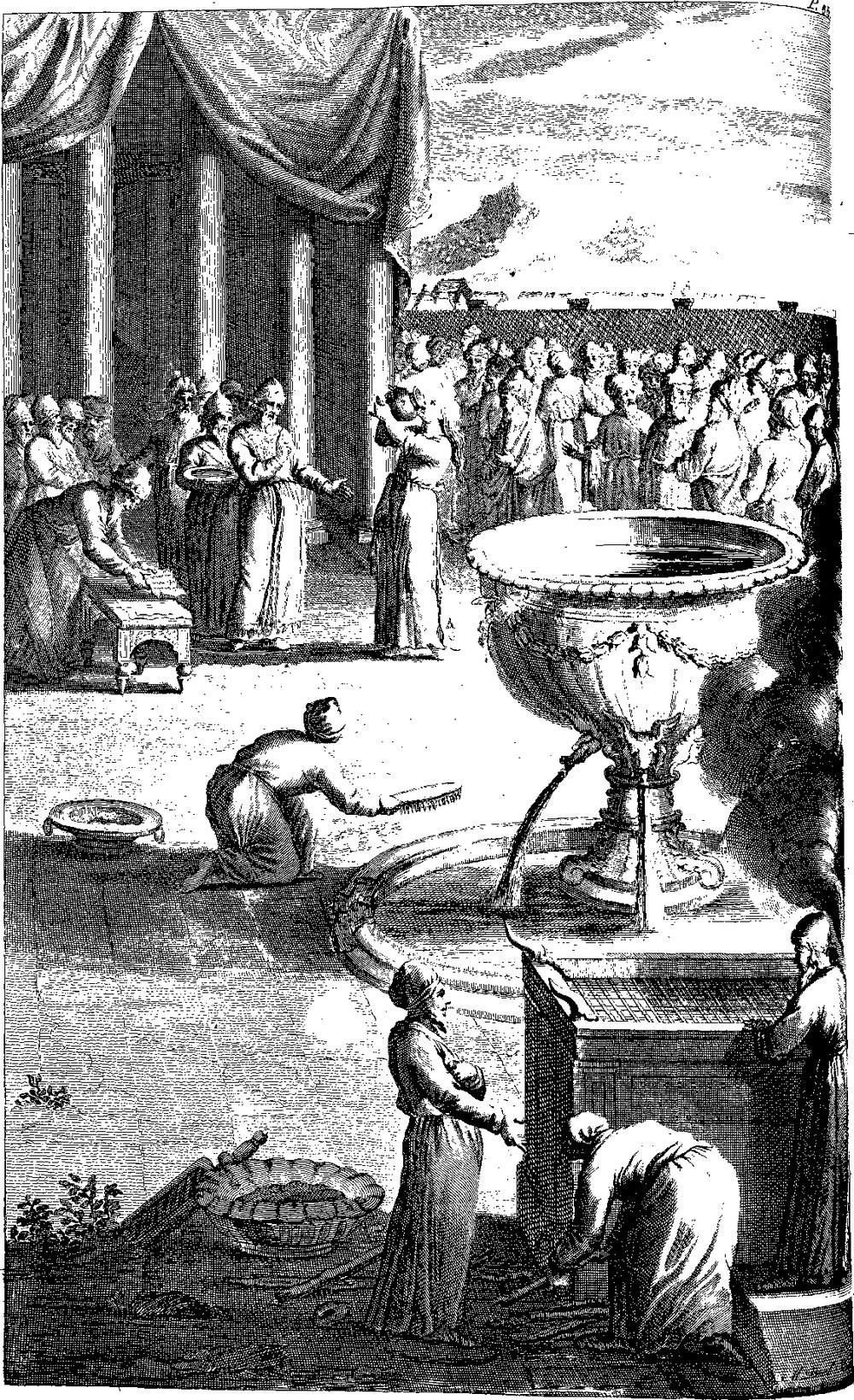
The Judges of the Sanhedrim at first endeavour’d with their threatnings to confound the Woman, and oblige her to confess her crime. If she persisted in denying it they had her well tired with walking, to see if any thing could be got out of her by this means: And if she still own’d nothing, she was led to the eastern gate of the Court of Israel, and when she was stript of the clothes she wore, and was dressed in black before a multitude of Persons of her own Sex, the Priest then told her, that if she knew herself to be innocent of that which she was accused of, she had nothing to apprehend; but that if she were guilty, she might expect to suffer all that the Law threaten’d her with; (and what that was we shall see hereafter) to which she answer’d Amen, Amen.
The Priest wrote the terms of the Law upon a piece of Vellum, with ink made particularly for this use, without vitriol, that it might more easily be blotted out: The words were these, If a strange Man has not come near you, and you are not polluted by forsaking the bed of your Husband, these bitter waters which I have cursed will not hurt you; but if you have gone astray from your Husband, and have polluted yourself by coming near to another Man, may you be accursed of the Lord, and become an example for all his People; may your Thighs rot, and your Belly swell till it burst; may these cursed waters enter into your Belly, and being swelled therewith, may your Thighs putrify.
After this the Priest took a pitcher made of new Earth, filled it with water out of the brazen bason, which was near the Altar of Burnt-offerings, cast some dust into it, taken from the pavement of the Temple, mingled something bitter with it, as Wormwood or some other drug; and having read the Curses above mentioned to the Woman, and received her answer of Amen, he scraped them into the pitcher of water. During all this time another Priest was tearing her cloaths as low as her bosom, made her head bare, untied the tresses of her hair, fasten’d her cloaths together which were torn after this manner, with a girdle bound under her breasts, and presented her with the tenth part of an Epha, or about three pints of Barley meal, which was in a frying-pan, without oil or incense.
The other Priest, who had prepared the waters of Jealousy or Bitterness, then gave them to be drank by the accused Person, and as soon as she had got them down he put the pan with the meal in it into her hand. This was stirr’d before the Lord, and part of it thrown into the fire of the Altar. If the Woman were innocent, she returned with her Husband, and the Waters, instead of incommoding her, increas’d her health, and made her more fruitful than ever: If on the contrary she were guilty, she was seen immediately to grow pale, and her eyes started out of her head; and, lest the Temple should be polluted by her death, she was carried out with all speed, and died instantly, with all the ignominious circumstances related in the Curses, which, as they say, had their effect too upon him with whom the Woman had transgressed, tho’ he were absent and at a distance. If her Husband had himself been guilty of Adultery, the bitter Waters had no bad effect upon her.
The Rabbins tell us, that since the return of the Jews from their captivity, the trial of Women suspected of Adultery has been suppressed, and that for two reasons: First, because Adulteries were become too frequent; and secondly, that the name of God might not be made liable to be too often erazed in the waters of Bitterness. When therefore any Husband had conceived just suspicions against the fidelity of his Wife, and had witnesses to depose that they had seen her privately with the suspected Persons, contrary to the directions of her Husband, she was immediately divorced, and deprived of her Dowry. Leo of Modena ¹ assures us, that in this case the Husband is obliged to dismiss his Wife whether he will or no, and to separate for ever from her. After this the Woman is at liberty to marry again, not however till four months are expir’d, that it may be discern’d whether she is with child by her Husband before she takes another.
John viii. 3.The Jews having one day surpriz’d a Woman in Adultery, brought her to Jesus Christ, and asked what they should do with her, Moses having commanded Women of this character to be stoned: But this they said tempting him, in order to find matter of accusation against him; Je2 sus therefore stooping, wrote with his Finger upon the ground3, and raising himself again, said, Let him who is without Sin cast the first Stone; then stooping once more, he continued writing on the ground. His Accusers hearing him speak after this manner, retired one after another, the oldest first withdrawing: Then Jesus getting up, and seeing himself left alone with the Woman, said to her, Woman, where are thy Accusers? has no one condemned thee? She said, No, Lord. Jesus answer’d her, Neither will I condemn thee, go away and sin no more.
Deut. xxii. 23.It is presumed with reason, first that this Woman’s Accusers were themselves guilty of the crime which they laid to her charge, in the same manner almost as the Accusers of the chaste Susanna. Now it is not just to receive the accusations of those Persons who are guilty of the evil which they find fault with in another4. Non modo accusator, sed me objurgatur, quidem ferendus est is, qui quod in alio reprehendit in eo ipse reprehenditur. Secondly, there is room to believe that the Woman here spoken of had suffer’d some violence, and that her crime was much lessen’d by the circumstances attending it. Selden5 and Fagius6 are of opinion that her case was the same with that related by Moses in these terms; If a Damsel, that is, a Virgin be betrothed to an Husband, and a Man find her in the City and lie with her, then ye shall bring them both unto the gate of that City, and ye shall stone them with stones that they die; the Damsel, because she cried not, being in the City, and the Man, because he hath humbled his Neighbour’s Wife.
Read this article in its place on the printed pages
Footnotes
-
See Levit. v. 11, 12. and the Commentators on this place; and Philo de specialib. legib. ↩
-
Leo of Modena, his Customs of the Jews, Part 5. c. 6. ↩
-
Translators’ note. St. Jerom aggravates the matter, and tells us, that our Saviour not only wrote the Sins of the Accusers, but those too of all Mankind, Jesus inclinans se digito scribebat in terrâ, eorum videlicet qui accusabant, & omnium peccata mortalium. Secundùm quod scriptum est in Propheta, relinquentes autem te, in terra scribentur. Hieron. Advers. Pelag. 1. 2. ↩
-
Cicero in verrem, Orat. 5. ↩
-
Selden Uxor Hebr. l. 3. c. 11. ↩
-
Fagius ad Deut. xxii. 22. ↩