Works › The Mariale: Questions on “Missus est”
Volume 37 · pp. 316–317
Question 225. Whether she said well: I do not know man?
A marker with ≈ is an approximate page boundary, placed by measure of the text; the page photographs remain the authority. In the paired views, clicking a page marker brings that page into view.
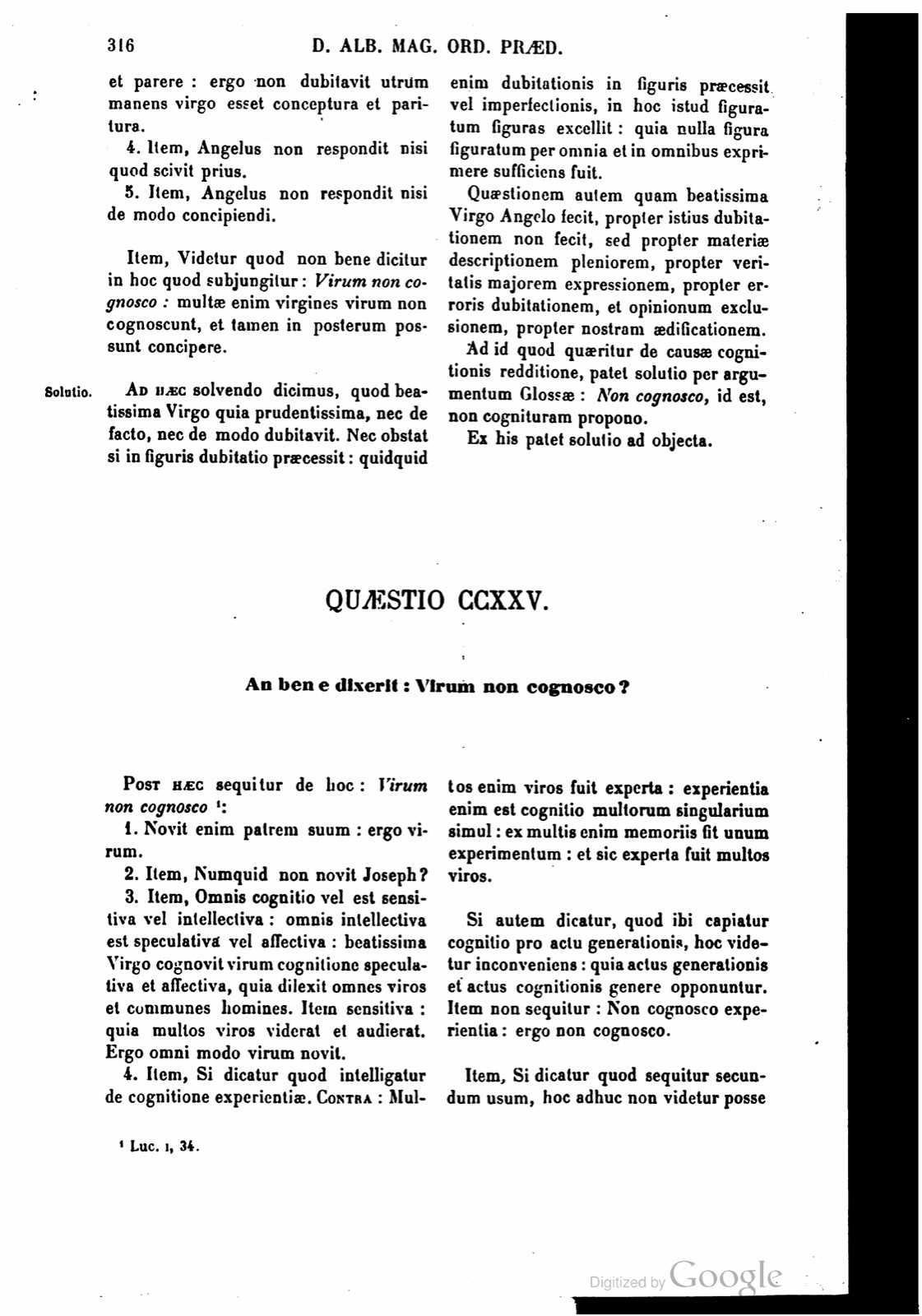
QUAESTIO CCXXV. An bene dixerit: Virum non cognosco?
Post haec sequitur de hoc: Virum non cognosco 1.
1. Novit enim patrem suum: ergo virum.
2. Item, Numquid non novit Joseph?
3. Item, Omnis cognitio vel est sensitiva vel intellectiva: omnis intellectiva est speculativa vel affectiva: beatissima Virgo cognovit virum cognitione speculativa et affectiva, quia dilexit omnes viros et communes homines. Item sensitiva: quia multos viros viderat et audierat. Ergo omni modo virum novit.
4. Item, Si dicatur quod intelligatur de cognitione experientiae. Contra: Multos enim viros fuit experta: experientia enim est cognitio multorum singularium simul: ex multis enim memoriis fit unum experimentum: et sic experta fuit multos viros.
Si autem dicatur, quod ibi capiatur cognitio pro actu generationis, hoc videtur inconveniens: quia actus generationis et actus cognitionis genere opponuntur.
QUESTION 225. Whether she said well: I do not know man?
After these things there follows concerning this: I do not know man 1.
1. For she knew her father; therefore a man.
2. Likewise, did she not know Joseph?
3. Likewise, every knowledge is either sensitive or intellective; every intellective knowledge is speculative or affective. The most blessed Virgin knew man by speculative and affective knowledge, because she loved all men and common human beings. Likewise by sensitive knowledge, because she had seen and heard many men. Therefore in every way she knew man.
4. Likewise, if it is said that this is understood of the knowledge of experience. To the contrary: she had experienced many men; for experience is knowledge of many singulars together; for from many memories one experience is made; and thus she had experienced many men.
But if it is said that knowledge is taken there for the act of generation, this seems unsuitable, because the act of generation and the act of knowledge are opposed in genus.
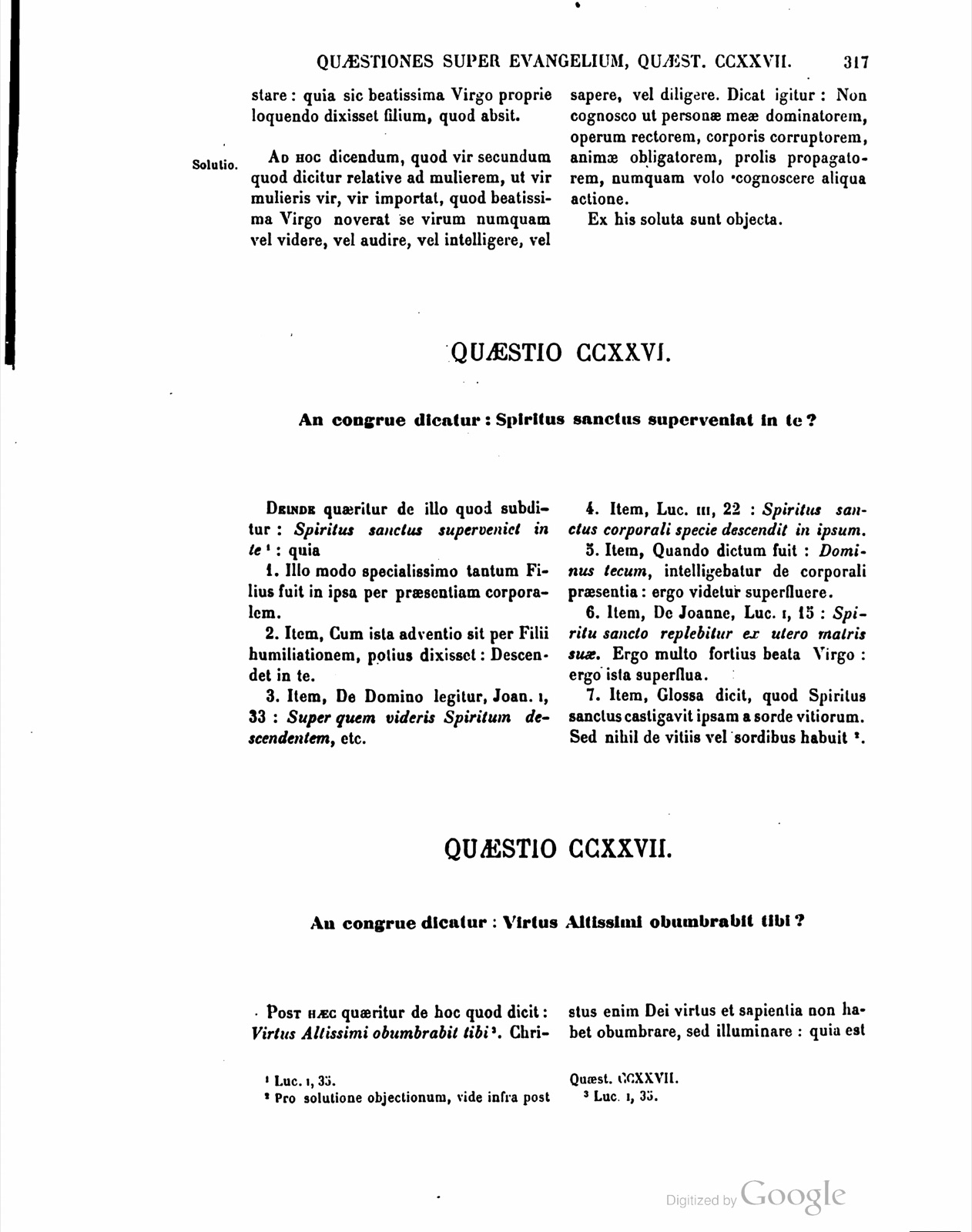
Item non sequitur: Non cognosco experientia: ergo non cognosco.
Item, Si dicatur quod sequitur secundum usum, hoc adhuc non videtur posse stare: quia sic beatissima Virgo proprie loquendo dixisset filium, quod absit.
Solutio. Ad hoc dicendum, quod vir secundum quod dicitur relative ad mulierem, ut vir mulieris vir, vir importat, quod beatissima Virgo noverat se virum numquam vel videre, vel audire, vel intelligere, vel sapere, vel diligere. Dicat igitur: Non cognosco ut personae meae dominatorem, operum rectorem, corporis corruptorem, animae obligatorem, prolis propagatorem, numquam volo cognoscere aliqua actione.
Ex his soluta sunt objecta.
Likewise, this does not follow: I do not know by experience; therefore I do not know.
Likewise, if it is said that it follows according to usage, this still does not seem able to stand, because in this way the most blessed Virgin, properly speaking, would have said son, which is far from it.
Solution. To this it must be said that man, according as it is said relatively to woman, as husband, the man of a woman, imports that the most blessed Virgin had known that she would never see, hear, understand, taste, or love a man. Therefore let her say: I do not know, and I never wish to know by any action, one as dominator of my person, rector of my works, corrupter of my body, binder of my soul, propagator of offspring.
From these things the objections are solved.
Notes
- Luke 1:34. (Luc. I, 34.) ↩
If a page does not appear, its photograph has not been uploaded yet.