Works › The Mariale: Questions on “Missus est”
Volume 37 · pp. 314–316
Question 224. Whether the Blessed Virgin said doubtfully: How shall this be done?
A marker with ≈ is an approximate page boundary, placed by measure of the text; the page photographs remain the authority. In the paired views, clicking a page marker brings that page into view.
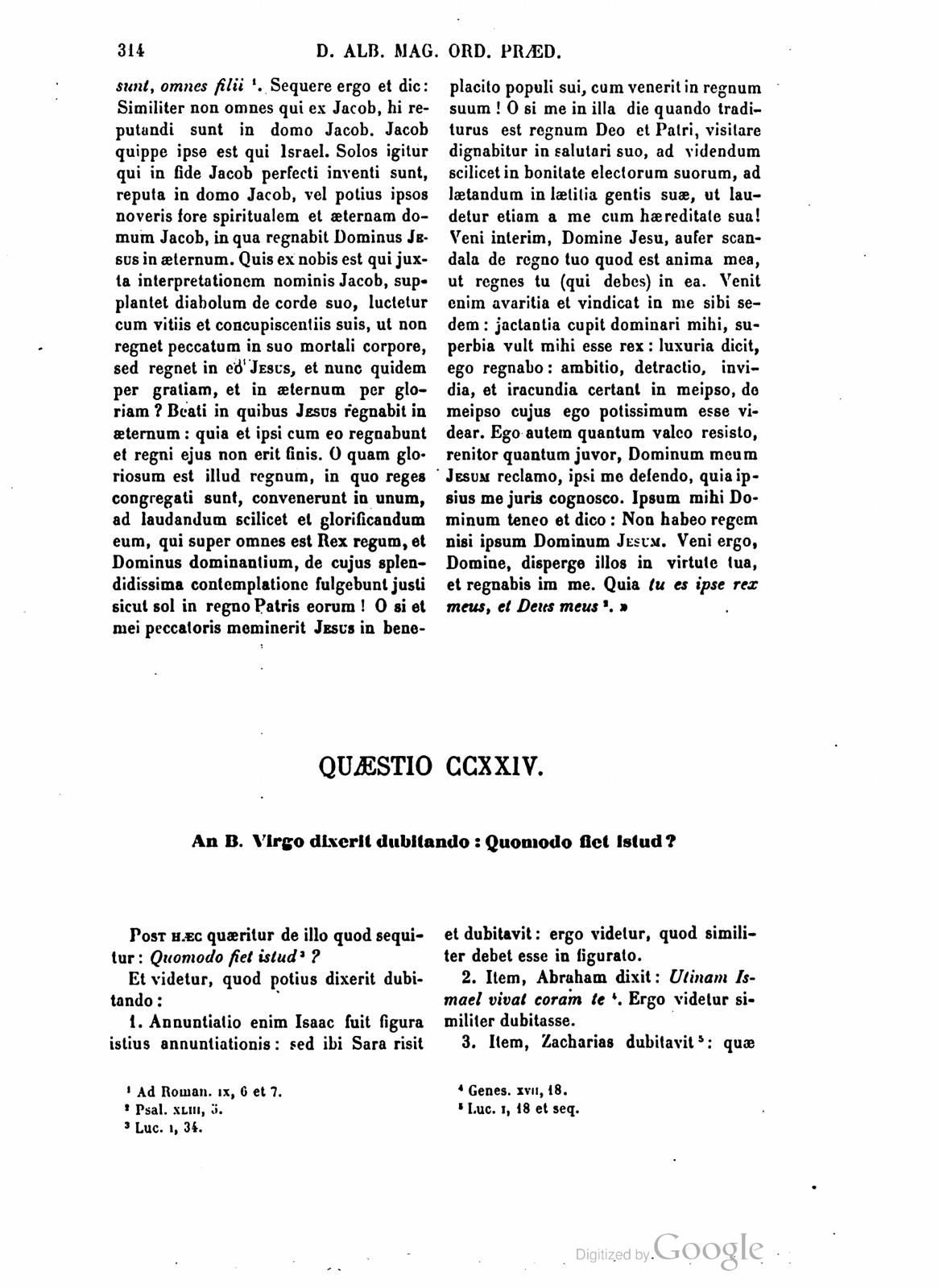
QUAESTIO CCXXIV. An B. Virgo dixerit dubitando: Quomodo fiet istud?
Post haec quaeritur de illo quod sequitur: Quomodo fiet istud 1?
Et videtur, quod potius dixerit dubitando:
1. Annuntiatio enim Isaac fuit figura istius annuntiationis: sed ibi Sara risit et dubitavit: ergo videtur, quod similiter debet esse in figurato.
2. Item, Abraham dixit: Utinam Ismael vivat coram te 2. Ergo videtur similiter dubitasse.
3. Item, Zacharias dubitavit: quae annuntiatio etiam fuit figura istius annuntiationis: ergo in ista annuntiatione debuit esse dubitatio 3.
Sed contra:
In Glossa super Lucam, I, 34: "Cum Sara riserit de promissione Dei, et Maria dixit: Quomodo fiet istud, quoniam virum non cognosco, cur non fuerunt mutae sicut Zacharias? Sed Sara et Maria non dubitant faciendum quod promittitur, sed modum requirunt." Item alia Glossa: "Legerat Maria virginem parituram. Non dubitabat: sciebat enim quia impleri oportebat quod ab Angelo nuntiabatur. Sed quia quo modo fieret non legerat, nec ab Angelo audierat, quo ordine impleri debeat, requirit." Unde Bernardus: "Non dubitabat de facto, sed modum requirit et ordinem. Nec enim quaerit an fiet istud, sed quomodo. Quasi dicat: Cum sciat Dominus meus, testis conscientiae meae, votum esse ancillae suae non cognoscere virum, qua lege, quo ordine placebit ei ut fiat istud? Si oportuerit me frangere votum ut pariam talem filium, et gaudeo de filio, et doleo de proposito. Fiat tamen voluntas ejus. Sin vero virgo concipiam, virgo et pariam, quod utique si placuerit ei, impossibile non erit, tunc scio vere, quia respexit humilitatem ancillae suae 4." Ex his videtur, quod non dubitavit de facto, sed de modo.
QUESTION 224. Whether the Blessed Virgin said doubtfully: How shall this be done?
After these things inquiry is made concerning that which follows: How shall this be done 1?
And it seems that she rather said it doubtfully:
1. For the annunciation of Isaac was a figure of this annunciation; but there Sarah laughed and doubted; therefore it seems that it ought to be similarly in the thing figured.
2. Likewise, Abraham said: Would that Ishmael might live before you 2. Therefore he seems similarly to have doubted.
3. Likewise, Zachary doubted; and that annunciation also was a figure of this annunciation; therefore in this annunciation there ought to have been doubt 3.
But to the contrary:
In the Gloss on Luke 1:34: "Since Sarah laughed concerning the promise of God, and Mary said, How shall this be done, since I do not know man, why were they not made mute as Zachary was? But Sarah and Mary do not doubt that what is promised is to be done; they seek the mode." Likewise, another Gloss says: "Mary had read that a virgin was to bear. She did not doubt, for she knew that what was announced by the Angel had to be fulfilled. But because she had not read how it would be done, nor had heard from the Angel in what order it ought to be fulfilled, she asks." Whence Bernard says: "She did not doubt concerning the fact, but seeks the mode and order. For she does not ask whether this shall be done, but how. As though she were saying: Since my Lord, witness of my conscience, knows that it is the vow of his handmaid not to know man, by what law, by what order will it please him that this be done? If it is necessary for me to break my vow in order that I may bear such a son, I both rejoice concerning the son and grieve concerning the purpose. Nevertheless let his will be done. But if I as a virgin shall conceive and as a virgin also bear, which surely, if it please him, will not be impossible, then I truly know that he has looked upon the humility of his handmaid 4." From these things it seems that she did not doubt concerning the fact, but concerning the mode.
Sed contra:
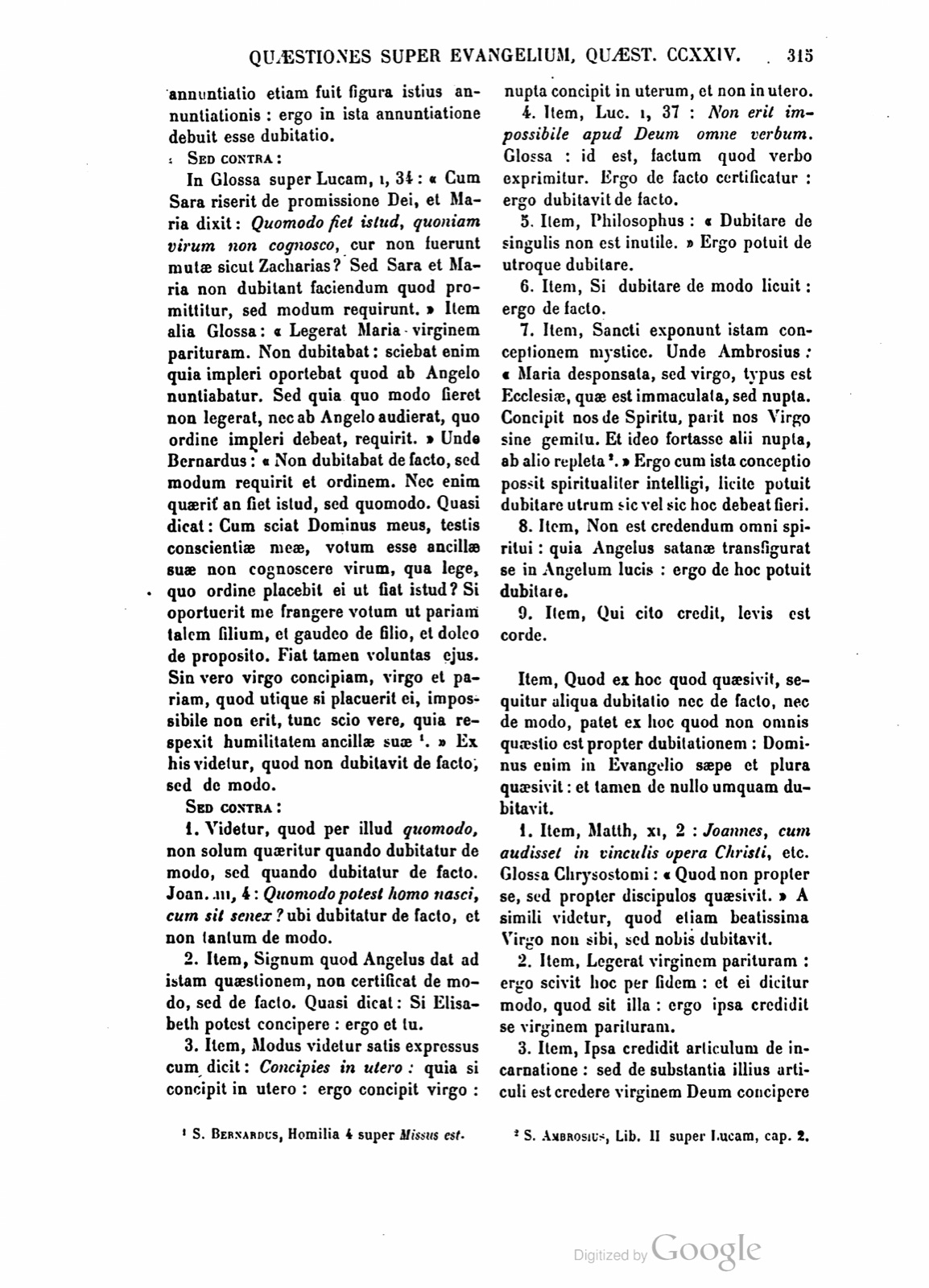
1. Videtur, quod per illud quomodo, non solum quaeritur quando dubitatur de modo, sed quando dubitatur de facto. Joan. III, 4: Quomodo potest homo nasci, cum sit senex? ubi dubitatur de facto, et non tantum de modo.
2. Item, Signum quod Angelus dat ad istam quaestionem, non certificat de modo, sed de facto. Quasi dicat: Si Elisabeth potest concipere: ergo et tu.
3. Item, Modus videtur satis expressus cum dicit: Concipies in utero: quia si concipit in utero: ergo concipit virgo: nupta concipit in uterum, et non in utero.
4. Item, Luc. I, 37: Non erit impossibile apud Deum omne verbum. Glossa: id est, factum quod verbo exprimitur. Ergo de facto certificatur: ergo dubitavit de facto.
5. Item, Philosophus: "Dubitare de singulis non est inutile." Ergo potuit de utroque dubitare.
6. Item, Si dubitare de modo licuit: ergo de facto.
7. Item, Sancti exponunt istam conceptionem mystice. Unde Ambrosius: "Maria desponsata, sed virgo, typus est Ecclesiae, quae est immaculata, sed nupta. Concipit nos de Spiritu, parit nos Virgo sine gemitu. Et ideo fortasse alii nupta, ab alio repleta 5." Ergo cum ista conceptio possit spiritualiter intelligi, licite potuit dubitare utrum sic vel sic hoc debeat fieri.
8. Item, Non est credendum omni spiritui: quia Angelus satanae transfigurat se in Angelum lucis: ergo de hoc potuit dubitare.
9. Item, Qui cito credit, levis est corde.
Item, Quod ex hoc quod quaesivit, sequitur aliqua dubitatio nec de facto, nec de modo, patet ex hoc quod non omnis quaestio est propter dubitationem: Dominus enim in Evangelio saepe et plura quaesivit: et tamen de nullo umquam dubitavit.
But to the contrary:
1. It seems that by that how, inquiry is made not only when there is doubt concerning the mode, but also when there is doubt concerning the fact. John 3:4: How can a man be born when he is old? where there is doubt concerning the fact and not only concerning the mode.
2. Likewise, the sign that the Angel gives for that question does not certify concerning the mode, but concerning the fact, as if he were saying: If Elizabeth can conceive, therefore you also can.
3. Likewise, the mode seems sufficiently expressed when he says: You shall conceive in the womb, because if she conceives in the womb, then she conceives as a virgin; a married woman conceives into the womb and not in the womb.
4. Likewise, Luke 1:37: No word will be impossible with God. The Gloss says: that is, the deed which is expressed by the word. Therefore she is certified concerning the fact; therefore she doubted concerning the fact.
5. Likewise, the Philosopher says: "To doubt concerning individual things is not useless." Therefore she could doubt concerning both.
6. Likewise, if it was permitted to doubt concerning the mode, therefore also concerning the fact.
7. Likewise, the saints expound this conception mystically. Whence Ambrose says: "Mary, betrothed but a virgin, is a type of the Church, which is immaculate but married. She conceives us from the Spirit; she, a Virgin, bears us without groaning. And therefore perhaps she is married to one, filled by another 5." Therefore, since this conception can be understood spiritually, she could lawfully doubt whether this ought to happen in this way or that.
8. Likewise, one must not believe every spirit, because an angel of Satan transforms himself into an angel of light; therefore she could doubt concerning this.
9. Likewise, one who believes quickly is light of heart.
Likewise, that from the fact that she asked there follows some doubt neither concerning the fact nor concerning the mode is clear from this, that not every question is because of doubt. For the Lord in the Gospel asked often and many things, and yet he never doubted concerning anything.
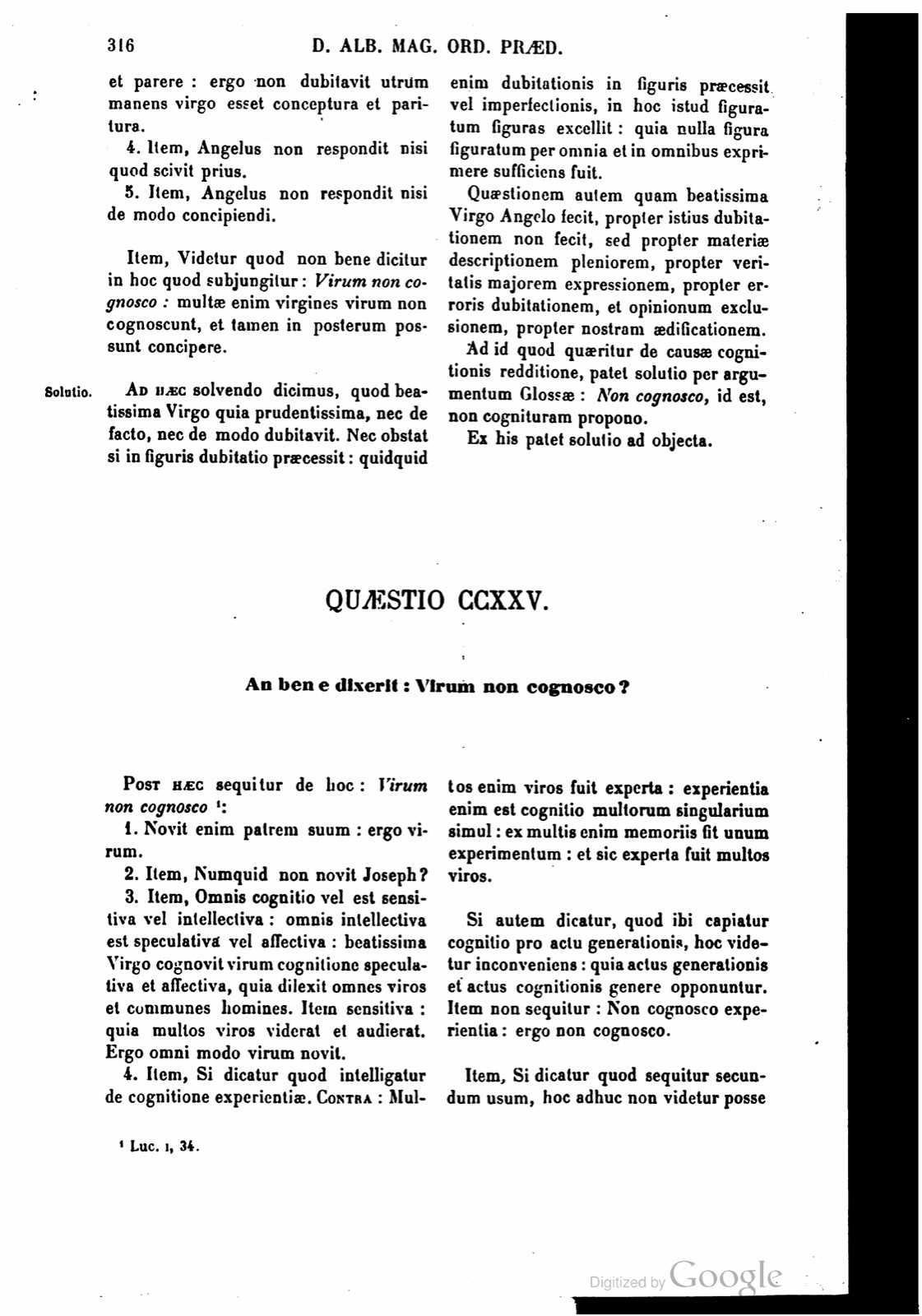
1. Item, Matth. XI, 2: Joannes, cum audisset in vinculis opera Christi, etc. Glossa Chrysostomi: "Quod non propter se, sed propter discipulos quaesivit." A simili videtur, quod etiam beatissima Virgo non sibi, sed nobis dubitavit.
2. Item, Legerat virginem parituram: ergo scivit hoc per fidem: et ei dicitur modo, quod sit illa: ergo ipsa credidit se virginem parituram.
3. Item, Ipsa credidit articulum de incarnatione: sed de substantia illius articuli est credere virginem Deum concipere et parere: ergo non dubitavit utrum manens virgo esset conceptura et paritura.
4. Item, Angelus non respondit nisi quod scivit prius.
5. Item, Angelus non respondit nisi de modo concipiendi.
Item, Videtur quod non bene dicitur in hoc quod subjungitur: Virum non cognosco: multae enim virgines virum non cognoscunt, et tamen in posterum possunt concipere.
Solutio. Ad haec solvendo dicimus, quod beatissima Virgo quia prudentissima, nec de facto, nec de modo dubitavit. Nec obstat si in figuris dubitatio praecessit: quidquid enim dubitationis in figuris praecessit vel imperfectionis, in hoc istud figuratum figuras excellit: quia nulla figura figuratum per omnia et in omnibus exprimere sufficiens fuit.
Quaestionem autem quam beatissima Virgo Angelo fecit, propter istius dubitationem non fecit, sed propter materiae descriptionem pleniorem, propter veritatis majorem expressionem, propter erroris dubitationem, et opinionum exclusionem, propter nostram aedificationem.
Ad id quod quaeritur de causae cognitionis redditione, patet solutio per argumentum Glossae: Non cognosco, id est, non cognituram propono.
Ex his patet solutio ad objecta.
1. Likewise, Matthew 11:2: John, when he had heard in chains the works of Christ, etc. The Gloss of Chrysostom says: "Because he asked not for his own sake, but for the sake of the disciples." From a similar case it seems that the most blessed Virgin also doubted not for herself but for us.
2. Likewise, she had read that a virgin was to bear; therefore she knew this by faith. And now it is said to her that she is that virgin; therefore she believed herself to be the virgin who would bear.
3. Likewise, she believed the article concerning the incarnation; but it belongs to the substance of that article to believe that a virgin conceives and bears God. Therefore she did not doubt whether, remaining a virgin, she was going to conceive and bear.
4. Likewise, the Angel did not answer except what she knew before.
5. Likewise, the Angel did not answer except concerning the mode of conceiving.
Likewise, it seems that it is not well said in this which is added: I do not know man; for many virgins do not know man and nevertheless can conceive in the future.
Solution. In solving these things, we say that the most blessed Virgin, because she was most prudent, doubted neither concerning the fact nor concerning the mode. Nor is it an obstacle if doubt preceded in the figures; for whatever of doubt or imperfection preceded in the figures, in this the thing figured excels the figures, because no figure was sufficient to express the thing figured in all respects and in all things.
But the question that the most blessed Virgin made to the Angel she did not make because of doubt about that thing, but because of a fuller description of the matter, because of a greater expression of the truth, because of doubt about error and exclusion of opinions, and because of our edification.
To that which is asked concerning the rendering of the cause of knowledge, the solution is clear through the argument of the Gloss: I do not know, that is, I propose not to know.
From these things the solution to the objections is clear.
If a page does not appear, its photograph has not been uploaded yet.