Works › The Mariale: Questions on “Missus est”
Volume 37 · p. 317
Question 226. Whether it is fittingly said: The Holy Spirit will come upon you?
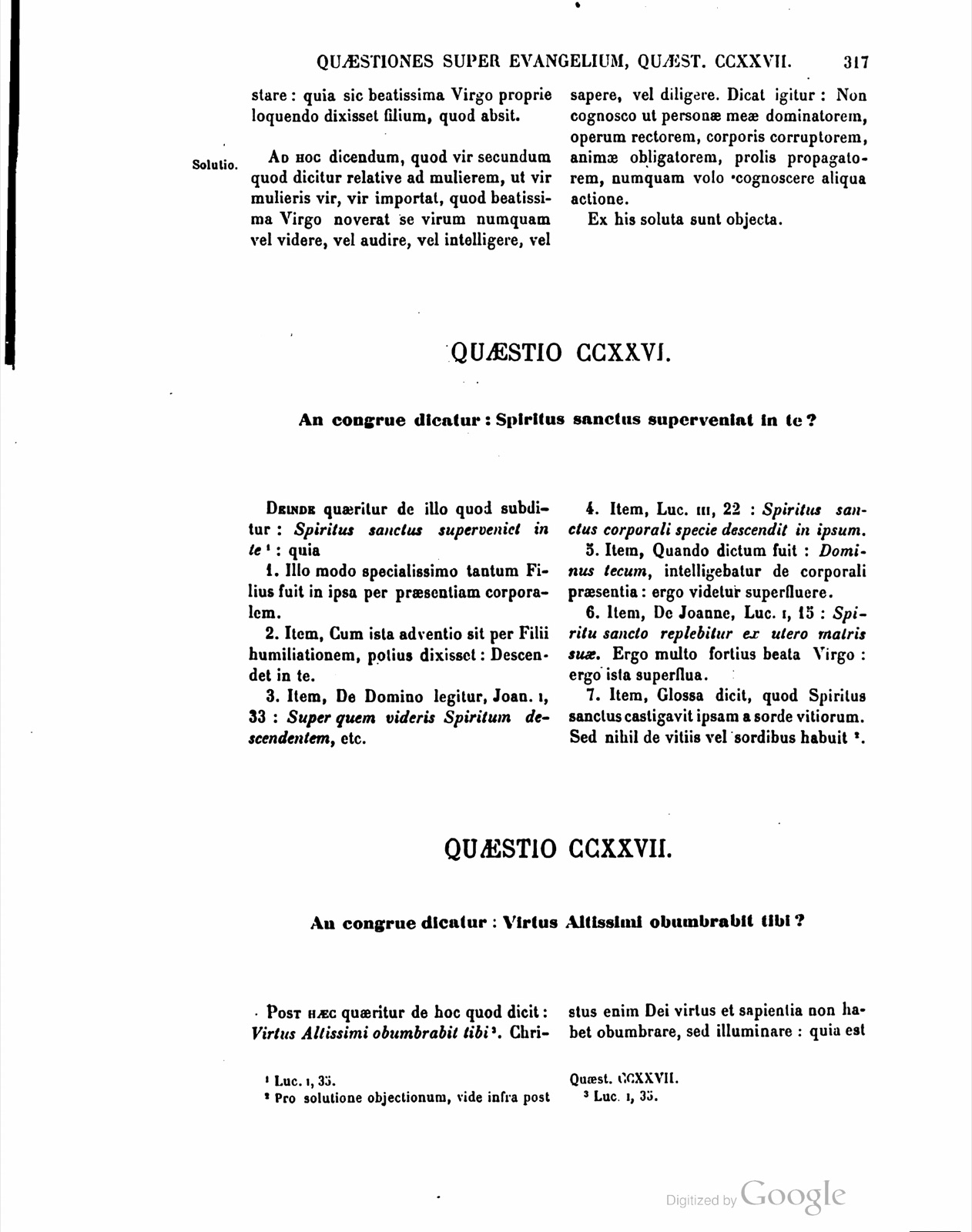
QUAESTIO CCXXVI. An congrue dicatur: Spiritus sanctus superveniat in te?
Deinde quaeritur de illo quod subditur: Spiritus sanctus superveniet in te 1: quia
1. Illo modo specialissimo tantum Filius fuit in ipsa per praesentiam corporalem.
2. Item, Cum ista adventio sit per Filii humiliationem, potius dixisset: Descendet in te.
3. Item, De Domino legitur, Joan. I, 33: Super quem videris Spiritum descendentem, etc.
4. Item, Luc. III, 22: Spiritus sanctus corporali specie descendit in ipsum.
5. Item, Quando dictum fuit: Dominus tecum, intelligebatur de corporali praesentia: ergo videtur superfluere.
6. Item, De Joanne, Luc. I, 15: Spiritu sancto replebitur ex utero matris suae. Ergo multo fortius beata Virgo: ergo ista superflua.
7. Item, Glossa dicit, quod Spiritus sanctus castigavit ipsam a sorde vitiorum. Sed nihil de vitiis vel sordibus habuit 2.
QUESTION 226. Whether it is fittingly said: The Holy Spirit will come upon you?
Then inquiry is made concerning that which is added: The Holy Spirit will come upon you 1, because:
1. In that most special mode only the Son was in her through bodily presence.
2. Likewise, since that coming is through the humiliation of the Son, it would rather have said: He will descend into you.
3. Likewise, concerning the Lord it is read, John 1:33: He upon whom you see the Spirit descending, etc.
4. Likewise, Luke 3:22: The Holy Spirit descended upon him in bodily form.
5. Likewise, when it was said, The Lord is with you, this was understood of bodily presence; therefore it seems superfluous.
6. Likewise, concerning John, Luke 1:15: He will be filled with the Holy Spirit from his mother's womb. Therefore much more the blessed Virgin; therefore this is superfluous.
7. Likewise, the Gloss says that the Holy Spirit cleansed her from the filth of vices. But she had nothing of vices or filth 2.
Notes
- Luke 1:35. (Luc. I, 35.) ↩
- For the solution of the objections, see below after Question 227. (Pro solutione objectionum, vide infra post Quaest. CCXXVII.) ↩
If a page does not appear, its photograph has not been uploaded yet.