Works › The Mariale: Questions on “Missus est”
Volume 37 · pp. 305–307
Question 219. Whether the Lord through his incarnation was made small or great?
A marker with ≈ is an approximate page boundary, placed by measure of the text; the page photographs remain the authority. In the paired views, clicking a page marker brings that page into view.
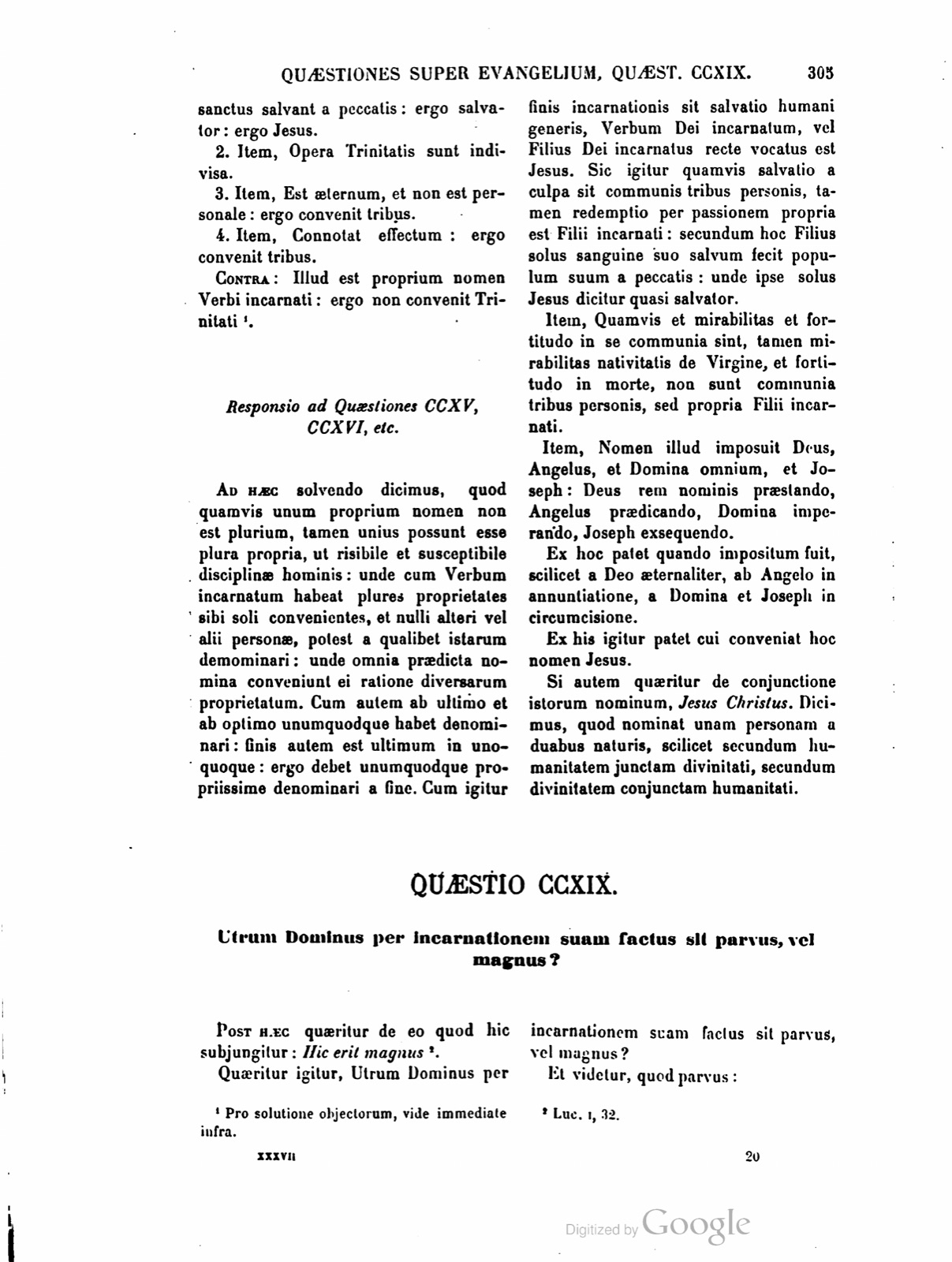
QUAESTIO CCXIX. Utrum Dominus per incarnationem suam factus sit parvus, vel magnus?
Post haec quaeritur de eo quod hic subjungitur: Hic erit magnus 1.
Quaeritur igitur, Utrum Dominus per incarnationem suam factus sit parvus, vel magnus?
Et videtur, quod parvus:
1. Unde, Psal. VII, 6: Minuisti eum paulo minus ab Angelis. Sed prius multo major fuit Angelis.
2. Item, Apostolus, ad Hebr. I, 9: Eum autem, qui modico quam Angeli minoratus est, videmus Jesum propter passionem mortis, gloria et honore coronatum.
3. Item, Ad Philip. II, 7: Exinanivit semetipsum, formam servi accipiens.
4. Item, Isa. IX, 6: Parvulus natus est nobis.
5. Item, Bernardus: "Quare erit et non potius est magnus, qui semper aequaliter magnus, non habet quo crescat, nec major post conceptum futurus sit quam ante, vel sit, vel fuerit 2?"
6. Item, Duplex est magnitudo: molis, et virtutis. De magnitudine molis nihil ad propositum, quia illa est indifferens: juxta quod, I Regum, XVI, 7, dicitur: Non respicias vultum ejus, nec altitudinem staturae ejus, quoniam abjeci eum. Magnitudo autem virtutis nulla accessit Deo per incarnationem: quidquid enim homo potest, Deus potest et plus: ergo quidquid potuit modo, potuit et prius: ergo non est magnus factus.
Contra:
1. Luc. I, 46: Magnificat anima mea Dominum. Ergo ipsa magnificavit eum: ergo ipse est magnificatus. Unde in figura, III Regum, X, 23 et 24: Magnificatus est rex Salomon super omnes reges terrae divitiis et sapientia. Et universa terra desiderabat vultum Salomonis, etc.
2. Item, Bernardus: "Erit magnus: quia magnificabit eum Deus in conspectu regum, adeo ut adorent eum omnes reges, et omnes gentes serviant ei."
3. Item, Augmentum est praeexistentis quantitatis additamentum: ipse autem manens quod erat, assumpsit quod non erat: ergo magnificatus.
4. Item, Tale additum tali facit magis tale: sed divinitas est bonum, et humanitas est bonum: ergo additum alteri erit magis bonum.
Solutio. Ad haec solvendo dicimus, quod Dominus Jesus Christus in incarnatione factus est magnus et parvus: quia factus est Deus et homo: magnus in quantum Deus, parvus in quantum homo respectu divinitatis: ergo una et eadem persona magnificata et parvificata est: magnificentia haec a deitate, parvitas autem sive exinanitio ab humanitate. Quod autem persona potest magnificari, hoc habet ab humanitate: quia divina natura non habet quo crescat. Quod autem persona dicitur exinaniri, hoc habet ratione divinitatis. Est autem parvificatio sive exinanitio non naturae diminutio in aliquo, sed cum inferiori unio: sic et magnificatio non est naturae extra metam propriam elevatio, sed cum summa natura personalis conjunctio.
QUESTION 219. Whether the Lord through his incarnation was made small or great?
After these things inquiry is made concerning that which is added here: This one will be great 1.
Therefore it is asked whether the Lord through his incarnation was made small or great.
And it seems that he was made small:
1. Whence Psalm 7:6: You made him a little less than the Angels. But before he was much greater than the Angels.
2. Likewise, the Apostle, Hebrews 1:9: But we see Jesus, who was made a little lower than the Angels, crowned with glory and honor because of the passion of death.
3. Likewise, Philippians 2:7: He emptied himself, taking the form of a servant.
4. Likewise, Isaiah 9:6: A little child is born to us.
5. Likewise, Bernard says: "Why will he be great, and not rather is he great, who is always equally great, has nothing by which he may grow, nor will he be greater after conception than before, or is, or has been 2?"
6. Likewise, greatness is twofold: of bulk and of power. Concerning greatness of bulk there is nothing to the purpose, because that is indifferent, according to which 1 Kings 16:7 says: Do not look upon his face, nor upon the height of his stature, because I have rejected him. But no greatness of power accrued to God through the incarnation. For whatever a human being can do, God can do, and more; therefore whatever he could do now, he could also do before; therefore he was not made great.
To the contrary:
1. Luke 1:46: My soul magnifies the Lord. Therefore she magnified him; therefore he himself was magnified. Whence in figure, 3 Kings 10:23 and 24: King Solomon was magnified above all kings of the earth in riches and wisdom. And the whole earth desired the face of Solomon, etc.
2. Likewise, Bernard says: "He will be great, because God will magnify him in the sight of kings, so that all kings will adore him and all nations will serve him."
3. Likewise, increase is an addition to preexisting quantity; but he, remaining what he was, assumed what he was not; therefore he was magnified.
4. Likewise, such a thing added to such a thing makes it more such; but divinity is good, and humanity is good; therefore one added to the other will be more good.
Solution. In solving these things, we say that the Lord Jesus Christ in the incarnation was made great and small, because he was made God and human: great insofar as God, small insofar as human with respect to the divinity. Therefore one and the same person was magnified and made small: this magnificence is from the deity, but the smallness or emptying is from the humanity. But that the person can be magnified, he has from humanity, because the divine nature has nothing by which it may grow. But that the person is said to be emptied, he has this by reason of divinity. Small-making or emptying, however, is not the diminution of nature in anything, but union with something lower; so also magnification is not the elevation of a nature beyond its proper boundary, but personal conjunction with the highest nature.
Erit itaque magnus nobilitate, dignitate, virtute, potestate, famositate, utilitate, novitate. De magnitudine nobilitatis, Bernardus: "Annon magnus, cujus magnitudinis non est finis? Et quis magnus sicut Deus noster? Plane magnus, qui tam magnus quam Altissimus." Et infra: "Altissimus enim Deus Pater quamvis omnipotens sit, non potuit tamen vel aequalem sibi condere creaturam, vel inaequalem gignere filium. Fecit itaque Angelum magnum: sed non quantus ipse: et ideo nec altissimum. Solum autem Unigenitum quem non fecit, sed genuit omnipotens omnipotentem, altissimus altissimum, aeternus coaeternum, ipsum sibi per omnia comparari, nec rapinam aestimat, nec injuriam."
De magnitudine dignitatis sive auctoritatis, idem Bernardus: "Erit enim magnus: quia magnificabit eum Dominus, ut supra."
De magnitudine autem potestatis, Bernardus: "Magnificet anima tua Dominum: quia hic erit magnus et magna faciet tibi, qui potens est, et sanctum nomen ejus. Item, Potestas ejus potestas aeterna, quae non auferetur 3."
De magnitudine autem virtutis et dignitatis simul, Apocal. XIX, 16: Habens in vestimento et in femore suo scriptum: Rex regum, et Dominus dominantium. Item, Apocal. V, 5: Vicit leo de tribu Juda.
De magnitudine famae, Psal. XLVII, 2: Magnus Dominus et laudabilis nimis 4. Item, Psal. XLIX, 1: A solis ortu usque ad occasum laudabile nomen Domini.
De magnitudine utilitatis, Bernardus: "Magnificetur et a nobis parvulis magnus Dominus, quos ut faceret magnos, factus est parvulus, Parvulus, ait, natus est nobis. Nobis, inquam, non Angelis: quia cum magnum haberent, parvulum non requirebant. Nobis ergo natus, nobis et datus, quia nobis necessarius. Jam de nobis nato et dato faciamus ad quod natus est et datus: utamur nostro in nostram utilitatem, de salvatore salutem operemur."
And so he will be great in nobility, dignity, virtue, power, fame, usefulness, and newness. Concerning greatness of nobility Bernard says: "Is he not great, of whose greatness there is no end? And who is great like our God? Plainly great, who is as great as the Most High." And below: "For although God the Father Most High is omnipotent, nevertheless he could neither establish a creature equal to himself nor beget a son unequal to himself. And so he made the Angel great, but not as great as himself; and therefore not most high. But the only-begotten, whom he did not make but begot, omnipotent from omnipotent, most high from most high, eternal from coeternal, he does not judge it robbery or injury that he be compared to himself in all things."
Concerning the greatness of dignity or authority, the same Bernard says: "For he will be great, because the Lord will magnify him, as above."
Concerning the greatness of power, Bernard says: "Let your soul magnify the Lord, because this one will be great and will do great things for you, he who is powerful, and holy is his name. Likewise, his power is eternal power, which will not be taken away 3."
Concerning the greatness of virtue and dignity together, Apocalypse 19:16 says: Having written on his garment and on his thigh: King of kings and Lord of lords. Likewise, Apocalypse 5:5: The lion of the tribe of Judah has conquered.
Concerning the greatness of fame, Psalm 47:2: Great is the Lord and exceedingly praiseworthy 4. Likewise, Psalm 49:1: From the rising of the sun to its setting, the name of the Lord is praiseworthy.
Concerning the greatness of usefulness, Bernard says: "Let the great Lord be magnified also by us little ones, whom, that he might make great, he was made a little child. A little child, he says, is born to us. To us, I say, not to the Angels, because since they had the great one, they did not require the little one. Therefore born for us, and given for us, because necessary for us. Now, concerning him born and given for us, let us do that for which he was born and given: let us use what is ours for our usefulness; from the Savior let us work salvation."
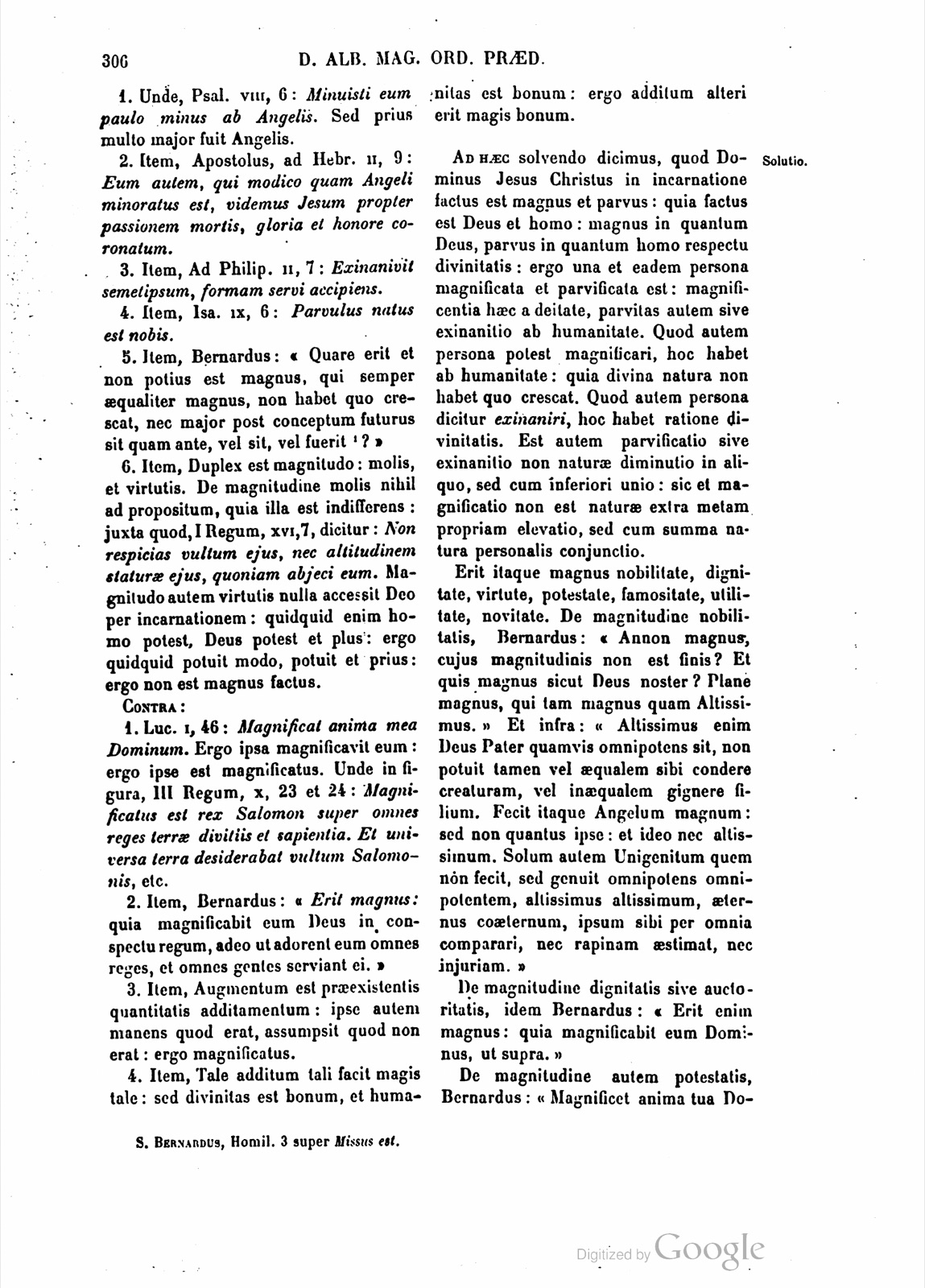
De magnitudine novitatis, Jerem. XXXI, 22: Creavit Dominus novum super terram: Foemina circumdabit virum. Et Dionysius: "Quod est omnium novorum novissimum."
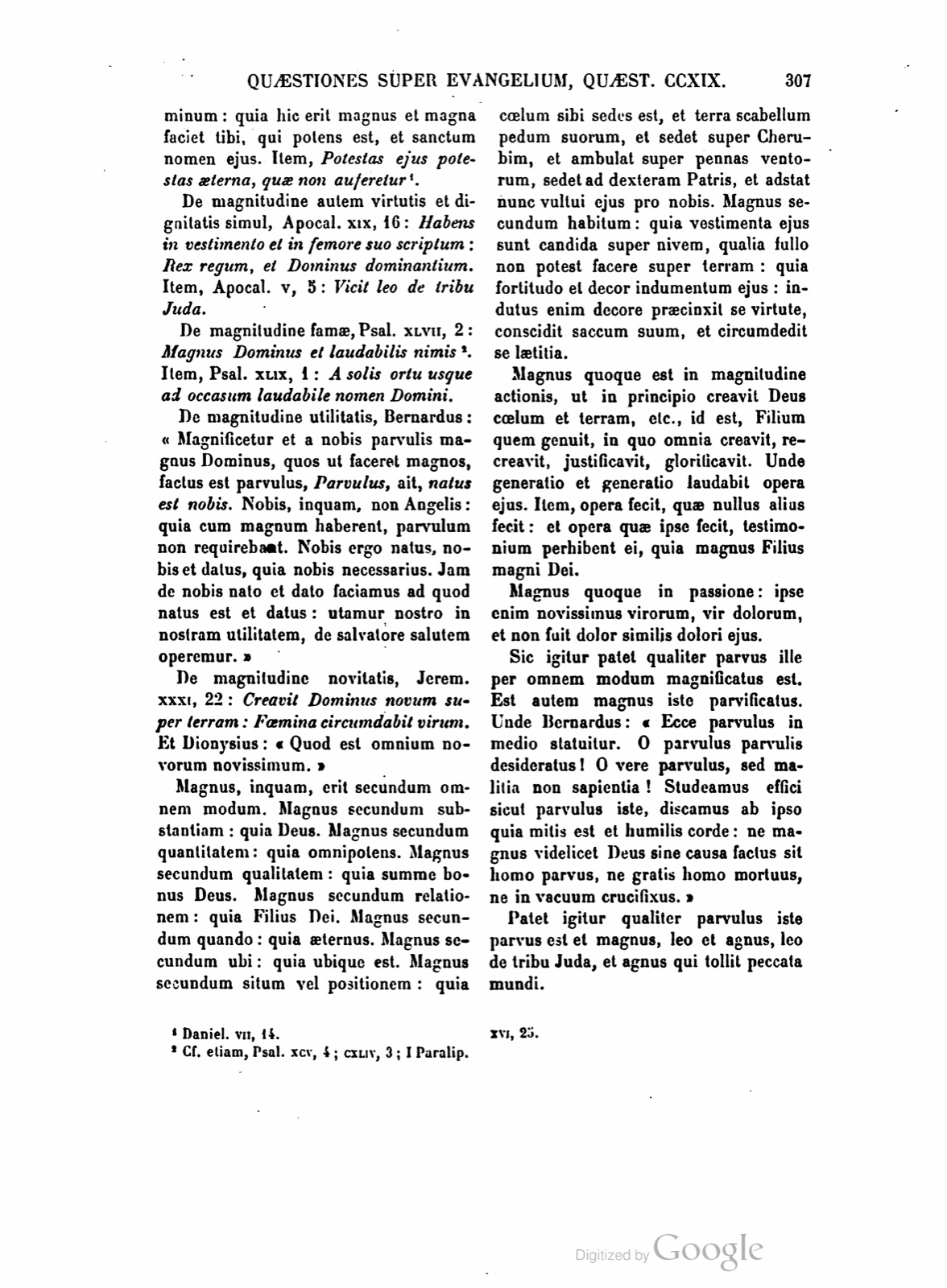
Magnus, inquam, erit secundum omnem modum. Magnus secundum substantiam: quia Deus. Magnus secundum quantitatem: quia omnipotens. Magnus secundum qualitatem: quia summe bonus Deus. Magnus secundum relationem: quia Filius Dei. Magnus secundum quando: quia aeternus. Magnus secundum ubi: quia ubique est. Magnus secundum situm vel positionem: quia caelum sibi sedes est, et terra scabellum pedum suorum, et sedet super Cherubim, et ambulat super pennas ventorum, sedet ad dexteram Patris, et adstat nunc vultui ejus pro nobis. Magnus secundum habitum: quia vestimenta ejus sunt candida super nivem, qualia fullo non potest facere super terram: quia fortitudo et decor indumentum ejus: indutus enim decore praecinxit se virtute, conscidit saccum suum, et circumdedit se laetitia.
Magnus quoque est in magnitudine actionis, ut in principio creavit Deus caelum et terram, etc., id est, Filium quem genuit, in quo omnia creavit, recreavit, justificavit, glorificavit. Unde generatio et generatio laudabit opera ejus. Item, opera fecit, quae nullus alius fecit: et opera quae ipse fecit, testimonium perhibent ei, quia magnus Filius magni Dei.
Magnus quoque in passione: ipse enim novissimus virorum, vir dolorum, et non fuit dolor similis dolori ejus.
Sic igitur patet qualiter parvus ille per omnem modum magnificatus est. Est autem magnus iste parvificatus. Unde Bernardus: "Ecce parvulus in medio statuitur. O parvulus parvulis desideratus! O vere parvulus, sed malitia non sapientia! Studeamus effici sicut parvulus iste, discamus ab ipso quia mitis est et humilis corde: ne magnus videlicet Deus sine causa factus sit homo parvus, ne gratis homo mortuus, ne in vacuum crucifixus."
Patet igitur qualiter parvulus iste parvus est et magnus, leo et agnus, leo de tribu Juda, et agnus qui tollit peccata mundi.
Concerning the greatness of newness, Jeremiah 31:22: The Lord has created a new thing upon the earth: a woman will encompass a man. And Dionysius says: "What is newest of all new things."
He will be great, I say, according to every mode. Great according to substance, because God. Great according to quantity, because omnipotent. Great according to quality, because supremely good God. Great according to relation, because Son of God. Great according to when, because eternal. Great according to where, because he is everywhere. Great according to situation or position, because heaven is his seat and the earth the footstool of his feet, and he sits upon the Cherubim and walks upon the wings of the winds, sits at the right hand of the Father and now stands before his face for us. Great according to habit, because his garments are white beyond snow, such as a fuller cannot make upon earth; because strength and beauty are his garment. For clothed with beauty he girded himself with power, tore his sackcloth, and surrounded himself with gladness.
He is also great in greatness of action, as in the beginning God created heaven and earth, etc., that is, the Son whom he begot, in whom he created, recreated, justified, and glorified all things. Whence generation and generation will praise his works. Likewise, he did works which no one else did; and the works which he did bear witness to him, because he is the great Son of the great God.
He is also great in the passion, for he is the least of men, a man of sorrows, and there was no sorrow like his sorrow.
Thus therefore it is clear how that small one was magnified in every mode. But that great one was made small. Whence Bernard says: "Behold, a little child is set in the midst. O little child desired by little ones! O truly little one, but in malice, not in wisdom! Let us strive to become like that little child; let us learn from him because he is meek and humble of heart, lest, namely, the great God have been made a small man without cause, lest the human being have died gratis, lest he have been crucified in vain."
Therefore it is clear how that little child is small and great, lion and lamb, lion of the tribe of Judah and lamb who takes away the sins of the world.
If a page does not appear, its photograph has not been uploaded yet.