Works › The Mariale: Questions on “Missus est”
Volume 37 · p. 299
Question 210. In what manner did he go out from the womb?
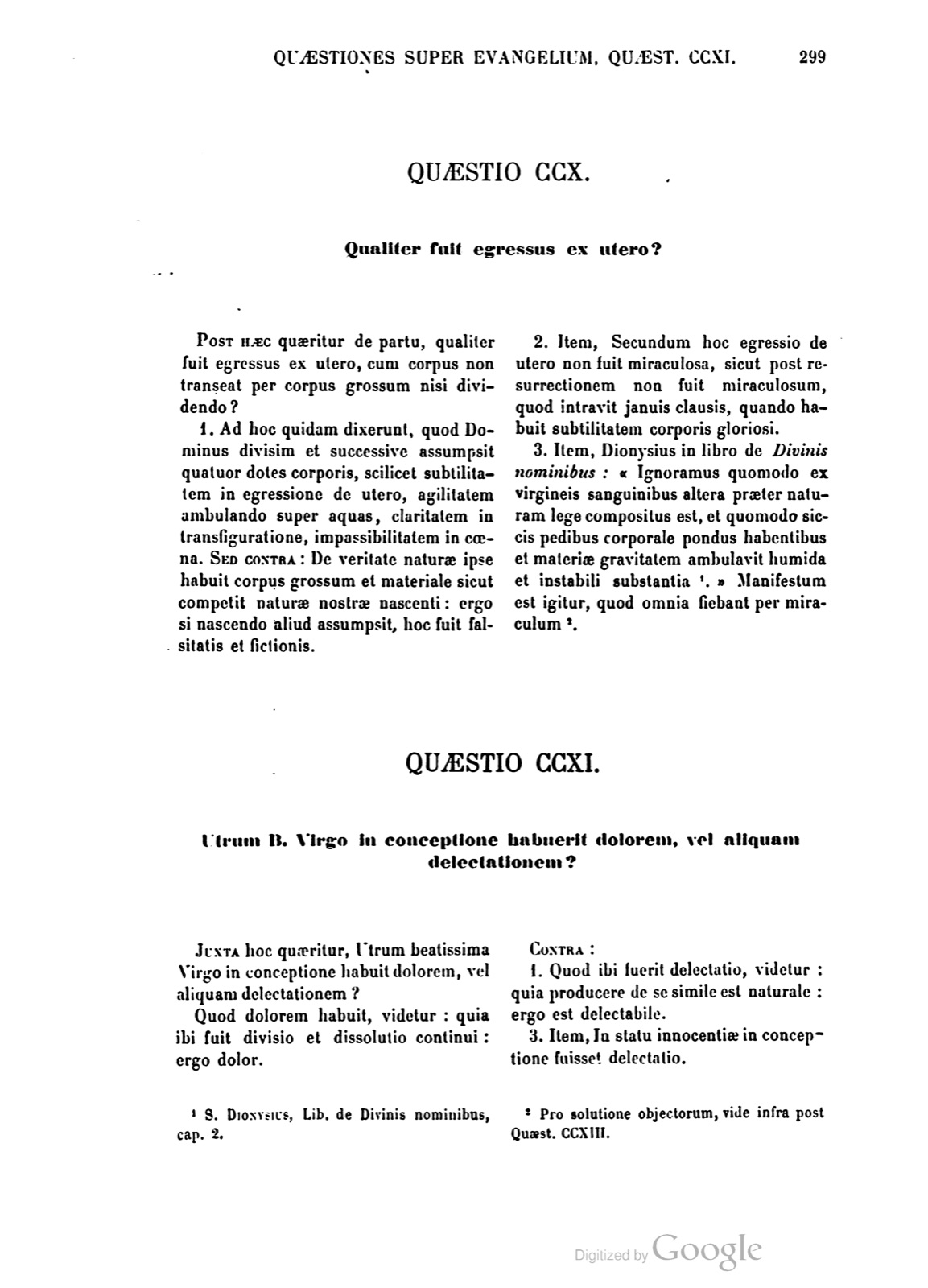
QUAESTIO CCX. Qualiter fuit egressus ex utero?
Post haec quaeritur de partu, qualiter fuit egressus ex utero, cum corpus non transeat per corpus grossum nisi dividendo?
1. Ad hoc quidam dixerunt, quod Dominus divisim et successive assumpsit quatuor dotes corporis, scilicet subtilitatem in egressione de utero, agilitatem ambulando super aquas, claritatem in transfiguratione, impassibilitatem in coena. Sed contra: De veritate naturae ipse habuit corpus grossum et materiale sicut competit naturae nostrae nascenti: ergo si nascendo aliud assumpsit, hoc fuit falsitatis et fictionis.
2. Item, Secundum hoc egressio de utero non fuit miraculosa, sicut post resurrectionem non fuit miraculosum, quod intravit januis clausis, quando habuit subtilitatem corporis gloriosi.
3. Item, Dionysius in libro de Divinis nominibus: "Ignoramus quomodo ex virgineis sanguinibus altera praeter naturam lege compositus est, et quomodo siccis pedibus corporale pondus habentibus et materiae gravitatem ambulavit humida et instabili substantia 1." Manifestum est igitur, quod omnia fiebant per miraculum 2.
QUESTION 210. In what manner did he go out from the womb?
After these things inquiry is made concerning the birth, in what manner he went out from the womb, since a body does not pass through a gross body except by dividing it.
1. To this certain persons said that the Lord assumed the four dowries of the body in divided fashion and successively, namely subtlety in his going out from the womb, agility by walking upon the waters, brightness in the transfiguration, impassibility in the supper. But to the contrary: from the truth of nature he had a gross and material body, as belongs to our nature being born; therefore, if in being born he assumed something else, this belonged to falsity and fiction.
2. Likewise, according to this his going out from the womb was not miraculous, just as after the resurrection it was not miraculous that he entered with the doors closed, when he had the subtlety of a glorious body.
3. Likewise, Dionysius in the book On the Divine Names says: "We do not know how from virginal bloods he was composed by another law beyond nature, and how with dry feet having bodily weight and the gravity of matter he walked upon a humid and unstable substance 1." Therefore it is manifest that all things were being done by miracle 2.
Notes
- St. Dionysius, Book On the Divine Names, chapter 2. (S. Dionysius, Lib. de Divinis nominibus, cap. 2.) ↩
- For the solution of the objections, see below after Question 213. (Pro solutione objectorum, vide infra post Quaest. CCXIII.) ↩
If a page does not appear, its photograph has not been uploaded yet.