Works › The Mariale: Questions on “Missus est”
Volume 37 · p. 298
Question 209. For how much time was the Lord in the womb?
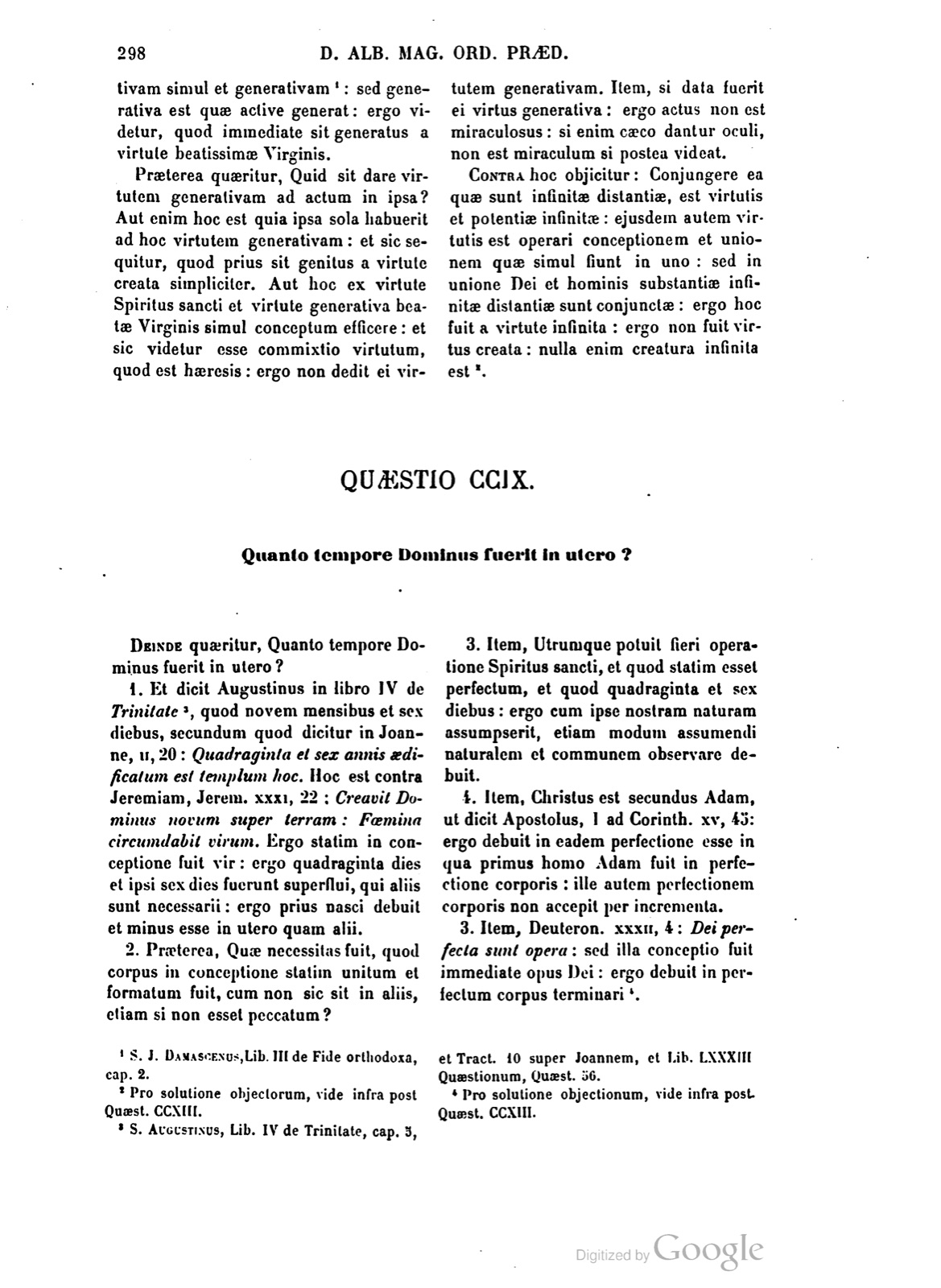
QUAESTIO CCIX. Quanto tempore Dominus fuerit in utero?
Deinde quaeritur, Quanto tempore Dominus fuerit in utero?
1. Et dicit Augustinus in libro IV de Trinitate 1, quod novem mensibus et sex diebus, secundum quod dicitur in Joanne, II, 20: Quadraginta et sex annis aedificatum est templum hoc. Hoc est contra Jeremiam, Jerem. XXXI, 22: Creavit Dominus novum super terram: Foemina circumdabit virum. Ergo statim in conceptione fuit vir: ergo quadraginta dies et ipsi sex dies fuerunt superflui, qui aliis sunt necessarii: ergo prius nasci debuit et minus esse in utero quam alii.
2. Praeterea, Quae necessitas fuit, quod corpus in conceptione statim unitum et formatum fuit, cum non sic sit in aliis, etiam si non esset peccatum?
3. Item, Utrumque potuit fieri operatione Spiritus sancti, et quod statim esset perfectum, et quod quadraginta et sex diebus: ergo cum ipse nostram naturam assumpserit, etiam modum assumendi naturalem et communem observare debuit.
4. Item, Christus est secundus Adam, ut dicit Apostolus, I ad Corinth. XV, 45: ergo debuit in eadem perfectione esse in qua primus homo Adam fuit in perfectione corporis: ille autem perfectionem corporis non accepit per incrementa.
3. Item, Deuteron. XXXII, 4: Dei perfecta sunt opera: sed illa conceptio fuit immediate opus Dei: ergo debuit in perfectum corpus terminari 2.
QUESTION 209. For how much time was the Lord in the womb?
Then it is asked for how much time the Lord was in the womb.
1. And Augustine says in book 4 On the Trinity 1 that it was for nine months and six days, according as it is said in John 2:20: This temple was built in forty-six years. This is against Jeremiah, Jeremiah 31:22: The Lord has created a new thing upon the earth: a woman will encompass a man. Therefore he was a man immediately in the conception; therefore the forty days and those six days were superfluous, which are necessary for others; therefore he ought to have been born earlier and to have been in the womb less than others.
2. Besides, what necessity was there that the body in the conception was immediately united and formed, since it is not so in others, even if there had been no sin?
3. Likewise, each could be done by the operation of the Holy Spirit, both that he should immediately be perfect and that he should be so in forty-six days; therefore, since he assumed our nature, he ought also to have observed the natural and common mode of assuming.
4. Likewise, Christ is the second Adam, as the Apostle says, 1 Corinthians 15:45; therefore he ought to have been in the same perfection in which the first man Adam was in perfection of body; but he did not receive the perfection of body through increments.
3. Likewise, Deuteronomy 32:4: God's works are perfect. But that conception was immediately the work of God; therefore it ought to have been terminated in a perfect body 2.
Notes
- St. Augustine, Book 4 On the Trinity, chapter 5, and Tractate 10 on John, and Book of Eighty-Three Questions, question 56. (S. Augustinus, Lib. IV de Trinitate, cap. 5, et Tract. 10 super Joannem, et Lib. LXXXIII Quaestionum, Quaest. 56.) ↩
- For the solution of the objections, see below after Question 213. (Pro solutione objectionum, vide infra post Quaest. CCXIII.) ↩
If a page does not appear, its photograph has not been uploaded yet.