Works › The Mariale: Questions on “Missus est”
Volume 37 · pp. 295–297
Question 206. From what, as from matter, was this conception made?
A marker with ≈ is an approximate page boundary, placed by measure of the text; the page photographs remain the authority. In the paired views, clicking a page marker brings that page into view.
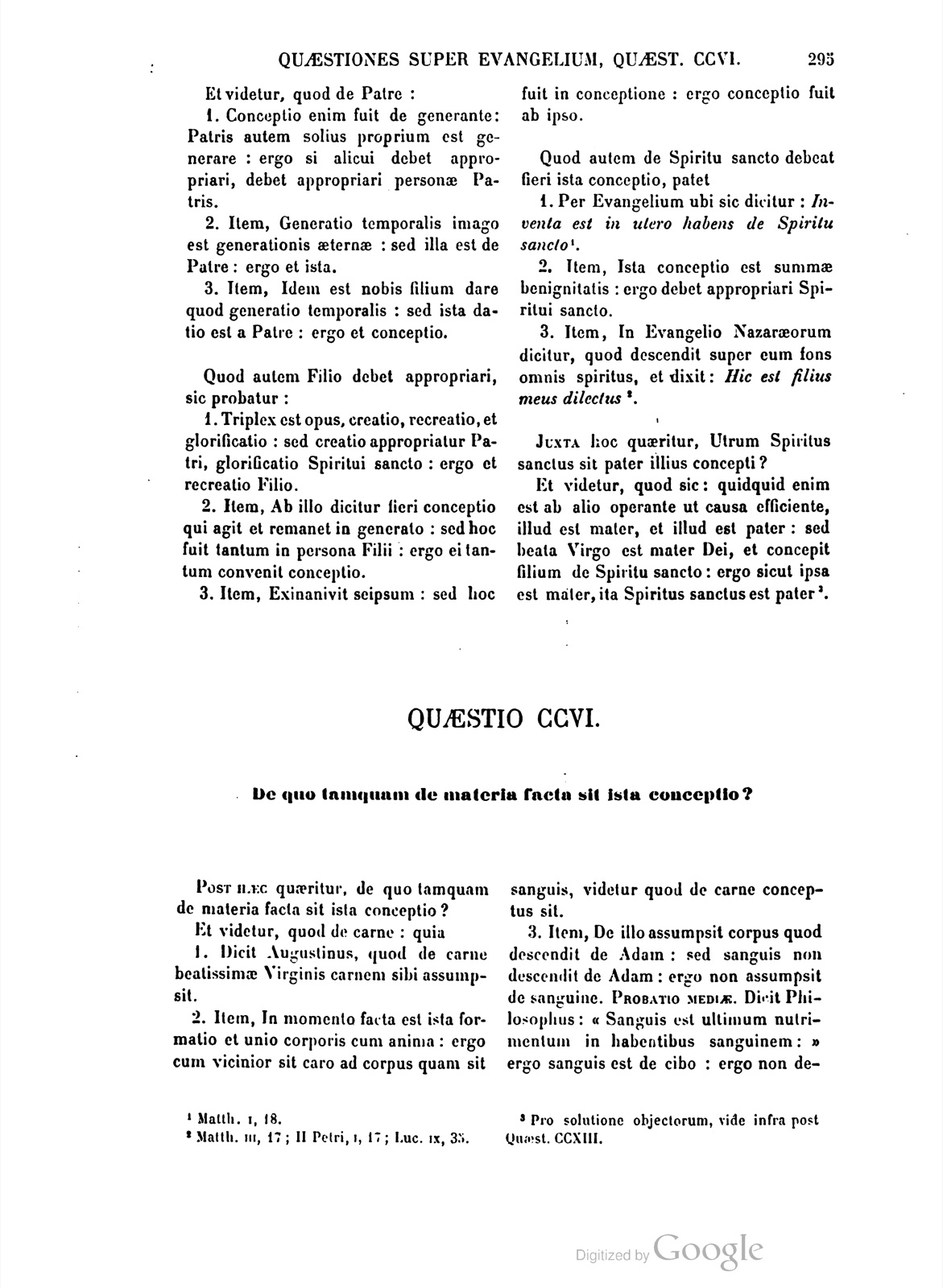
QUAESTIO CCVI. De quo tamquam de materia facta sit ista conceptio?
Post haec quaeritur, de quo tamquam de materia facta sit ista conceptio?
Et videtur, quod de carne: quia
1. Dicit Augustinus, quod de carne beatissimae Virginis carnem sibi assumpsit.
2. Item, In momento facta est ista formatio et unio corporis cum anima: ergo cum vicinior sit caro ad corpus quam sit sanguis, videtur quod de carne conceptus sit.
3. Item, De illo assumpsit corpus quod descendit de Adam: sed sanguis non descendit de Adam: ergo non assumpsit de sanguine. Probatio mediae. Dicit Philosophus: "Sanguis est ultimum nutrimentum in habentibus sanguinem:" ergo sanguis est de cibo: ergo non descendit de Adam: ergo non assumpsit de sanguine.
Contra:
1. Damascenus: "Ex castis semper Virginis sanguinibus carnem animatam anima rationali et intellectuali sustentavit 1."
2. Item, Sanguis potentia est totum corpus: caro autem non est potentia totum corpus: ergo non potuit accipere de carne. Ita etiam est in aliis hominibus, quod corpus eorum coagulatur de sanguine matris et non carne.
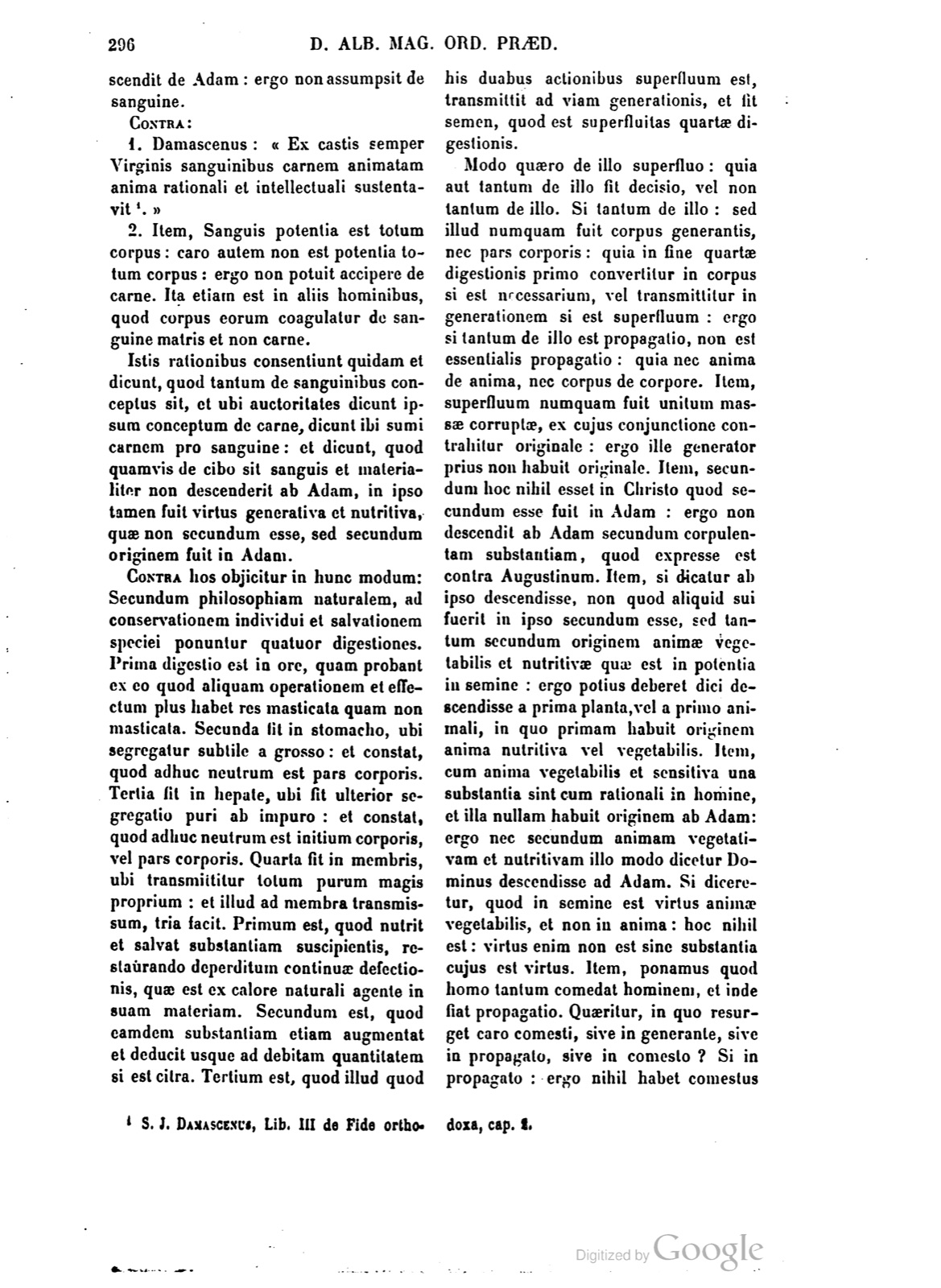
Istis rationibus consentiunt quidam et dicunt, quod tantum de sanguinibus conceptus sit, et ubi auctoritates dicunt ipsum conceptum de carne, dicunt ibi sumi carnem pro sanguine: et dicunt, quod quamvis de cibo sit sanguis et materialiter non descenderit ab Adam, in ipso tamen fuit virtus generativa et nutritiva, quae non secundum esse, sed secundum originem fuit in Adam.
Contra hos objicitur in hunc modum: Secundum philosophiam naturalem, ad conservationem individui et salvationem speciei ponuntur quatuor digestiones. Prima digestio est in ore, quam probant ex eo quod aliquam operationem et effectum plus habet res masticata quam non masticata. Secunda fit in stomacho, ubi segregatur subtile a grosso: et constat, quod adhuc neutrum est pars corporis. Tertia fit in hepate, ubi fit ulterior segregatio puri ab impuro: et constat, quod adhuc neutrum est initium corporis, vel pars corporis. Quarta fit in membris, ubi transmittitur totum purum magis proprium: et illud ad membra transmissum, tria facit. Primum est, quod nutrit et salvat substantiam suscipientis, restaurando deperditum continuae defectionis, quae est ex calore naturali agente in suam materiam. Secundum est, quod eamdem substantiam etiam augmentat et deducit usque ad debitam quantitatem si est citra. Tertium est, quod illud quod de his duabus actionibus superfluum est, transmittit ad viam generationis, et fit semen, quod est superfluitas quartae digestionis.
QUESTION 206. From what, as from matter, was this conception made?
After these things it is asked from what, as from matter, this conception was made.
And it seems that it was from flesh, because:
1. Augustine says that from the flesh of the most blessed Virgin he assumed flesh for himself.
2. Likewise, this formation and union of the body with the soul was made in a moment. Therefore, since flesh is nearer to body than blood is, it seems that he was conceived from flesh.
3. Likewise, from that he assumed a body which descended from Adam; but blood did not descend from Adam; therefore he did not assume from blood. Proof of the middle term: the Philosopher says, "Blood is the last nourishment in things having blood"; therefore blood is from food; therefore it did not descend from Adam; therefore he did not assume from blood.
To the contrary:
1. Damascene says: "From the chaste bloods of the ever-Virgin he sustained flesh animated by a rational and intellectual soul 1."
2. Likewise, blood is the whole body in potency; but flesh is not the whole body in potency; therefore he could not receive from flesh. So also it is in other human beings, that their body is coagulated from the blood of the mother and not from flesh.
Certain persons agree with these reasons and say that he was conceived only from the bloods, and where authorities say that he was conceived from flesh, they say that flesh is taken there for blood. And they say that, although blood is from food and materially did not descend from Adam, nevertheless in it there was a generative and nutritive power, which was in Adam not according to being, but according to origin.
Against these persons objection is made in this way: according to natural philosophy, four digestions are posited for the preservation of the individual and the salvation of the species. The first digestion is in the mouth, which they prove from the fact that a chewed thing has some operation and effect more than a non-chewed thing. The second occurs in the stomach, where the subtle is separated from the gross; and it is evident that as yet neither is a part of the body. The third occurs in the liver, where a further separation of the pure from the impure occurs; and it is evident that as yet neither is the beginning of the body or a part of the body. The fourth occurs in the members, where the whole pure thing, more proper, is transmitted; and that which has been transmitted to the members does three things. The first is that it nourishes and preserves the substance of the recipient by restoring what has been lost through continuous defect, which comes from natural heat acting on its matter. The second is that it also increases that same substance and leads it up to the due quantity if it is below it. The third is that it transmits what is superfluous from these two actions to the way of generation, and it becomes seed, which is the superfluity of the fourth digestion.
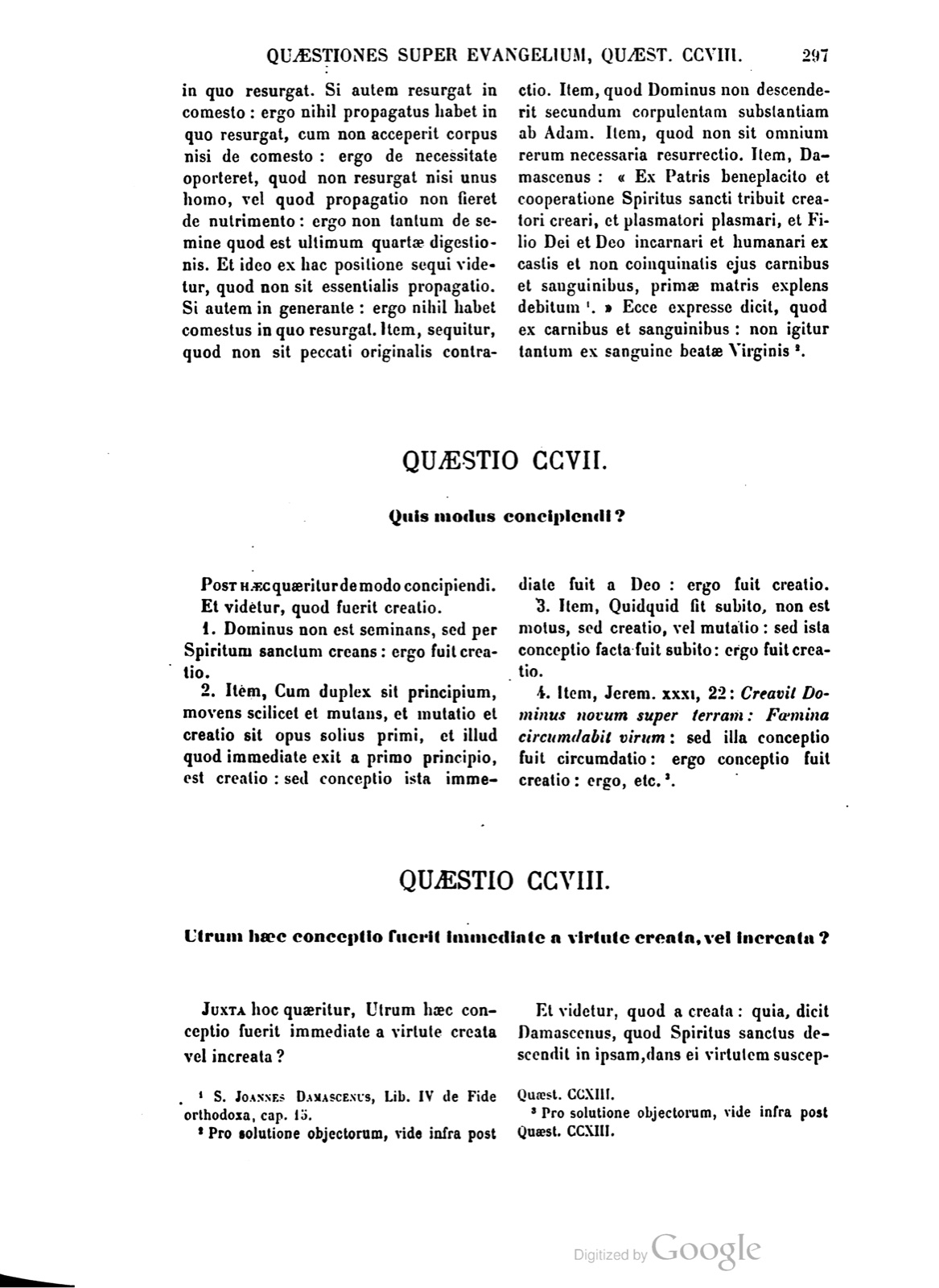
Modo quaero de illo superfluo: quia aut tantum de illo fit decisio, vel non tantum de illo. Si tantum de illo: sed illud numquam fuit corpus generantis, nec pars corporis: quia in fine quartae digestionis primo convertitur in corpus si est necessarium, vel transmittitur in generationem si est superfluum: ergo si tantum de illo est propagatio, non est essentialis propagatio: quia nec anima de anima, nec corpus de corpore. Item, superfluum numquam fuit unitum massae corruptae, ex cujus conjunctione contrahitur originale: ergo ille generator prius non habuit originale. Item, secundum hoc nihil esset in Christo quod secundum esse fuit in Adam: ergo non descendit ab Adam secundum corpulentam substantiam, quod expresse est contra Augustinum. Item, si dicatur ab ipso descendisse, non quod aliquid sui fuerit in ipso secundum esse, sed tantum secundum originem animae vegetabilis et nutritivae quae est in potentia in semine: ergo potius deberet dici descendisse a prima planta, vel a primo animali, in quo primam habuit originem anima nutritiva vel vegetabilis. Item, cum anima vegetabilis et sensitiva una substantia sint cum rationali in homine, et illa nullam habuit originem ab Adam: ergo nec secundum animam vegetativam et nutritivam illo modo dicetur Dominus descendisse ad Adam. Si diceretur, quod in semine est virtus animae vegetabilis, et non in anima: hoc nihil est: virtus enim non est sine substantia cujus est virtus. Item, ponamus quod homo tantum comedat hominem, et inde fiat propagatio. Quaeritur, in quo resurget caro comesti, sive in generante, sive in propagato, sive in comesto? Si in propagato: ergo nihil habet comestus in quo resurgat. Si autem resurgat in comesto: ergo nihil propagatus habet in quo resurgat, cum non acceperit corpus nisi de comesto: ergo de necessitate oporteret, quod non resurgat nisi unus homo, vel quod propagatio non fieret de nutrimento: ergo non tantum de semine quod est ultimum quartae digestionis. Et ideo ex hac positione sequi videtur, quod non sit essentialis propagatio. Si autem in generante: ergo nihil habet comestus in quo resurgat. Item, sequitur, quod non sit peccati originalis contractio. Item, quod Dominus non descenderit secundum corpulentam substantiam ab Adam. Item, quod non sit omnium rerum necessaria resurrectio. Item, Damascenus: "Ex Patris beneplacito et cooperatione Spiritus sancti tribuit creatori creari, et plasmatori plasmari, et Filio Dei et Deo incarnari et humanari ex castis et non coinquinatis ejus carnibus et sanguinibus, primae matris explens debitum 2." Ecce expresse dicit, quod ex carnibus et sanguinibus: non igitur tantum ex sanguine beatae Virginis.
Now I ask concerning that superfluity: either a separation is made only from it, or not only from it. If only from it: but that never was the body of the one generating, nor a part of the body, because at the end of the fourth digestion it is first converted into body if it is necessary, or transmitted into generation if it is superfluous. Therefore, if propagation is only from it, it is not an essential propagation, because neither is soul from soul nor body from body. Likewise, the superfluity was never united to the corrupt mass from whose conjunction original sin is contracted; therefore that generator previously did not have original sin. Likewise, according to this there would be nothing in Christ which according to being was in Adam; therefore he did not descend from Adam according to corpulent substance, which is expressly contrary to Augustine. Likewise, if he is said to have descended from him, not because something of him was in him according to being, but only according to the origin of the vegetative and nutritive soul which is in potency in seed, then he ought rather to be said to have descended from the first plant or from the first animal in which the nutritive or vegetative soul had its first origin. Likewise, since the vegetative and sensitive soul are one substance with the rational soul in the human being, and that soul had no origin from Adam, therefore neither according to the vegetative and nutritive soul will the Lord be said in that mode to have descended to Adam. If it were said that the power of the vegetative soul is in the seed and not in the soul, this is nothing, for power is not without the substance whose power it is. Likewise, let us suppose that a human being eats only a human being, and propagation is made from that. It is asked in what the flesh of the eaten one will rise again: in the generator, or in the propagated one, or in the eaten one? If in the propagated one, then the eaten one has nothing in which he may rise again. But if it rises again in the eaten one, then the propagated one has nothing in which he may rise again, since he received a body only from the eaten one; therefore of necessity it would be necessary either that only one human being rise again, or that propagation not be made from nourishment; therefore it is not only from seed, which is the last thing of the fourth digestion. And therefore from this position it seems to follow that there is not essential propagation. But if in the generator, then the eaten one has nothing in which he may rise again. Likewise, it follows that there is no contraction of original sin. Likewise, that the Lord did not descend from Adam according to corpulent substance. Likewise, that there is not a necessary resurrection of all things. Likewise, Damascene says: "By the good pleasure of the Father and the cooperation of the Holy Spirit, she granted to the creator to be created, and to the molder to be molded, and to the Son of God and God to be incarnate and humanized from her chaste and undefiled flesh and blood, fulfilling the debt of the first mother 2." Behold, he expressly says that it was from flesh and blood; therefore not only from the blood of the blessed Virgin.
If a page does not appear, its photograph has not been uploaded yet.