Works › The Mariale: Questions on “Missus est”
Volume 37 · pp. 294–295
Question 205. When it is said: Behold, you shall conceive, by whom was the conception made as by an efficient cause through appropriation?
A marker with ≈ is an approximate page boundary, placed by measure of the text; the page photographs remain the authority. In the paired views, clicking a page marker brings that page into view.
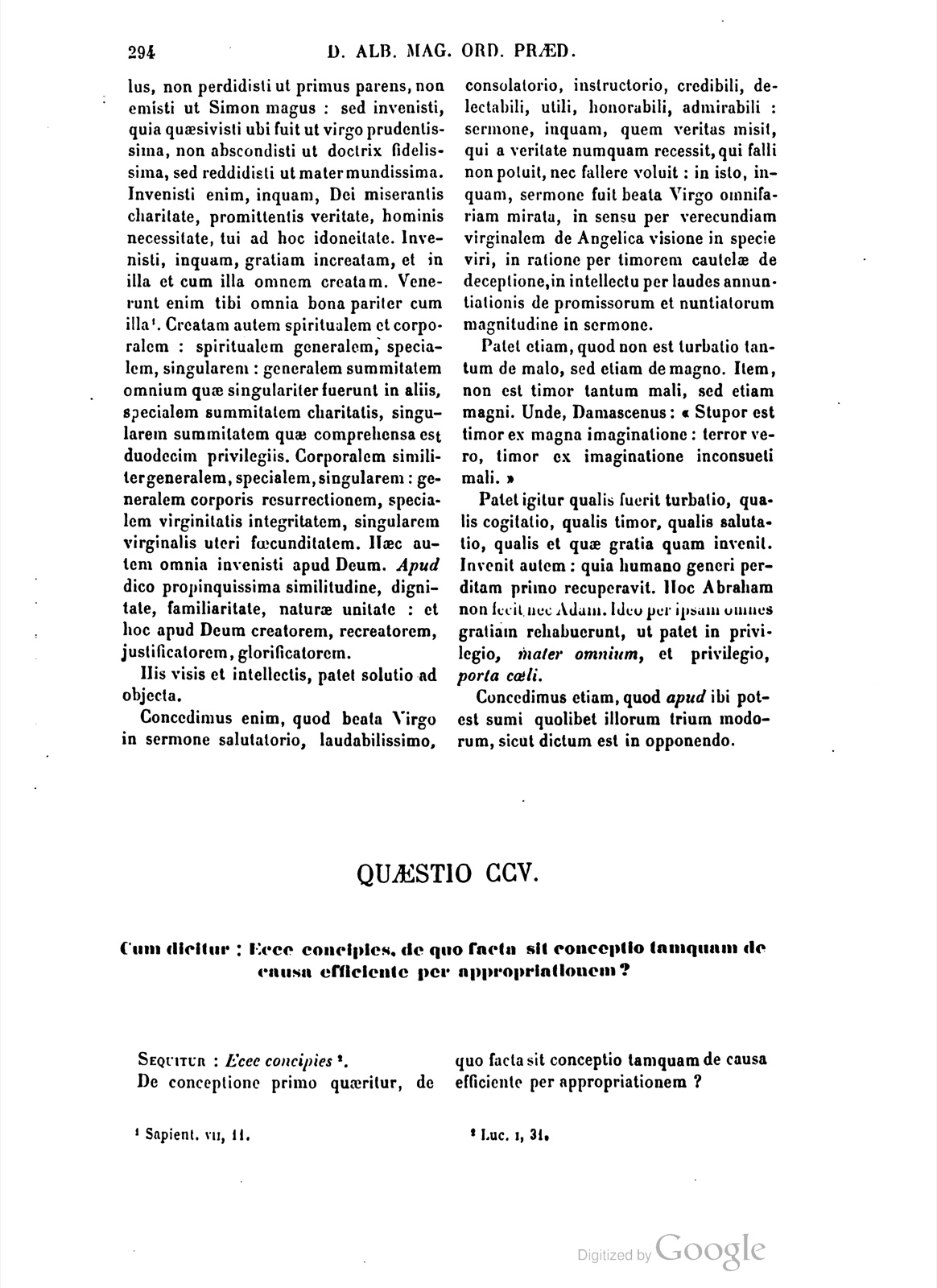
QUAESTIO CCV. Cum dicitur: Ecce concipies, de quo facta sit conceptio tamquam de causa efficiente per appropriationem?
Sequitur: Ecce concipies 1. De conceptione primo quaeritur, de quo facta sit conceptio tamquam de causa efficiente per appropriationem?
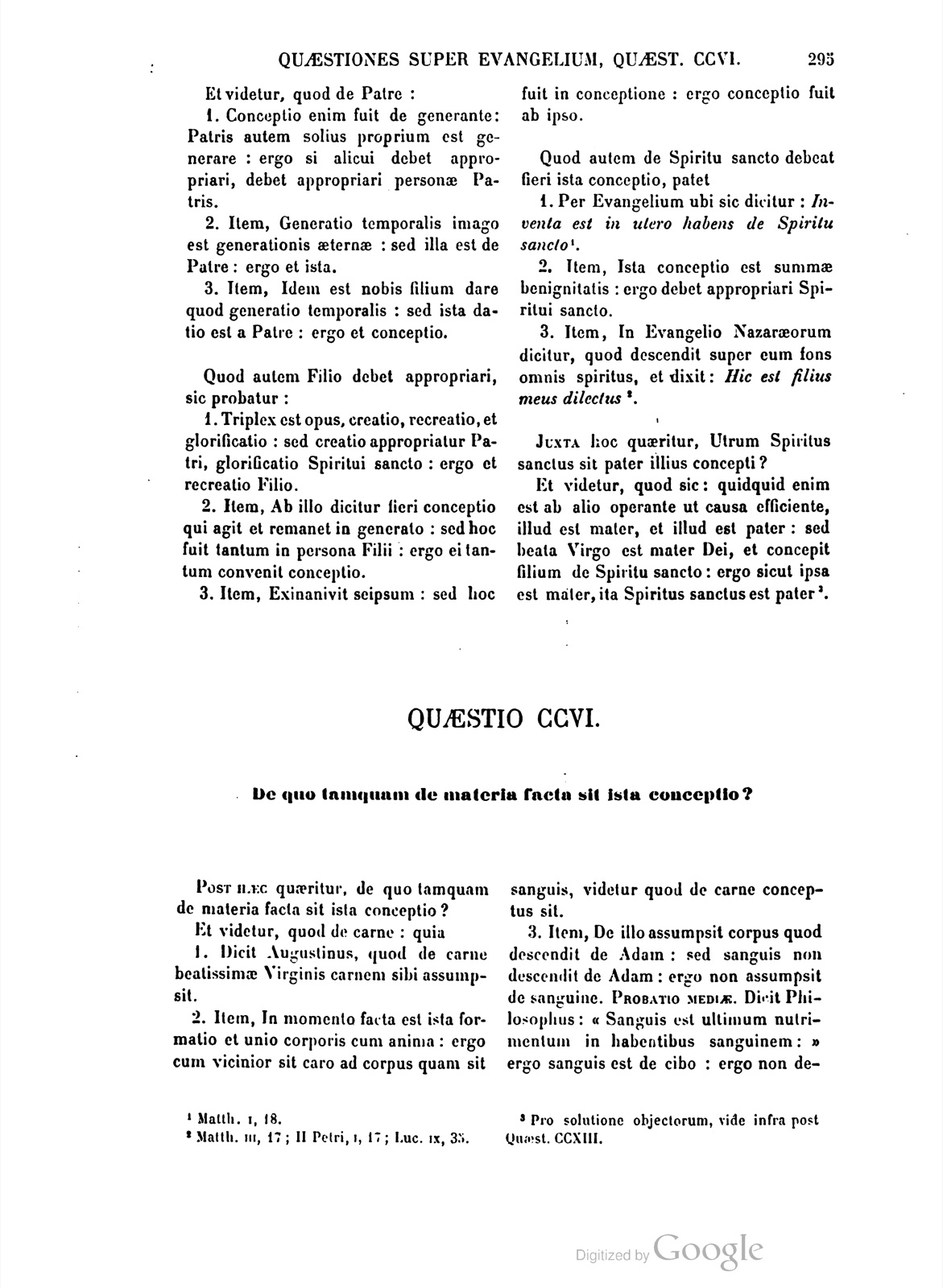
Et videtur, quod de Patre:
1. Conceptio enim fuit de generante: Patris autem solius proprium est generare: ergo si alicui debet appropriari, debet appropriari personae Patris.
2. Item, Generatio temporalis imago est generationis aeternae: sed illa est de Patre: ergo et ista.
3. Item, Idem est nobis filium dare quod generatio temporalis: sed ista datio est a Patre: ergo et conceptio.
Quod autem Filio debet appropriari, sic probatur:
1. Triplex est opus, creatio, recreatio, et glorificatio: sed creatio appropriatur Patri, glorificatio Spiritui sancto: ergo et recreatio Filio.
2. Item, Ab illo dicitur fieri conceptio qui agit et remanet in generato: sed hoc fuit tantum in persona Filii: ergo ei tantum convenit conceptio.
QUESTION 205. When it is said: Behold, you shall conceive, by whom was the conception made as by an efficient cause through appropriation?
There follows: Behold, you shall conceive 1. Concerning the conception, first it is asked by whom the conception was made as by an efficient cause through appropriation.
And it seems that it was by the Father:
1. For conception was from the one generating; but it is proper to the Father alone to generate. Therefore, if it ought to be appropriated to someone, it ought to be appropriated to the person of the Father.
2. Likewise, temporal generation is the image of eternal generation; but that is from the Father; therefore also this.
3. Likewise, for the Son to give himself to us is the same as temporal generation; but that giving is from the Father; therefore also the conception.
But that it ought to be appropriated to the Son is proved thus:
1. There is a threefold work, creation, recreation, and glorification; but creation is appropriated to the Father, glorification to the Holy Spirit; therefore recreation also is appropriated to the Son.
2. Likewise, conception is said to be made by him who acts and remains in the generated one; but this was only in the person of the Son; therefore conception belongs to him alone.
3. Item, Exinanivit seipsum: sed hoc fuit in conceptione: ergo conceptio fuit ab ipso.
Quod autem de Spiritu sancto debeat fieri ista conceptio, patet:
1. Per Evangelium ubi sic dicitur: Inventa est in utero habens de Spiritu sancto 2.
2. Item, Ista conceptio est summae benignitatis: ergo debet appropriari Spiritui sancto.
3. Item, In Evangelio Nazaraeorum dicitur, quod descendit super eum fons omnis spiritus, et dixit: Hic est filius meus dilectus 3.
Juxta hoc quaeritur, Utrum Spiritus sanctus sit pater illius concepti?
Et videtur, quod sic: quidquid enim est ab alio operante ut causa efficiente, illud est mater, et illud est pater: sed beata Virgo est mater Dei, et concepit filium de Spiritu sancto: ergo sicut ipsa est mater, ita Spiritus sanctus est pater 4.
3. Likewise, he emptied himself; but this was in the conception; therefore the conception was from him.
But that this conception ought to be made from the Holy Spirit is clear:
1. Through the Gospel, where it is said thus: She was found to have in the womb from the Holy Spirit 2.
2. Likewise, this conception is of the highest kindness; therefore it ought to be appropriated to the Holy Spirit.
3. Likewise, in the Gospel of the Nazarenes it is said that the fountain of every spirit descended upon him and said: This is my beloved Son 3.
Next to this it is asked whether the Holy Spirit is the father of that conceived one.
And it seems that he is, because whatever is from another operating as an efficient cause, that one is mother and that one is father. But the blessed Virgin is Mother of God, and she conceived a son from the Holy Spirit. Therefore, just as she is mother, so the Holy Spirit is father 4.
Notes
- Luke 1:31. (Luc. I, 31.) ↩
- Matthew 1:18. (Matth. I, 18.) ↩
- Matthew 3:17; 2 Peter 1:17; Luke 9:35. (Matth. III, 17; II Petri, I, 17; Luc. IX, 35.) ↩
- For the solution of the objections, see below after Question 213. (Pro solutione objectorum, vide infra post Quaest. CCXIII.) ↩
If a page does not appear, its photograph has not been uploaded yet.