Works › The Mariale: Questions on “Missus est”
Volume 37 · pp. 283–284
Question 197. Why did the angelic salutation have only ten words, and not more or fewer?
A marker with ≈ is an approximate page boundary, placed by measure of the text; the page photographs remain the authority. In the paired views, clicking a page marker brings that page into view.
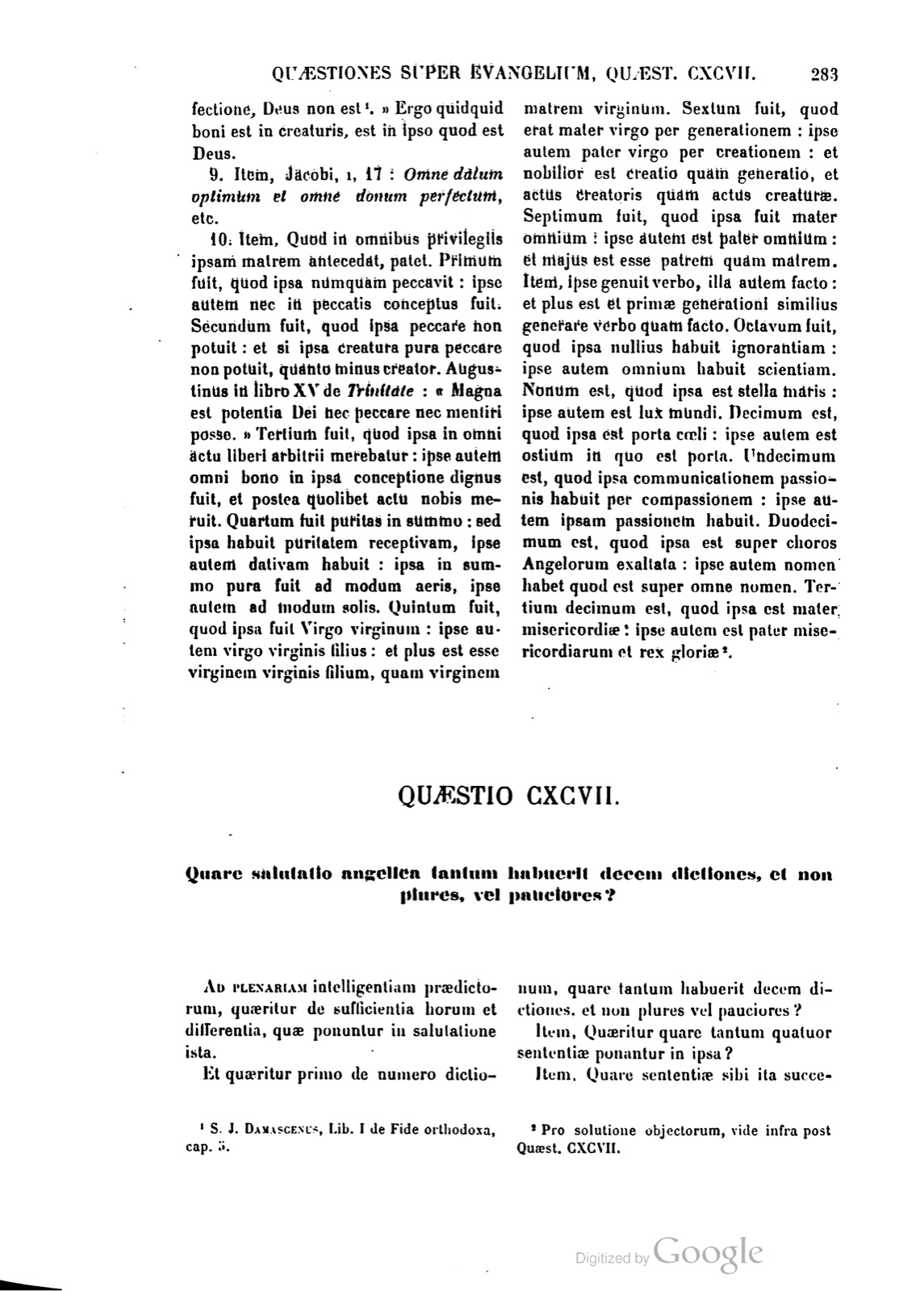
QUAESTIO CXCVII. Quare salutatio angelica tantum habuerit decem dictiones, et non plures, vel pauciores?
Ad plenariam intelligentiam praedictorum, quaeritur de sufficientia horum et differentia, quae ponuntur in salutatione ista.
Et quaeritur primo de numero dictionum, quare tantum habuerit decem dictiones, et non plures vel pauciores?
Item, Quaeritur quare tantum quatuor sententiae ponantur in ipsa?
Item, Quare sententiae sibi ita succedant progressive, ita quod prima habeat unam dictionem, secunda duas, tertia tres, quarta quatuor.
Item, Secundum additionem Elisabeth, quinque sunt dictiones, et una est sententia.
Item, Quid significat, quod hic ponitur denarius, qui est numerus triangularis ex omni parte, et quaternarius qui est triangularis a base in communi.
Item, Similiter sunt decem et quinque, sed tunc oportet quinque poni pro base.
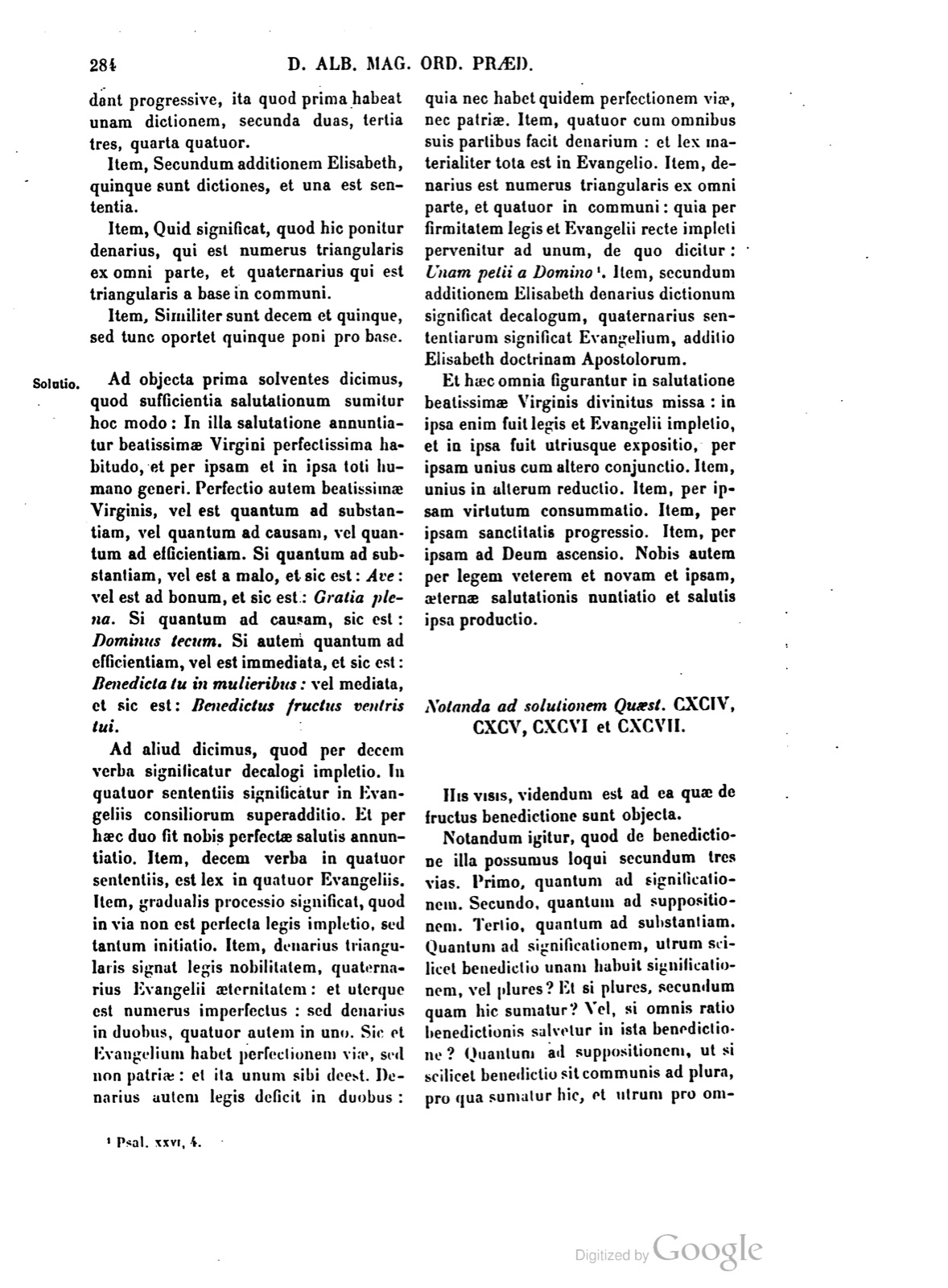
Solutio. Ad objecta prima solventes dicimus, quod sufficientia salutationum sumitur hoc modo: In illa salutatione annuntiatur beatissimae Virgini perfectissima habitudo, et per ipsam et in ipsa toti humano generi. Perfectio autem beatissimae Virginis, vel est quantum ad substantiam, vel quantum ad causam, vel quantum ad efficientiam. Si quantum ad substantiam, vel est a malo, et sic est: Ave: vel est ad bonum, et sic est: Gratia plena. Si quantum ad causam, sic est: Dominus tecum. Si autem quantum ad efficientiam, vel est immediata, et sic est: Benedicta tu in mulieribus: vel mediata, et sic est: Benedictus fructus ventris tui.
Ad aliud dicimus, quod per decem verba significatur decalogi impletio. In quatuor sententiis significatur in Evangeliis consiliorum superadditio. Et per haec duo fit nobis perfectae salutis annuntiatio. Item, decem verba in quatuor sententiis, est lex in quatuor Evangeliis. Item, gradualis processio significat, quod in via non est perfecta legis impletio, sed tantum initiatio. Item, denarius triangularis signat legis nobilitatem, quaternarius Evangelii aeternitatem: et uterque est numerus imperfectus: sed denarius in duobus, quatuor autem in uno. Sic et Evangelium habet perfectionem viae, sed non patriae: et ita unum sibi deest. Denarius autem legis deficit in duobus: quia nec habet quidem perfectionem viae, nec patriae. Item, quatuor cum omnibus suis partibus facit denarium: et lex materialiter tota est in Evangelio. Item, denarius est numerus triangularis ex omni parte, et quatuor in communi: quia per firmitatem legis et Evangelii recte impleti pervenitur ad unum, de quo dicitur: Unam petii a Domino 1. Item, secundum additionem Elisabeth denarius dictionum significat decalogum, quaternarius sententiarum significat Evangelium, additio Elisabeth doctrinam Apostolorum.
QUESTION 197. Why did the angelic salutation have only ten words, and not more or fewer?
For the full understanding of the foregoing, it is asked concerning the sufficiency and difference of these things which are posited in this salutation.
And first it is asked concerning the number of words, why it had only ten words and not more or fewer.
Likewise, it is asked why only four sentences are posited in it.
Likewise, why the sentences succeed one another so progressively, such that the first has one word, the second two, the third three, the fourth four.
Likewise, according to the addition of Elizabeth, there are five words and one sentence.
Likewise, what does it signify that here there is posited a denary, which is a triangular number from every side, and a quaternary, which is triangular from the base in common.
Likewise, similarly there are ten and five, but then five must be posited as the base.
Solution. In solving the first objections we say that the sufficiency of the salutations is taken in this way: in that salutation a most perfect condition is announced to the most blessed Virgin, and through her and in her to the whole human race. But the perfection of the most blessed Virgin is either as regards substance, or as regards cause, or as regards efficiency. If as regards substance, either it is from evil, and thus it is Hail; or it is toward good, and thus it is full of grace. If as regards cause, thus it is The Lord is with you. But if as regards efficiency, either it is immediate, and thus it is Blessed are you among women; or mediate, and thus it is Blessed is the fruit of your womb.
To the other we say that through the ten words the fulfillment of the Decalogue is signified. In the four sentences is signified the superaddition of the counsels in the Gospels. And through these two the announcement of perfect salvation is made to us. Likewise, the ten words in four sentences is the law in the four Gospels. Likewise, the gradual progression signifies that on the way there is not perfect fulfillment of the law, but only initiation. Likewise, the triangular denary signifies the nobility of the law, the quaternary the eternity of the Gospel; and each is an imperfect number, but the denary in two things and the four in one. So also the Gospel has the perfection of the way, but not of the homeland, and thus one thing is lacking to it. But the denary of the law is lacking in two things, because it does not have the perfection either of the way or of the homeland. Likewise, four with all its parts makes ten, and materially the whole law is in the Gospel. Likewise, the denary is a triangular number from every side, and four in common, because through the firmness of the law and of the Gospel rightly fulfilled one arrives at the one thing, of which it is said: One thing I have asked of the Lord 1. Likewise, according to the addition of Elizabeth, the denary of words signifies the Decalogue, the quaternary of sentences signifies the Gospel, and the addition of Elizabeth the teaching of the Apostles.
Et haec omnia figurantur in salutatione beatissimae Virginis divinitus missa: in ipsa enim fuit legis et Evangelii impletio, et in ipsa fuit utriusque expositio, per ipsam unius cum altero conjunctio. Item, unius in alterum reductio. Item, per ipsam virtutum consummatio. Item, per ipsam sanctitatis progressio. Item, per ipsam ad Deum ascensio. Nobis autem per legem veterem et novam et ipsam, aeternae salutationis nuntiatio et salutis ipsa productio.
And all these things are figured in the salutation divinely sent to the most blessed Virgin. For in her was the fulfillment of the law and the Gospel, and in her was the exposition of both; through her, the conjunction of one with the other; likewise, the reduction of one into the other; likewise, through her, the consummation of virtues; likewise, through her, the progress of holiness; likewise, through her, ascent to God. But for us, through the old and new law and through her, there is the announcement of eternal salutation and the very production of salvation.
Notes
- Psalm 26:4. (Psal. XXVI, 4.) ↩
If a page does not appear, its photograph has not been uploaded yet.