Works › The Mariale: Questions on “Missus est”
Volume 37 · pp. 281–283
Question 196. Whether the blessing of the fruit contains in itself the blessings of all, and especially whether it has the blessings of all that are comprehended in the blessings of his mother?
A marker with ≈ is an approximate page boundary, placed by measure of the text; the page photographs remain the authority. In the paired views, clicking a page marker brings that page into view.
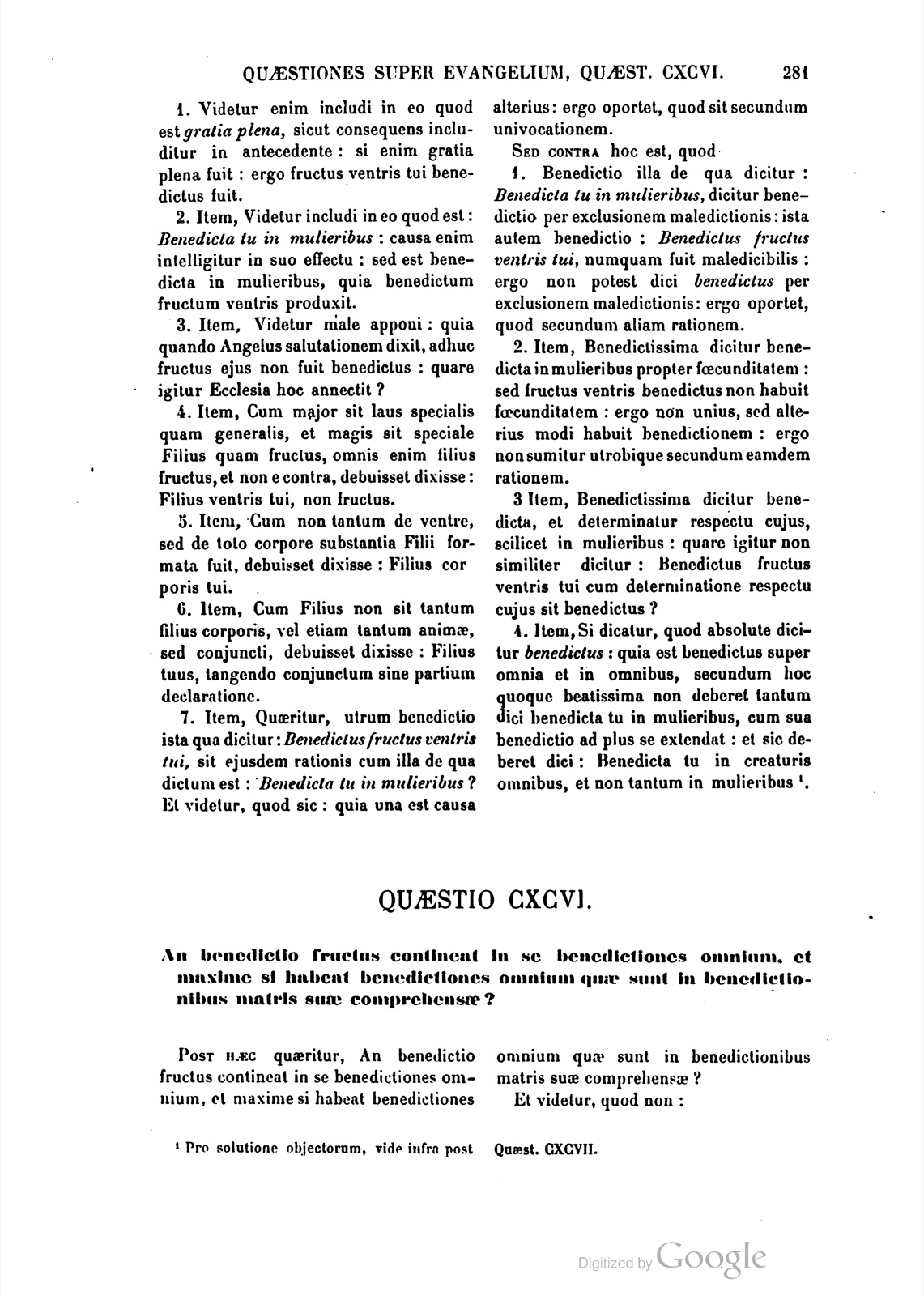
QUAESTIO CXCVI. An benedictio fructus contineat in se benedictiones omnium, et maxime si habeat benedictiones omnium quae sunt in benedictionibus matris suae comprehensae?
Post haec quaeritur, An benedictio fructus contineat in se benedictiones omnium, et maxime si habeat benedictiones omnium quae sunt in benedictionibus matris suae comprehensae?
Et videtur, quod non:
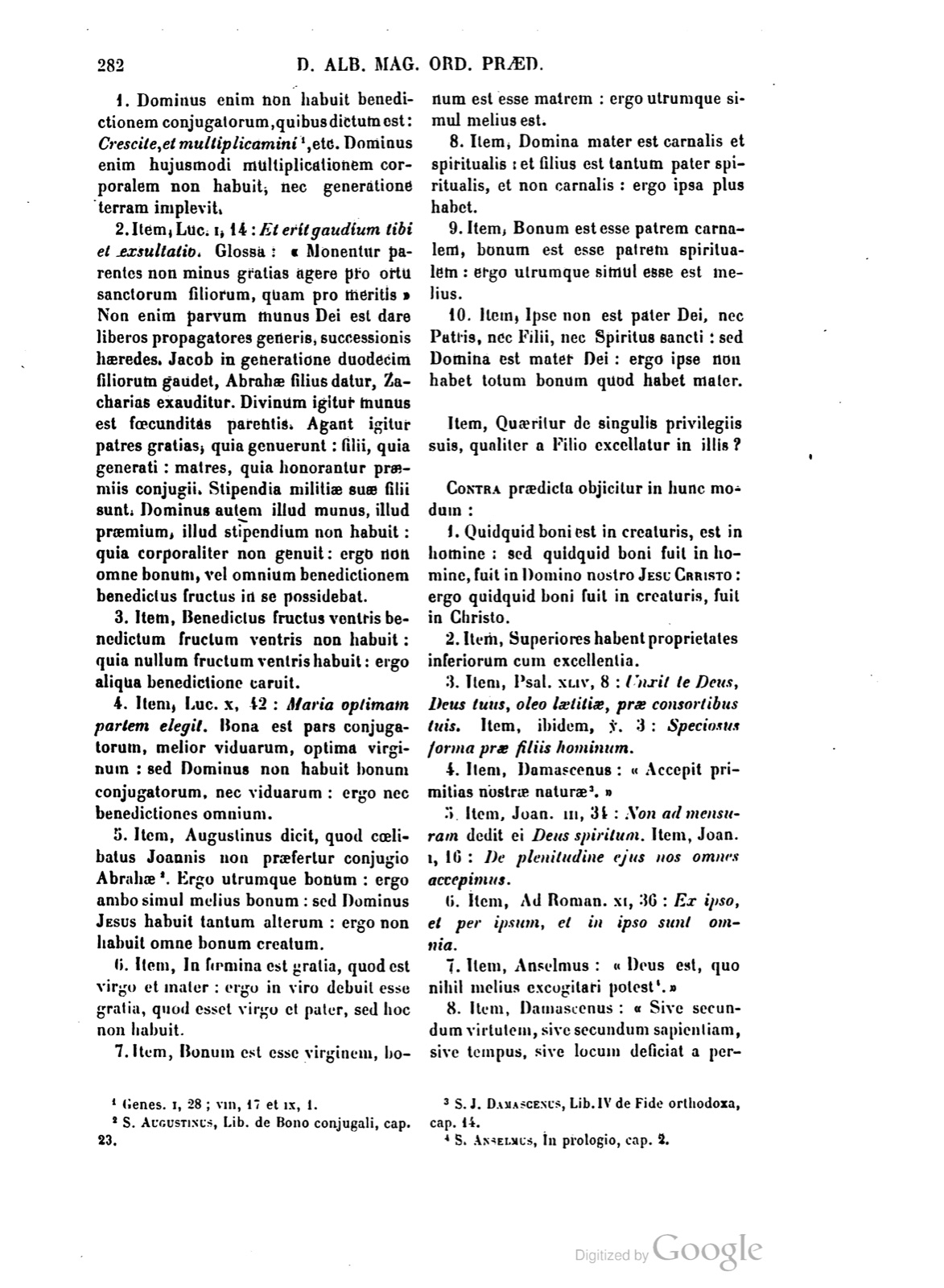
1. Dominus enim non habuit benedictionem conjugatorum, quibus dictum est: Crescite, et multiplicamini 1, etc. Dominus enim hujusmodi multiplicationem corporalem non habuit, nec generatione terram implevit.
2. Item, Luc. I, 14: Et erit gaudium tibi et exsultatio. Glossa: « Monentur parentes non minus gratias agere pro ortu sanctorum filiorum, quam pro meritis. » Non enim parvum munus Dei est dare liberos propagatores generis, successionis haeredes. Jacob in generatione duodecim filiorum gaudet, Abrahae filius datur, Zacharias exauditur. Divinum igitur munus est foecunditas parentis. Agant igitur patres gratias, quia genuerunt: filii, quia generati: matres, quia honorantur praemiis conjugii. Stipendia militiae suae filii sunt. Dominus autem illud munus, illud praemium, illud stipendium non habuit: quia corporaliter non genuit: ergo non omne bonum, vel omnium benedictionem benedictus fructus in se possidebat.
3. Item, Benedictus fructus ventris benedictum fructum ventris non habuit: quia nullum fructum ventris habuit: ergo aliqua benedictione caruit.
4. Item, Luc. X, 42: Maria optimam partem elegit. Bona est pars conjugatorum, melior viduarum, optima virginum: sed Dominus non habuit bonum conjugatorum, nec viduarum: ergo nec benedictiones omnium.
5. Item, Augustinus dicit, quod caelibatus Joannis non praefertur conjugio Abrahae 2. Ergo utrumque bonum: ergo ambo simul melius bonum: sed Dominus Jesus habuit tantum alterum: ergo non habuit omne bonum creatum.
QUESTION 196. Whether the blessing of the fruit contains in itself the blessings of all, and especially whether it has the blessings of all that are comprehended in the blessings of his mother?
After these things it is asked whether the blessing of the fruit contains in itself the blessings of all, and especially whether it has the blessings of all that are comprehended in the blessings of his mother.
And it seems that it does not:
1. For the Lord did not have the blessing of married persons, to whom it was said: Increase and multiply 1, etc. For the Lord did not have corporeal multiplication of this sort, nor did he fill the earth by generation.
2. Likewise, Luke 1:14: And there will be joy and exultation for you. The Gloss says: “Parents are admonished to give thanks no less for the birth of holy sons than for merits.” For it is no small gift of God to give children, propagators of the race and heirs of succession. Jacob rejoices in the generation of twelve sons; a son is given to Abraham; Zachary is heard. Therefore fecundity of a parent is a divine gift. Therefore let fathers give thanks because they generated; sons, because they were generated; mothers, because they are honored with the rewards of marriage. Sons are the stipends of their warfare. But the Lord did not have that gift, that reward, that stipend, because he did not generate corporeally. Therefore the blessed fruit did not possess in himself every good, or the blessing of all.
3. Likewise, the blessed fruit of the womb did not have a blessed fruit of the womb, because he had no fruit of the womb; therefore he lacked some blessing.
4. Likewise, Luke 10:42: Mary chose the best part. The part of married persons is good, that of widows better, that of virgins best. But the Lord did not have the good of married persons nor of widows; therefore neither did he have the blessings of all.
5. Likewise, Augustine says that the celibacy of John is not preferred to the marriage of Abraham 2. Therefore each is good; therefore both together are a better good. But the Lord Jesus had only the one; therefore he did not have every created good.
6. Item, In femina est gratia, quod est virgo et mater: ergo in viro debuit esse gratia, quod esset virgo et pater, sed hoc non habuit.
7. Item, Bonum est esse virginem, bonum est esse matrem: ergo utrumque simul melius est.
8. Item, Domina mater est carnalis et spiritualis: et filius est tantum pater spiritualis, et non carnalis: ergo ipsa plus habet.
9. Item, Bonum est esse patrem carnalem, bonum est esse patrem spiritualem: ergo utrumque simul esse est melius.
10. Item, Ipse non est pater Dei, nec Patris, nec Filii, nec Spiritus sancti: sed Domina est mater Dei: ergo ipse non habet totum bonum quod habet mater.
Item, Quaeritur de singulis privilegiis suis, qualiter a Filio excellatur in illis?
Contra praedicta objicitur in hunc modum:
1. Quidquid boni est in creaturis, est in homine: sed quidquid boni fuit in homine, fuit in Domino nostro Jesu Christo: ergo quidquid boni fuit in creaturis, fuit in Christo.
2. Item, Superiores habent proprietates inferiorum cum excellentia.
3. Item, Psal. XLIV, 8: Unxit te Deus, Deus tuus, oleo laetitiae, prae consortibus tuis. Item, ibidem, v. 3: Speciosus forma prae filiis hominum.
4. Item, Damascenus: « Accepit primitias nostrae naturae 3. »
5. Item, Joan. I, 34: Non ad mensuram dedit ei Deus spiritum. Item, Joan. I, 16: De plenitudine ejus nos omnes accepimus.
6. Item, Ad Roman. XI, 36: Ex ipso, et per ipsum, et in ipso sunt omnia.
7. Item, Anselmus: « Deus est, quo nihil melius excogitari potest 4. »
8. Item, Damascenus: « Sive secundum virtutem, sive secundum sapientiam, sive tempus, sive locum deficiat a perfectione, Deus non est 5. » Ergo quidquid boni est in creaturis, est in ipso quod est Deus.
9. Item, Jacobi, I, 17: Omne datum optimum et omne donum perfectum, etc.
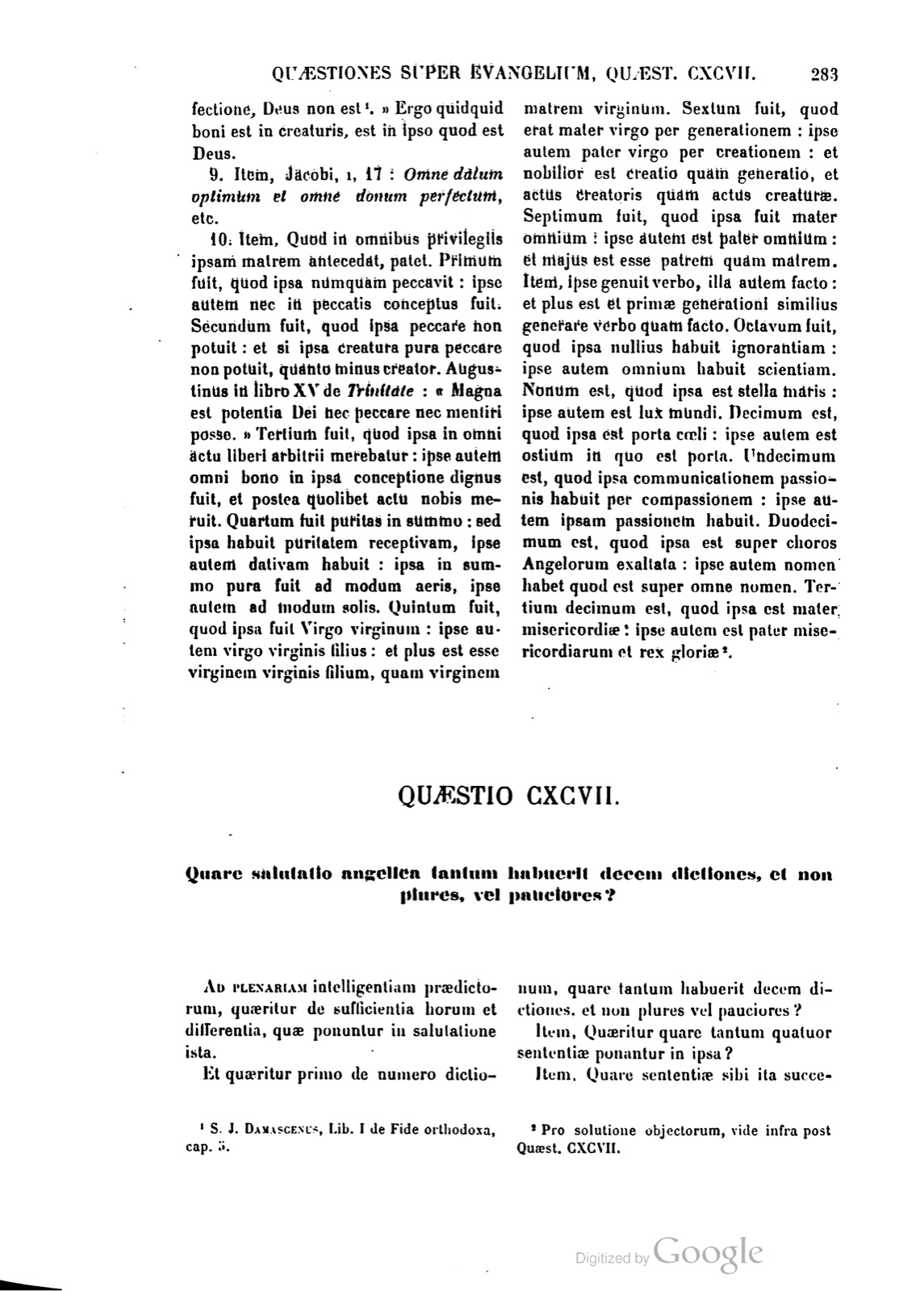
10. Item, Quod in omnibus privilegiis ipsam matrem antecedat, patet. Primum fuit, quod ipsa numquam peccavit: ipse autem nec in peccatis conceptus fuit. Secundum fuit, quod ipsa peccare non potuit: et si ipsa creatura pura peccare non potuit, quanto minus creator. Augustinus in libro XV de Trinitate: « Magna est potentia Dei haec peccare nec mentiri posse. » Tertium fuit, quod ipsa in omni actu liberi arbitrii merebatur: ipse autem omni bono in ipsa conceptione dignus fuit, et postea quolibet actu nobis meruit. Quartum fuit puritas in summo: sed ipsa habuit puritatem receptivam, ipse autem dativam habuit: ipsa in summo pura fuit ad modum aeris, ipse autem ad modum solis. Quintum fuit, quod ipsa fuit Virgo virginum: ipse autem virgo virginis filius: et plus est esse virginem virginis filium, quam virginem matrem virginum. Sextum fuit, quod erat mater virgo per generationem: ipse autem pater virgo per creationem: et nobilior est creatio quam generatio, et actus creatoris quam actus creaturae. Septimum fuit, quod ipsa fuit mater omnium ipse autem est pater omnium: et majus est esse patrem quam matrem. Item, ipse genuit verbo, illa autem facto: et plus est et primae generationi similius generare verbo quam facto. Octavum fuit, quod ipsa nullius habuit ignorantiam: ipse autem omnium habuit scientiam. Nonum est, quod ipsa est stella maris: ipse autem est lux mundi. Decimum est, quod ipsa est porta caeli: ipse autem est ostium in quo est porta. Undecimum est, quod ipsa communicationem passionis habuit per compassionem: ipse autem ipsam passionem habuit. Duodecimum est, quod ipsa est super choros Angelorum exaltata: ipse autem nomen habet quod est super omne nomen. Tertium decimum est, quod ipsa est mater misericordiae: ipse autem est pater misericordiarum et rex gloriae 6.
6. Likewise, in a woman it is a grace that she is virgin and mother; therefore in a man it ought to be a grace that he is virgin and father, but he did not have this.
7. Likewise, it is good to be a virgin, and it is good to be a mother; therefore both together is better.
8. Likewise, the Lady is a carnal and spiritual mother; and the Son is only a spiritual father, and not a carnal one; therefore she has more.
9. Likewise, it is good to be a carnal father, and it is good to be a spiritual father; therefore to be both together is better.
10. Likewise, he is not father of God, nor of the Father, nor of the Son, nor of the Holy Spirit; but the Lady is mother of God; therefore he does not have the whole good that the mother has.
Likewise, it is asked concerning her individual privileges how she is surpassed by the Son in them.
Against the aforesaid, objection is made in this way:
1. Whatever good is in creatures is in the human being; but whatever good was in the human being was in our Lord Jesus Christ; therefore whatever good was in creatures was in Christ.
2. Likewise, higher things have the properties of lower things with excellence.
3. Likewise, Psalm 44:8: God, your God, has anointed you with the oil of gladness before your fellows. Likewise, in the same place, verse 3: Beautiful in form before the sons of men.
4. Likewise, Damascene says: “He received the first-fruits of our nature 3.”
5. Likewise, John 1:34: God did not give him the Spirit by measure. Likewise, John 1:16: From his fullness we all have received.
6. Likewise, Romans 11:36: From him and through him and in him are all things.
7. Likewise, Anselm says: “God is that than which nothing better can be thought 4.”
8. Likewise, Damascene says: “Whether according to virtue, or according to wisdom, or time, or place, it falls short of perfection, it is not God 5.” Therefore whatever good is in creatures is in him who is God.
9. Likewise, James 1:17: Every best gift and every perfect gift, etc.
10. Likewise, that in all privileges he precedes his mother is clear. The first was that she never sinned; but he was not even conceived in sins. The second was that she could not sin; and if she, a pure creature, could not sin, how much less the creator. Augustine in book 15 On the Trinity says: “This is the great power of God, to be unable to sin or lie.” The third was that she merited in every act of free choice; but he was worthy of every good in the very conception, and afterward by any act he merited for us. The fourth was purity in the highest degree; but she had receptive purity, whereas he had giving purity: she was pure in the highest degree after the manner of air, but he after the manner of the sun. The fifth was that she was Virgin of virgins; but he was a virgin son of a virgin, and it is greater to be a virgin son of a virgin than to be a virgin mother of virgins. The sixth was that she was a virgin mother by generation; but he was a virgin father by creation, and creation is nobler than generation, and the act of the creator than the act of a creature. The seventh was that she was mother of all, but he is father of all; and it is greater to be father than mother. Likewise, he generated by word, but she by deed; and it is greater and more similar to the first generation to generate by word than by deed. The eighth was that she had ignorance of nothing; but he had knowledge of all things. The ninth is that she is star of the sea; but he is light of the world. The tenth is that she is gate of heaven; but he is the door in which the gate is. The eleventh is that she had communication of the passion through compassion; but he had the passion itself. The twelfth is that she is exalted above the choirs of Angels; but he has the name that is above every name. The thirteenth is that she is mother of mercy; but he is father of mercies and king of glory 6.
Notes
- Genesis 1:28; 8:17 and 9:1. (Genes. I, 28; VIII, 17 et IX, 1.) ↩
- St. Augustine, Book on the Good of Marriage, chapter 23. (S. Augustinus, Lib. de Bono conjugali, cap. 23.) ↩
- St. John Damascene, Book 4 On the Orthodox Faith, chapter 14. (S. J. Damascenus, Lib. IV de Fide orthodoxa, cap. 14.) ↩
- St. Anselm, in the Proslogion, chapter 2. (S. Anselmus, In Proslogio, cap. 2.) ↩
- St. John Damascene, Book 1 On the Orthodox Faith, chapter 3. (S. J. Damascenus, Lib. I de Fide orthodoxa, cap. 3.) ↩
- For the solution of the objections, see below after Question 197. (Pro solutione objectorum, vide infra post Quaest. CXCVII.) ↩
If a page does not appear, its photograph has not been uploaded yet.