Works › The Mariale: Questions on “Missus est”
Volume 37 · pp. 280–281
Question 195. What does this phrase import: Blessed is the fruit of your womb, and in what does it differ from the others premised in the salutation?
A marker with ≈ is an approximate page boundary, placed by measure of the text; the page photographs remain the authority. In the paired views, clicking a page marker brings that page into view.
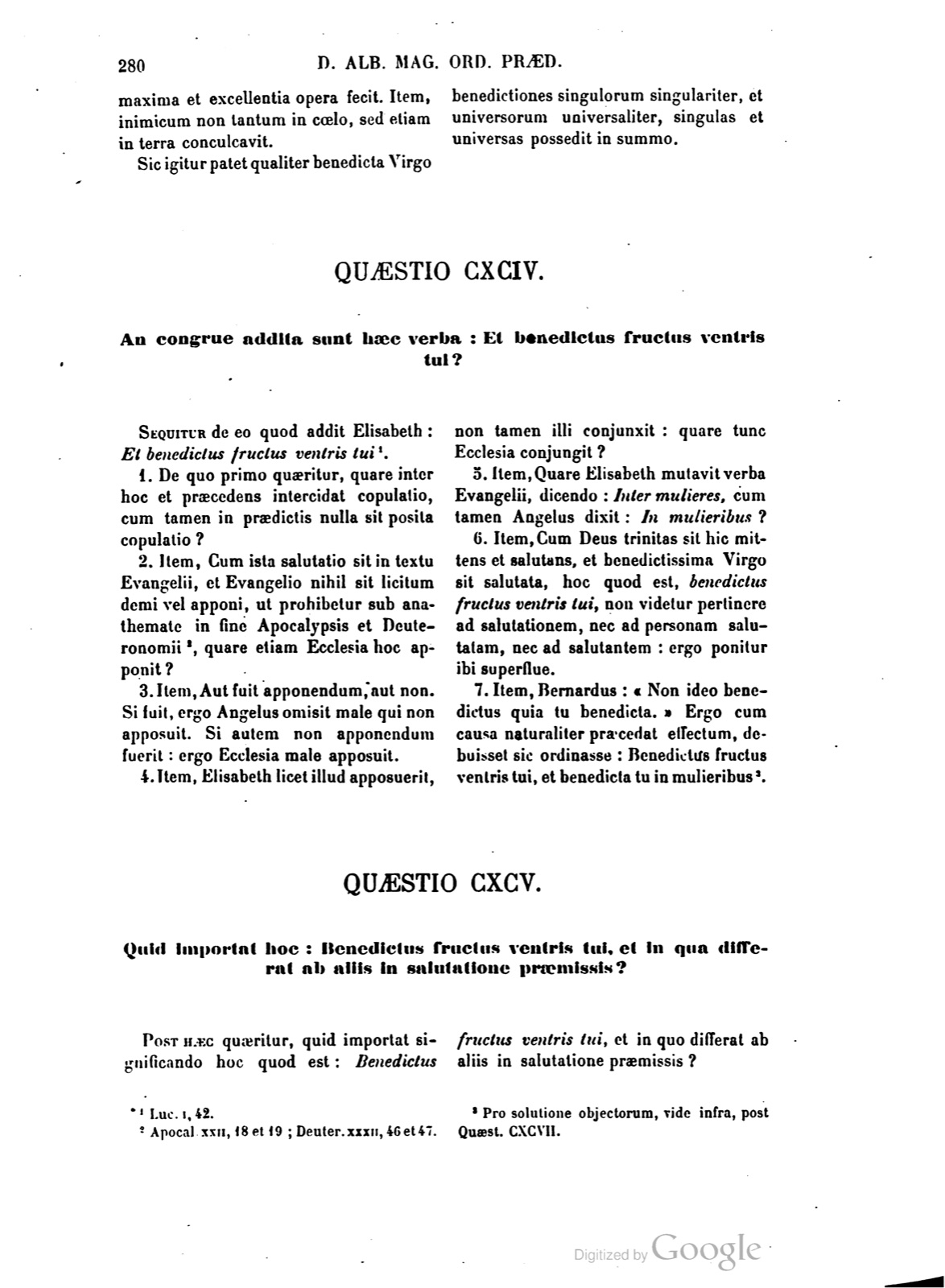
QUAESTIO CXCV. Quid importat hoc: Benedictus fructus ventris tui, et in qua differat ab aliis in salutatione praemissis?
Post haec quaeritur, quid importat significando hoc quod est: Benedictus fructus ventris tui, et in quo differat ab aliis in salutatione praemissis?
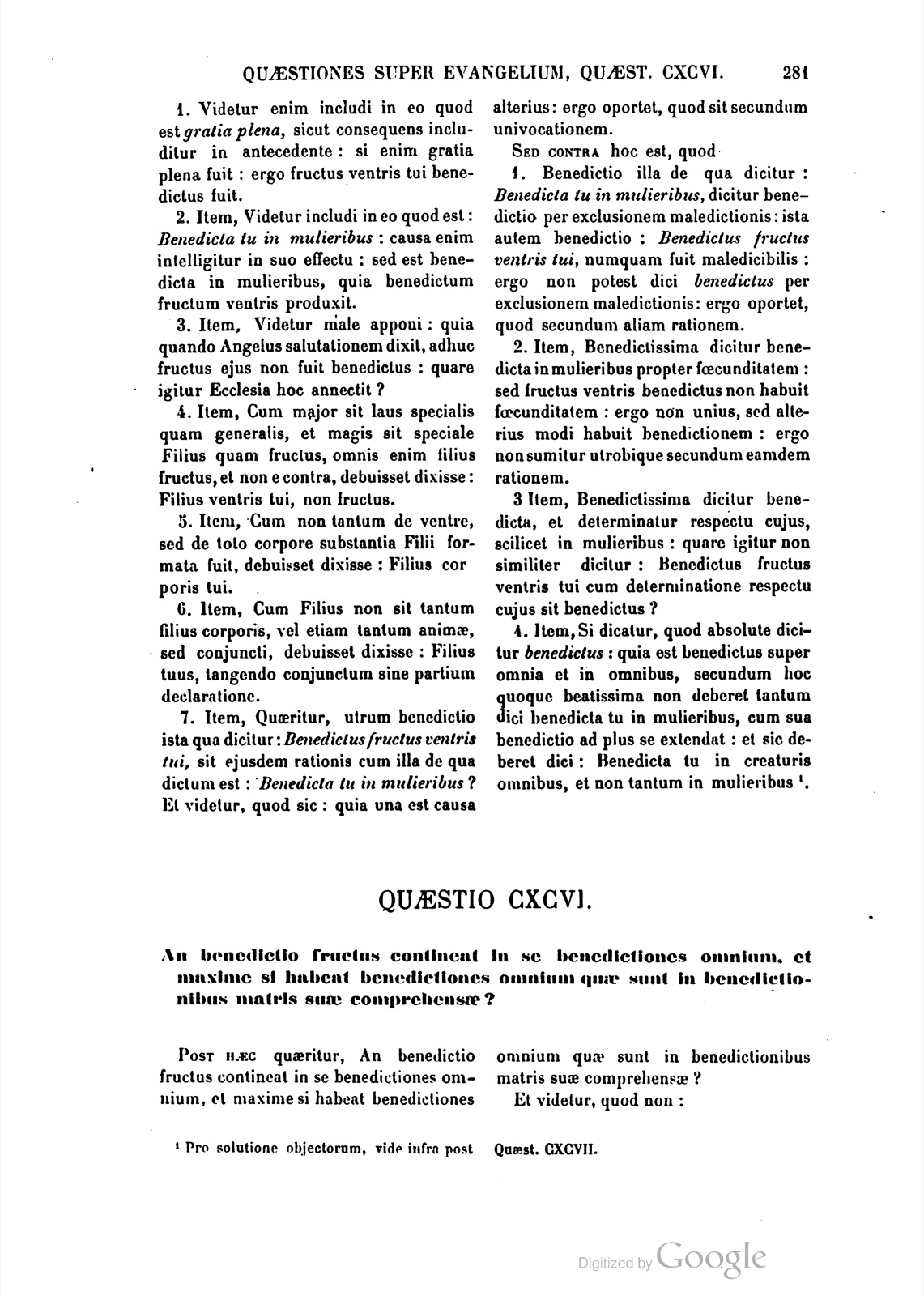
1. Videtur enim includi in eo quod est gratia plena, sicut consequens includitur in antecedente: si enim gratia plena fuit: ergo fructus ventris tui benedictus fuit.
2. Item, Videtur includi in eo quod est: Benedicta tu in mulieribus: causa enim intelligitur in suo effectu: sed est benedicta in mulieribus, quia benedictum fructum ventris produxit.
3. Item, Videtur male apponi: quia quando Angelus salutationem dixit, adhuc fructus ejus non fuit benedictus: quare igitur Ecclesia hoc annectit?
4. Item, Cum major sit laus specialis quam generalis, et magis sit speciale Filius quam fructus, omnis enim filius fructus, et non e contra, debuisset dixisse: Filius ventris tui, non fructus.
5. Item, Cum non tantum de ventre, sed de toto corpore substantia Filii formata fuit, debuisset dixisse: Filius corporis tui.
6. Item, Cum Filius non sit tantum filius corporis, vel etiam tantum animae, sed conjuncti, debuisset dixisse: Filius tuus, tangendo conjunctum sine partium declaratione.
7. Item, Quaeritur, utrum benedictio ista qua dicitur: Benedictus fructus ventris tui, sit ejusdem rationis cum illa de qua dictum est: Benedicta tu in mulieribus? Et videtur, quod sic: quia una est causa alterius: ergo oportet, quod sit secundum univocationem.
QUESTION 195. What does this phrase import: Blessed is the fruit of your womb, and in what does it differ from the others premised in the salutation?
After these things it is asked what this phrase signifies by importing, Blessed is the fruit of your womb, and in what it differs from the others premised in the salutation.
1. For it seems to be included in the phrase full of grace, as a consequent is included in an antecedent; for if she was full of grace, then the fruit of your womb was blessed.
2. Likewise, it seems to be included in this phrase: Blessed are you among women. For the cause is understood in its effect; but she is blessed among women because she produced the blessed fruit of the womb.
3. Likewise, it seems to be added badly, because when the Angel spoke the salutation, her fruit was not yet blessed; why then does the Church attach this?
4. Likewise, since special praise is greater than general praise, and Son is more special than fruit, for every son is a fruit and not conversely, it ought to have said: The Son of your womb, not fruit.
5. Likewise, since the substance of the Son was formed not only from the womb but from the whole body, it ought to have said: The Son of your body.
6. Likewise, since the Son is not only son of the body, nor even only of the soul, but of the composite, it ought to have said: Your Son, touching the composite without declaration of parts.
7. Likewise, it is asked whether this blessing by which it is said: Blessed is the fruit of your womb, is of the same account as that concerning which it was said: Blessed are you among women. And it seems that it is, because one is the cause of the other; therefore it must be according to univocation.
Sed contra hoc est, quod:
1. Benedictio illa de qua dicitur: Benedicta tu in mulieribus, dicitur benedictio per exclusionem maledictionis: ista autem benedictio: Benedictus fructus ventris tui, numquam fuit maledicibilis: ergo non potest dici benedictus per exclusionem maledictionis: ergo oportet, quod secundum aliam rationem.
2. Item, Benedictissima dicitur benedicta in mulieribus propter foecunditatem: sed fructus ventris benedictus non habuit foecunditatem: ergo non unius, sed alterius modi habuit benedictionem: ergo non sumitur utrobique secundum eamdem rationem.
3. Item, Benedictissima dicitur benedicta, et determinatur respectu cujus, scilicet in mulieribus: quare igitur non similiter dicitur: Benedictus fructus ventris tui cum determinatione respectu cujus sit benedictus?
4. Item, Si dicatur, quod absolute dicitur benedictus: quia est benedictus super omnia et in omnibus, secundum hoc quoque beatissima non deberet tantum dici benedicta tu in mulieribus, cum sua benedictio ad plus se extendat: et sic deberet dici: Benedicta tu in creaturis omnibus, et non tantum in mulieribus 1.
But against this is the fact that:
1. That blessing about which it is said, Blessed are you among women, is called blessing by exclusion of curse. But this blessing, Blessed is the fruit of your womb, was never capable of being cursed. Therefore he cannot be called blessed by exclusion of curse; therefore it must be according to another account.
2. Likewise, the most blessed one is called blessed among women because of fecundity; but the blessed fruit of the womb did not have fecundity. Therefore he had blessing not of one and the same mode, but of another; therefore it is not taken in both places according to the same account.
3. Likewise, the most blessed one is called blessed, and it is determined with respect to what, namely among women. Why therefore is it not similarly said: Blessed is the fruit of your womb with a determination with respect to what he is blessed?
4. Likewise, if it is said that he is called blessed absolutely because he is blessed above all things and in all things, according to this the most blessed one also should not be called only blessed among women, since her blessing extends farther; and thus it ought to be said: Blessed are you among all creatures, and not only among women 1.
Notes
- For the solution of the objections, see below after Question 197. (Pro solutione objectorum, vide infra post Quaest. CXCVII.) ↩
If a page does not appear, its photograph has not been uploaded yet.