Works › The Mariale: Questions on “Missus est”
Volume 37 · pp. 264–265
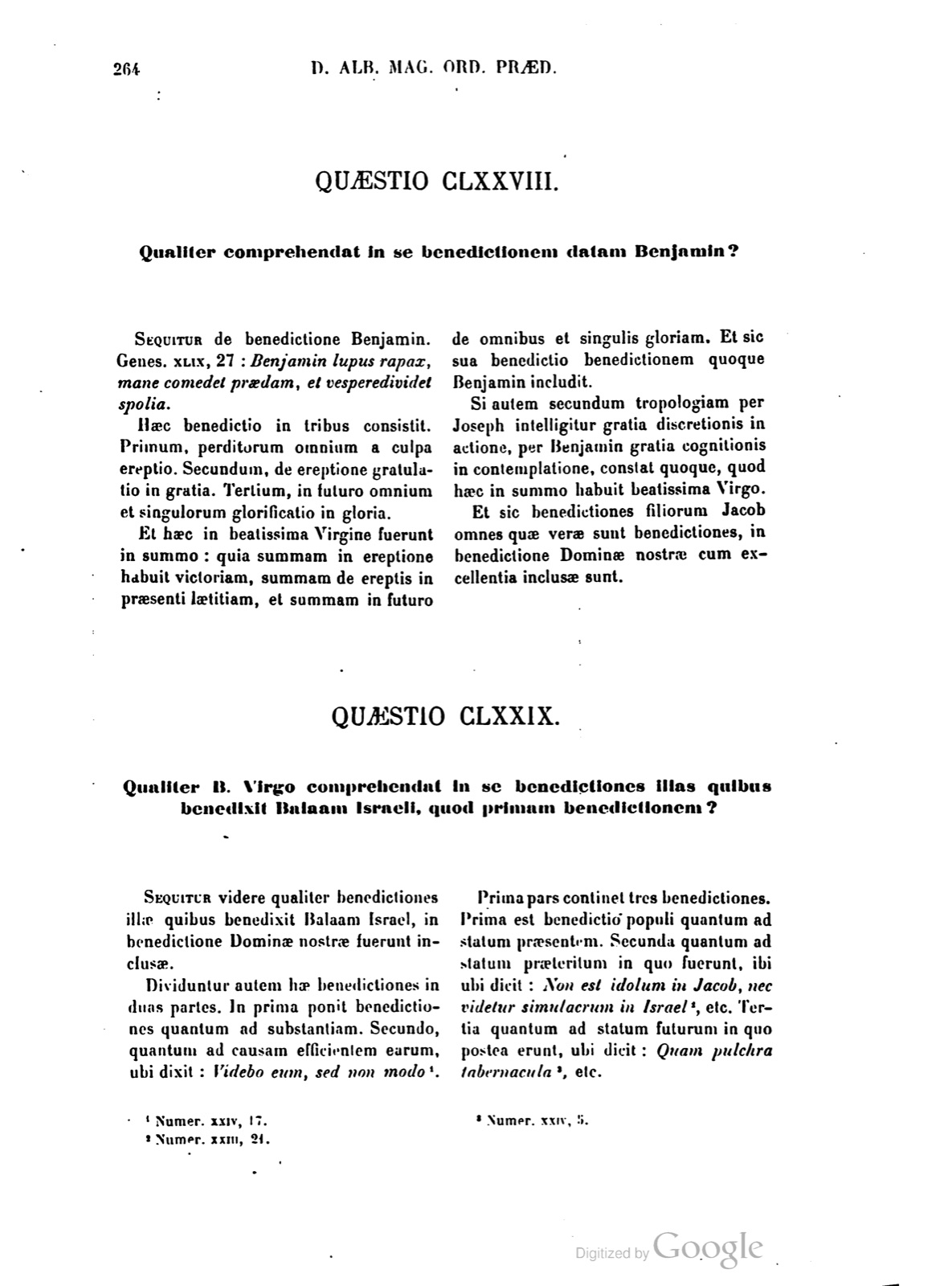
Question 179. How does the Blessed Virgin comprehend in herself those blessings with which Balaam blessed Israel, as to the first blessing?
QUAESTIO CLXXIX. Qualiter B. Virgo comprehendat in se benedictiones illas quibus benedixit Balaam Israeli, quod primam benedictionem?
Sequitur videre qualiter benedictiones illae quibus benedixit Balaam Israel, in benedictione Dominae nostrae fuerunt inclusae.
Dividuntur autem hae benedictiones in duas partes. In prima ponit benedictiones quantum ad substantiam. Secundo, quantum ad causam efficientem earum, ubi dixit: Videbo eum, sed non modo 1. Prima pars continet tres benedictiones. Prima est benedictio populi quantum ad statum praesentem. Secunda quantum ad statum praeteritum in quo fuerunt, ibi ubi dicit: Non est idolum in Jacob, nec videtur simulacrum in Israel 2, etc. Tertia quantum ad statum futurum in quo postea erunt, ubi dicit: Quam pulchra tabernacula 3, etc.
QUESTION 179. How does the Blessed Virgin comprehend in herself those blessings with which Balaam blessed Israel, as to the first blessing?
It follows to see how those blessings with which Balaam blessed Israel were included in the blessing of our Lady.
Now these blessings are divided into two parts. In the first, he sets down blessings as regards their substance. Second, as regards their efficient cause, where he said: I shall see him, but not now 1. The first part contains three blessings. The first is the blessing of the people as regards their present state. The second is as regards the past state in which they were, there where he says: There is no idol in Jacob, nor is an image seen in Israel 2, etc. The third is as regards the future state in which they will afterward be, where he says: How beautiful are the tabernacles 3, etc.
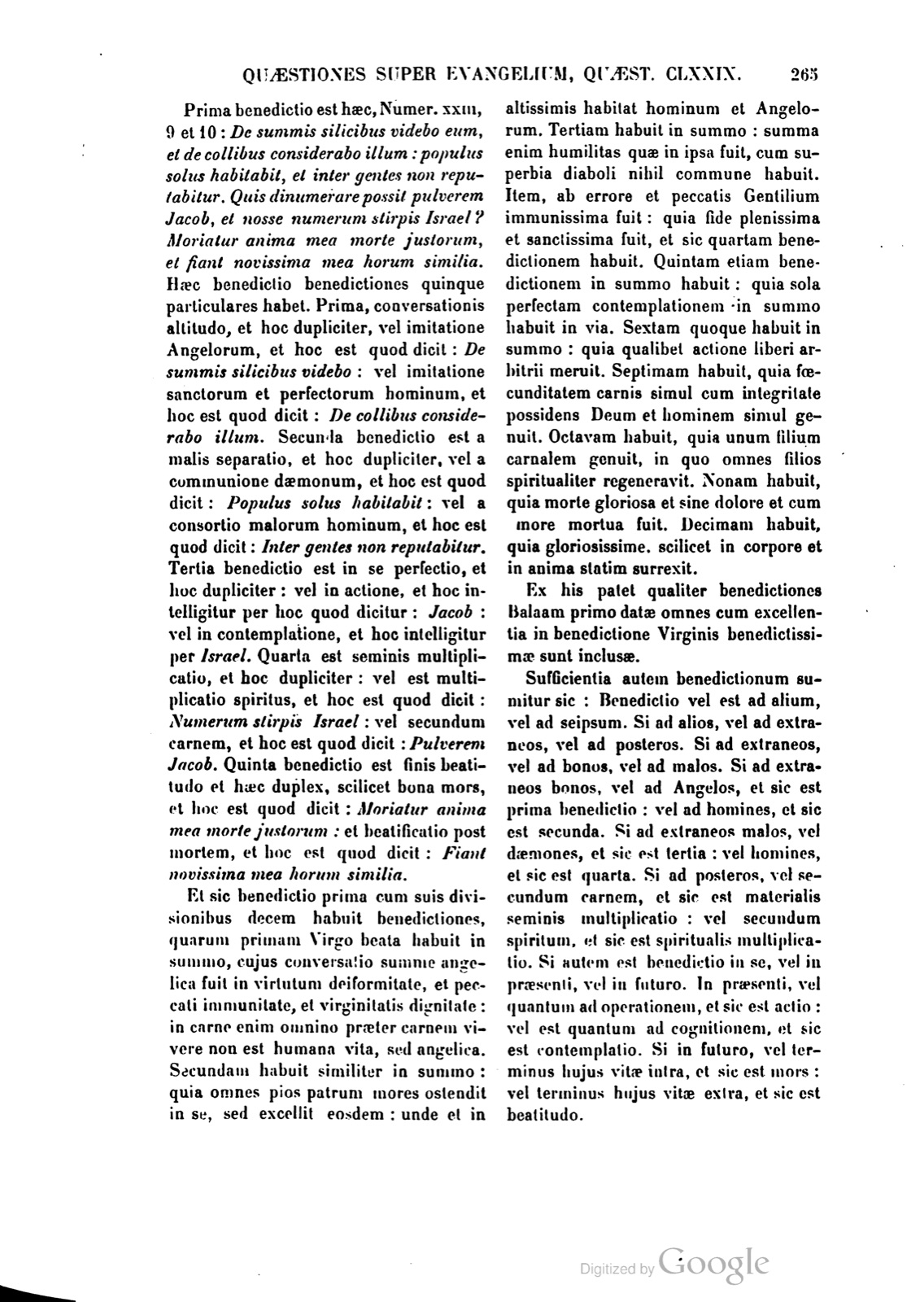
Prima benedictio est haec, Numer. XXIII, 9 et 10: De summis silicibus videbo eum, et de collibus considerabo illum: populus solus habitabit, et inter gentes non reputabitur. Quis dinumerare possit pulverem Jacob, et nosse numerum stirpis Israel? Moriatur anima mea morte justorum, et fiant novissima mea horum similia.
Haec benedictio benedictiones quinque particulares habet. Prima, conversationis altitudo, et hoc dupliciter, vel imitatione Angelorum, et hoc est quod dicit: De summis silicibus videbo: vel imitatione sanctorum et perfectorum hominum, et hoc est quod dicit: De collibus considerabo illum. Secunda benedictio est a malis separatio, et hoc dupliciter, vel a communione daemonum, et hoc est quod dicit: Populus solus habitabit: vel a consortio malorum hominum, et hoc est quod dicit: Inter gentes non reputabitur. Tertia benedictio est in se perfectio, et hoc dupliciter: vel in actione, et hoc intelligitur per hoc quod dicitur: Jacob: vel in contemplatione, et hoc intelligitur per Israel. Quarta est seminis multiplicatio, et hoc dupliciter: vel est multiplicatio spiritus, et hoc est quod dicit: Numerum stirpis Israel: vel secundum carnem, et hoc est quod dicit: Pulverem Jacob. Quinta benedictio est finis beatitudo et haec duplex, scilicet bona mors, et hoc est quod dicit: Moriatur anima mea morte justorum: et beatificatio post mortem, et hoc est quod dicit: Fiant novissima mea horum similia.
Et sic benedictio prima cum suis divisionibus decem habuit benedictiones, quarum primam Virgo beata habuit in summo, cujus conversatio summe angelica fuit in virtutum deiformitate, et peccati immunitate, et virginitatis dignitate: in carne enim omnino praeter carnem vivere non est humana vita, sed angelica. Secundam habuit similiter in summo: quia omnes pios patrum mores ostendit in se, sed excellit eosdem: unde et in altissimis habitat hominum et Angelorum. Tertiam habuit in summo: summa enim humilitas quae in ipsa fuit, cum superbia diaboli nihil commune habuit. Item, ab errore et peccatis Gentilium immunissima fuit: quia fide plenissima et sanctissima fuit, et sic quartam benedictionem habuit. Quintam etiam benedictionem in summo habuit: quia sola perfectam contemplationem in summo habuit in via. Sextam quoque habuit in summo: quia qualibet actione liberi arbitrii meruit. Septimam habuit, quia foecunditatem carnis simul cum integritate possidens Deum et hominem simul genuit. Octavam habuit, quia unum filium carnalem genuit, in quo omnes filios spiritualiter regeneravit. Nonam habuit, quia morte gloriosa et sine dolore et cum more mortua fuit. Decimam habuit, quia gloriosissime, scilicet in corpore et in anima statim surrexit.
Ex his patet qualiter benedictiones Balaam primo datae omnes cum excellentia in benedictione Virginis benedictissimae sunt inclusae.
Sufficientia autem benedictionum sumitur sic: Benedictio vel est ad alium, vel ad seipsum. Si ad alios, vel ad extraneos, vel ad posteros. Si ad extraneos, vel ad bonos, vel ad malos. Si ad extraneos bonos, vel ad Angelos, et sic est prima benedictio: vel ad homines, et sic est secunda. Si ad extraneos malos, vel daemones, et sic est tertia: vel homines, et sic est quarta. Si ad posteros, vel secundum carnem, et sic est materialis seminis multiplicatio: vel secundum spiritum, et sic est spiritualis multiplicatio. Si autem est benedictio in se, vel in praesenti, vel in futuro. In praesenti, vel quantum ad operationem, et sic est actio: vel est quantum ad cognitionem, et sic est contemplatio. Si in futuro, vel terminus hujus vitae intra, et sic est mors: vel terminus hujus vitae extra, et sic est beatitudo.
The first blessing is this, Numbers 23:9 and 10: From the highest rocks I shall see him, and from the hills I shall consider him: the people will dwell alone, and will not be reckoned among the nations. Who can number the dust of Jacob and know the number of the stock of Israel? May my soul die the death of the just, and may my last things be like theirs.
This blessing has five particular blessings. The first is height of manner of life, and this in two ways: either by imitation of Angels, and this is what he says: From the highest rocks I shall see; or by imitation of holy and perfect human beings, and this is what he says: From the hills I shall consider him. The second blessing is separation from evils, and this in two ways: either from communion with demons, and this is what he says: The people will dwell alone; or from fellowship with evil human beings, and this is what he says: He will not be reckoned among the nations. The third blessing is perfection in oneself, and this in two ways: either in action, and this is understood through what is said, Jacob; or in contemplation, and this is understood through Israel. The fourth is multiplication of seed, and this in two ways: either it is multiplication of spirit, and this is what he says: The number of the stock of Israel; or according to the flesh, and this is what he says: The dust of Jacob. The fifth blessing is blessedness of the end, and this is twofold, namely a good death, and this is what he says: May my soul die the death of the just; and beatification after death, and this is what he says: May my last things be like theirs.
And thus the first blessing with its divisions had ten blessings. The blessed Virgin had the first of these in the highest degree, for her manner of life was supremely angelic in deiformity of virtues, immunity from sin, and dignity of virginity; for to live in the flesh wholly beyond the flesh is not a human life but an angelic one. She likewise had the second in the highest degree, because she showed in herself all the pious morals of the fathers, but surpassed them; whence she dwells in the highest places of human beings and Angels. She had the third in the highest degree, for the supreme humility that was in her had nothing in common with the pride of the devil. Likewise, she was most immune from the error and sins of the Gentiles, because she was most full of faith and most holy; and thus she had the fourth blessing. She also had the fifth blessing in the highest degree, because she alone had perfect contemplation in the highest degree on the way. She also had the sixth in the highest degree, because by every action of free choice she merited. She had the seventh, because, possessing fecundity of the flesh together with integrity, she gave birth to God and man at once. She had the eighth, because she generated one carnal Son, in whom she spiritually regenerated all sons. She had the ninth, because she died with a glorious death, without pain and according to custom. She had the tenth, because she immediately rose most gloriously, namely in body and in soul.
From these things it is clear how all the blessings first given by Balaam are included with excellence in the blessing of the most blessed Virgin.
The sufficiency of the blessings is taken thus: a blessing is either toward another or toward oneself. If toward others, then either toward outsiders or toward descendants. If toward outsiders, then either toward the good or toward the evil. If toward good outsiders, then either toward Angels, and thus it is the first blessing; or toward human beings, and thus it is the second. If toward evil outsiders, then either demons, and thus it is the third; or human beings, and thus it is the fourth. If toward descendants, then either according to the flesh, and thus it is material multiplication of seed; or according to the spirit, and thus it is spiritual multiplication. But if it is a blessing in oneself, then either in the present or in the future. In the present, either as regards operation, and thus it is action; or as regards knowledge, and thus it is contemplation. If in the future, either within the boundary of this life, and thus it is death; or beyond the boundary of this life, and thus it is beatitude.
If a page does not appear, its photograph has not been uploaded yet.