Works › The Mariale: Questions on “Missus est”
Volume 37 · pp. 266–267
Question 180. How does she comprehend in herself the second blessing of Balaam?
A marker with ≈ is an approximate page boundary, placed by measure of the text; the page photographs remain the authority. In the paired views, clicking a page marker brings that page into view.
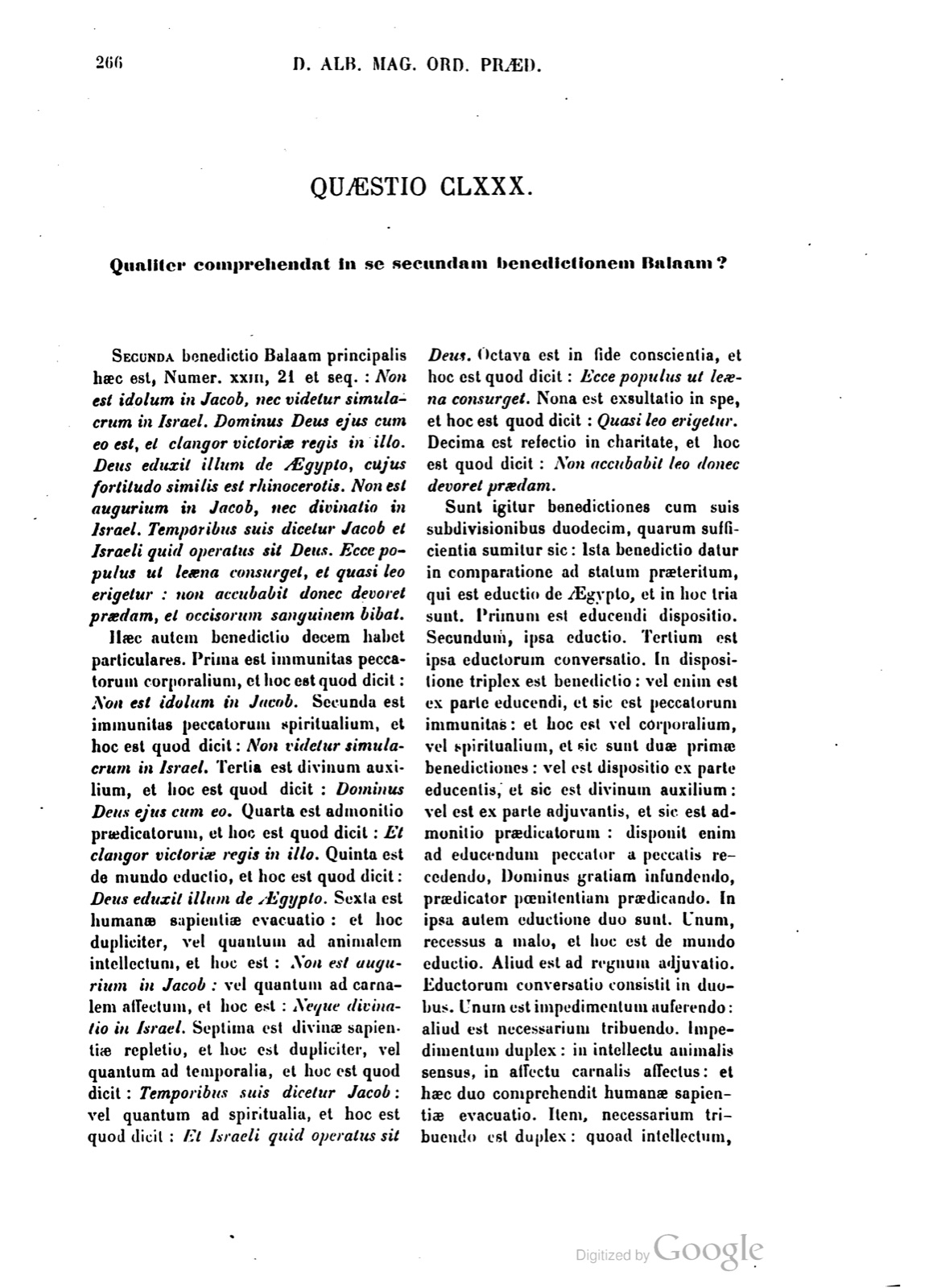
QUAESTIO CLXXX. Qualiter comprehendat in se secundam benedictionem Balaam?
Secunda benedictio Balaam principalis haec est, Numer. XXIII, 21 et seq.: Non est idolum in Jacob, nec videtur simulacrum in Israel. Dominus Deus ejus cum eo est, et clangor victoriae regis in illo. Deus eduxit illum de Aegypto, cujus fortitudo similis est rhinocerotis. Non est augurium in Jacob, nec divinatio in Israel. Temporibus suis dicetur Jacob et Israeli quid operatus sit Deus. Ecce populus ut leaena consurget, et quasi leo erigetur: non accubabit donec devoret praedam, et occisorum sanguinem bibat.
Haec autem benedictio decem habet particulares. Prima est immunitas peccatorum corporalium, et hoc est quod dicit: Non est idolum in Jacob. Secunda est immunitas peccatorum spiritualium, et hoc est quod dicit: Non videtur simulacrum in Israel. Tertia est divinum auxilium, et hoc est quod dicit: Dominus Deus ejus cum eo. Quarta est admonitio praedicatorum, et hoc est quod dicit: Et clangor victoriae regis in illo. Quinta est de mundo eductio, et hoc est quod dicit: Deus eduxit illum de Aegypto. Sexta est humanae sapientiae evacuatio: et hoc dupliciter, vel quantum ad animalem intellectum, et hoc est: Non est augurium in Jacob: vel quantum ad carnalem affectum, et hoc est: Neque divinatio in Israel. Septima est divinae sapientiae repletio, et hoc est dupliciter, vel quantum ad temporalia, et hoc est quod dicit: Temporibus suis dicetur Jacob: vel quantum ad spiritualia, et hoc est quod dicit: Et Israeli quid operatus sit Deus. Octava est in fide conscientia, et hoc est quod dicit: Ecce populus ut leaena consurget. Nona est exsultatio in spe, et hoc est quod dicit: Quasi leo erigetur. Decima est refectio in charitate, et hoc est quod dicit: Non accubabit leo donec devoret praedam.
Sunt igitur benedictiones cum suis subdivisionibus duodecim, quarum sufficientia sumitur sic: Ista benedictio datur in comparatione ad statum praeteritum, qui est eductio de Aegypto, et in hoc tria sunt. Primum est educendi dispositio. Secundum, ipsa eductio. Tertium est ipsa eductorum conversatio. In dispositione triplex est benedictio: vel enim est ex parte educendi, et sic est peccatorum immunitas: et hoc est vel corporalium, vel spiritualium, et sic sunt duae primae benedictiones: vel est dispositio ex parte educentis, et sic est divinum auxilium: vel est ex parte adjuvantis, et sic est admonitio praedicatorum: disponit enim ad educendum peccator a peccatis recedendo, Dominus gratiam infundendo, praedicator paenitentiam praedicando. In ipsa autem eductione duo sunt. Unum, recessus a malo, et hoc est de mundo eductio. Aliud est ad regnum adjuvatio. Eductorum conversatio consistit in duobus. Unum est impedimentum auferendo: aliud est necessarium tribuendo. Impedimentum duplex: in intellectu animalis sensus, in affectu carnalis affectus: et haec duo comprehendit humanae sapientiae evacuatio. Item, necessarium tribuendo est duplex: quoad intellectum, et sic est divinae sapientiae repletio: quoad affectum, et sic est in rationali fides, in irascibili spes, in concupiscibili refectio in charitate, et sacramentorum perceptione.
QUESTION 180. How does she comprehend in herself the second blessing of Balaam?
The second principal blessing of Balaam is this, Numbers 23:21 and following: There is no idol in Jacob, nor is an image seen in Israel. The Lord his God is with him, and the clangor of the king's victory is in him. God led him out of Egypt; his strength is like that of the rhinoceros. There is no augury in Jacob, nor divination in Israel. In their times it will be said to Jacob and to Israel what God has worked. Behold, the people will rise like a lioness, and will be raised like a lion; the lion will not lie down until it devours prey and drinks the blood of the slain.
Now this blessing has ten particulars. The first is immunity from corporeal sins, and this is what he says: There is no idol in Jacob. The second is immunity from spiritual sins, and this is what he says: Nor is an image seen in Israel. The third is divine help, and this is what he says: The Lord his God is with him. The fourth is the admonition of preachers, and this is what he says: And the clangor of the king's victory is in him. The fifth is being led out from the world, and this is what he says: God led him out of Egypt. The sixth is the evacuation of human wisdom; and this in two ways, either as regards the animal intellect, and this is: There is no augury in Jacob; or as regards carnal affection, and this is: Nor divination in Israel. The seventh is repletion with divine wisdom, and this in two ways: either as regards temporal things, and this is what he says: In their times it will be said to Jacob; or as regards spiritual things, and this is what he says: And to Israel what God has worked. The eighth is conscience in faith, and this is what he says: Behold, the people will rise like a lioness. The ninth is exultation in hope, and this is what he says: It will be raised like a lion. The tenth is refreshment in charity, and this is what he says: The lion will not lie down until it devours prey.
Therefore there are twelve blessings with their subdivisions, whose sufficiency is taken thus. This blessing is given in comparison to the past state, which is the leading out from Egypt, and in this there are three things. The first is the disposition of the one to be led out. The second, the leading out itself. The third is the manner of life of those led out. In the disposition there is a threefold blessing: for either it is on the part of the one to be led out, and thus it is immunity from sins; and this is either from corporeal or from spiritual sins, and thus these are the first two blessings; or the disposition is on the part of the one leading out, and thus it is divine help; or it is on the part of the one helping, and thus it is the admonition of preachers. For the sinner disposes toward being led out by withdrawing from sins; the Lord, by pouring in grace; the preacher, by preaching penance. But in the leading out itself there are two things. One is withdrawal from evil, and this is being led out from the world. The other is assistance toward the kingdom. The manner of life of those led out consists in two things: one by removing an impediment; the other by bestowing what is necessary. The impediment is twofold: in the intellect, that of the animal sense; in the affection, that of carnal affection; and the evacuation of human wisdom comprehends these two. Likewise, in bestowing what is necessary there is a twofold thing: as to the intellect, and thus it is repletion with divine wisdom; as to the affection, and thus in the rational part there is faith, in the irascible part hope, in the concupiscible part refreshment in charity and in the reception of the sacraments.
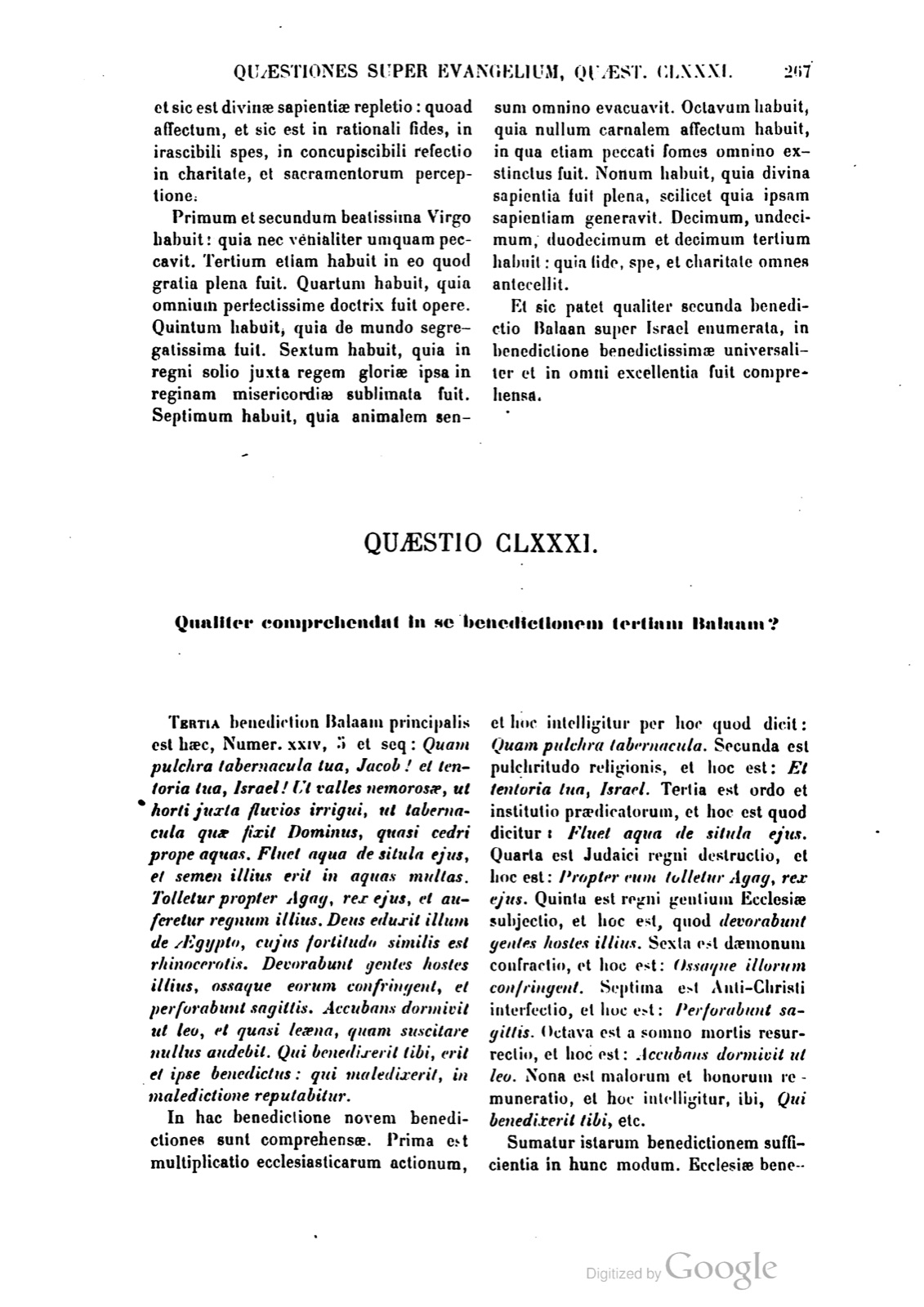
Primum et secundum beatissima Virgo habuit: quia nec venialiter umquam peccavit. Tertium etiam habuit in eo quod gratia plena fuit. Quartum habuit, quia omnium perfectissime doctrix fuit opere. Quintum habuit, quia de mundo segregatissima fuit. Sextum habuit, quia in regni solio juxta regem gloriae ipsa in reginam misericordiae sublimata fuit. Septimum habuit, quia animalem sensum omnino evacuavit. Octavum habuit, quia nullum carnalem affectum habuit, in qua etiam peccati fomes omnino exstinctus fuit. Nonum habuit, quia divina sapientia fuit plena, scilicet quia ipsam sapientiam generavit. Decimum, undecimum, duodecimum et decimum tertium habuit: quia fide, spe, et charitate omnes antecellit.
Et sic patet qualiter secunda benedictio Balaam super Israel enumerata, in benedictione benedictissimae universaliter et in omni excellentia fuit comprehensa.
The most blessed Virgin had the first and second, because she never sinned even venially. She also had the third in that she was full of grace. She had the fourth, because she was most perfectly teacher of all by deed. She had the fifth, because she was most separated from the world. She had the sixth, because on the throne of the kingdom beside the King of glory she herself was raised up as queen of mercy. She had the seventh, because she wholly evacuated the animal sense. She had the eighth, because she had no carnal affection, in whom also the tinder of sin was wholly extinguished. She had the ninth, because she was full of divine wisdom, namely because she generated Wisdom itself. She had the tenth, eleventh, twelfth, and thirteenth, because she surpasses all in faith, hope, and charity.
And thus it is clear how the second blessing of Balaam enumerated over Israel was comprehended universally and in every excellence in the blessing of the most blessed one.
If a page does not appear, its photograph has not been uploaded yet.