Works › The Mariale: Questions on “Missus est”
Volume 37 · pp. 262–263
Question 177. How does she comprehend in herself the blessing given to Joseph?
A marker with ≈ is an approximate page boundary, placed by measure of the text; the page photographs remain the authority. In the paired views, clicking a page marker brings that page into view.
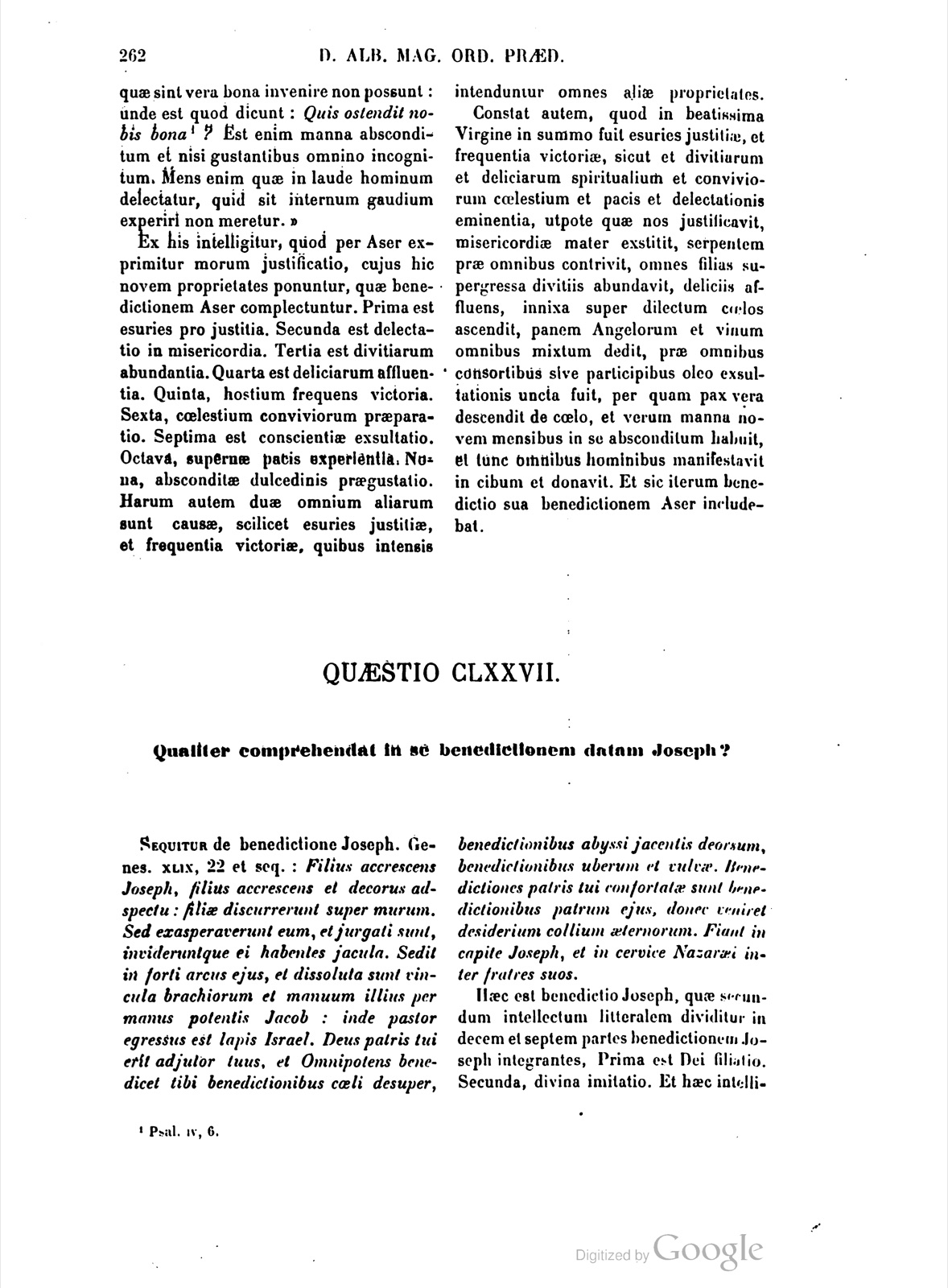
QUAESTIO CLXXVII. Qualiter comprehendat in se benedictionem datam Joseph?
Sequitur de benedictione Joseph. Genes. XLIX, 22 et seq.: Filius accrescens Joseph, filius accrescens et decorus adspectu: filiae discurrerunt super murum. Sed exasperaverunt eum, et jurgati sunt, invideruntque ei habentes jacula. Sedit in forti arcus ejus, et dissoluta sunt vincula brachiorum et manuum illius per manus potentis Jacob: inde pastor egressus est lapis Israel. Deus patris tui erit adjutor tuus, et Omnipotens benedicet tibi benedictionibus caeli desuper, benedictionibus abyssi jacentis deorsum, benedictionibus uberum et vulvae. Benedictiones patris tui confortatae sunt benedictionibus patrum ejus, donec veniret desiderium collium aeternorum. Fiant in capite Joseph, et in cervice Nazaraei inter fratres suos.
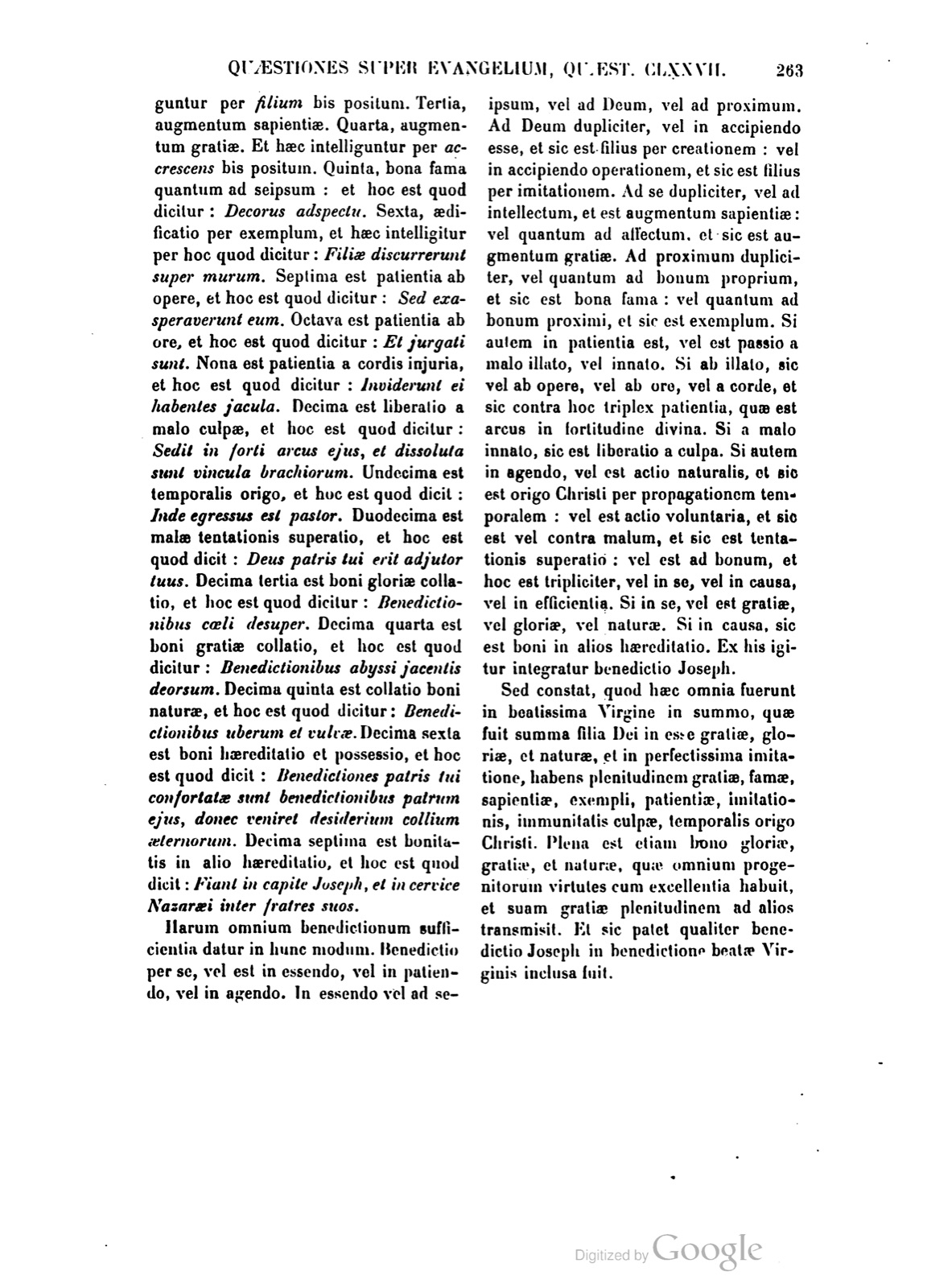
Haec est benedictio Joseph, quae secundum intellectum litteralem dividitur in decem et septem partes benedictionem Joseph integrantes. Prima est Dei filiatio. Secunda, divina imitatio. Et haec intelliguntur per filium bis positum. Tertia, augmentum sapientiae. Quarta, augmentum gratiae. Et haec intelliguntur per accrescens bis positum. Quinta, bona fama quantum ad seipsum: et hoc est quod dicitur: Decorus adspectu. Sexta, aedificatio per exemplum, et haec intelligitur per hoc quod dicitur: Filiae discurrerunt super murum. Septima est patientia ab opere, et hoc est quod dicitur: Sed exasperaverunt eum. Octava est patientia ab ore, et hoc est quod dicitur: Et jurgati sunt. Nona est patientia a cordis injuria, et hoc est quod dicitur: Inviderunt ei habentes jacula. Decima est liberatio a malo culpae, et hoc est quod dicitur: Sedit in forti arcus ejus, et dissoluta sunt vincula brachiorum. Undecima est temporalis origo, et hoc est quod dicit: Inde egressus est pastor. Duodecima est malae tentationis superatio, et hoc est quod dicit: Deus patris tui erit adjutor tuus. Decima tertia est boni gloriae collatio, et hoc est quod dicitur: Benedictionibus caeli desuper. Decima quarta est boni gratiae collatio, et hoc est quod dicitur: Benedictionibus abyssi jacentis deorsum. Decima quinta est collatio boni naturae, et hoc est quod dicitur: Benedictionibus uberum et vulvae. Decima sexta est boni haereditatio et possessio, et hoc est quod dicit: Benedictiones patris tui confortatae sunt benedictionibus patrum ejus, donec veniret desiderium collium aeternorum. Decima septima est bonitatis in alio haereditatio, et hoc est quod dicit: Fiant in capite Joseph, et in cervice Nazaraei inter fratres suos.
QUESTION 177. How does she comprehend in herself the blessing given to Joseph?
There follows concerning the blessing of Joseph. Genesis 49:22 and following: Joseph is an increasing son, an increasing son and beautiful to behold; daughters ran about upon the wall. But they exasperated him and quarreled, and those having darts envied him. His bow sat in strength, and the bonds of his arms and hands were loosened by the hands of the mighty one of Jacob; thence a shepherd went forth, the stone of Israel. The God of your father will be your helper, and the Almighty will bless you with blessings of heaven from above, with blessings of the abyss lying below, with blessings of breasts and womb. The blessings of your father have been strengthened by the blessings of his fathers, until the desire of the eternal hills should come. Let them be upon the head of Joseph and upon the neck of the Nazirite among his brothers.
This is the blessing of Joseph, which according to the literal understanding is divided into seventeen parts integrating the blessing of Joseph. The first is divine filiation. The second, divine imitation. And these are understood by son being placed twice. The third, increase of wisdom. The fourth, increase of grace. And these are understood by increasing being placed twice. The fifth, good reputation as regards himself; and this is what is said: Beautiful to behold. The sixth, edification through example; and this is understood through what is said: Daughters ran about upon the wall. The seventh is patience from deed, and this is what is said: But they exasperated him. The eighth is patience from speech, and this is what is said: And they quarreled. The ninth is patience from injury of the heart, and this is what is said: Those having darts envied him. The tenth is liberation from the evil of fault, and this is what is said: His bow sat in strength, and the bonds of his arms were loosened. The eleventh is temporal origin, and this is what he says: Thence a shepherd went forth. The twelfth is overcoming of evil temptation, and this is what he says: The God of your father will be your helper. The thirteenth is bestowal of the good of glory, and this is what is said: With blessings of heaven from above. The fourteenth is bestowal of the good of grace, and this is what is said: With blessings of the abyss lying below. The fifteenth is bestowal of the good of nature, and this is what is said: With blessings of breasts and womb. The sixteenth is inheritance and possession of good, and this is what he says: The blessings of your father have been strengthened by the blessings of his fathers, until the desire of the eternal hills should come. The seventeenth is inheritance of goodness in another, and this is what he says: Let them be upon the head of Joseph and upon the neck of the Nazirite among his brothers.
Harum omnium benedictionum sufficientia datur in hunc modum. Benedictio per se, vel est in essendo, vel in patiendo, vel in agendo. In essendo vel ad seipsum, vel ad Deum, vel ad proximum. Ad Deum dupliciter, vel in accipiendo esse, et sic est filius per creationem: vel in accipiendo operationem, et sic est filius per imitationem. Ad se dupliciter, vel ad intellectum, et est augmentum sapientiae: vel quantum ad affectum, et sic est augmentum gratiae. Ad proximum dupliciter, vel quantum ad bonum proprium, et sic est bona fama: vel quantum ad bonum proximi, et sic est exemplum. Si autem in patientia est, vel est passio a malo illato, vel innato. Si ab illato, sic vel ab opere, vel ab ore, vel a corde, et sic contra hoc triplex patientia, quae est arcus in fortitudine divina. Si a malo innato, sic est liberatio a culpa. Si autem in agendo, vel est actio naturalis, et sic est origo Christi per propagationem temporalem: vel est actio voluntaria, et sic est vel contra malum, et sic est tentationis superatio: vel est ad bonum, et hoc est tripliciter, vel in se, vel in causa, vel in efficientia. Si in se, vel est gratiae, vel gloriae, vel naturae. Si in causa, sic est boni in alios haereditatio. Ex his igitur integratur benedictio Joseph.
Sed constat, quod haec omnia fuerunt in beatissima Virgine in summo, quae fuit summa filia Dei in esse gratiae, gloriae, et naturae, et in perfectissima imitatione, habens plenitudinem gratiae, famae, sapientiae, exempli, patientiae, imitationis, immunitatis culpae, temporalis origo Christi. Plena est etiam bono gloriae, gratiae, et naturae, quae omnium progenitorum virtutes cum excellentia habuit, et suam gratiae plenitudinem ad alios transmisit. Et sic patet qualiter benedictio Joseph in benedictione beatae Virginis inclusa fuit.
The sufficiency of all these blessings is given in this way. Blessing in itself is either in being, or in suffering, or in acting. In being, it is either toward oneself, or toward God, or toward one's neighbor. Toward God in two ways: either in receiving being, and thus one is a son by creation; or in receiving operation, and thus one is a son by imitation. Toward oneself in two ways: either toward the intellect, and it is increase of wisdom; or as regards the affection, and thus it is increase of grace. Toward one's neighbor in two ways: either as regards one's own good, and thus it is good reputation; or as regards the good of the neighbor, and thus it is example. But if it is in patience, the suffering is either from an evil inflicted or from an evil inborn. If from an inflicted evil, then either from deed, or from mouth, or from heart; and against this there is a threefold patience, which is a bow in divine strength. If from an inborn evil, thus it is liberation from fault. But if it is in acting, either it is a natural action, and thus it is the origin of Christ through temporal propagation; or it is a voluntary action, and thus it is either against evil, and in this way it is overcoming of temptation; or it is toward good, and this is in three ways: either in itself, or in its cause, or in its efficiency. If in itself, it is either of grace, or of glory, or of nature. If in cause, thus it is the inheritance of good into others. Therefore from these the blessing of Joseph is integrated.
But it is agreed that all these things were in the most blessed Virgin in the highest degree, for she was the highest daughter of God in the being of grace, glory, and nature, and in most perfect imitation, having fullness of grace, reputation, wisdom, example, patience, imitation, immunity from fault, and temporal origin of Christ. She is also full of the good of glory, grace, and nature, she who had the virtues of all her progenitors with excellence, and transmitted the fullness of her grace to others. And thus it is clear how the blessing of Joseph was included in the blessing of the blessed Virgin.
If a page does not appear, its photograph has not been uploaded yet.